Skip to content
recaplica

    One moment: security check

    Cloudflare wants to make sure you're not a robot. Tick the box below and your search will continue on its own.

    IT
    recaplica Electric Current: What It Is and How It Works
    © 2026 Recaplica · recaplica.com — All rights reserved
    Home › Science

    Electric Current: What It Is and How It Works

    By Recaplica Newsroom · Updated on September 6, 2026

    What to print

    Page numbers appear when printing with default margins.

    Slides

    Choose a cut

    Flash10 slidesThe essential thread, to present in classFull18 slidesEvery chapter and the deeper detail

    Both come with speaker notes.

    Telegram channel
    recaplica Clear in 30 seconds, yours in 10 minutes.
    In 30 seconds Key points Figures Deep dive Slides Myths Mind map Quiz Flashcards FAQ

    In 30 seconds quick read

    Electric current is a flow of charge, mostly carried by electrons, moving along a conductor and pushed by a difference in electric potential called voltage. We've used it for just over two centuries: from Alessandro Volta's battery in 1800 to the "war of the currents" between direct and alternating current, all the way to the grid that carries electricity into every home. It's also a force that deserves respect: it isn't voltage that harms the body, but the current that passes through it. And it's a huge piece of the world economy, with demand growing faster every year.

    Key Points

    • Electric current is a flow of electric charge (mostly electrons) along a conductor, caused by a difference in electric potential: voltage.
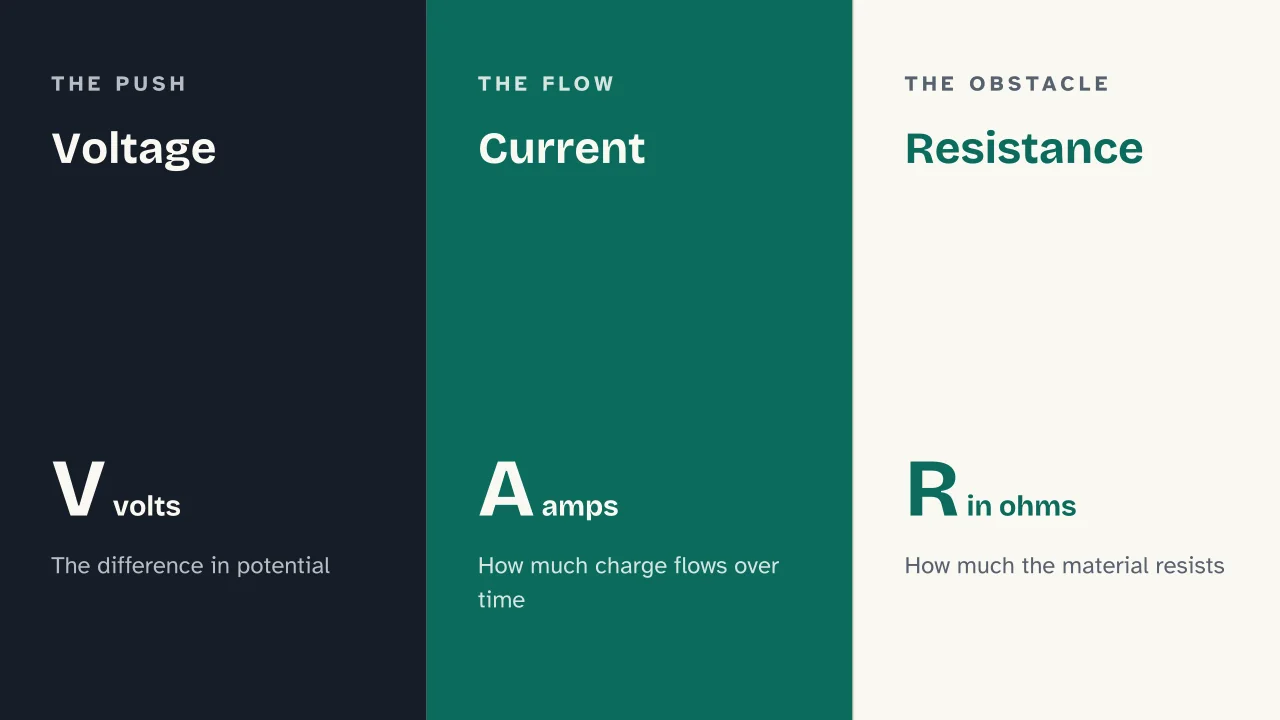
    • Voltage (volts), current (amps), and resistance (ohms) are three different quantities: voltage is the push, current is how much charge flows, resistance is the obstacle it meets.
    • Alessandro Volta's pile, from 1800, was the first device able to supply a steady electric flow over time.
    • In direct current (DC) the flow always moves the same way; in alternating current (AC) it reverses periodically, typically 50 or 60 times a second in household grids.
    • Voltage isn't dangerous by itself — it's the current that manages to pass through the body: around 100 milliamps is enough to risk a fatal ventricular fibrillation.
    • Global electricity demand is growing at a record pace, driven by industry, air conditioning, and digitalization.

    Key figures

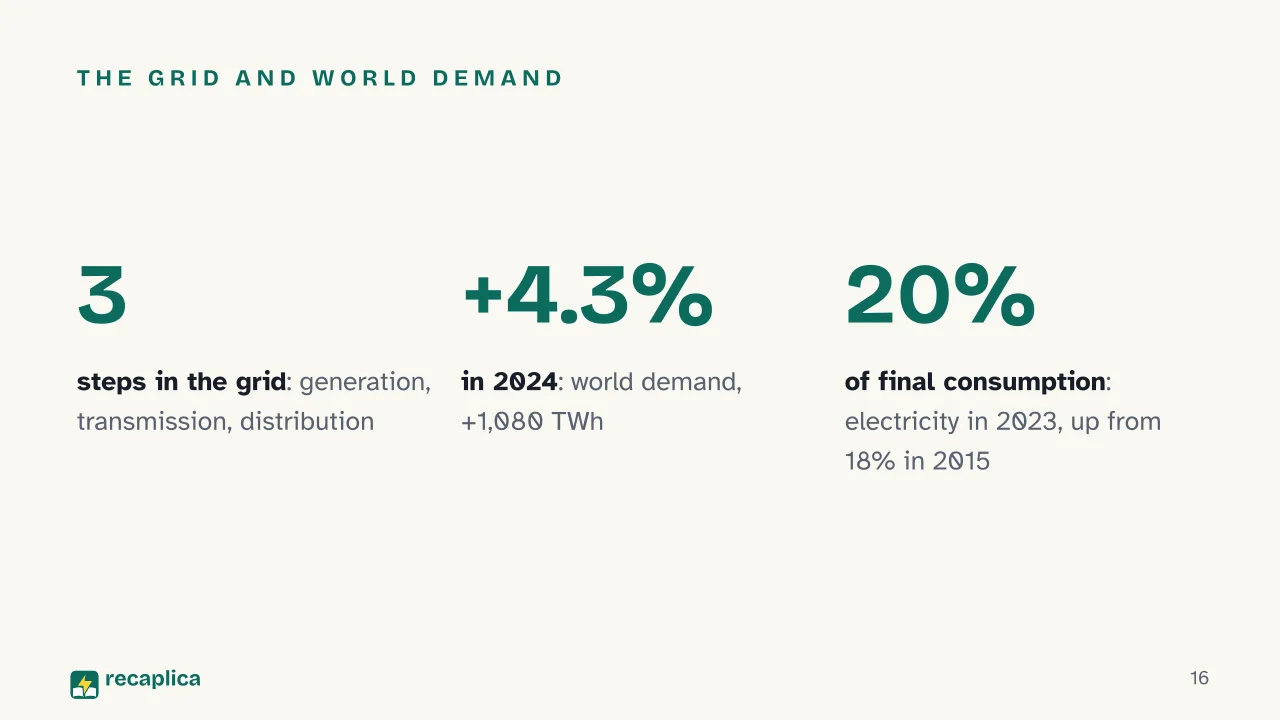
    • +4.3% the growth in world electricity demand in 2024 (+1,080 TWh), the largest absolute increase ever recorded in a single year, excluding post-recession rebound years Source: IEA, Global Energy Review 2025
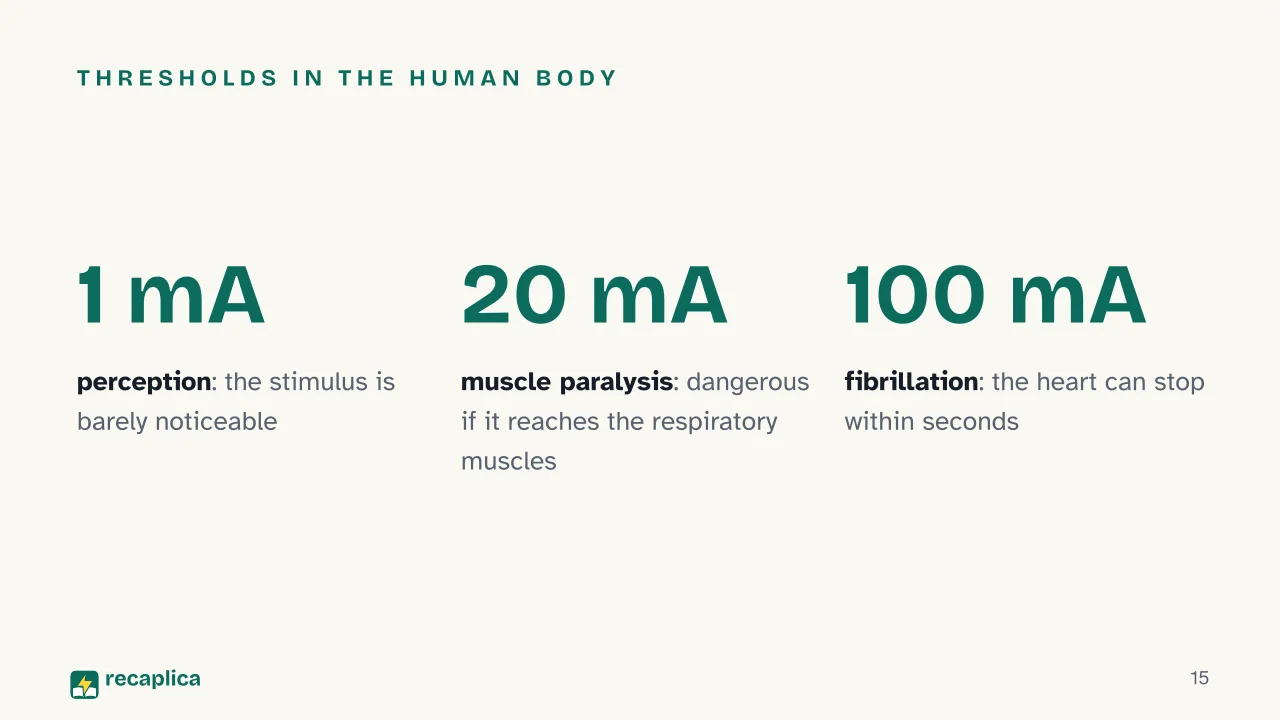
    • 100 mA the current (a tenth of an amp) that, passing through the body for a few seconds, can trigger fatal ventricular fibrillation Source: NIH/NCBI StatPearls, OSHA Electrical Safety
    • 20% electricity's share of the world's final energy consumption in 2023, up from 18% in 2015 Source: IEA / Enerdata

    Deep Dive

    An Invisible Flow, Not a Recent Invention

    Electric current is a flow of electric charge, mostly carried by electrons, moving through a conductive material. That movement isn’t random: it’s driven by a difference in electric potential between two points in a circuit, what we call voltage. The higher the voltage, the stronger the push; how much charge actually gets through also depends on the resistance the material puts up against it.

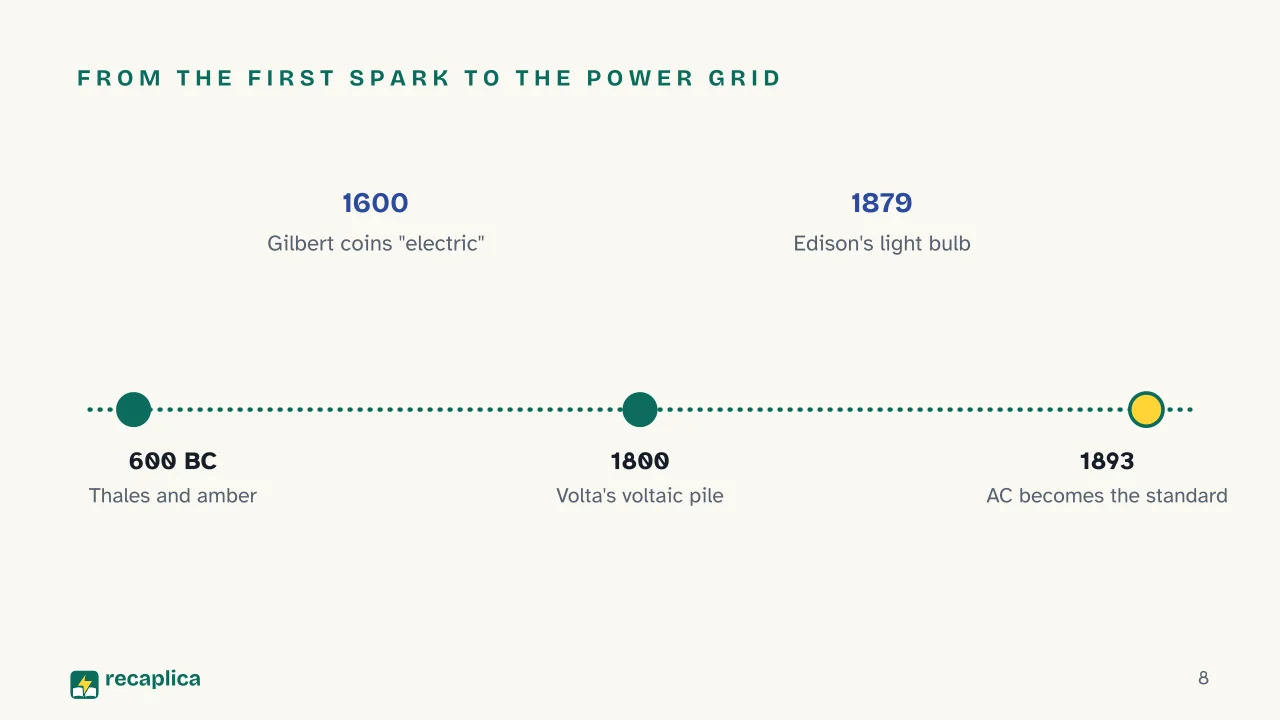
    Observations of electrical phenomena go back long before the light bulb. Around 600 BC, the Greek philosopher Thales noticed that amber rubbed with fur would attract small objects — an electrostatic effect, not yet a current. The word itself comes from there: in 1600 the English physician William Gilbert coined the term “electric” from the Greek word for amber, elektron.

    Volta’s Battery and the Dispute with Galvani

    A steady electric flow, not just a spark, had to wait until 1800: the year of Alessandro Volta’s voltaic pile, the first device able to supply electricity continuously. Volta stacked discs of zinc and copper, separated by cloth soaked in brine or vinegar; each three-disc unit formed an electrochemical cell, and stacking more cells produced more electricity.

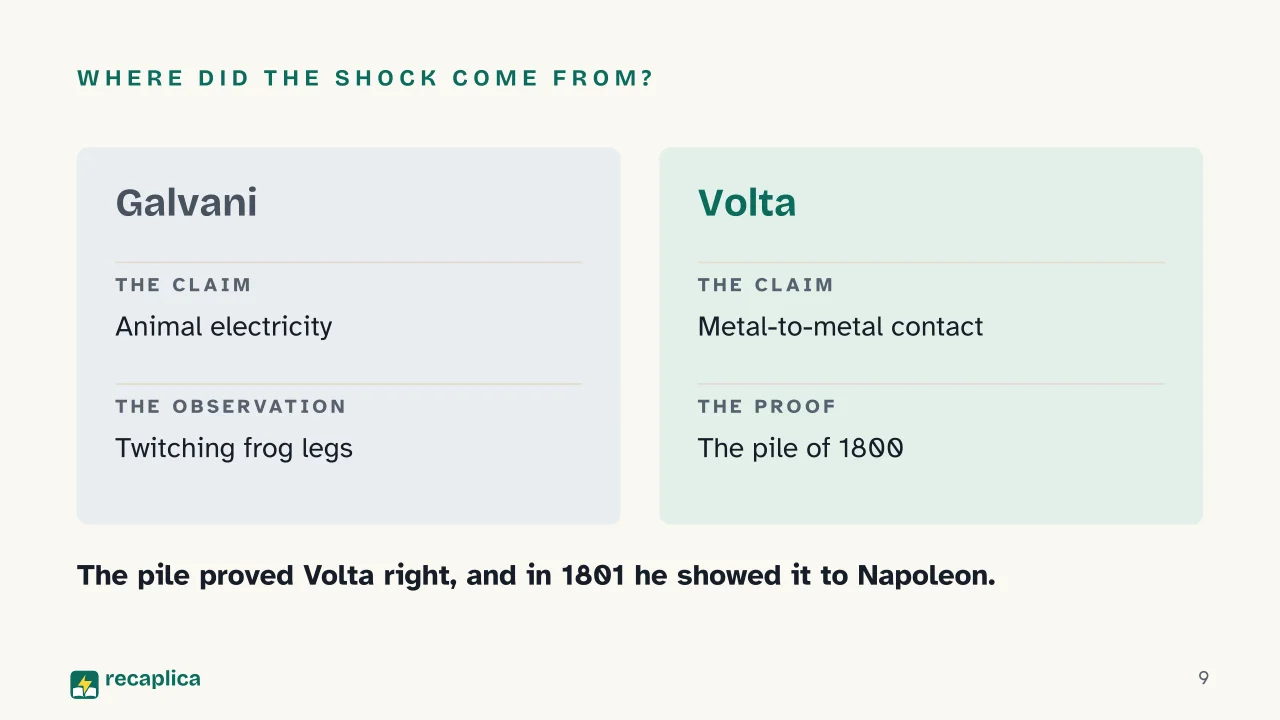
    The invention grew out of a scientific dispute. Luigi Galvani, a physician at the University of Bologna, had observed that dissected frog legs twitched on contact with two different metals, and concluded there was an “animal electricity” inherent to living tissue. Volta, at the University of Pavia, argued instead that the effect came from the contact between different metals, not from the frog itself — and the pile proved him right. In 1801 Volta demonstrated the invention to Napoleon Bonaparte, and shortly after, chemists William Nicholson and Anthony Carlisle used it to split water into hydrogen and oxygen, giving rise to electrochemistry.

    The War of the Currents

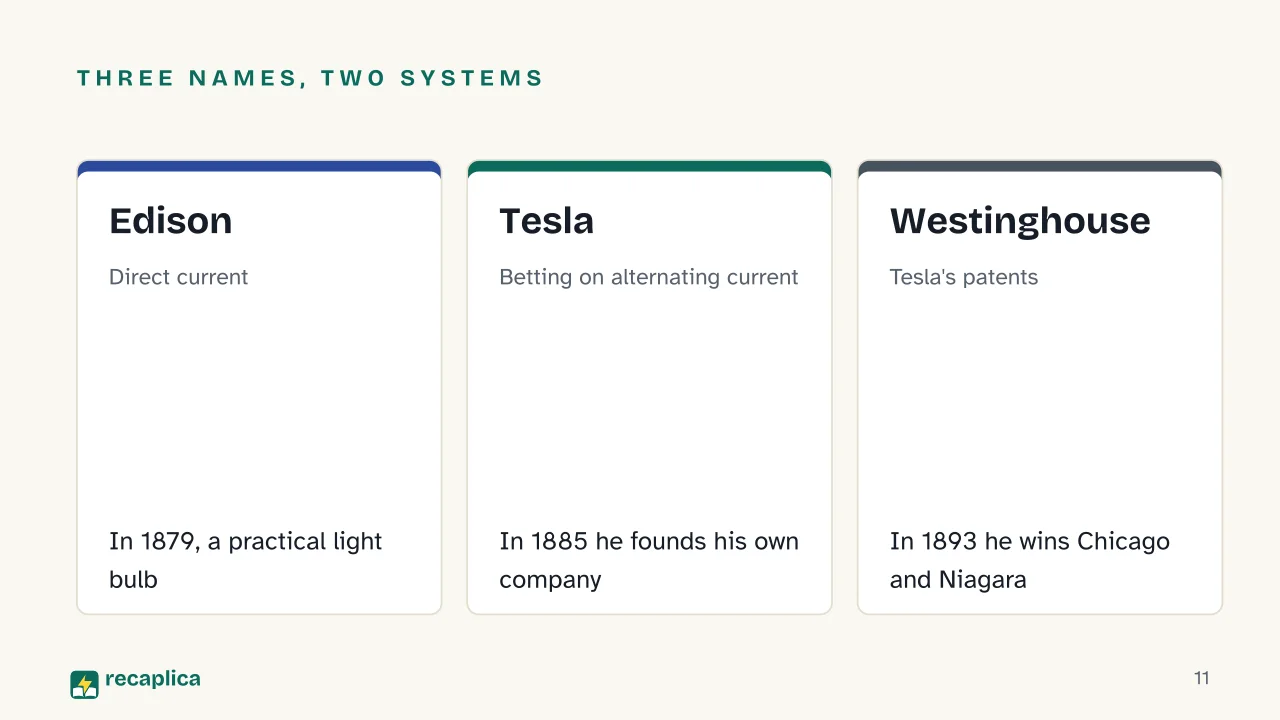
    For nearly a century, electricity remained mostly a laboratory curiosity. That changed in the closing decades of the nineteenth century, when it became a business. In 1879 Thomas Edison developed a practical incandescent light bulb and promoted it alongside his direct current (DC) system. In 1885 Nikola Tesla, who had left Edison’s lab, founded his own company convinced the future belonged to alternating current (AC); his patents were later acquired and commercialized by George Westinghouse.

    The commercial rivalry turned bitter. Edison staged public demonstrations meant to show how dangerous alternating current supposedly was, going as far as electrocuting animals in front of journalists, and publicly claimed it was “without doubt more fatal” than direct current. In 1890 the electric chair, powered by AC, was used for the first execution of its kind in history; Westinghouse, who also produced that type of current, called the episode “a brutal affair.” A story often repeated but chronologically out of place is the public electrocution of the elephant Topsy in 1903 at Coney Island: it happened about a decade after the war of the currents had actually ended, and it wasn’t an Edison initiative.

    The dispute wasn’t settled by demonstrations, but by engineering: alternating current can be stepped up to very high voltages for long-distance transmission, with lower losses, and then stepped back down for household use. In 1893 Westinghouse won the contract to light the World’s Columbian Exposition in Chicago and much of the Niagara Falls hydroelectric project: alternating current had become the standard that electrical grids rely on. That same technological shift is intertwined with the Industrial Revolution, the period when factories and cities began organizing around new sources of power.

    How a Circuit Works, in Practice

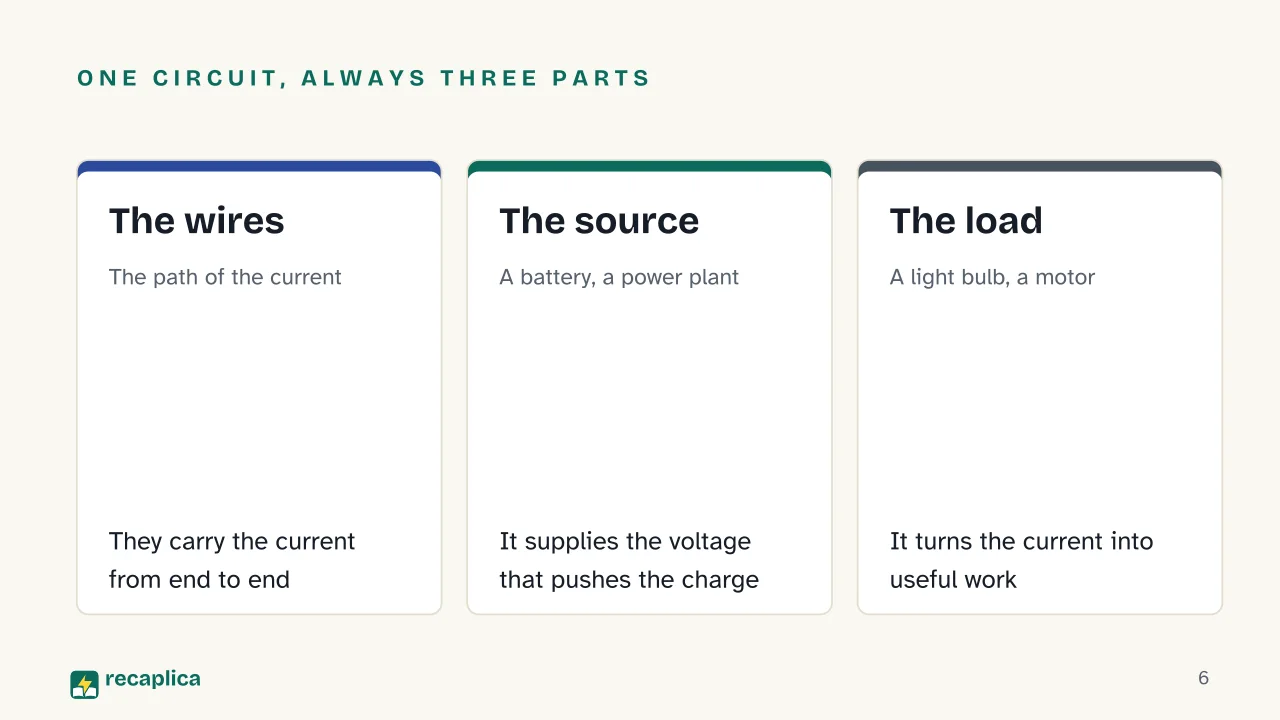
    An electric circuit always has three components: wires that carry the current, a source (a battery, a power plant) that supplies the voltage, and a load (a light bulb, a motor) that turns the current into useful work — light, heat, motion. Components can be wired in series, one after another along the same path, or in parallel, on separate paths that share the same two points: the arrangement changes how current is distributed among the elements.

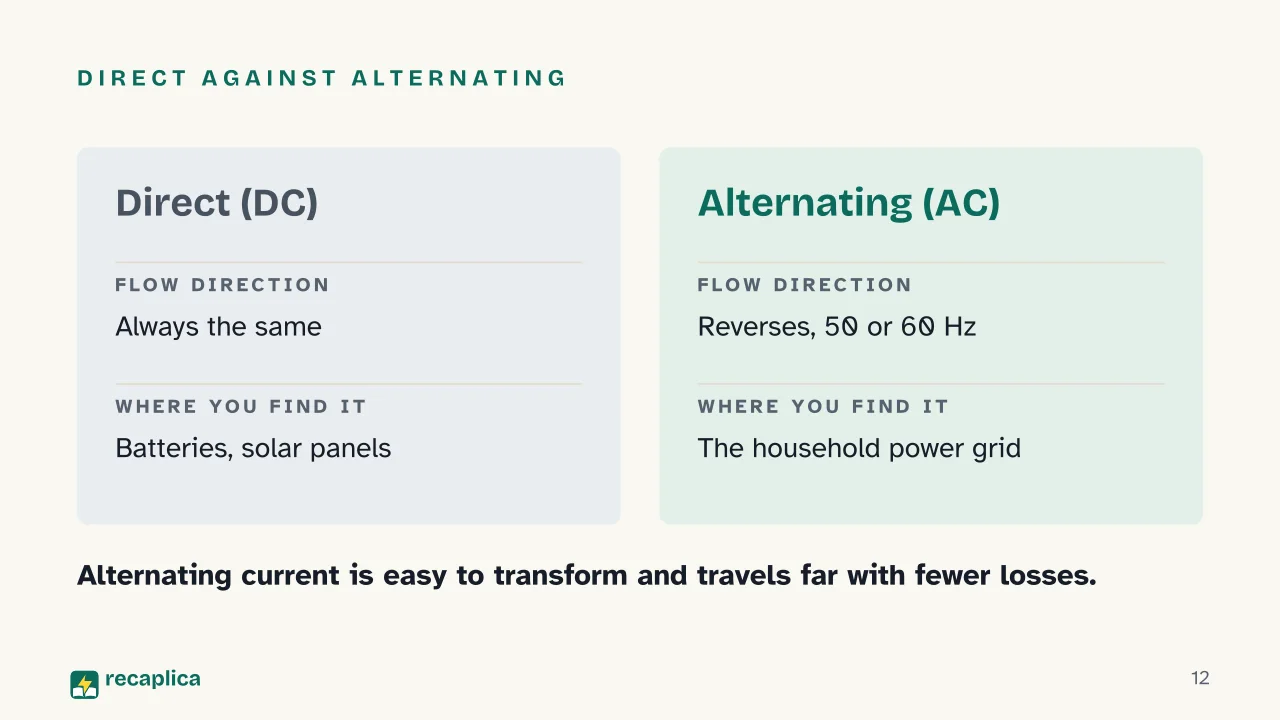
    The practical difference between direct and alternating current comes down to the direction of flow:

    Direct current (DC)Alternating current (AC)
    Flow directionAlways the sameReverses periodically
    Common examplesBatteries, solar panelsHousehold power grid
    FrequencyNot applicable50 or 60 Hz, depending on the country
    StrengthEasy to storeEasy to transform and send over long distances

    Practical example: your phone’s battery runs on direct current, but the wall outlet you charge it from supplies alternating current — that’s why every charger contains a small transformer-rectifier that converts the grid’s AC into the DC your electronics need.

    The Real Danger: Not the Voltage, but the Current

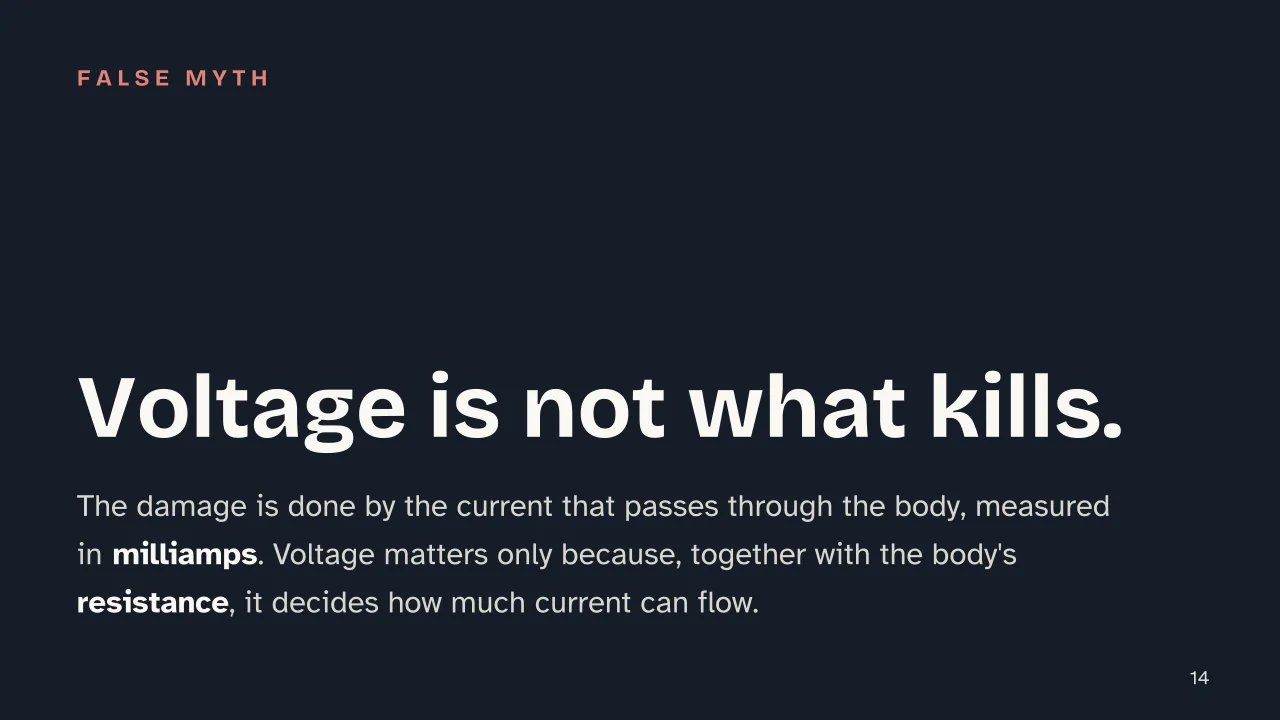
    Electricity is useful because it’s powerful, and dangerous for the same reason. Common perception ties the danger to “high voltage,” but electrical-safety sources are clear on one point: it’s the current that manages to pass through the body, measured in milliamps, that determines the physiological damage.

    The rough thresholds are well established: at around 1 milliamp (mA), the stimulus is barely perceptible; up to 16 mA, a person can still voluntarily let go of the contact; at 20 mA, muscle paralysis sets in, particularly dangerous if it involves the respiratory muscles; around 100 mA — a tenth of an amp — the heart can go into ventricular fibrillation and cause death within seconds; at 2 amps, cardiac activity stops completely. For comparison, ordinary household circuit breakers trip at 15-20 A, a level roughly a thousand times higher than what’s already enough to paralyze respiratory muscles, designed to prevent fires more than to protect someone in direct contact.

    Skin resistance, around 100,000 ohms, offers some protection against weaker currents; but beneath the skin, the body’s resistance drops to as little as 300 ohms, and a wound or cut removes most of that natural barrier.

    Practical example: a hair dryer that falls into a bathtub full of tap water is dangerous not because the water “attracts” electricity, but because the salts dissolved in tap water (and in the submerged body) make it an excellent conductor. Distilled laboratory water, free of dissolved ions, is instead an insulator — the same principle the USGS relies on when it checks water quality by measuring its electrical conductivity.

    Statistics confirm the risk isn’t just theoretical: in the United States, an estimated 400 people are electrocuted every year, and arc faults from worn wiring or aging installations cause about 35,000 house fires annually, with $1.4 billion in property damage. Home wiring — damaged or exposed wires — is tied to about 14% of deaths, a share comparable to the 15% of electrocutions linked to consumer products.

    The Everyday and Global Impact

    Beyond the risk, electric current is the quiet backbone of modern life. The grid that brings electricity into every home works in three steps: generation at power plants (thermal, hydroelectric, wind, or from the solar panel systems on private rooftops), step-up transformation for long-distance transmission with limited losses, and finally step-down transformation for distribution to homes and businesses.

    Global demand isn’t standing still: according to the International Energy Agency, it grew 4.3% in 2024, about 1,080 terawatt-hours more than the year before — the largest absolute increase ever recorded, excluding post-recession rebound years, and nearly double the average of the past decade. The main drivers were record temperatures (more air conditioning), the growing electrification of industry and transport, and digitalization, including data centers and artificial intelligence. About half of the growth came from industry, another 40% from households and commercial activity; China alone accounted for more than half of the global increase in 2024. Overall, electricity covered about 20% of the world’s final energy consumption in 2023, up from 18% in 2015.

    In everyday life, this invisible flow powers nearly everything we do: from the microwave oven that heats up lunch to the computers we work on, direct descendants of machines that, throughout the history of computers, have always needed electric current to power their circuits. It’s infrastructure we take almost entirely for granted until it’s gone — and behind the apparent simplicity of a wall outlet lies more than two centuries of discoveries, industrial rivalries, and safety lessons often learned the hard way.

    Slide deck

    Slides ready to download and make your own in PowerPoint or Google Slides, with speaker notes. Pick the Flash cut or the Full one.
    Slide 1 of the presentation on Electric Current: Electric currentSlide 2 of the presentation on Electric Current: What pushes the charge along a wire?Slide 3 of the presentation on Electric Current: What we will coverSlide 4 of the presentation on Electric Current: Chapter 01: Voltage, current, resistanceSlide 5 of the presentation on Electric Current: Voltage · Current · ResistanceSlide 6 of the presentation on Electric Current: One circuit, always three parts: The wires, The source, The loadSlide 7 of the presentation on Electric Current: Chapter 02: Two centuries of discoverySlide 8 of the presentation on Electric Current: From the first spark to the power gridSlide 9 of the presentation on Electric Current: Where did the shock come from?Slide 10 of the presentation on Electric Current: Chapter 03: The war of the currentsSlide 11 of the presentation on Electric Current: Three names, two systems: Edison, Tesla, WestinghouseSlide 12 of the presentation on Electric Current: Direct against alternatingSlide 13 of the presentation on Electric Current: Chapter 04: Safety and everyday impactSlide 14 of the presentation on Electric Current: Voltage is not what kills.Slide 15 of the presentation on Electric Current: Thresholds in the human bodySlide 16 of the presentation on Electric Current: The grid and world demandSlide 17 of the presentation on Electric Current: Who built, in 1800, the first device to supply a steady flow?Slide 18 of the presentation on Electric Current: And now, the review
    Flash10 slidesThe essential thread, to present in classFull18 slidesEvery chapter and the deeper detail

    Common myths

    • ✗ Myth Water itself is what's dangerous near electric current.

      ✓ Reality In fact, pure, distilled, or deionized water is an excellent insulator and doesn't conduct electricity. What makes water dangerous are the dissolved salts and minerals, which form free ions able to carry charge: that's why tap water, seawater, sweat, or the human body (mostly water with dissolved electrolytes) conduct electricity, while pure H2O does not.

    • ✗ Myth Voltage is what kills.

      ✓ Reality In fact, it's the current that manages to pass through the body, measured in milliamps, that causes physiological damage: already at around 20 mA the muscles become paralyzed (dangerous if it involves the respiratory muscles), and at around 100 mA the heart risks ventricular fibrillation. Voltage only matters because, together with the body's resistance, it determines how much current can actually flow.

    • ✗ Myth The elephant Topsy was executed in 1903 as a public demonstration staged by Edison against alternating current.

      ✓ Reality In fact, the episode took place about a decade after the war of the currents had ended, in the early 1890s, and Edison did not organize the event. It's an often-cited anecdote, but placed in the wrong period and wrongly attributed to him.

    Mind map

    Drag the background to move around and the nodes to reposition them; use − and + to collapse and expand branches.
    Customize
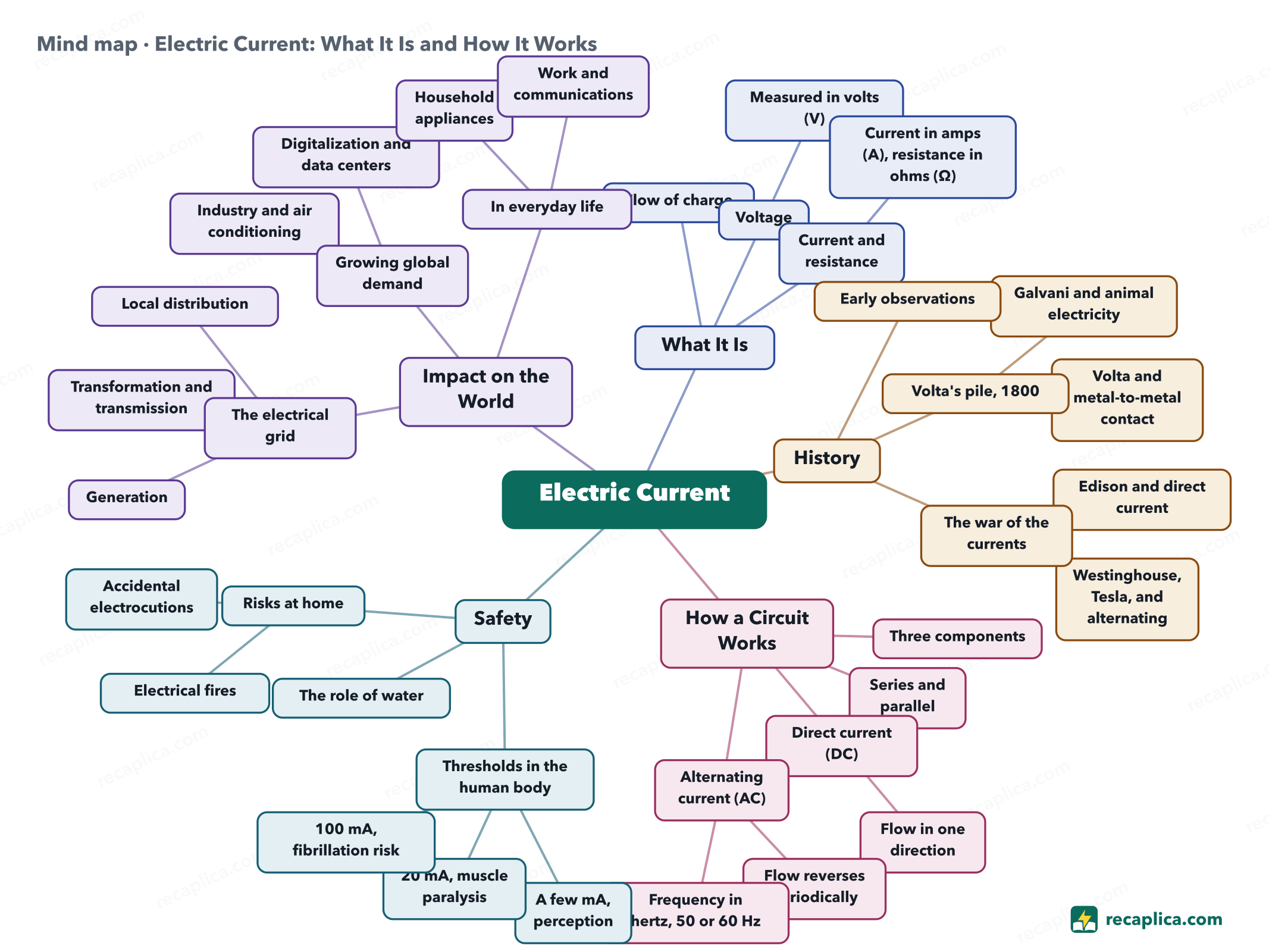
    Mind map: Electric Current: What It Is and How It Works
    • Electric Current
      • What It Is
        • Flow of charge Mostly electrons, along a conductor.
        • Voltage
          • Measured in volts (V)
        • Current and resistance
          • Current in amps (A), resistance in ohms (Ω)
      • History
        • Early observations Thales and rubbed amber, around 600 BC.
        • Volta's pile, 1800
          • Galvani and animal electricity
          • Volta and metal-to-metal contact
        • The war of the currents
          • Edison and direct current
          • Westinghouse, Tesla, and alternating current
      • How a Circuit Works
        • Three components Wires, source, load.
        • Series and parallel
        • Direct current (DC)
          • Flow in one direction
        • Alternating current (AC)
          • Flow reverses periodically
          • Frequency in hertz, 50 or 60 Hz
      • Safety
        • Thresholds in the human body
          • A few mA, perception
          • 20 mA, muscle paralysis
          • 100 mA, fibrillation risk
        • The role of water Dissolved salts are dangerous, not pure water.
        • Risks at home
          • Electrical fires
          • Accidental electrocutions
      • Impact on the World
        • The electrical grid
          • Generation
          • Transformation and transmission
          • Local distribution
        • Growing global demand
          • Industry and air conditioning
          • Digitalization and data centers
        • In everyday life
          • Household appliances
          • Work and communications

    Quiz: test yourself

    Answer the questions to check what you have learned: you get instant feedback and a short explanation.

    Grade 0/10 0/5
    1 In physics, what is electric current?

    Current is the movement of charge, typically electrons, pushed along a conductor by a difference in electric potential (voltage).

    2 Who built, in 1800, the first device able to supply a steady electric flow?

    Volta, of the University of Pavia, built the pile by stacking discs of zinc and copper separated by cloth soaked in brine or vinegar, arguing that the effect came from the contact between different metals, not from an "animal electricity" as Galvani had proposed.

    3 In the late-nineteenth-century "war of the currents," which systems were competing for the market?

    Edison championed his direct current (DC) system; Westinghouse, using Tesla's patents, bet on alternating current (AC), which ultimately won out thanks to its ability to be transmitted over long distances with lower losses.

    4 True or false: voltage alone determines whether an electric shock is fatal.

    False: it's the current passing through the body, measured in milliamps, that causes harm. At around 100 mA the heart risks ventricular fibrillation; voltage only matters in that it determines, together with the body's resistance, how much current can flow.

    5 Why does tap water or seawater conduct electricity, while distilled water doesn't?

    Pure water (H2O) is on its own an insulator. It's the ions produced by dissolved salts and minerals that make it conductive: even tiny amounts are enough to let current flow.

    Answers: 1-A · 2-A · 3-A · 4-B · 5-A

    Flashcards

    Tap the card to flip it and check whether you remember the answer, then move to the next one.

    1 / 8

    Explain it in your own words

    The ultimate test: if you can explain it in simple words, you've truly understood it. Write your explanation, then compare it with the Recap.

    Your explanation is saved only on this device.

    Electric current is a flow of charge, mostly carried by electrons, moving along a conductor and pushed by a difference in electric potential called voltage. We've used it for just over two centuries: from Alessandro Volta's battery in 1800 to the "war of the currents" between direct and alternating current, all the way to the grid that carries electricity into every home. It's also a force that deserves respect: it isn't voltage that harms the body, but the current that passes through it. And it's a huge piece of the world economy, with demand growing faster every year.

    Frequently asked questions

    What's the difference between direct current and alternating current?

    In direct current (DC), the flow of charge always moves in the same direction, as in a battery. In alternating current (AC), the flow reverses periodically, swinging from a positive peak to a negative one: household electrical grids do this 50 or 60 times per second, depending on the country.

    Why are electricity and water such a dangerous combination?

    Not because of the water itself, which pure would be an insulator, but because the water we encounter in everyday life (tap water, rain, sweat, the human body) always contains dissolved salts and minerals that make it conductive, opening a path for current.

    How much current does it take for a shock to be fatal?

    The thresholds depend on the path and duration of contact, but roughly: at 1 mA it's barely noticeable, at 16 mA it becomes hard to let go voluntarily, at 20 mA the muscles become paralyzed, and around 100 mA the heart can go into ventricular fibrillation within seconds.

    Why did alternating current win the war of the currents?

    Because the voltage of alternating current can be raised or lowered with a transformer: high for long-distance transmission, with lower losses, then reduced for household use. Direct current at the time had no equally efficient way to cover long distances.

    Why is global electricity demand growing so fast?

    According to the International Energy Agency, the main drivers are industry, air conditioning (record temperatures), and digitalization, including data centers and artificial intelligence: in 2024 growth was the highest ever recorded in absolute terms.

    Sources

    • Britannica — How Does Electricity Work?
    • Britannica — Electric current
    • Britannica — Alternating current
    • National MagLab — Electromagnetism History (600 BC-1599)
    • National MagLab — Electromagnetism History (1600-1699)
    • National MagLab — Voltaic Pile, 1800
    • Smithsonian Magazine — Edison vs. Westinghouse: A Shocking Rivalry
    • NIH/NCBI StatPearls — OSHA Electrical Safety
    • USGS Water Science School — Conductivity, Electrical Conductance and Water
    • IEA — Global Energy Review 2025, Electricity
    • IEA — Electricity 2025, Executive Summary
    • ESFI — Electrical Safety statistics

    Every Recap goes through an independent review before publication.

    Every evening, the day's new Recaps on our Telegram channel. Join the channel →

    Keep learning

    • Science Cognitive Load Theory: The Definition Behind Sweller's Research Cognitive load is the amount of working memory a task uses up while you learn something new. Psychologist John Sweller first described it in 1988, starting from research on problem solving: a strategy that is too demanding leaves little room to build stable mental structures. Later research distinguishes three types of load, intrinsic, extraneous, and germane, though part of the field treats the third as indistinguishable from the first. Cutting extraneous load, with worked examples or less cluttered materials, frees up mental room for actual learning. Read the Recap →
    • Science Cognitivism: how the mind processes information Cognitivism is the psychological paradigm that treats the mind as a system for processing information, spanning perception, memory, reasoning and language. The shift began around 1956, while behaviorism, championed by Watson and Skinner, still ruled academic psychology and reduced the field to observable stimuli and responses. That same year, George Miller exposed the limits of short-term memory, and Chomsky joined McCarthy, Minsky, Newell and Simon in laying the groundwork for cognitive science. Donald Broadbent's attention model in 1958 and Ulric Neisser's 1967 book, which put the name cognitive psychology into common use, complete the roster of its founding figures. Read the Recap →
    • Science Behaviorism: What It Is and Where It Came From Behaviorism is the school of psychology that studies only observable behavior, leaving aside the thoughts and feelings that stay hidden inside the mind. It began in 1913, when the American psychologist John B. Watson published an essay calling for psychology to become an experimental science, without relying on introspection. After him, Ivan Pavlov studied conditioned reflexes and Edward Thorndike studied trial-and-error learning; Burrhus Skinner pushed the ideas to their most extreme form with radical behaviorism. The thread running through all of it is the stimulus-response model: a behavior is explained by what comes before it and what follows it, not by guessing what happens inside the head of the person doing it. Read the Recap →

    recaplica

    Clear in 30 seconds, yours in 10 minutes.

    Recaps Mind maps Request a Recap Telegram channel Mind map maker Our method About Privacy & cookies Legal notes & terms of use

    © 2026 Recaplica · A project by Curi S.r.l. — VAT IT05472000750

    Statistics, only if you say so

    To learn which Recaps help most we would use Google Analytics, with aggregate, anonymous data. It starts only with your OK, and you can change your mind anytime. Privacy policy