Skip to content
recaplica

    One moment: security check

    Cloudflare wants to make sure you're not a robot. Tick the box below and your search will continue on its own.

    IT
    recaplica The periodic table: how to read it and why it's organized this way
    © 2026 Recaplica · recaplica.com — All rights reserved
    Home › Science

    The periodic table: how to read it and why it's organized this way

    By Recaplica Newsroom · Updated on September 16, 2026

    What to print

    Page numbers appear when printing with default margins.

    Slides

    Choose a cut

    Flash10 slidesThe essential thread, to present in classFull16 slidesEvery chapter and the deeper detail

    Both come with speaker notes.

    Telegram channel
    recaplica Clear in 30 seconds, yours in 10 minutes.
    In 30 seconds Key points Figures Deep dive Slides Myths Mind map Quiz Flashcards FAQ

    In 30 seconds quick read

    The periodic table arranges the 118 known chemical elements into rows and columns that aren't a random design but a reflection of atomic structure. The ordering rule is increasing atomic number, the count of protons in the nucleus, a principle established in 1913 by Henry Moseley, replacing the atomic-weight ordering Dmitri Mendeleev had used in his 1869 table. The rows, called periods, each end with a noble gas; the columns, called groups, gather elements with similar chemical properties because they share the same number of electrons in their outermost shell. IUPAC still updates the table: the current group numbering dates to 1988, and the most recent elements were named in 2016.

    Key Points

    • The periodic table orders the 118 known elements by increasing atomic number, the count of protons in the nucleus.
    • Horizontal rows are called periods and each one ends with a noble gas; vertical columns are called groups.
    • Elements in the same group share the same number of electrons in their outermost shell, which gives them similar chemical properties.
    • Dmitri Mendeleev published the first table able to predict the properties of undiscovered elements in 1869, after at least six earlier attempts had already tried to classify the elements.
    • Since 1913 the official ordering criterion has been atomic number, measured by Henry Moseley with X-rays, replacing the atomic weight Mendeleev had relied on.
    • The 1-18 group numbering only dates to 1988, and the last four elements were officially named in 2016: the table is still a work in progress.

    Key figures

    • 1869 Dmitri Mendeleev publishes the first organized, predictive periodic table, leaving gaps for elements not yet discovered. Source: Royal Society of Chemistry
    • 1988 IUPAC adopts the 1-18 group numbering that is now the international standard, replacing older systems of Roman numerals and letters. Source: IUPAC
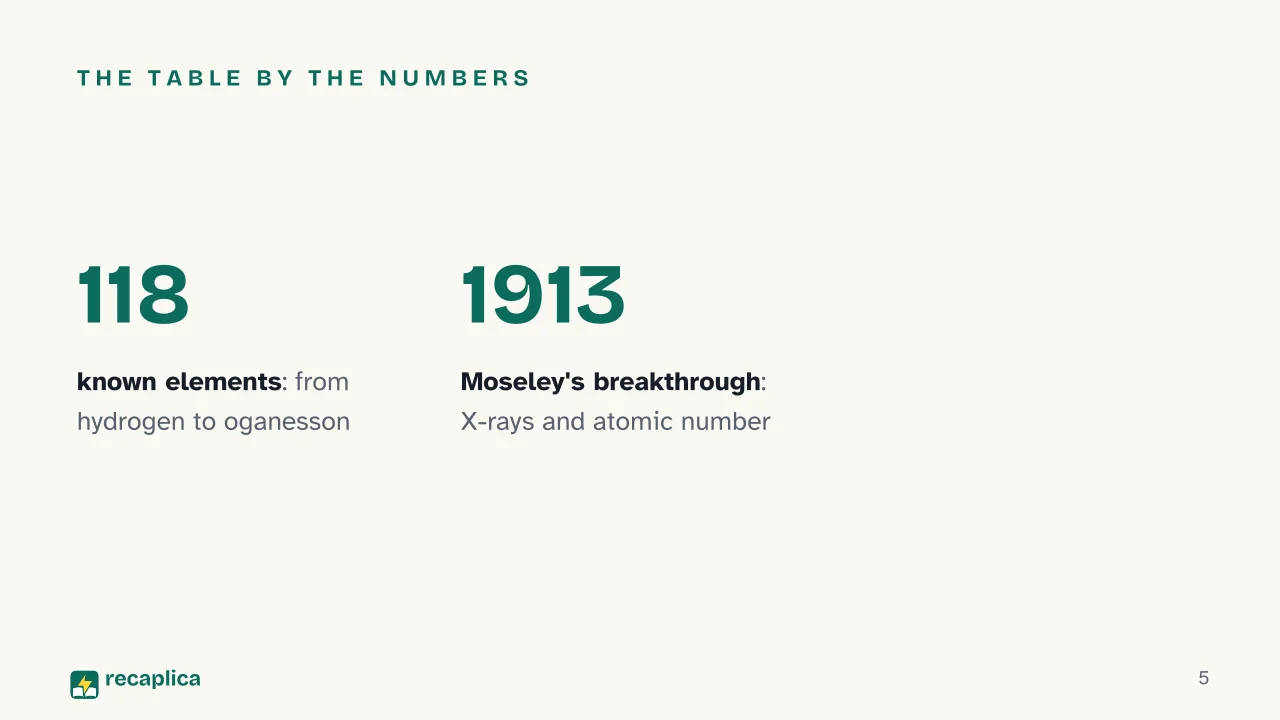
    • 2016 IUPAC officially names elements 113, 115, 117 and 118, rounding out the table at 118 known elements. Source: IUPAC

    Deep Dive

    The ordering rule: atomic number

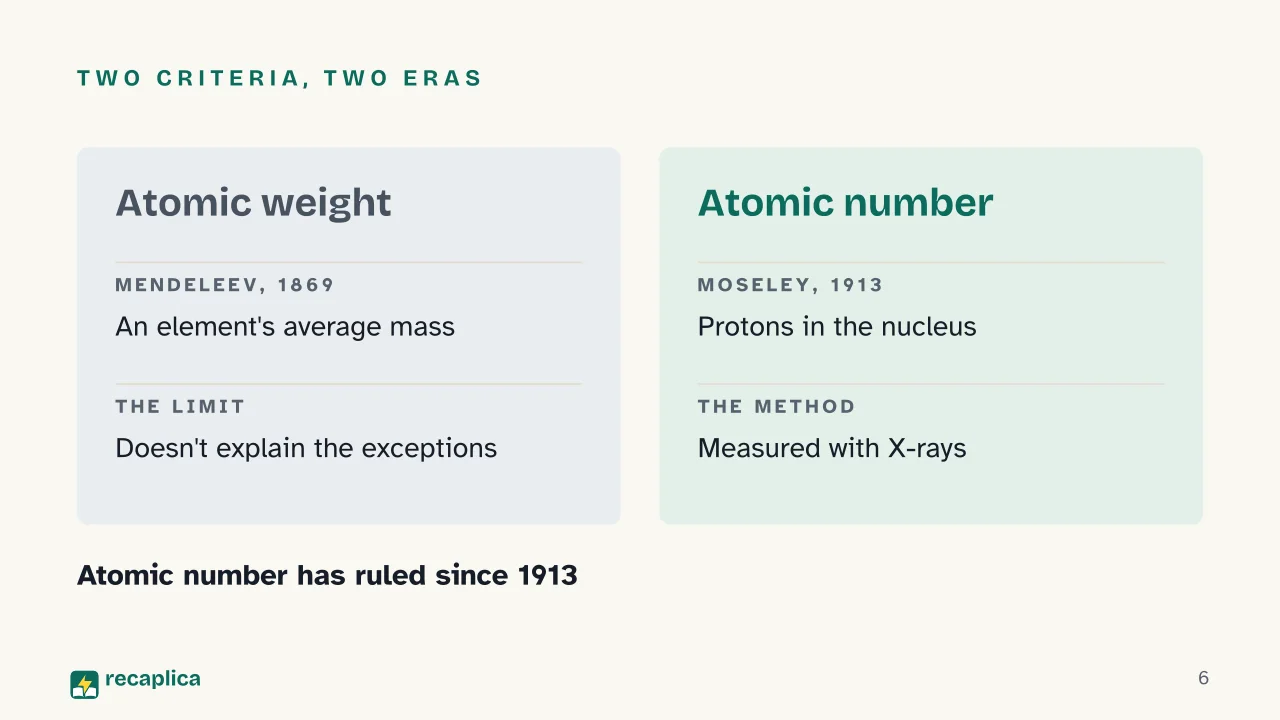
    The periodic table lists chemical elements in order of increasing atomic number, the number of protons packed into each atom’s nucleus. It wasn’t always organized this way. When Dmitri Mendeleev published his table in February 1869, the only tool available for comparing elements was atomic weight, an element’s average mass: he laid out cards for the known elements in order of increasing atomic weight and noticed that certain types of element recurred at regular intervals.

    The real shift came in 1913, when the physicist Henry Moseley used X-rays to experimentally measure the atomic number of every element. Plotting the square root of the frequency of the X-rays each element emitted against its atomic number, he got a perfectly straight line: a measurable, repeatable method that explained why some elements needed to be reordered relative to Mendeleev’s weight-only classification. Since then, atomic number, the count of protons in the nucleus, has been the official criterion of the modern periodic table.

    Periods and groups: rows and columns with a purpose

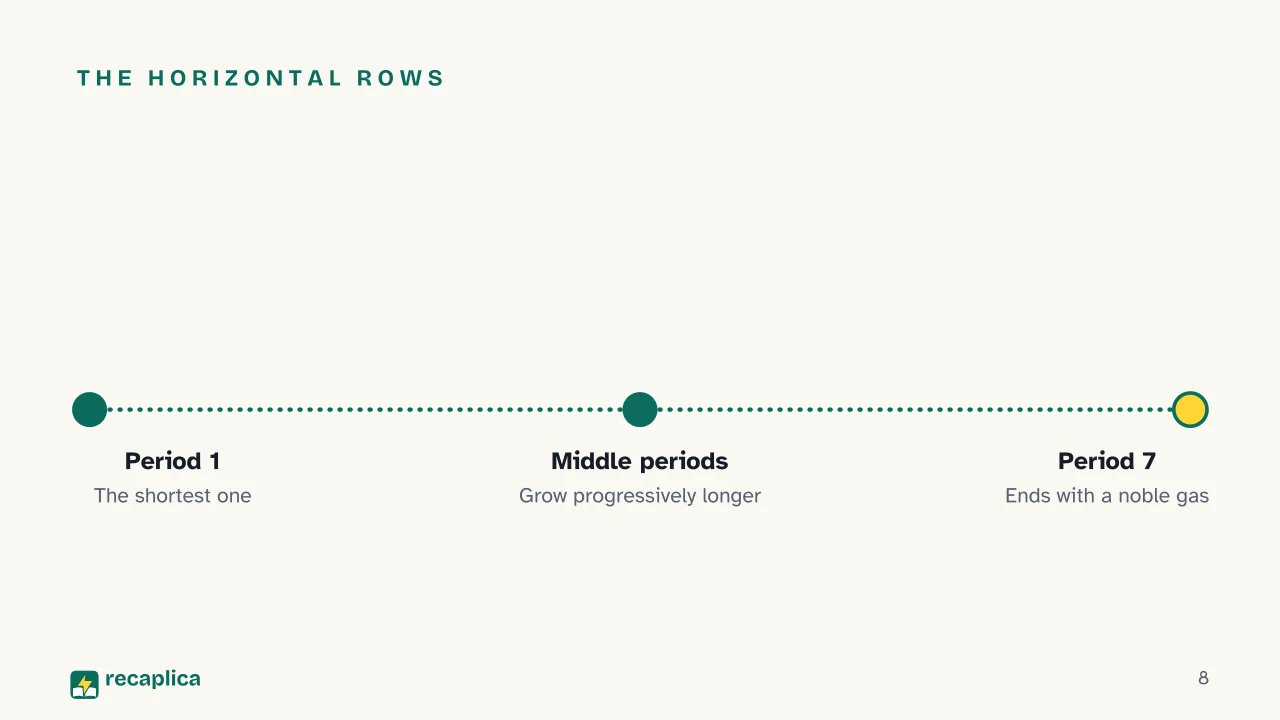
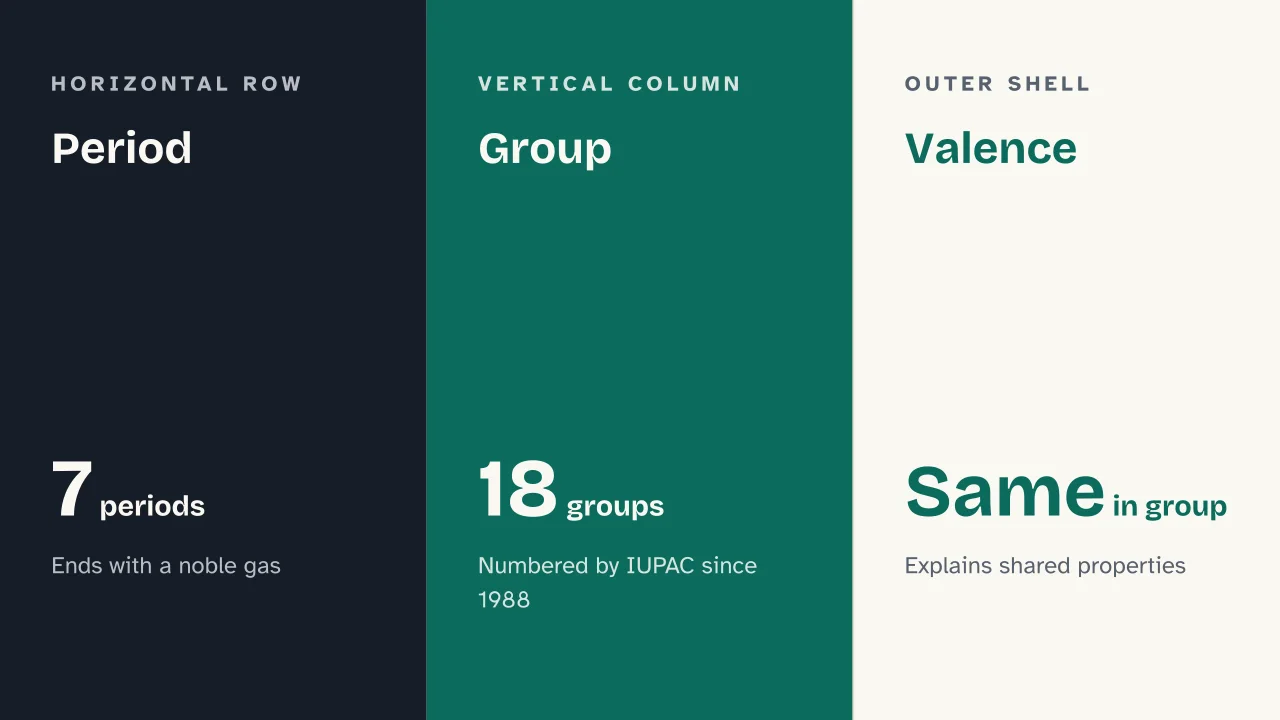
    The table’s horizontal rows are called periods, and every period ends with a noble gas. The vertical columns are called groups, numbered 1 through 18: that numbering, now the worldwide standard, has been recommended by IUPAC since 1988, replacing older systems built on Roman numerals and letters such as A and B.

    A group’s membership follows the atom’s own structure: elements sharing a column also share the same number of electrons in the atom’s outermost energy level, the valence electrons, and that’s what gives them similar chemical properties. Ground-state electron configuration, together with atomic number, is among the values that define each element and its place in the table — the same concept that comes up when talking about electrons in electric current.

    CriterionWho used itWhat it measures
    Atomic weightMendeleev, 1869An element’s average mass
    Atomic numberMoseley, 1913Protons in the nucleus
    Electron configurationNIST, modern technical dataElectrons in the outermost shell

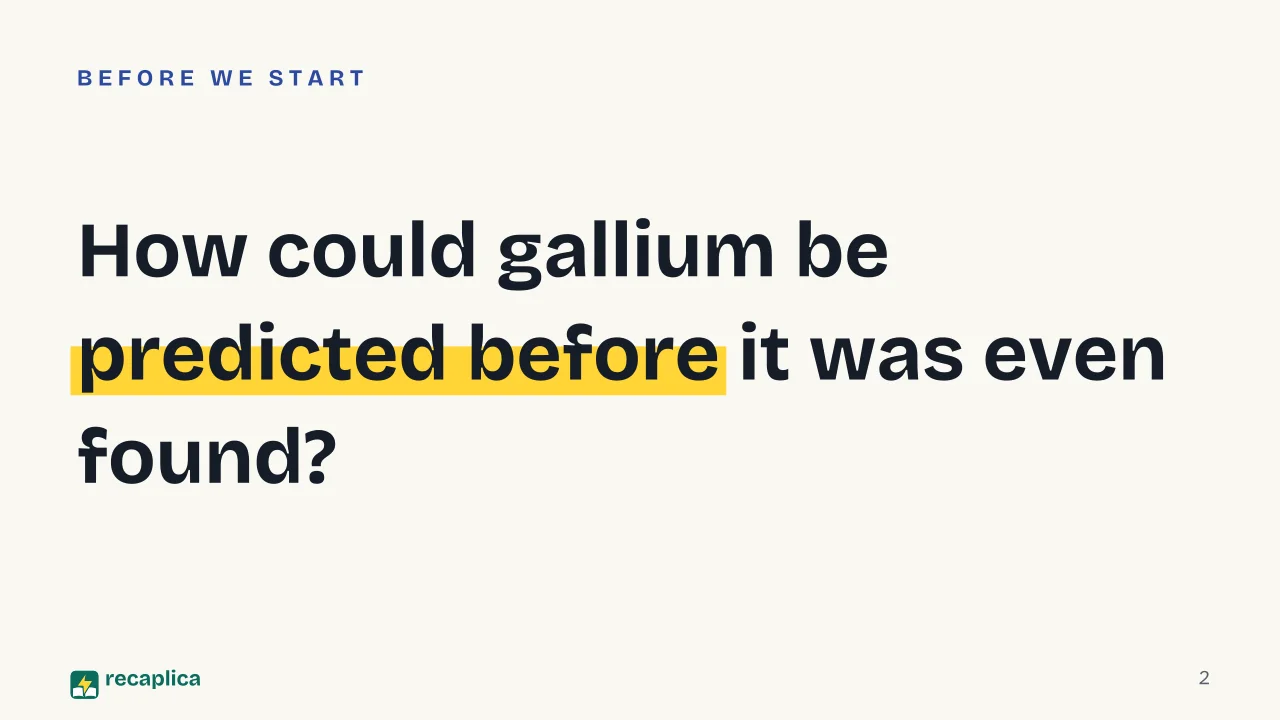
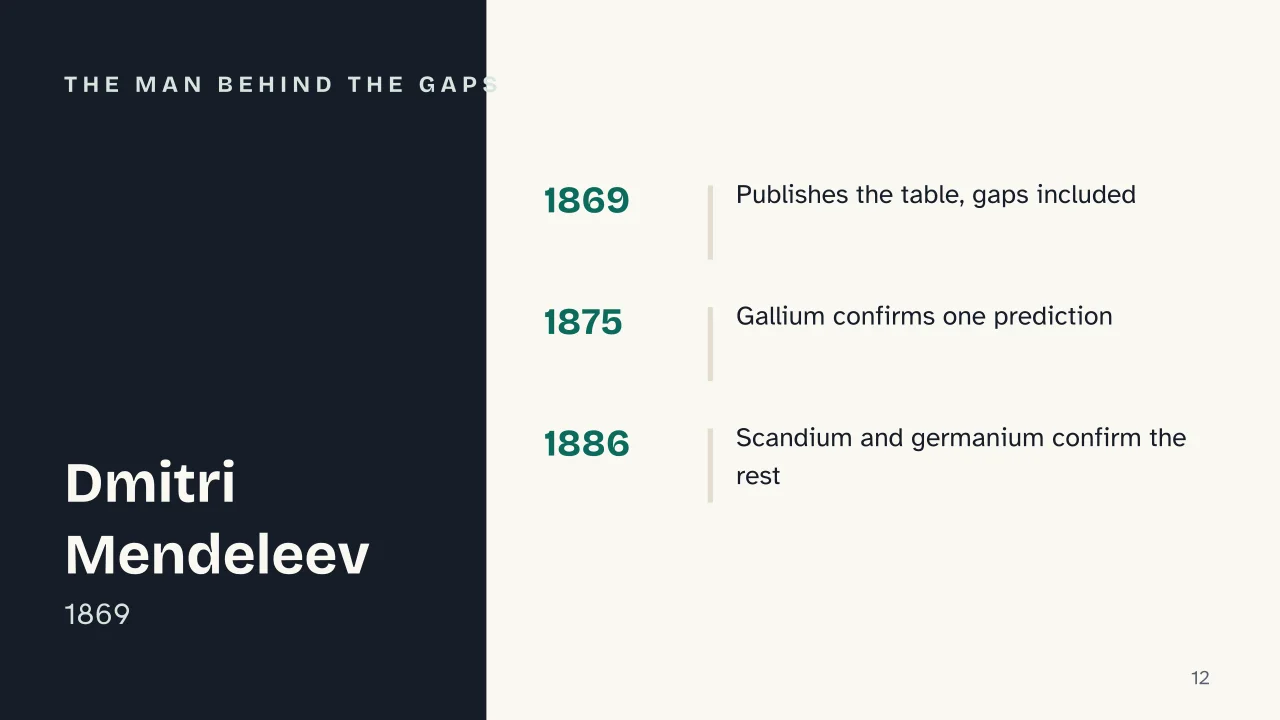
    Real-world example: when Mendeleev left a gap in his 1869 table, its position among the known elements let him predict the properties of an element still unknown, which he provisionally called eka-aluminium. In 1875 gallium was discovered, and its chemical properties matched the forecast almost exactly. The same happened by 1886 for scandium and germanium: three confirmations that earned Mendeleev’s table lasting recognition.

    Before Mendeleev: nearly a century in the making

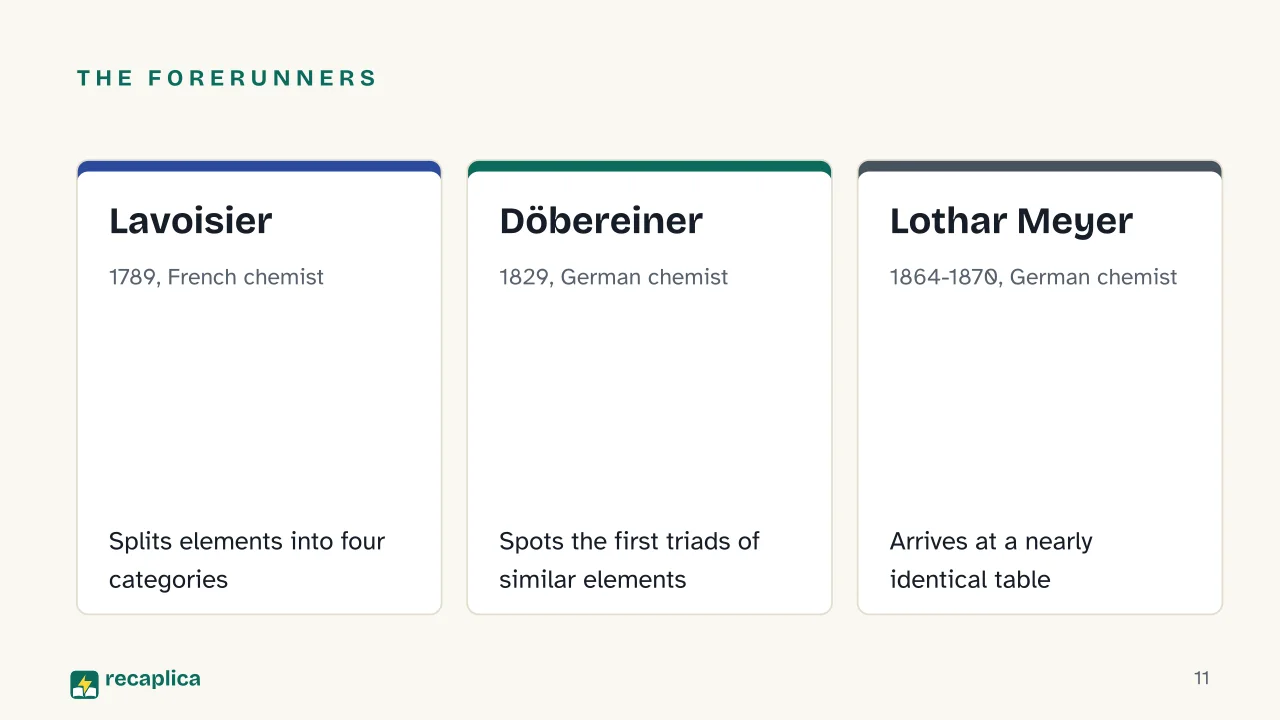
    In 1789 Antoine Lavoisier had already grouped the known elements into four categories: gases, nonmetals, metals and “earths.” In 1829 Johann Döbereiner identified the first “triads” of elements with similar properties. In 1860 the Karlsruhe Congress supplied more accurate atomic-weight data, a technical groundwork that made later attempts possible: in 1862 Alexandre-Émile Béguyer de Chancourtois published a three-dimensional cylindrical layout, the telluric helix, which already showed the periodicity of elemental properties, and in 1865 John Newlands proposed the “law of octaves,” noting similarities between elements whose atomic weights differed by seven units.

    Between 1864 and 1870 Julius Lothar Meyer produced several periodic tables: his 1868 version listed elements by atomic weight, with those of equal valence arranged in vertical columns, work developed independently and arriving at something nearly identical to Mendeleev’s, though published later. Mendeleev’s specific contribution was deliberately leaving gaps for undiscovered elements and predicting their properties, a predictive power none of the earlier attempts had managed to demonstrate.

    A table still being updated

    The International Union of Pure and Applied Chemistry (IUPAC), the world’s official authority on naming and classifying elements, keeps the periodic table current. The table’s last four elements, numbers 113, 115, 117 and 118, were officially named in November 2016, after their discoveries were verified by IUPAC together with the International Union of Pure and Applied Physics (IUPAP). The official table now runs up to element 118, oganesson.

    The numerical data tied to each element gets revised too. The latest official release of the IUPAC table is dated 4 May 2022 and folds in the most recent standard atomic weight values, calculated by the Commission on Isotopic Abundances and Atomic Weights, an IUPAC body established in 1899. The same logic behind groups shows up elsewhere too: in tracing where the carbon plants use in photosynthesis comes from, or in the role carbon dioxide plays in the greenhouse effect.

    Slide deck

    Slides ready to download and make your own in PowerPoint or Google Slides, with speaker notes. Pick the Flash cut or the Full one.
    Slide 1 of the presentation on The periodic table: The periodic tableSlide 2 of the presentation on The periodic table: How could gallium be predicted before it was even found?Slide 3 of the presentation on The periodic table: In this RecapSlide 4 of the presentation on The periodic table: Chapter 01: The ordering ruleSlide 5 of the presentation on The periodic table: The table by the numbersSlide 6 of the presentation on The periodic table: Two criteria, two erasSlide 7 of the presentation on The periodic table: Chapter 02: Periods and groupsSlide 8 of the presentation on The periodic table: The horizontal rowsSlide 9 of the presentation on The periodic table: Period · Group · ValenceSlide 10 of the presentation on The periodic table: Chapter 03: Before MendeleevSlide 11 of the presentation on The periodic table: The forerunners: Lavoisier, Döbereiner, Lothar MeyerSlide 12 of the presentation on The periodic table: The man behind the gapsSlide 13 of the presentation on The periodic table: Chapter 04: A table still in progressSlide 14 of the presentation on The periodic table: Mendeleev didn't build the table from nothingSlide 15 of the presentation on The periodic table: What determines an element's group?Slide 16 of the presentation on The periodic table: The full Recap
    Flash10 slidesThe essential thread, to present in classFull16 slidesEvery chapter and the deeper detail

    Common myths

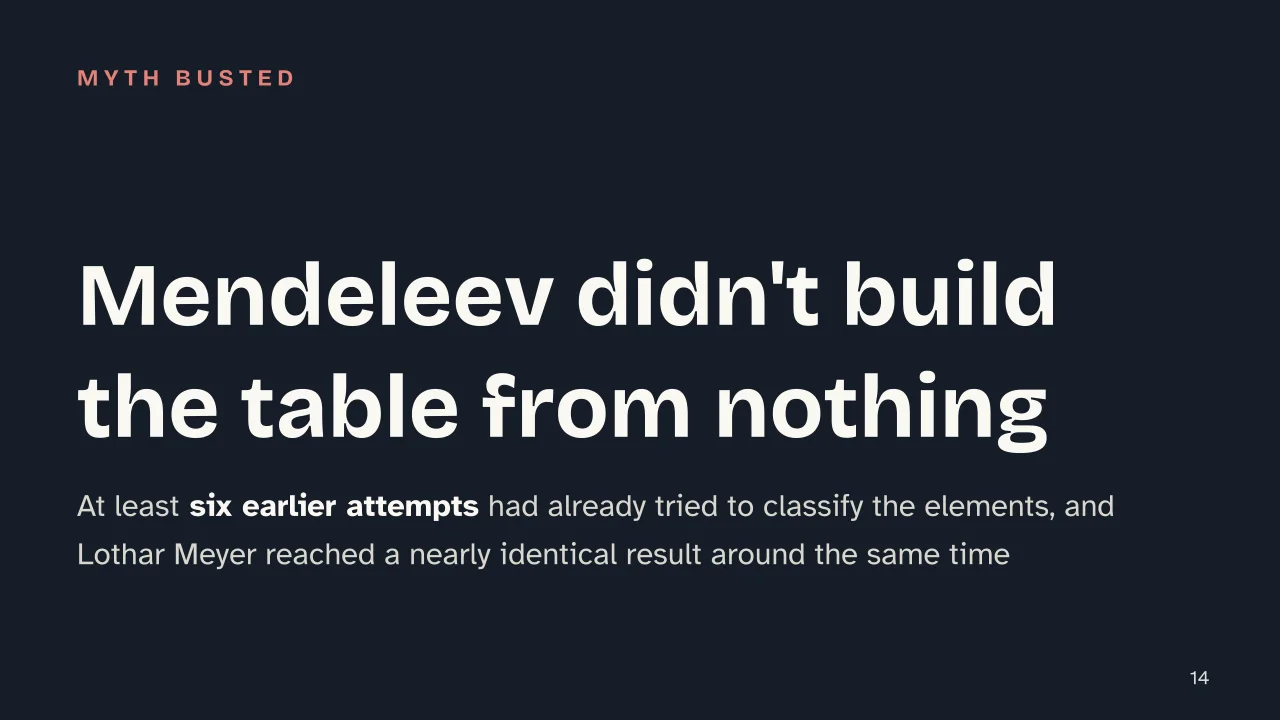
    • ✗ Myth Mendeleev invented the periodic table single-handedly, out of nothing, in 1869.

      ✓ Reality Mendeleev was the first to publish, in February 1869, a table capable of predicting the properties of elements still unknown, and that earned him lasting credit: three of his predictions, including gallium, were confirmed by 1886. But the ground had already been broken by at least six earlier attempts, from Lavoisier in 1789 to Lothar Meyer, who reached an almost identical table independently around the same time, published shortly after Mendeleev's.

    • ✗ Myth Elements in the periodic table are ordered by atomic weight.

      ✓ Reality That was true in 1869, when atomic weight was the only tool Mendeleev had to compare elements. In 1913 Henry Moseley used X-rays to measure each element's atomic number, the count of protons in the nucleus, and showed that was the correct criterion: it usually lines up with the order by weight, but not always, and atomic number remains the official standard today.

    • ✗ Myth The periodic table has been finished and unchanged for a long time.

      ✓ Reality IUPAC updates it regularly: the 1-18 group numbering used today was only adopted in 1988, elements 113, 115, 117 and 118 were officially named in November 2016, and the latest revision of standard atomic weights is dated 4 May 2022. Research into new synthetic elements remains an active field.

    Mind map

    Drag the background to move around and the nodes to reposition them; use − and + to collapse and expand branches.
    Customize
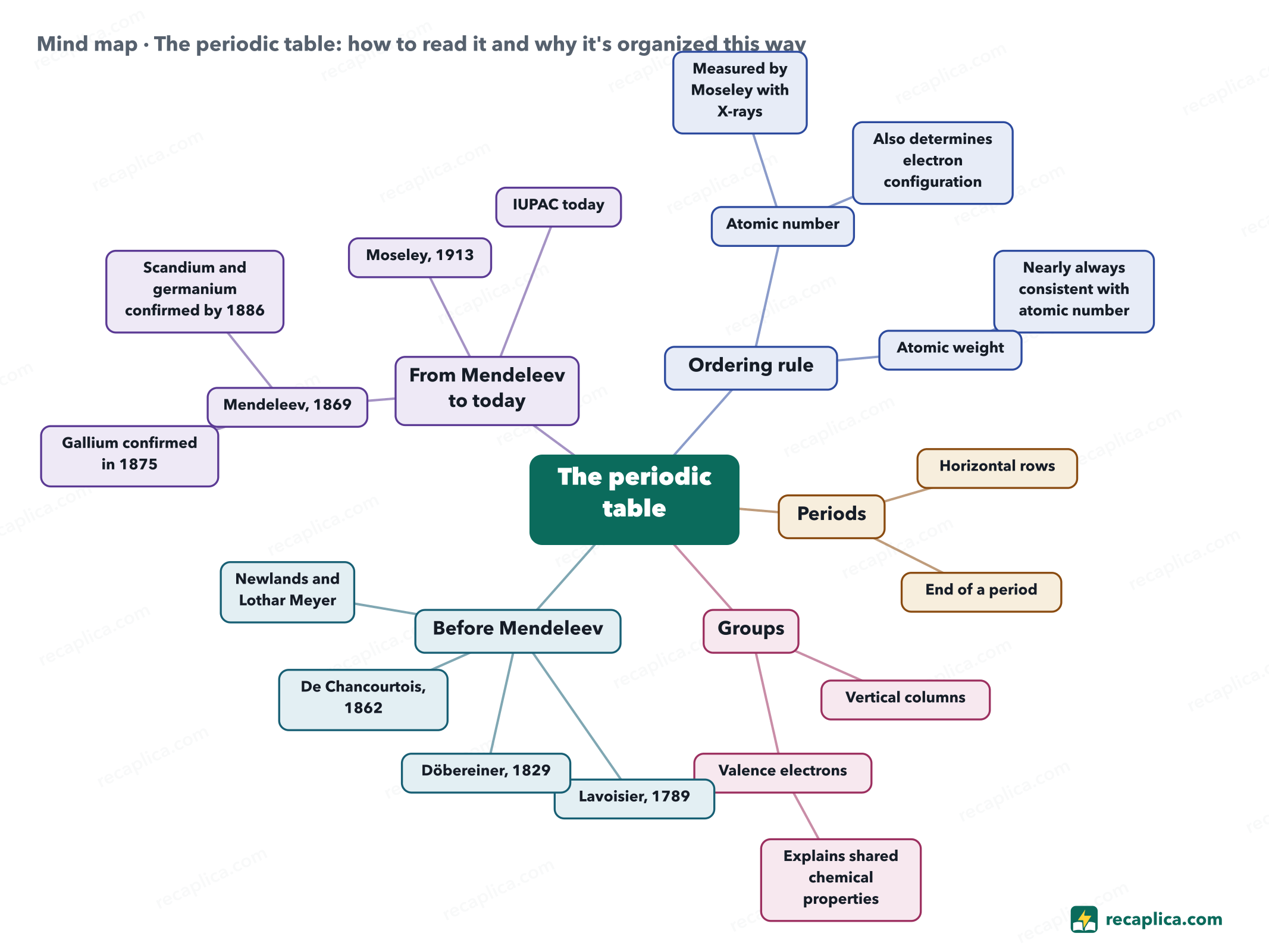
    Mind map: The periodic table: how to read it and why it's organized this way
    • The periodic table
      • Ordering rule
        • Atomic number The count of protons in the nucleus, the official criterion since 1913
          • Measured by Moseley with X-rays
          • Also determines electron configuration
        • Atomic weight The criterion Mendeleev used in 1869, now superseded
          • Nearly always consistent with atomic number
      • Periods
        • Horizontal rows Seven periods in the modern table
        • End of a period Every period ends with a noble gas
      • Groups
        • Vertical columns Eighteen groups, numbered 1-18 by IUPAC since 1988
        • Valence electrons Same number of electrons in the outermost shell
          • Explains shared chemical properties
      • Before Mendeleev
        • Lavoisier, 1789 Four categories: gases, nonmetals, metals, earths
        • Döbereiner, 1829 First triads of similar elements
        • De Chancourtois, 1862 A cylindrical layout, the telluric helix
        • Newlands and Lothar Meyer Law of octaves in 1865, tables nearly identical to Mendeleev's between 1864 and 1870
      • From Mendeleev to today
        • Mendeleev, 1869 Blank spaces left for undiscovered elements
          • Gallium confirmed in 1875
          • Scandium and germanium confirmed by 1886
        • Moseley, 1913 Atomic number replaces atomic weight
        • IUPAC today 118 elements, the last four named in 2016

    Quiz: test yourself

    Answer the questions to check what you have learned: you get instant feedback and a short explanation.

    Grade 0/10 0/5
    1 What criterion orders the elements in today's periodic table?

    Since 1913, following Henry Moseley's X-ray measurements, the official criterion has been atomic number; atomic weight was the criterion Mendeleev used earlier.

    2 Who published, in 1869, the first periodic table able to predict the properties of elements not yet discovered?

    Mendeleev left gaps in his 1869 table and predicted the properties of the missing elements; three of those predictions, including gallium, were confirmed by 1886.

    3 True or false: Lothar Meyer independently worked out a periodic table nearly identical to Mendeleev's, around the same time.

    True: between 1864 and 1870 Lothar Meyer produced several tables, arriving at a result very close to Mendeleev's, but his version was published later.

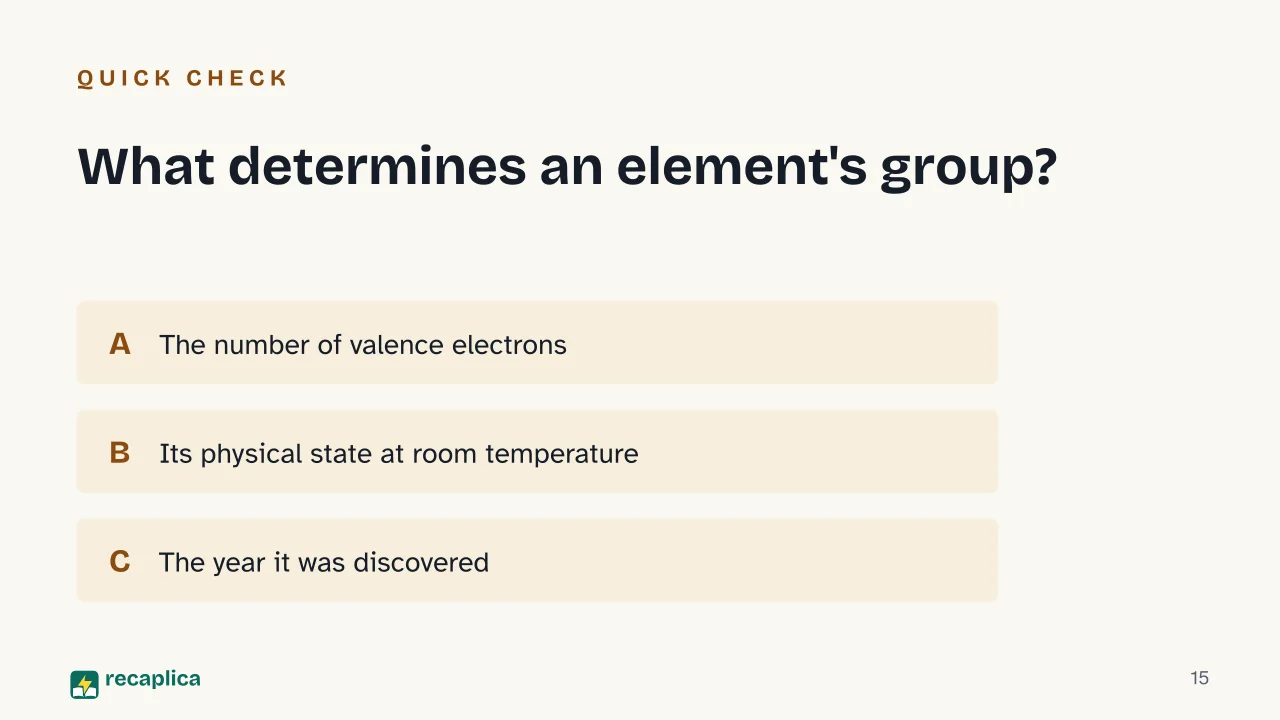
    4 What determines which group, meaning which column, an element belongs to?

    Elements in the same group share the same number of electrons in their outermost shell, which is why they have similar chemical properties.

    5 In what year did IUPAC adopt the 1-18 group numbering used today?

    The 1-18 numbering has been recommended by IUPAC since 1988; older systems used Roman numerals and letters.

    Answers: 1-B · 2-C · 3-A · 4-A · 5-C

    Flashcards

    Tap the card to flip it and check whether you remember the answer, then move to the next one.

    1 / 8

    Explain it in your own words

    The ultimate test: if you can explain it in simple words, you've truly understood it. Write your explanation, then compare it with the Recap.

    Your explanation is saved only on this device.

    The periodic table arranges the 118 known chemical elements into rows and columns that aren't a random design but a reflection of atomic structure. The ordering rule is increasing atomic number, the count of protons in the nucleus, a principle established in 1913 by Henry Moseley, replacing the atomic-weight ordering Dmitri Mendeleev had used in his 1869 table. The rows, called periods, each end with a noble gas; the columns, called groups, gather elements with similar chemical properties because they share the same number of electrons in their outermost shell. IUPAC still updates the table: the current group numbering dates to 1988, and the most recent elements were named in 2016.

    Frequently asked questions

    How many elements are in the periodic table?

    The official periodic table, numbered by IUPAC, has 118 elements, from hydrogen, atomic number 1, to oganesson, atomic number 118. The last four, numbers 113, 115, 117 and 118, were officially named in November 2016.

    Why aren't the elements in the periodic table ordered by atomic weight?

    They were in Mendeleev's original 1869 version, but in 1913 Henry Moseley showed, by measuring the X-rays emitted by elements, that the correct criterion is atomic number, the count of protons in the nucleus. The two orderings usually match, but atomic number has been the official standard for over a century.

    What determines an element's group, meaning its column, in the periodic table?

    The number of electrons in the atom's outermost energy level, called valence electrons. Elements with the same number of valence electrons sit in the same column and share similar chemical properties.

    Was Mendeleev the first person to propose a periodic table?

    No: before him, at least six attempts, from Antoine Lavoisier in 1789 to Julius Lothar Meyer between 1864 and 1870, had already tried to classify the elements. Mendeleev's specific achievement, in February 1869, was leaving gaps and successfully predicting the properties of undiscovered elements, such as gallium, confirmed in 1875.

    Does the periodic table still change today?

    Yes. IUPAC updates it regularly: the 1-18 group numbering dates to 1988, the most recent elements were named in 2016, and the latest revision of standard atomic weights is dated 4 May 2022.

    Sources

    • IUPAC — Periodic Table of Elements
    • Royal Society of Chemistry — Development of the periodic table
    • Royal Society of Chemistry — Periodic Table
    • NIST — Periodic Table of the Elements: Atomic Properties

    Every Recap goes through an independent review before publication.

    Every evening, the day's new Recaps on our Telegram channel. Join the channel →

    Keep learning

    • Science Cognitive Load Theory: The Definition Behind Sweller's Research Cognitive load is the amount of working memory a task uses up while you learn something new. Psychologist John Sweller first described it in 1988, starting from research on problem solving: a strategy that is too demanding leaves little room to build stable mental structures. Later research distinguishes three types of load, intrinsic, extraneous, and germane, though part of the field treats the third as indistinguishable from the first. Cutting extraneous load, with worked examples or less cluttered materials, frees up mental room for actual learning. Read the Recap →
    • Science Cognitivism: how the mind processes information Cognitivism is the psychological paradigm that treats the mind as a system for processing information, spanning perception, memory, reasoning and language. The shift began around 1956, while behaviorism, championed by Watson and Skinner, still ruled academic psychology and reduced the field to observable stimuli and responses. That same year, George Miller exposed the limits of short-term memory, and Chomsky joined McCarthy, Minsky, Newell and Simon in laying the groundwork for cognitive science. Donald Broadbent's attention model in 1958 and Ulric Neisser's 1967 book, which put the name cognitive psychology into common use, complete the roster of its founding figures. Read the Recap →
    • Science Behaviorism: What It Is and Where It Came From Behaviorism is the school of psychology that studies only observable behavior, leaving aside the thoughts and feelings that stay hidden inside the mind. It began in 1913, when the American psychologist John B. Watson published an essay calling for psychology to become an experimental science, without relying on introspection. After him, Ivan Pavlov studied conditioned reflexes and Edward Thorndike studied trial-and-error learning; Burrhus Skinner pushed the ideas to their most extreme form with radical behaviorism. The thread running through all of it is the stimulus-response model: a behavior is explained by what comes before it and what follows it, not by guessing what happens inside the head of the person doing it. Read the Recap →

    recaplica

    Clear in 30 seconds, yours in 10 minutes.

    Recaps Mind maps Request a Recap Telegram channel Mind map maker Our method About Privacy & cookies Legal notes & terms of use

    © 2026 Recaplica · A project by Curi S.r.l. — VAT IT05472000750

    Statistics, only if you say so

    To learn which Recaps help most we would use Google Analytics, with aggregate, anonymous data. It starts only with your OK, and you can change your mind anytime. Privacy policy