Skip to content
recaplica

    One moment: security check

    Cloudflare wants to make sure you're not a robot. Tick the box below and your search will continue on its own.

    IT
    recaplica Radioactive Decay Explained: Why a Nucleus Decays and What Half-Life Means
    © 2026 Recaplica · recaplica.com — All rights reserved
    Home › Science

    Radioactive Decay Explained: Why a Nucleus Decays and What Half-Life Means

    By Recaplica Newsroom · Updated on October 20, 2026

    What to print

    Page numbers appear when printing with default margins.

    Slides

    Choose a cut

    Flash10 slidesThe essential thread, to present in classFull16 slidesEvery chapter and the deeper detail

    Both come with speaker notes.

    Telegram channel
    recaplica Clear in 30 seconds, yours in 10 minutes.
    In 30 seconds Key points Figures Deep dive Slides Myths Mind map Quiz Flashcards FAQ

    In 30 seconds quick read

    Radioactive decay is the spontaneous transformation of an unstable nucleus, which releases energy as radiation until it settles into a more stable nucleus. A nucleus becomes unstable when it carries too many protons or neutrons: the extra energy throws it off balance, and decay is how it settles back down. The three main types are alpha, beta and gamma decay, each with a different ability to pass through matter. Half-life measures how long it takes for a sample's atoms to fall to half their original number: there is no way to predict when a single atom will decay, only the average behavior of many atoms together.

    Key Points

    • Radioactive decay is the spontaneous transformation of a radionuclide into one or more daughter products, with the release of energy.
    • An excess of protons or neutrons creates extra energy in the nucleus, which is why it becomes unstable.
    • There are three main types of decay — alpha, beta and gamma — with very different abilities to penetrate matter.
    • Half-life is how long it takes a sample's radioactive atoms to drop to half their original count; it ranges from seconds to billions of years depending on the radionuclide.
    • The decay of a single atom is random and unpredictable: half-life only makes sense across large numbers of atoms.
    • Some radionuclides decay in a chain: uranium-238, for example, produces a daughter that is itself radioactive, and the series continues until it reaches a stable element.

    Key figures

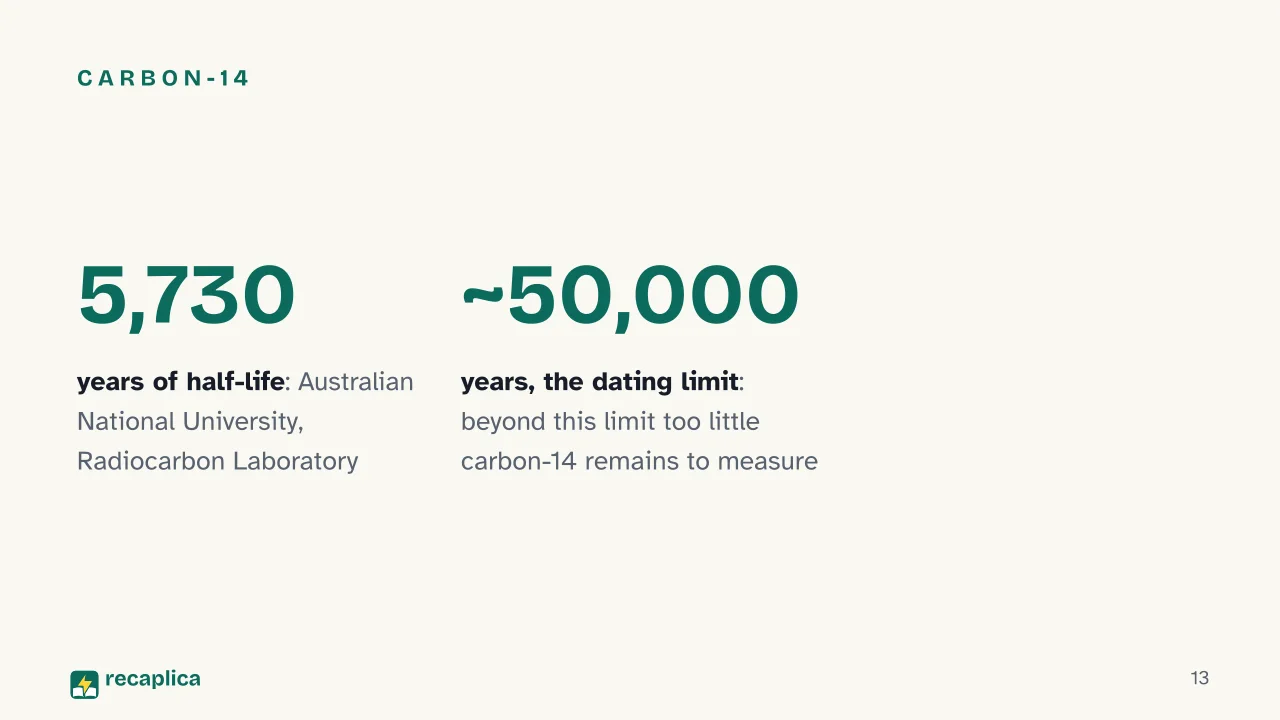
    • 5,730 years Half-life of carbon-14, the radioactive isotope radiocarbon dating is based on. Source: Australian National University, Radiocarbon Laboratory
    • ~50,000 years Upper time limit of radiocarbon dating, made possible by the method Willard Libby invented in the late 1940s. Source: Australian National University, Radiocarbon Laboratory

    Deep Dive

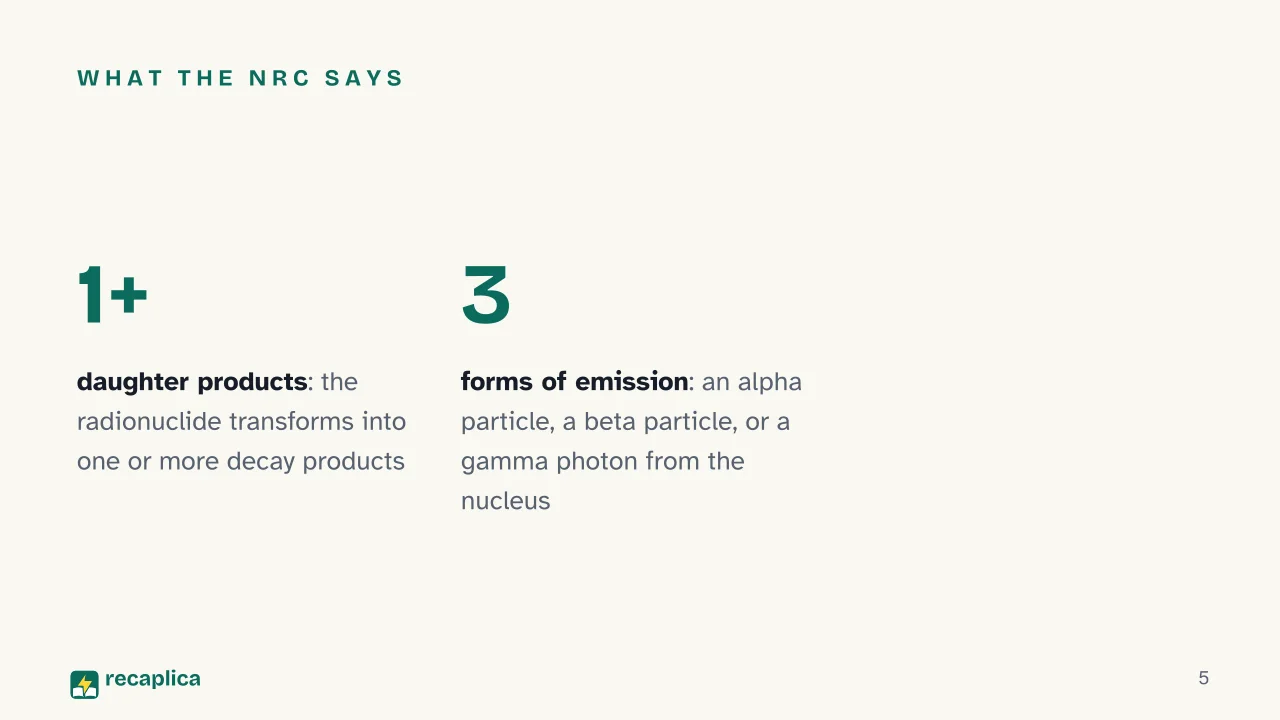
    An unstable atom doesn’t need a push from the outside to change what it is. The NRC spells this out in its official glossary: a radionuclide transforms on its own into one or more descendant nuclei, called “daughters,” typically releasing an alpha particle, a beta particle, or one or more gamma photons from the nucleus.

    Where does that inner push come from? The EPA explains that when an element’s atoms carry an excess of neutrons or protons, extra energy builds up in the nucleus, leaving it unbalanced, or unstable. The EPA describes decay as the release of that energy as ionizing radiation: the unstable nucleus emits radiation and becomes a new atom, and the process keeps going until the internal forces settle into balance.

    Practical example: think of a nucleus with a couple of extra neutrons as cargo loaded past its rated limit. It doesn’t stay put under that extra weight forever — at some point it sheds energy by emitting a particle, and turns into a different nucleus, lighter or more stable than before. That moment of release is decay.

    The three types of decay: alpha, beta, gamma

    The three forms of radiation an unstable nucleus can give off don’t behave the same way once they leave the nucleus. The difference that matters for telling them apart is how well each one penetrates other materials.

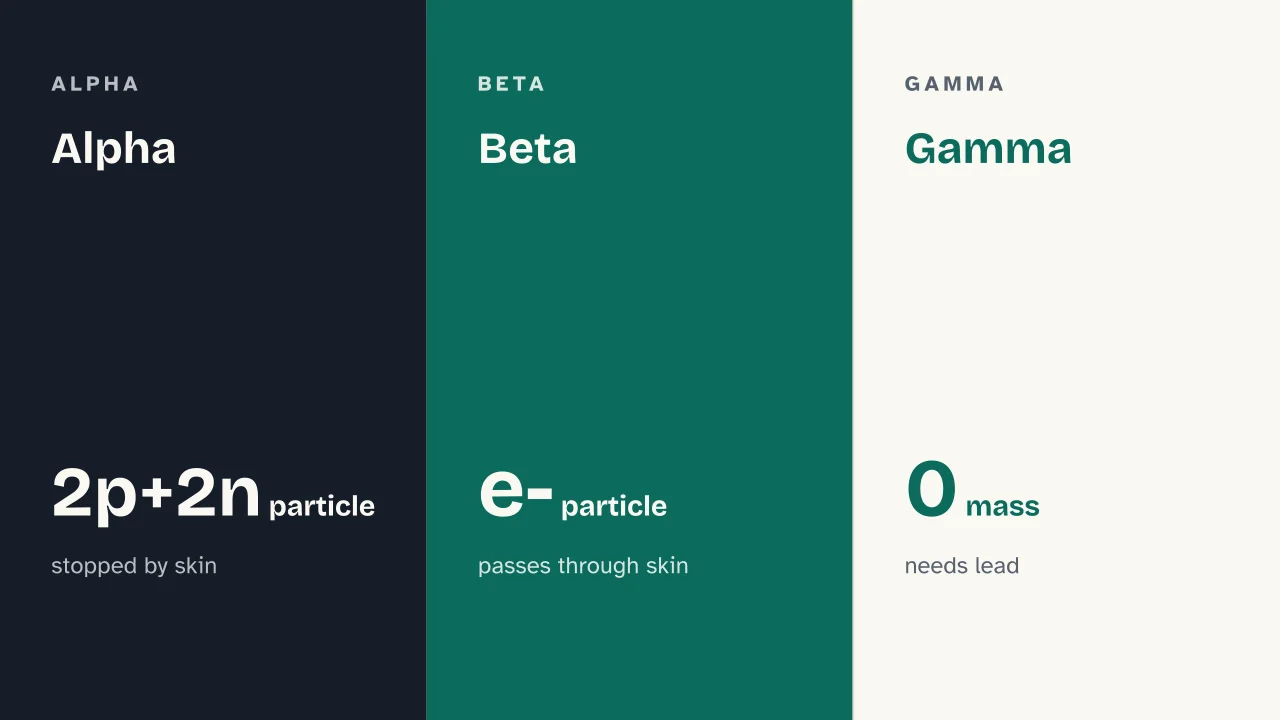
    According to the EPA, an alpha particle is made of two neutrons and two protons. The NRC adds that its reach into other materials is quite short: a sheet of paper, skin, or a few centimeters of air is enough to stop it. That’s why it carries little reach from the outside; the real risk comes from inhaling or swallowing it.

    Beta particles behave differently. The EPA describes them as small and fast, able to pass through skin. The NRC notes that, being lighter than alpha particles, they travel several meters through air and pass through skin, but get stopped by a thin layer of metal, plastic or wood.

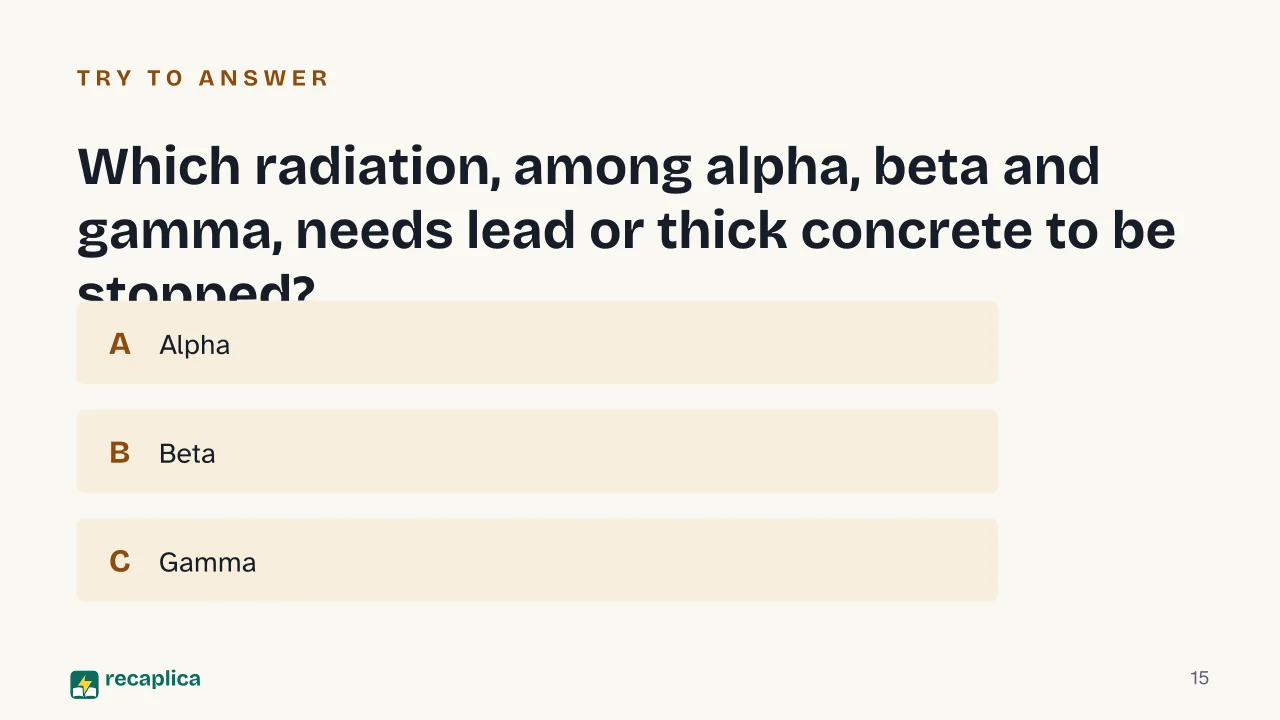
    Gamma rays sit at the opposite end. The EPA describes them as massless “packets” of energy, photons able to pass through the human body. The NRC describes them as able to penetrate matter so effectively that stopping them takes several meters of concrete or a few centimeters of a dense material like lead.

    TypeWhat it isPenetrating powerWhat stops it
    Alphatwo protons and two neutronsvery limiteda sheet of paper, skin, a few cm of air
    Betasmall, fast particleintermediate, several meters in airthin metal, plastic, wood
    Gammamassless photonvery high, passes through the bodyseveral meters of concrete or lead

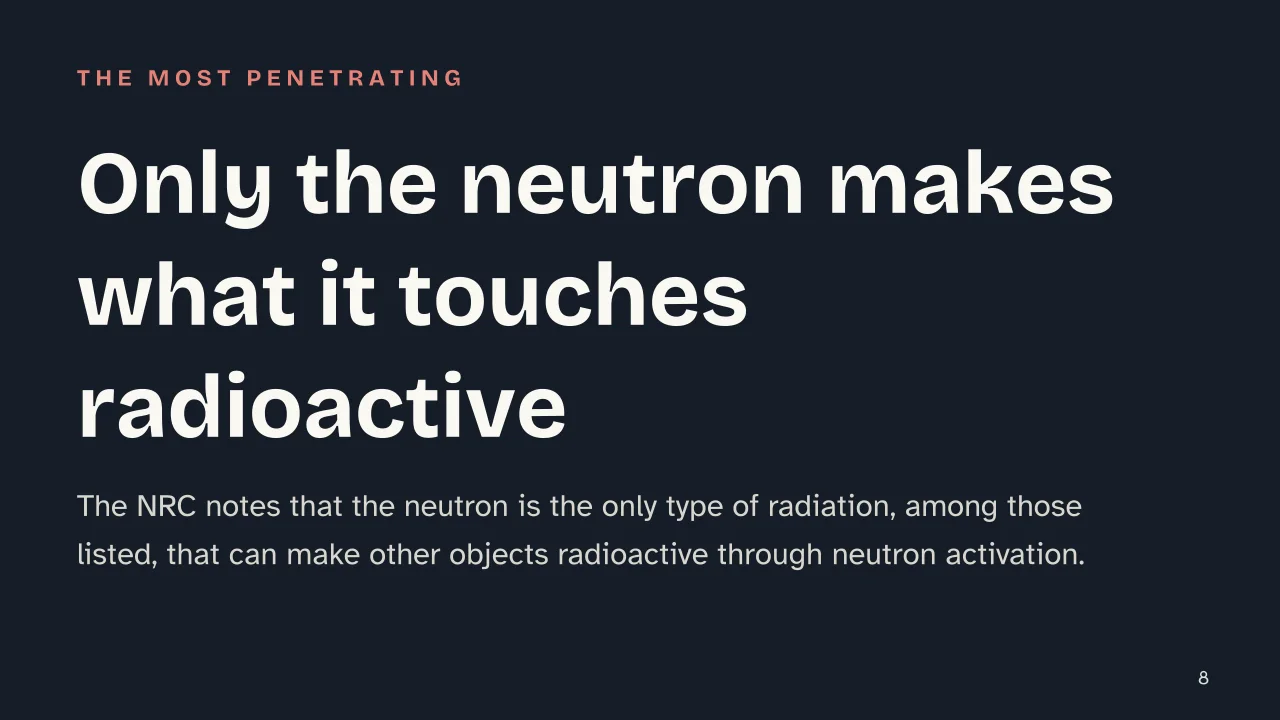
    There’s a fourth player the NRC flags separately: the neutron. It has an exceptional ability to penetrate matter, and it is the only type of radiation, among those mentioned, that can make other objects radioactive through neutron activation — a trait that sets it clearly apart from alpha, beta and gamma.

    Half-life: a probability that only works on large numbers

    HyperPhysics defines half-life as a measure of a nucleus’s tendency to decay, grounded purely in probability. It’s a property that holds steady from the outside: HyperPhysics is explicit that it stays the same regardless of physical state (solid, liquid, gas), temperature, pressure, or the chemical compound the nucleus happens to sit in.

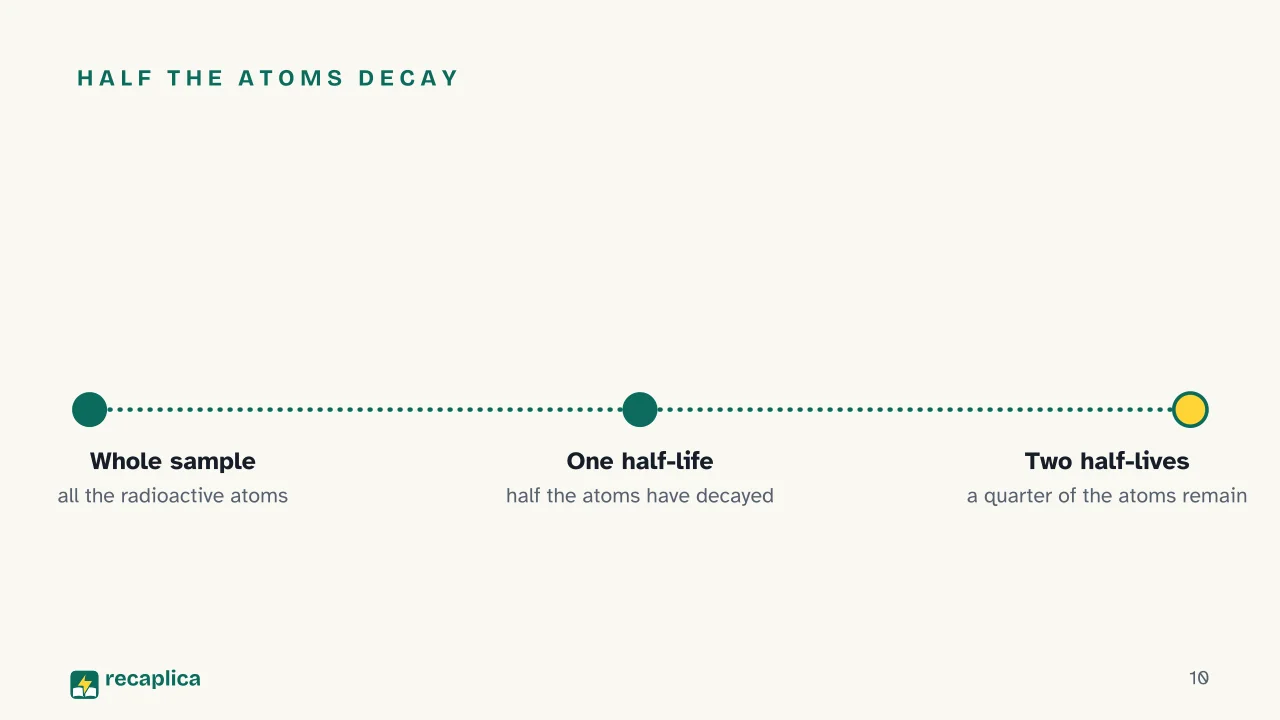
    The EPA defines half-life as the span during which half of the radioactive atoms present in a sample break down or transform, with figures running from a few seconds to hundreds, millions, or even billions of years depending on the radionuclide.

    The most counterintuitive point concerns a single atom.

    HyperPhysics is clear that radioactive decay is a statistical process, tied to the instability of the radioisotope, but entirely unpredictable for any single nucleus in a sample: nobody can know when a specific atom will decay, only estimate the average behavior of a large population. Individual nuclear decays are purely random events, which is why the math only holds for large numbers of atoms, never for one isolated nucleus.

    Some radionuclides don’t stop at a single transformation. The NRC describes how uranium-238, for instance, decays into products that are themselves radioactive, forming a decay chain: a cascade of two or more linked radionuclides that keeps going until it lands on a stable element. The EPA defines this chain as the series of decays or transformations a radionuclide goes through before settling into a stable form.

    A concrete application: carbon-14 dating

    Carbon-14 is a radioactive isotope with a half-life of 5,730 years, measured by the Australian National University’s Radiocarbon Laboratory. That figure underpins radiocarbon dating: by measuring how much carbon-14 remains in an organic sample, compared with how much it held while alive, scientists estimate how long ago the organism died.

    The method was invented by Willard Libby in the late 1940s. Thanks to this technique, it became possible for the first time to date events going back roughly 50,000 years: beyond that point, too little carbon-14 remains to measure reliably.

    Not to be confused with nuclear fission and fusion reactions: there, the transformation is triggered from the outside.

    Here, by contrast, the nucleus transforms on its own. Anyone starting from scratch with scientific reasoning can also brush up on the scientific method.

    Exposure and contamination: two words that get mixed up

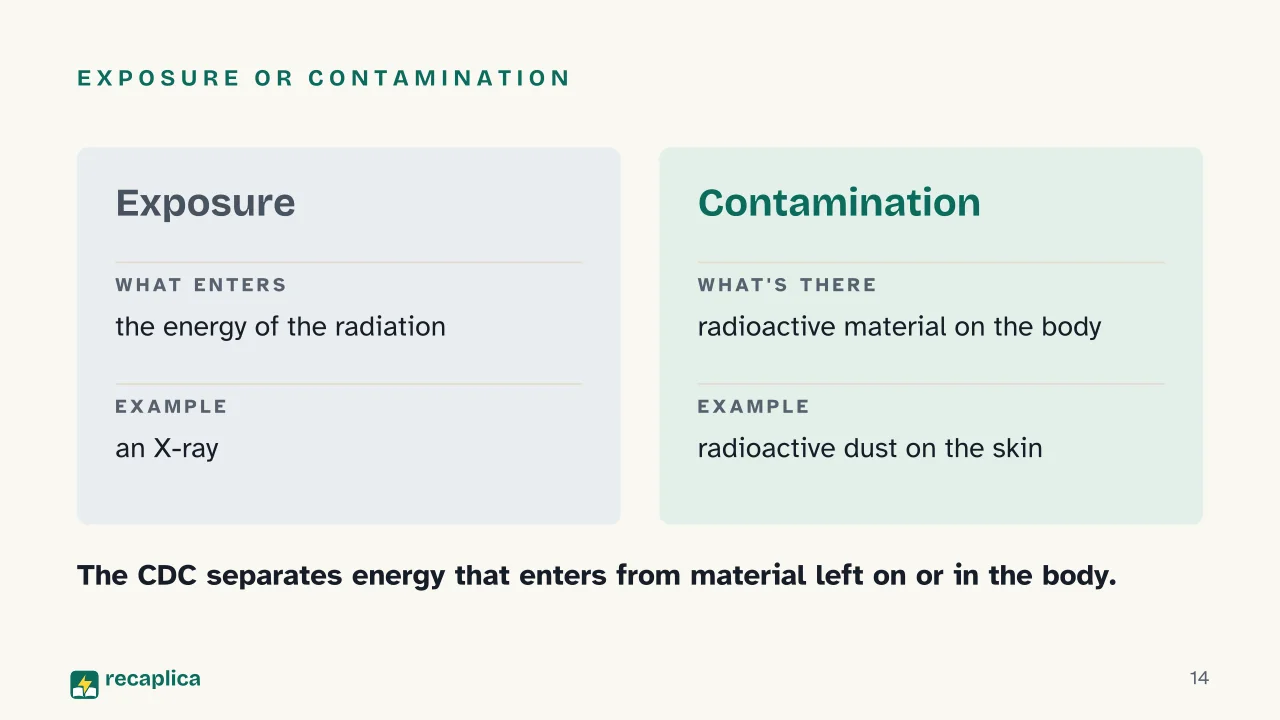
    The U.S. CDC draws a precise line between two concepts that everyday language tends to blur. When a person is exposed to radiation, it’s energy entering the body. A “contaminated” person, by contrast, has radioactive material on or inside the body.

    Practical example: the CDC uses an X-ray to make the distinction concrete. Someone getting an X-ray is exposed to radiation — the energy from the X-rays passes through the body for an instant — but stays free of contamination: once the scan is done, there’s no radioactive material left to remove.

    Getting this distinction straight also makes it easier to read the vocabulary of the periodic table and the radioactive elements that populate it: for a refresher, see the periodic table.

    Slide deck

    Slides ready to download and make your own in PowerPoint or Google Slides, with speaker notes. Pick the Flash cut or the Full one.
    Slide 1 of the presentation on Radioactive Decay Explained: Radioactive DecaySlide 2 of the presentation on Radioactive Decay Explained: Why does a nucleus transform on its own?Slide 3 of the presentation on Radioactive Decay Explained: Today's chaptersSlide 4 of the presentation on Radioactive Decay Explained: Chapter 01: What decay isSlide 5 of the presentation on Radioactive Decay Explained: What the NRC saysSlide 6 of the presentation on Radioactive Decay Explained: Chapter 02: Alpha, beta, gammaSlide 7 of the presentation on Radioactive Decay Explained: Alpha · Beta · GammaSlide 8 of the presentation on Radioactive Decay Explained: Only the neutron makes what it touches radioactiveSlide 9 of the presentation on Radioactive Decay Explained: Chapter 03: Half-lifeSlide 10 of the presentation on Radioactive Decay Explained: Half the atoms decaySlide 11 of the presentation on Radioactive Decay Explained: Nobody knows when a single atom will decaySlide 12 of the presentation on Radioactive Decay Explained: Chapter 04: Carbon-14 datingSlide 13 of the presentation on Radioactive Decay Explained: Carbon-14Slide 14 of the presentation on Radioactive Decay Explained: Exposure or contaminationSlide 15 of the presentation on Radioactive Decay Explained: Which radiation, among alpha, beta and gamma, needs lead or thick concrete to be stopped?Slide 16 of the presentation on Radioactive Decay Explained: Now, the review
    Flash10 slidesThe essential thread, to present in classFull16 slidesEvery chapter and the deeper detail

    Common myths

    • ✗ Myth Being exposed to radiation means being contaminated with radioactive material.

      ✓ Reality The U.S. CDC draws a clear line between the two: exposure is energy reaching the body, while contamination is radioactive material actually sitting on the skin or lodged inside it. Someone having an X-ray absorbs a burst of energy and leaves the room without any radioactive source attached to them.

    • ✗ Myth Half-life depends on how the radioactive material is stored — for example, on temperature.

      ✓ Reality According to HyperPhysics, a radionuclide's half-life stays the same no matter its physical state, temperature, pressure or the chemical compound the nucleus sits in: it is a probability built into the nucleus itself, something no outside condition can speed up or slow down.

    Mind map

    Drag the background to move around and the nodes to reposition them; use − and + to collapse and expand branches.
    Customize
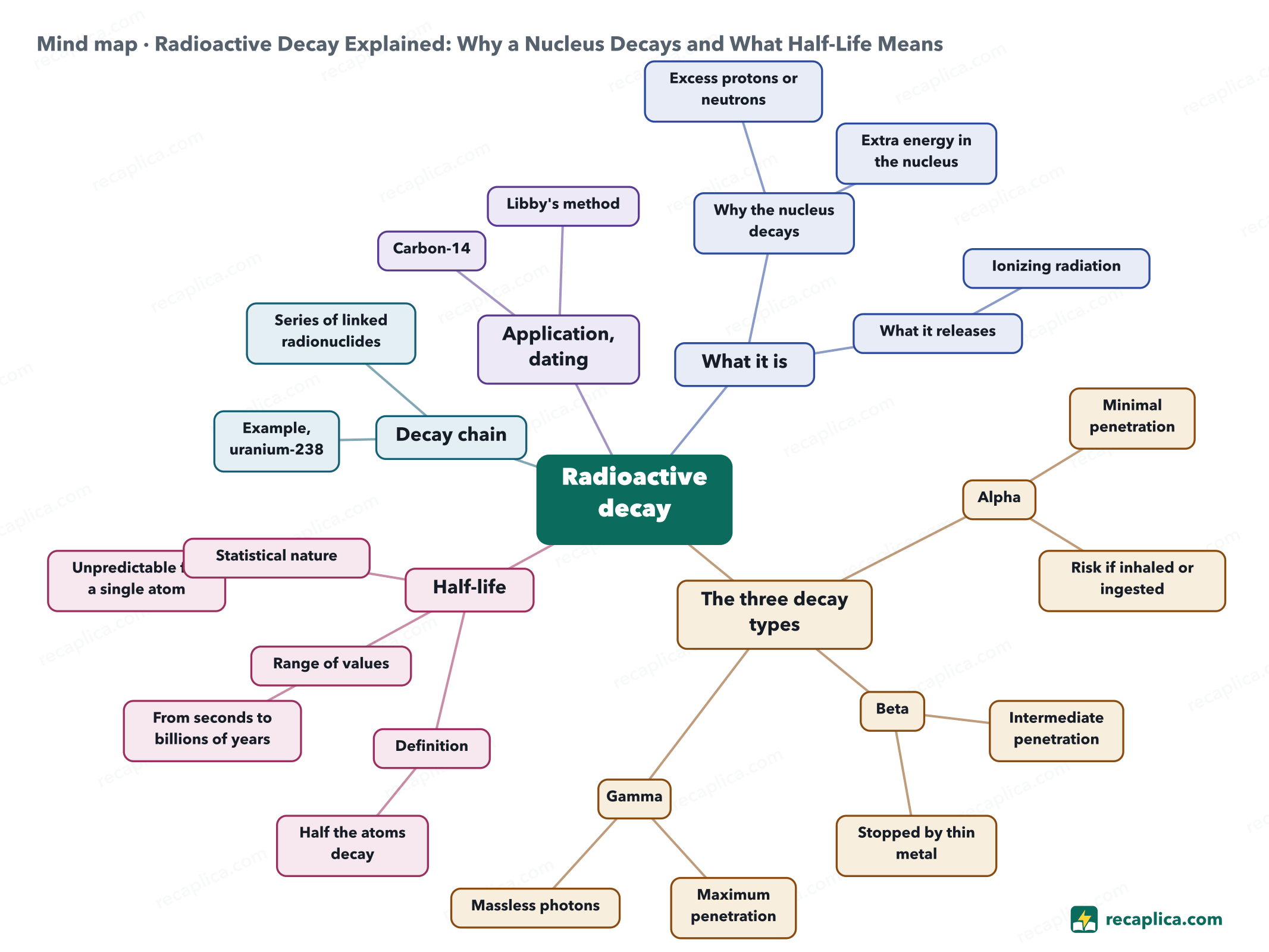
    Mind map: Radioactive Decay Explained: Why a Nucleus Decays and What Half-Life Means
    • Radioactive decay
      • What it is spontaneous transformation of an unstable nucleus
        • Why the nucleus decays
          • Excess protons or neutrons
          • Extra energy in the nucleus
        • What it releases
          • Ionizing radiation
      • The three decay types
        • Alpha
          • Minimal penetration
          • Risk if inhaled or ingested
        • Beta
          • Intermediate penetration
          • Stopped by thin metal
        • Gamma
          • Maximum penetration
          • Massless photons
      • Half-life
        • Definition
          • Half the atoms decay
        • Range of values
          • From seconds to billions of years
        • Statistical nature
          • Unpredictable for a single atom
      • Decay chain
        • Example, uranium-238
        • Series of linked radionuclides
      • Application, dating
        • Carbon-14 5,730-year half-life
        • Libby's method late 1940s

    Quiz: test yourself

    Answer the questions to check what you have learned: you get instant feedback and a short explanation.

    Grade 0/10 0/5
    1 According to the NRC, what is radioactive decay?

    This is the NRC's definition: a radionuclide changes on its own, producing one or more daughter nuclei and releasing energy.

    2 Why does an atomic nucleus become unstable, according to the EPA?

    The EPA links an excess of neutrons or protons to the extra energy that unbalances the nucleus, making it unstable.

    3 Which particle, among those described by the NRC, can make other objects radioactive through neutron activation?

    The NRC notes that the neutron is the only type of radiation, among those listed, capable of activating other objects and making them radioactive in turn.

    4 True or false: according to HyperPhysics, you can predict exactly when a single atom in a radioactive sample will decay.

    False: HyperPhysics makes clear that the decay of a single nucleus is a random event, predictable only on average across a large population of atoms.

    5 What is the half-life of carbon-14?

    Carbon-14 has a half-life of 5,730 years, the figure behind the time limit of radiocarbon dating.

    Answers: 1-A · 2-B · 3-C · 4-B · 5-B

    Flashcards

    Tap the card to flip it and check whether you remember the answer, then move to the next one.

    1 / 8

    Explain it in your own words

    The ultimate test: if you can explain it in simple words, you've truly understood it. Write your explanation, then compare it with the Recap.

    Your explanation is saved only on this device.

    Radioactive decay is the spontaneous transformation of an unstable nucleus, which releases energy as radiation until it settles into a more stable nucleus. A nucleus becomes unstable when it carries too many protons or neutrons: the extra energy throws it off balance, and decay is how it settles back down. The three main types are alpha, beta and gamma decay, each with a different ability to pass through matter. Half-life measures how long it takes for a sample's atoms to fall to half their original number: there is no way to predict when a single atom will decay, only the average behavior of many atoms together.

    Frequently asked questions

    What is radioactive decay in simple terms?

    It is the spontaneous transformation of an unstable atomic nucleus, which releases energy as radiation (alpha particles, beta particles or gamma photons) until it becomes a more stable nucleus. The NRC defines it this way in its official glossary.

    What is the difference between alpha, beta and gamma decay?

    They differ in the particle released and its ability to penetrate matter. Alpha is stopped by a sheet of paper or skin; beta passes through skin but not a thin layer of metal; the gamma ray is the most penetrating of the three and needs lead or thick concrete to be stopped (NRC, "Radiation Basics").

    What is half-life?

    It is the span of time over which half of a sample's radioactive atoms break down or transform. The length varies enormously from one radionuclide to another: from a few seconds to hundreds, millions or billions of years (EPA).

    How does carbon-14 dating work?

    Carbon-14 is a radioactive isotope whose half-life runs 5,730 years: measuring how much is left in an organic sample shows roughly how long ago the organism died. The method, invented by Willard Libby in the late 1940s, can date events as far back as about 50,000 years (Australian National University).

    Does being exposed to radiation mean you are contaminated?

    No, they're different things. The CDC says exposure happens when radiation energy hits the body, while contamination means radioactive material is physically on someone or absorbed inside them. Getting an X-ray exposes a person to radiation without contaminating them.

    Sources

    • U.S. NRC, Radioactive decay (glossary)
    • U.S. EPA, Radioactive Decay
    • U.S. NRC, Radiation Basics
    • HyperPhysics, Radioactive Half-Life
    • U.S. EPA, RadTown, Atomic Stability
    • Australian National University, Radiocarbon Laboratory
    • U.S. CDC, What Causes Contamination versus Exposure

    Every Recap goes through an independent review before publication.

    Every evening, the day's new Recaps on our Telegram channel. Join the channel →

    Keep learning

    • Science Balancing Redox Reactions: Half-Reaction and Oxidation Number Methods A redox reaction is balanced when every element has the same number of atoms on both sides and the total charge is the same too. There are two routes. With the half-reaction method you write oxidation and reduction separately, add water, H⁺ and electrons, and then add the two halves together. With the oxidation number method you look at how much each element's number rises and falls, and pick coefficients that make the total rise equal the total fall. In basic solution you start as in acid, and at the end the H⁺ ions are turned into water with OH⁻. Read the Recap →
    • Science Brønsted-Lowry theory: definition of acids, bases and conjugate pairs In 1923 Johannes Brønsted and Thomas Lowry, working independently, defined an acid as a species that gives away a proton and a base as a species that takes one in. An acid-base reaction is therefore a transfer of a proton, and every transfer produces two conjugate pairs. Water can act as either an acid or a base, and ammonia is a base even though its formula has no OH-. The theory generalizes Arrhenius's, which holds only for water solutions. Read the Recap →
    • Science Chemical Equilibrium: Definition, the Constant K and the Reaction Quotient Q A reversible reaction can run in either direction, and in a closed system it reaches a point where the amounts of reactants and products stop changing. At that point the forward and reverse reactions keep going at the same rate. The equilibrium constant K depends on temperature. Comparing the reaction quotient Q with K shows which way the reaction is heading. An ICE table handles the calculations. Read the Recap →

    recaplica

    Clear in 30 seconds, yours in 10 minutes.

    Recaps Mind maps Request a Recap Telegram channel Mind map maker Our method About Privacy & cookies Legal notes & terms of use

    © 2026 Recaplica · A project by Curi S.r.l. — VAT IT05472000750

    Statistics, only if you say so

    To learn which Recaps help most we would use Google Analytics, with aggregate, anonymous data. It starts only with your OK, and you can change your mind anytime. Privacy policy