|
recaplica
The Atomic Bomb: How Nuclear Fission Works, and the History of Hiroshima and Nagasaki | ||||||||||||||||||
| © 2026 Recaplica · recaplica.com — All rights reserved | ||||||||||||||||||
The Atomic Bomb: How Nuclear Fission Works, and the History of Hiroshima and NagasakiWhat to print Page numbers appear when printing with default margins. SlidesChoose a cut Flash10 slidesThe essential thread, to present in classFull19 slidesEvery chapter and the deeper detailBoth come with speaker notes. In 30 seconds quick readThe atomic bomb is a weapon that releases an enormous amount of energy by splitting the nuclei of heavy atoms such as uranium or plutonium, a process called nuclear fission. The Manhattan Project, the secret program that built the first American atomic bombs, cost $2.2 billion at the time and employed 130,000 people at its peak. On 6 August 1945 the United States dropped Little Boy on Hiroshima, and three days later, on 9 August, Fat Man on Nagasaki: the only two atomic bombs ever used in a war. Deaths ran into the tens of thousands in the months that followed, and Japan surrendered on 14 August 1945, a decision whose relative weight of causes historians still debate. Since 1970 the Treaty on the Non-Proliferation of Nuclear Weapons has tried to limit the spread of these weapons around the world. Key Points
Key figures
Deep DiveHow nuclear fission worksThe atomic bomb releases energy by splitting the nuclei of heavy atoms, a process physicists call nuclear fission. When a neutron strikes a heavy nucleus such as uranium-235 or plutonium-239, the nucleus becomes unstable and quickly splits into two fragments of similar mass. Each split releases on average 2-3 new neutrons (fission of uranium-235 releases about 2.45, fission of plutonium-239 about 2.9), along with an enormous amount of energy, about 200 MeV for every uranium-235 nucleus split, the equivalent of 82 trillion joules for every kilogram of material fissioned. About 85% of that energy is heat, carried as the kinetic energy of the fragments. For the reaction to sustain itself, a minimum amount of material is needed, the critical mass, the threshold beyond which the neutrons produced outnumber those lost to the outside. With a neutron reflector around the material, about 15 kg of uranium-235 or 5 kg of plutonium-239 is enough; without a reflector, Enrico Fermi and Leo Szilard’s early experiments put the uranium-235 threshold at around 50 kg. Shape matters as much as quantity, a sphere has the smallest surface area for a given mass, so it loses fewer neutrons outward than any other shape.
Fission should be kept separate from fusion, the opposite process that powers stars, in fusion two light nuclei, such as deuterium and tritium, join into a heavier nucleus, releasing even more energy per kilogram of material (the deuterium-tritium reaction produces helium-4, one neutron and 17.6 MeV). Both bombs used in 1945 relied on fission, not fusion. The Manhattan ProjectDevelopment of the bomb took place during the Second World War, inside the secret program known as the Manhattan Project. It was an operation on an industrial scale, comparable in organization to the era’s automobile industry, bringing together leading scientists, private industry, the military and tens of thousands of ordinary Americans. It cost $2.2 billion at the time and employed as many as 130,000 workers at its peak, spread mainly across three sites: Oak Ridge, in Tennessee, where uranium was enriched; Hanford, in Washington State, where plutonium was produced; and Los Alamos, in New Mexico, where the devices were designed. On 16 July 1945, in the New Mexico desert, the project reached its decisive moment: the Trinity test detonated the first nuclear device in history, an implosion-type plutonium bomb of the same design that, three weeks later, would be used on Nagasaki. The U.S. Department of Energy is the direct successor to the Manhattan Engineer District, the Army Corps of Engineers unit that built the bomb. On 10 November 2015 the project’s three main sites became the Manhattan Project National Historical Park, after a national defense law had authorized its creation on 19 December 2014. Hiroshima and Nagasaki, August 1945On 6 August 1945, at 8:15 am local time, the B-29 bomber “Enola Gay” (which had taken off from the island of Tinian at 2:45 that morning, piloted by Colonel Paul Tibbets) dropped the bomb “Little Boy” on Hiroshima. Three days later, on 9 August, the B-29 “Bockscar”, piloted by Charles Sweeney, dropped “Fat Man” on Nagasaki at 10:58 am local time, the mission’s original target had been Kokura, scrapped at the last moment because of cloud cover and poor visibility.
At Hiroshima, home to between 280,000 and 290,000 civilians plus 43,000 soldiers, the blast damaged or destroyed 70,000 of 76,000 buildings, 48,000 of them razed completely, ground temperature reached 7,000 degrees Fahrenheit, about 3,870 °C, in under a second. Casualty estimates vary with the time frame considered, from 90,000 to 166,000 deaths in the following four months, while the city of Hiroshima itself estimates 237,000 deaths, direct and indirect (burns, radiation sickness, cancer), over a longer span. At Nagasaki, home to about 263,000 people, civilians, soldiers and prisoners combined, an estimated 40,000 to 75,000 people died immediately, with about 80,000 total deaths by the end of 1945, the radius of total destruction was about 1.6 kilometers. According to the World Nuclear Association, most deaths in both cities were caused by blast injuries and burns, not direct radiation.
Japan’s surrender, and a debate that remains openJapan announced its surrender on 14 August 1945. The preceding weeks had seen several factors converge. On 8 August 1945 the Soviet Union declared war on Japan, and the next day, 9 August, it invaded Manchuria with over 1.5 million soldiers along three fronts, ending Japan’s hope of a Moscow-mediated negotiated peace. The relative weight of these factors remains a matter of debate among historians. Some, such as Tsuyoshi Hasegawa, argue that the Soviet entry into the war weighed as much as the atomic bombings, if not more, precisely because it removed Japan’s last diplomatic path toward a negotiated peace. Others assign the decisive weight to the two bombs. There is no single consensus, and it is a simplification to name the atomic bombs as the sole cause of the surrender, the Japanese decision grew out of several converging pressures within the same handful of days. After the bomb, radiation, rebuilding, non-proliferationThe bomb’s energy split between initial radiation, about 5% of the total, responsible for immediate damage within roughly one kilometer, and residual radiation, about 10% of the total. The latter fell off quickly, according to the city of Hiroshima, 80% of it was released within the first 24 hours, and within a week levels had already dropped to one-millionth of what they were immediately after the explosion. By 2026 the radiation levels measured at Hiroshima and Nagasaki match the natural background radiation found everywhere on the planet. Both cities were rebuilt and became major industrial centers, by 2026 Hiroshima has over one million residents and Nagasaki about 440,000. Internationally, the nuclear arms race that marked the Cold War, the same technological rivalry between the United States and the Soviet Union that, by a different route, also led to the Apollo 11 moon landing, pushed the two superpowers and other countries toward ever larger arsenals. The Treaty on the Non-Proliferation of Nuclear Weapons, opened for signature in 1968 and in force since 5 March 1970, tried to halt that spread, states with nuclear weapons committed not to transfer them, states without them committed not to acquire them, under verification by the International Atomic Energy Agency over civilian nuclear activity. Extended indefinitely in 1995, the treaty counts 191 states parties, the most widely signed agreement in the world on nuclear non-proliferation. Slide deckSlides ready to download and make your own in PowerPoint or Google Slides, with speaker notes. Pick the Flash cut or the Full one.     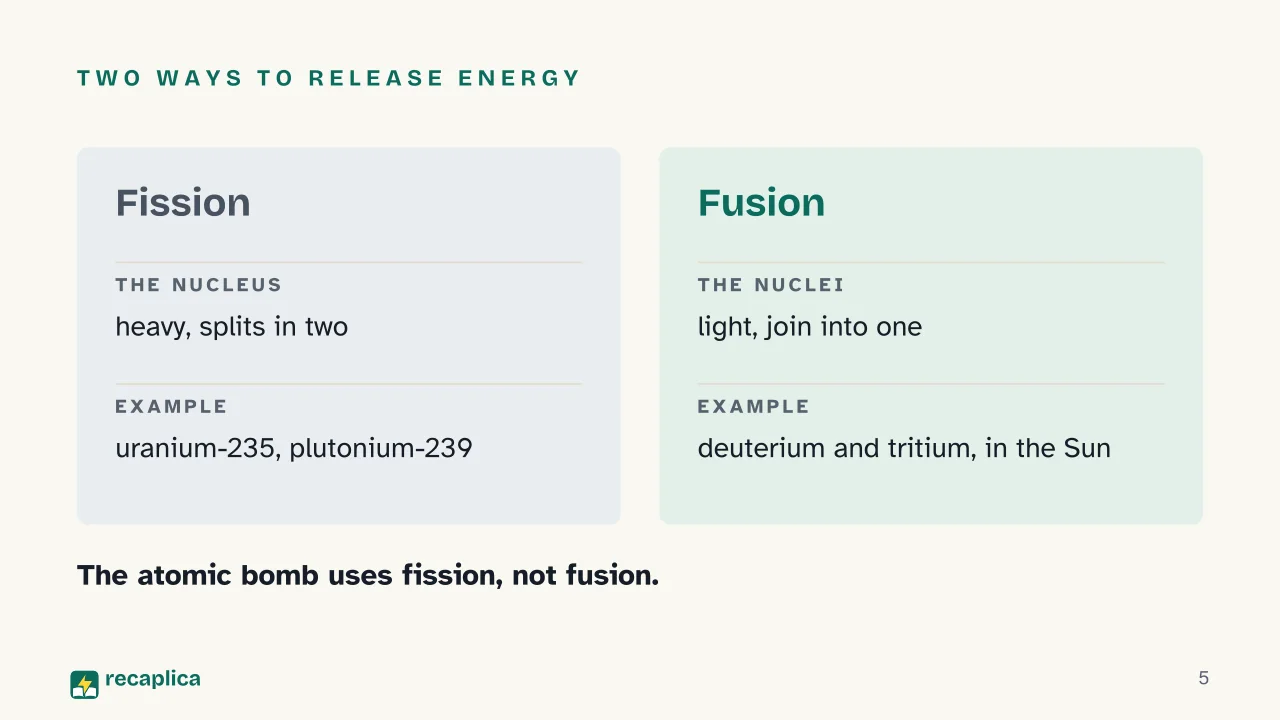 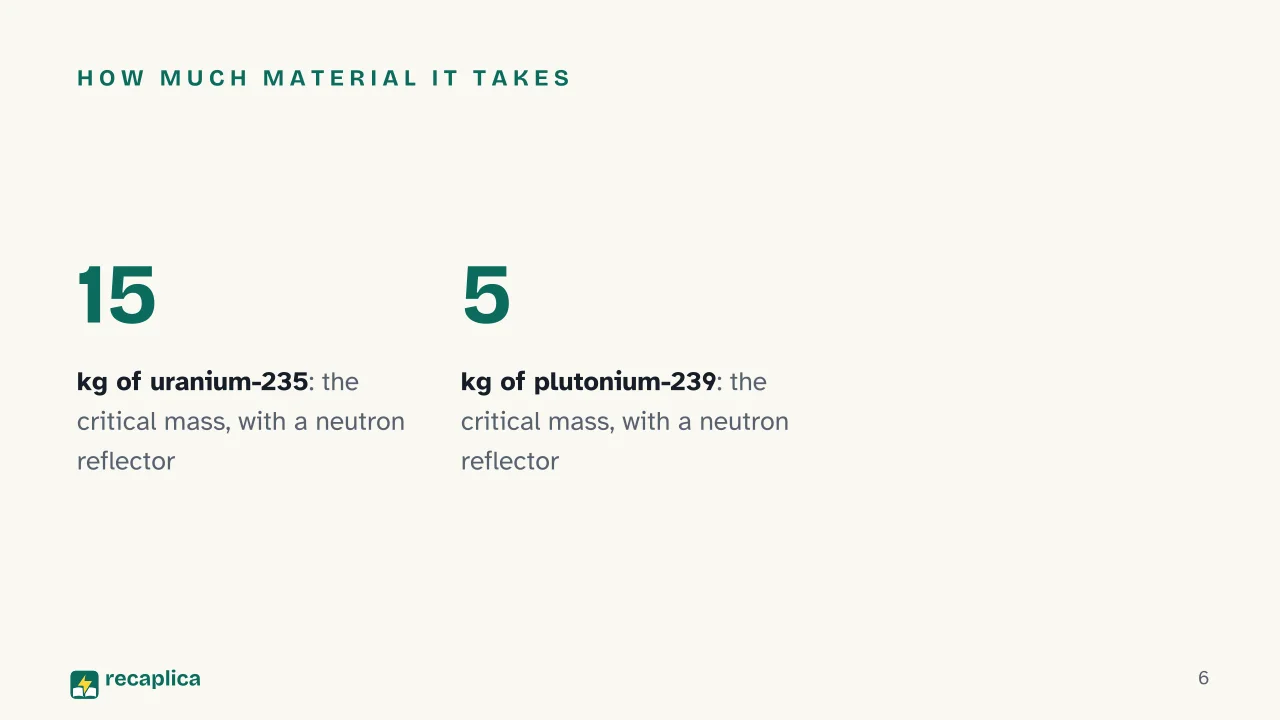  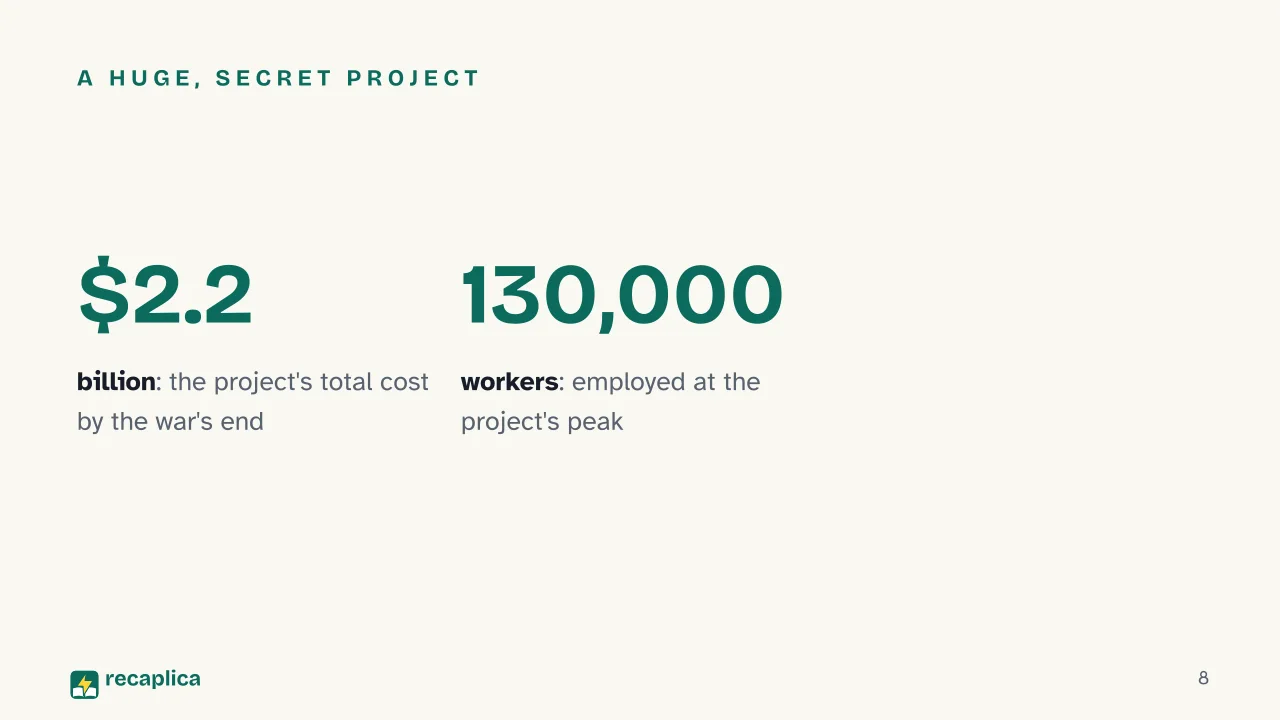 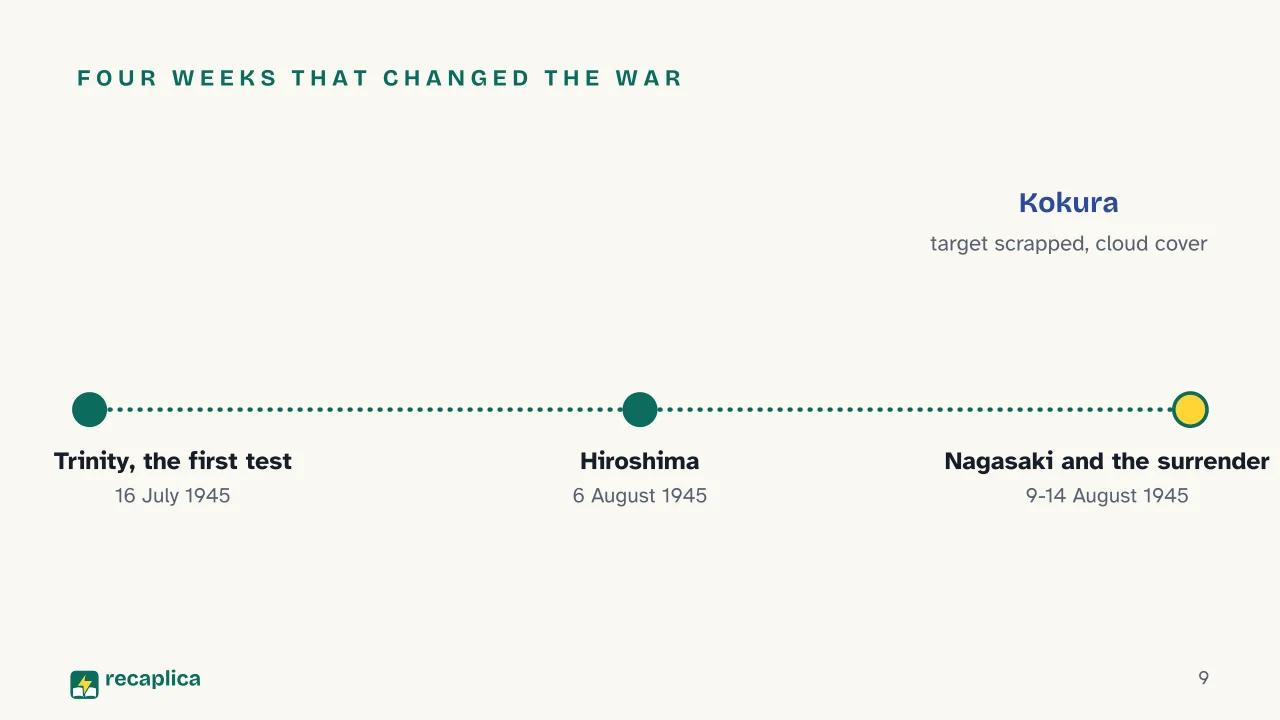  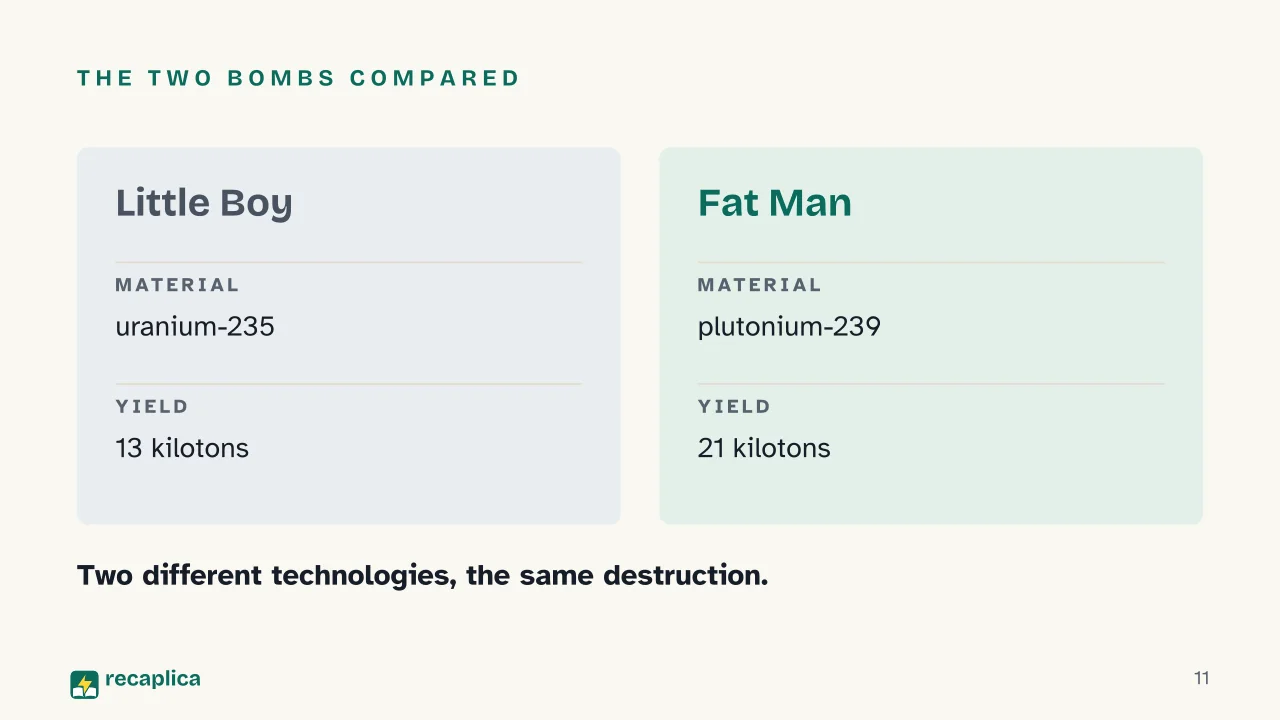 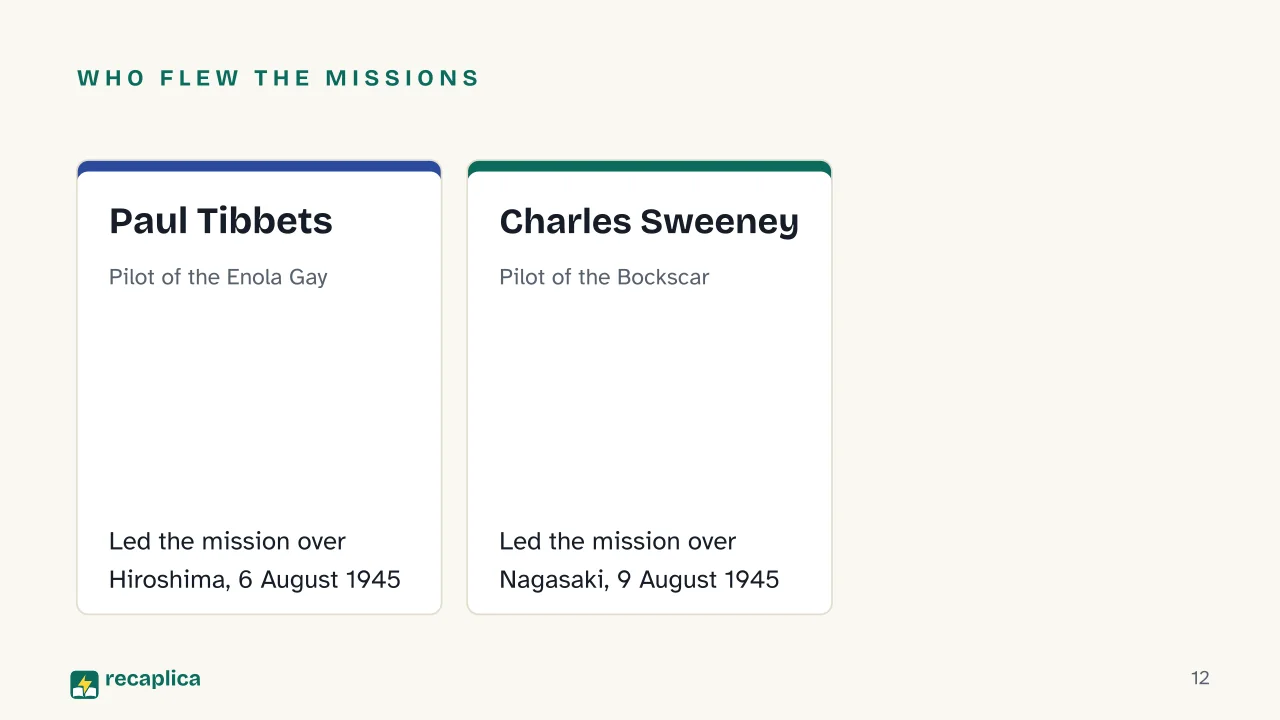 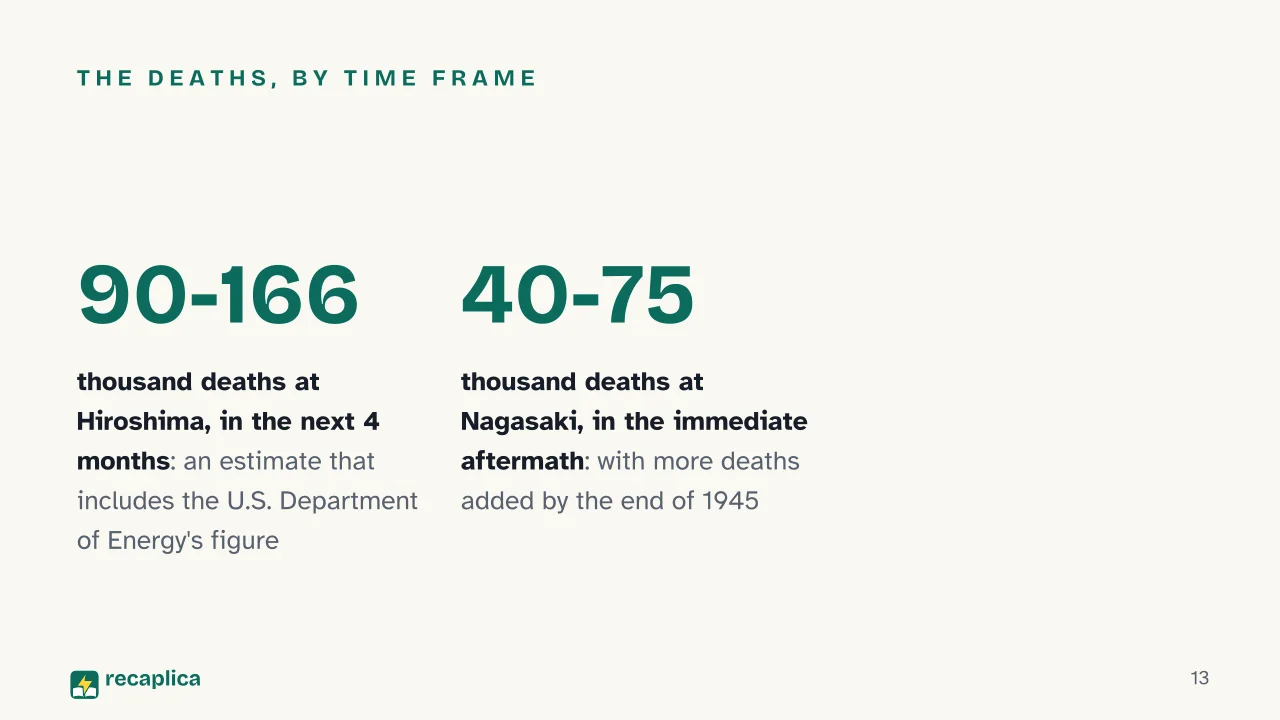 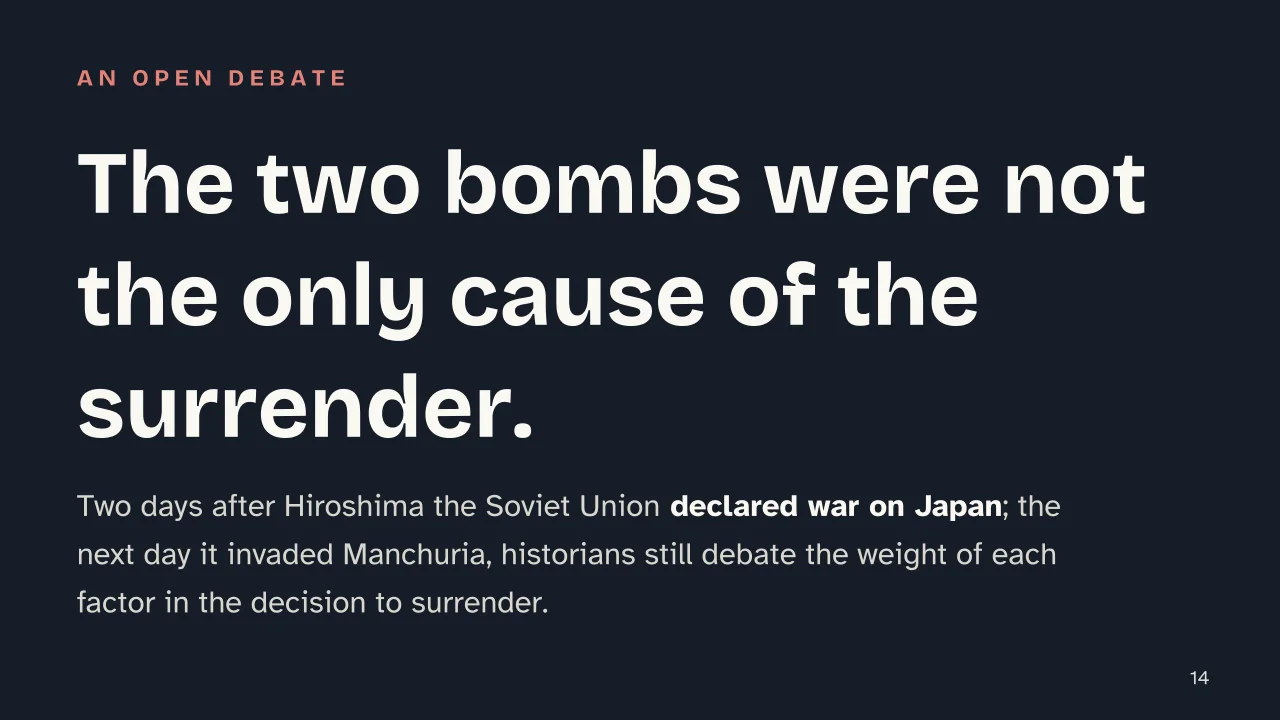  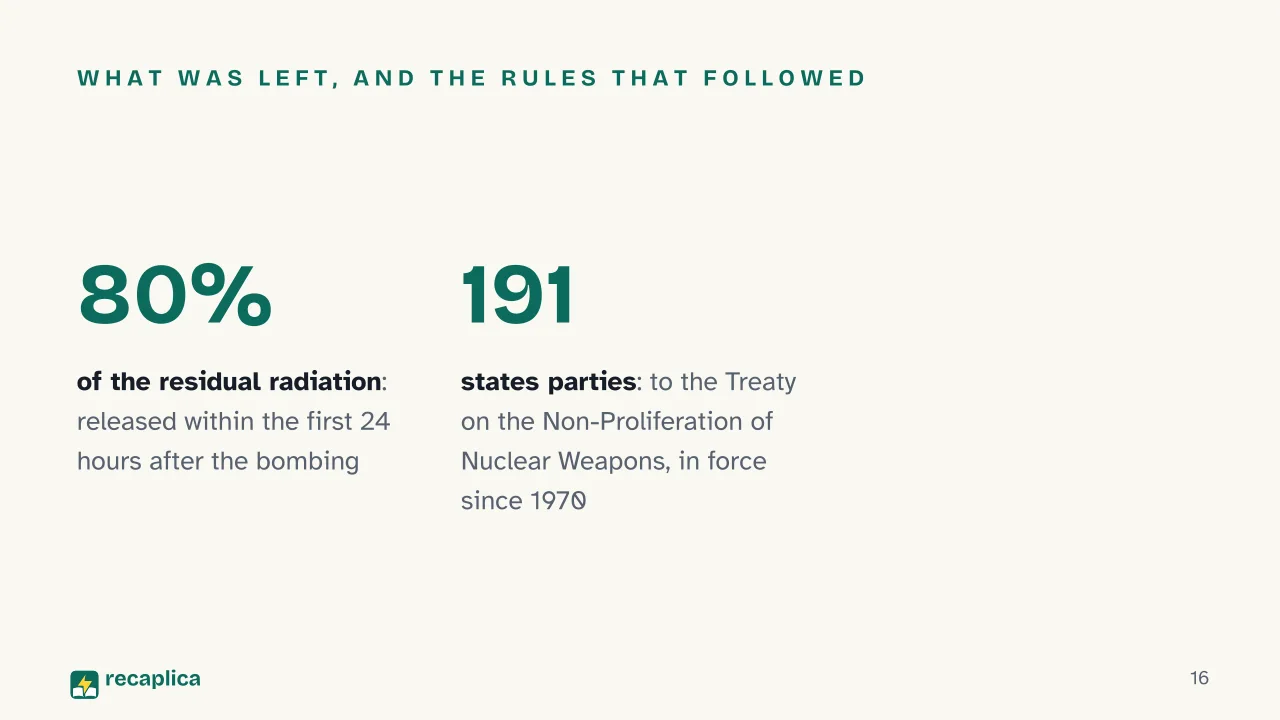 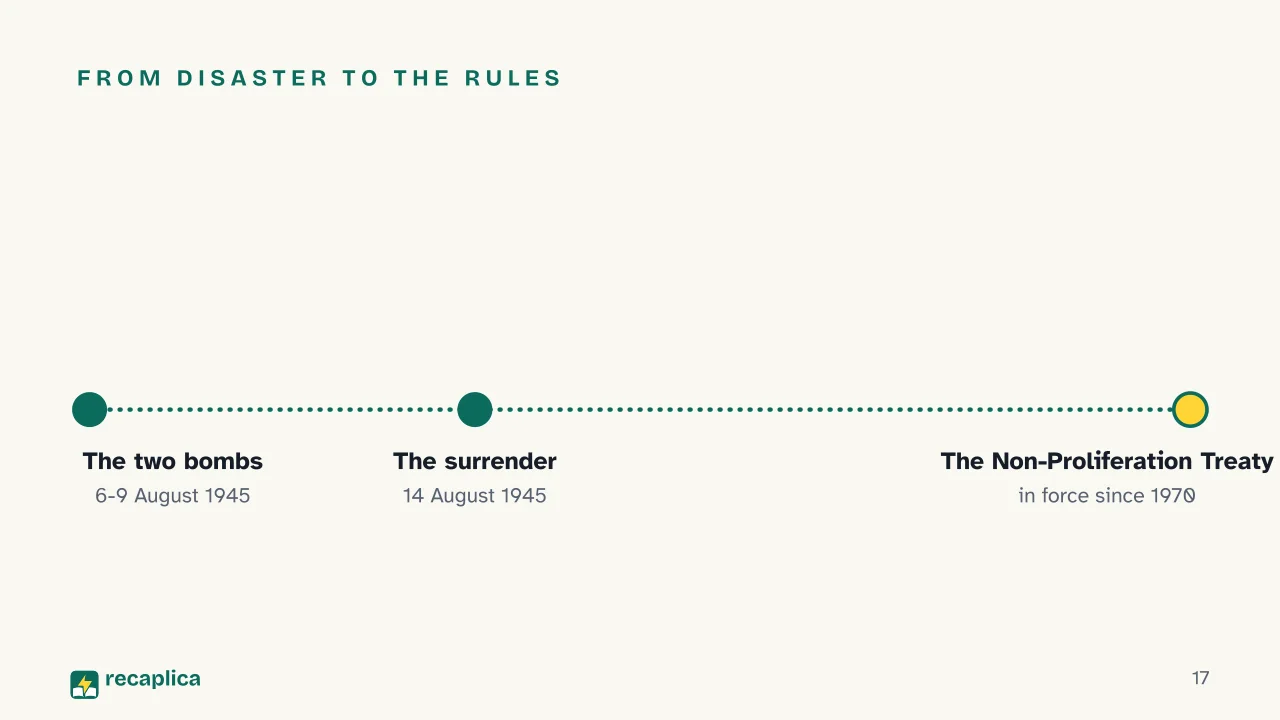 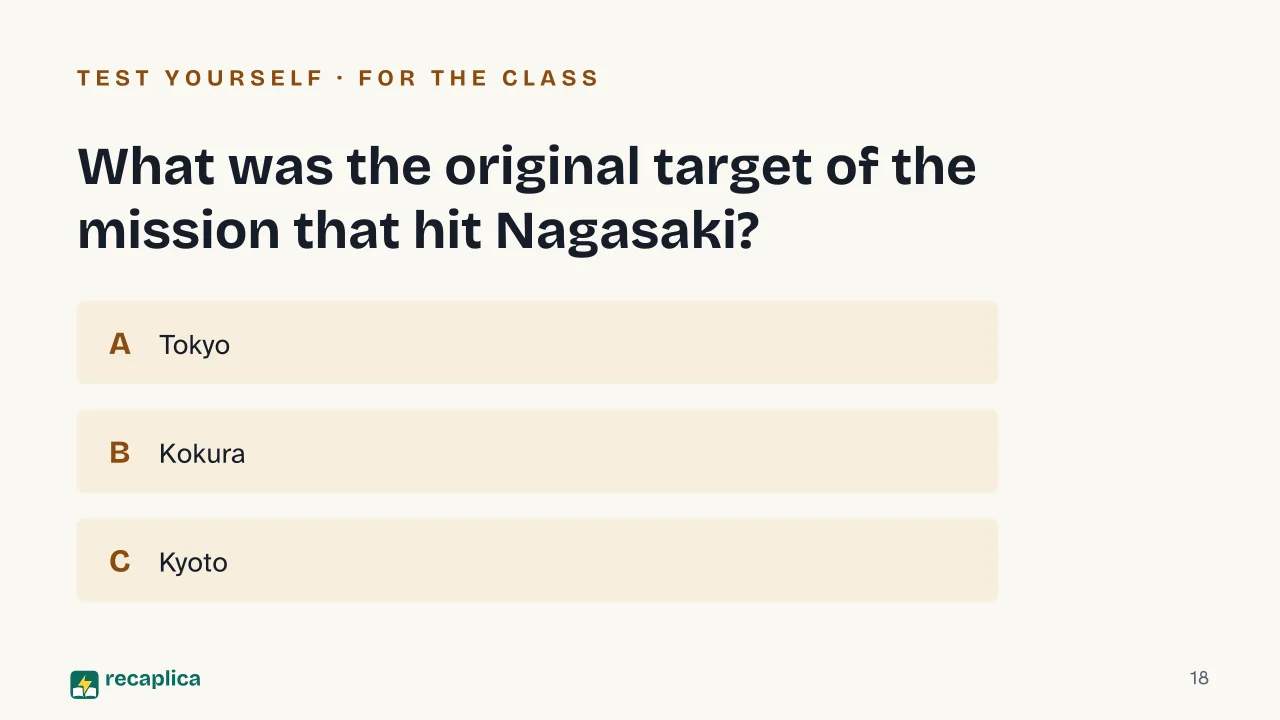  Common myths
Mind mapDrag the background to move around and the nodes to reposition them; use − and + to collapse and expand branches. 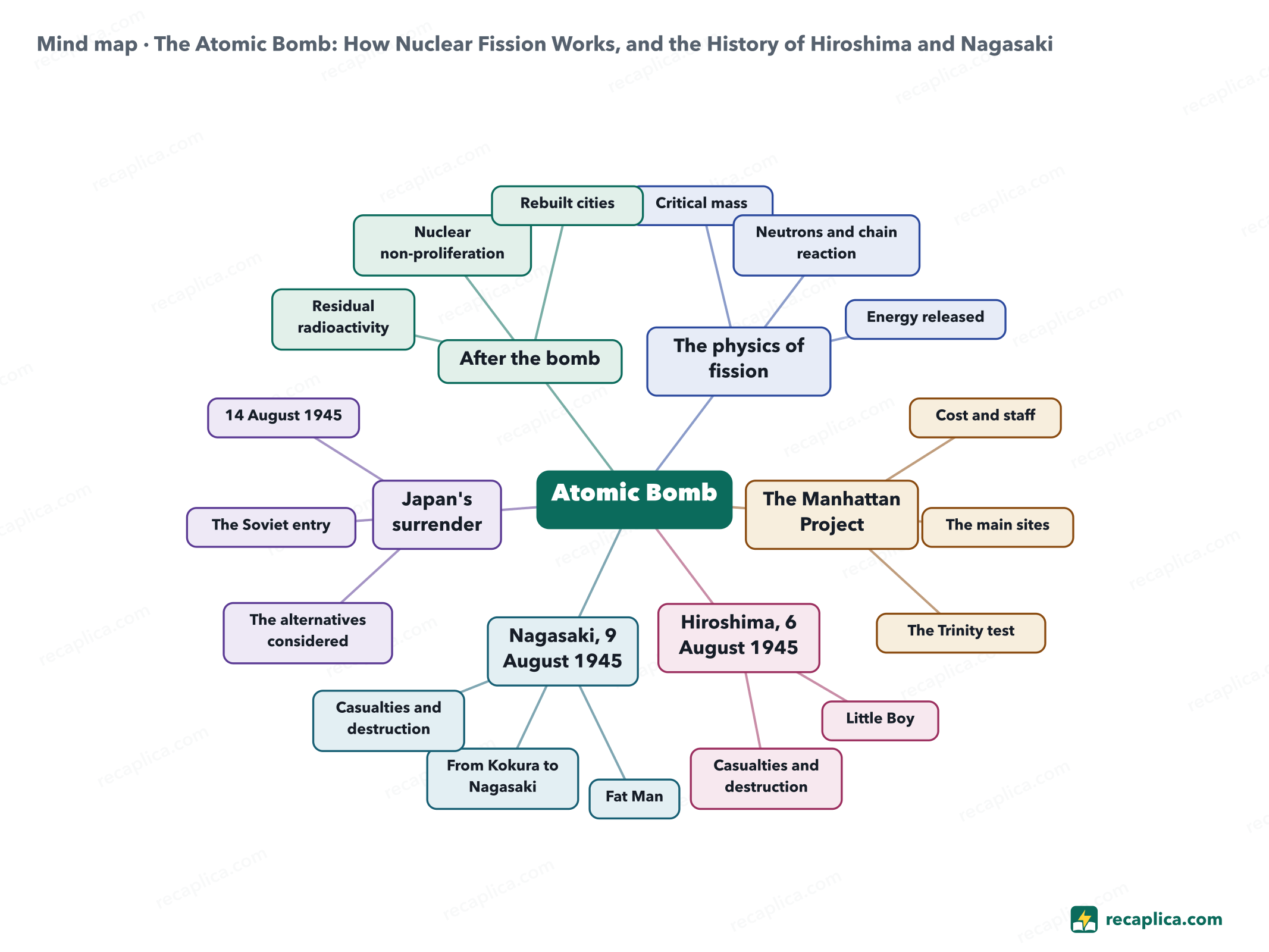
Quiz: test yourselfAnswer the questions to check what you have learned: you get instant feedback and a short explanation. Grade 0/10 0/5
FlashcardsTap the card to flip it and check whether you remember the answer, then move to the next one. 1 / 8 Explain it in your own wordsThe ultimate test: if you can explain it in simple words, you've truly understood it. Write your explanation, then compare it with the Recap. Your explanation is saved only on this device.
Frequently asked questionsHow does a fission atomic bomb work?A fission bomb releases energy by splitting heavy nuclei such as uranium-235 or plutonium-239. When a neutron strikes one of these nuclei, it becomes unstable. The nucleus splits into two fragments and releases on average 2-3 new neutrons, along with an enormous amount of energy, about 200 MeV for every uranium-235 nucleus split. If the mass of material exceeds a critical threshold, those new neutrons trigger further fissions in a chain reaction that sustains itself within a fraction of a second. Why was Nagasaki hit and not Kokura, the original target?The mission of 9 August 1945 was meant to hit Kokura, but the city was covered by clouds and poor visibility ruled out a visual bombing run, as required by the rules of engagement. The Bockscar, piloted by Charles Sweeney, then diverted to Nagasaki, the secondary target, where it dropped Fat Man at 10:58 local time. How many people died at Hiroshima and Nagasaki?Estimates vary depending on the time frame considered. At Hiroshima, an estimated 90,000 to 166,000 people died in the four months after the bombing, while the city of Hiroshima itself estimates 237,000 deaths, direct and indirect (burns, radiation sickness, cancer), over a longer period. At Nagasaki, an estimated 40,000 to 75,000 people died immediately, with about 80,000 total deaths by the end of 1945. Most deaths in both cities were caused by blast injuries and burns, not direct radiation. Did the Soviet Union's entry into the war play a role in Japan's surrender?It is an open historiographical debate. On 8 August 1945 the Soviet Union declared war on Japan, and the following day it invaded Manchuria with over 1.5 million soldiers, ending Japan's hope of a Moscow-mediated negotiated peace. Some historians, such as Tsuyoshi Hasegawa, argue that this factor weighed as much as the atomic bombings, if not more, in Japan's decision to surrender on 14 August 1945. Others assign the greater weight to the bombs. There is no single consensus, and it is a simplification to present the two bombs as the sole cause of the surrender. Are Hiroshima and Nagasaki still radioactive?No. About 80% of the residual radiation was released within the first 24 hours after the bombings, and within a week levels had already dropped to one-millionth of what they were immediately after the explosion. According to the city of Hiroshima, the radiation levels measured in 2026 match the natural background radiation found everywhere on Earth. Both cities were rebuilt and became major industrial centers, and in 2026 Hiroshima has over one million residents and Nagasaki about 440,000. Every Recap goes through an independent review before publication. |