Skip to content
recaplica

    One moment: security check

    Cloudflare wants to make sure you're not a robot. Tick the box below and your search will continue on its own.

    IT
    recaplica Mathematical Limit: Definition and How to Calculate It
    © 2026 Recaplica · recaplica.com — All rights reserved
    Home › Science

    Mathematical Limit: Definition and How to Calculate It

    By Recaplica Newsroom · Updated on October 12, 2026

    What to print

    Page numbers appear when printing with default margins.

    Slides

    Choose a cut

    Flash10 slidesThe essential thread, to present in classFull17 slidesEvery chapter and the deeper detail

    Both come with speaker notes.

    Telegram channel
    recaplica Clear in 30 seconds, yours in 10 minutes.
    In 30 seconds Key points Deep dive Slides Myths Mind map Quiz Flashcards FAQ

    In 30 seconds quick read

    A limit describes what value a function heads toward as its input moves toward a fixed point, written lim(x→a) f(x) = L; the input never has to equal that point itself. Sums, products, and quotients of two functions have limits built from their own limits, with one exception for the quotient when the denominator's limit is zero. Continuity adds one more condition: at that same point, the function must also be defined, and its value must match the limit. Indeterminate forms, such as 0/0, need dedicated techniques — factoring, rationalizing, or L'Hôpital's rule — because basic algebra runs out of answers there. The epsilon-delta definition, formalized in the 19th century by Cauchy and Weierstrass, puts the same idea into language that can be checked step by step.

    Key Points

    • A limit is the value f(x) approaches as x gets closer to a, even though x never has to reach a.
    • The notation lim(x→a) f(x) = L is the same idea written in compact form.
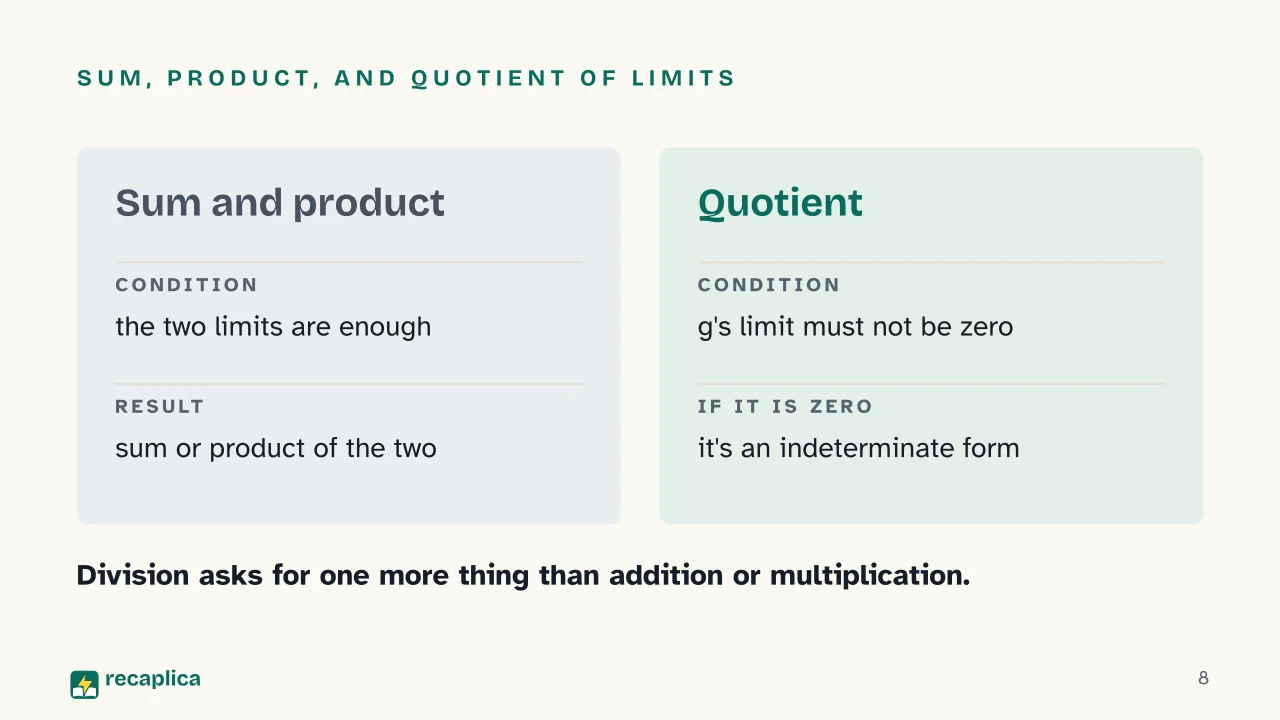
    • Sums, products, and quotients of limits follow their own rules; the quotient additionally requires that the denominator's limit not be zero.
    • A function is continuous at a point when it is defined there, the limit exists, and the two values match.
    • Indeterminate forms — 0/0, infinity minus infinity, zero times infinity, infinity over infinity — need dedicated techniques outside basic algebra.
    • The squeeze theorem finds the limit of a function trapped between two others that head toward the same value.

    Deep Dive

    A function’s output can crowd closer and closer to a single number without ever landing on it — that’s the picture most textbooks reach for first. As x moves toward a fixed point a, the value of f(x) gets closer to a number L.

    OpenStax puts it precisely: L is what f(x) heads toward, as x — always distinct from a — gets closer to that point, with every value f(x) takes ending up closer to that same number L. What trips up students starting out in calculus is exactly that “distinct from a”: the input never has to reach a, nor does f have to be defined there. It’s written lim(x→a) f(x) = L, and that notation shows up unchanged in every calculation that follows.

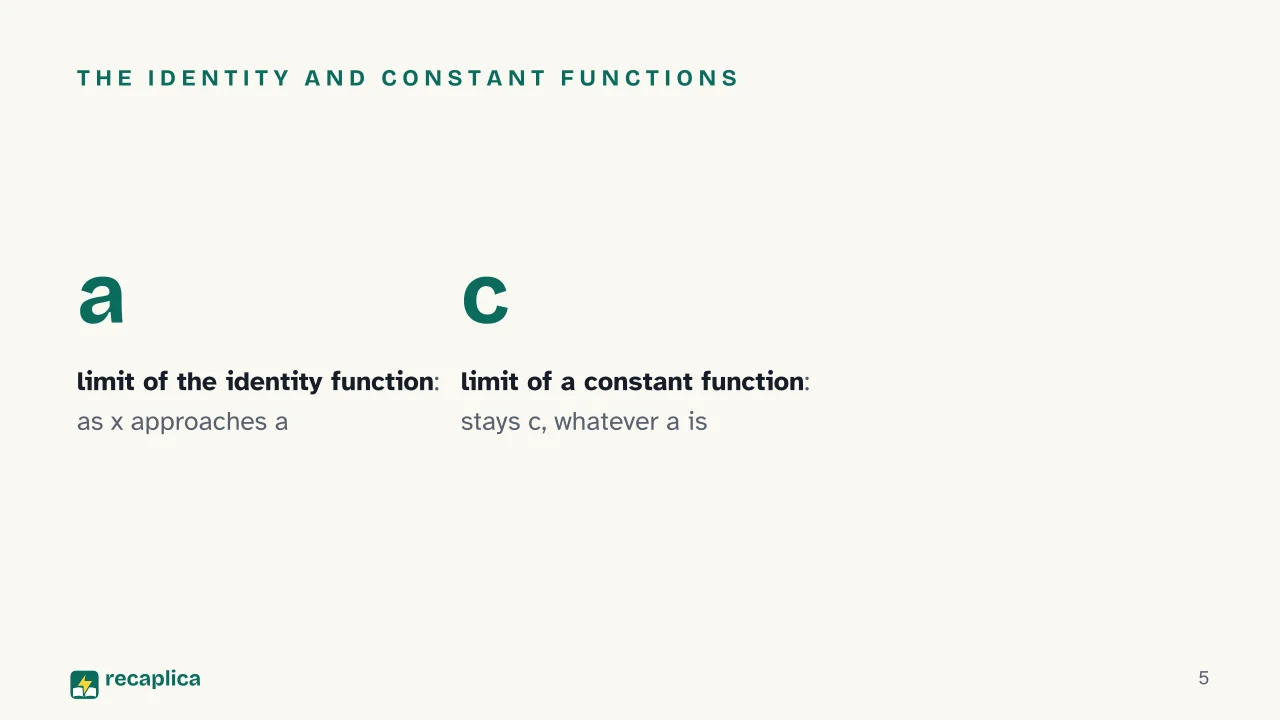
    Two simple cases open the door: the limit of the identity function as x approaches a is a itself, and the limit of a constant function c is always c, no matter which point a the variable is heading toward.

    Limit laws

    Once two functions already have their own limits, the limit of a combination of them can be found without going back to the definition each time.

    OperationRuleCondition
    Sumlim (f+g) = lim f + lim gboth limits exist
    Productlim (f·g) = lim f · lim gboth limits exist
    Quotientlim (f/g) = lim f / lim gthe limit of g is not zero

    The quotient row carries one extra condition the other two don’t: if the denominator’s limit is zero, the rule doesn’t apply. That’s exactly where indeterminate forms show up.

    A two-sided limit follows a similar logic: it exists and equals L precisely when the limit from the left and the limit from the right both exist and also equal L.

    Continuity and limits

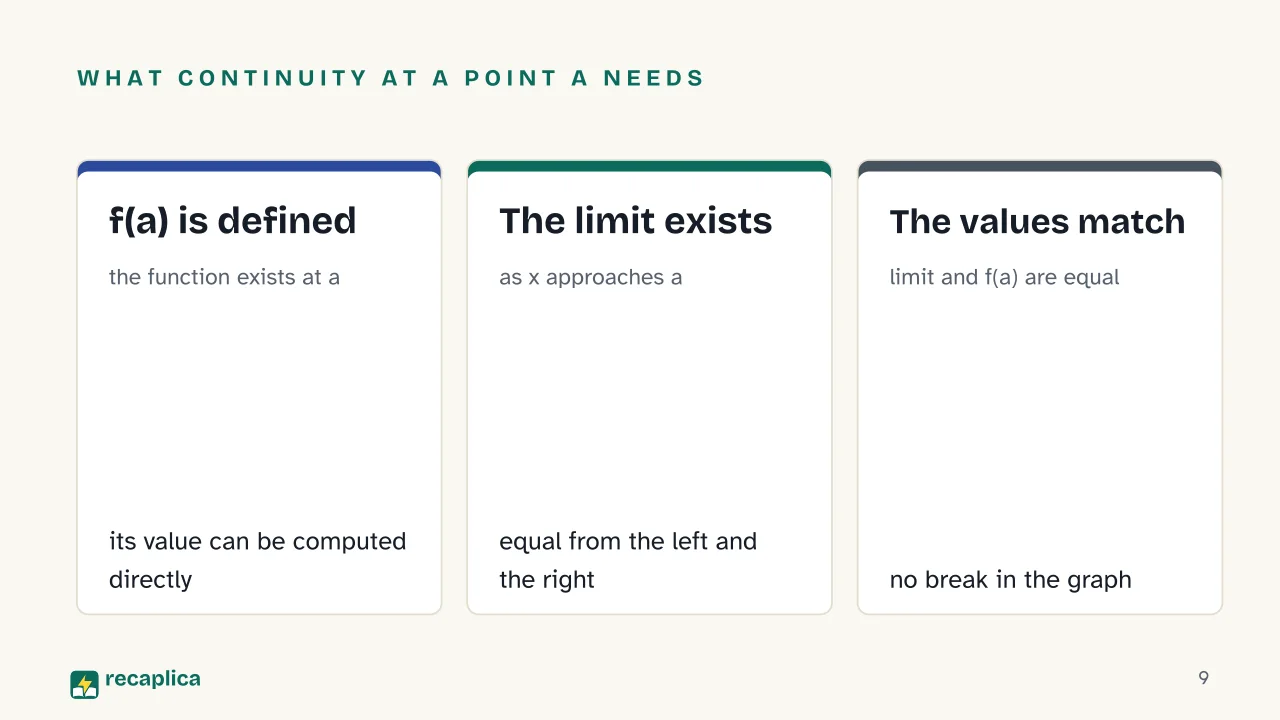
    A function is continuous at a point a only if three conditions hold together: the function is defined at a, the limit as x approaches a exists, and that limit matches the function’s value at a.

    OpenStax turns this into a simple picture: a function is continuous at a point when its graph has no break there — no jump, no hole, no asymptote. It’s a way of reading a graph before doing any calculation at all: trace the curve with your eyes, and if the pencil never has to lift off the page to get past that point, the function is continuous there. Where the graph instead edges toward a certain height without ever touching it — a curve that climbs closer and closer to a horizontal line but stays below it in the drawing — a limit can exist by eye even though it sits outside the value the function actually takes at that point.

    Indeterminate forms

    Four combinations resist basic algebraic rules: (+∞)−(+∞), 0·∞, ∞/∞, 0/0. Each one calls for its own method, case by case.

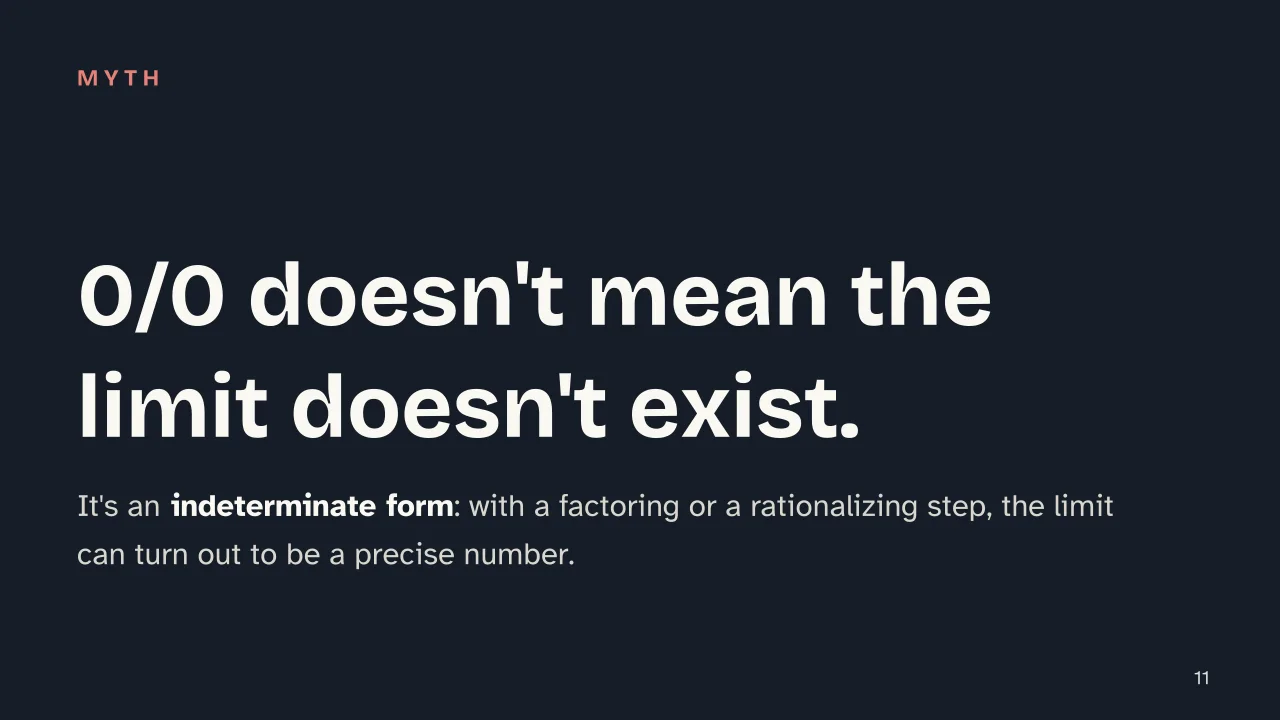
    On the most common one, 0/0, the fix is to rework the expression algebraically — through factoring, multiplying by the conjugate, or simplifying — into an equivalent form that no longer gives 0/0, then evaluate the limit on that new form.

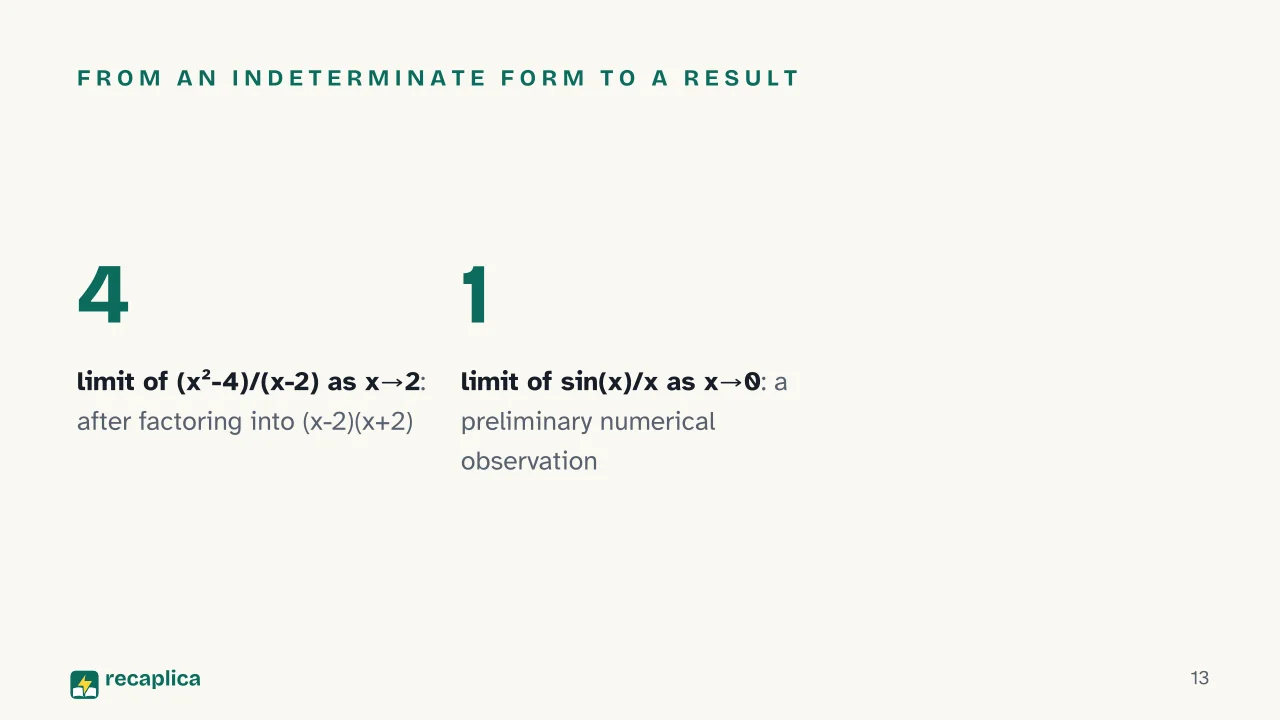
    Practical example: the fraction (x²−4)/(x−2) gives 0/0 if x=2 is plugged in directly. Factoring the numerator gives (x−2)(x+2)/(x−2): for x different from 2 the factor (x−2) cancels, leaving x+2, which equals 4 as x approaches 2.

    For 0/0 and infinity over infinity, L’Hôpital’s rule often settles the limit on its own.

    The squeeze theorem

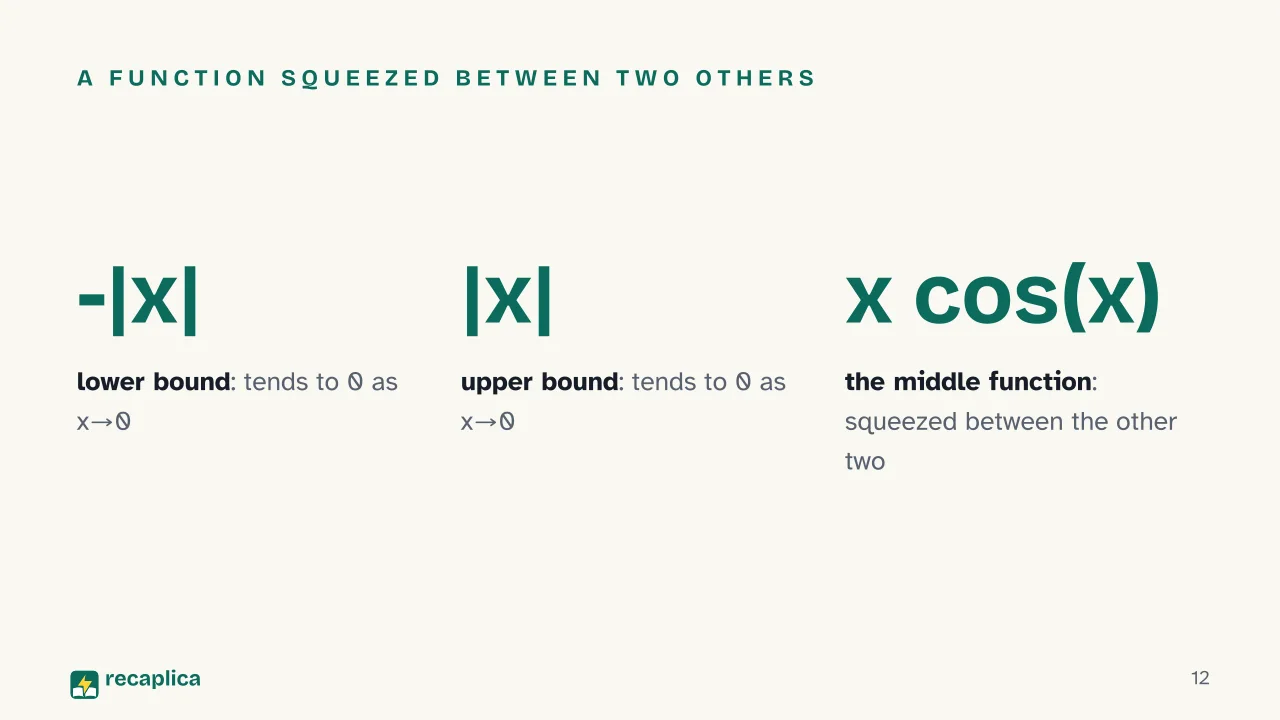
    If a function is squeezed between two others that both tend to the same value L near a point, the middle function tends to L as well.

    Practical example: to evaluate the limit of x·cos(x) as x approaches 0, start from a known fact: cos(x) always stays between -1 and 1. Multiplying by x gives that x·cos(x) stays between -|x| and |x|. Both -|x| and |x| tend to 0 as x tends to 0, and x·cos(x) tends to 0 right along with them.

    A notable limit: sin(x)/x

    This case doesn’t yield to the limit laws covered above, because plugging in x=0 still gives 0/0.

    Practical example: computing sin(x)/x for values of x that get smaller and smaller but stay different from zero, the results keep getting closer to 1. That numerical pattern leads to the conclusion that the limit of sin(x)/x as x approaches 0 is 1 — not a formal proof, but the numerical observation used to introduce the result.

    This limit belongs to a wider family, the indeterminate forms: ready-made formulas for the patterns that keep coming up in calculus exercises.

    From intuition to a formal definition

    Treccani traces the concept back to an informal intuition, one that mathematicians only turned rigorous in the 19th century, mainly through Cauchy and Weierstrass. That’s where the epsilon-delta definition comes from.

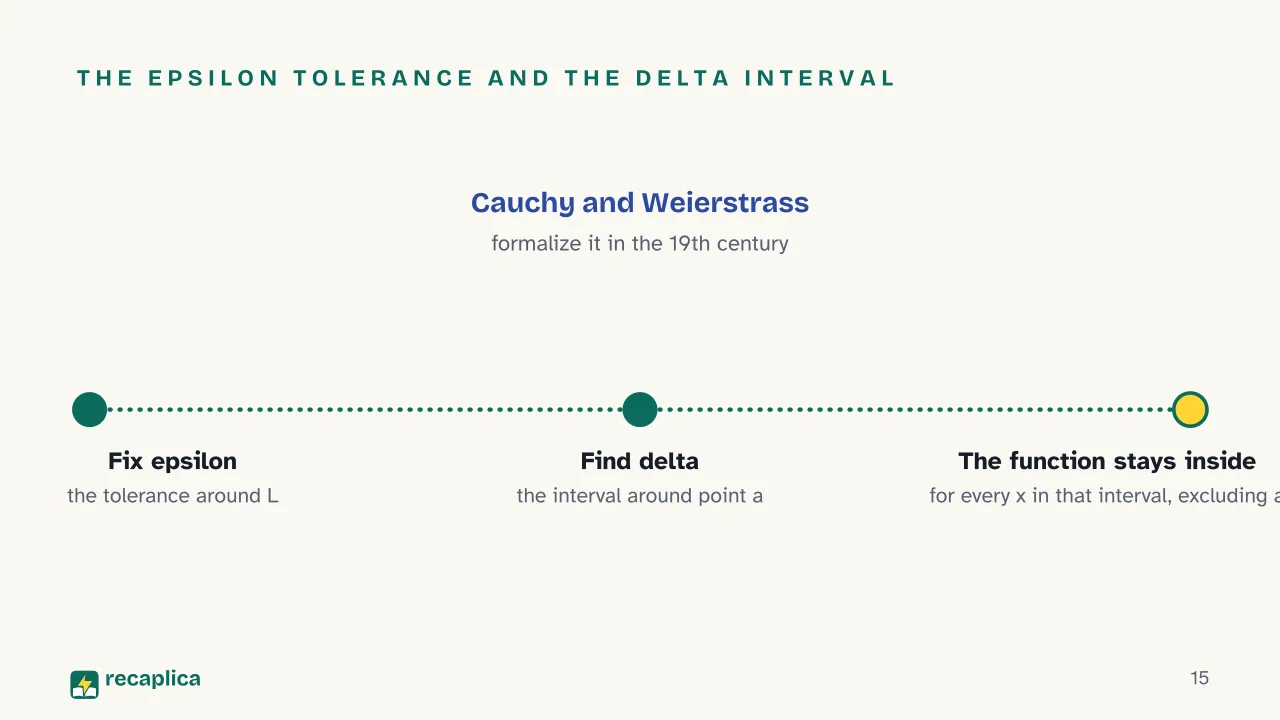
    In rigorous terms, the same idea reads like this: however small a tolerance (epsilon) is set on the allowed distance from the value L, an interval (delta) around the point x₀ can always be found so that, for every x inside that interval but different from x₀, the function stays closer to L than that tolerance. It’s the same closeness described at the start, just written in a language that can be checked step by step instead of just eyeballed.

    Anyone studying limits has usually already met equations and the coordinate plane: both come in handy, since many limit checks involve either an algebraic rewrite of the expression or a reading of the graph. The basics of number sets also help explain why a tolerance epsilon that can be made as small as needed makes sense on the real numbers in particular.

    Slide deck

    Slides ready to download and make your own in PowerPoint or Google Slides, with speaker notes. Pick the Flash cut or the Full one.
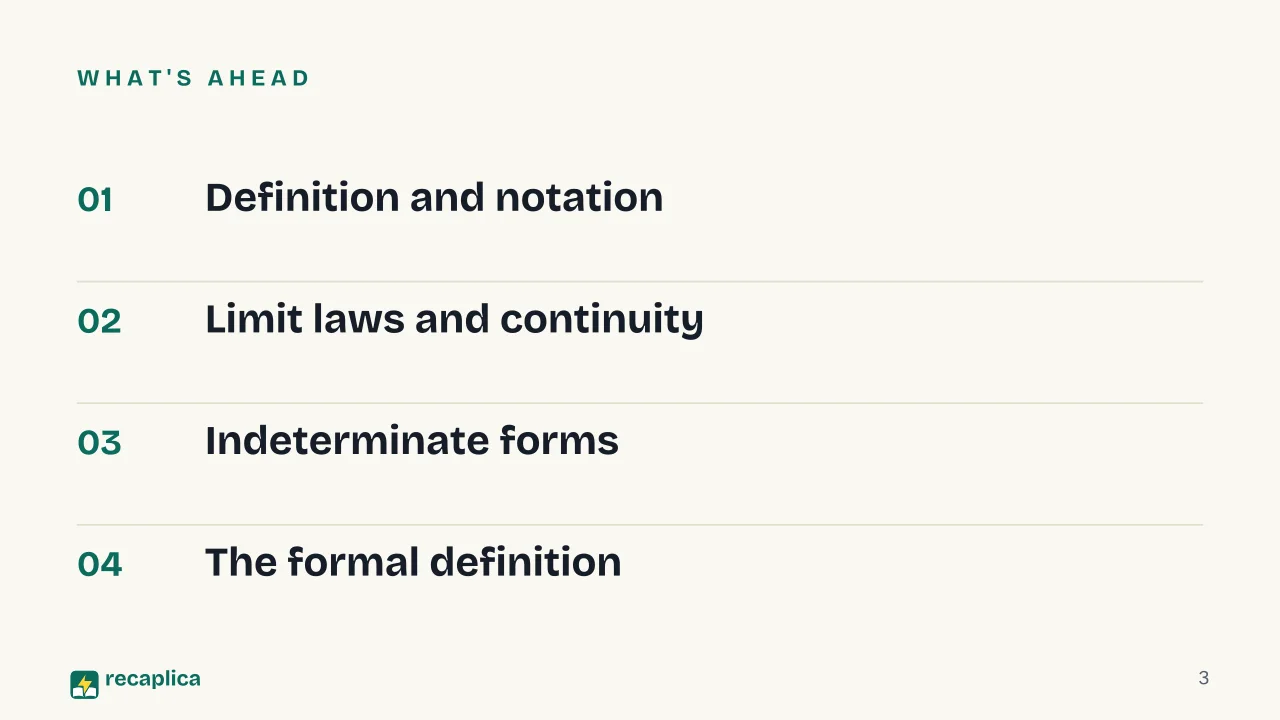
    Slide 1 of the presentation on Mathematical Limit: Mathematical LimitsSlide 2 of the presentation on Mathematical Limit: Without ever touching a, what does f(x) approach?Slide 3 of the presentation on Mathematical Limit: What's aheadSlide 4 of the presentation on Mathematical Limit: Chapter 01: Definition and notationSlide 5 of the presentation on Mathematical Limit: The identity and constant functionsSlide 6 of the presentation on Mathematical Limit: Does the limit always match f(a)?Slide 7 of the presentation on Mathematical Limit: Chapter 02: Limit laws and continuitySlide 8 of the presentation on Mathematical Limit: Sum, product, and quotient of limitsSlide 9 of the presentation on Mathematical Limit: What continuity at a point a needs: f(a) is defined, The limit exists, The values matchSlide 10 of the presentation on Mathematical Limit: Chapter 03: Indeterminate formsSlide 11 of the presentation on Mathematical Limit: 0/0 doesn't mean the limit doesn't exist.Slide 12 of the presentation on Mathematical Limit: A function squeezed between two othersSlide 13 of the presentation on Mathematical Limit: From an indeterminate form to a resultSlide 14 of the presentation on Mathematical Limit: Chapter 04: The formal definitionSlide 15 of the presentation on Mathematical Limit: The epsilon tolerance and the delta intervalSlide 16 of the presentation on Mathematical Limit: Which conditions are needed for a function to be continuous at a point a?Slide 17 of the presentation on Mathematical Limit: Now, time to review
    Flash10 slidesThe essential thread, to present in classFull17 slidesEvery chapter and the deeper detail

    Common myths

    • ✗ Myth A limit is just the value the function happens to take at point a.

      ✓ Reality OpenStax defines the limit through what happens to f(x) while x itself stays different from a, not through f(a) — so a limit can exist even where the function isn't defined, or it can land on a number that differs from f(a) entirely.

    • ✗ Myth Seeing 0/0 means the limit doesn't exist.

      ✓ Reality According to OpenStax, 0/0 only marks an indeterminate form: rewrite the expression through factoring or rationalizing into an equivalent one that no longer gives 0/0, and the limit can turn out to be a precise number after all.

    • ✗ Myth The epsilon-delta definition only exists to make an already-simple idea harder.

      ✓ Reality Treccani notes that the idea of a limit started as an informal intuition and only got a rigorous footing in the 19th century, mainly through Cauchy and Weierstrass: epsilon and delta translate that same intuitive closeness into language anyone can check with a calculation, without changing the underlying idea.

    Mind map

    Drag the background to move around and the nodes to reposition them; use − and + to collapse and expand branches.
    Customize
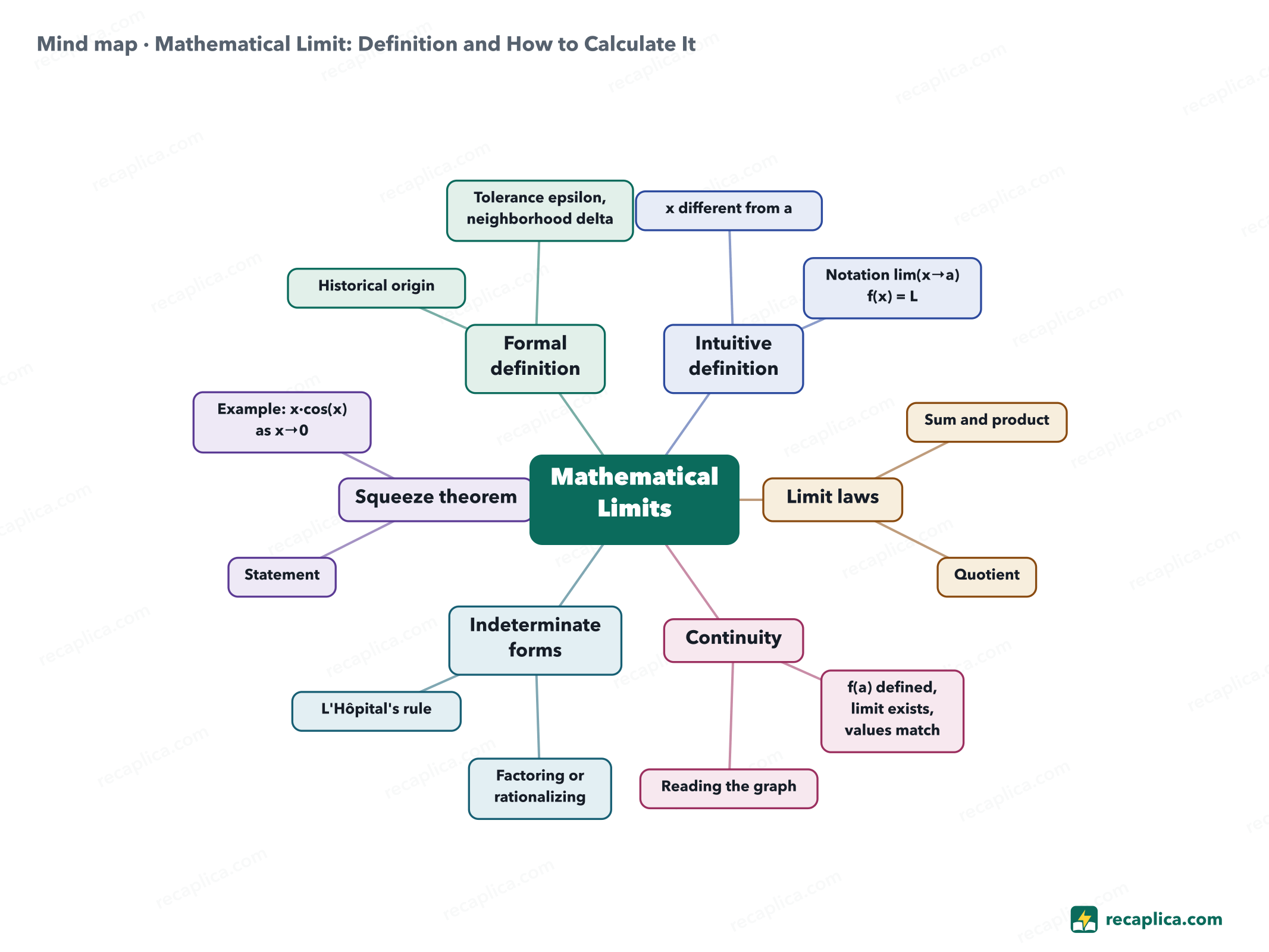
    Mind map: Mathematical Limit: Definition and How to Calculate It
    • Mathematical Limits
      • Intuitive definition f(x) approaches L as x approaches a
        • x different from a the limit never requires x to reach a
        • Notation lim(x→a) f(x) = L
      • Limit laws hold when the individual limits exist
        • Sum and product lim(f+g), lim(f·g)
        • Quotient holds only when the limit of g is not zero
      • Continuity three conditions together
        • f(a) defined, limit exists, values match
        • Reading the graph no break in the curve
      • Indeterminate forms (+∞)−(+∞), 0·∞, ∞/∞, 0/0
        • Factoring or rationalizing to turn 0/0 into a form that can be evaluated
        • L'Hôpital's rule
      • Squeeze theorem the middle function heads toward the same value
        • Statement f trapped between two functions approaching L
        • Example: x·cos(x) as x→0
      • Formal definition epsilon and delta
        • Historical origin formalized in the 19th century by Cauchy and Weierstrass
        • Tolerance epsilon, neighborhood delta

    Quiz: test yourself

    Answer the questions to check what you have learned: you get instant feedback and a short explanation.

    Grade 0/10 0/5
    1 According to the intuitive definition, what is the limit of f(x) as x approaches a?

    This is exactly OpenStax's definition: the function approaches a value L without x ever having to touch a.

    2 The limit of a quotient of two functions equals the quotient of their limits...

    When the limit of g is zero, the quotient falls into an indeterminate form and the simple rule no longer applies.

    3 A function can have a limit at a point even if it isn't defined there. True or false?

    The definition of a limit concerns the values of x near a, excluding a itself: the function can be undefined exactly at a.

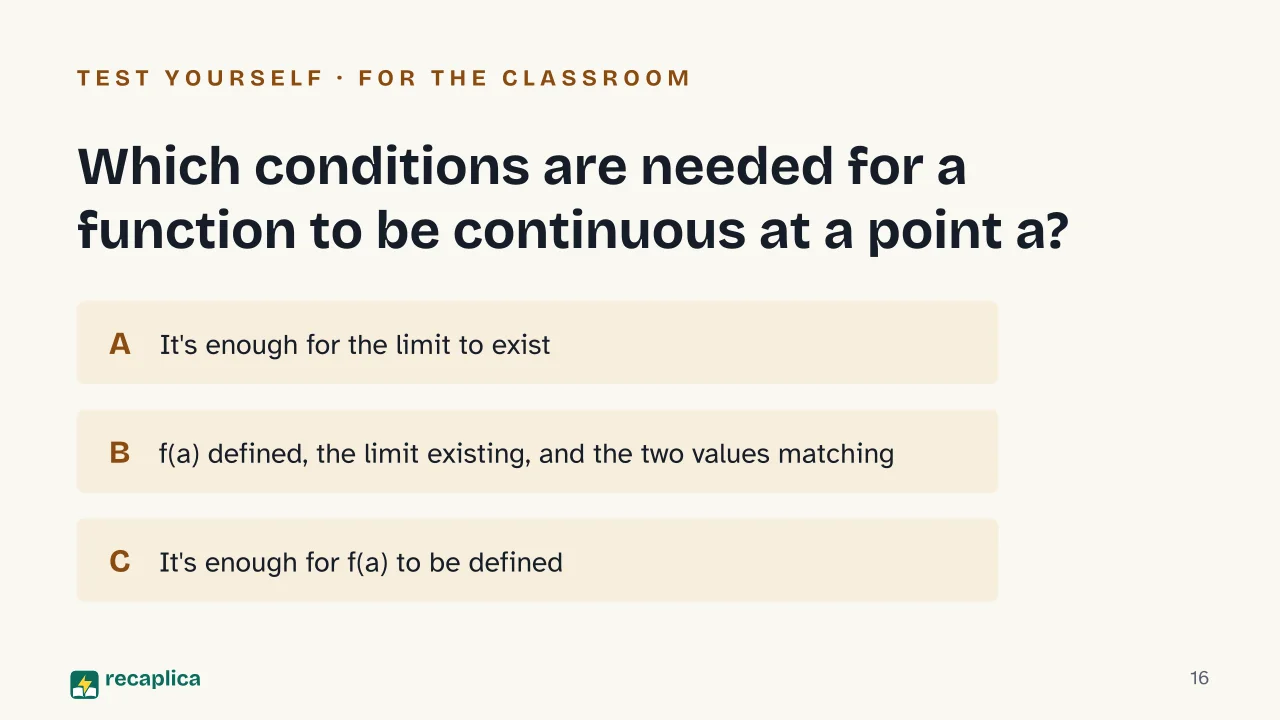
    4 Which conditions are needed for a function to be continuous at a point a?

    OpenStax lists all three conditions together: miss even one, and the function isn't continuous at that point.

    5 In the squeeze theorem applied to x·cos(x) as x approaches 0, why is the limit 0?

    The middle function is trapped between two functions that both tend to 0, so it tends to 0 as well.

    Answers: 1-A · 2-B · 3-A · 4-B · 5-A

    Flashcards

    Tap the card to flip it and check whether you remember the answer, then move to the next one.

    1 / 8

    Explain it in your own words

    The ultimate test: if you can explain it in simple words, you've truly understood it. Write your explanation, then compare it with the Recap.

    Your explanation is saved only on this device.

    A limit describes what value a function heads toward as its input moves toward a fixed point, written lim(x→a) f(x) = L; the input never has to equal that point itself. Sums, products, and quotients of two functions have limits built from their own limits, with one exception for the quotient when the denominator's limit is zero. Continuity adds one more condition: at that same point, the function must also be defined, and its value must match the limit. Indeterminate forms, such as 0/0, need dedicated techniques — factoring, rationalizing, or L'Hôpital's rule — because basic algebra runs out of answers there. The epsilon-delta definition, formalized in the 19th century by Cauchy and Weierstrass, puts the same idea into language that can be checked step by step.

    Frequently asked questions

    What is a mathematical limit, in simple terms?

    It's the value a function approaches as its input gets closer to a certain point, without ever having to reach that point exactly.

    How do you calculate a limit?

    For sums, products, and quotients of functions, the relevant algebraic rule applies whenever the limits involved exist. If the result is an indeterminate form like 0/0, rewrite the expression through factoring or rationalizing, or apply L'Hôpital's rule.

    What's the difference between a limit and continuity?

    The limit is the value a function approaches near a point. Continuity is when that value also matches the function's actual value at that same point.

    What does the epsilon-delta definition mean?

    It means that however small a margin of error on the function's value you demand (epsilon), you can always find an interval around the point (delta) inside which the function stays within that margin, excluding the point itself.

    What is an indeterminate form?

    It's a combination of limits, such as 0/0 or infinity minus infinity, whose result can't be settled with basic algebraic rules: it needs a dedicated technique, case by case.

    Sources

    • OpenStax, Calculus Volume 1 — 2.2 The Limit of a Function
    • OpenStax, Calculus Volume 1 — 2.3 The Limit Laws / 2.4 Continuity
    • Treccani, Enciclopedia della Matematica — voce Limite
    • Wolfram MathWorld — voce Limit

    Every Recap goes through an independent review before publication.

    Every evening, the day's new Recaps on our Telegram channel. Join the channel →

    Keep learning

    • Science Correlation: What It Means and How to Read the Coefficient Correlation measures how closely two variables move together, and the most common way to put a number on it is the correlation coefficient, which runs from -1 to +1. A value near +1 means the two variables rise together, near -1 means one rises while the other falls, and near 0 means no linear relationship stands out. The coefficient only captures the strength of a straight-line relationship, and a single unusual data point can push it up or down by a lot. Even when it's strong, a correlation between two variables never shows that one causes the other. Read the Recap →
    • Science Light Refraction: What It Is, the Laws Behind It, and Examples A surface that separates two transparent materials sends some light back, reflecting it, and lets the rest through while bending it toward a new direction. The law of reflection keeps the incoming and outgoing angles equal, both measured from the normal to the surface. Snell's law governs refraction instead, linking the index of each material to how much the ray tilts before and after it crosses over. These two laws alone explain mirrors, lenses, prisms and everyday sights such as a pencil that appears to snap inside a glass of water. Read the Recap →
    • Science Total Internal Reflection and the Critical Angle: Definition and Formula Total internal reflection is what happens when a light ray stops being able to leave a transparent medium and gets sent back inside it completely. It takes place past a specific angle of incidence, called the critical angle, calculated with Snell's law by comparing the refractive indices of the two materials involved. It only happens under one precise condition: the ray must be traveling from an optically denser medium into a less dense one, such as from water into air or from glass into air. Optical fibers and, in part, the sparkle of diamonds rely on this same principle. Read the Recap →

    recaplica

    Clear in 30 seconds, yours in 10 minutes.

    Recaps Mind maps Request a Recap Telegram channel Mind map maker Our method About Privacy & cookies Legal notes & terms of use

    © 2026 Recaplica · A project by Curi S.r.l. — VAT IT05472000750

    Statistics, only if you say so

    To learn which Recaps help most we would use Google Analytics, with aggregate, anonymous data. It starts only with your OK, and you can change your mind anytime. Privacy policy