|
recaplica
Integrals: Definition and How They're Calculated |
| © 2026 Recaplica · recaplica.com — All rights reserved |
Integrals: Definition and How They're CalculatedWhat to print Page numbers appear when printing with default margins. SlidesChoose a cut Flash10 slidesThe essential thread, to present in classFull16 slidesEvery chapter and the deeper detailBoth come with speaker notes. In 30 seconds quick readAn integral, in its most common use, measures the area enclosed between the graph of a function and the horizontal axis, over a chosen interval. To find it, the area is first approximated with a sum of thin rectangles, a Riemann sum; as the rectangles get thinner, that sum approaches a single finite value, the definite integral. A fundamental theorem then connects this number to the antiderivative of the function, the same one found by reversing the process of differentiation, so many areas can be calculated without ever taking a limit. The symbol ∫ still used today was first written by Leibniz in 1675. Key Points
Deep DivePicture a curve drawn above a horizontal axis: how much area sits between that curve and the axis, from one point a to another point b? This geometric question is where the definite integral comes from, historically. According to Treccani, the definite integral corresponds exactly to the area of the region between a function’s graph and the x-axis, on an interval [a, b] — one of the central ideas of calculus. The method behind it is old. Approximating an area with rectangles was already common practice, Fermat among others, long before integral calculus became a formal discipline. From rectangles to a limitThe practical idea: build n rectangles on the interval, each with its own base, and add up their total area. Wolfram MathWorld calls this sum a Riemann sum — the Riemann integral is the simplest definition of an integral, the one usually met in elementary calculus. The height of each rectangle is the value of the function at a point inside its little interval. This is where limits come in: as the rectangles get thinner — their width, often written δ, approaching zero — the sum of their areas approaches a single finite value. That limit is exactly what the definite integral is.
The fundamental theorem: from antiderivative to derivativeTaking the limit of a sum every single time would be impractical. The fundamental theorem of calculus bridges the definite integral and the indefinite integral — the antiderivative of the function — making it possible to find many areas through an antiderivative, with no limit involved. For continuous functions, Treccani notes, integrating and differentiating undo each other: finding an antiderivative means retracing, backward, the path that leads from a function to its derivative. The formula that gives the definite integral as F(b) minus F(a), with F standing for one of its antiderivatives, is known as the Newton-Leibniz formula; the same theorem also goes by the name Torricelli-Barrow theorem. On the coordinate plane, this turns into a familiar picture: the area under the curve, evaluated at the two ends of the interval, gives the same answer as the limit of the sums. The notation that won outThe symbol ∫ still in use today has a precise birthdate. MacTutor reports that on 29 October 1675, Gottfried Wilhelm Leibniz wrote it for the first time, in an unpublished manuscript titled Analyseos tetragonisticae pars secunda, to denote integration. Two weeks later, on 11 November 1675, Leibniz placed the symbol dx next to the integral sign, in the form still familiar today. Isaac Newton arrived later, by a different route. In his 1704 work Quadratura curvarum, he used a vertical bar above the variable x to mark its integral. Historian Florian Cajori, cited by MacTutor, considered that notation flawed: the bar over the x could be confused with a prime, and the box drawn around the term was difficult to typeset. For that reason, according to Cajori, Newton’s notation never caught on, not even in England — it is Leibniz’s symbol that remained in universal use. Slide deckSlides ready to download and make your own in PowerPoint or Google Slides, with speaker notes. Pick the Flash cut or the Full one.     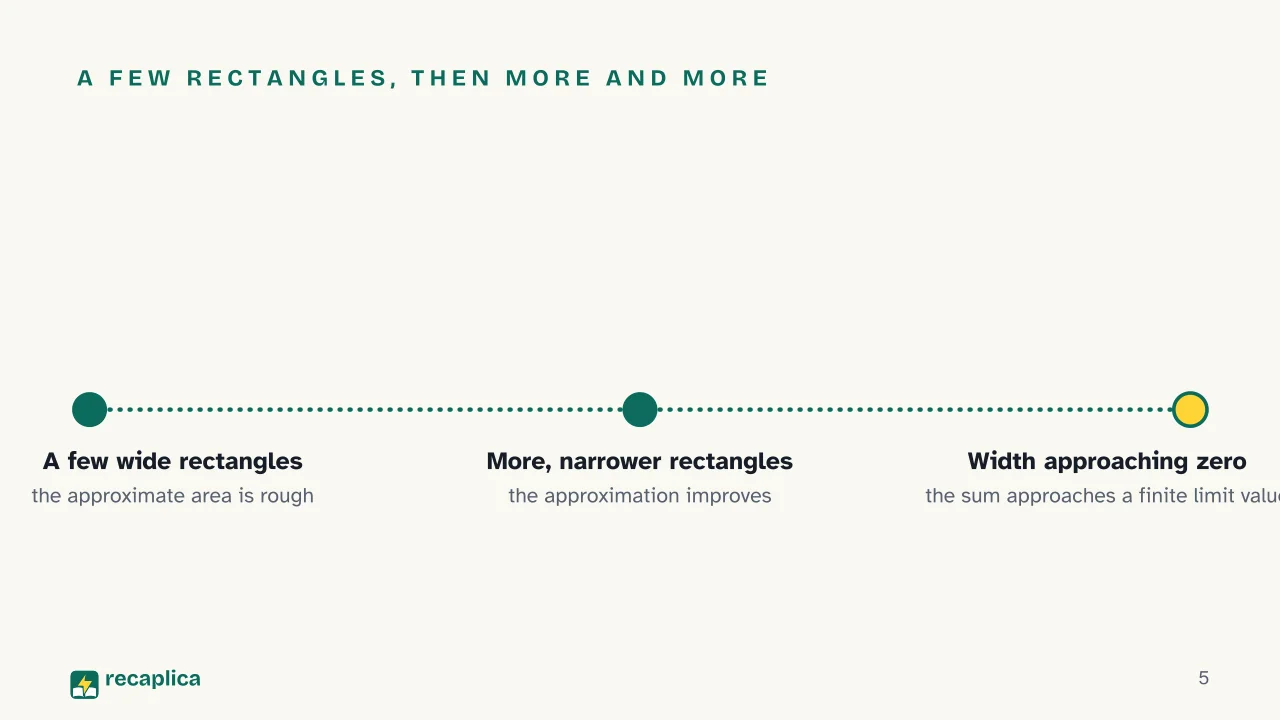 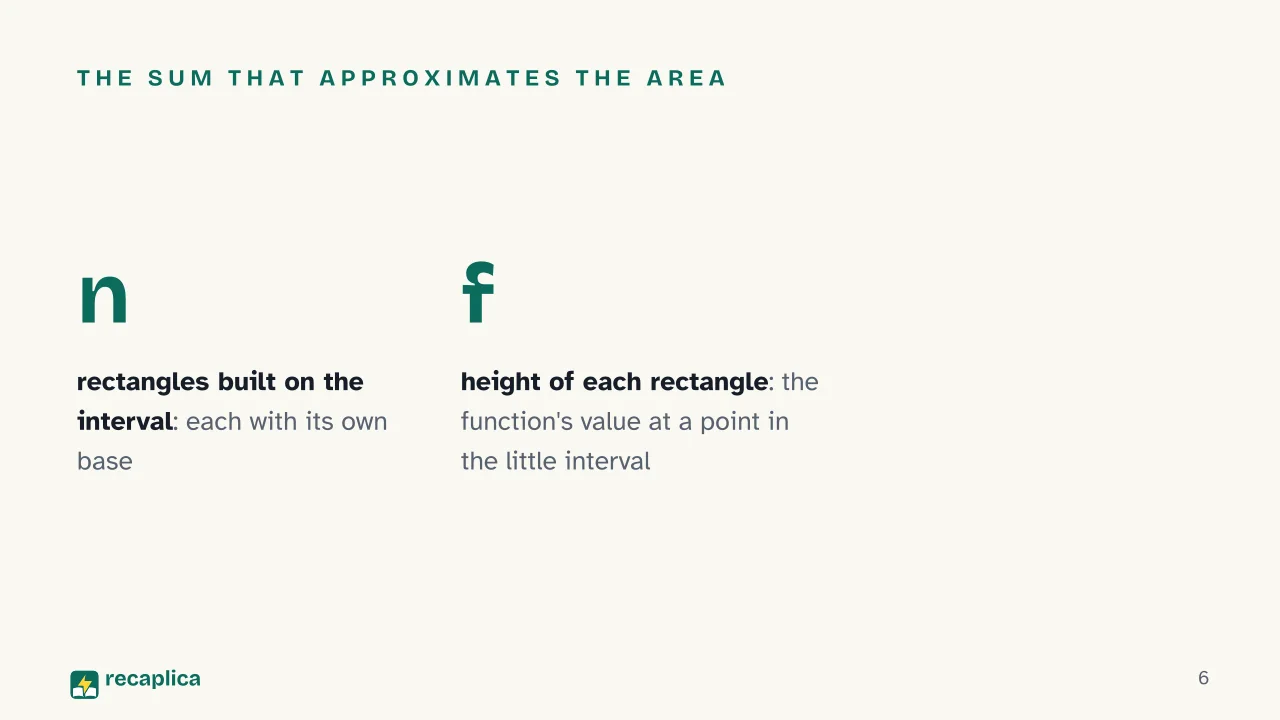   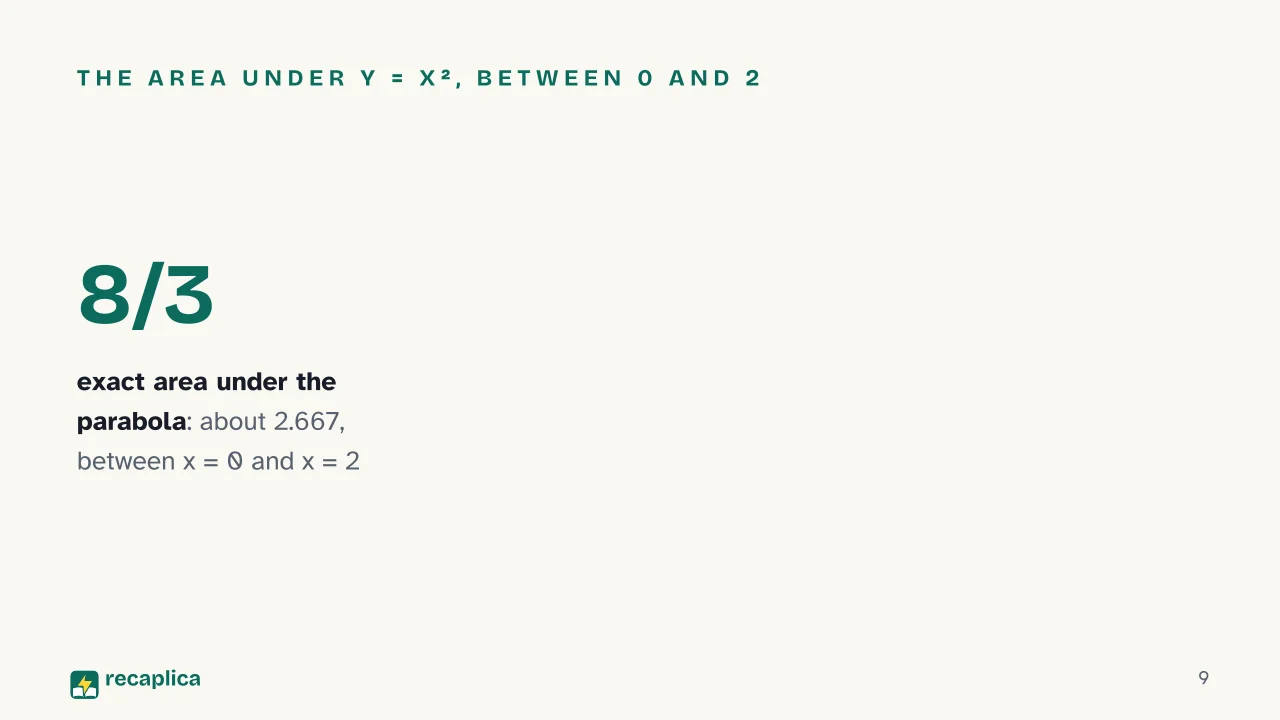   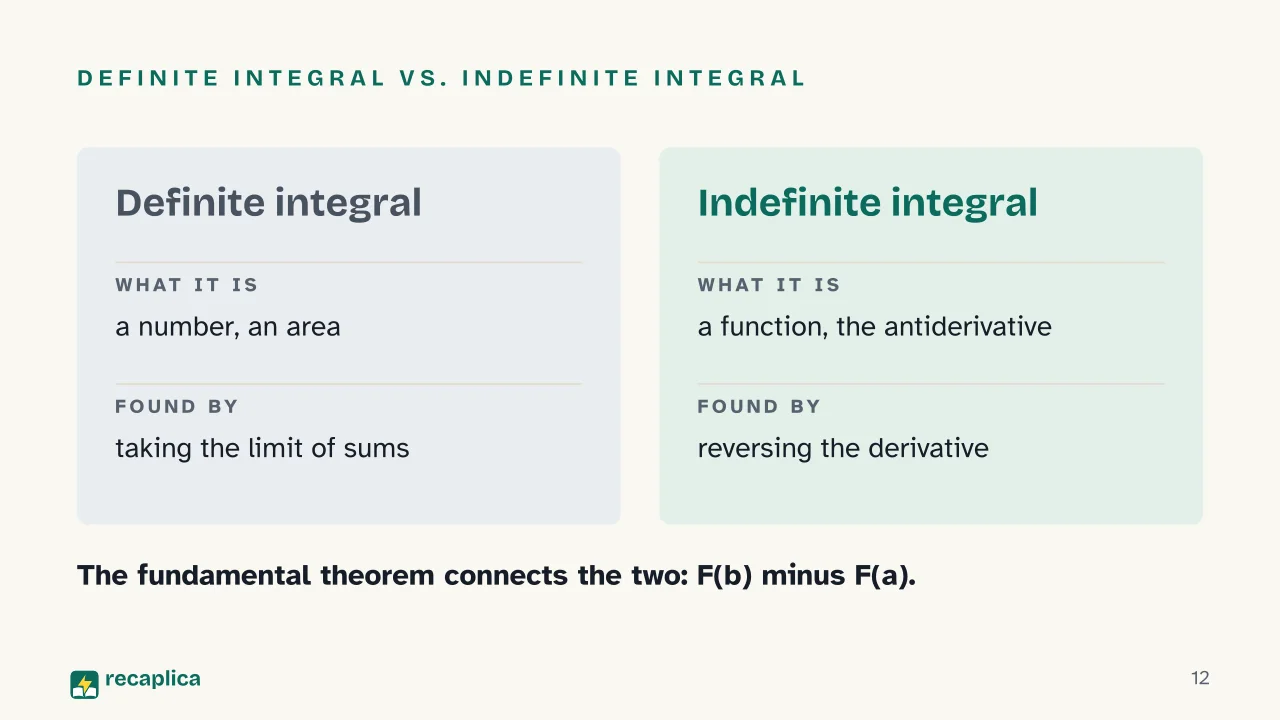  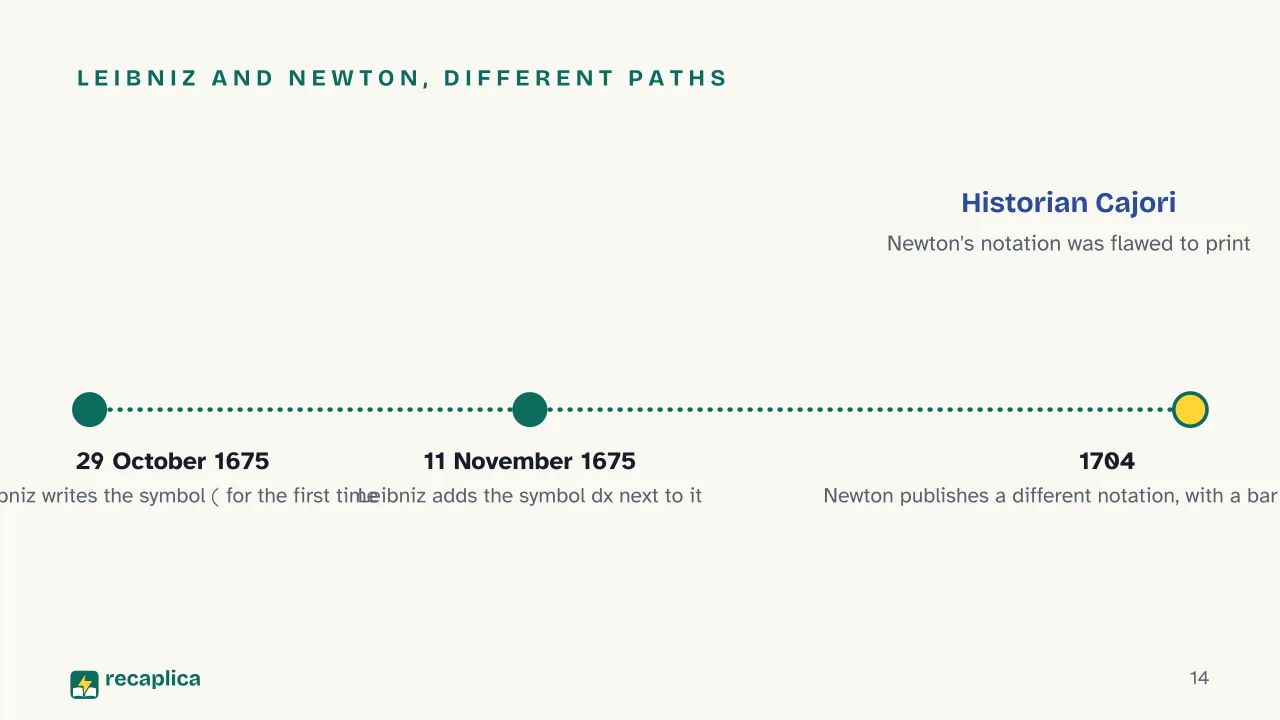   Common myths
Mind mapDrag the background to move around and the nodes to reposition them; use − and + to collapse and expand branches. 
Quiz: test yourselfAnswer the questions to check what you have learned: you get instant feedback and a short explanation. Grade 0/10 0/5
FlashcardsTap the card to flip it and check whether you remember the answer, then move to the next one. 1 / 8 Explain it in your own wordsThe ultimate test: if you can explain it in simple words, you've truly understood it. Write your explanation, then compare it with the Recap. Your explanation is saved only on this device.
Frequently asked questionsWhat is an integral, in simple terms?In its most common use, it is the region's area bounded by a function's curve and the horizontal axis, over a chosen interval; more generally, it is the limit of a sum of infinitely small pieces. How do you calculate the area under a curve with integrals?The area is approximated by adding up the areas of many thin rectangles, a Riemann sum; as the rectangles become infinitely thin, that sum approaches the definite integral. In practice, an antiderivative of the function is found and the Newton-Leibniz formula is applied. What does the fundamental theorem of calculus say?It connects the definite integral to the antiderivative of the function: the definite integral between a and b is calculated as F(b) minus F(a), where F is an antiderivative. For continuous functions, differentiating and integrating cancel each other out. What is the difference between a definite integral and an indefinite integral?The definite integral is a single number, the measure of an area over an interval [a, b]. The indefinite integral, by contrast, is a function, not a number — the antiderivative of the original function — and the fundamental theorem links the two. Who invented the integral symbol?Gottfried Wilhelm Leibniz, who first used the symbol ∫ in a manuscript dated 29 October 1675, and a few weeks later added the symbol dx next to it, in the form still familiar today. Every Recap goes through an independent review before publication. |