Skip to content
recaplica

    One moment: security check

    Cloudflare wants to make sure you're not a robot. Tick the box below and your search will continue on its own.

    IT
    recaplica Mechanical Energy: Definition and the Conservation Formula
    © 2026 Recaplica · recaplica.com — All rights reserved
    Home › Science

    Mechanical Energy: Definition and the Conservation Formula

    By Recaplica Newsroom · Updated on October 17, 2026

    What to print

    Page numbers appear when printing with default margins.

    Slides

    Choose a cut

    Flash10 slidesThe essential thread, to present in classFull16 slidesEvery chapter and the deeper detail

    Both come with speaker notes.

    Telegram channel
    recaplica Clear in 30 seconds, yours in 10 minutes.
    In 30 seconds Key points Deep dive Slides Myths Mind map Quiz Flashcards FAQ

    In 30 seconds quick read

    Mechanical energy is the kinetic energy of a moving object plus its potential energy, the energy tied to its position. Changing an object's speed takes work, and work is what shifts energy from one form into another. When the only forces acting are conservative, like gravity, mechanical energy stays constant as the object moves: one form grows while the other shrinks, but their sum never changes. Friction and air resistance break that balance and dissipate part of the mechanical energy. The formula that captures this is Em = KE + PE = constant.

    Key Points

    • Work is what a force does when it moves an object along its own direction; it's measured in joules, a newton times a metre.
    • The work-energy theorem ties the two together, changing an object's speed takes a net amount of work equal to the change in its kinetic energy.
    • Mechanical energy is the sum of kinetic energy (½mv²) and potential energy, mgh for gravity.
    • Without non-conservative forces like friction, mechanical energy stays constant, Em = KE + PE doesn't change as the object moves.
    • When friction or air resistance act, part of the mechanical energy dissipates, by exactly the amount of work those forces do.
    • As an object falls, a pendulum swings, or a roller-coaster car descends, energy keeps shifting between kinetic and potential form.

    Deep Dive

    Work: the condition for transferring energy

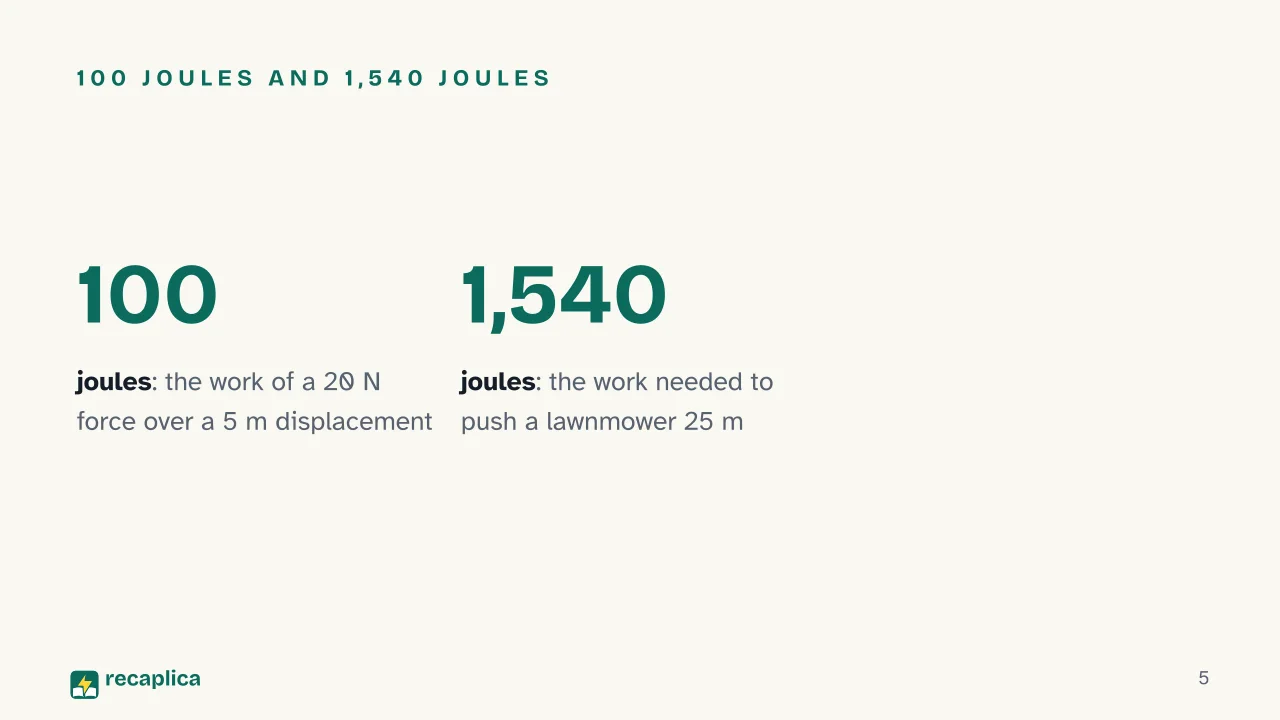
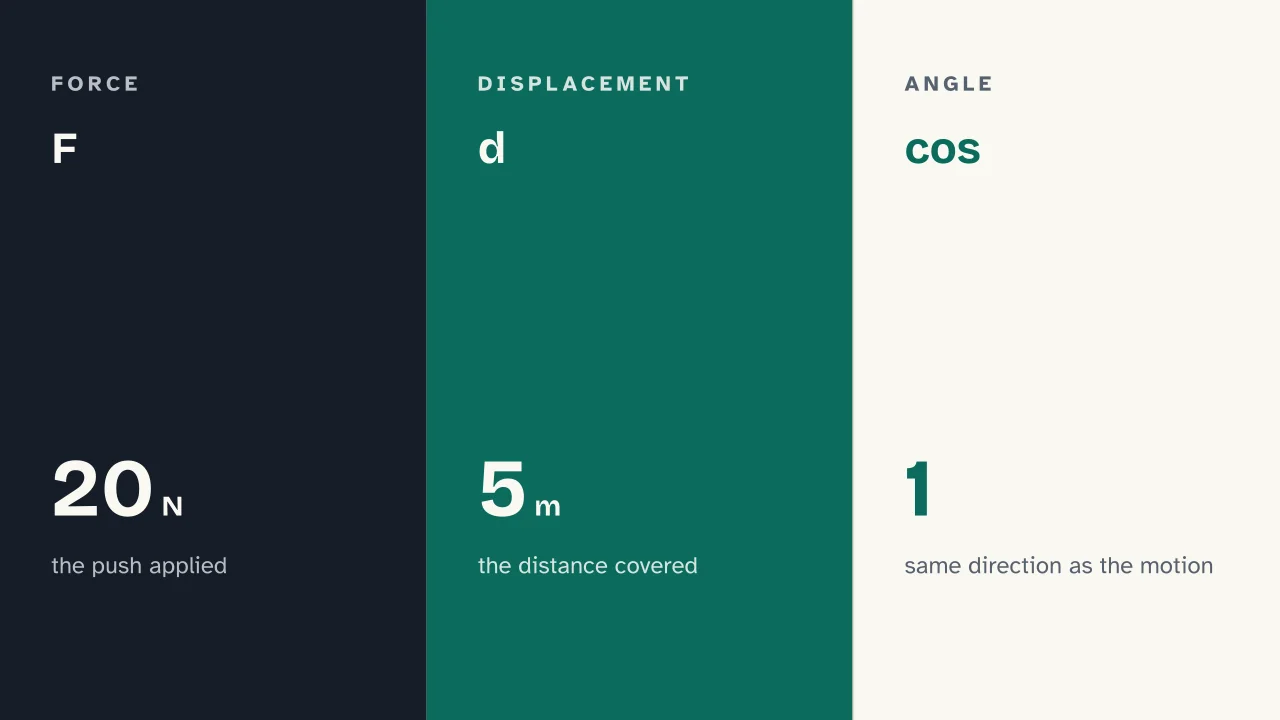
    According to HyperPhysics, energy is defined as the capacity to do work. Work, in turn, is what a force produces when it causes a displacement along its own direction. If a 20-newton force moves an object 5 metres along its own direction, the work done comes to 100 joules: the International System unit for work, equal to one newton times one metre.

    For a constant force, work is calculated by multiplying the force’s magnitude, the displacement, and the cosine of the angle between the two directions (W = F·d·cosθ).

    Practical example: a person pushes a lawnmower with a 75-newton force, tilted 35 degrees below horizontal, over 25 metres. According to OpenStax, the work done in this case comes out to about 1,540 joules, less than the same force would do pushing flat, because only part of it points in the direction of motion.

    The same principle, applied to electric force, underlies electric current. The description of forces that makes it possible to calculate work in the first place comes from Newton’s three laws of motion.

    The work-energy theorem and kinetic energy

    Kinetic energy is the energy an object has simply because it’s moving. Giving it to an object requires doing work on it: that’s a specific case of a broader principle, the work-energy theorem, which ties the two quantities together in a single rule.

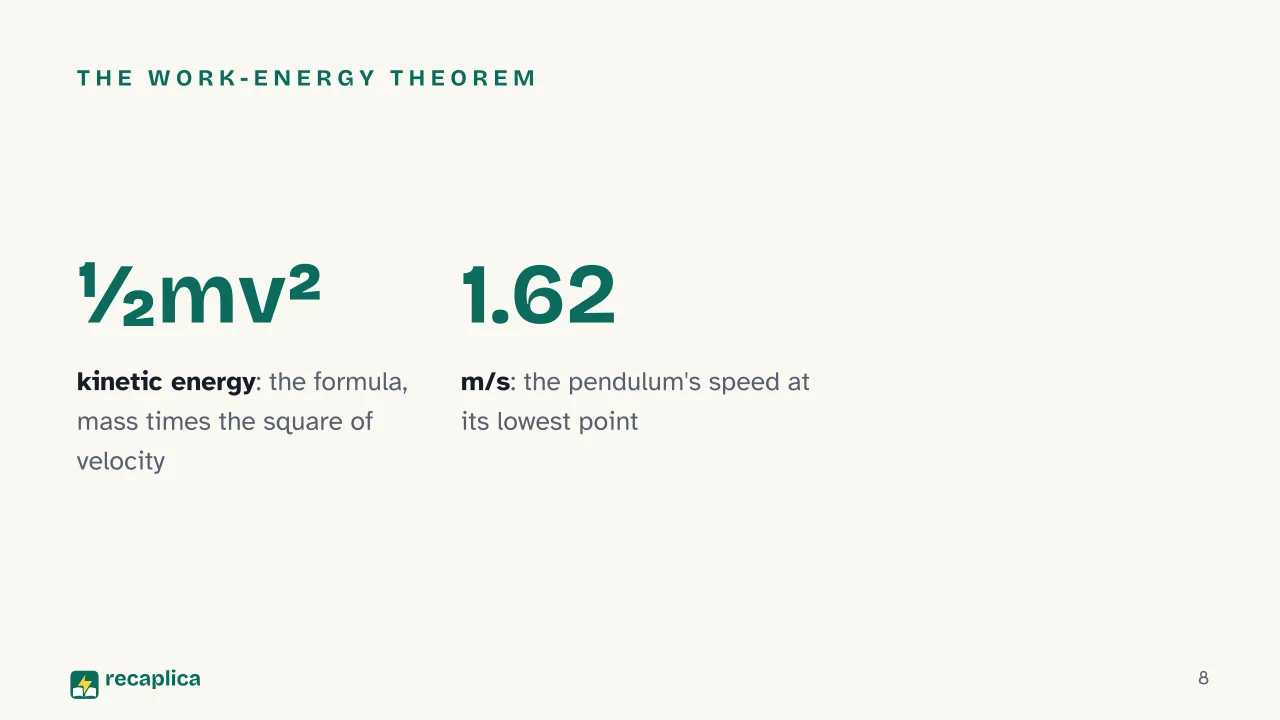
    An object’s kinetic energy is calculated as half the product of its mass and the square of its velocity, KE = ½mv². It also measures the work that moving object could do on whatever it hits, purely because of its motion: a car travelling at 100 km/h doesn’t have twice the kinetic energy of one at 50 km/h, it has four times as much, because velocity is squared in the formula.

    QuantityFormulaDepends on
    WorkW = F·d·cosθforce, displacement, angle
    Kinetic energyKE = ½mv²mass, velocity
    Gravitational potential energyPE = mghmass, height, gravity

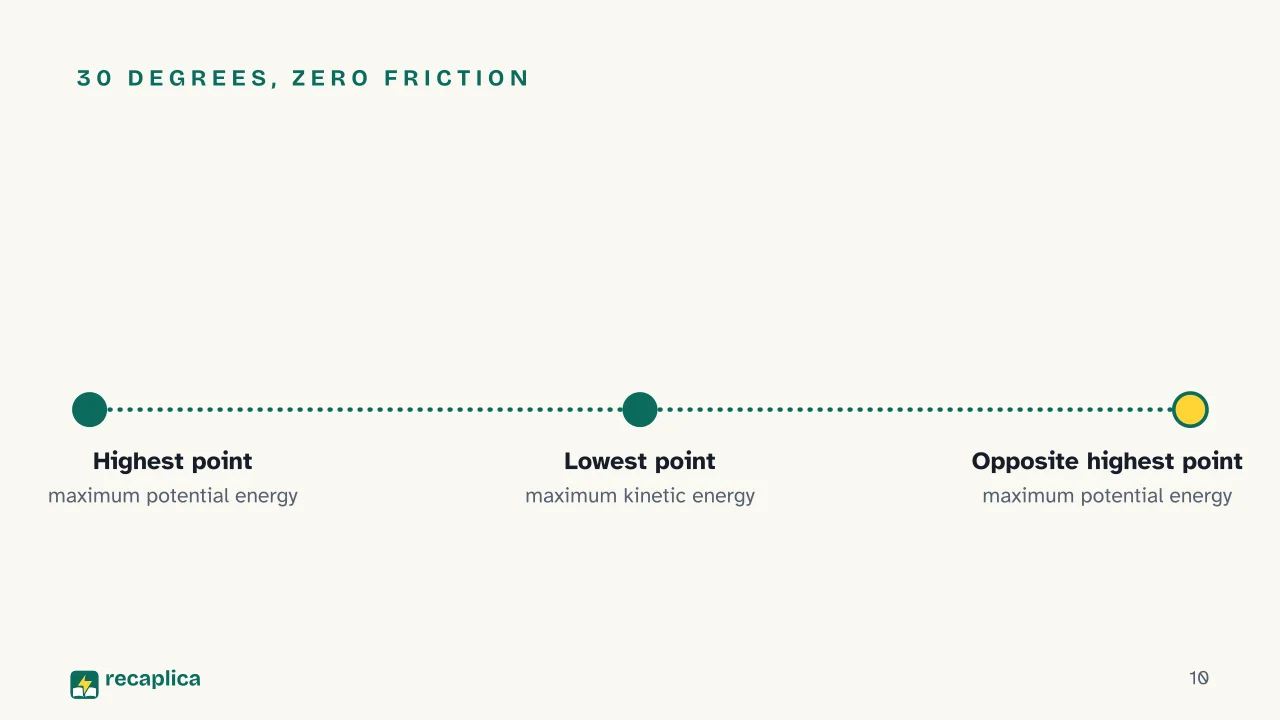
    A simple pendulum one metre long, released from 30 degrees with no friction, reaches a speed of about 1.62 m/s at the lowest point of its swing. That calculation links work and velocity in a case of oscillating motion.

    Potential energy and the conservation formula

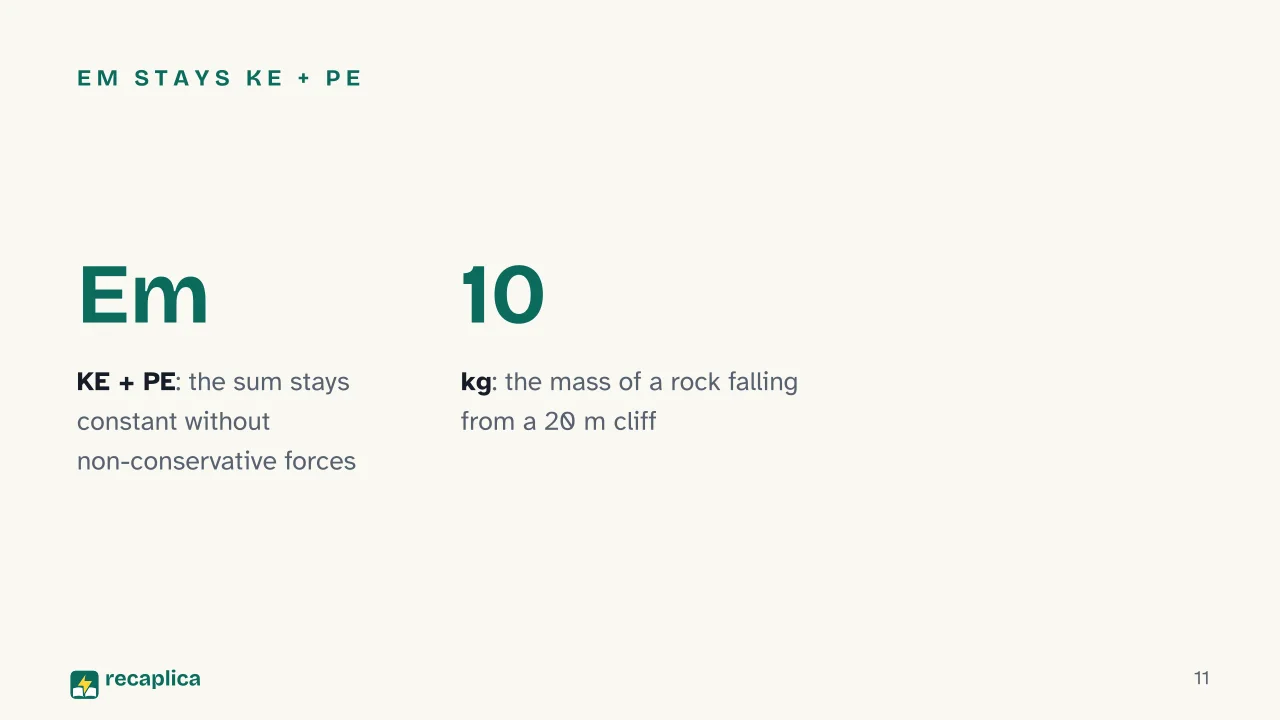
    An object’s mechanical energy is defined as the sum of its kinetic energy and its potential energy. In its gravitational form, potential energy is calculated by multiplying an object’s mass, the acceleration of gravity, and its height above a chosen reference level, PE = mgh.

    When an object with gravitational potential energy falls, that energy converts into kinetic energy. A 10-kilogram rock falling from a 20-metre cliff turns potential energy into kinetic energy as it drops. In a pendulum, the same exchange runs both ways: the kinetic energy at the lowest point of the swing equals the potential energy at the highest point, in a continuous back-and-forth between the two forms, with the total staying the same.

    An object’s mechanical energy stays constant as long as any non-conservative forces, such as friction, do no work on it: in that case, the change in mechanical energy between two instants is zero. It’s the same broader principle behind the fact that, when a system doesn’t interact with its surroundings, certain quantities, energy among them, stay constant, the so-called conserved quantities: in an isolated system, total energy is neither created nor destroyed. The formula that captures the conservation of mechanical energy is Em = KE

    • PE = constant.

    When mechanical energy isn’t conserved

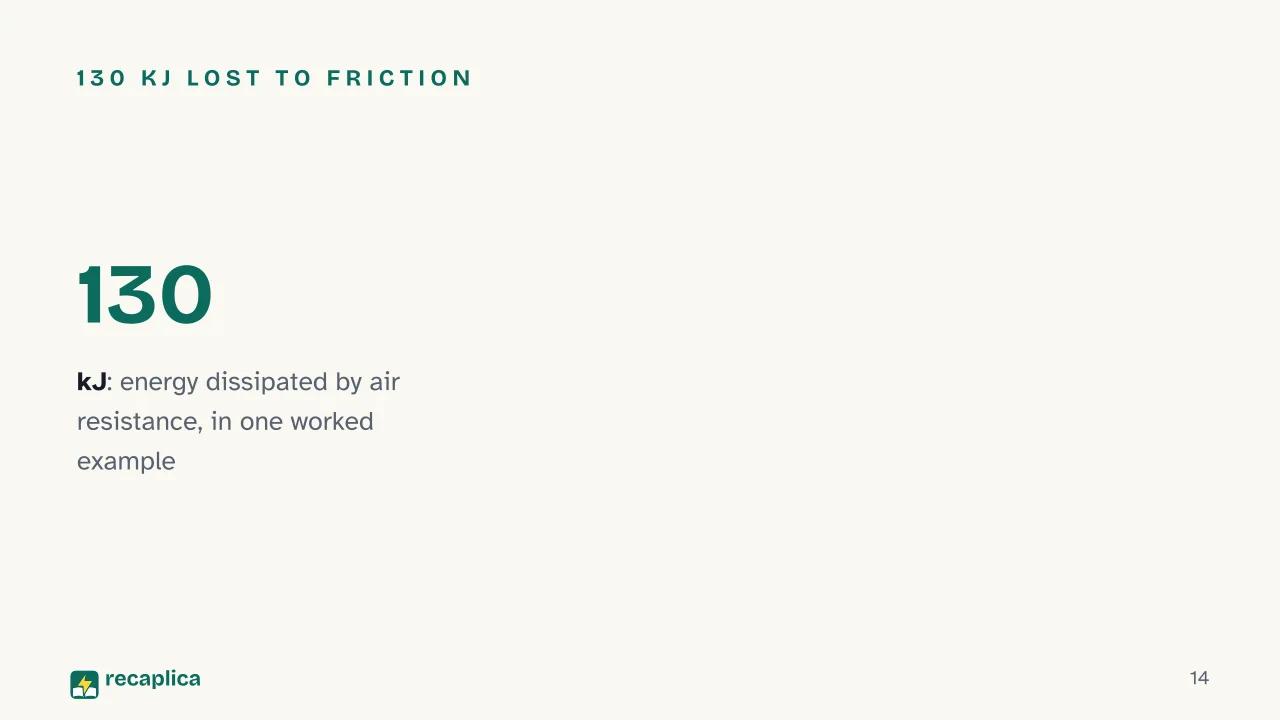
    When non-conservative forces such as friction act, mechanical energy is no longer exactly conserved: its change equals the work those forces do. With dissipative forces such as air resistance, the difference between initial and final mechanical energy is exactly the energy that got dissipated, 130 kJ in one worked example from OpenStax. On a roller coaster, as the car goes down the first drop, potential energy converts into kinetic energy, and by the lowest point it has already picked up most of the potential energy it started with. Treating a system as closed, in this context, means assuming no energy is lost to friction or air resistance along the way; real systems rarely match that assumption exactly.

    Energy conservation remains one of physics’s foundational principles, alongside the conservation of mass and of momentum. The same transformation between forms of energy, made possible by the work a force does, also underlies how a nuclear power plant works, where steam does work on the turbines.

    Slide deck

    Slides ready to download and make your own in PowerPoint or Google Slides, with speaker notes. Pick the Flash cut or the Full one.
    Slide 1 of the presentation on Mechanical Energy: Mechanical EnergySlide 2 of the presentation on Mechanical Energy: Where does a moving object's kinetic energy come from?Slide 3 of the presentation on Mechanical Energy: What this Recap coversSlide 4 of the presentation on Mechanical Energy: Chapter 01: WorkSlide 5 of the presentation on Mechanical Energy: 100 joules and 1,540 joulesSlide 6 of the presentation on Mechanical Energy: F · d · cosSlide 7 of the presentation on Mechanical Energy: Chapter 02: Kinetic energySlide 8 of the presentation on Mechanical Energy: The work-energy theoremSlide 9 of the presentation on Mechanical Energy: Chapter 03: Potential energySlide 10 of the presentation on Mechanical Energy: 30 degrees, zero frictionSlide 11 of the presentation on Mechanical Energy: Em stays KE + PESlide 12 of the presentation on Mechanical Energy: Mechanical energy is always conserved, no matter what.Slide 13 of the presentation on Mechanical Energy: Chapter 04: When it dissipatesSlide 14 of the presentation on Mechanical Energy: 130 kJ lost to frictionSlide 15 of the presentation on Mechanical Energy: What is work, in physics?Slide 16 of the presentation on Mechanical Energy: Now, the recap
    Flash10 slidesThe essential thread, to present in classFull16 slidesEvery chapter and the deeper detail

    Common myths

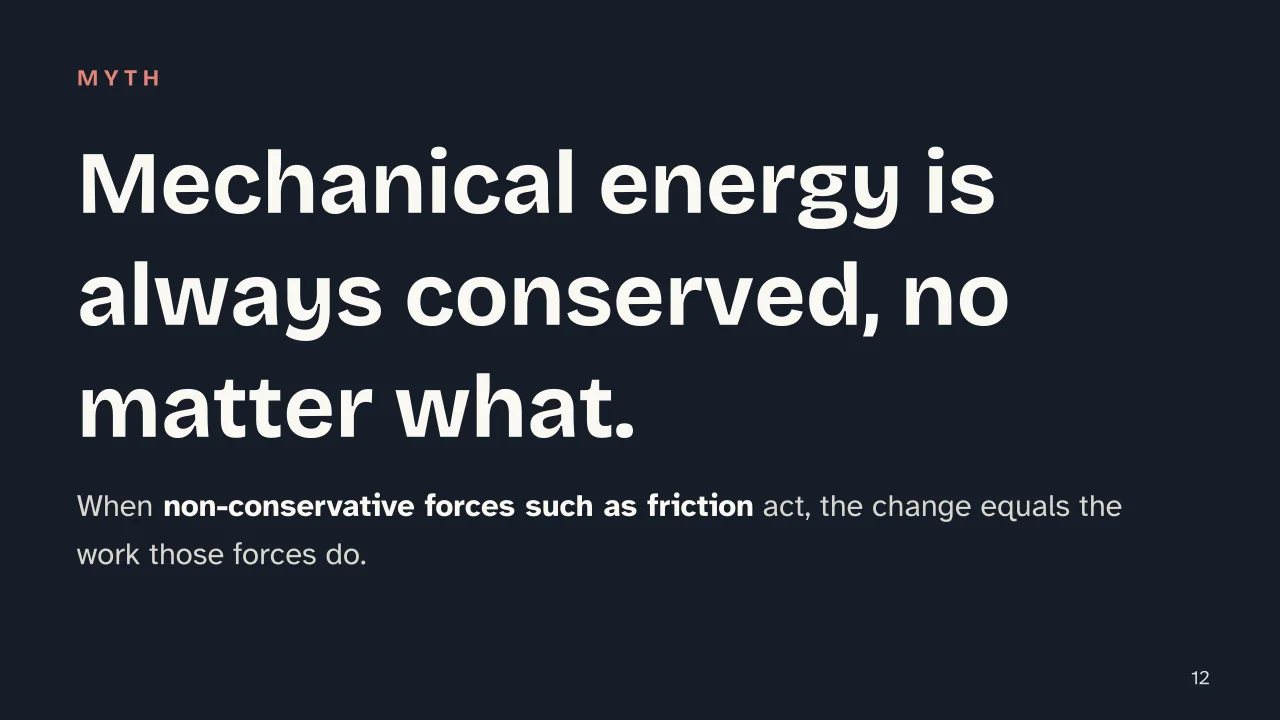
    • ✗ Myth Mechanical energy is always conserved, no matter what.

      ✓ Reality When non-conservative forces such as friction act, the change in mechanical energy equals the work those forces do: part of the energy dissipates, and kinetic plus potential energy no longer add up to the same total.

    • ✗ Myth Kinetic energy grows in direct proportion to speed.

      ✓ Reality The formula KE = ½mv² squares the speed, not the speed itself: doubling an object's speed quadruples its kinetic energy, at the same mass.

    • ✗ Myth A force acting on a moving object always does work on it.

      ✓ Reality Work is calculated as W = F·d·cosθ, and when the displacement is perpendicular to the force, the cosine of that angle is zero: the force is there, but the work done is zero.

    Mind map

    Drag the background to move around and the nodes to reposition them; use − and + to collapse and expand branches.
    Customize
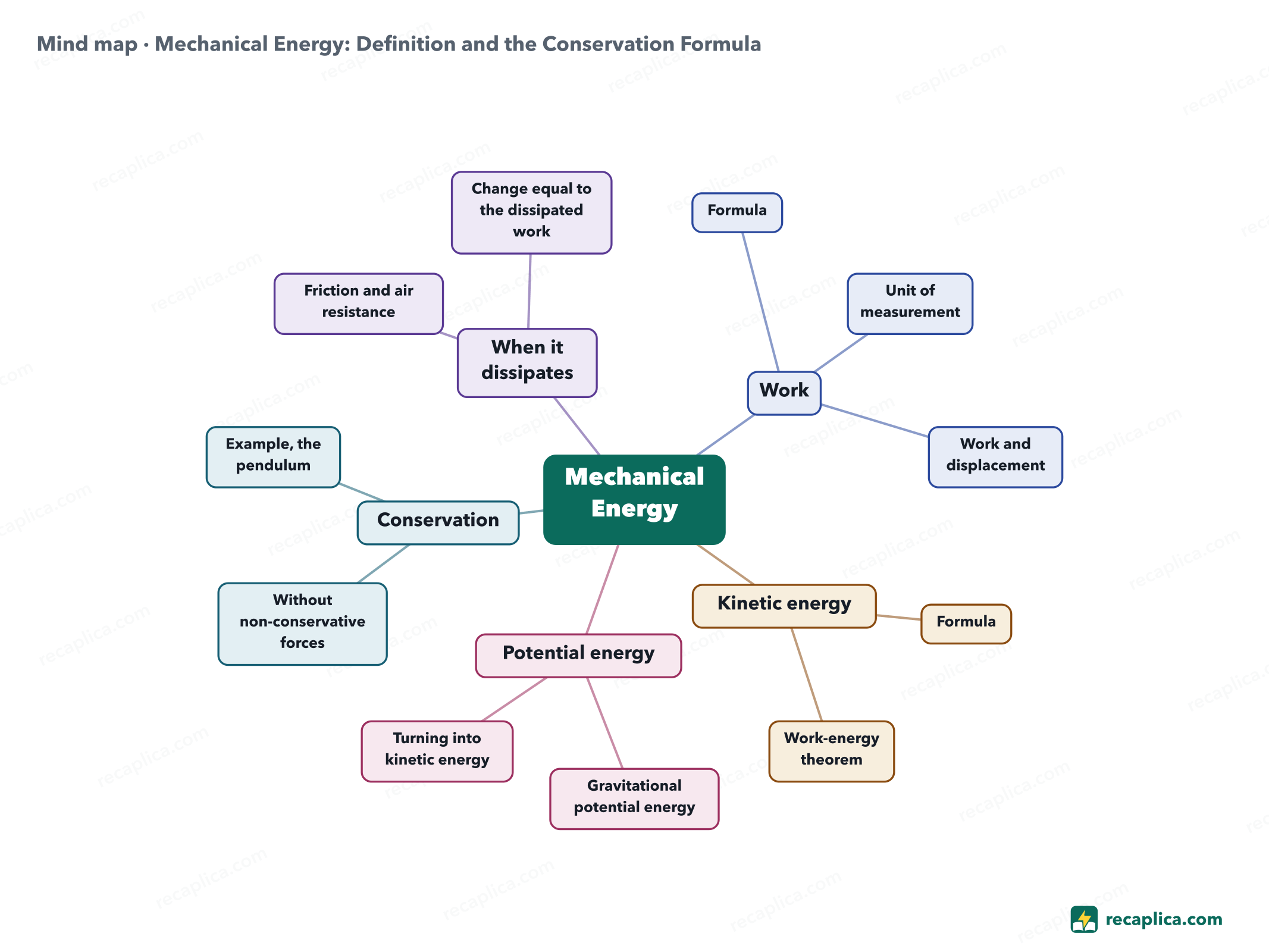
    Mind map: Mechanical Energy: Definition and the Conservation Formula
    • Mechanical Energy
      • Work
        • Formula W = F · d · cosθ
        • Unit of measurement the joule, a newton times a metre
        • Work and displacement needs a force that moves the body along its own direction
      • Kinetic energy
        • Formula KE = ½mv²
        • Work-energy theorem the change in kinetic energy equals the net work done
      • Potential energy
        • Gravitational potential energy PE = mgh
        • Turning into kinetic energy happens during a fall or a descent
      • Conservation
        • Without non-conservative forces Em = KE + PE stays constant
        • Example, the pendulum continuous exchange between kinetic and potential
      • When it dissipates
        • Friction and air resistance
        • Change equal to the dissipated work

    Quiz: test yourself

    Answer the questions to check what you have learned: you get instant feedback and a short explanation.

    Grade 0/10 0/5
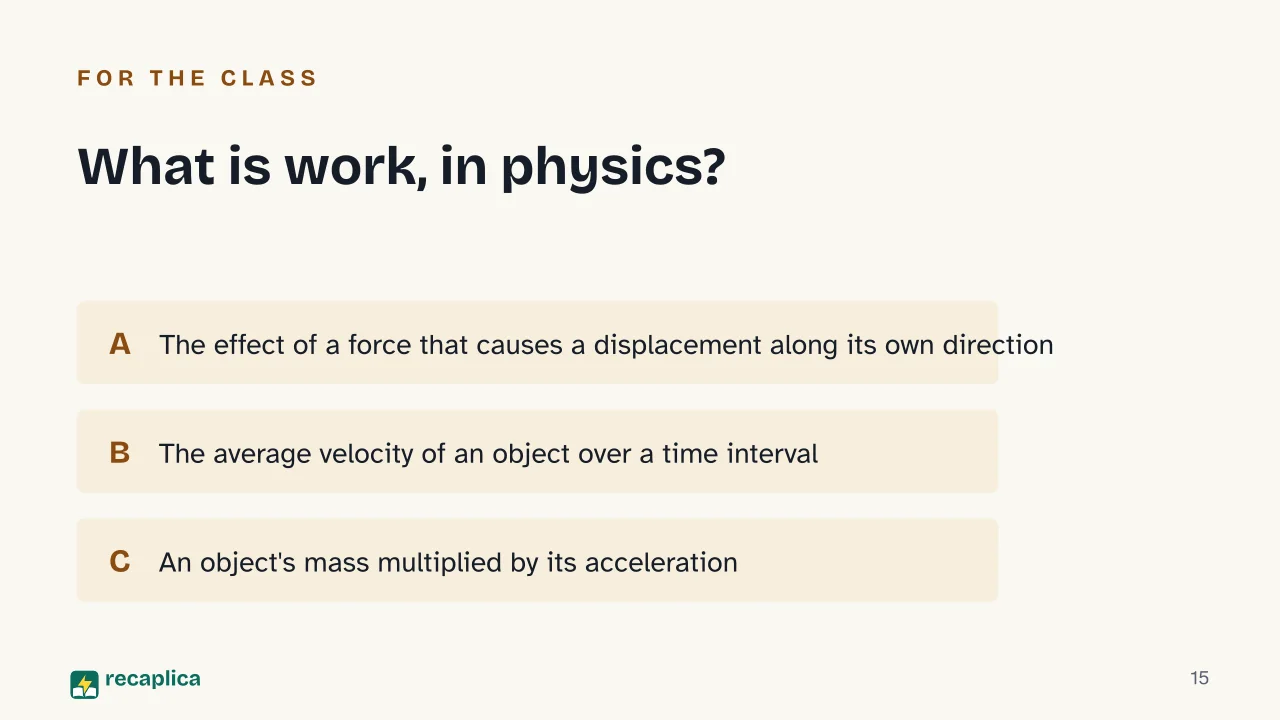
    1 What is work, in physics?

    A force only does work if it actually causes a displacement along its own direction, and the result is measured in joules.

    2 A 20-newton force moves an object 5 metres along its own direction. How much work does it do?

    For a constant force acting in the same direction as the displacement, work is the force times the distance: 20 newtons times 5 metres gives 100 joules.

    3 What does the work-energy theorem state?

    The work-energy principle confirms it: an object never speeds up on its own, because it always takes a net amount of work.

    4 True or false, if no non-conservative forces such as friction act on an object, its mechanical energy stays constant as it moves.

    With no non-conservative forces doing work on it, an object's mechanical energy holds the same value from one instant to the next.

    5 In a frictionless pendulum, what happens to kinetic and potential energy during the swing?

    At the highest point and the lowest point alike, the pendulum keeps trading kinetic for potential energy while their total stays the same.

    Answers: 1-B · 2-C · 3-B · 4-A · 5-B

    Flashcards

    Tap the card to flip it and check whether you remember the answer, then move to the next one.

    1 / 8

    Explain it in your own words

    The ultimate test: if you can explain it in simple words, you've truly understood it. Write your explanation, then compare it with the Recap.

    Your explanation is saved only on this device.

    Mechanical energy is the kinetic energy of a moving object plus its potential energy, the energy tied to its position. Changing an object's speed takes work, and work is what shifts energy from one form into another. When the only forces acting are conservative, like gravity, mechanical energy stays constant as the object moves: one form grows while the other shrinks, but their sum never changes. Friction and air resistance break that balance and dissipate part of the mechanical energy. The formula that captures this is Em = KE + PE = constant.

    Frequently asked questions

    What is the formula for mechanical energy?

    It's the energy an object has from motion added to the energy tied to its position, Em = KE + PE. When no non-conservative forces such as friction act, that sum stays constant as the object moves.

    What's the difference between work and energy?

    Work is what a force does when it causes a displacement along its own direction; energy is the capacity to do that work. In physics, a force does work on an object whenever it transfers energy to it.

    Does mechanical energy always stay the same?

    Only when friction and other non-conservative forces do no work on the object. When they do, part of the mechanical energy dissipates, by exactly the amount of work those forces perform.

    How do you calculate an object's kinetic energy?

    Multiply half its mass by the square of its velocity, KE = ½mv²: it's the energy tied to the fact that the object is moving.

    What does the work-energy theorem measure?

    It states that the net work done on an object determines exactly how much its kinetic energy changes, which is why speeding up or slowing down always takes work.

    Sources

    • HyperPhysics, Georgia State University — Energy
    • OpenStax, University Physics Volume 1 — Work
    • OpenStax, Physics — Work, Power, and the Work-Energy Theorem
    • NASA Glenn Research Center — Conservation of Energy

    Every Recap goes through an independent review before publication.

    Every evening, the day's new Recaps on our Telegram channel. Join the channel →

    Keep learning

    • Science Kinematics: What It Is and the Equations of Motion Kinematics is the branch of physics that tracks how a body moves: its position, velocity, and acceleration over time. The forces that explain why it moves belong to dynamics instead. Pinning down where an object is at a given instant always needs a fixed frame of reference, a set of measuring axes. Position-time and velocity-time graphs show the same motion as a line, with the slope telling velocity in one graph and acceleration in the other. Free fall and uniform circular motion are the two examples students meet first. Read the Recap →
    • Science Correlation: What It Means and How to Read the Coefficient Correlation measures how closely two variables move together, and the most common way to put a number on it is the correlation coefficient, which runs from -1 to +1. A value near +1 means the two variables rise together, near -1 means one rises while the other falls, and near 0 means no linear relationship stands out. The coefficient only captures the strength of a straight-line relationship, and a single unusual data point can push it up or down by a lot. Even when it's strong, a correlation between two variables never shows that one causes the other. Read the Recap →
    • Science Light Refraction: What It Is, the Laws Behind It, and Examples A surface that separates two transparent materials sends some light back, reflecting it, and lets the rest through while bending it toward a new direction. The law of reflection keeps the incoming and outgoing angles equal, both measured from the normal to the surface. Snell's law governs refraction instead, linking the index of each material to how much the ray tilts before and after it crosses over. These two laws alone explain mirrors, lenses, prisms and everyday sights such as a pencil that appears to snap inside a glass of water. Read the Recap →

    recaplica

    Clear in 30 seconds, yours in 10 minutes.

    Recaps Mind maps Request a Recap Telegram channel Mind map maker Our method About Privacy & cookies Legal notes & terms of use

    © 2026 Recaplica · A project by Curi S.r.l. — VAT IT05472000750

    Statistics, only if you say so

    To learn which Recaps help most we would use Google Analytics, with aggregate, anonymous data. It starts only with your OK, and you can change your mind anytime. Privacy policy