|
recaplica
Geometric Transformations: Translation, Rotation, Reflection and Dilation | |||||||||||||||
| © 2026 Recaplica · recaplica.com — All rights reserved | |||||||||||||||
Geometric Transformations: Translation, Rotation, Reflection and DilationWhat to print Page numbers appear when printing with default margins. SlidesChoose a cut Flash10 slidesThe essential thread, to present in classFull14 slidesEvery chapter and the deeper detailBoth come with speaker notes. In 30 seconds quick readA geometric transformation turns one figure into another, called the image, by changing its shape, size or position. Three of these operations always keep lengths and angles the same: translation slides every point the same distance, in the same direction; rotation turns the figure around a fixed center; reflection flips it like a mirror image across a line. Dilation works on a different logic: it enlarges or shrinks the figure, and the result keeps the original shape at a different size. Key Points
Deep DiveA geometric transformation is a procedure that changes a figure’s shape, size or position, producing a new figure called the image. Three of these operations belong to the same family and leave both the lengths and the angles of the starting figure unchanged. The technical name is rigid transformation, or isometry: the original figure and its image stay congruent, with the same shape and the same size, and only the position on the plane changes. TranslationIn a translation, every point of the figure moves the same distance, in the same direction. There is no center to turn around and no line to flip across.
RotationRotation turns the figure around a point that stays fixed, the center of rotation. Everything else about the figure moves, through an amount called the angle of rotation: the angle formed by the lines joining a point of the original figure to the center, and the center to the corresponding point of the rotated figure. Rotation, like translation, also leaves shape and size untouched: anyone reviewing the difference with an enlarged figure can compare it with the triangle similarity theorems, where shape is preserved but size is not. ReflectionReflection flips the figure across a line called the axis of reflection, producing the mirror image of the original. The simplest case to follow in coordinate geometry is reflection across the x-axis: the y-coordinate of every point changes sign, while the x-coordinate stays the same. Like translation and rotation, reflection leaves lengths and angles untouched, which is why the three operations share the name rigid transformation. Anyone still unsure how to read a point’s coordinates can review it on the coordinate plane, where these shifts can be followed step by step, one row at a time.
Dilation, the exceptionDilation enlarges or shrinks the figure according to a scale factor, written as k. With k between 0 and 1 the resulting figure is smaller than the original; with k greater than 1 it is larger. Unlike the rigid transformations, dilation touches the figure’s size: shape carries over, measurements don’t, so the image is similar rather than congruent to the original. This is also where the geometry of transformations meets analytic geometry, where the same operations are written as coordinates changing according to a rule. The center of dilation and what a negative k does to the image are covered in the Recap on geometric dilations. Combining several transformationsA composition happens when several transformations are applied to the same figure, one after another. A glide reflection combines a reflection and a translation: the figure flips across an axis, then slides in a direction parallel to that axis. It belongs to the elementary isometries along with translation, rotation, reflection and the identity transformation, which leaves the figure exactly where it was.
Recognizing a transformation at a glance also helps when reading proofs in Euclidean geometry, where congruence between figures is established by comparing corresponding sides and angles — the same comparison that separates an isometry from a dilation. Slide deckSlides ready to download and make your own in PowerPoint or Google Slides, with speaker notes. Pick the Flash cut or the Full one.     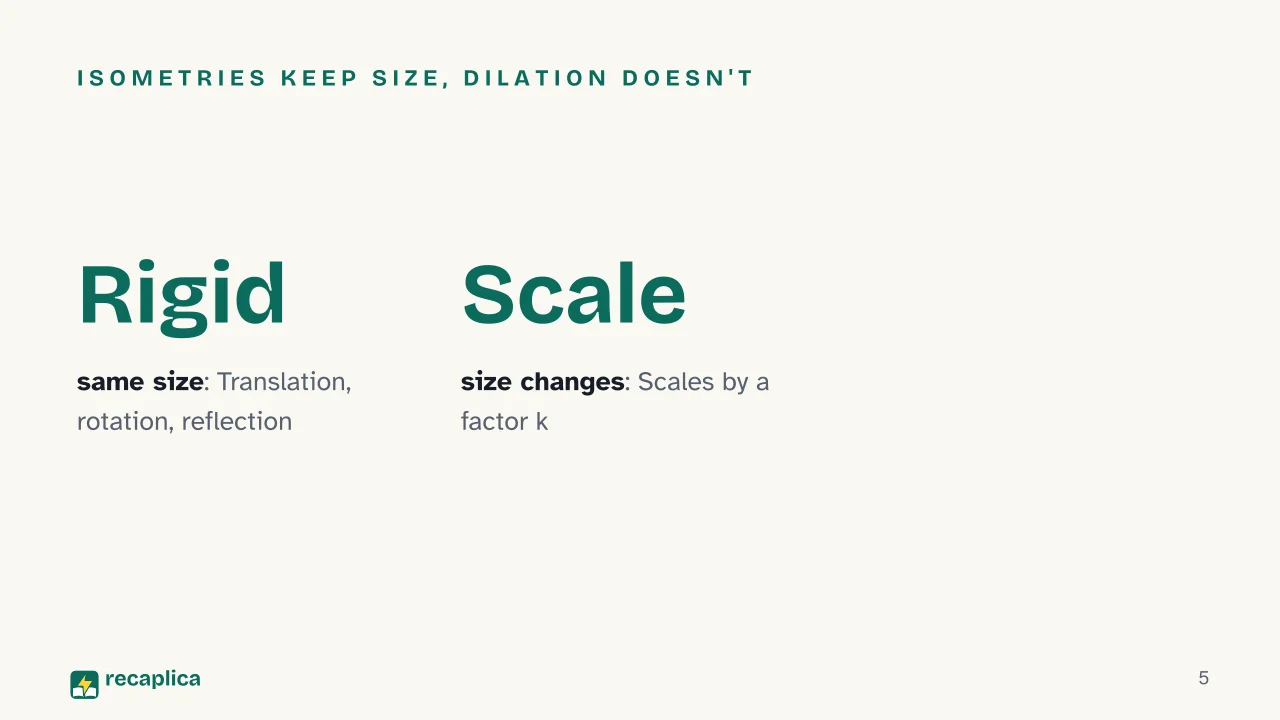  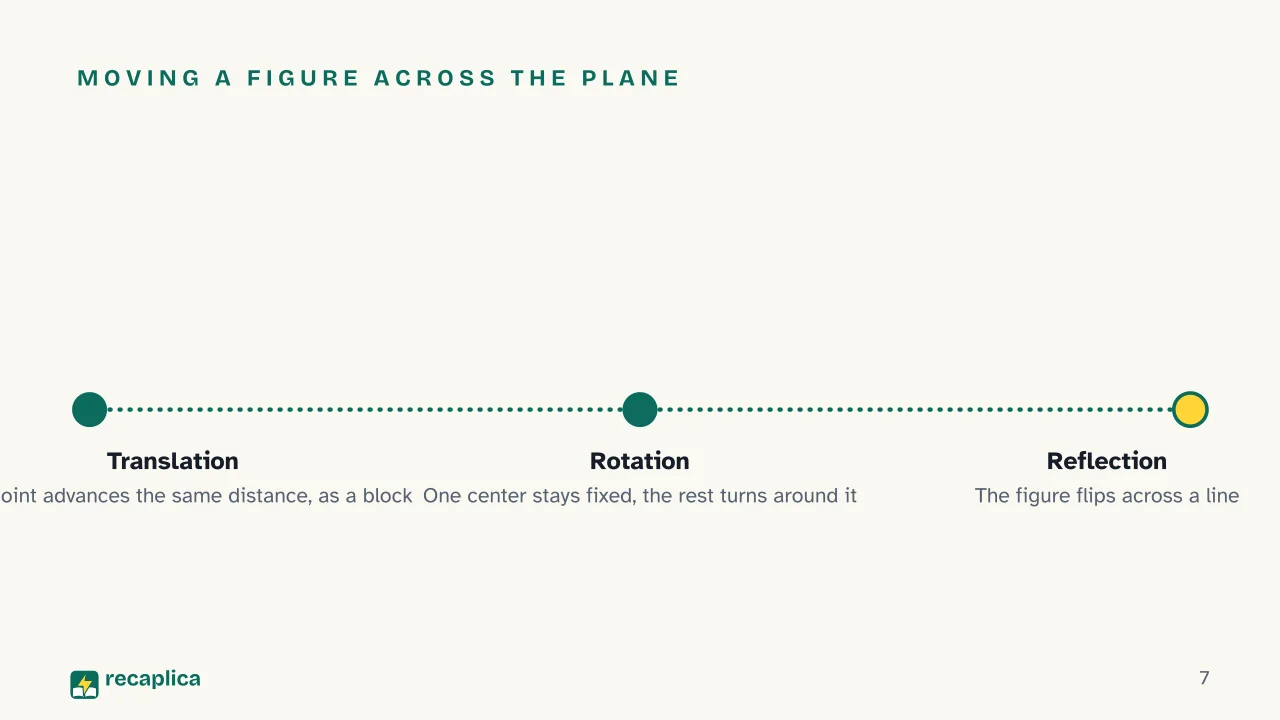 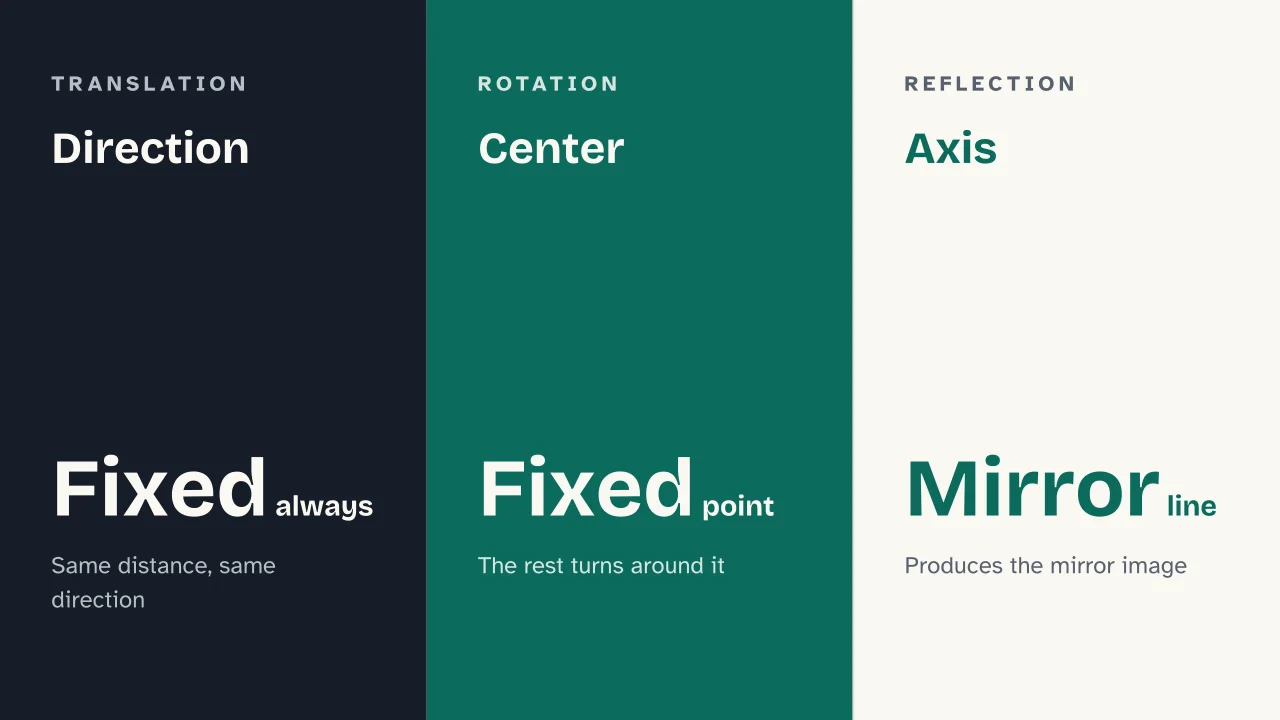  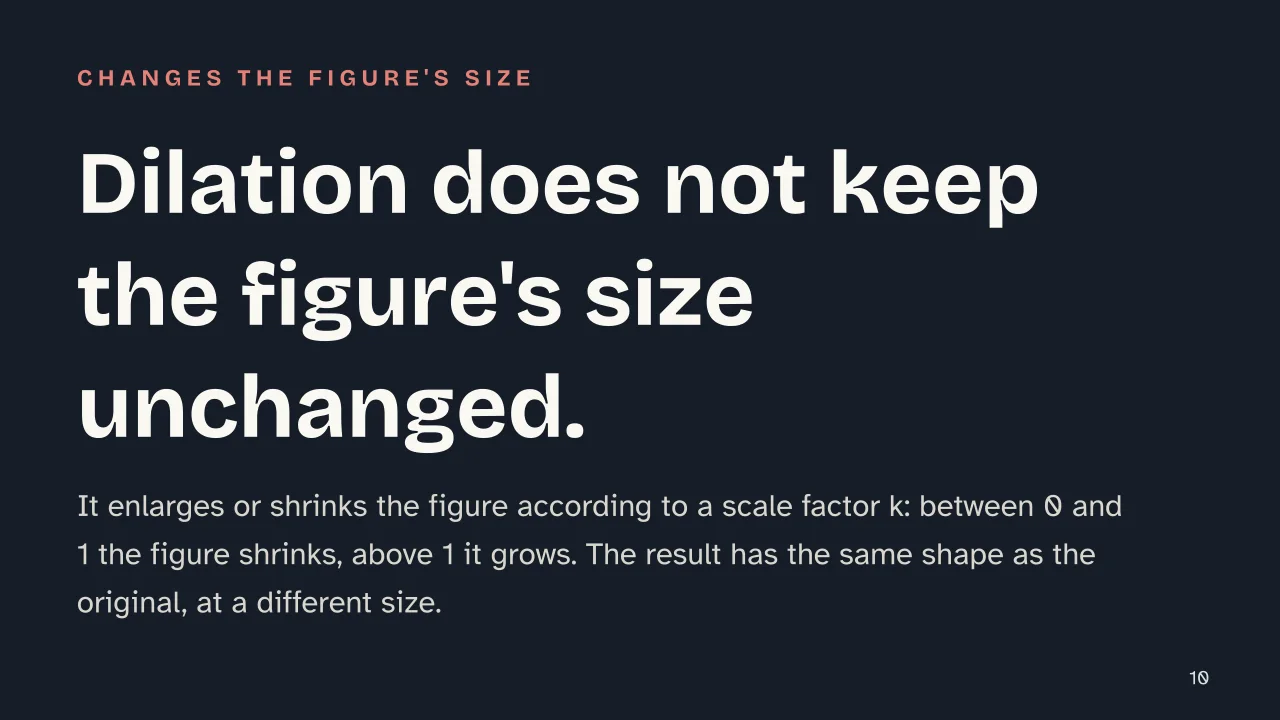  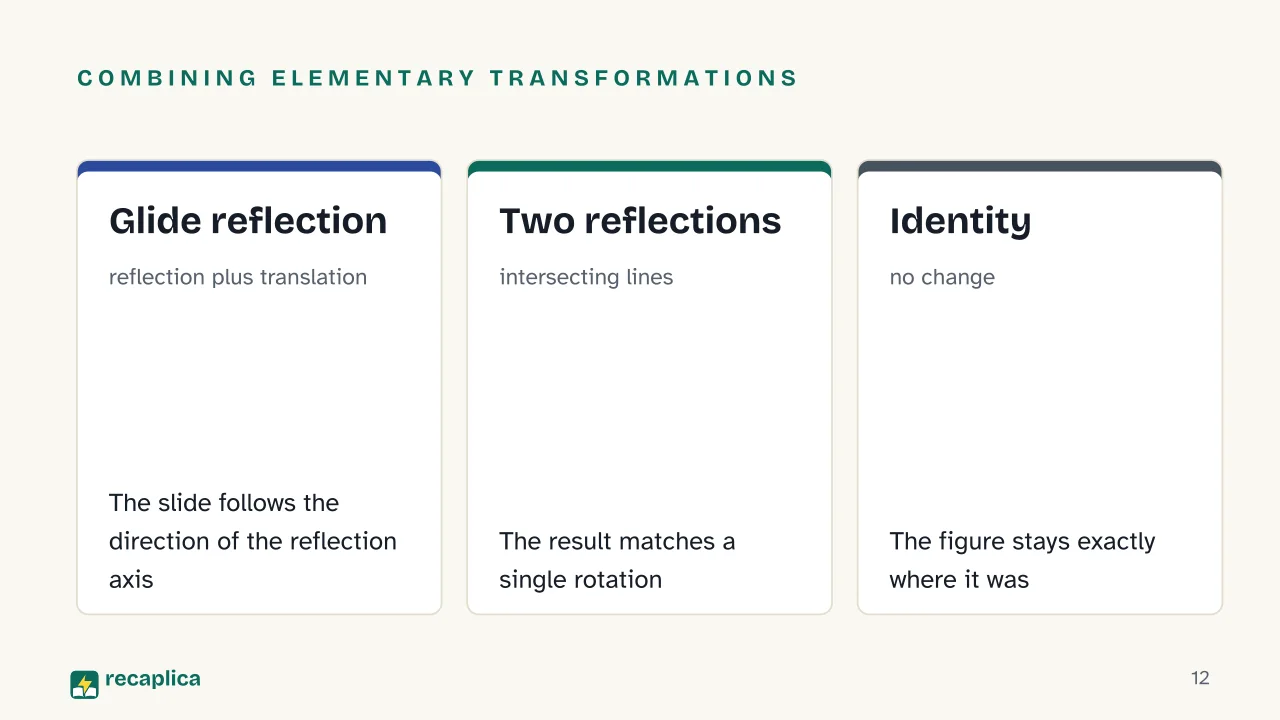 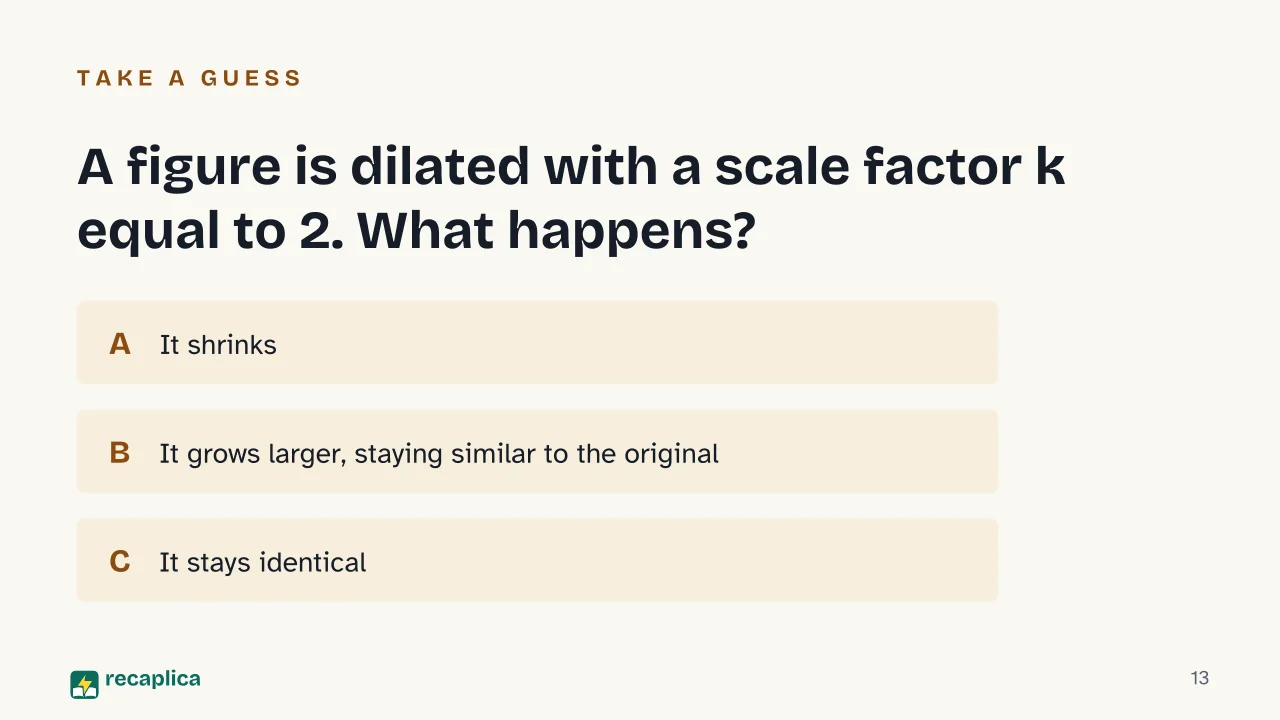  Common myths
Mind mapDrag the background to move around and the nodes to reposition them; use − and + to collapse and expand branches. 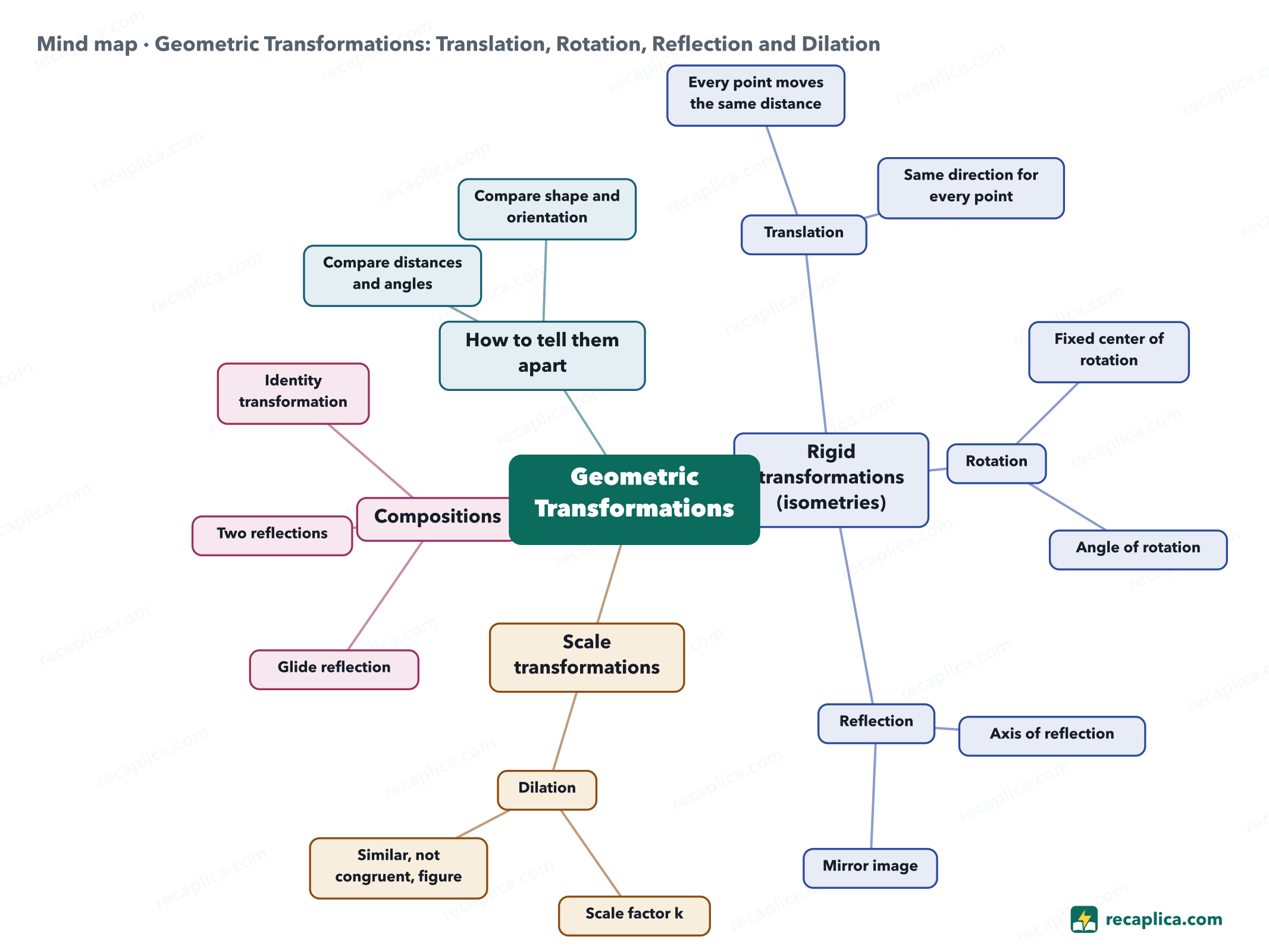
Quiz: test yourselfAnswer the questions to check what you have learned: you get instant feedback and a short explanation. Grade 0/10 0/5
FlashcardsTap the card to flip it and check whether you remember the answer, then move to the next one. 1 / 8 Explain it in your own wordsThe ultimate test: if you can explain it in simple words, you've truly understood it. Write your explanation, then compare it with the Recap. Your explanation is saved only on this device.
Frequently asked questionsWhat is the difference between an isometry and a rigid transformation?None: they are two names for the same concept. Both describe a transformation in which lengths and angles stay the same, from the starting figure to its image. Is dilation an isometry?No, because it changes the figure's size according to a scale factor. The result has the same shape as the original but a different size, so it is similar, not congruent. How do you tell a rotation from a reflection?In a rotation the figure stays on the plane and turns around a fixed center: sliding and turning it is enough to match the original. In a reflection the figure is flipped across a line, and matching it to the original would take lifting and turning it over, as in a mirror. What is a glide reflection?It is a two-step transformation: first a reflection across an axis, then a slide parallel to that same axis. It counts among the isometries, together with translation, rotation and reflection. What happens when you compose several transformations in sequence?The figure goes through several transformations applied one after another, and the final result depends on the order and type of each one. In one case the composition simplifies: two reflections, when the reference lines meet, are equivalent to a single rotation. Every Recap goes through an independent review before publication. |