|
recaplica
What Is Dilation in Math? Center, Scale Factor, Rules | ||||||||||||
| © 2026 Recaplica · recaplica.com — All rights reserved | ||||||||||||
What Is Dilation in Math? Center, Scale Factor, RulesWhat to print Page numbers appear when printing with default margins. SlidesChoose a cut Flash10 slidesThe essential thread, to present in classFull16 slidesEvery chapter and the deeper detailBoth come with speaker notes. In 30 seconds quick readA dilation is a geometric transformation defined by a fixed point, the center, and a nonzero number k, called the scale factor. Every length in the figure gets multiplied by the absolute value of k, while angles stay the same and lines map to parallel lines. Isometries — translations, rotations, and reflections — are different because they preserve lengths too. Combining a dilation with an isometry produces a similarity transformation, the broader family dilation belongs to. Key Points
Deep DiveCenter and scale factor, the only two ingredientsA dilation is built from just two pieces: a fixed point, the center, and a nonzero real number k, the scale factor (also called the ratio). Once those two are set, every point P of the starting figure moves along the line joining it to the center, landing on a new point P′ whose distance from the center equals the distance of P multiplied by the absolute value of k. The scale factor k decides how much the figure grows or shrinks. With k greater than 1, every length increases and the figure enlarges; with k between 0 and 1, every length shrinks. Either way, the resulting figure stays similar to the original. The definition only requires k to be a nonzero real number; it places no other condition on its sign. The sources used here stop at that general definition: none of them works through a numeric example with a negative scale factor. What changes, and what stays the sameDilation preserves the measure of angles: a dilated figure has the same interior angles as the original. It also preserves parallelism, mapping every line to a line parallel to it. Segment lengths, though, scale with k: each one is multiplied by its absolute value, while the ratio between any two corresponding segments holds steady before and after the transformation. This is the point where dilation splits off from isometries — the transformations that preserve both the shape and the size of a figure: translations, rotations, reflections, and glide reflections. A figure moved by an isometry is congruent to the original, overlapping it point for point. A figure dilated by a scale factor stays similar to the original, with its size multiplied by k. The name given to the combination of these two transformations, a dilation plus an isometry, is similarity transformation.
Calculating it on the coordinate planeWhen the center of the dilation sits at the origin of the axes, the calculation is direct: multiply both coordinates of the point by the scale factor k. A point (−4,6), dilated from the origin with k=2, becomes (−8,12): both coordinates double. A point (9,−13), dilated with k=0.5, becomes a point with x=4.5 and y=−6.5: both coordinates are cut in half. When the center is not the origin, the process has three steps: first find the difference between the point and the center, then multiply that difference by k, and finally add the center back to the result.
A broader look at transformations applied to whole figures on the coordinate plane is in the page on analytic geometry. Dilation, scaling, similarity: the overlapping namesIn most references, “dilation” covers both enlargement and reduction under one term. A minority of mathematical dictionaries in English draw a stricter line: “dilation” refers only to the case k>1 (enlargement), while 0<k<1 gets a separate term, “compression” (reduction). That split is a minority convention; most sources, including American high-school geometry textbooks, treat enlargement and reduction as one family, dilation, distinguished only by the value of k — the more common convention. It is also worth telling dilation and similarity transformation apart, since the two terms get mixed up often. Dilation is a single type of transformation: a center plus a scale factor k, nothing else. Similarity transformation is the wider family, the one dilation joins once a translation or a rotation is added to the change in scale. Readers who have already looked at the conditions for two triangles to be similar will find the same concept, applied to one specific case, on the page about triangle similarity theorems. Where it shows up, outside the textbookDilation, under other names, is everywhere a shape needs to change size without changing form. Cartographers use it to shrink real territory down to a map or a screen: the shape of coastlines and borders stays recognizable, only the measurements change. Architects build scale models of buildings to see how a construction will look before it goes up. In medicine, radiologists reading MRI or CT images zoom in or out on organs and tissue to examine them more closely, without the observed shape changing. Readers who want to revisit where this family of transformations starts, with angles and parallel lines at its foundation, can go back to the page on Euclidean geometry. Isometries, which preserve measurements too — translations, rotations, and reflections — get the full picture on the page about geometric transformations, the chapter dilation adds to as a closer look. Slide deckSlides ready to download and make your own in PowerPoint or Google Slides, with speaker notes. Pick the Flash cut or the Full one.     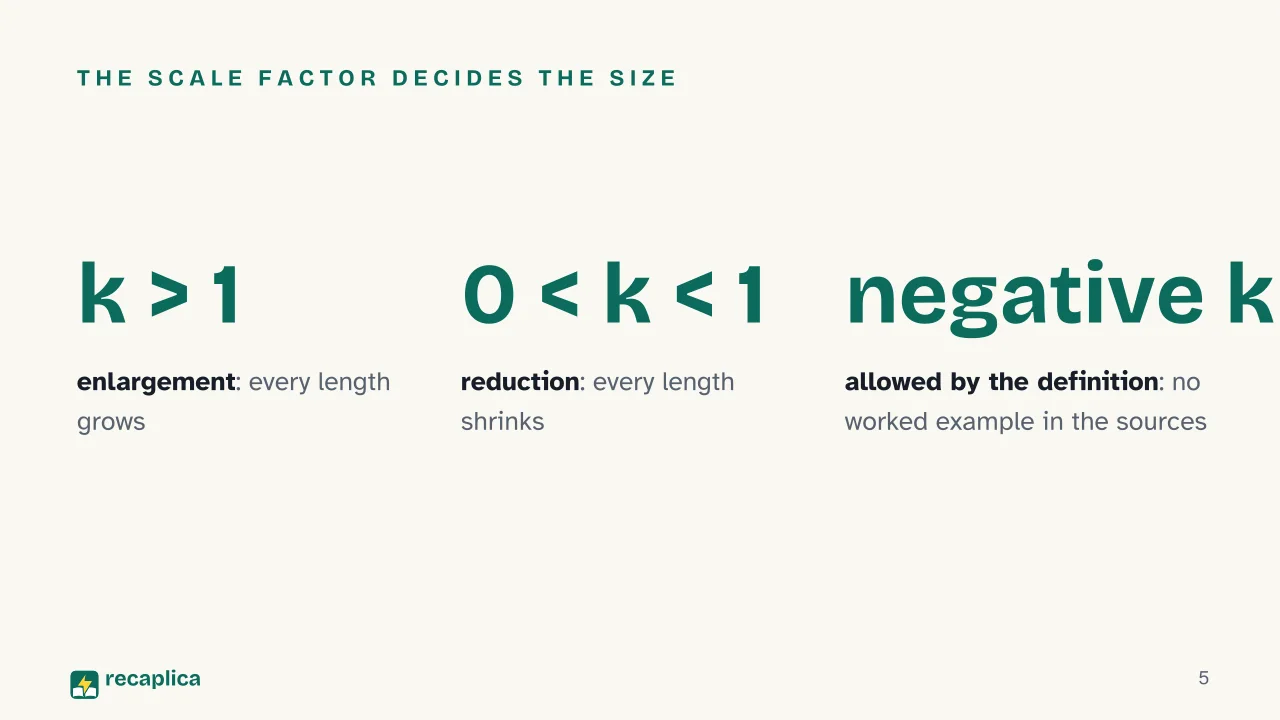  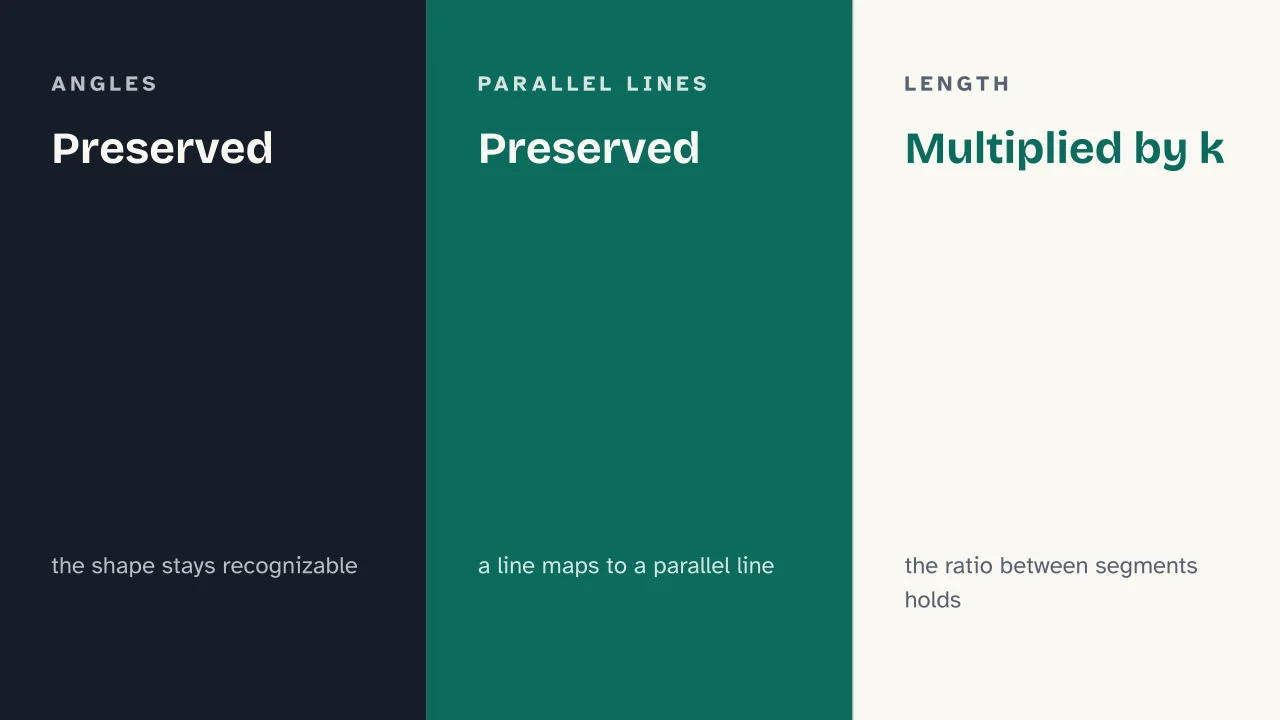  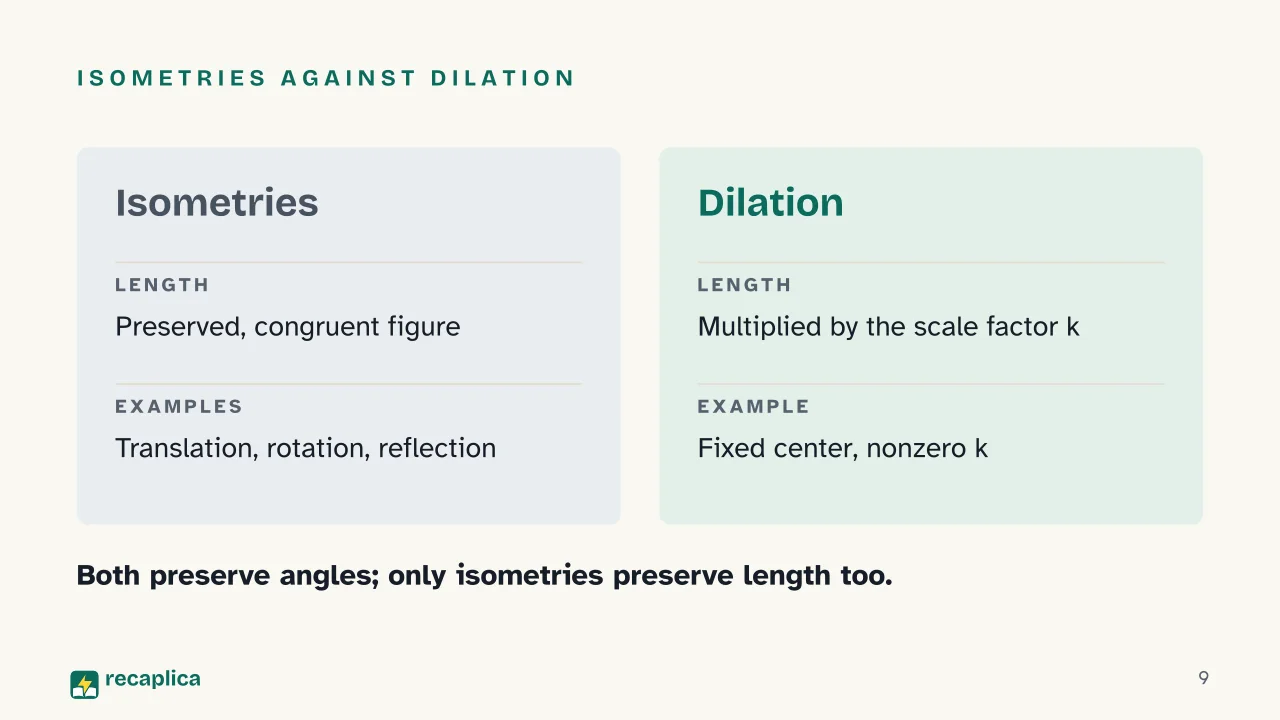 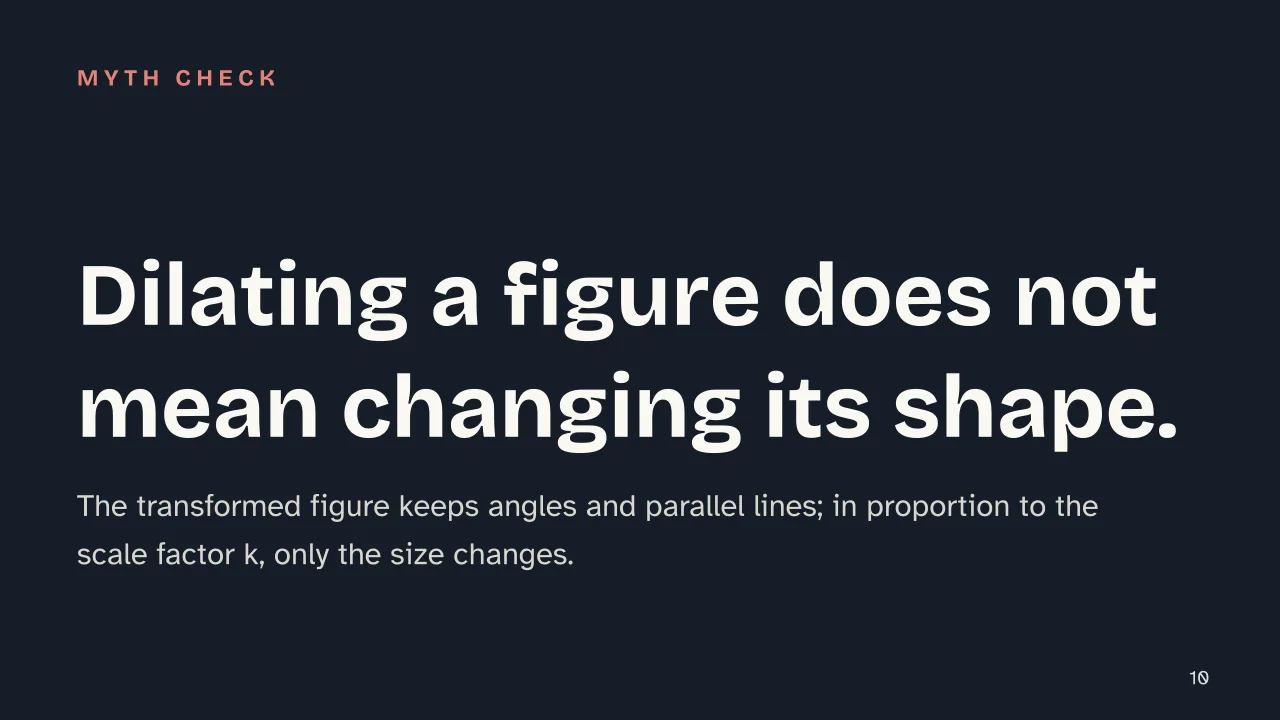  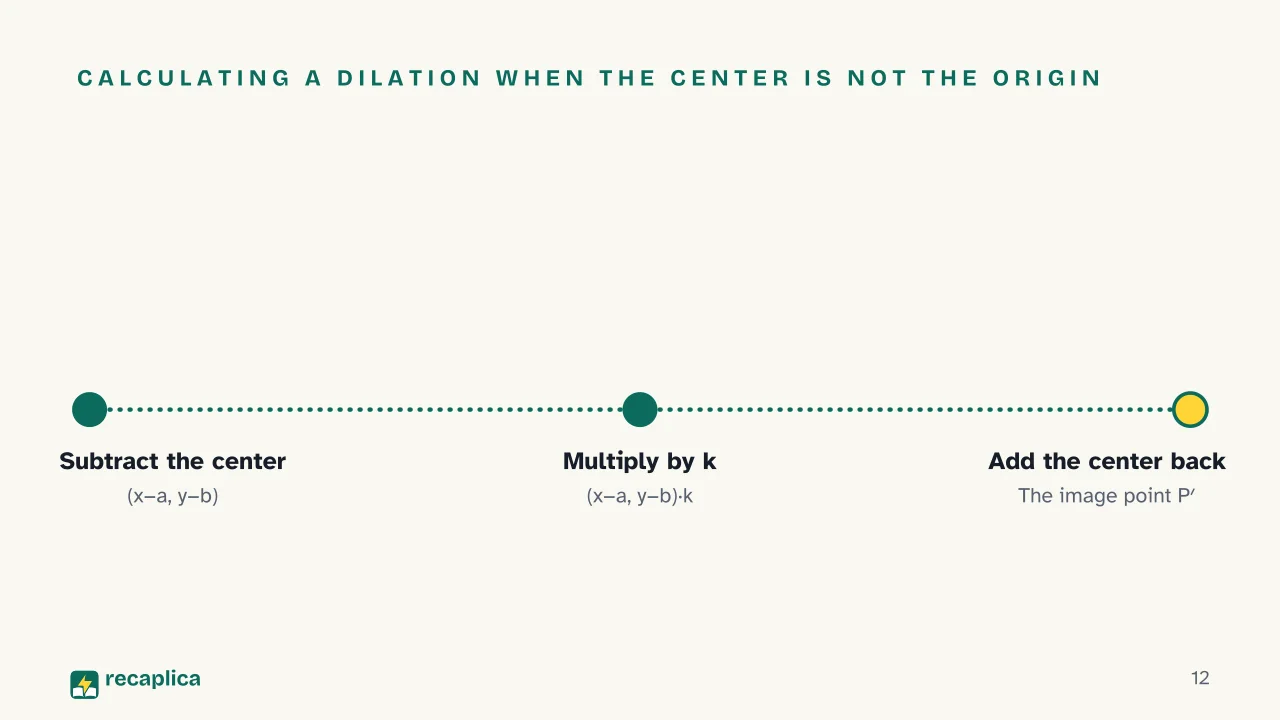  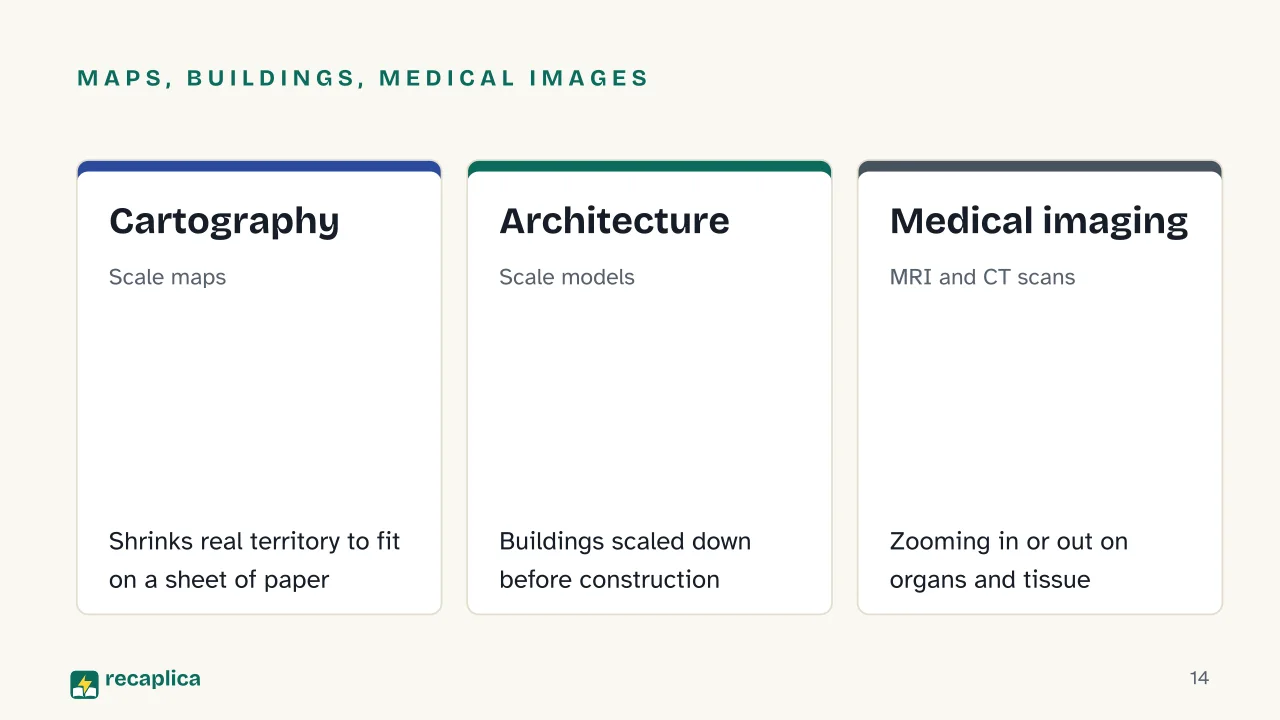 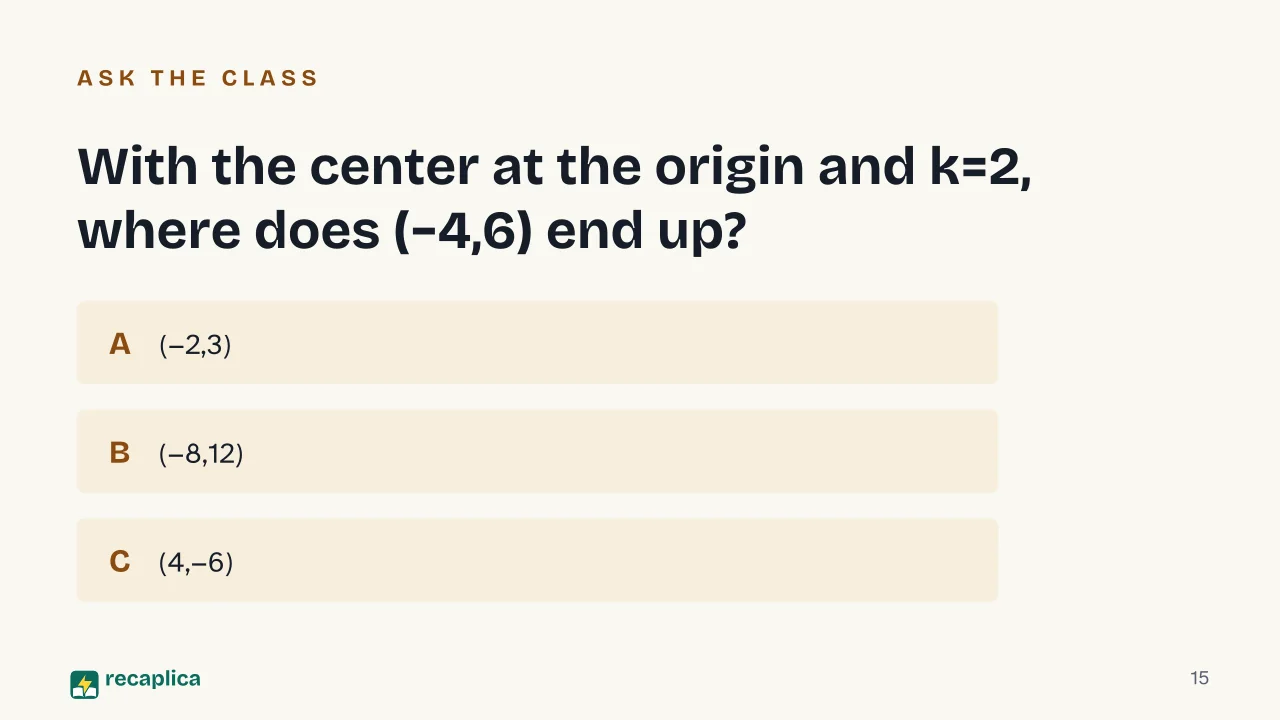  Common myths
Mind mapDrag the background to move around and the nodes to reposition them; use − and + to collapse and expand branches. 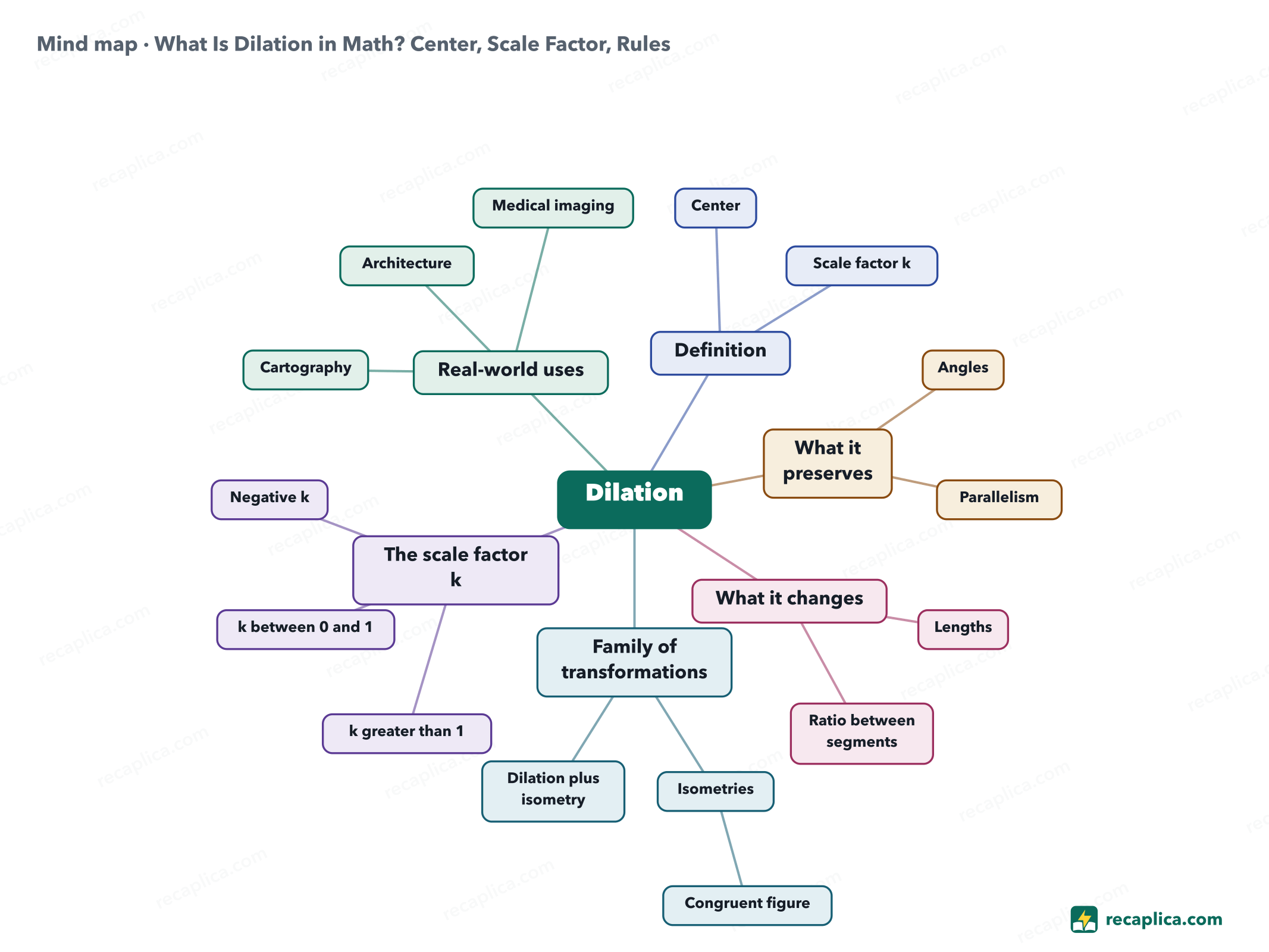
Quiz: test yourselfAnswer the questions to check what you have learned: you get instant feedback and a short explanation. Grade 0/10 0/5
FlashcardsTap the card to flip it and check whether you remember the answer, then move to the next one. 1 / 8 Explain it in your own wordsThe ultimate test: if you can explain it in simple words, you've truly understood it. Write your explanation, then compare it with the Recap. Your explanation is saved only on this device.
Frequently asked questionsWhat is the difference between dilation and a similarity transformation?Dilation is a single type of transformation, set by a center and a scale factor k. Similarity transformation is a wider family: it appears when a translation, a rotation, or a reflection is added to a dilation, so it can include a shift along with the change in scale. Is dilation an isometry?No. Isometries (translations, rotations, reflections, glide reflections) preserve the lengths of segments. A dilation scales every length instead, by the scale factor k. Can the scale factor k be negative?Yes, Treccani's general definition allows it. For this Recap we looked for a worked numeric example with a negative k in the sources used and did not find one. How do you calculate the dilation of a point on the coordinate plane?If the center sits at the origin, multiply both coordinates by k. If the center is a different point, subtract the center from the point, apply k to that difference, then add the center back to the result. What is dilation used for in real life?Cartographers rely on the same principle to scale down real territory onto a map, architects use it to build scale models of buildings before construction, and radiologists use it to zoom in or out on organs and tissue in MRI or CT images. Every Recap goes through an independent review before publication. |