|
recaplica
Black Holes, What They Are and How They Form | |||||||||||||||
| © 2026 Recaplica · recaplica.com — All rights reserved | |||||||||||||||
Black Holes, What They Are and How They FormWhat to print Page numbers appear when printing with default margins. SlidesChoose a cut Flash10 slidesThe essential thread, to present in classFull15 slidesEvery chapter and the deeper detailBoth come with speaker notes. In 30 seconds quick readA black hole is matter packed so tightly that its gravity stops anything, including light, from escaping. Most form when a massive star runs out of fuel, explodes as a supernova, and its collapsing core packs itself past a critical density; others sit at the center of nearly every galaxy, ours included, with masses far beyond anything a dying star could leave behind. The point of no return is called the event horizon, and inside it general relativity predicts a singularity, where matter is crushed to an extreme. Direct evidence only arrived in 2015, when LIGO detected gravitational waves from two merging black holes, followed by images of the shadow cast by two more, in 2019 and 2022. Key Points
Key figures
Deep DiveWhat Are Black HolesA black hole is a mass packed into an extremely small volume. According to NASA, the gravity just below its apparent surface, the event horizon, is so strong that nothing escapes it, not even light. ESA describes it in similar terms, as an object so dense that its escape velocity outruns light itself: for comparison, Earth’s escape velocity is about 11 km/s, a tiny fraction of what it would take to leave a black hole behind. NASA defines the event horizon as the boundary containing all the matter that makes up the black hole: past that boundary, escaping would require moving faster than light, which makes it impossible. Newton’s laws explain gravity well enough for everyday purposes, but close to a black hole they give way to Einstein’s general relativity, published in 1915, which laid the theoretical groundwork for these objects to exist at all. At the black hole’s center, its equations predict a singularity, a point where matter is crushed beyond anything known physics can describe. How They FormStellar black holes come from the death of a star far more massive than the Sun. Once its nuclear fuel runs out, the star explodes as a supernova; if the leftover core exceeds roughly three solar masses, per ESA, it keeps collapsing under its own weight until it becomes a black hole. Below that threshold, the remnant stops shrinking earlier, ending up as a white dwarf or a neutron star instead. Supermassive black holes are a different story. ESA describes them as objects found at the center of most galaxies, the Milky Way included, with masses of millions or even billions of times the Sun’s. Exactly how they form isn’t covered by the general-audience sources consulted for this Recap; what is documented is how common they are at galactic centers, and how precisely their masses have been measured in a few well-studied cases.
How We Observe ThemFor centuries, black holes stayed a theoretical guess. John Michell first proposed the idea in 1784, describing objects so dense that light couldn’t escape them; in 1915, Einstein supplied the theoretical foundation with general relativity. Direct proof didn’t arrive until 2015, when LIGO detected gravitational waves from the merger of two black holes weighing 29 and 36 solar masses, an event that produced a 62-solar-mass black hole and released roughly 3 solar masses’ worth of energy as gravitational radiation in a fraction of a second. In 2019 came the first direct image, of the black hole at the center of galaxy M87, some 55 million light-years away, with a mass of 6.5 billion suns. In 2022 came the second, of Sagittarius A*, the black hole at the Milky Way’s center, with a mass of about 4 million suns and a distance of roughly 27,000 light-years. In both cases, the Event Horizon Telescope didn’t photograph the black hole itself, which by definition emits no light, but the dark shadow it casts against the glowing ring of gas surrounding it. Among the records NASA catalogs, without a specific year attached in the source consulted: the closest known black hole, Gaia BH1, about 1,500 light-years away; the most distant, the quasar QSO J0313-1806, roughly 13 billion light-years out; the most massive, TON 618, at 66 billion solar masses; and the fastest spinning, GRS 1915+105, turning over more than 1,000 times a second. Myths Worth RetiringThe most common myth is the cosmic vacuum cleaner: a black hole that sucks in everything nearby. NASA rejects that outright, its gravity behaves exactly like that of any other mass at the same distance. A planet orbiting far from a black hole would keep orbiting the same way if that mass belonged to an ordinary star of equal weight instead. Slide deckSlides ready to download and make your own in PowerPoint or Google Slides, with speaker notes. Pick the Flash cut or the Full one.     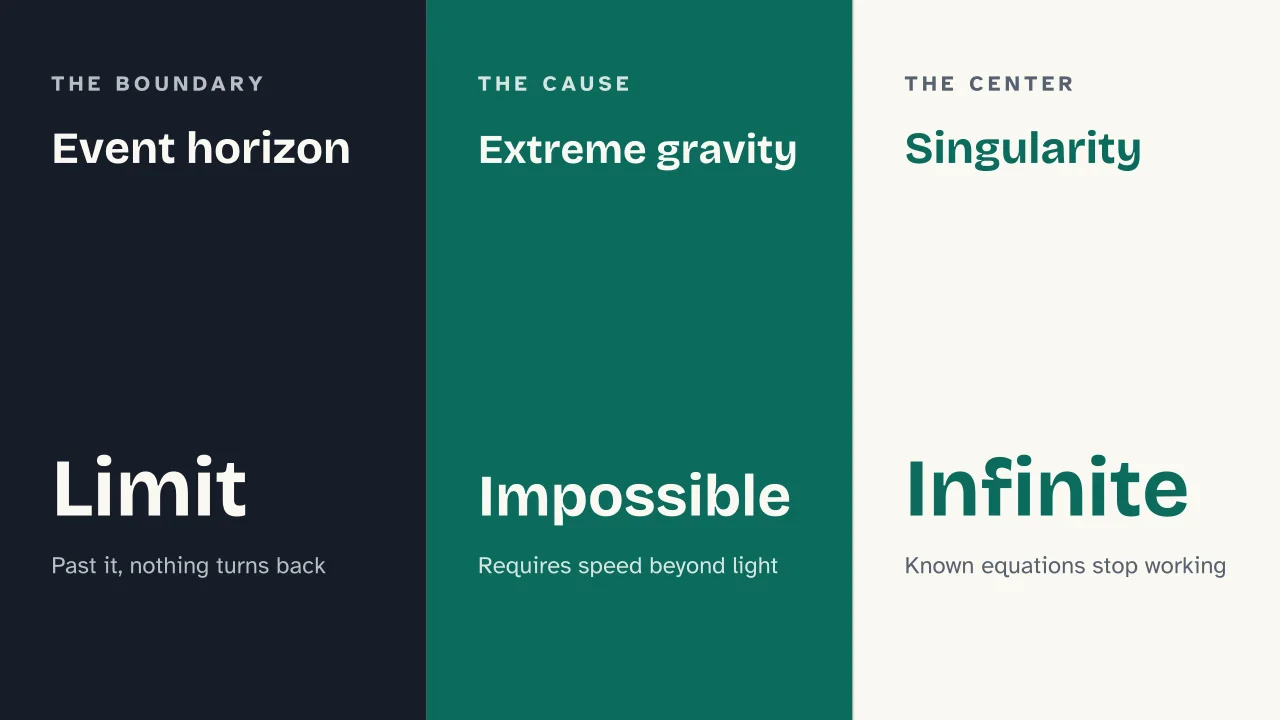  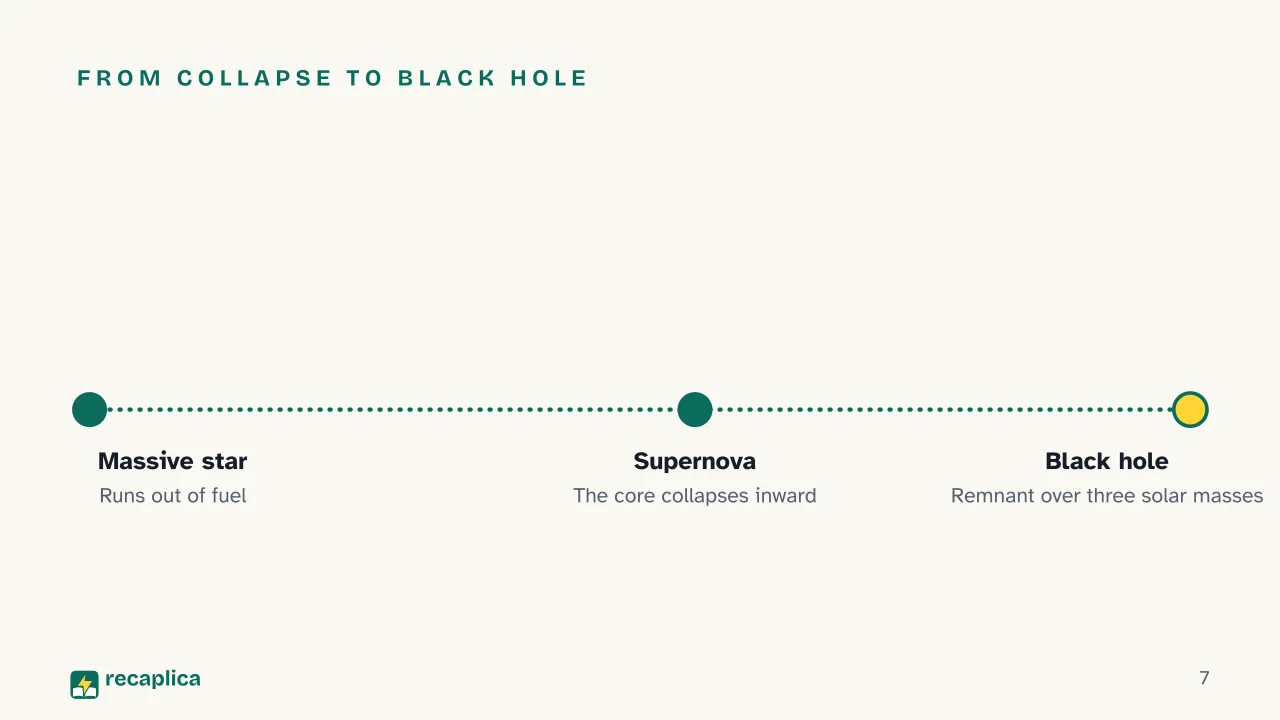 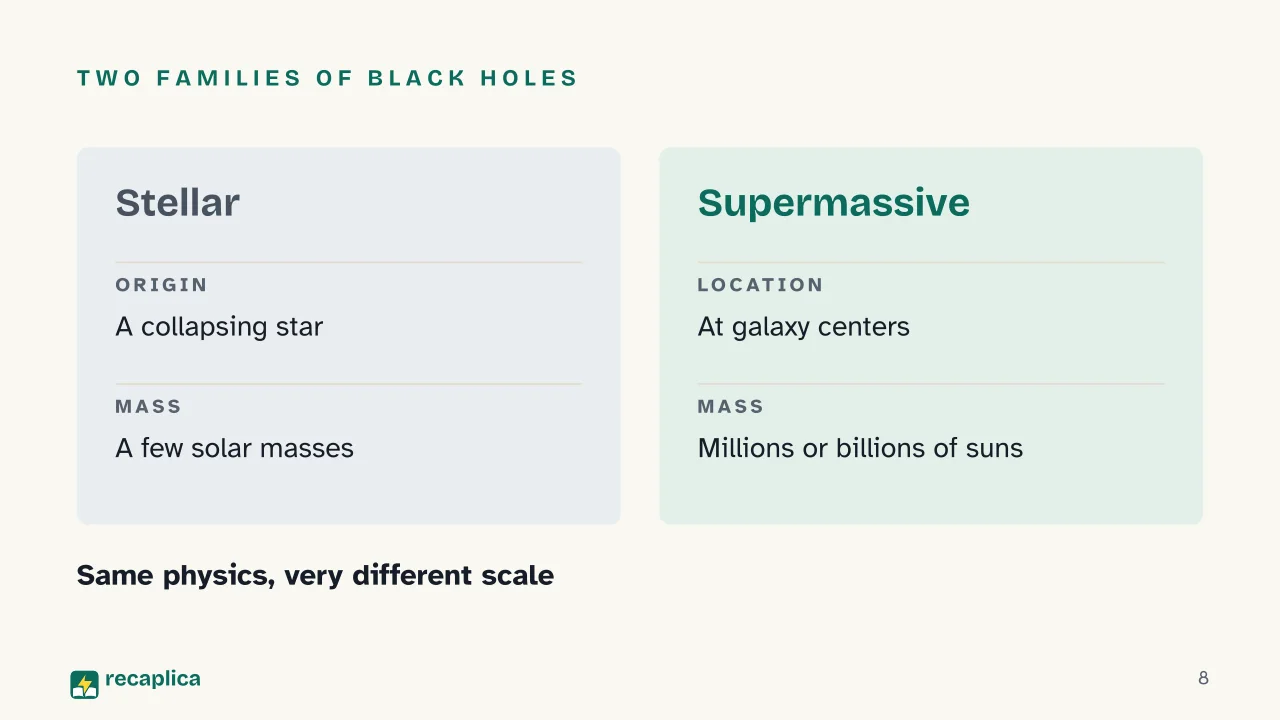  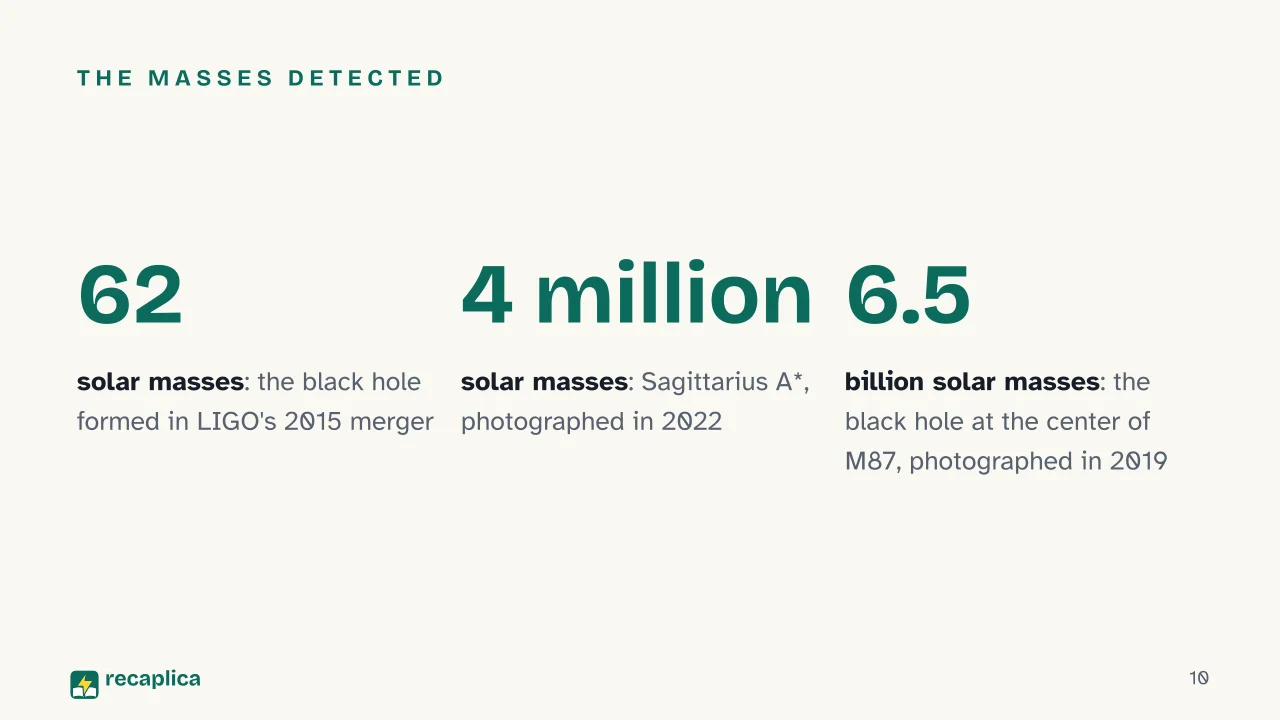 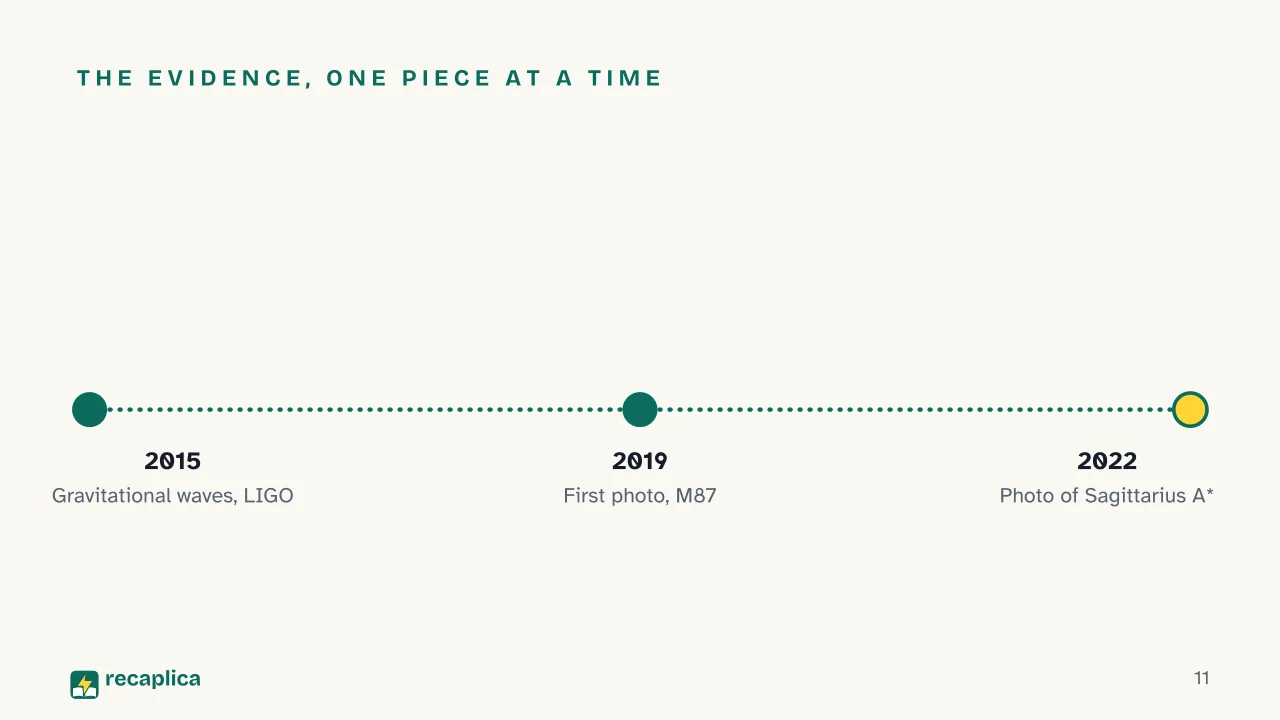  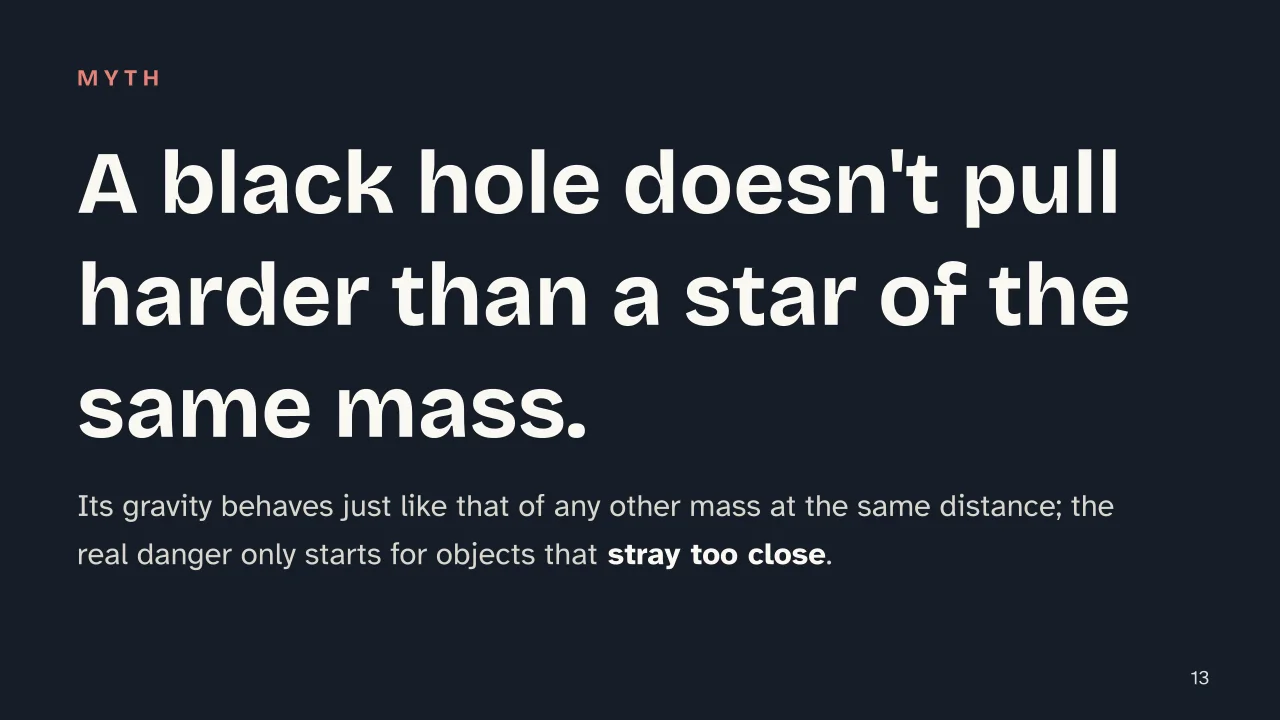 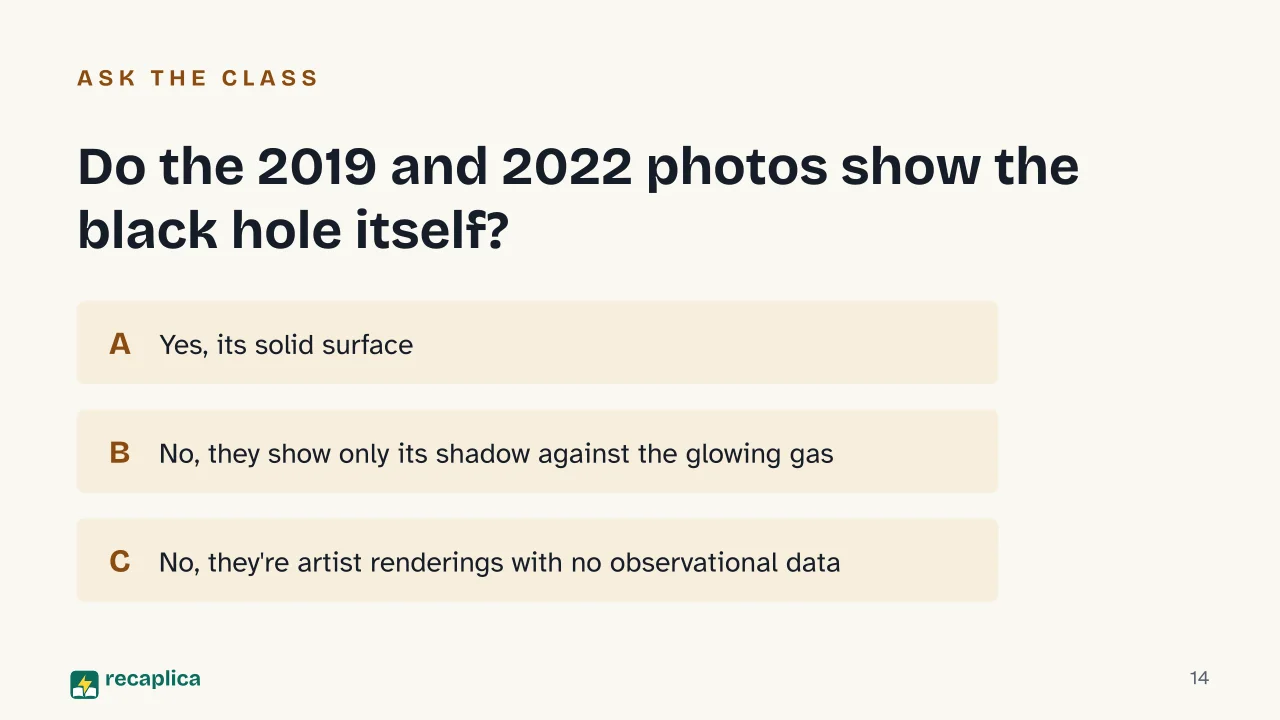  Common myths
Mind mapDrag the background to move around and the nodes to reposition them; use − and + to collapse and expand branches. 
Quiz: test yourselfAnswer the questions to check what you have learned: you get instant feedback and a short explanation. Grade 0/10 0/5
FlashcardsTap the card to flip it and check whether you remember the answer, then move to the next one. 1 / 7 Explain it in your own wordsThe ultimate test: if you can explain it in simple words, you've truly understood it. Write your explanation, then compare it with the Recap. Your explanation is saved only on this device.
Frequently asked questionsWhat are black holes?They are concentrations of matter so dense that their gravity keeps anything from escaping, light included. There are two main kinds, stellar and supermassive, both woven into the structure of galaxies. How do black holes form?Stellar black holes come from the collapsed core of a very massive star after it explodes as a supernova, once the remnant exceeds about three solar masses. Supermassive ones sit at the center of nearly every galaxy, with masses of millions or billions of suns. Can black holes actually be seen?Not directly, since they give off no light of their own. The 2019 (M87) and 2022 (Sagittarius A*) photographs show the dark shadow a black hole casts against the glowing ring of gas around it. What is the event horizon?It's the boundary beyond which the speed needed to escape exceeds the speed of light: past that point, nothing can turn back. What's the difference between stellar and supermassive black holes?The first kind has a mass of only a few suns and comes from a star's death; the second reaches millions or billions of solar masses and sits at the center of galaxies, including the Milky Way. Every Recap goes through an independent review before publication. |