|
recaplica
What Is the Fibonacci Sequence? The Formula and Where It Appears in Nature | ||||||||||
| © 2026 Recaplica · recaplica.com — All rights reserved | ||||||||||
What Is the Fibonacci Sequence? The Formula and Where It Appears in NatureWhat to print Page numbers appear when printing with default margins. SlidesChoose a cut Flash10 slidesThe essential thread, to present in classFull16 slidesEvery chapter and the deeper detailBoth come with speaker notes. In 30 seconds quick readThe Fibonacci sequence is a list of numbers that starts with 1, 1 and keeps going by adding the two previous numbers, 1, 1, 2, 3, 5, 8, 13, 21 and so on. It was first written down in 1202 by the mathematician Leonardo of Pisa, known as Fibonacci, starting from a problem about rabbits breeding. The ratio between two consecutive numbers in the sequence gets closer and closer to a specific value, the golden ratio, about 1.618, as the numbers grow. This proportion shows up often in nature, for example in the spiral patterns of sunflower seeds, but it is not a universal rule without exceptions. Key Points
Deep DiveWhat the Fibonacci sequence isThe Fibonacci sequence is a list of whole numbers that starts with 1, 1 and keeps going by adding the two previous terms: 1, 1, 2, 3, 5, 8, 13, 21, 34, 55, and so on, without end. It is one of the best-known examples of arithmetic applied to a repeating pattern: the operations are just additions, yet they generate a structure that keeps reappearing in fields far from pure mathematics. The recursive rule, step by stepEvery number in the sequence has a specific position, first, second, third, and the rule is written F(n) = F(n-1) + F(n-2), where n marks the position of the term in the sequence (a concept worth revisiting through ordinal and cardinal numbers). To find the eighth term, just add the sixth and the seventh: 8 plus 13 makes 21. Taken as an ordered collection of numbers, the whole sequence belongs among the objects covered when reviewing number sets: here the set is not given in advance, it grows one term at a time according to the rule. Writing the rule with a letter instead of a number, F(n) instead of “the eighth term,” is the same move made in algebra: a general formula that holds for any position in the sequence, not just one particular case. A 13th-century origin: Leonardo of Pisa and the rabbit problemThe sequence was introduced to Europe by Leonardo of Pisa, known as Fibonacci, in the Liber Abaci, published in 1202. Fibonacci grew up between Italy and North Africa, where his father Guilielmo held a diplomatic post. He returned to Pisa around 1200, carrying with him a direct contact with Arabic and Indian mathematics that he later brought into Europe in the Liber Abaci, along with the Hindu-Arabic numerals and the decimal system. In the book, Fibonacci posed a concrete problem: how many pairs of rabbits result in a year, starting from a single pair, if every month each mature pair produces a new pair? The sequence that solves the problem is exactly 1, 1, 2, 3, 5, 8, 13, 21, 34, 55. In the original text, though, Fibonacci left out the very first term, starting from 1, 2, 3, 5 rather than 1, 1, 2, 3, 5, which is why some sources show the sequence beginning with one number fewer. The link with the golden ratioDividing one number in the sequence by the one immediately before it gives a value that shifts little by little: 21 divided by 13 makes about 1.615, 34 divided by 21 makes about 1.619. The further along the sequence you go, the closer these ratios get to a single number, the golden ratio, about 1.618, the limit of the ratio between two consecutive terms as n approaches infinity. It is a proven result, not just an impression: the mathematical link between the Fibonacci sequence and the golden ratio is one of the few solid connections among the many claims circulating about this number. Fibonacci himself, though, never discovered it: nothing from the 13th century suggests he connected his sequence to this proportion, which was only formalized centuries later. Where it shows up in nature: from sunflowers to phyllotaxis
There is a shortcut to avoid, though: not every real sunflower matches the pattern perfectly. It is widespread, typical of most specimens, but counts exist that fall outside the sequence, a detail worth keeping in mind before treating Fibonacci as a rule without exceptions. A second example involves phyllotaxis, the arrangement of leaves around a plant’s stem, often described as the fraction of a turn separating one leaf from the next:
Further down the table, the value gets closer to the golden ratio, the same limit described above for the ratios between consecutive terms of the sequence. Fibonacci in art: more legend than historyThe Fibonacci sequence is also often called the Fibonacci series, and that name tends to come with a recurring story: that the golden ratio was used on purpose in building the Parthenon or in the proportions of Renaissance paintings. Mathematics historian Keith Devlin, of Stanford University, traced these claims back and found no support in sources from the period: the idea took hold from an 1855 book by the German scholar Adolf Zeising, after which, in Devlin’s words, the golden ratio theme “took off.” Slide deckSlides ready to download and make your own in PowerPoint or Google Slides, with speaker notes. Pick the Flash cut or the Full one.     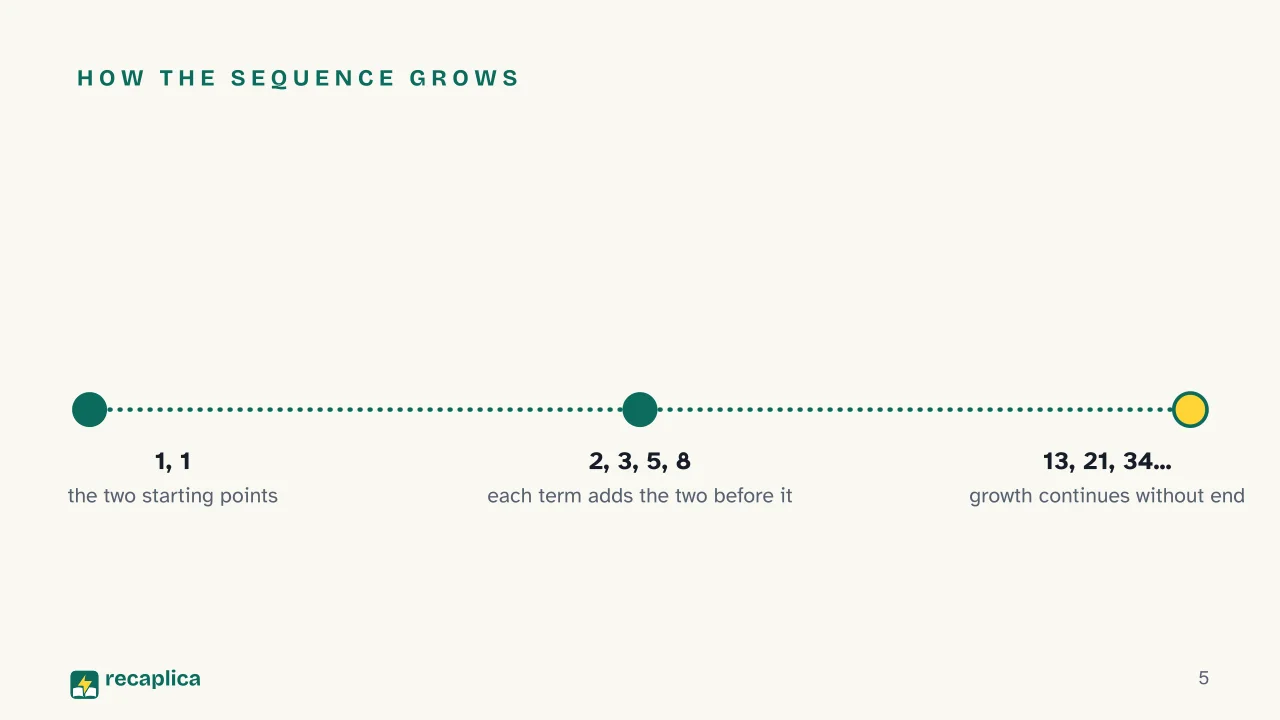  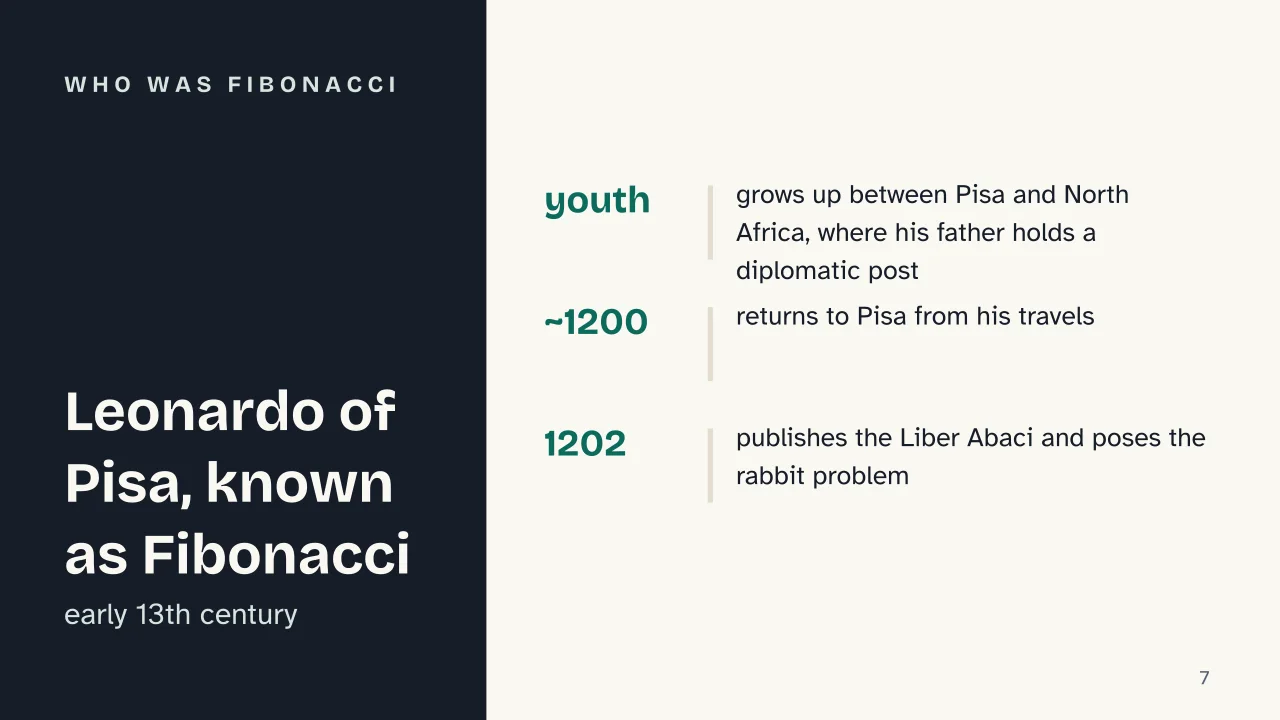  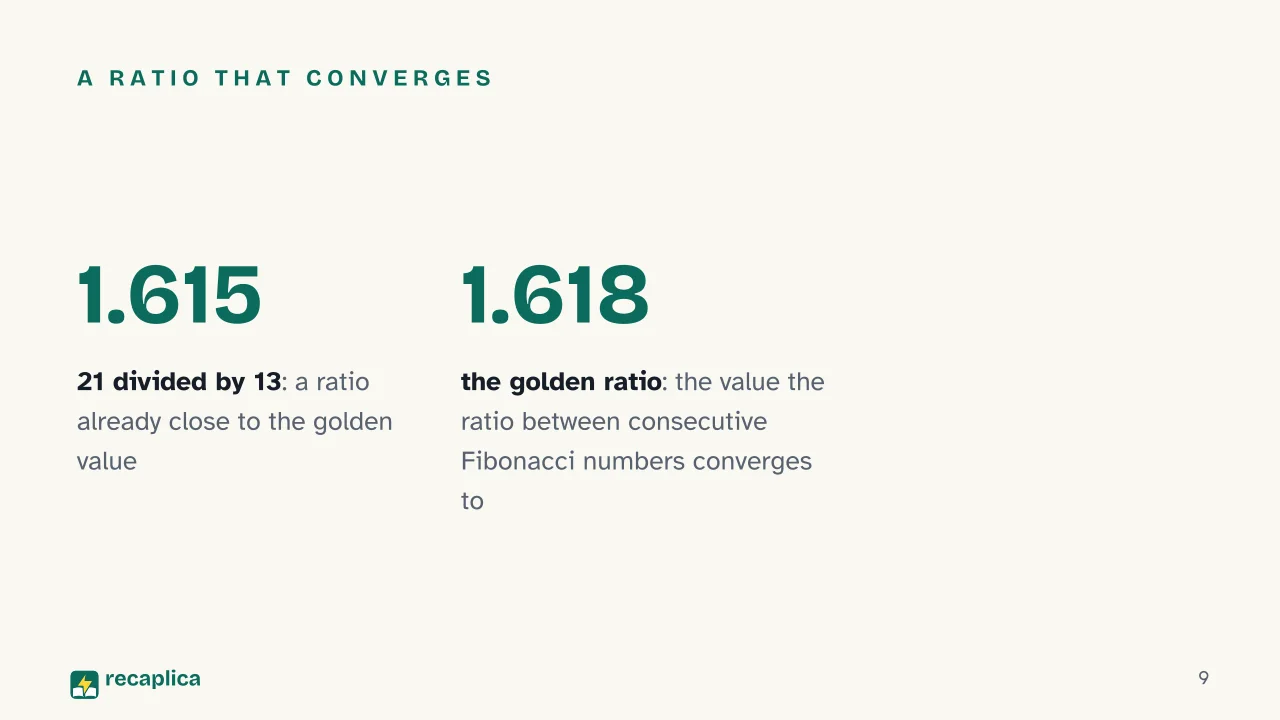 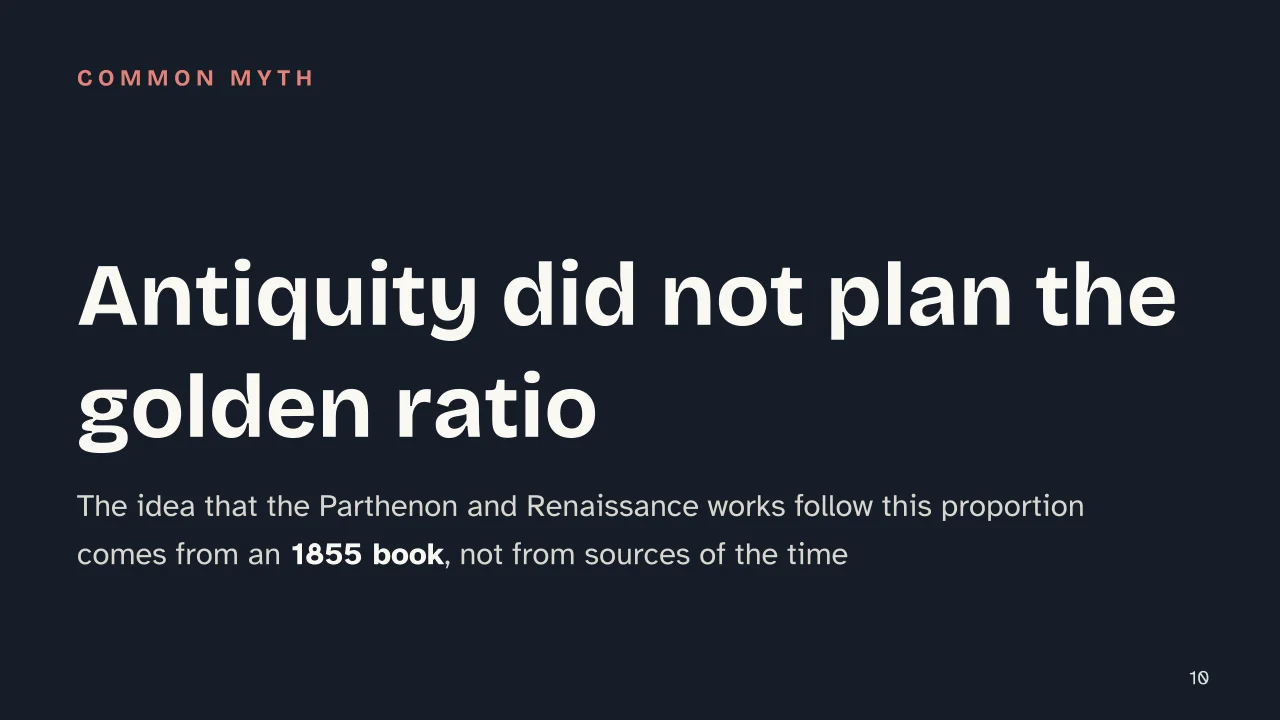  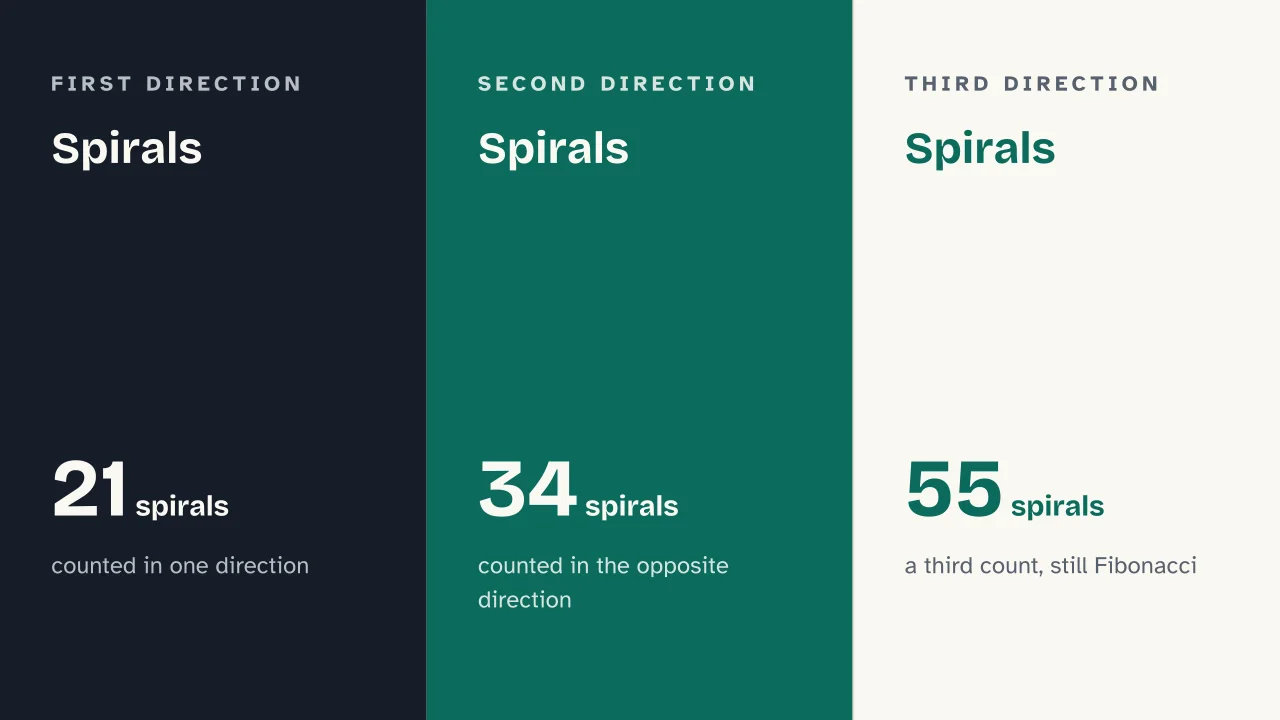 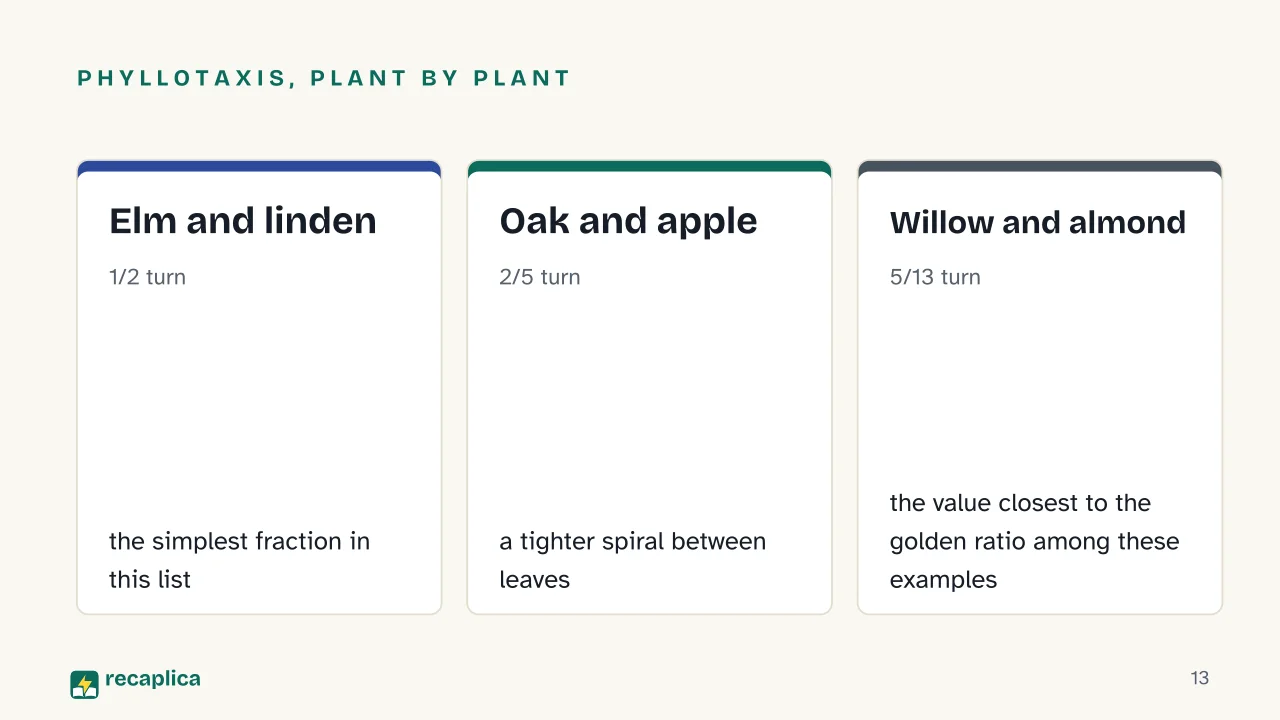 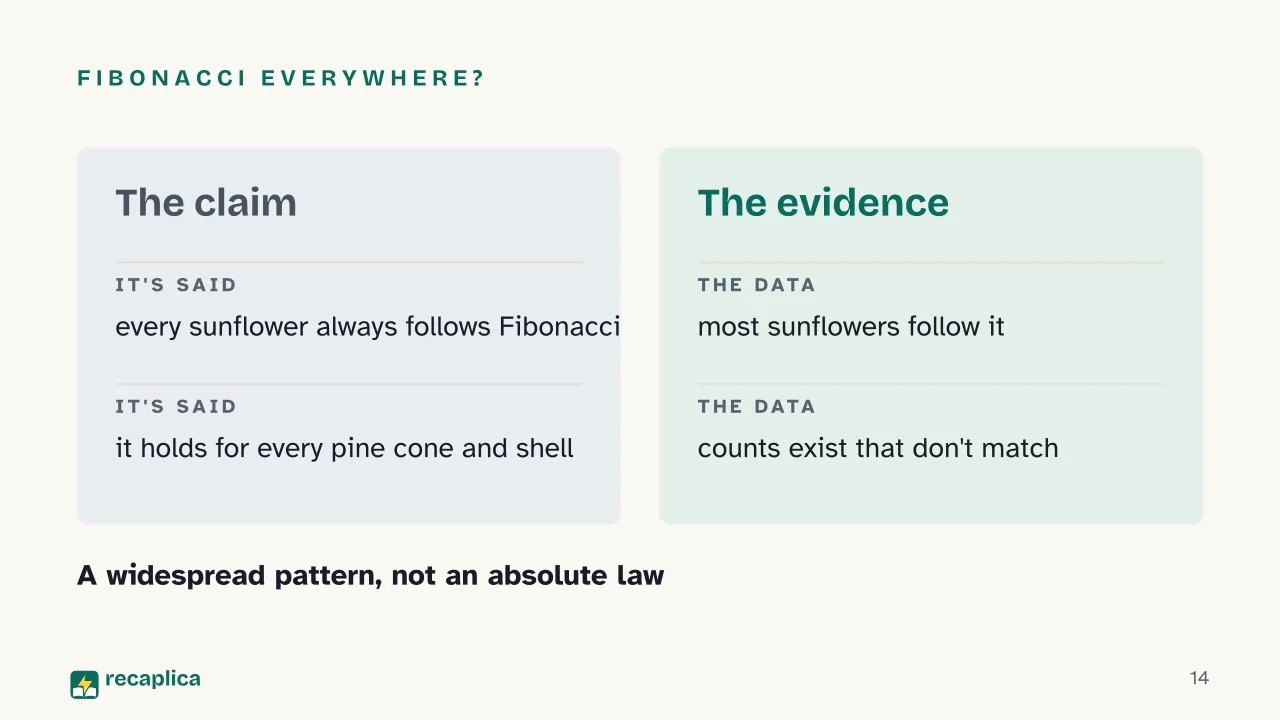 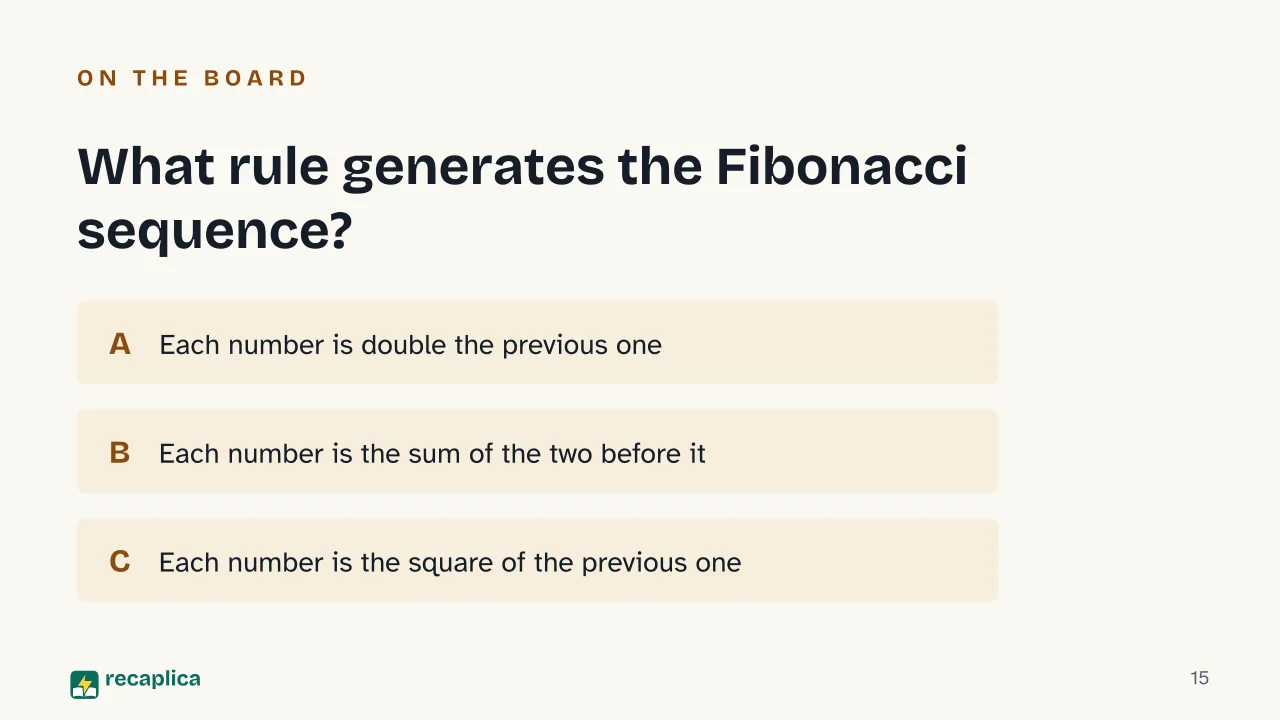  Common myths
Mind mapDrag the background to move around and the nodes to reposition them; use − and + to collapse and expand branches. 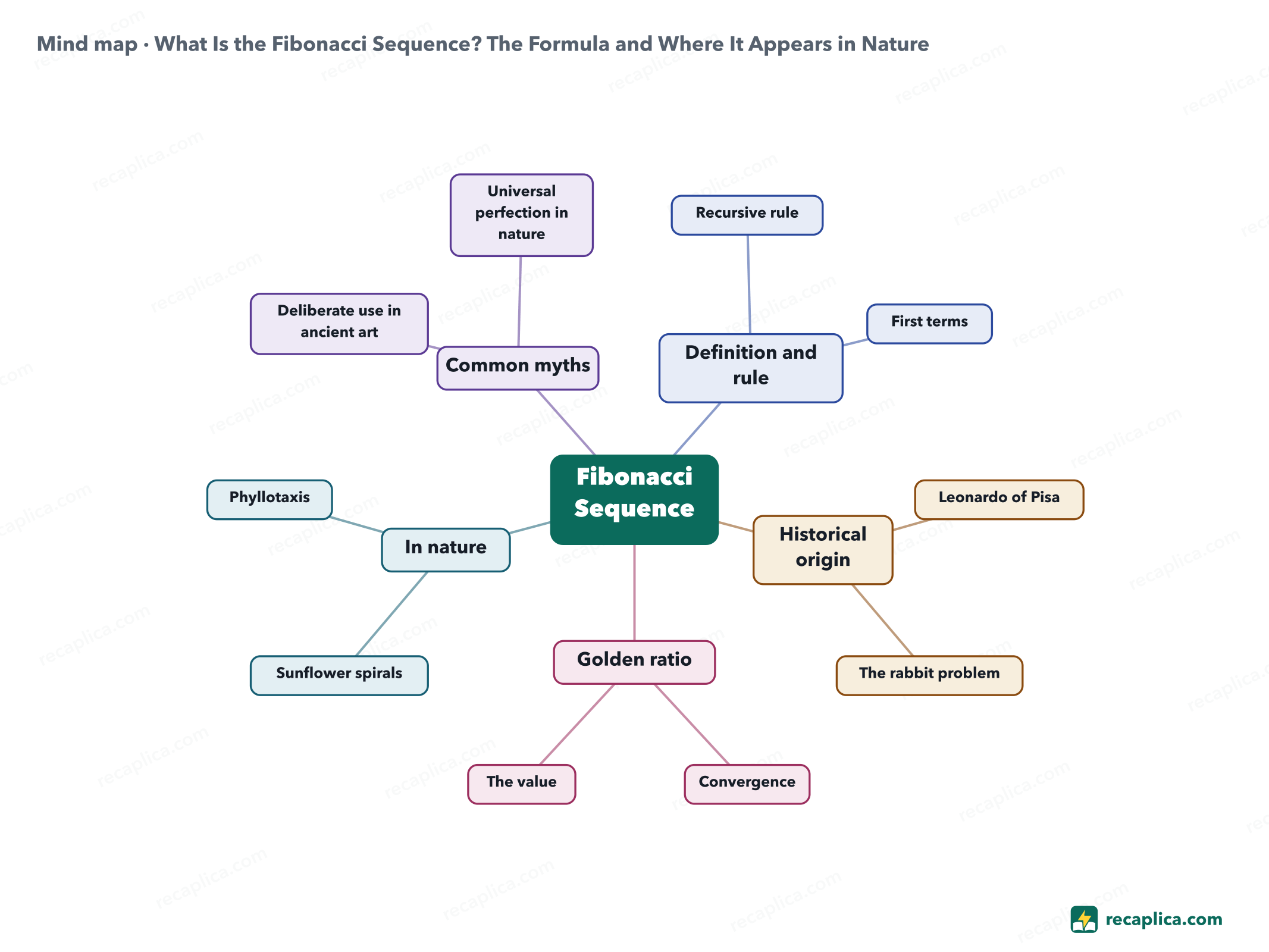
Quiz: test yourselfAnswer the questions to check what you have learned: you get instant feedback and a short explanation. Grade 0/10 0/5
FlashcardsTap the card to flip it and check whether you remember the answer, then move to the next one. 1 / 8 Explain it in your own wordsThe ultimate test: if you can explain it in simple words, you've truly understood it. Write your explanation, then compare it with the Recap. Your explanation is saved only on this device.
Frequently asked questionsWhat is the Fibonacci series?It is another name for the same sequence: the list of numbers that starts with 1, 1 and continues by adding the two previous terms, 1, 1, 2, 3, 5, 8, 13... 'Series' and 'sequence' are often used as synonyms in everyday language, even though in mathematics a series strictly refers to the sum of the terms. What is the relationship between Fibonacci numbers and the golden ratio?Dividing a Fibonacci number by the one immediately before it gives a value that gets closer and closer to the golden ratio, about 1.618, the further along the sequence you go. Where does the Fibonacci sequence show up in nature?It appears, for example, in the spiral counts of sunflower seeds, often 21, 34, or 55, and in phyllotaxis, the arrangement of leaves around a stem, which in various plants follows fractions linked to Fibonacci numbers. It is not, however, a rule without exceptions. Does the Fibonacci sequence also appear in art?It is often said that works like the Parthenon or Renaissance paintings deliberately follow the golden ratio linked to Fibonacci numbers, but mathematics historians have found no evidence of intentional use in ancient times: the idea originates from an 1855 book. Who discovered the Fibonacci sequence?It was described in Europe by Leonardo of Pisa, known as Fibonacci, in the Liber Abaci of 1202, starting from a problem about rabbits breeding. Every Recap goes through an independent review before publication. |