|
recaplica
Ordinal Numbers: Definition, Formation Rules, and How They Differ from Cardinal Numbers | ||||||||||||||||||||||||||||||||||||||||||||
| © 2026 Recaplica · recaplica.com — All rights reserved | ||||||||||||||||||||||||||||||||||||||||||||
Ordinal Numbers: Definition, Formation Rules, and How They Differ from Cardinal NumbersWhat to print Page numbers appear when printing with default margins. SlidesChoose a cut Flash10 slidesThe essential thread, to present in classFull14 slidesEvery chapter and the deeper detailBoth come with speaker notes. In 30 seconds quick readCardinal numbers count a quantity (one, two, three...), ordinal numbers mark a position in a sequence (first, second, third...). English ordinals mostly add the suffix -th to the cardinal, but seven of them are irregular or change their spelling: first, second, third, fifth, eighth, ninth and twelfth. Ordinals from 11 to 13 always take -th, breaking the usual pattern of -st, -nd and -rd for numbers ending in 1, 2 and 3. In figures, ordinals are written with a suffix (1st, 9th) or, for royal names, with a roman numeral placed after the name and read aloud as an ordinal. Key Points
Deep DiveNumbers do two different jobs in everyday English. When you’re counting, you reach for cardinal numbers (two apples, twenty-nine pages); when you’re putting something in order, you reach for ordinal numbers (the second apple, the twenty-ninth day). Anyone studying number sets meets both families early on, using the same set of numbers to count in one context and to rank in another. Cardinal numbersCardinal numbers match the counting sequence and answer “how many”: two, twenty-nine, one hundred and four. In English they don’t change form for gender, unlike in some other languages — “two apples” and “two oranges” use the same word “two” regardless of what’s being counted.
Ordinal numbersOrdinal numbers show the position of something or someone in an ordered sequence: first, second, third. Most of them are formed by taking the cardinal number and adding the suffix -th: four becomes fourth, six becomes sixth, ten becomes tenth. Seven ordinals break that pattern. Three have no connection at all to their cardinal form: first, second and third. Four more keep the -th suffix but shift their spelling: five becomes fifth, eight becomes eighth, nine becomes ninth, and twelve becomes twelfth. Every other ordinal simply adds -th to the cardinal, sometimes dropping a final letter, as in twenty becoming twentieth.
The same rule carries on past twenty, with the tens taking -ieth in place of a final -y: thirty becomes 30th (thirtieth), forty becomes 40th (fortieth), and so on up to ninety becoming 90th (ninetieth), with one hundred becoming 100th (hundredth). Compound numbers only change their last word: seventy-one becomes 71st (seventy-first), and one hundred ninety-eight becomes 198th (one hundred ninety-eighth). How ordinals are written in figuresOrdinals are usually written as a number followed by a suffix that depends on the last digit: -st for numbers ending in 1 (21st, 31st), -nd for numbers ending in 2 (22nd, 32nd), -rd for numbers ending in 3 (23rd, 33rd), and -th for everything else, including all the multiples of ten (20th, 30th). From 11 to 19 the rule is overridden: the suffix is always -th, so 11th, 12th and 13th never take -st, -nd or -rd even though their last digit would suggest it. Style guides differ on when to spell an ordinal out versus using figures — AP style spells out first to ninth and switches to figures from 10th, while the Chicago Manual of Style spells out up to one hundredth — so treat “spell it out for small numbers” as a common convention, not a fixed rule. Where the ordinal goes in a sentenceOrdinals usually come before the noun they describe: the third chapter, the second door. Royal and papal names flip that order: the ordinal follows the name and is written almost always as a roman numeral, as in Henry VIII or John Paul II. In writing, the numeral stays in roman numerals; read aloud, it becomes an ordinal — Henry VIII is spoken as “Henry the Eighth”, not “Henry the Eight”.
Cardinal and ordinal numbers side by sidePut the two side by side and the distinction is simple: a cardinal number answers “how many” and stays fixed to a quantity, while an ordinal number answers “which one” and depends on a sequence. “Four books” is a cardinal number and a cardinal number meaning of quantity; “the fourth book” is an ordinal number describing where that book sits on the shelf. Cardinal and ordinal numbers share the same numerals — four and fourth both trace back to “4” — though each fills a different grammatical role in a sentence. Anyone reviewing counting and sequencing also runs into ordinals and cardinals in arithmetic, where they help read sequences and progressions, and in algebra, where a formula referring to “the nth term” of a sequence uses a generic ordinal to stand in for all the others. Slide deckSlides ready to download and make your own in PowerPoint or Google Slides, with speaker notes. Pick the Flash cut or the Full one.     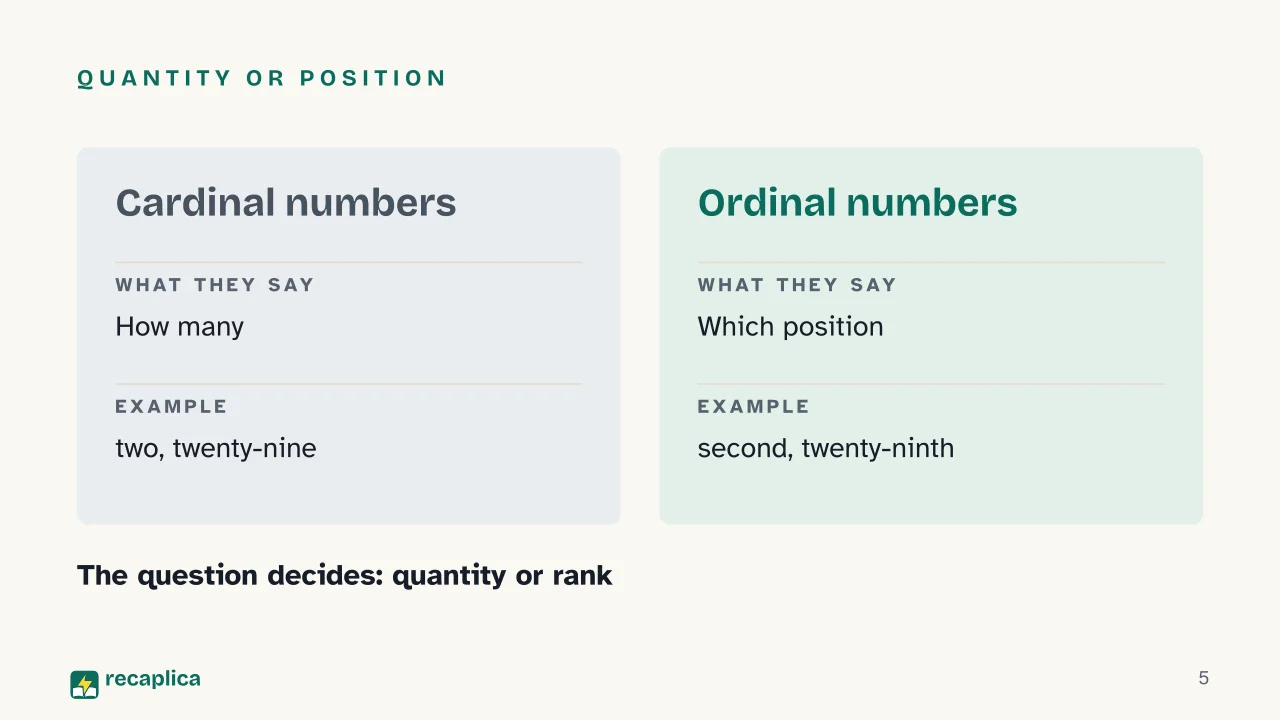  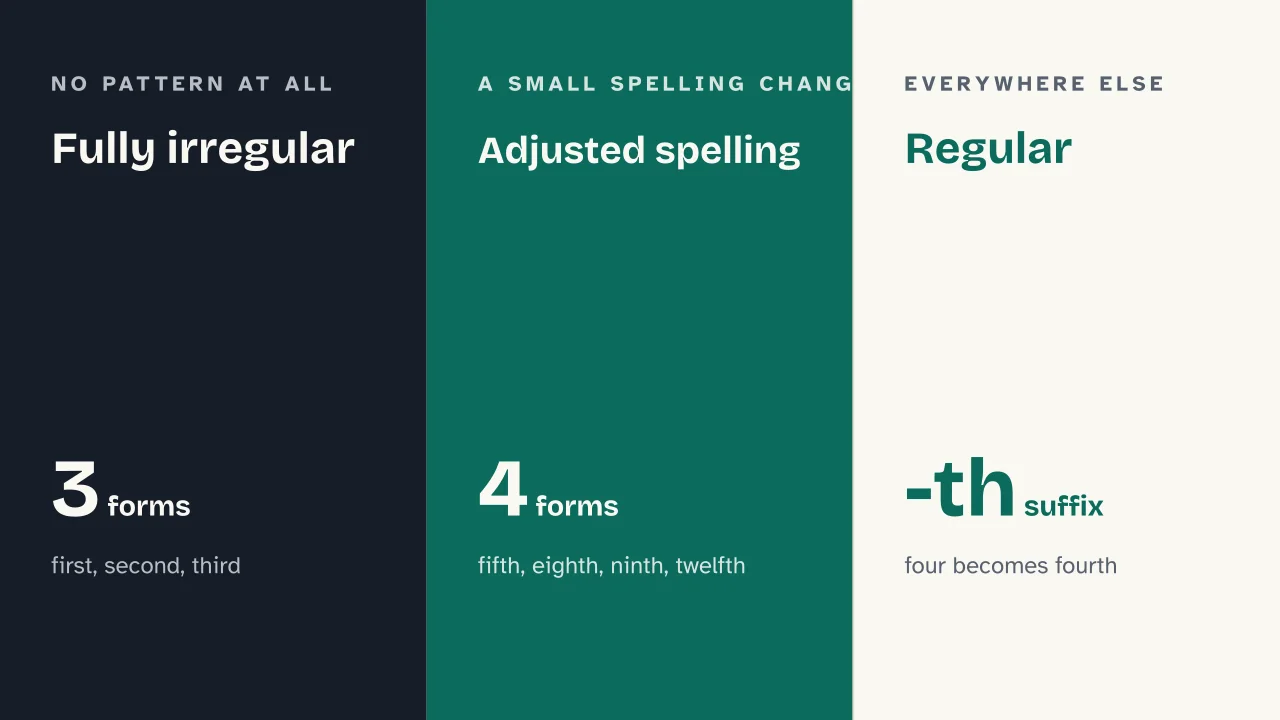  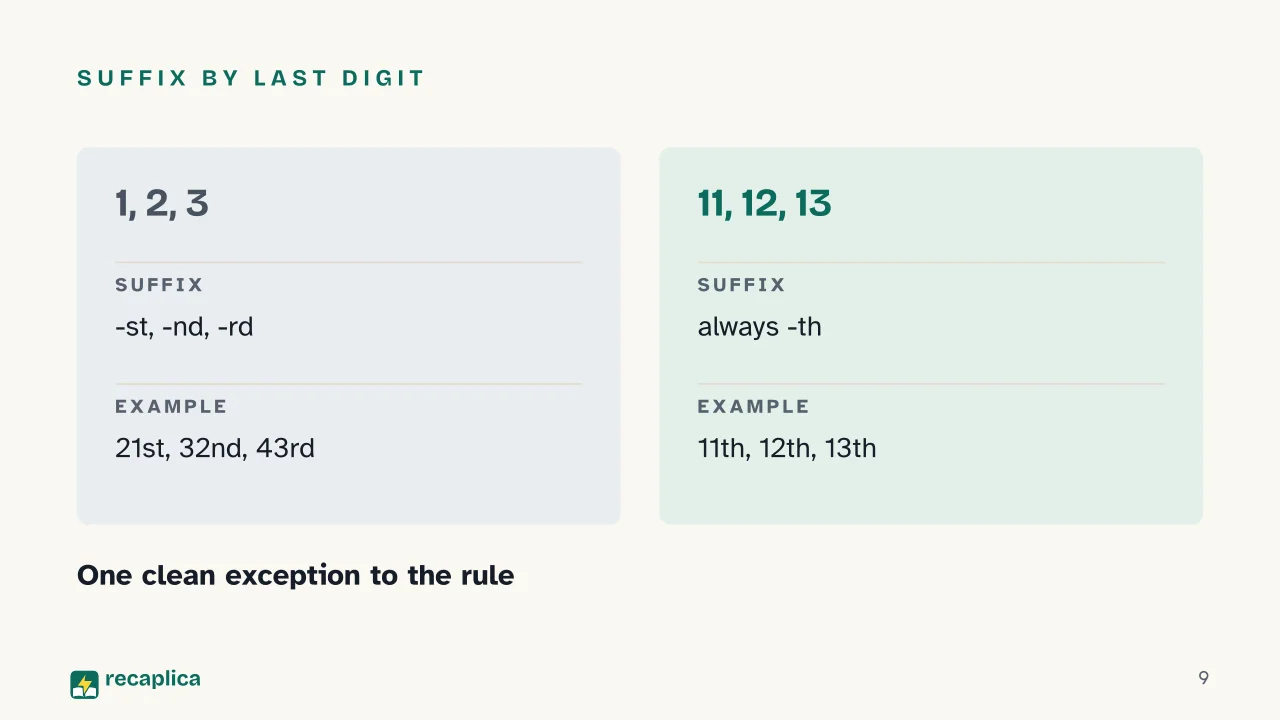   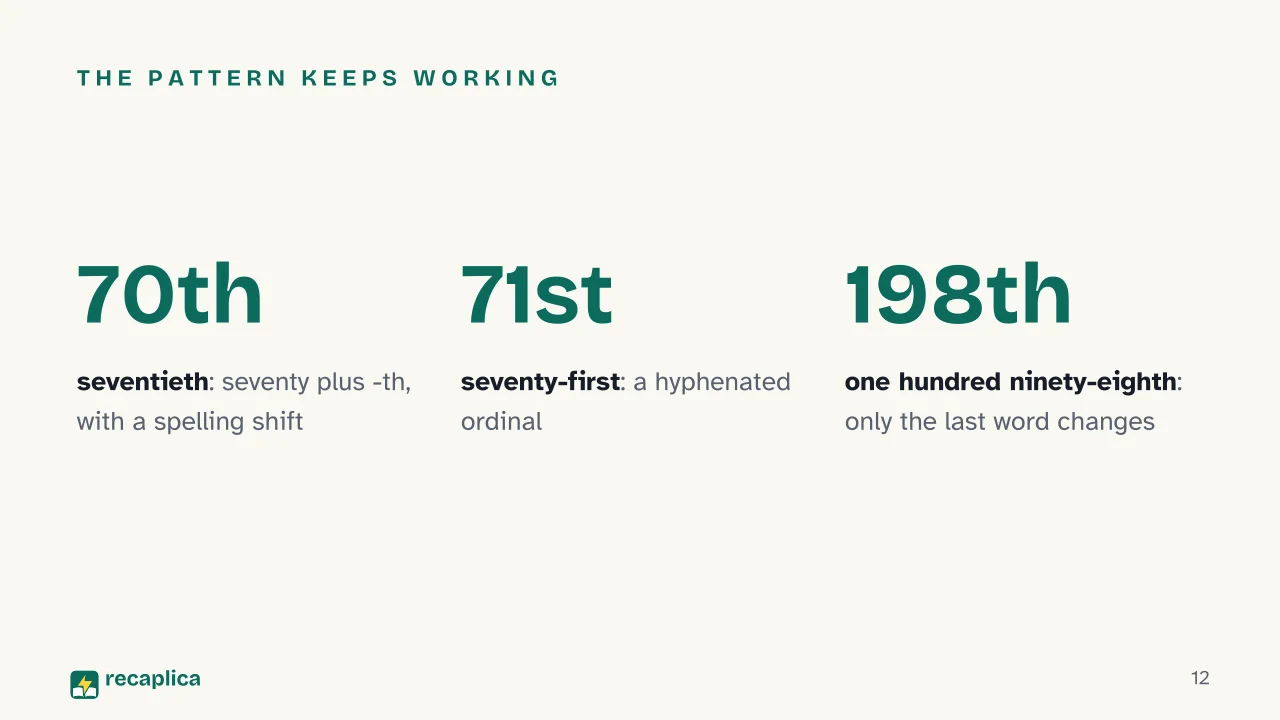 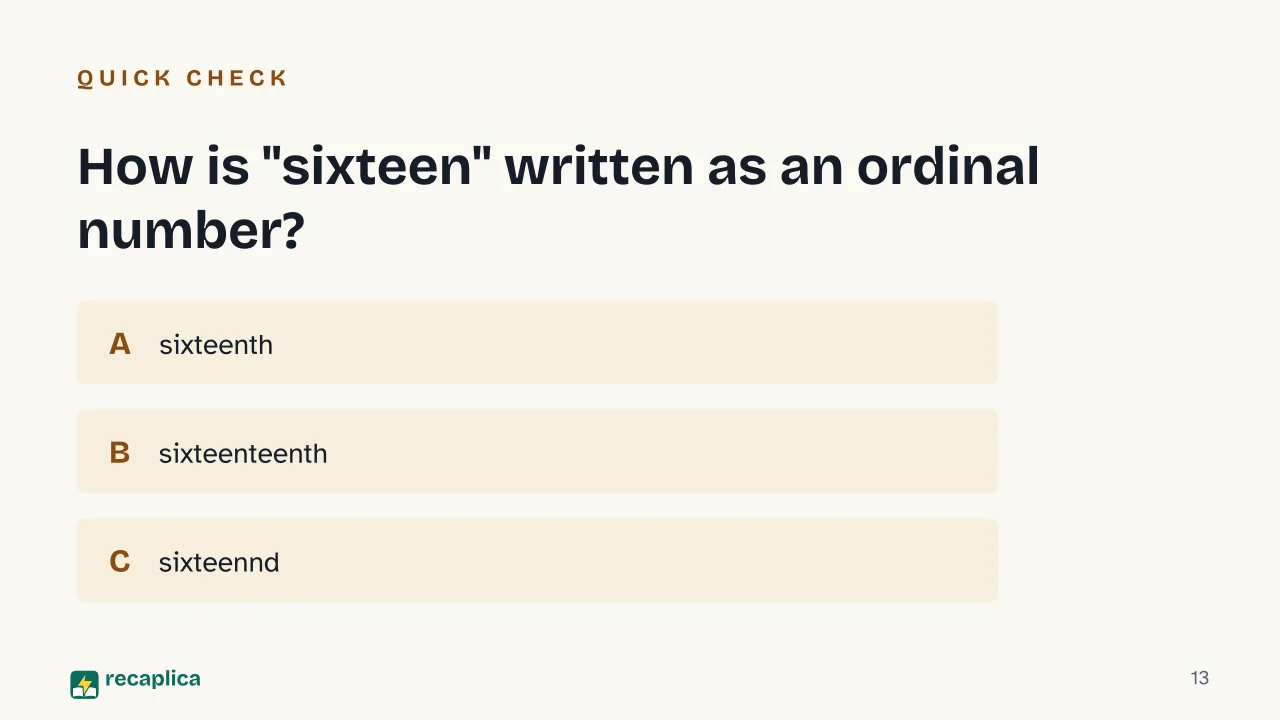  Common myths
Mind mapDrag the background to move around and the nodes to reposition them; use − and + to collapse and expand branches. 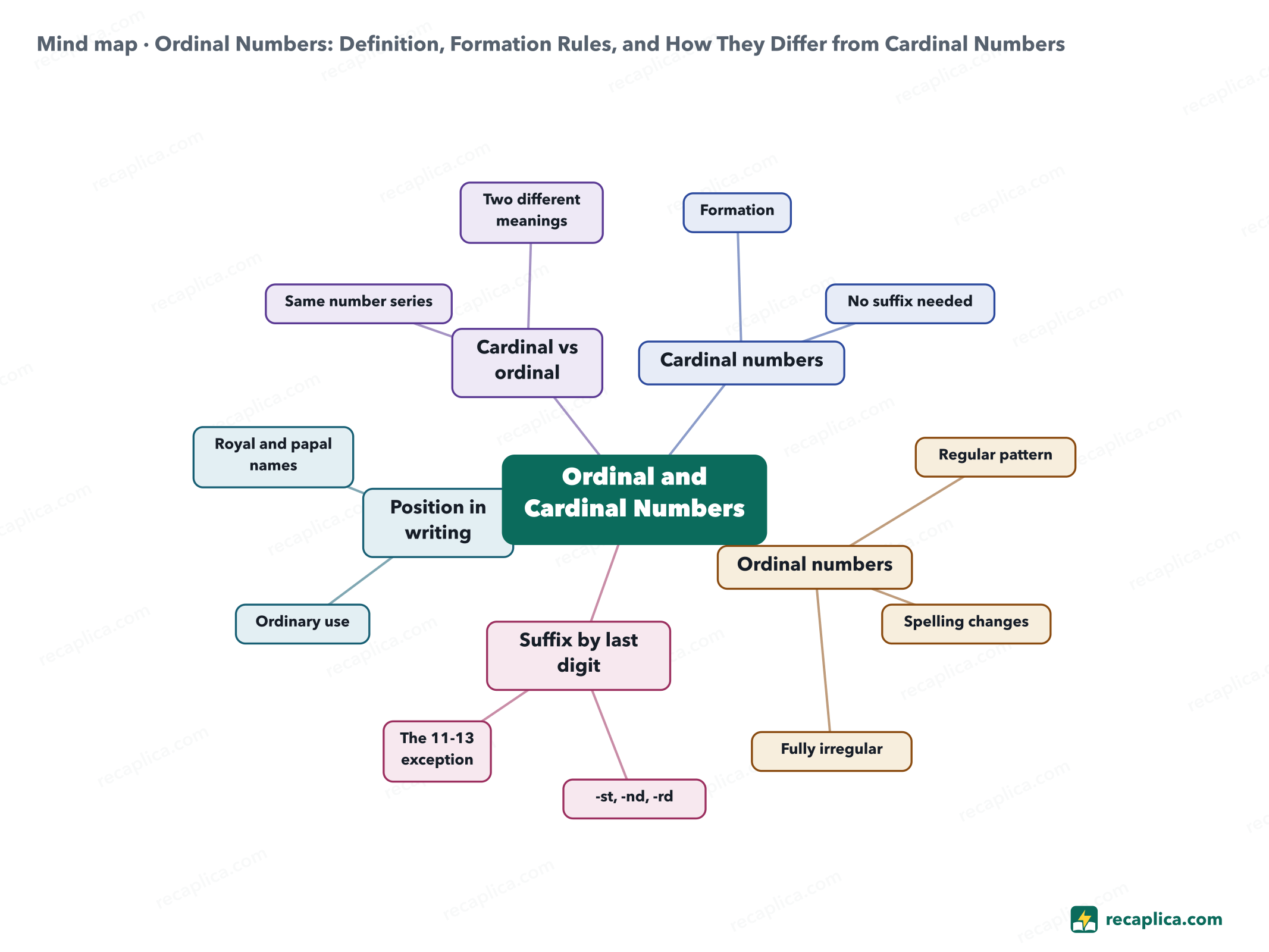
Quiz: test yourselfAnswer the questions to check what you have learned: you get instant feedback and a short explanation. Grade 0/10 0/5
FlashcardsTap the card to flip it and check whether you remember the answer, then move to the next one. 1 / 8 Explain it in your own wordsThe ultimate test: if you can explain it in simple words, you've truly understood it. Write your explanation, then compare it with the Recap. Your explanation is saved only on this device.
Frequently asked questionsWhat is the difference between cardinal and ordinal numbers?A cardinal number shows a quantity (two, twenty-nine), an ordinal number shows a position in an ordered sequence (second, twenty-ninth). It's the same series of numbers used for two different jobs: counting or ordering. What does cardinal number mean?A cardinal number is a counting number: it states how many of something there are, such as one, two or one hundred and four. It carries no information about order or rank, only quantity. How do you write ordinal numbers in English?Either spelled out (first, second, third) or as a figure with a suffix (1st, 2nd, 3rd, 4th). The suffix depends on the last digit of the number, except for 11 to 13, which always take -th. Which ordinal numbers are irregular in English?First, second and third have no connection to their cardinal forms, and fifth, eighth, ninth and twelfth keep the -th suffix but change their spelling. Every other ordinal simply adds -th to the cardinal number. Why do we write 11th and not 11st?Because from 11 to 19 the ordinal suffix is always -th, even when the last digit would suggest -st, -nd or -rd. It's an explicit exception to the general suffix rule. Every Recap goes through an independent review before publication. |