|
recaplica
Erikson's Stages of Psychosocial Development: Who Erik Erikson Was | ||||||||||||||||||||||||||||||||||||
| © 2026 Recaplica · recaplica.com — All rights reserved | ||||||||||||||||||||||||||||||||||||
Erikson's Stages of Psychosocial Development: Who Erik Erikson WasWhat to print Page numbers appear when printing with default margins. SlidesChoose a cut Flash10 slidesThe essential thread, to present in classFull16 slidesEvery chapter and the deeper detailBoth come with speaker notes. In 30 seconds quick readErik Erikson (1902-1994) was a psychoanalyst trained alongside Anna Freud in Vienna who later emigrated to the United States, where he taught at Yale and Harvard. In 1950, in the book "Childhood and Society," he laid out his theory of eight stages of psychosocial development: each stage, from birth to old age, centers on a different conflict the person has to face. Resolving one stage's conflict, by leaning into an adaptive way of responding, builds the strength needed for the next. Key Points
Key figures
Deep DiveWho Erik Erikson WasErik Erikson was born on June 15, 1902, in Frankfurt, Germany. His biological father was a Danish man who left his mother, Karla Abrahamsen; when Erik was three, his mother married the pediatrician Theodor Homburger, and the boy grew up as Erik Homburger, in a Jewish family and community. As a young man he moved to Vienna, where he entered analysis with Anna Freud and trained as one of the first child psychoanalysts, graduating from the Vienna Psychoanalytic Institute in 1933. After the Nazi rise to power he moved to the United States, where in 1939 he became a US citizen and changed his surname from Homburger to Erikson. He taught at Yale, at Harvard, at the University of California, Berkeley, and worked at the Austen Riggs Center. In 1950 he published Childhood and Society, the book that first presented his theory of eight stages of psychosocial development. He also wrote Young Man Luther (1958), Insight and Responsibility (1964), Identity: Youth and Crisis (1968), and Gandhi’s Truth (1969), which won a Pulitzer Prize and a National Book Award. He died on May 12, 1994, in Harwich, Massachusetts. Erikson trained alongside Anna Freud in the Vienna of the 1920s, a hub for psychological science and psychoanalysis alike. His eight-stage theory reaches all the way to old age, not just childhood. The Theory of Eight StagesFor Erikson, a person’s development moves through eight stages, and each one centers on a different conflict that has to be resolved. The conflicts arise when the environment places new demands on the person: at every stage, they face a choice between an adaptive and a maladaptive way of responding. Only by resolving the crisis — a passage that involves a change in personality — does the person gain the strength to take on the next stage.
The age ranges in the table are approximate: the sources consulted disagree with one another, stage by stage. For the second stage alone, one university tutorial gives “one to two years,” an encyclopedia “two to three years,” and a popular-science source “eighteen months to three years,” so the boundaries between phases stay loose.
In the earliest stages, the person mostly contends with family: in the second, according to the teaching material consulted, “self control and self confidence begin to develop”; in the third, the most important event is independence, as the child keeps asserting itself and taking initiative. In the fourth stage, spanning elementary and middle school, the child learns to connect perseverance with the satisfaction of finishing a job. In the stages of adulthood, the center of gravity shifts to relationships: in early adulthood, love relationships become the central event; in middle adulthood, generativity describes the adult’s ability to care for another person; in the final stage, the person comes to accept their whole life, looking back on it in a positive way. One Theory Among Several on DevelopmentErikson is not the only author to have proposed a stage theory of development: anyone who has studied children’s cognitive growth will also know Piaget’s stages of cognitive development, which center on reasoning rather than relationships. Another author from the same field, working slightly earlier, is Lev Vygotsky, with his zone of proximal development: it looks at what a child can achieve with an adult’s help, while Erikson looks at the inner conflict of each life stage. Every conflict, resolved or not, leaves an emotional trace that carries into the next stage. Researchers working on human emotions often draw on Erikson’s theory precisely because it ties a person’s development to their emotional life instead of treating the two separately. Slide deckSlides ready to download and make your own in PowerPoint or Google Slides, with speaker notes. Pick the Flash cut or the Full one.     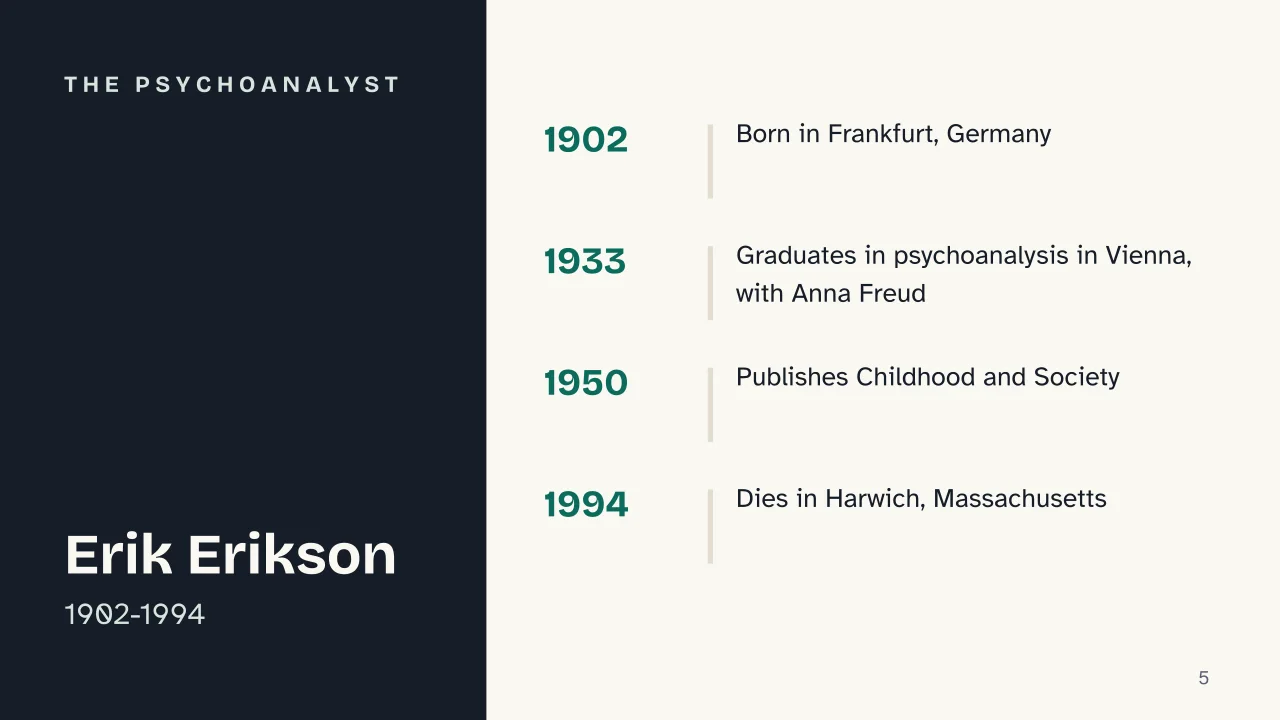  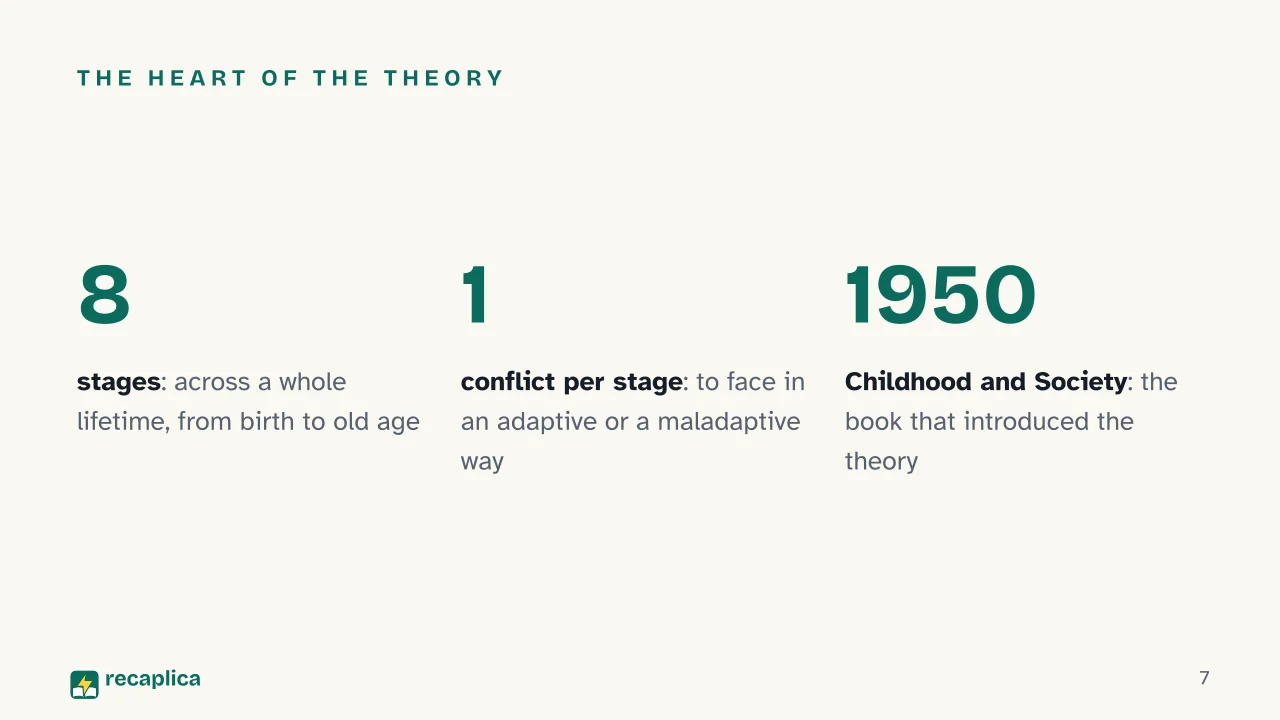 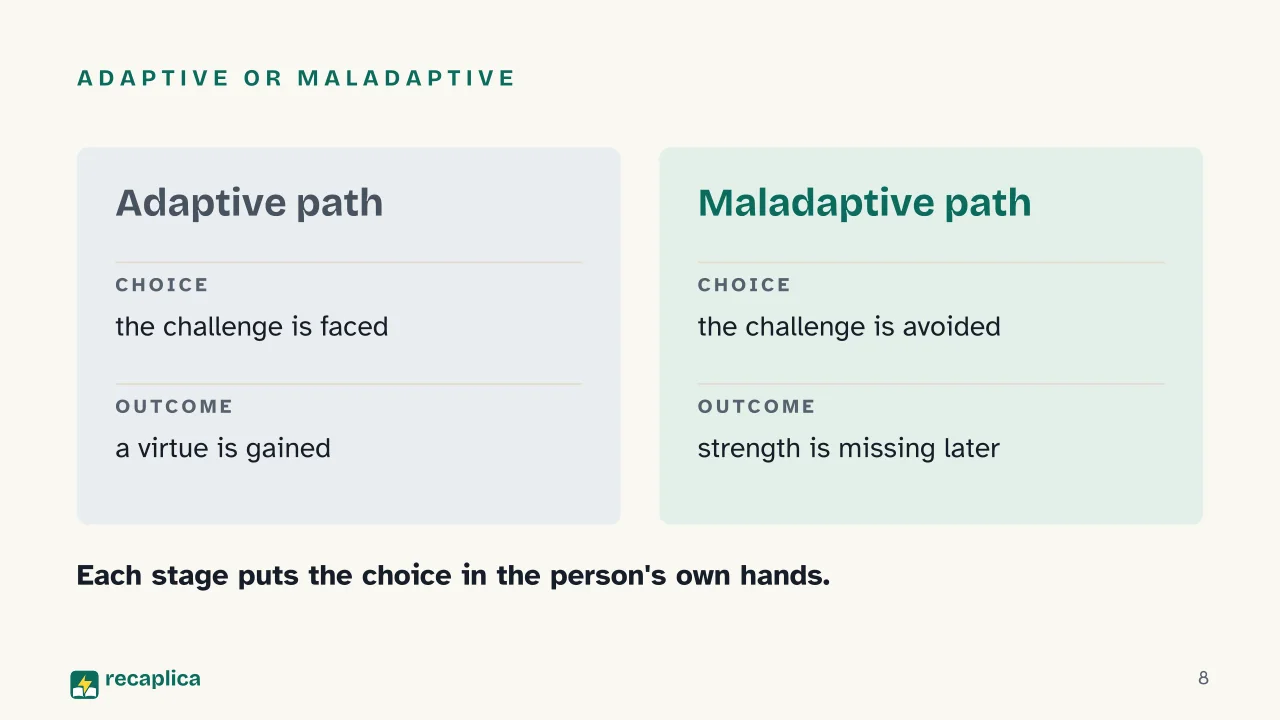  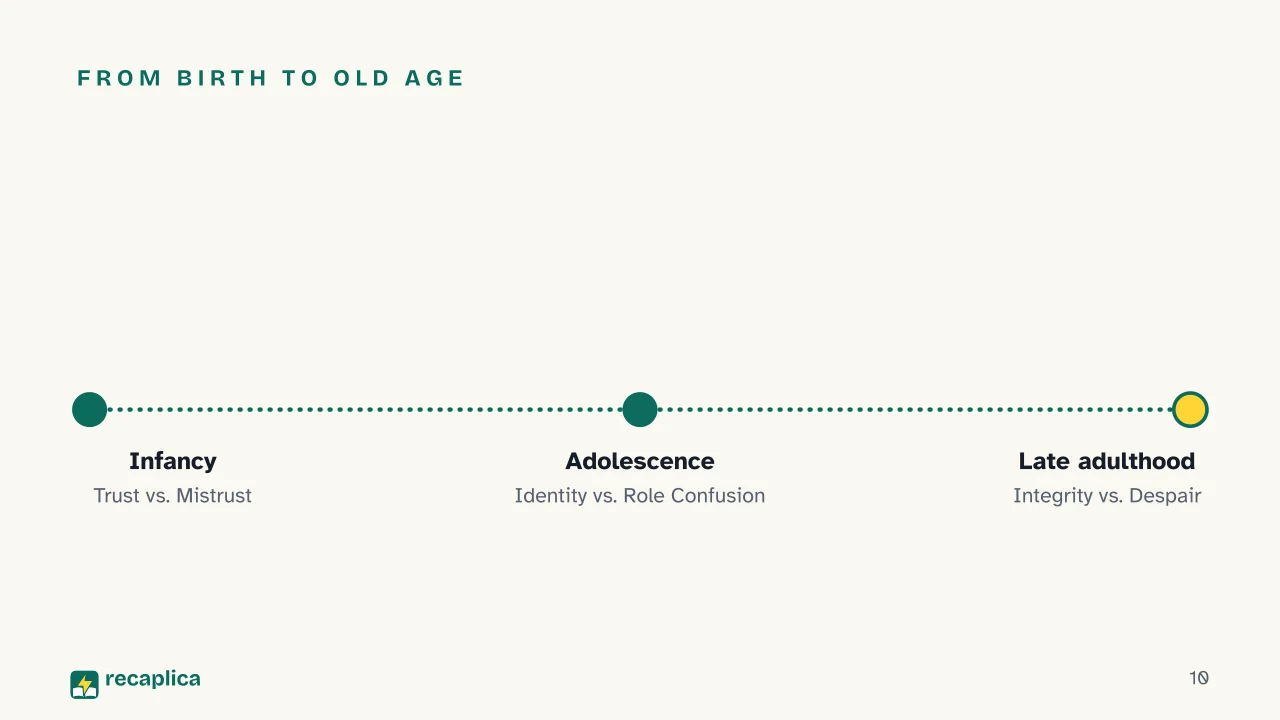 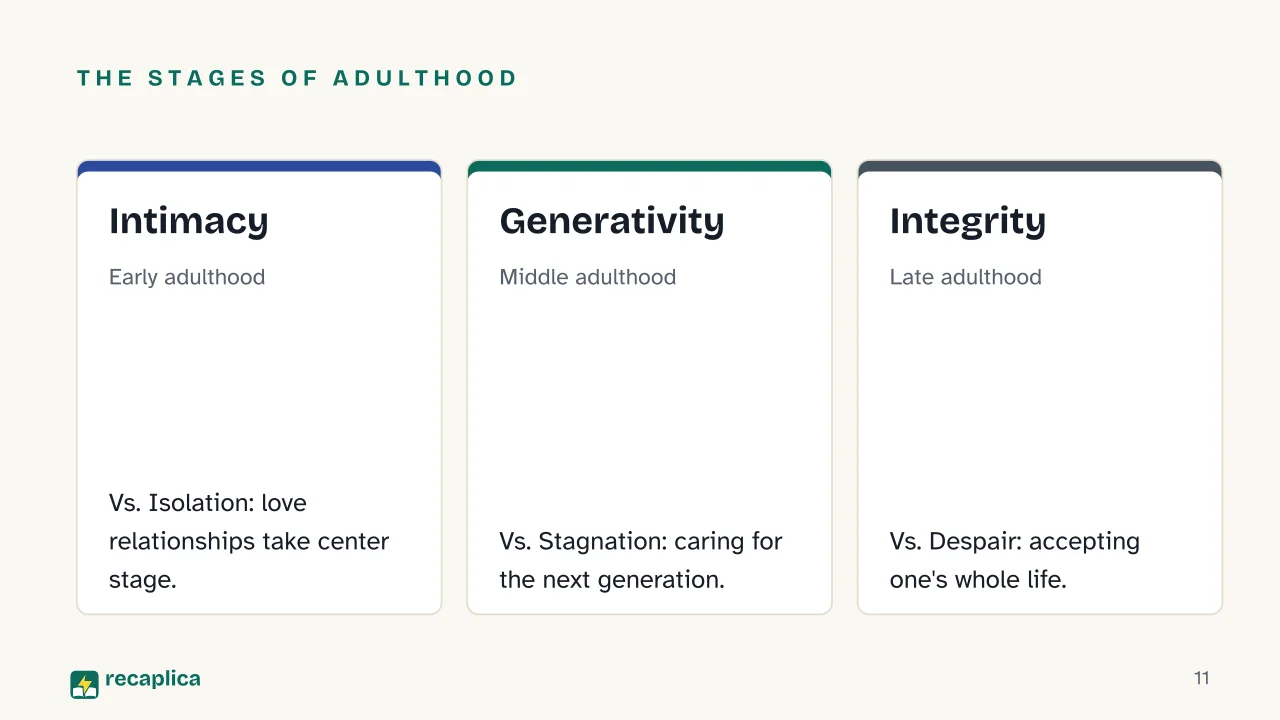  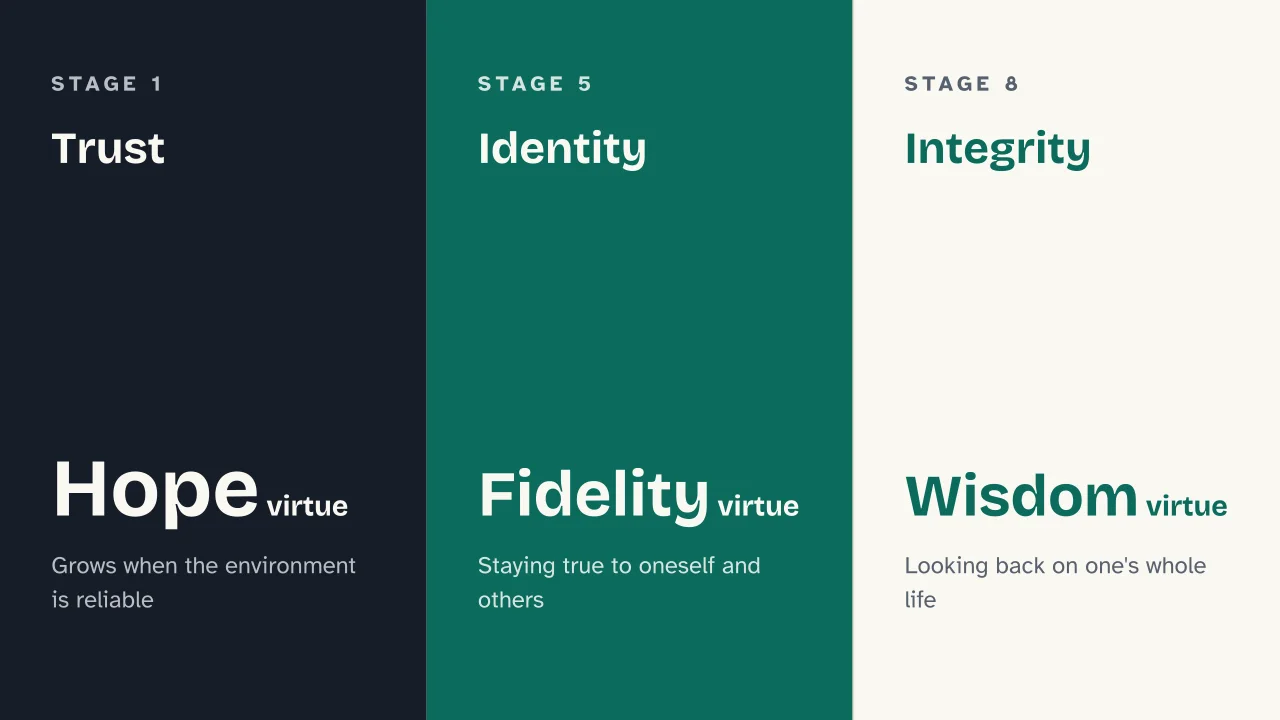 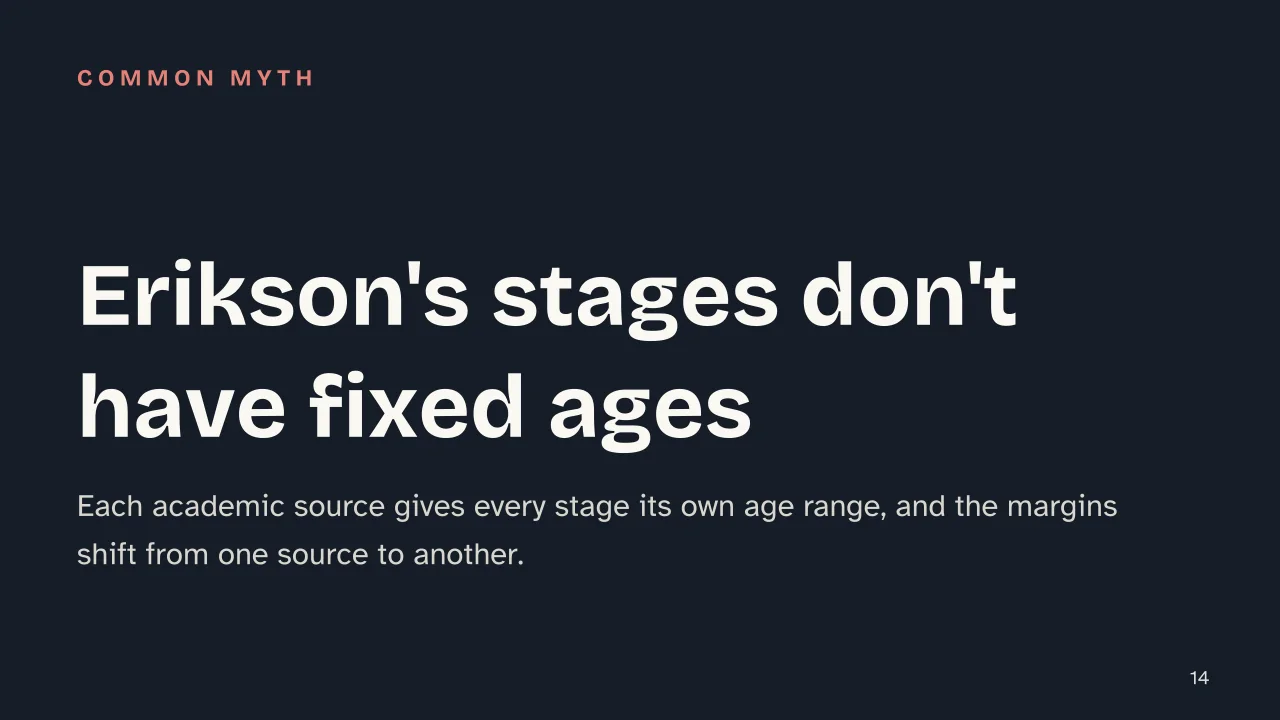 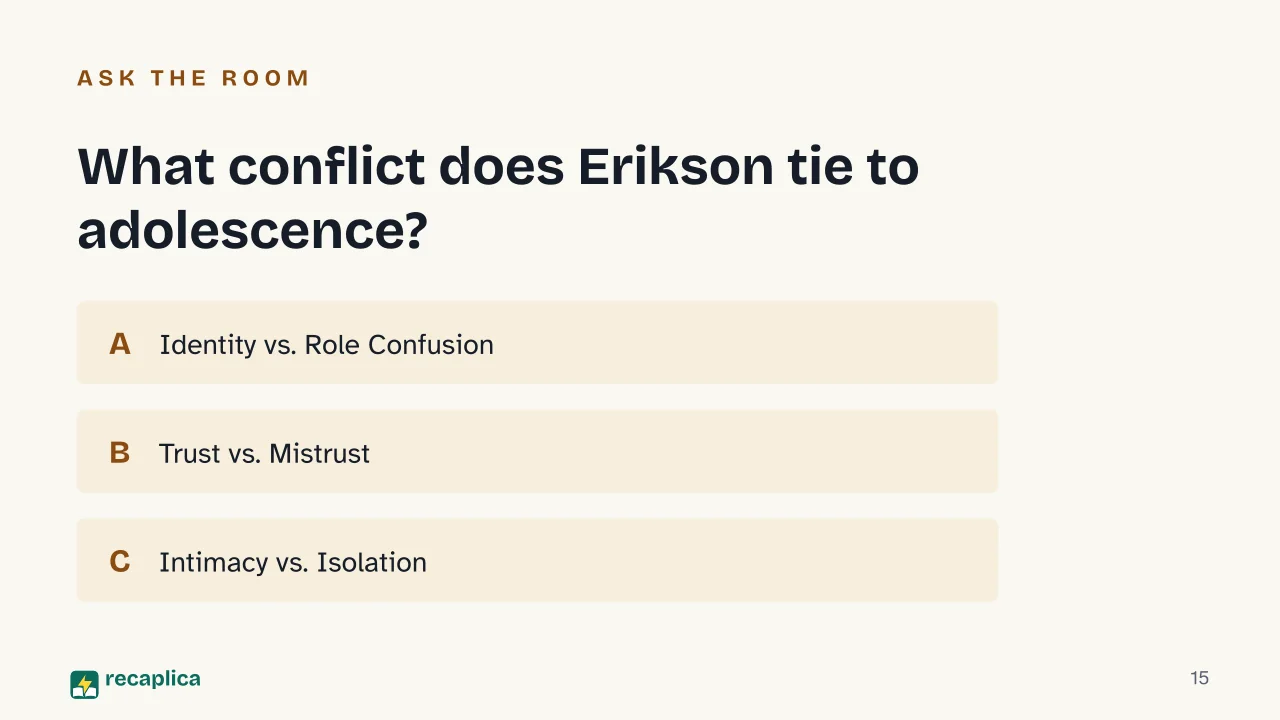  Common myths
Mind mapDrag the background to move around and the nodes to reposition them; use − and + to collapse and expand branches. 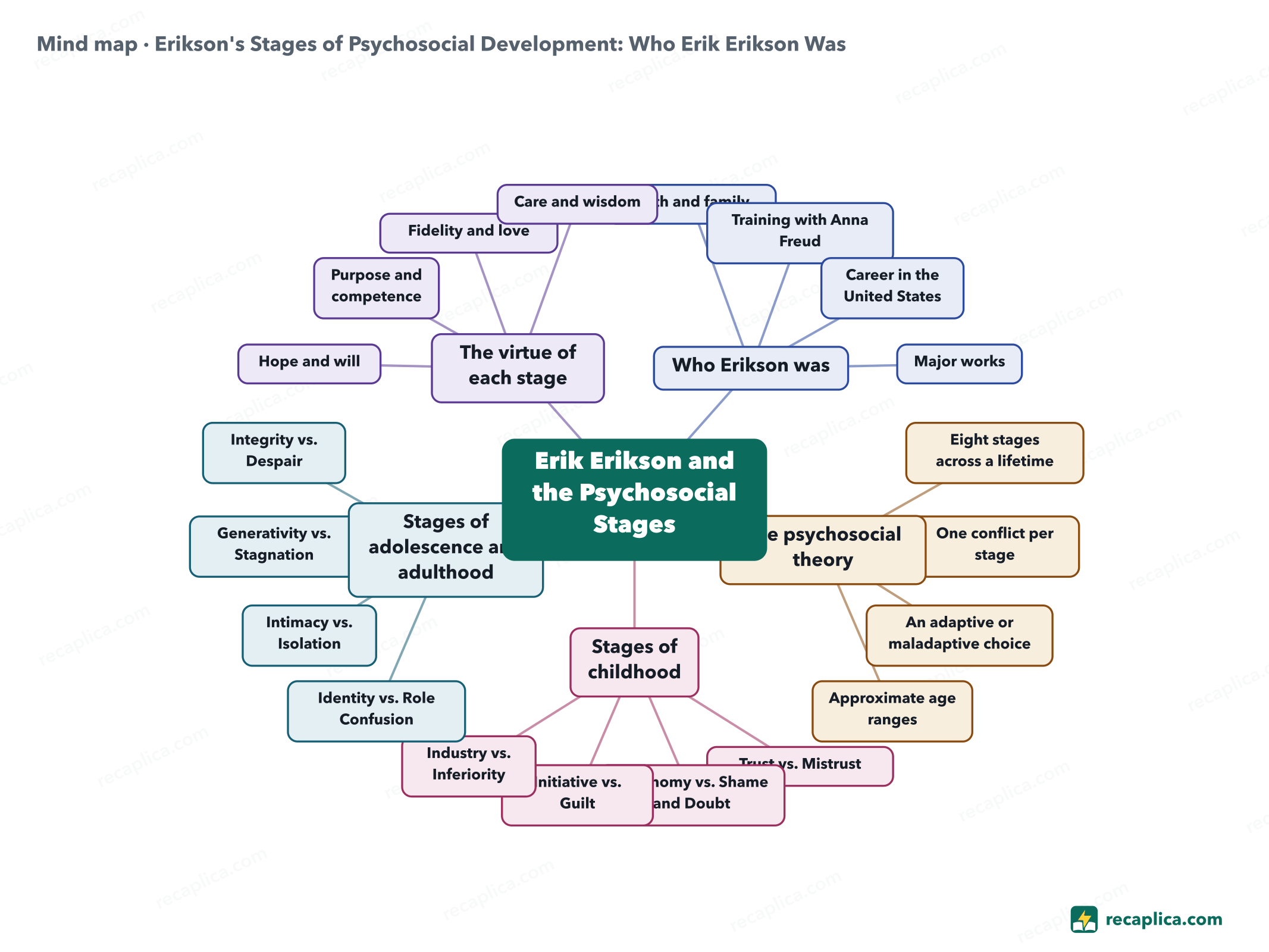
Quiz: test yourselfAnswer the questions to check what you have learned: you get instant feedback and a short explanation. Grade 0/10 0/5
FlashcardsTap the card to flip it and check whether you remember the answer, then move to the next one. 1 / 8 Explain it in your own wordsThe ultimate test: if you can explain it in simple words, you've truly understood it. Write your explanation, then compare it with the Recap. Your explanation is saved only on this device.
Frequently asked questionsWhat are Erikson's eight stages?In order: Trust vs. Mistrust, Autonomy vs. Shame and Doubt, Initiative vs. Guilt, Industry vs. Inferiority, Identity vs. Role Confusion, Intimacy vs. Isolation, Generativity vs. Stagnation, and Integrity vs. Despair. Together they span the whole of life, from birth to old age. What is Erikson's theory?It is the theory of psychosocial development: a person's life moves through eight stages, each centered on a different conflict that surfaces when the environment places new demands on them. Erikson presented it in 1950 in the book Childhood and Society. Who was Erik Erikson?A psychoanalyst born in Frankfurt in 1902, trained in Vienna alongside Anna Freud, who later emigrated to the United States and taught at Yale and Harvard. He died in 1994 in Massachusetts. What age does each of Erikson's stages correspond to?The age ranges are approximate, not fixed: the sources give slightly different figures for each stage, with the exact margins depending on which source you check. What happens if a stage's conflict is not resolved?According to Erikson, only resolving a stage's crisis gives the person enough strength to fully take on the next stage of development. Every Recap goes through an independent review before publication. |