|
recaplica
How Tanning Works: Melanin, UV Rays and Why Skin Darkens | ||||||||||||||||||||
| © 2026 Recaplica · recaplica.com — All rights reserved | ||||||||||||||||||||
How Tanning Works: Melanin, UV Rays and Why Skin DarkensWhat to print Page numbers appear when printing with default margins. SlidesChoose a cut Flash10 slidesThe essential thread, to present in classFull18 slidesEvery chapter and the deeper detailBoth come with speaker notes. In 30 seconds quick readA tan is not a healthy process in its own right: it is skin's response to UV damage that is already underway. Melanocytes produce more melanin to absorb radiation and protect the DNA of the cells below. It happens in two stages: a quick darkening that fades within hours, and the real tan, which shows up after a couple of days and lasts. UVA and UVB rays act on skin in different ways, with different consequences for sunburn, skin aging and cancer risk. Several widespread myths, from 'you need to burn before you can tan' to the idea that tanning beds are safe, don't hold up against the scientific sources. Key Points
Key figures
Deep DiveWhat happens in the skin when you tanTanning can look like a purely cosmetic side effect of a day outdoors, but it begins as a biological response. When UV rays hit the skin, melanocytes — cells tucked into the deepest layer of the epidermis that, curiously, originate in the embryo’s neural crest rather than in the skin itself — respond by producing more melanin. This step is catalyzed by an enzyme called tyrosinase, which converts the amino acid tyrosine through a chain of compounds into eumelanin, the main brown-black pigment in skin; a lighter variant, pheomelanin, contributes the reddish and fair tones instead. The melanin produced is passed along to surrounding cells and protects in two ways: it physically absorbs part of the UV radiation before it reaches deeper layers, and at the same time it mops up the free radicals generated by exposure, limiting DNA damage in skin cells. The FDA describes it this way: skin increases melanin production “in an attempt to protect the skin from further damage.” A tan is the visible consequence of damage that has already happened, not a process that makes skin healthier to begin with. Two different tans: immediate and delayedTanning happens in two different phases, and they don’t differ only in intensity. Dermatology literature calls them immediate tanning and delayed tanning. Immediate tanning can appear within minutes of exposure to UVA rays or visible light, especially in people with darker skin types. It isn’t new melanin at all — it’s the chemical oxidation of pigment that was already sitting in skin cells. Because it doesn’t come from any real extra production, it fades within a few hours.
Delayed tanning is what people usually mean by “getting a tan”: it becomes visible about two days after exposure and peaks around a week later. It comes from actual melanogenesis — newly synthesized melanin distributed to cells throughout the epidermis — and is triggered mainly by UVB rays, though UVA and visible light can play a part too. It’s slower to appear, but also more durable than the immediate kind. UVA, UVB and UVC: not the same radiationTalking about “the sun’s rays” as one thing glosses over some important differences. Ultraviolet radiation splits into three bands, distinguished by wavelength and by how they interact with skin.
UVA rays, the ones least associated with sunburn, are also the most abundant and the best at penetrating deep into the skin. On this point, AIRC cites a blunt line from the American Cancer Society: there is no such thing as a safe UV ray, UVA included. UV exposure isn’t just a summer issue, either — according to Italy’s Istituto Superiore di Sanità, UV levels climb 10-12% for every 1,000 meters of altitude, so exposure can be significant in the mountains even outside summer months, so the risk isn’t limited to beach days, as the piece on heat waves also notes when discussing extreme heat and the seasons. The documented risks: photoaging and skin cancerChronic UV exposure leaves marks that outlast any single tan. Over the long term it damages the collagen and elastin fibers in the dermis, producing visible effects such as wrinkles, loss of elasticity and dark spots — what dermatologists and oncologists call photoaging. On skin cancer, the sources draw a clear distinction between mechanisms. Basal cell and squamous cell carcinomas are linked mainly to repeated UV exposure accumulated over a lifetime. Melanoma has a different exposure profile: according to the American Cancer Society, short, intense exposure that ends in sunburn weighs most, and so does intermittent, recreational sun exposure in general, such as sunbathing, water sports and holidays in sunny places. The distinction matters because it shifts attention away from the tan itself and toward how people expose themselves. IARC’s GLOBOCAN estimates count over 330,000 new cases of skin melanoma worldwide in 2022; in Italy, according to the AIOM and AIRTUM report “I numeri del cancro in Italia 2022”, an estimated 12,700 new cases were diagnosed that same year. Mortality within Italy varies considerably by region: according to Italy’s Istituto Superiore di Sanità, northern regions record roughly double the rate seen in the south, and in Trieste incidence exceeds 10 cases per 100,000 people a year, though the source doesn’t point to a specific cause for this geographic gap. The picture has improved a great deal: according to AIOM’s 2022 estimates, five-year net survival after diagnosis is 88% for men and 91% for women, while Italy’s Istituto Superiore di Sanità recalls that in 1960 only 50% of patients survived, and credits the jump mainly to early diagnosis. UV exposure doesn’t only affect skin. The FDA also documents two types of eye damage: photokeratitis, a sunburn-like injury to the cornea that usually heals within 24-48 hours, and cataracts, clouding of the lens that in severe cases can lead to blindness. The case of tanning bedsTanning from lamps and beds involves the same UV-related skin damage as a natural tan, and it can be more intense. IARC, the World Health Organization’s cancer research agency, has classified the use of tanning beds as a known human carcinogen, placing it in Group 1, the same category as tobacco smoke and asbestos. That category needs reading for what it is: IARC itself points out that its groups measure how strong the evidence is that an agent can cause cancer, not how high the risk is at a given level of exposure, and agents in the same group can carry very different risks. The UV output of these devices is comparable to direct sunlight, and in some cases higher. The sources report different estimates depending on the age bracket considered: IARC cites roughly a 75% increase in melanoma risk for people who use tanning beds before age 30; the American Academy of Dermatology reports a 47% increase for those who start before age 20, with further increases for every additional use; the American Cancer Society also quantifies increased risk for basal cell carcinoma (24%) and squamous cell carcinoma (58%). In Italy, decree no. 110 of May 12, 2011 bars minors from accessing sunlamps, tanning showers and beds, and extends the ban to pregnant women and people with a history of skin cancer. Despite this, use remains widespread: according to data collected between 2013 and 2018, roughly 6.5% of teenagers and 10.4% of adults had used a tanning bed at least once in the previous year. Curiosities: vitamin D, endorphins and melanocytes from far awaySun exposure doesn’t only have negative effects. Vitamin D, a substance involved in skeletal development and in protecting bones against conditions such as rickets, osteomalacia and osteoporosis, is synthesized in the skin through UV exposure — but according to Italy’s Istituto Superiore di Sanità, only a minimal amount is needed: no tan, and no long sun exposure, is required for this protective effect.
Another line of research has pointed to a behavioral component in sun exposure: in a study cited by AIRC involving women under 30, one in five turned out to be “dependent” on artificial tanning, a phenomenon some studies link to the endorphin release triggered by UV exposure, with mechanisms that resemble other forms of behavioral dependence. Finally, a curiosity about where melanocytes come from: these cells aren’t born in the skin at all. They originate in the neural crest, an embryonic structure also tied to the development of the nervous system, and during development they migrate until they settle into the basal layer of the epidermis, where they contribute to pigmentation and UV protection. Tanning comes with beliefs the sources don’t back up, much like the supposed need to wait before swimming after eating: there too, common belief doesn’t match what medical sources say. What this article doesn’t coverThis Recap explains the biological mechanism behind tanning and reports the risks documented by the scientific and institutional sources consulted: it is not a practical guide, and it does not tell you how long to spend in the sun, which sunscreen to choose, or how to handle specific cases such as suspicious moles, very fair skin or a family history of skin cancer. For any personal assessment, the right point of reference is a dermatologist. Slide deckSlides ready to download and make your own in PowerPoint or Google Slides, with speaker notes. Pick the Flash cut or the Full one.     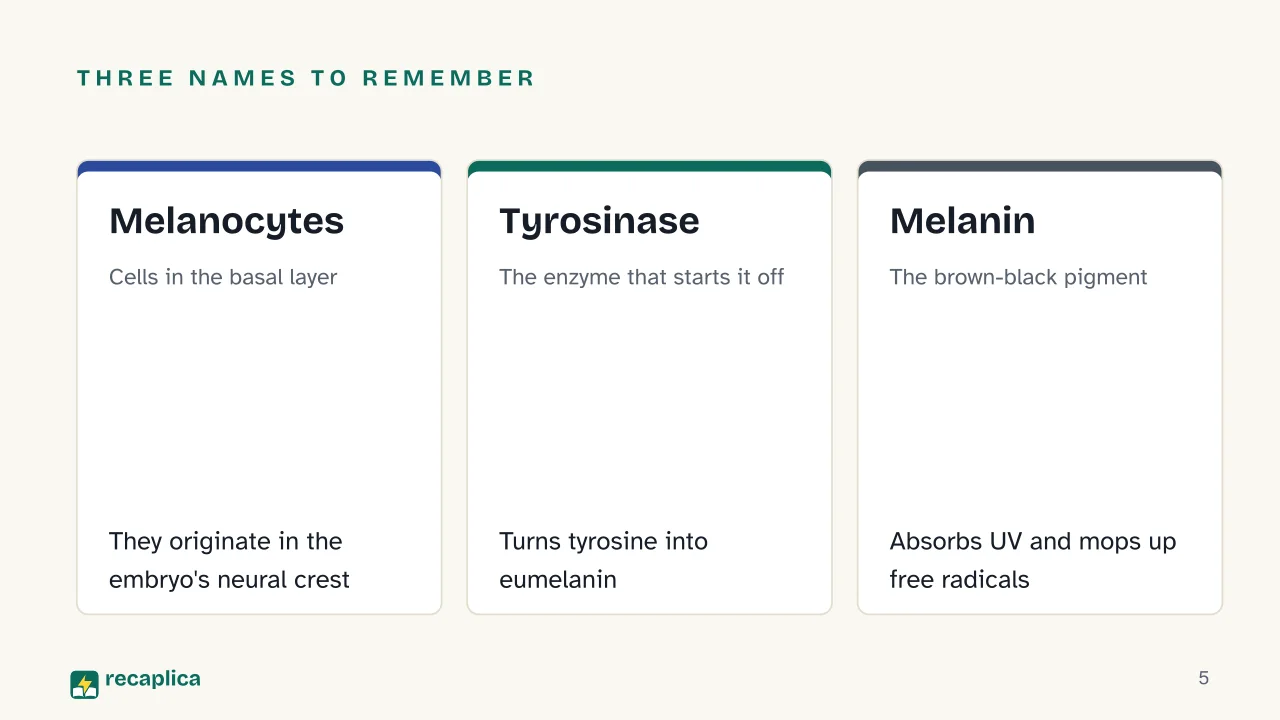   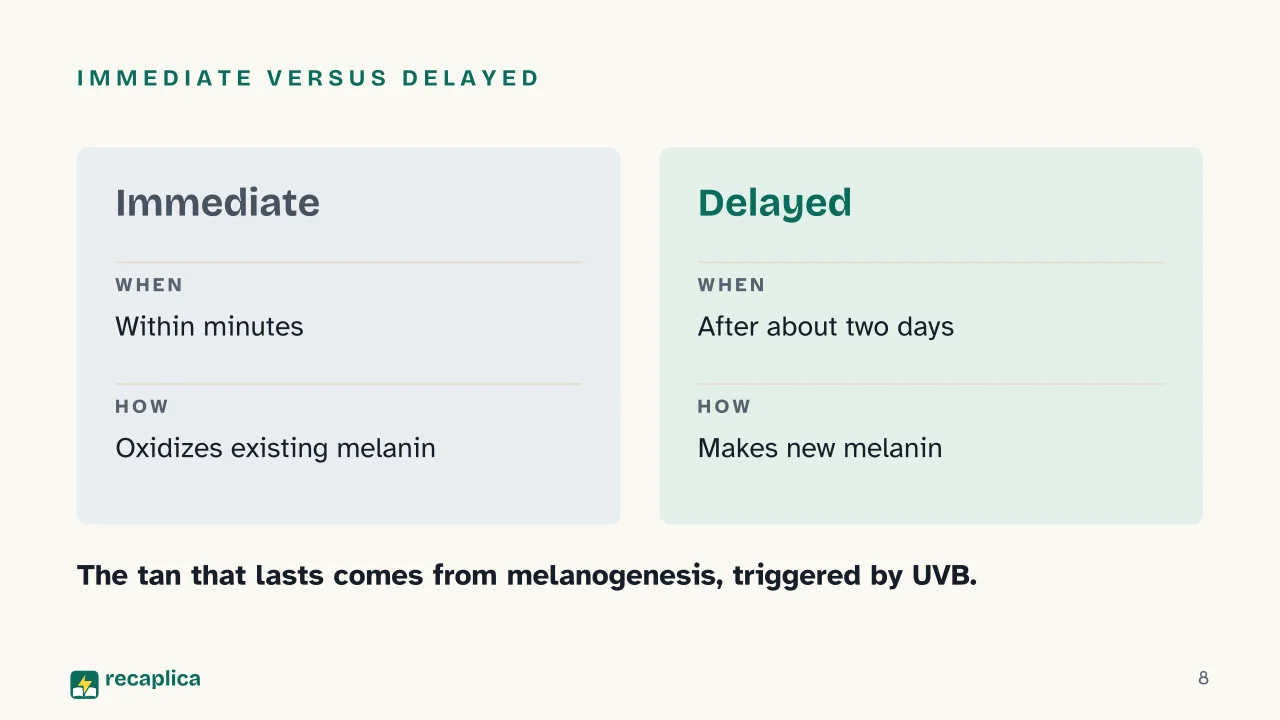 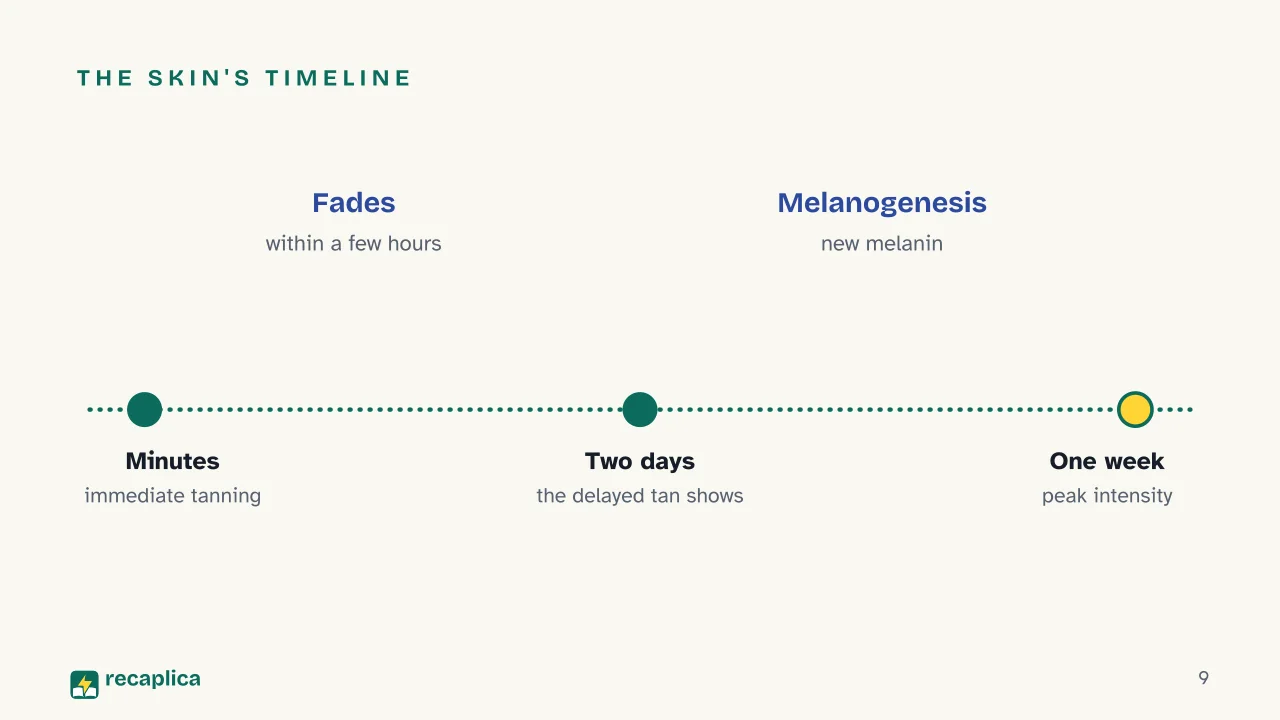  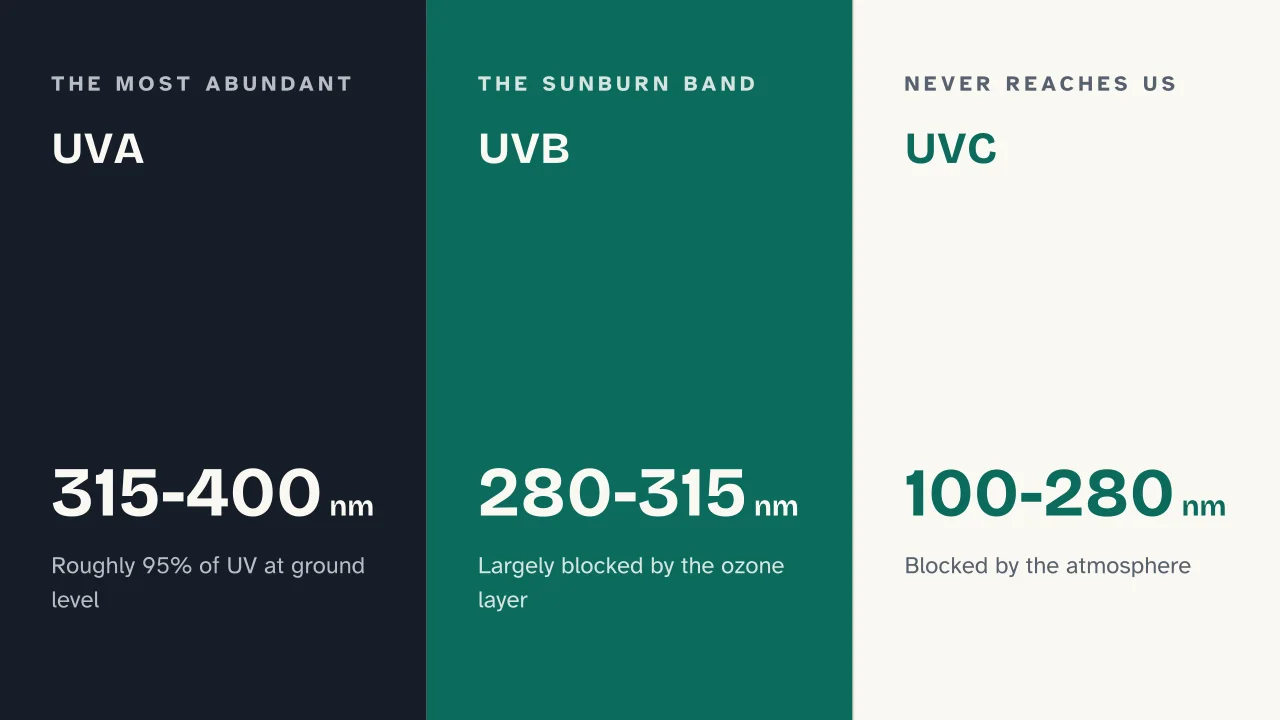 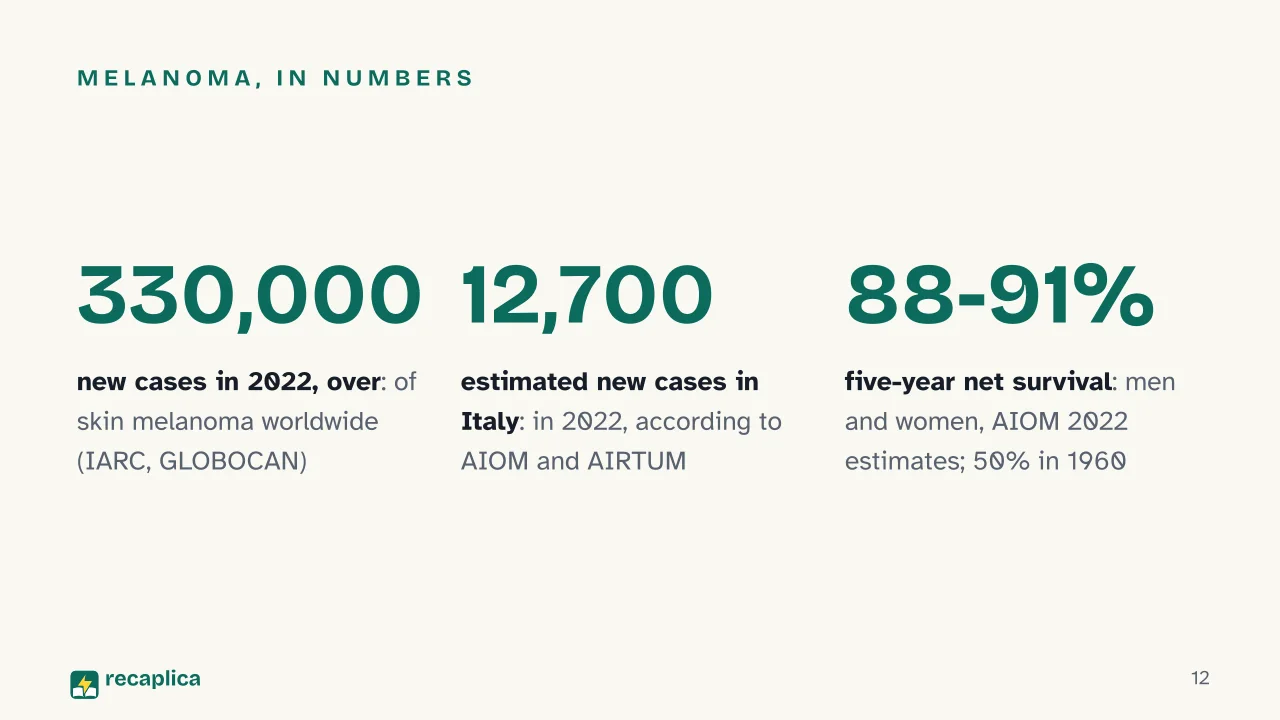  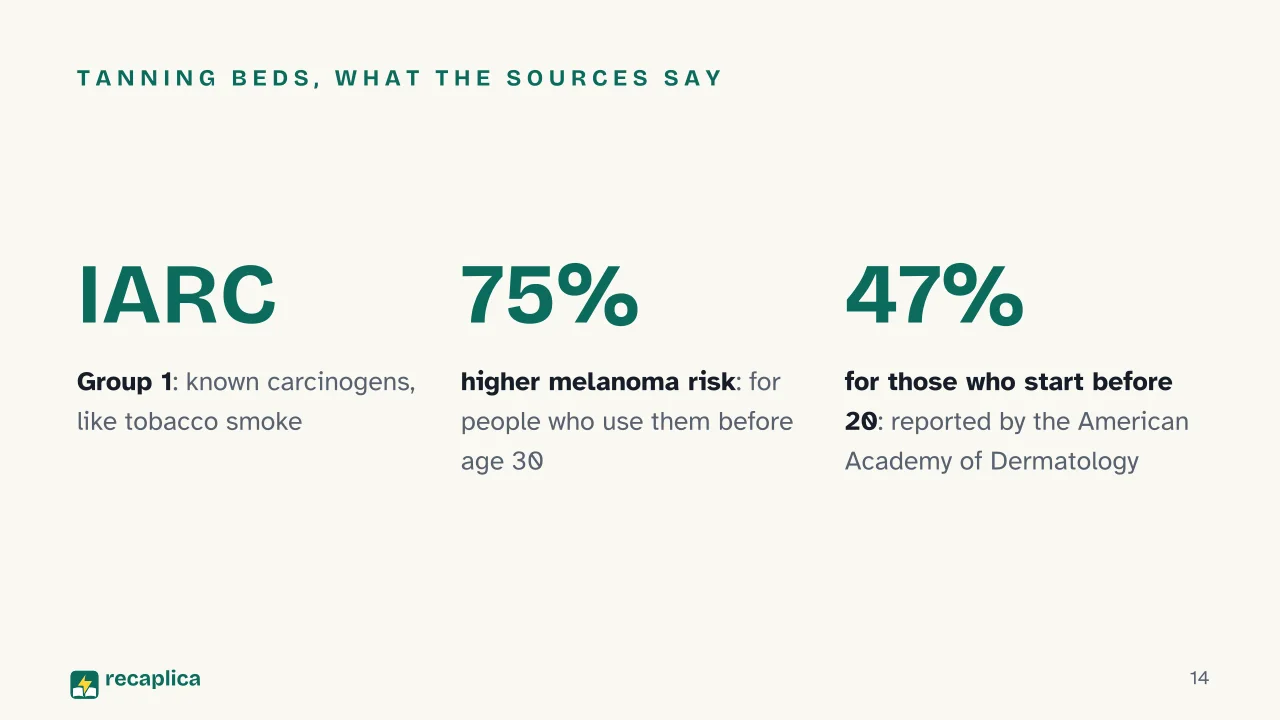 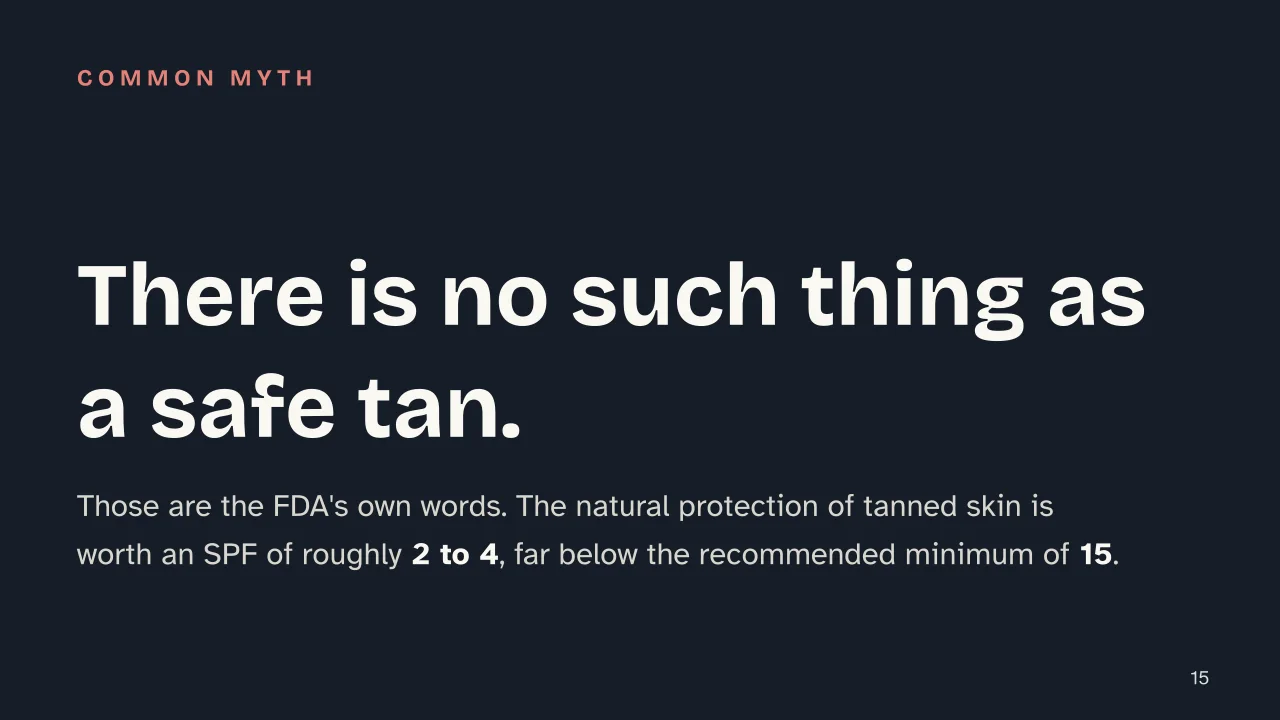 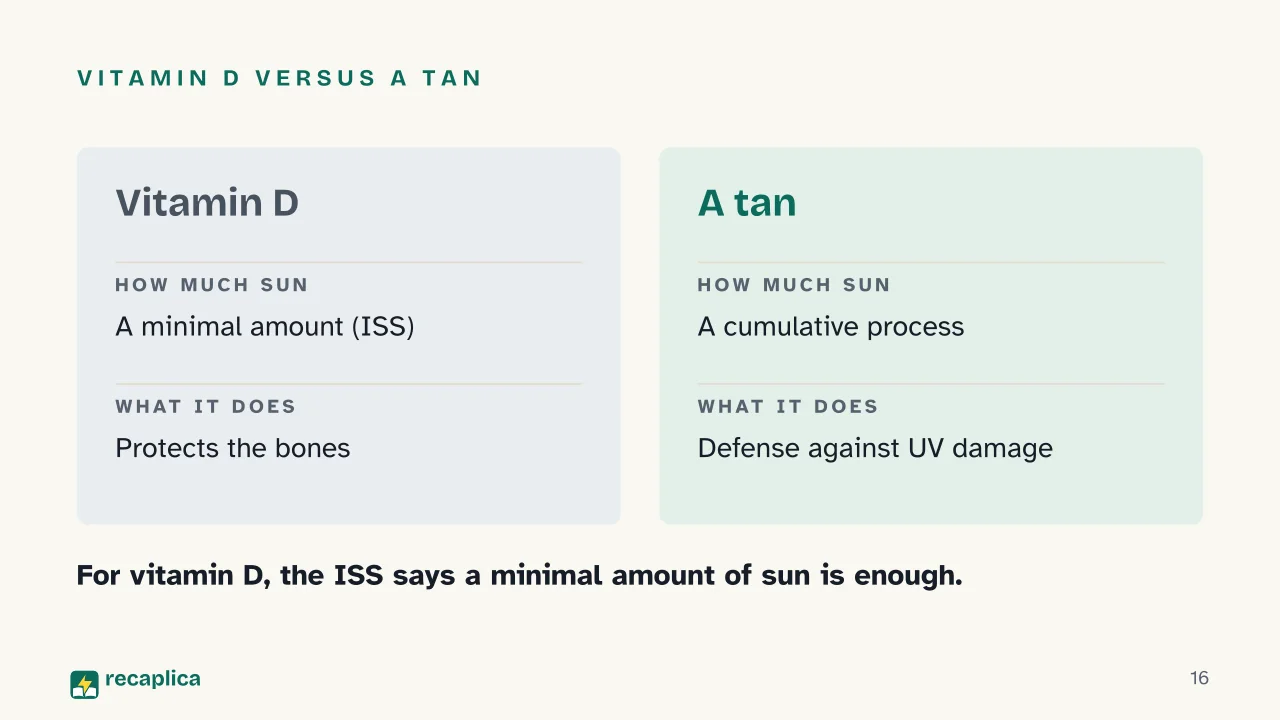 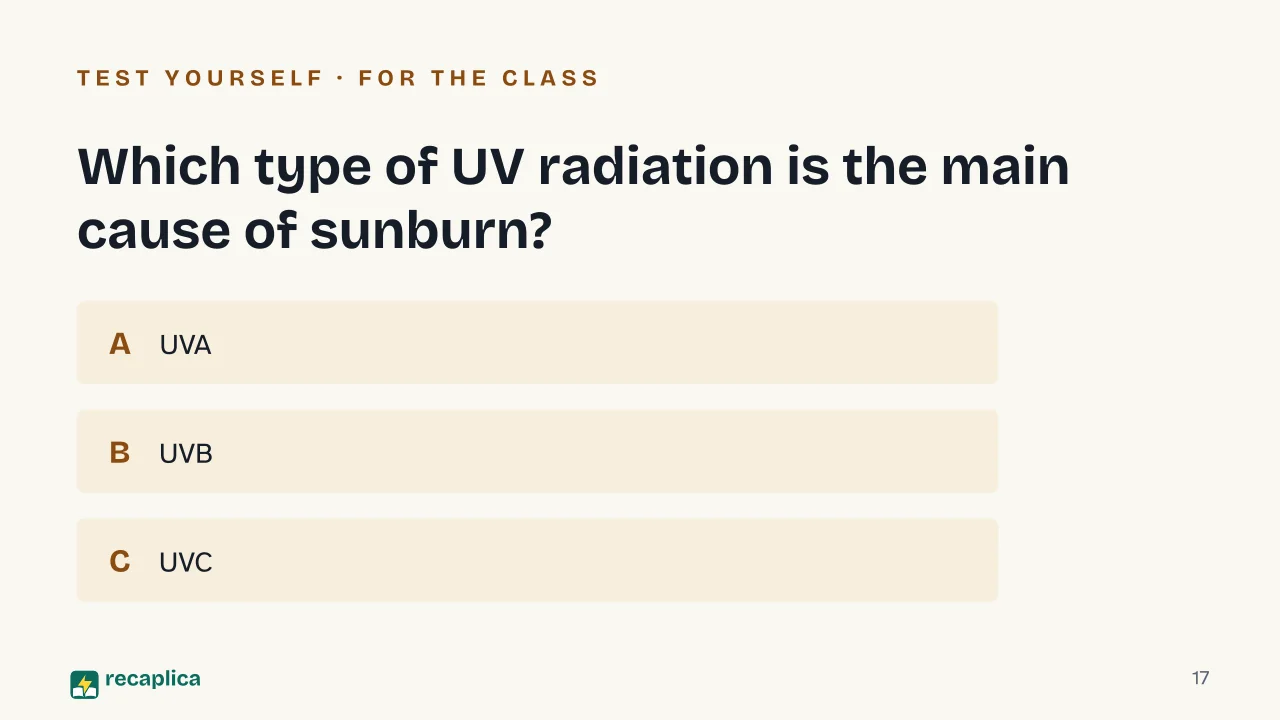  Common myths
Mind mapDrag the background to move around and the nodes to reposition them; use − and + to collapse and expand branches. 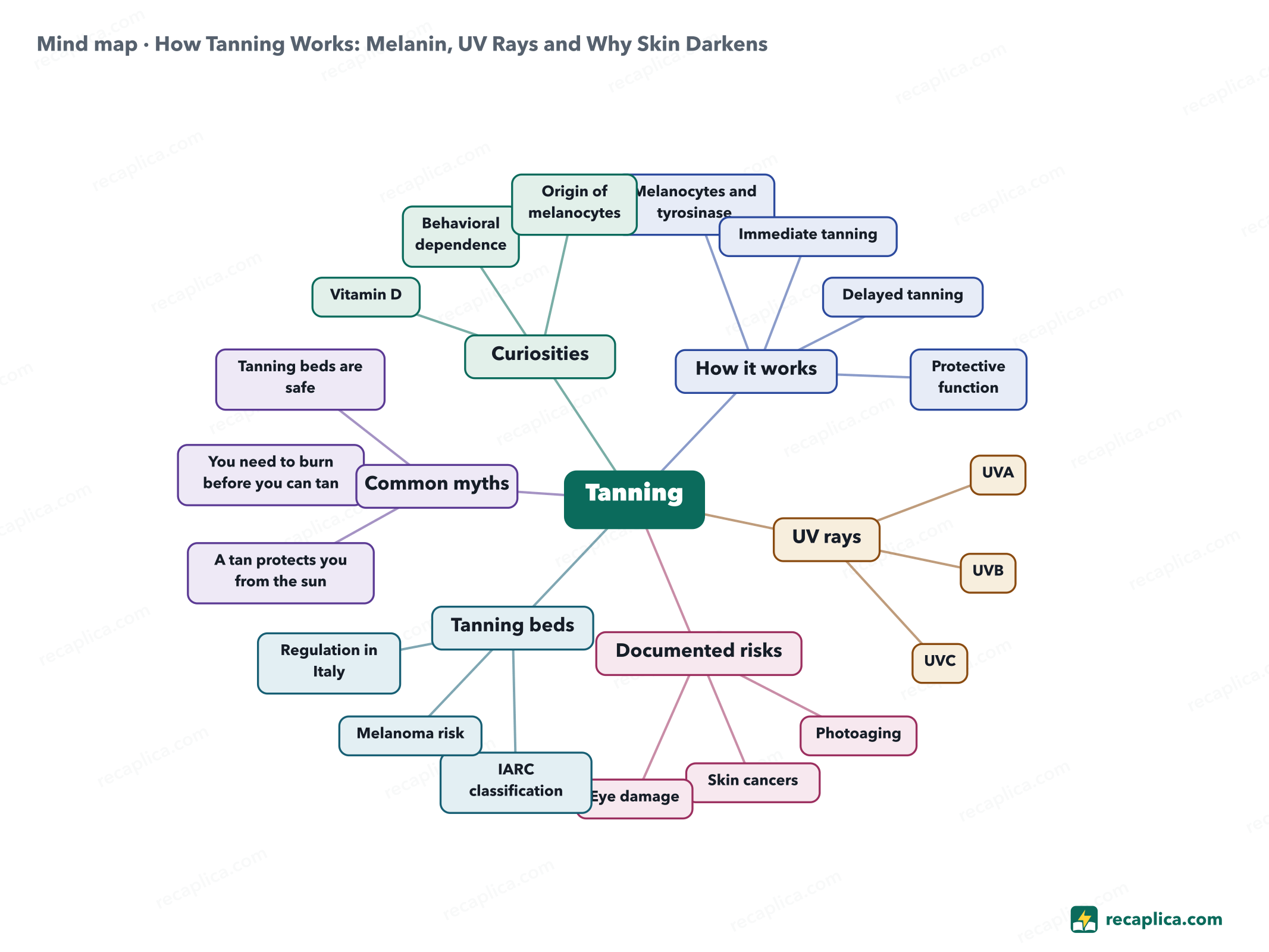
Quiz: test yourselfAnswer the questions to check what you have learned: you get instant feedback and a short explanation. Grade 0/10 0/5
FlashcardsTap the card to flip it and check whether you remember the answer, then move to the next one. 1 / 8 Explain it in your own wordsThe ultimate test: if you can explain it in simple words, you've truly understood it. Write your explanation, then compare it with the Recap. Your explanation is saved only on this device.
Frequently asked questionsIs tanning good or bad for the skin?Biologically speaking, a tan is skin's defensive response to UV damage that is already underway: the FDA describes it as melanocytes' attempt to protect the skin from further harm, not a 'healthy' process in its own right. Sun exposure in general does bring some documented benefits, such as minimal vitamin D synthesis, but working out what's appropriate for a given person's skin — based on skin type, family history and existing skin conditions — is a job for a dermatologist, not for a general explainer. Do you really need to get sunburned before you can tan?No. A 'true' tan (the delayed kind) comes from melanogenesis, the process of new melanin production triggered mainly by UVB rays, and it doesn't require a sunburn. If anything, according to the American Cancer Society, intense exposure that ends in sunburn, and intermittent recreational sun exposure in general, are among the main risk factors for melanoma. Anyone who burns often should talk to a dermatologist. Are tanning beds and sunlamps a safe alternative to the sun?No, not according to the institutional sources consulted here. IARC, the World Health Organization's cancer research agency, classifies the use of tanning beds as a known human carcinogen (Group 1, the category with the strongest evidence, the same as tobacco smoke), and their UV output is comparable to or even higher than direct sunlight. In Italy, minors have been barred from using them since 2011. For any questions about individual risk, a dermatologist remains the right point of reference. Is tanning enough to build up vitamin D?No. According to Italy's Istituto Superiore di Sanità, only minimal UV exposure is needed to get the bone-protective effects of vitamin D: no tan, and no prolonged sun exposure, is required. For any assessment of a possible vitamin D deficiency, the right reference is still a doctor, not do-it-yourself sun exposure. How long does it actually take skin to tan?There are two different timelines. Immediate tanning shows up within minutes of exposure but fades within hours, because it's only the oxidation of melanin that was already there. Delayed tanning, the kind that lasts, becomes visible after about two days and peaks after roughly a week, because it requires the synthesis of new melanin (DermNet NZ). Every Recap goes through an independent review before publication. |