|
recaplica
DNA: what it is, how it's built and what it does | ||||||||||||
| © 2026 Recaplica · recaplica.com — All rights reserved | ||||||||||||
DNA: what it is, how it's built and what it doesWhat to print Page numbers appear when printing with default margins. SlidesChoose a cut Flash10 slidesThe essential thread, to present in classFull16 slidesEvery chapter and the deeper detailBoth come with speaker notes. In 30 seconds quick readDNA is life's instruction manual: a very long molecule shaped like a double helix, written in an alphabet of just four "letters" (A, T, C, G). Stored in the nucleus of every cell, it holds the genes: the recipes for building all the organism's proteins. Every time a cell divides, the DNA is copied and passed on: that's how traits travel from one generation to the next. Key Points
Key figures
Deep DiveAn instruction manual written with four lettersInside the nucleus of nearly every one of your cells sits a manual holding the instructions to build and run you: DNA (deoxyribonucleic acid). What makes it extraordinary is its simplicity. The entire manual is written in an alphabet of four letters, the bases Adenine, Thymine, Cytosine and Guanine, repeated and combined across 3 billion positions.
The double helix: a molecular spiral staircaseIn 1953 James Watson and Francis Crick, with Rosalind Franklin’s data proving decisive, worked out DNA’s shape: a double helix, two strands coiled like the handrails of a spiral staircase. The steps are pairs of bases, and the rule never bends: A binds only T, C binds only G. This pairing rule is the secret of self-replicating life: unzip the staircase down the middle, and each half contains the information to rebuild the other. That’s precisely what happens when a cell prepares to divide: the DNA is copied with astonishing fidelity. Genes, chromosomes, genome: the library in orderThree words that get mixed up, and one simple hierarchy:
Humans have 46 chromosomes in 23 pairs: for each pair, one volume comes from your mother and one from your father. That’s why you resemble both — and why every child shuffles the deck in a unique way.
What DNA does all dayDNA builds nothing with its own hands: it directs. When the cell needs a protein (an enzyme to digest, collagen for skin, hemoglobin for blood), the right gene is copied into a message (messenger RNA) that leaves the nucleus and reaches the ribosomes, the assembly lines that build the protein piece by piece. Everything you are, biologically, flows through this pipeline: DNA → RNA → proteins. Biologists call it the central dogma of biology. 99.9% identical, forever uniqueAny two human beings, whether an Icelander and a Kenyan or you and your neighbor, share 99.9% of their DNA. All human variety fits in that 0.1%: millions of small differences governing height, facial features, blood type, predispositions. When DNA copying gets a letter wrong, a mutation is born: almost always harmless, sometimes damaging, very rarely advantageous. Over vast stretches of time, those rare useful variants accumulate: they are the fuel of evolution. Slide deckSlides ready to download and make your own in PowerPoint or Google Slides, with speaker notes. Pick the Flash cut or the Full one.     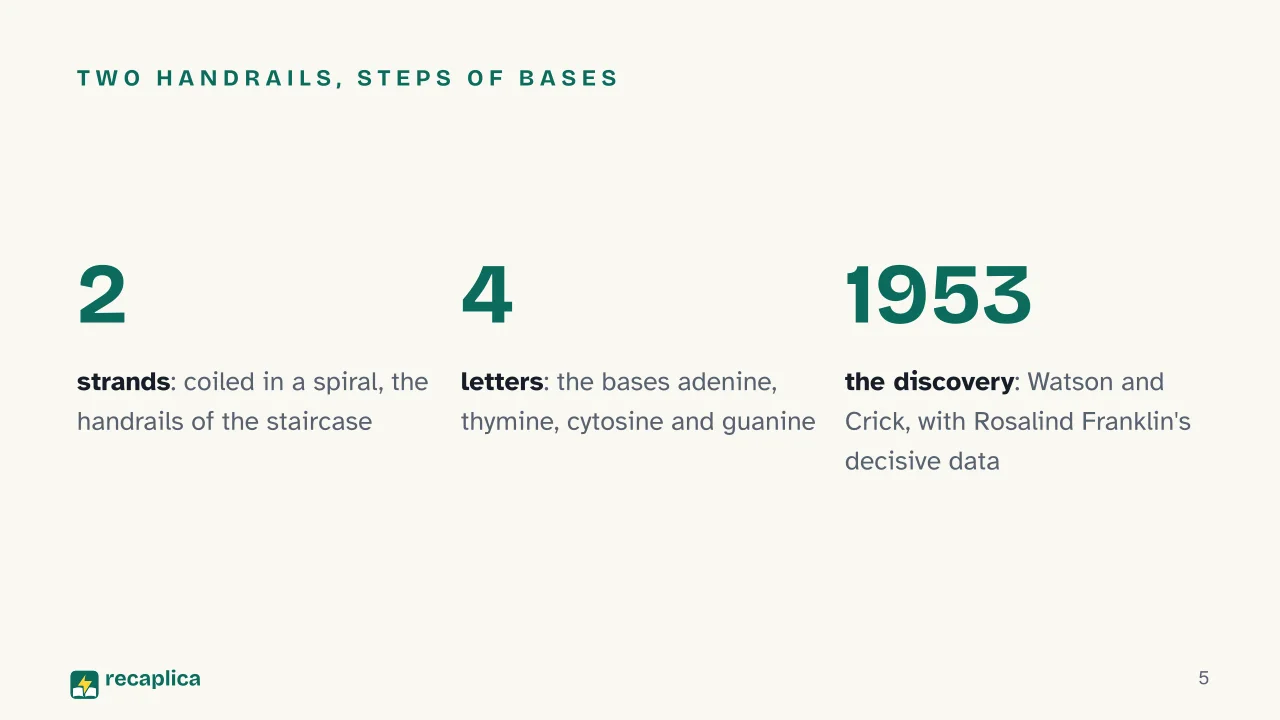  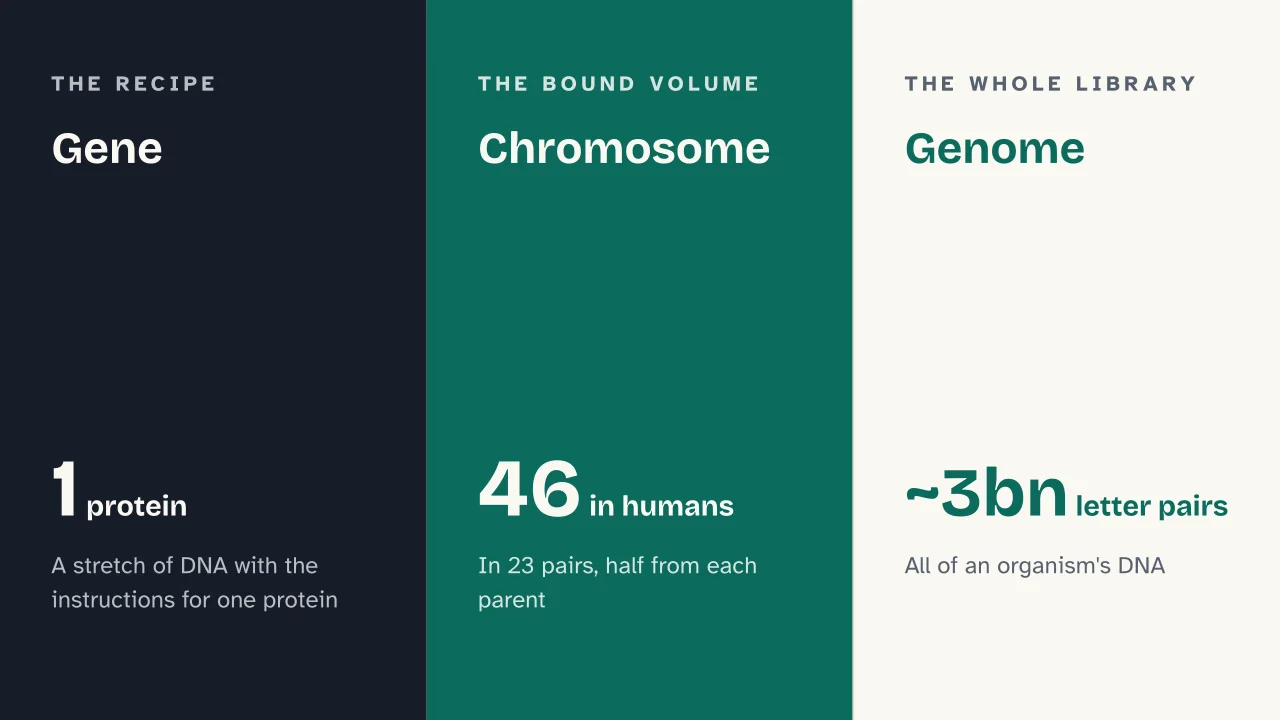    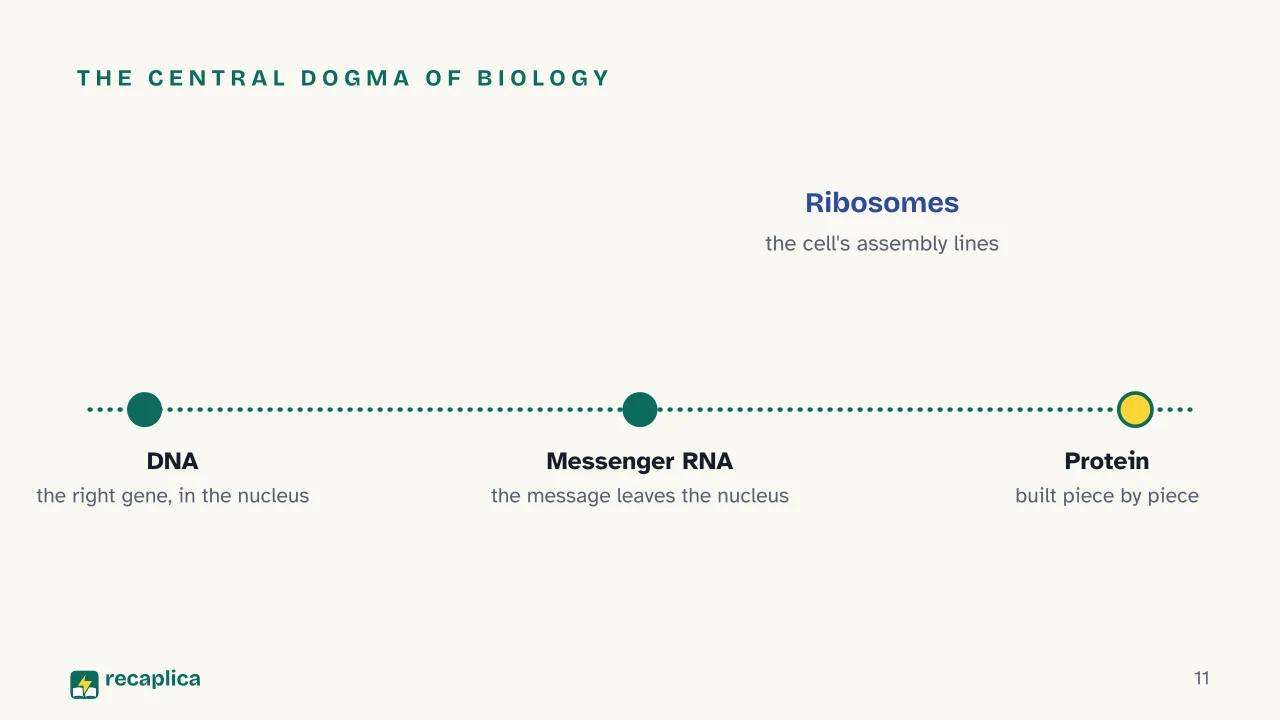  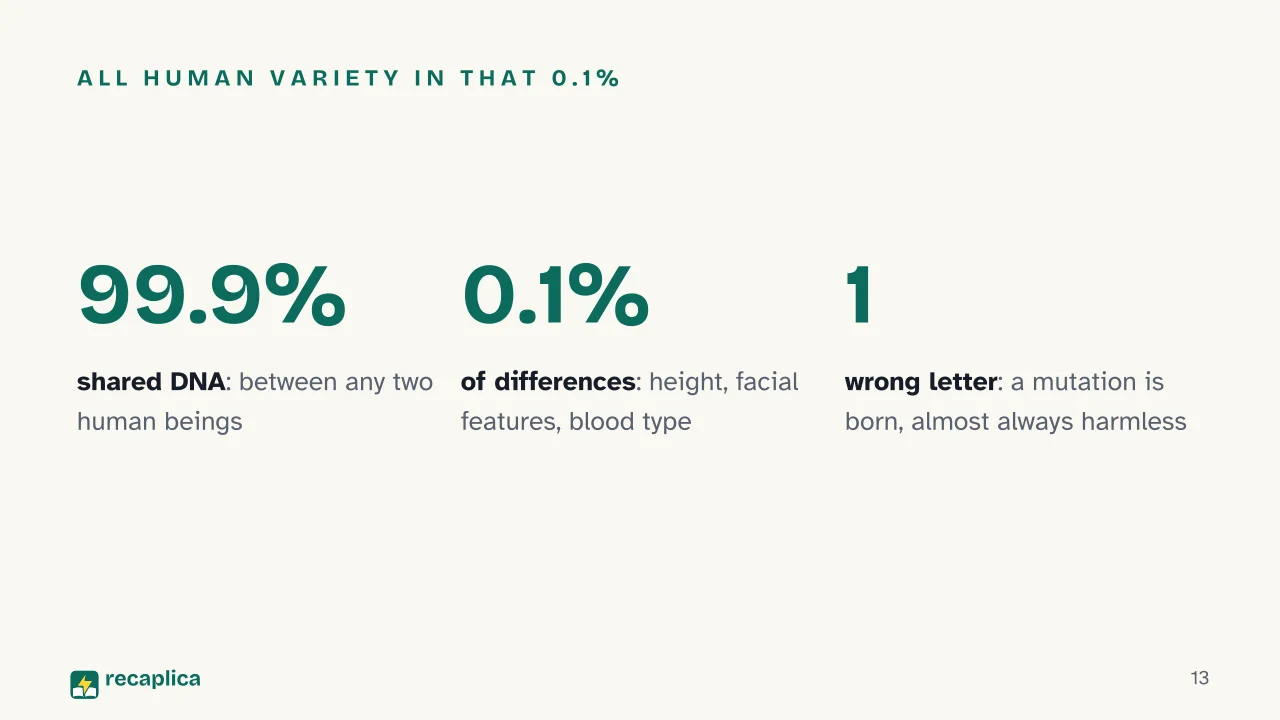 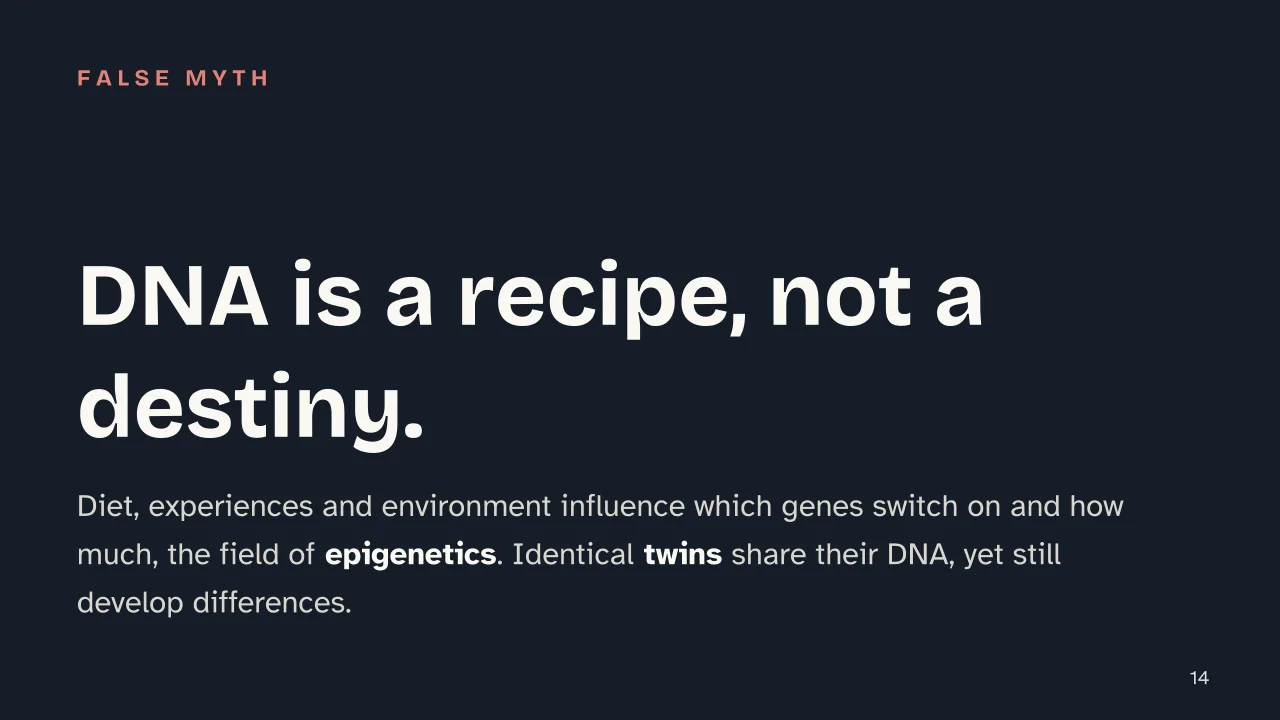 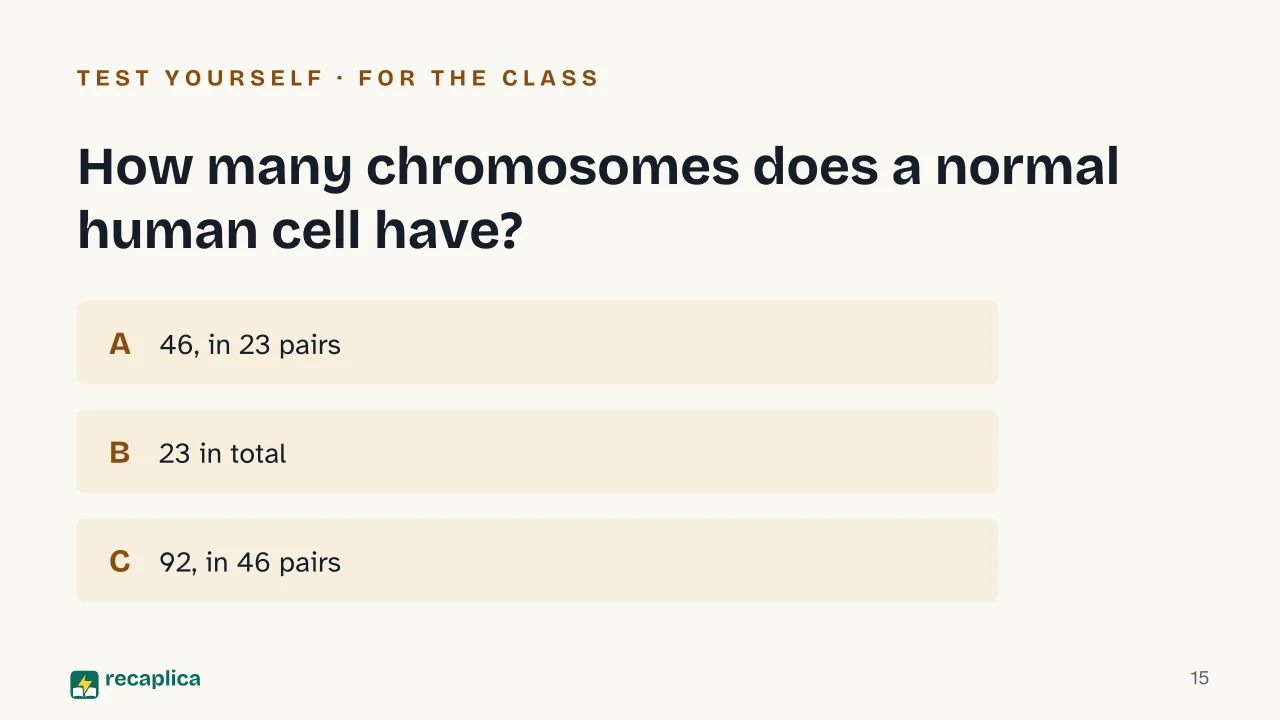  Common myths
Mind mapDrag the background to move around and the nodes to reposition them; use − and + to collapse and expand branches. 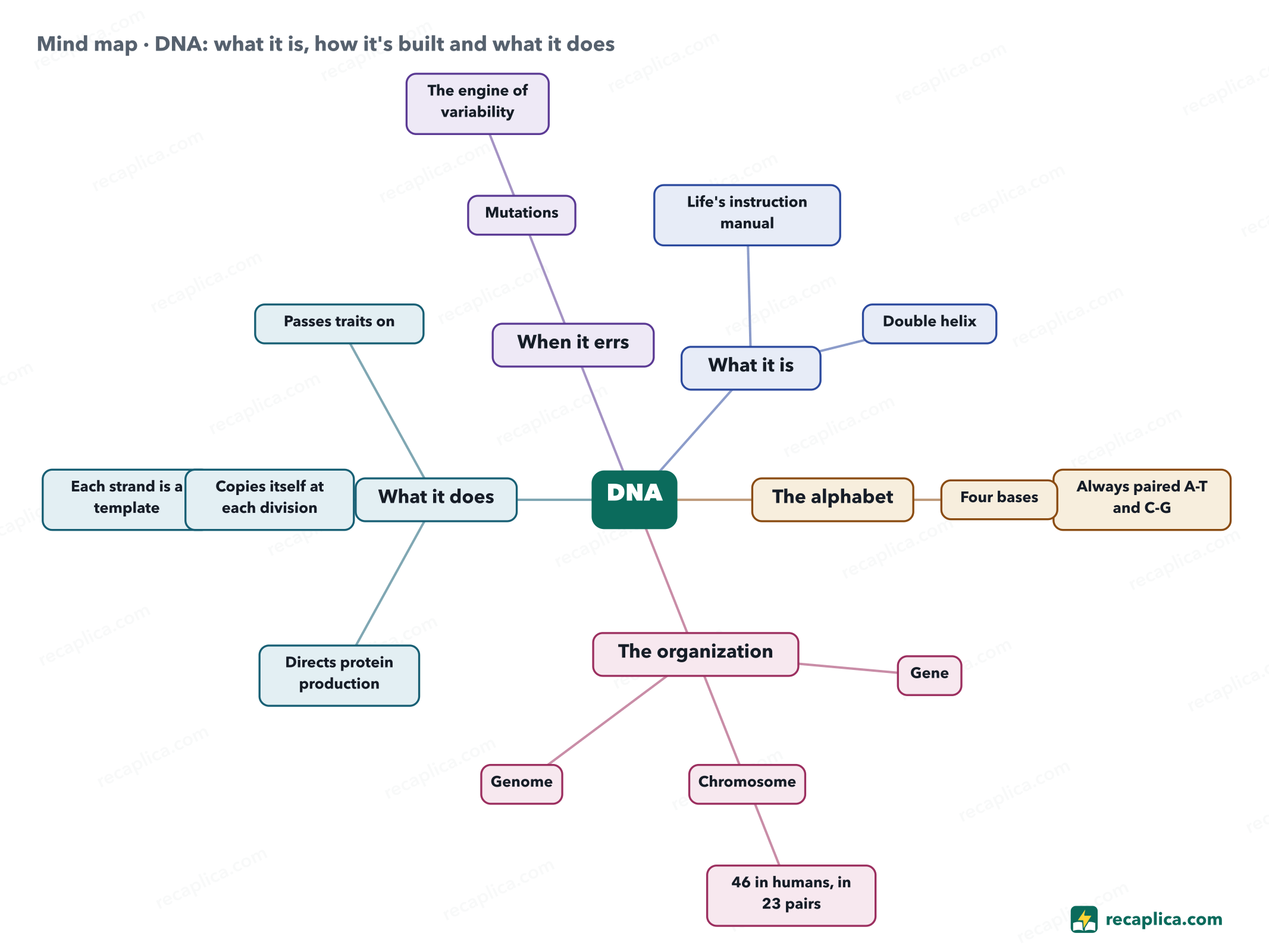
Quiz: test yourselfAnswer the questions to check what you have learned: you get instant feedback and a short explanation. Grade 0/10 0/5
FlashcardsTap the card to flip it and check whether you remember the answer, then move to the next one. 1 / 7 Explain it in your own wordsThe ultimate test: if you can explain it in simple words, you've truly understood it. Write your explanation, then compare it with the Recap. Your explanation is saved only on this device.
Frequently asked questionsWhere is DNA located?In eukaryotes it sits in the nucleus of every cell, packed into chromosomes; a small amount also lives in mitochondria (mitochondrial DNA, inherited only from the mother). In bacteria it floats free in the cytoplasm. What's the difference between DNA, a gene and a chromosome?Picture a library: DNA is all the written text, a gene is a single recipe, a chromosome is one of the bound volumes. The genome is the entire library. What is a DNA test for?By comparing variable regions of the genome you can establish identity (forensics), kinship (paternity tests) or predisposition to certain inherited conditions. Tiny traces suffice: saliva, hair, blood. What is a mutation?A copying error in the DNA: a wrong, missing or duplicated letter. Most are harmless, some are damaging, a rare few are useful, and those are the engine of the variability evolution works with. Every Recap goes through an independent review before publication. |