Skip to content
recaplica

    One moment: security check

    Cloudflare wants to make sure you're not a robot. Tick the box below and your search will continue on its own.

    IT
    recaplica How microwave ovens work, and why they don't make food radioactive
    © 2026 Recaplica · recaplica.com — All rights reserved
    Home › Technology Food and cooking

    How microwave ovens work, and why they don't make food radioactive

    By Recaplica Newsroom · Updated on September 6, 2026

    What to print

    Page numbers appear when printing with default margins.

    Slides

    Choose a cut

    Flash10 slidesThe essential thread, to present in classFull18 slidesEvery chapter and the deeper detail

    Both come with speaker notes.

    Telegram channel
    recaplica Clear in 30 seconds, yours in 10 minutes.
    In 30 seconds Key points Figures Deep dive Slides Myths Mind map Quiz Flashcards FAQ

    In 30 seconds quick read

    A microwave oven heats food with a component called a magnetron, which generates high-power radio waves strong enough to make water molecules vibrate. That vibration produces heat through friction, not through a flame or a heating element. The effect was discovered by accident in 1945 by Percy Spencer, a Raytheon engineer, after a candy bar melted in his pocket while he stood near a running magnetron. The oven's metal interior walls bounce the microwaves back toward the food like a mirror, while an isolated piece of metal inside can throw off sparks. It isn't a radiation that makes food radioactive, and the most common practical risk isn't the microwaves themselves but the heat, meaning burns from food or liquids that come out hotter than expected.

    Key Points

    • A microwave oven produces, through a component called a magnetron, non-ionizing electromagnetic radiation that makes water molecules in food vibrate, generating heat through friction.
    • It was discovered by accident in 1945 by Percy Spencer, an engineer and vice president at Raytheon, after he noticed a candy bar had melted in his pocket while he stood near a running magnetron; the first commercial model was called the Radarange.
    • The oven's metal interior walls reflect microwaves toward the food like a mirror, while an isolated metal object inside, such as a fork or a crumpled piece of aluminum foil, can concentrate the electric field at its sharp edges and throw off electric arcs.
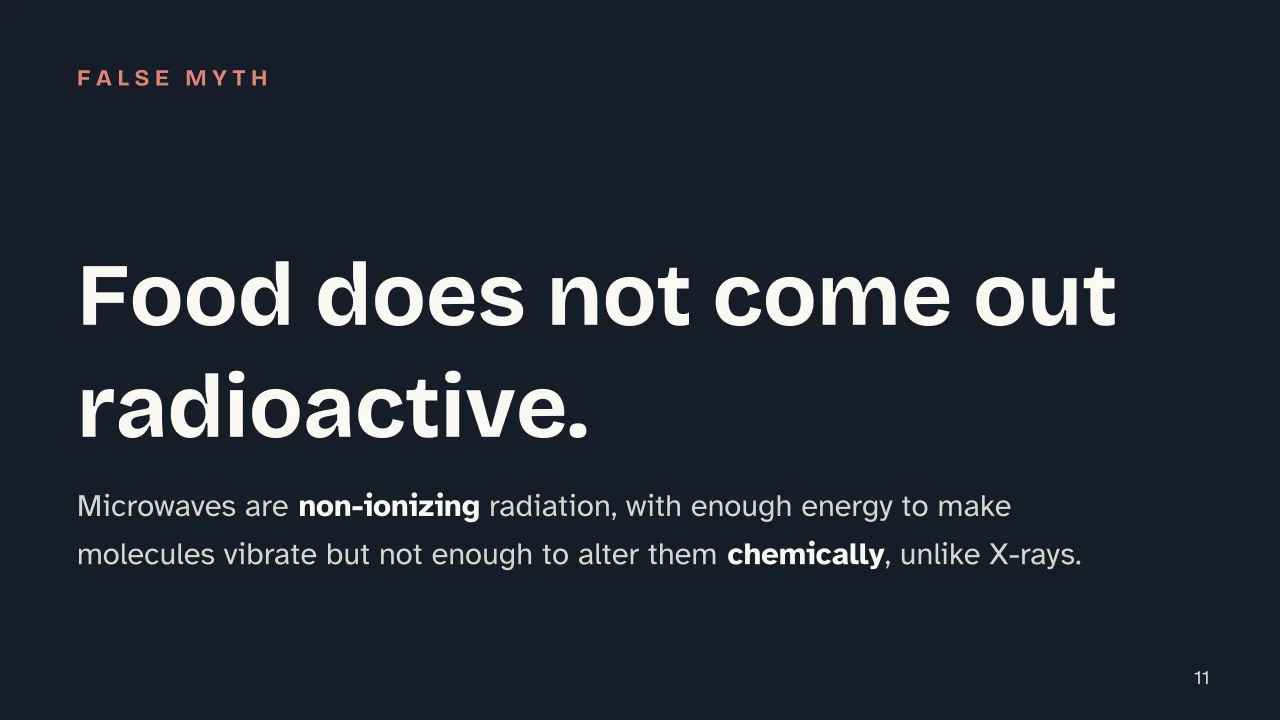
    • Microwaves don't make food radioactive, according to the FDA and the EPA; they are non-ionizing radiation, with enough energy to make molecules vibrate but not enough to alter them chemically, unlike X-rays.
    • The most common practical risk isn't the radiation but the heat, burns from overheated food or liquids, and uneven cooking that leaves colder spots where bacteria can survive.
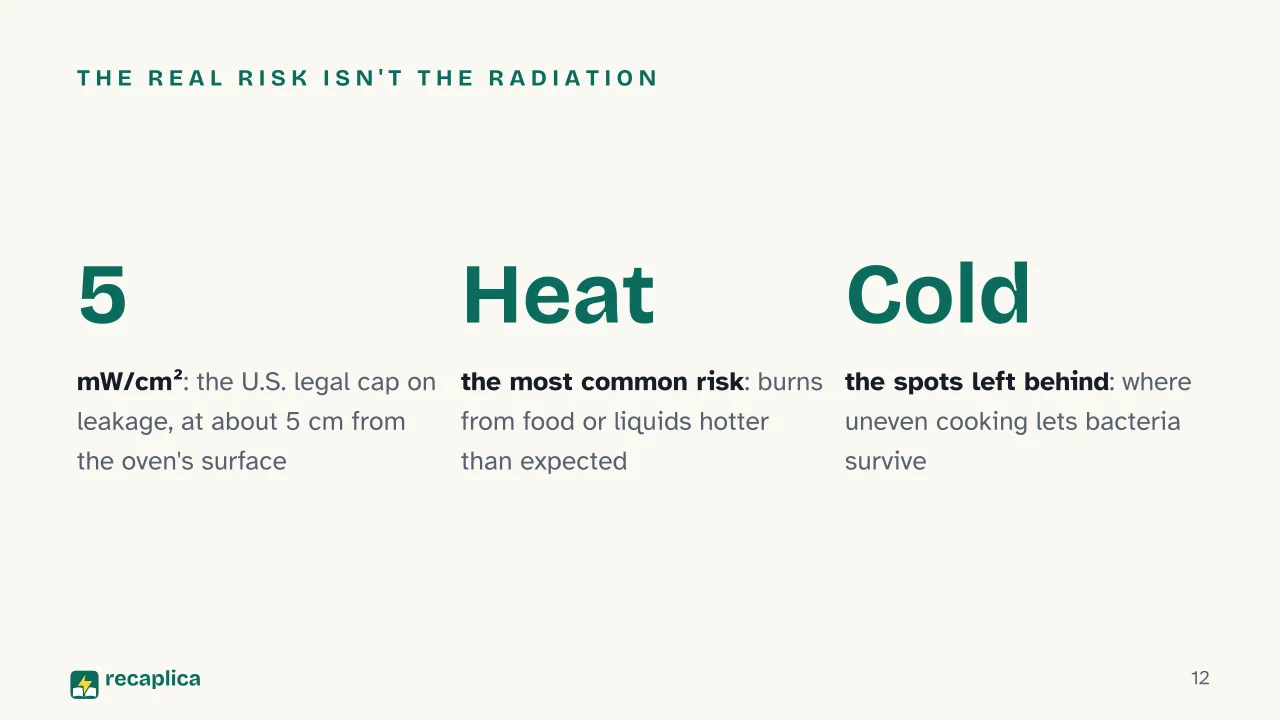
    • A U.S. federal limit (21 CFR 1030.10) requires that an oven leak no more than 5 milliwatts of microwave radiation per square centimeter at about 2 inches (5 cm) from its surface, for its entire working life.

    Key figures

    • 5 mW/cm² the maximum microwave leakage allowed by law in the United States, measured at about 2 inches (5 cm) from the oven's surface, for its entire working life Source: FDA, 21 CFR 1030.10
    • About 12 cm the wavelength of the microwaves produced by the magnetron in a standard home microwave oven Source: Explain that Stuff
    • 1945 the year Percy Spencer, a Raytheon engineer, accidentally discovered microwave heating of food; the first commercial model was called the Radarange Source: National Inventors Hall of Fame

    Deep Dive

    What actually makes the food vibrate

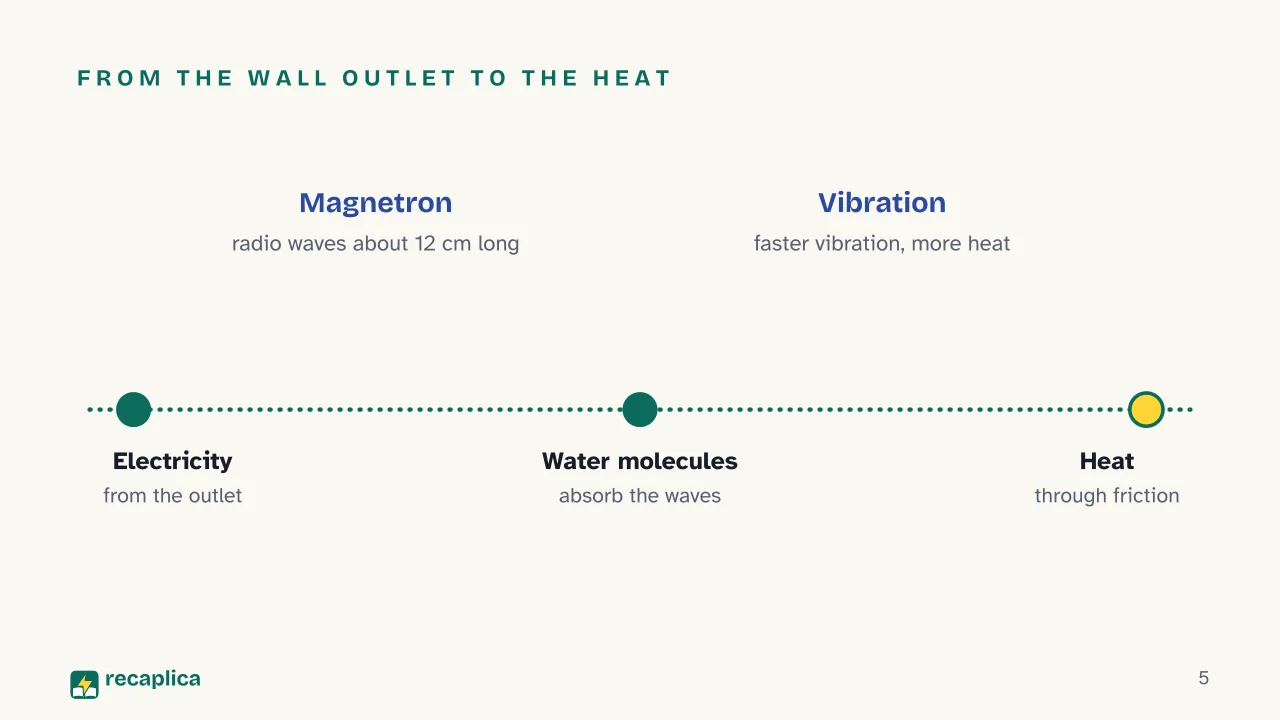
    Open the door and a microwave oven doesn’t hide a flame or a glowing heating coil: the heart of the appliance is a component called a magnetron, which draws electricity from the wall outlet and turns it into high-power radio waves, about 12 centimeters long. As these microwaves pass through food, the water molecules inside absorb them and start vibrating faster; the faster they vibrate, the more heat is generated, through friction, not through contact with an already-hot source the way a conventional oven or a stovetop burner works.

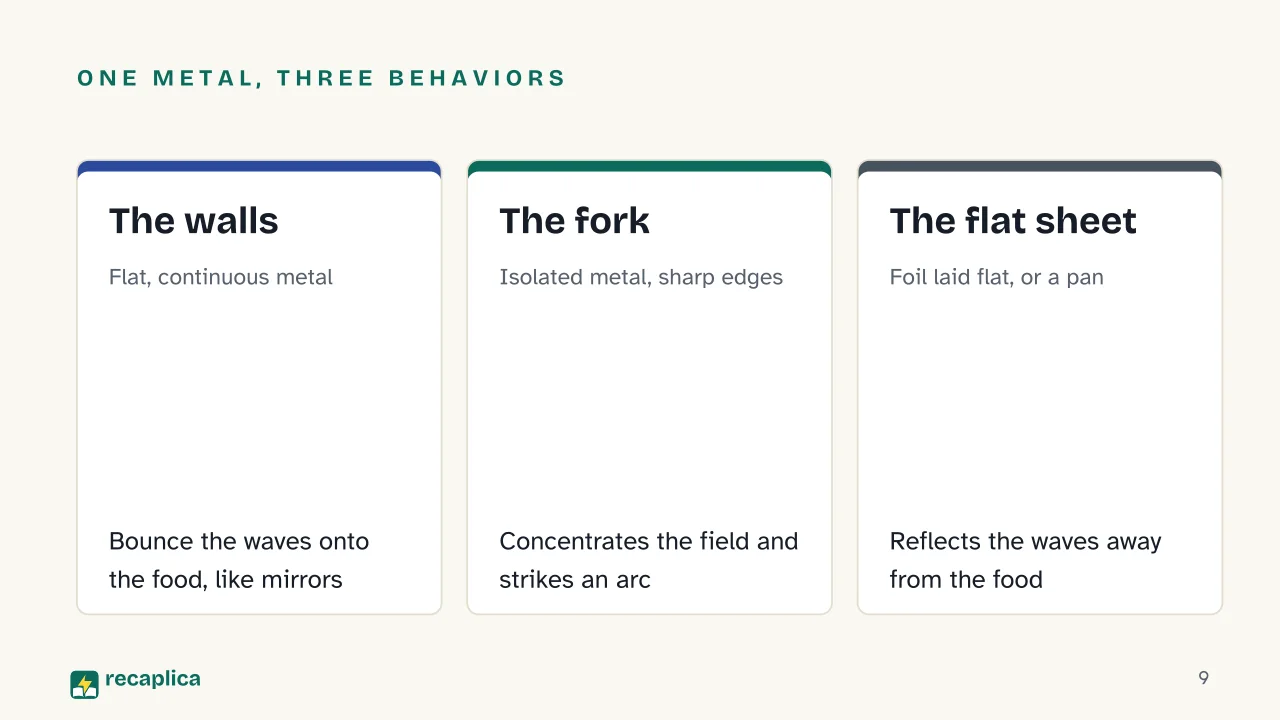
    The interior walls of the cooking chamber are also metal, but here the metal works in favor of the cooking process: they’re flat and continuous, and they bounce microwaves from one side to the other like a row of small mirrors, directing them toward the food instead of letting them scatter. It’s a similar principle, in the end, to what pushes many kitchen appliances to rely on a physical mechanism different from the one we’re used to: an air fryer achieves a result close to traditional deep frying by moving hot air instead of submerging food in oil, changing the medium that carries the heat.

    Why the fork sparks but the walls don’t

    A natural question at this point is why the oven itself is lined with metal if metal is also the first thing you’re told not to put inside. The answer lies in shape. The oven’s walls are broad, edge-free surfaces: they reflect an electric field that stays fairly evenly distributed. An isolated metal object inside the cooking chamber, like a fork or a crumpled piece of aluminum foil, has sharp edges and tight folds instead: that’s exactly where the electric field concentrates until it becomes strong enough to produce a visible arc, the spark that sometimes flashes inside the microwave. For the same reason, putting a flat pan or a flat sheet of aluminum foil in a microwave oven simply reflects the microwaves away from the food, resulting in uneven cooking, on top of the risk of damaging the appliance.

    A discovery born by accident

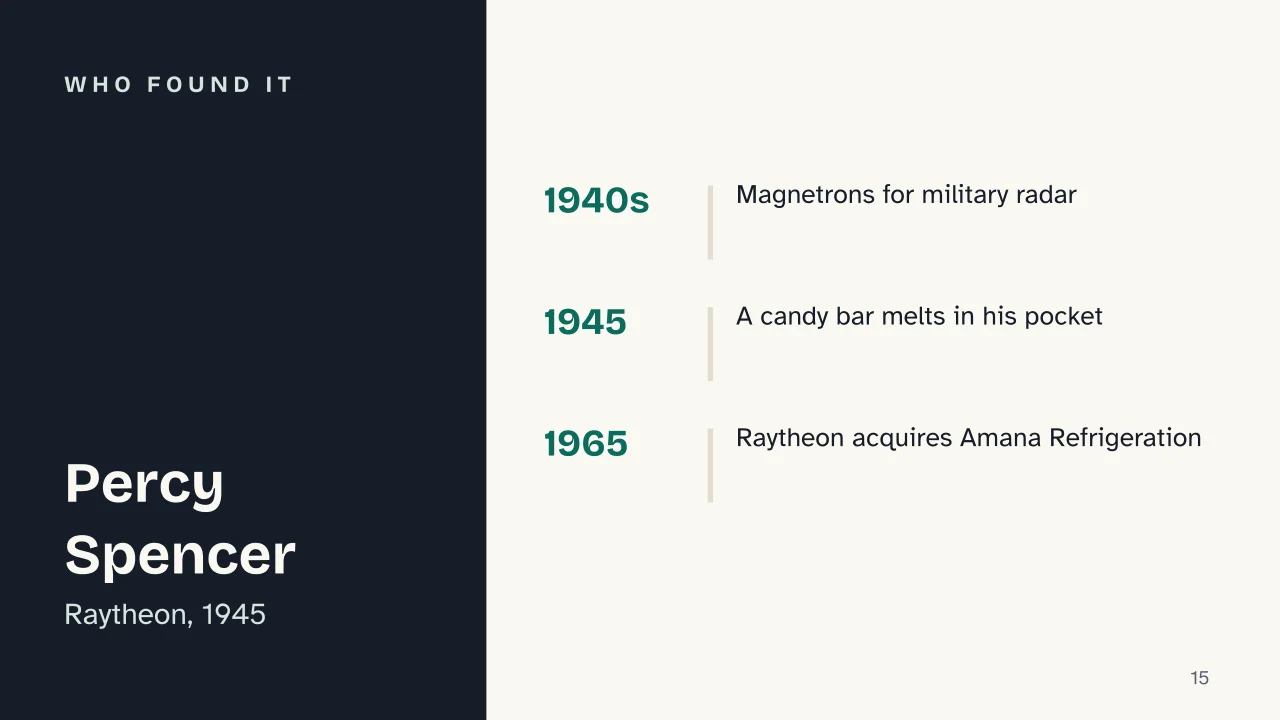
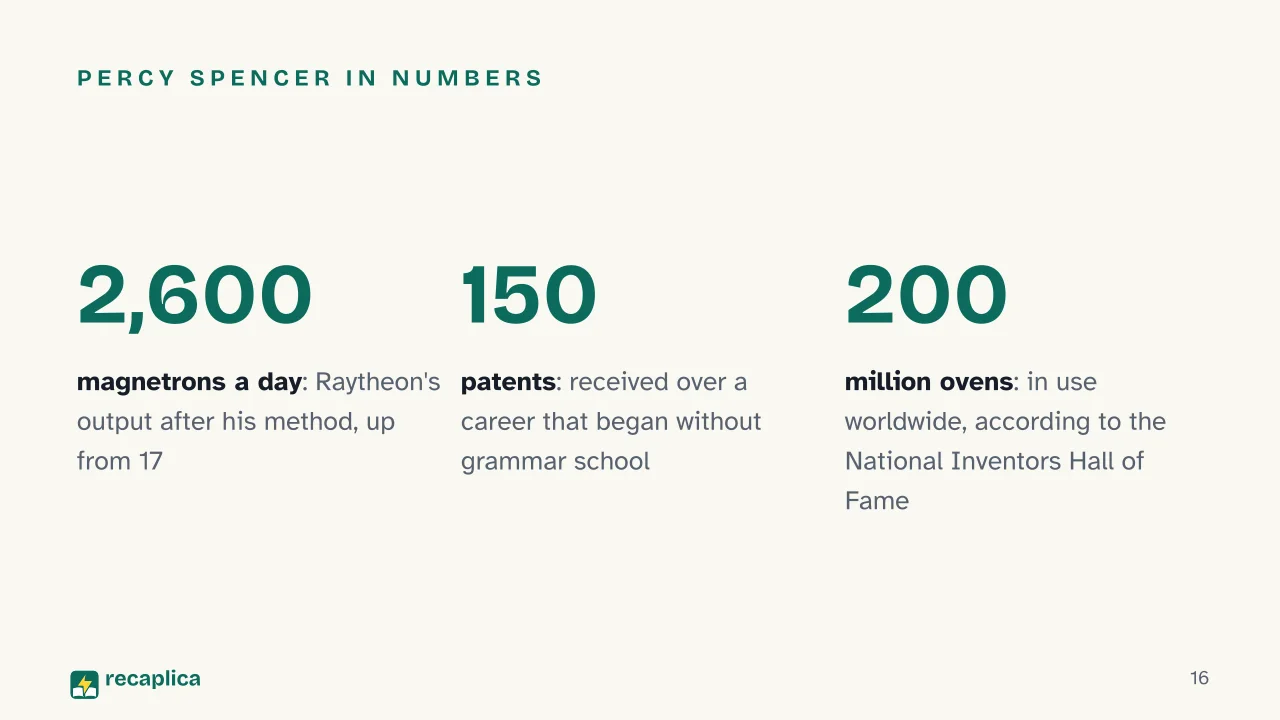
    The microwave oven didn’t start out as a project meant for cooking. In the 1940s, Percy Spencer was an engineer and vice president at Raytheon, an American company that built magnetrons for World War II military radar. Spencer had already found a more efficient way to build them, replacing precision-machined internal parts with simpler versions that were easier to assemble, a change that pushed Raytheon’s magnetron output from 17 to 2,600 units a day.

    Real-world example: working near a running magnetron in 1945, Spencer noticed a candy bar in his pocket had melted. Curious, he tried placing popcorn kernels near the magnetron, and they popped; he then tried an egg, which exploded. Those tests led to the first commercial microwave oven, called the Radarange.

    Widespread home use, though, came only later: Raytheon acquired the company Amana Refrigeration in 1965, and from there the microwave oven started becoming a common appliance in American homes and eventually around the world, reaching an estimated more than 200 million units in use worldwide, according to the National Inventors Hall of Fame. Spencer, who never finished grammar school, went on to receive 150 patents over the course of his career and was awarded the Distinguished Service Medal by the U.S. Navy.

    Non-ionizing radiation: what the safety science says

    The word “radiation” puts a lot of people on edge, but not all radiation is the same. Microwaves belong to the category of non-ionizing radiation: they have enough energy to move atoms and molecules, making them vibrate, but not enough to alter them chemically or strip away electrons, the way X-rays or gamma rays do, which are ionizing radiation. It’s this physical difference, not a marketing reassurance, that explains why a microwave oven doesn’t carry the same kind of risk as an X-ray machine.

    By law, in the United States a microwave oven can’t leak more than 5 milliwatts of microwave radiation per square centimeter, measured at about 2 inches (5 cm) from the appliance’s surface, for its entire working life. The oven is also built with safety interlocks that automatically shut it off as soon as the door opens, so microwaves stop being produced the instant the food becomes accessible. The most common practical risk, according to institutional sources, isn’t the radiation at all but the heat: most microwave-related injuries are burns caused by food or liquids that come out hotter than expected.

    The most common myths

    The first myth worth clearing up is radioactivity: a microwave doesn’t make food radioactive or contaminated; the absorbed energy simply turns into heat, and microwaves only exist while the oven is running, they don’t stay trapped inside the appliance or the plate after it’s switched off.

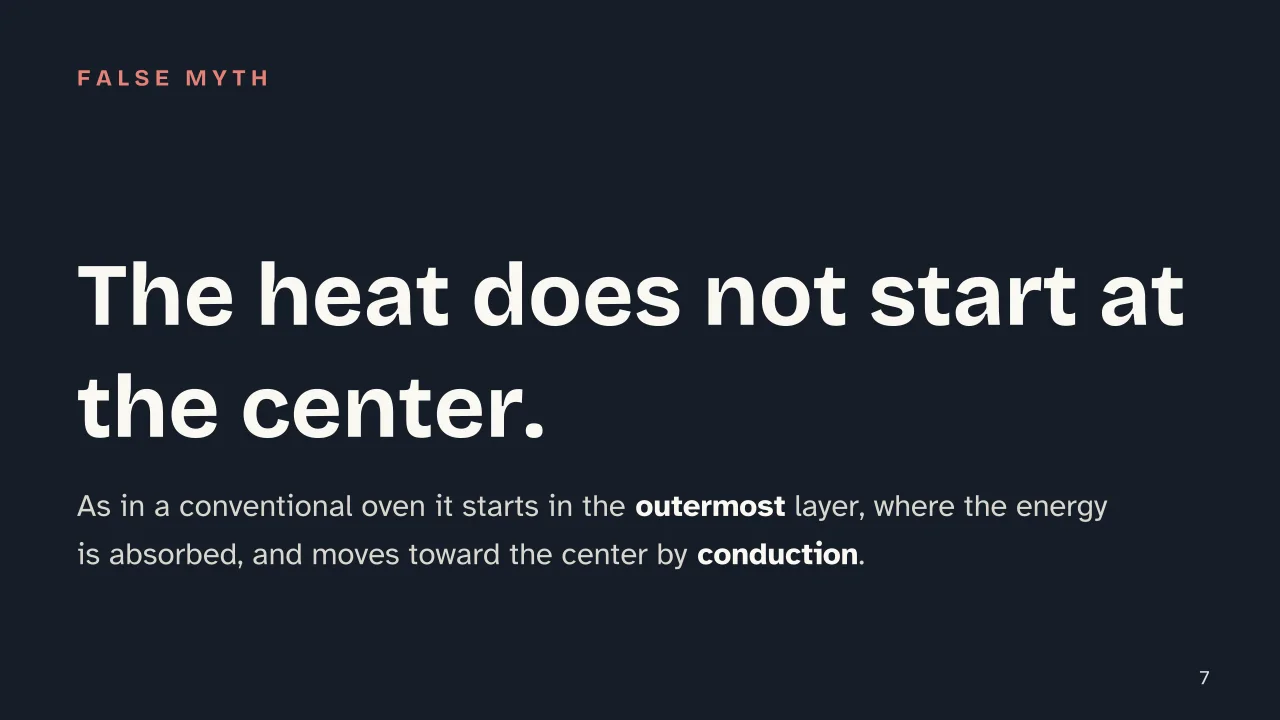
    The second concerns the direction of cooking: many people believe a microwave heats food “from the inside out,” but that’s not the case. As in a conventional oven, heat starts wherever the energy is absorbed first, meaning the outermost, most superficial layer of the food; from there it moves toward the center by conduction, exactly as happens with any other heat source. The opposite impression comes from the fact that microwave cooking is often less even than oven cooking, with spots that stay colder near the center or close to a bone, not from a different direction of heat flow.

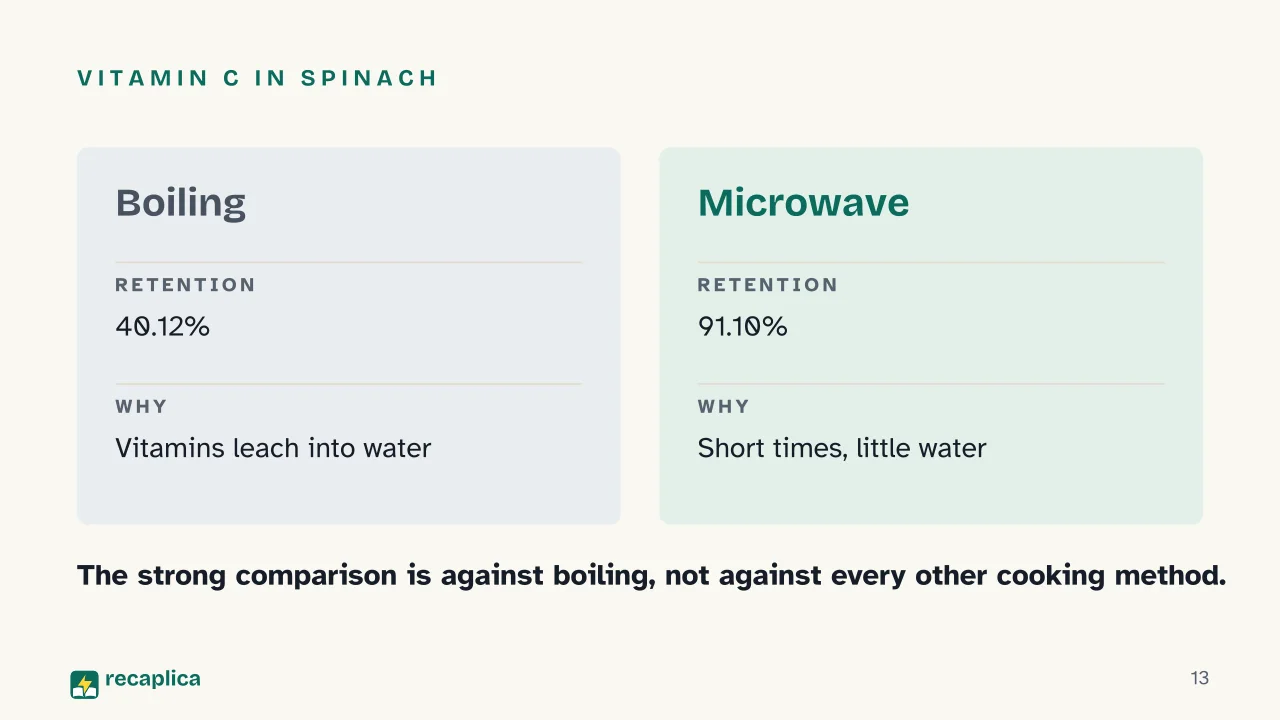
    A third common doubt concerns nutrients, and here the myth runs backwards: according to Harvard Health Publishing, microwave cooking tends to preserve heat-sensitive vitamins like vitamin C better, precisely because cook times are shorter and it needs little or no water, the main way nutrients leach out during boiling. A study published in Food Science and Biotechnology measured a vitamin C retention of 91.10% for spinach cooked in a microwave, against 40.12% for boiled spinach, with similarly high retention, above 90%, for carrots, sweet potato, and broccoli. The strong comparison is mainly against boiling; steaming, for instance, also preserves nutrients well, so the point isn’t that a microwave beats every other method, just that it isn’t the culprit its reputation suggests. A separate safety issue does remain, though: uneven cooking can leave “cold spots” in food where bacteria survive even after cooking times that seem sufficient. That’s why stirring the food, rotating the plate during cooking, and letting it stand for a few minutes afterward helps heat spread more evenly through the whole portion.

    Finally, people with a pacemaker often wonder whether a microwave is risky. According to the FDA, modern pacemakers are designed to shield against electrical interference from appliances like microwave ovens: anyone with specific concerns can still talk to their doctor, but there’s no general guidance to avoid the appliance for this reason.

    Microwave versus conventional oven: a practical comparison

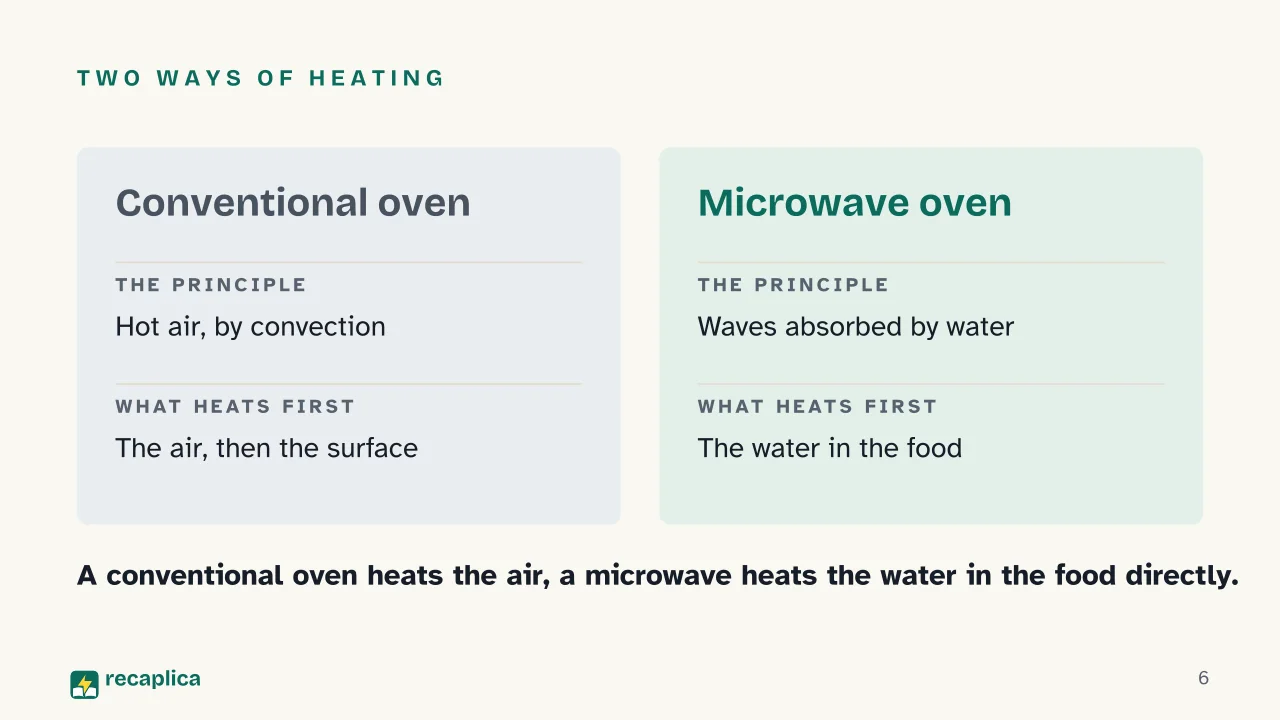
    A microwave oven and a conventional oven heat food in two physically different ways, and that changes both the timing and the result on the plate.

    Conventional ovenMicrowave oven
    Physical principleHot air heats food by convection and radiationMicrowaves absorbed by water molecules, which vibrate and generate heat
    What heats up firstThe air in the cooking chamber, then the food’s surfaceDirectly the water and other polar molecules in the food
    Cooking timeLonger, requires preheatingFaster, no preheating needed
    Surface browningYes, typical of prolonged high heatGenerally absent, except with combined grill functions
    Suitable containersMetal, glass, ceramicGlass, ceramic without metallic trim, microwave-safe plastic

    Anyone looking for appliances that cut down kitchen time without giving up on results often ends up comparing the microwave with other devices built to do a familiar task “better and faster”: it’s the same spirit behind the spread of the robot vacuum, another home technology that reached the market long after it was originally invented.

    Curiously, the very phenomenon that made Spencer’s discovery possible, chocolate melting, has a precise physical explanation that has nothing to do with microwaves: it comes down to the structure of cocoa butter crystals, covered in this Recap.

    Slide deck

    Slides ready to download and make your own in PowerPoint or Google Slides, with speaker notes. Pick the Flash cut or the Full one.
    Slide 1 of the presentation on How microwave ovens work, and why they don't make food radioactive: The microwave ovenSlide 2 of the presentation on How microwave ovens work, and why they don't make food radioactive: Where is the flame inside a microwave oven?Slide 3 of the presentation on How microwave ovens work, and why they don't make food radioactive: What we will coverSlide 4 of the presentation on How microwave ovens work, and why they don't make food radioactive: Chapter 01: The wave that heats waterSlide 5 of the presentation on How microwave ovens work, and why they don't make food radioactive: From the wall outlet to the heatSlide 6 of the presentation on How microwave ovens work, and why they don't make food radioactive: Two ways of heatingSlide 7 of the presentation on How microwave ovens work, and why they don't make food radioactive: The heat does not start at the center.Slide 8 of the presentation on How microwave ovens work, and why they don't make food radioactive: Chapter 02: Metal, mirror and sparkSlide 9 of the presentation on How microwave ovens work, and why they don't make food radioactive: One metal, three behaviors: The walls, The fork, The flat sheetSlide 10 of the presentation on How microwave ovens work, and why they don't make food radioactive: Chapter 03: Non-ionizing radiationSlide 11 of the presentation on How microwave ovens work, and why they don't make food radioactive: Food does not come out radioactive.Slide 12 of the presentation on How microwave ovens work, and why they don't make food radioactive: The real risk isn't the radiationSlide 13 of the presentation on How microwave ovens work, and why they don't make food radioactive: Vitamin C in spinachSlide 14 of the presentation on How microwave ovens work, and why they don't make food radioactive: Chapter 04: A discovery by accidentSlide 15 of the presentation on How microwave ovens work, and why they don't make food radioactive: Who found itSlide 16 of the presentation on How microwave ovens work, and why they don't make food radioactive: Percy Spencer in numbersSlide 17 of the presentation on How microwave ovens work, and why they don't make food radioactive: What makes the water in food vibrate?Slide 18 of the presentation on How microwave ovens work, and why they don't make food radioactive: And now, the review
    Flash10 slidesThe essential thread, to present in classFull18 slidesEvery chapter and the deeper detail

    Common myths

    • ✗ Myth A microwave oven makes food radioactive.

      ✓ Reality False. Microwaves are non-ionizing electromagnetic radiation, with enough energy to make molecules vibrate but not enough to alter them chemically, unlike X-rays or gamma rays. The energy turns into heat absorbed by the food during cooking, and is only produced while the oven is running; it doesn't stay "stored" in the food or the appliance after it's switched off, according to the FDA and the EPA.

    • ✗ Myth A microwave oven cooks food from the inside out.

      ✓ Reality False. As in a conventional oven, heat starts wherever the energy is absorbed, meaning the outermost layer of the food; from there it moves toward the center by conduction, the same heat transfer mechanism as any other type of cooking. The opposite impression comes from the fact that microwave cooking is often less even than oven cooking, with spots that stay colder, not from a different direction of heat flow.

    • ✗ Myth A microwave oven is dangerous for people with pacemakers.

      ✓ Reality Modern pacemakers are designed to shield against electrical interference from appliances like microwave ovens, according to the FDA. Anyone with a pacemaker who has specific concerns should still talk to their doctor, but there's no general guidance to avoid the appliance for this reason.

    Mind map

    Drag the background to move around and the nodes to reposition them; use − and + to collapse and expand branches.
    Customize
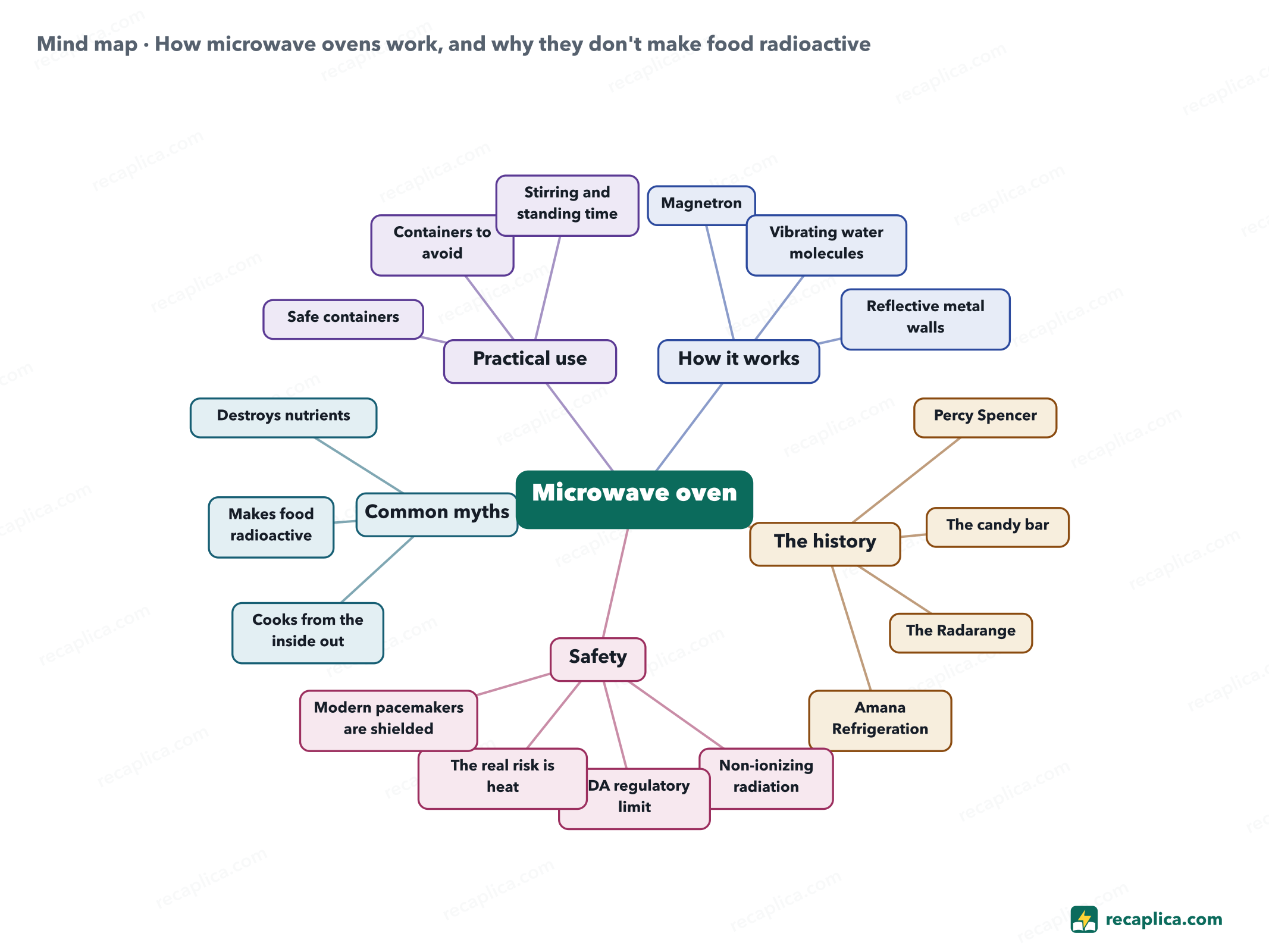
    Mind map: How microwave ovens work, and why they don't make food radioactive
    • Microwave oven
      • How it works
        • Magnetron Generates the microwaves, radio waves about 12 cm long, turning electricity into radiation.
        • Vibrating water molecules Microwaves get absorbed and generate heat through friction.
        • Reflective metal walls Bounce microwaves back toward the food like a mirror.
      • The history
        • Percy Spencer Raytheon engineer, discovered the effect in 1945.
        • The candy bar Melted in his pocket near a running magnetron.
        • The Radarange First commercial Raytheon model.
        • Amana Refrigeration Acquired in 1965, start of widespread home use.
      • Safety
        • Non-ionizing radiation Not enough energy to chemically alter molecules, unlike X-rays.
        • FDA regulatory limit Maximum 5 mW/cm² at 2 inches from the surface.
        • The real risk is heat Burns from overheated food or liquids, not radiation.
        • Modern pacemakers are shielded
      • Common myths
        • Cooks from the inside out False, heat starts at the surface and moves inward by conduction.
        • Makes food radioactive False, the non-ionizing energy only turns into heat.
        • Destroys nutrients False, it preserves more vitamin C than boiling thanks to short cook times and little water.
      • Practical use
        • Safe containers Glass, ceramic without metallic trim, plastic labeled microwave-safe.
        • Containers to avoid Metal, aluminum foil, paper or plastic bags not meant for microwave use.
        • Stirring and standing time Distributes heat evenly and avoids cold spots.

    Quiz: test yourself

    Answer the questions to check what you have learned: you get instant feedback and a short explanation.

    Grade 0/10 0/5
    1 What exactly makes the water in food vibrate inside a microwave oven?

    The magnetron generates microwaves, a type of electromagnetic radiation. As these waves pass through food, water molecules (and other polar molecules) absorb them and vibrate faster; that vibration is heat, so the food warms up.

    2 True or false: a microwave oven makes food radioactive.

    False. According to the FDA and the EPA, microwaves are non-ionizing radiation, with enough energy to make molecules vibrate but not enough to alter them chemically. The energy turns into heat absorbed by the food during cooking and doesn't stay trapped in it afterward.

    3 Why can a metal fork inside a microwave throw off sparks, while the oven's metal walls don't?

    The flat, continuous interior walls reflect microwaves back toward the food like a mirror. An isolated metal object with edges or folds instead concentrates the electric field in a narrow spot, and that's where the field becomes strong enough to produce a visible electric arc, the spark.

    4 Who accidentally discovered microwave heating of food, in 1945?

    Percy Spencer worked at Raytheon on magnetrons for military radar. He noticed a candy bar had melted in his pocket while he stood near a running magnetron, and from there went on to develop the first commercial oven, called the Radarange.

    5 According to the EPA, what is the most common practical risk from a microwave oven?

    Most microwave-related injuries come from heat, food or liquids coming out hotter than expected, not from radiation. The oven is also built to keep microwaves from escaping, with safety interlocks that shut it off as soon as the door opens.

    Answers: 1-B · 2-B · 3-A · 4-B · 5-A

    Flashcards

    Tap the card to flip it and check whether you remember the answer, then move to the next one.

    1 / 8

    Explain it in your own words

    The ultimate test: if you can explain it in simple words, you've truly understood it. Write your explanation, then compare it with the Recap.

    Your explanation is saved only on this device.

    A microwave oven heats food with a component called a magnetron, which generates high-power radio waves strong enough to make water molecules vibrate. That vibration produces heat through friction, not through a flame or a heating element. The effect was discovered by accident in 1945 by Percy Spencer, a Raytheon engineer, after a candy bar melted in his pocket while he stood near a running magnetron. The oven's metal interior walls bounce the microwaves back toward the food like a mirror, while an isolated piece of metal inside can throw off sparks. It isn't a radiation that makes food radioactive, and the most common practical risk isn't the microwaves themselves but the heat, meaning burns from food or liquids that come out hotter than expected.

    Frequently asked questions

    Does a microwave oven make food radioactive?

    No. Both the U.S. FDA and EPA explicitly rule this out; microwaves are non-ionizing radiation, and the energy turns into heat absorbed by the food while it cooks, without contaminating it or making it radioactive.

    Can I put a metal container or aluminum foil in the microwave?

    Better not to. Microwaves get reflected off metal instead of being absorbed by the food, resulting in uneven cooking and, sometimes, sparks or damage to the oven. Glass, ceramic without metallic trim, or plastic labeled microwave-safe work better.

    Does a microwave oven destroy more nutrients than other cooking methods?

    The opposite, if anything. According to Harvard Health Publishing, microwaving tends to preserve nutrients better than boiling, because cook times are shorter and it needs little or no water, so fewer vitamins leach out into the cooking liquid. A study published in Food Science and Biotechnology measured a vitamin C retention of 91.10% for spinach cooked in a microwave, against 40.12% for boiled spinach. The strong comparison is mainly against boiling, not every other method, steaming, for instance, also preserves nutrients well.

    Is it harmful to stand near a running microwave oven?

    The oven is built to keep microwaves from escaping, with shielding walls and a safety interlock that shuts it off as soon as the door opens. A U.S. regulatory limit still caps leakage at 5 mW of microwave radiation per square centimeter at about 2 inches (5 cm) from the surface, for the appliance's entire working life; the FDA still recommends, as a precaution, not standing directly up against the oven while it's running, a recommendation the EPA repeats as well.

    Sources

    • U.S. Food and Drug Administration (FDA), Microwave Ovens
    • U.S. Environmental Protection Agency (EPA), Non-Ionizing Radiation Used in Microwave Ovens
    • National Inventors Hall of Fame, Percy L. Spencer
    • Home & Garden Information Center, Clemson University, Microwave Food Safety
    • Explain that Stuff, Microwave ovens, How do they work?
    • Harvard Health Publishing, Microwave cooking and nutrition
    • Lee et al., Effect of different cooking methods on the content of vitamins and true retention in selected vegetables, Food Science and Biotechnology (2017)

    Every Recap goes through an independent review before publication.

    Every evening, the day's new Recaps on our Telegram channel. Join the channel →

    Keep learning

    • Technology How air fryers work (and why they don't really fry anything) An air fryer is, mechanically speaking, a small forced-convection oven: a heating element warms the air, and a powerful fan pushes it around the food at high speed inside a perforated basket. The result mimics deep frying in hot oil, but needs only a light coating of fat instead of full immersion. The browning comes from the same chemical reaction as traditional frying, the Maillard reaction, triggered once the food's surface passes roughly 140-165°C. Compared with deep frying, the appliance cuts fat intake and some unwanted compounds like acrylamide by a wide margin, but it doesn't eliminate them. Read the Recap →
    • Technology Foldable Smartphones: How the Hinge and Screen Really Work Foldable smartphones pair a flexible screen with an intricate mechanical hinge, and in 2026 Samsung's Galaxy Z Fold8 shows both the strengths and the limits of the category clearly. The Armor FlexHinge and Flex Titanium display have reached a genuinely refined level of engineering, but an independent iFixit teardown found that fine dust can still jam the mechanism despite the phone's stated IP48 rating. The crease down the middle of the screen remains a defining trait of the category, showing up within days on some units and barely noticeable on others after months of use. Globally, foldables are still a niche: 2.5% of smartphone shipments in the third quarter of 2025, though growing. Read the Recap →
    • Technology Smartphone Battery Life: How to Make It Last Longer A phone battery wears out gradually with use, it doesn't fail all at once: every full charge counts as one cycle, and the capacity it can hold drops a little with each one. Heat is the real culprit, and it damages the battery permanently in a way cold never does. Topping up often, instead of waiting for the battery to hit zero, helps it last longer, and modern phones already manage charging for you in the background. Not every tip that circulates online holds up, either — closing apps manually does far less than most people assume. Read the Recap →

    recaplica

    Clear in 30 seconds, yours in 10 minutes.

    Recaps Mind maps Request a Recap Telegram channel Mind map maker Our method About Privacy & cookies Legal notes & terms of use

    © 2026 Recaplica · A project by Curi S.r.l. — VAT IT05472000750

    Statistics, only if you say so

    To learn which Recaps help most we would use Google Analytics, with aggregate, anonymous data. It starts only with your OK, and you can change your mind anytime. Privacy policy