|
recaplica
Digestive System: How It Breaks Down Food, Step by Step | ||||||||||||
| © 2026 Recaplica · recaplica.com — All rights reserved | ||||||||||||
Digestive System: How It Breaks Down Food, Step by StepWhat to print Page numbers appear when printing with default margins. SlidesChoose a cut Flash10 slidesThe essential thread, to present in classFull16 slidesEvery chapter and the deeper detailBoth come with speaker notes. In 30 seconds quick readThe digestive system breaks food down, piece by piece, into molecules the body can absorb. It starts in the mouth, where teeth cut food into fragments and saliva carries the first enzymes, continues in the stomach, which churns food with gastric acid, and does most of its chemical work in the small intestine, according to StatPearls (2022). Along the way, the liver, pancreas, and gallbladder — organs outside the digestive tract itself — add bile and enzymes to the mix. What's left moves on to the large intestine, which reclaims water and minerals before waste leaves the body. Key Points
Key figures
Deep DiveMouth: the first stopIt all starts with chewing: teeth cut food into smaller pieces while the tongue works it together with saliva. That’s the mechanical side of the job, the first to act on food. Saliva isn’t just water: it already carries two enzymes. Salivary amylase, sometimes called ptyalin, breaks starch down into maltose and maltotriose, working best at a pH between 6.7 and 7.0 according to StatPearls (2022); lingual lipase, meanwhile, starts working on fat. It’s only a partial job — most of the digestion still lies ahead — but it begins here, before you’ve even swallowed. Stomach: acid and churningIn the stomach, food gets churned by muscular contractions that StatPearls (2023) describes as a back-and-forth motion, driven by the smooth muscle in the stomach wall — the same tissue type covered in the muscular system Recap. Gastric juice has a pH of about 1.0 (StatPearls, 2023), among the most acidic fluids the body makes. Hydrochloric acid, secreted by the stomach’s parietal cells — the same basic units described in the cell Recap — switches on pepsinogen, an inactive enzyme form, turning it into pepsin. Pepsin is the enzyme that starts cutting proteins into smaller polypeptides. Stomach emptying into the intestine isn’t constant: according to StatPearls (2023), it slows down when fat and acid show up in the duodenum, and also during stress or exercise.
Liver, pancreas, and gallbladder: the outside suppliersThe liver, pancreas, and gallbladder aren’t technically part of the digestive tract, but they connect to it through ducts and feed in the substances that make much of chemical digestion possible.
Bile’s main job is emulsifying fat; what happens to that fat once it’s absorbed is covered in the body fat Recap. About 80% of pancreatic tissue is exocrine, meaning it’s dedicated to producing the digestive juice that reaches the duodenum through the pancreatic ducts, according to a StatPearls review updated in December 2025; the rest is endocrine tissue that makes insulin and glucagon, released directly into the bloodstream. The pancreas’s protein-digesting enzymes — trypsinogen, chymotrypsinogen, procarboxypeptidase, and proelastase — leave the gland already switched off, as zymogens, and only become active once they reach the duodenum. That’s one reason the pancreas doesn’t digest itself despite making enzymes capable of breaking down protein. Small intestine: where the work finishesThe duodenum, the first section of the small intestine, receives enzymes from the liver, pancreas, and gallbladder through the ducts that feed into it, according to StatPearls (2024). Further along, in the jejunum, the intestinal wall contracts in a pattern called segmentation, driven by the myenteric plexus: it mixes food with enzymes rather than simply pushing it forward, according to the same source. Meanwhile, brush-border enzymes — maltase, isomaltase, sucrase, β-galactosidase, and trehalase — finish breaking down sugars, alongside trypsin, chymotrypsin, elastase, and carboxypeptidase A and B, the active forms of the protein-digesting enzymes that arrived from the pancreas. The result: the small intestine, averaging about 7 meters (StatPearls, 2024), absorbs 95% of the nutrients in food, in a process that can take up to 5 hours to run its full course. Large intestine: water, vitamins, and gut bacteriaBy the time undigested material reaches the large intestine, the small intestine has already absorbed most of the nutrients and up to 90% of the water, according to StatPearls (2023). The large intestine, about 1.5 meters long (StatPearls, 2023) — roughly a fifth of the entire gastrointestinal tract — has three jobs: absorbing water and electrolytes, producing and absorbing vitamins, and forming stool and moving it toward the rectum. The bacteria living there, the colon’s gut microbiome, make vitamin K and B vitamins such as biotin as a byproduct of their own metabolism. The same basic principle — microorganisms transforming organic material into new substances — is what drives fermentation, though in the colon the result stays inside the body instead of ending up in a jar. Slide deckSlides ready to download and make your own in PowerPoint or Google Slides, with speaker notes. Pick the Flash cut or the Full one.   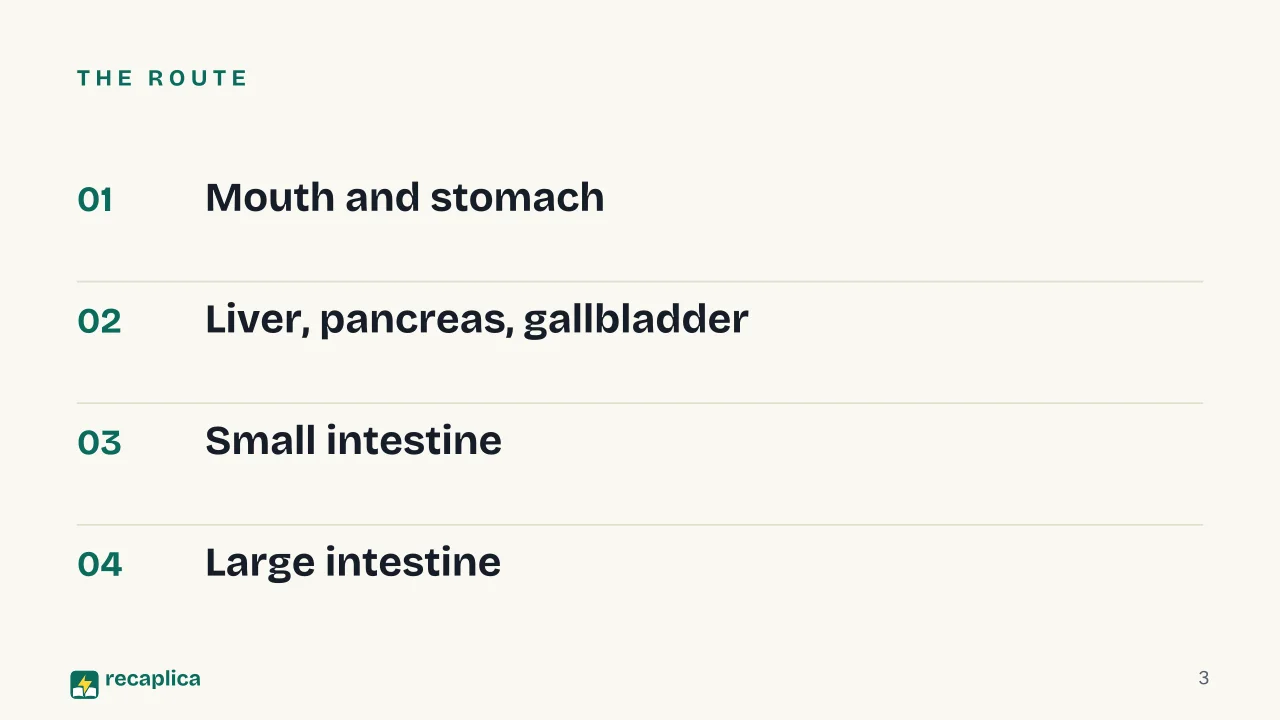 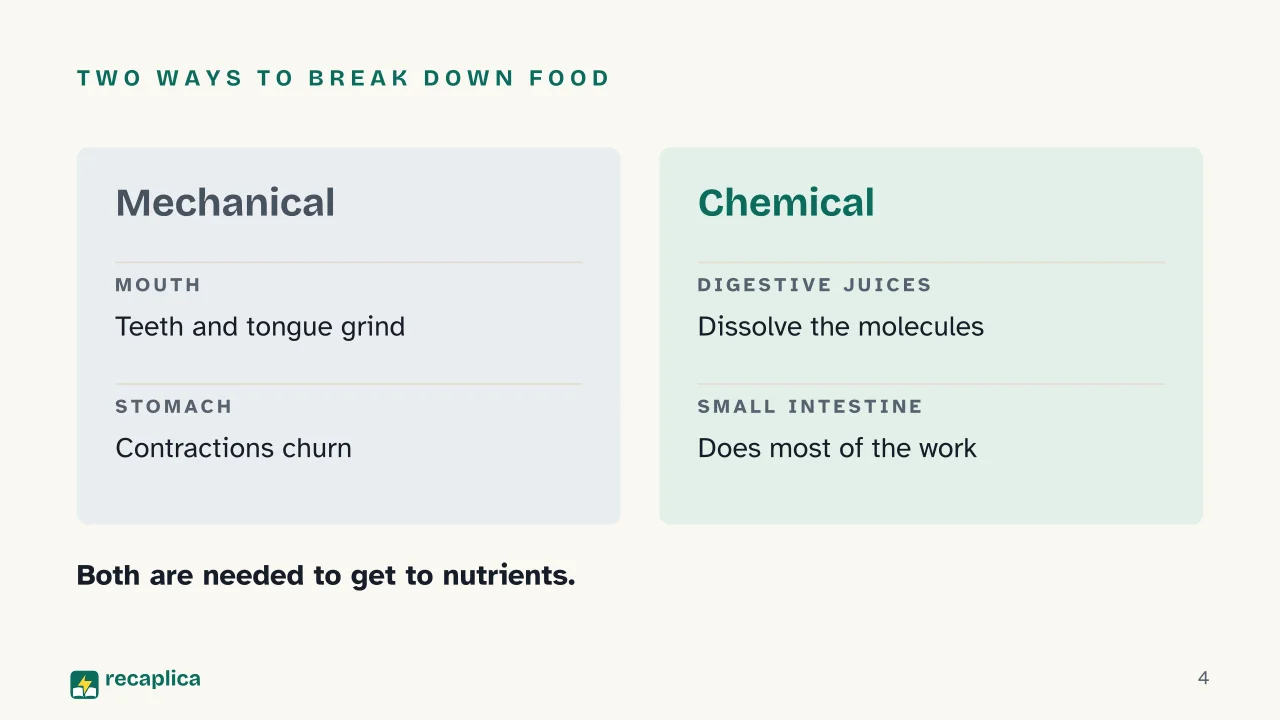  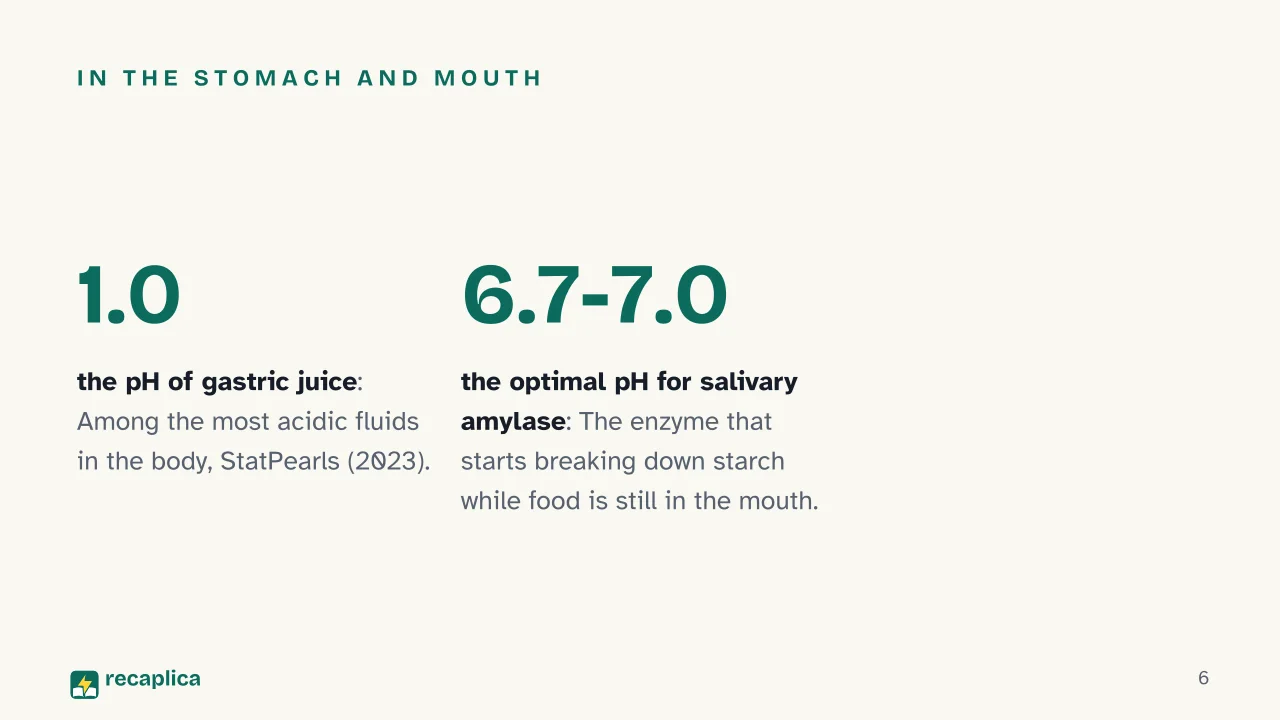 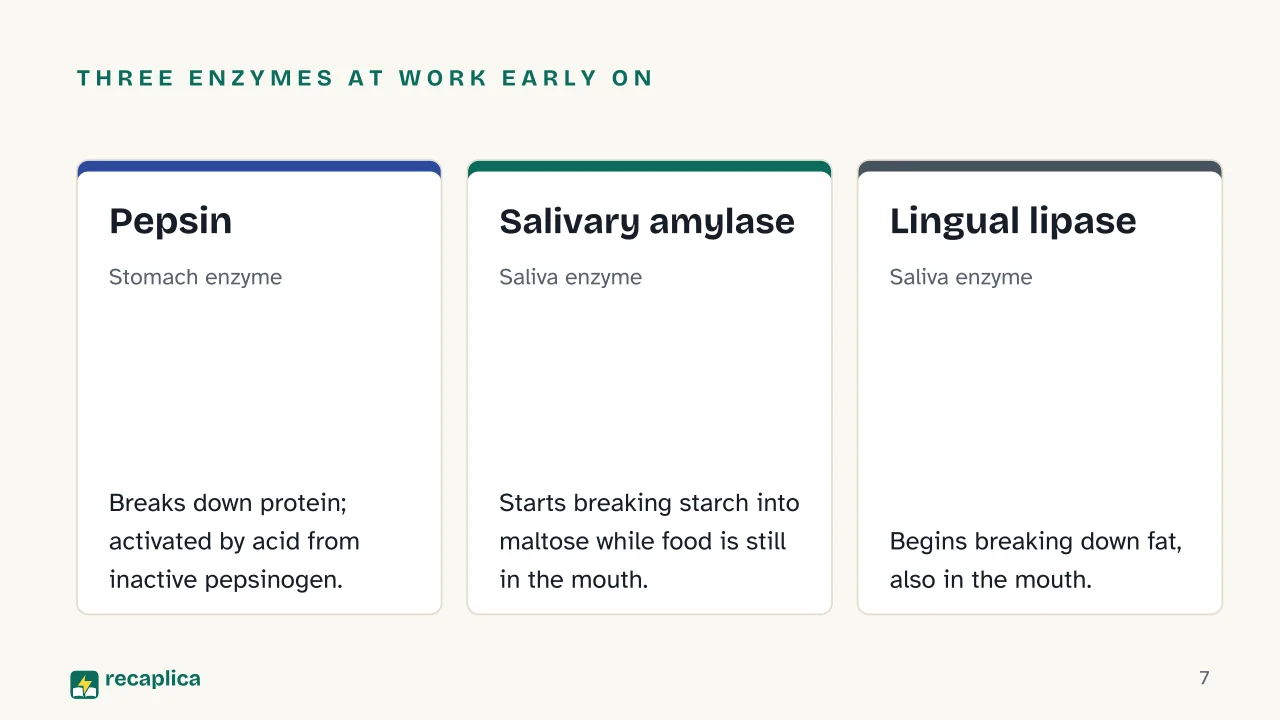  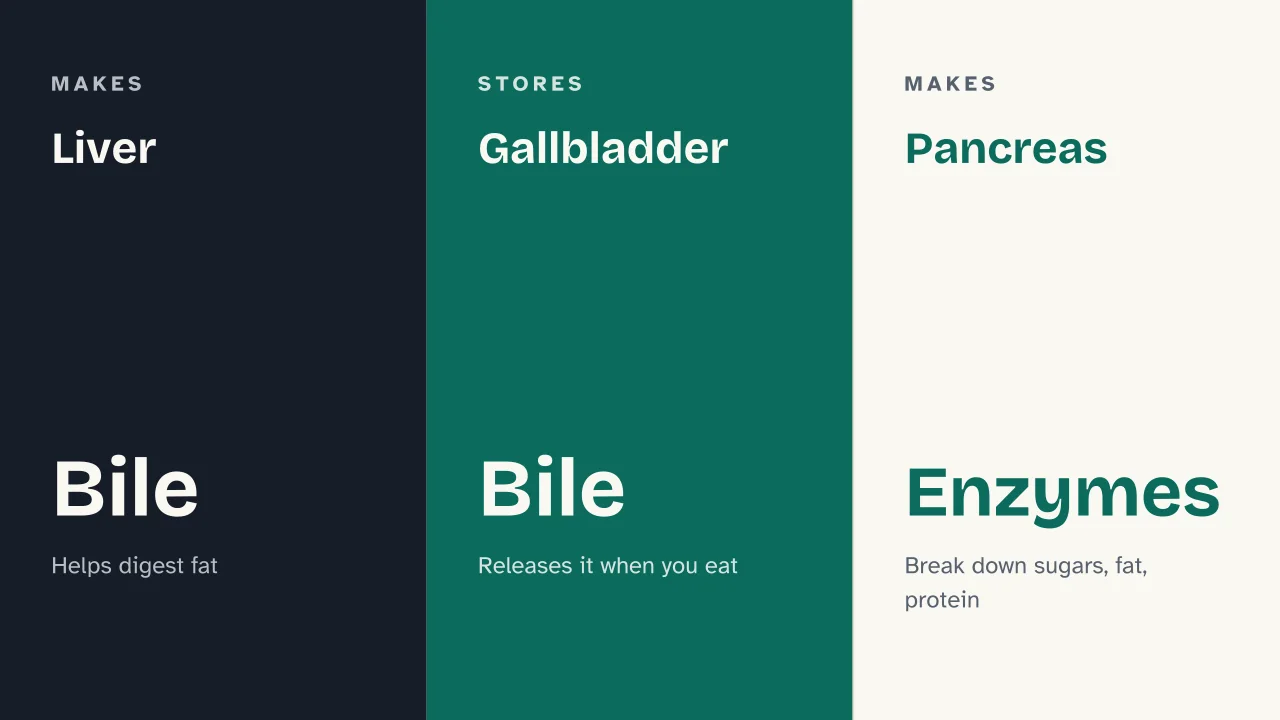 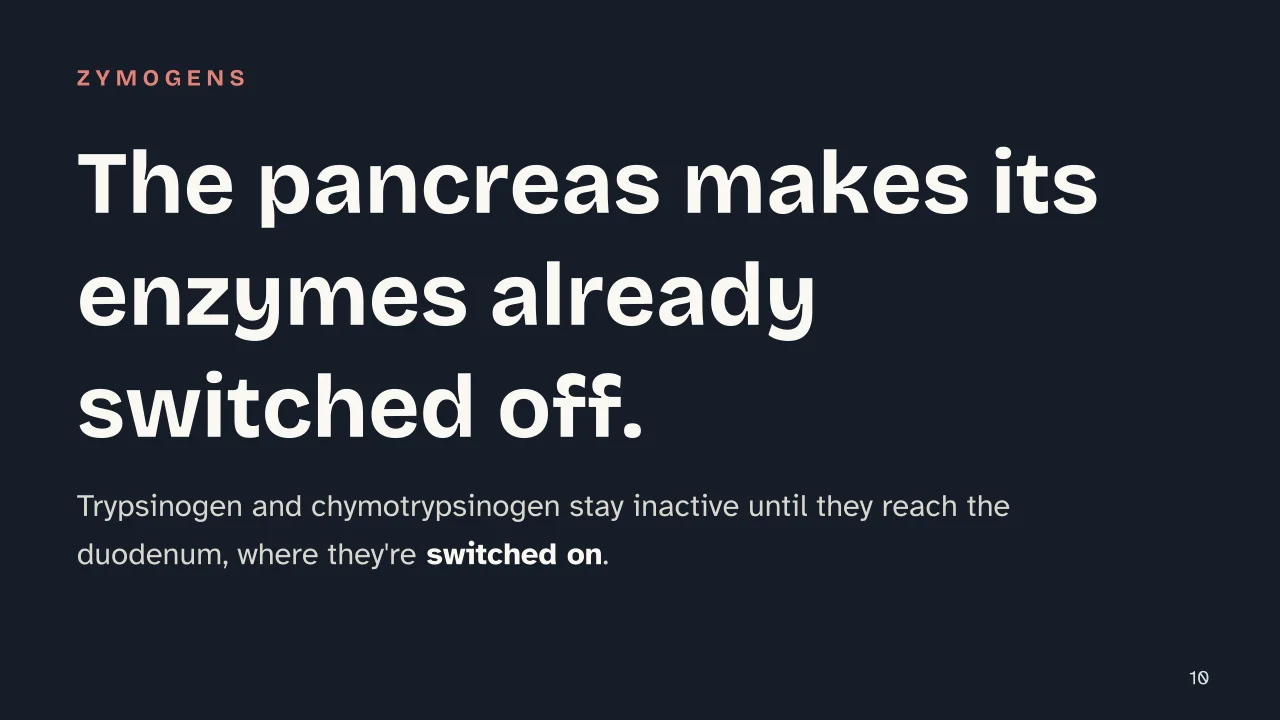  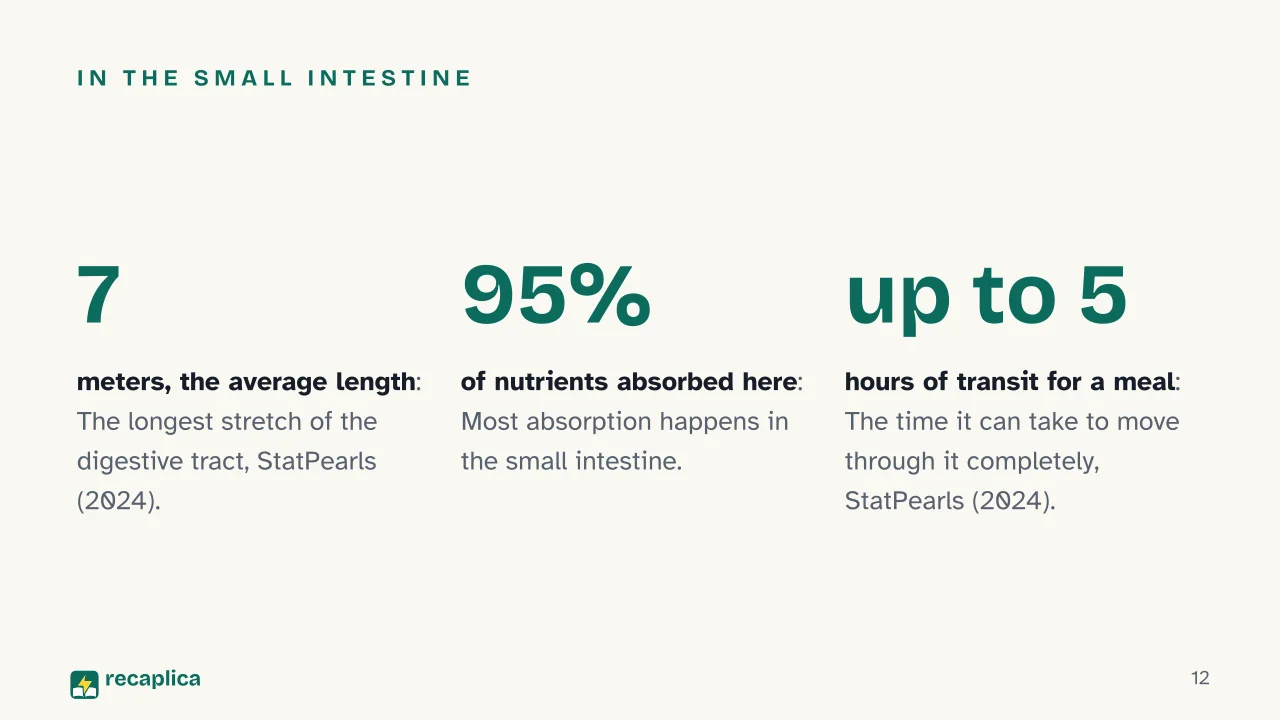  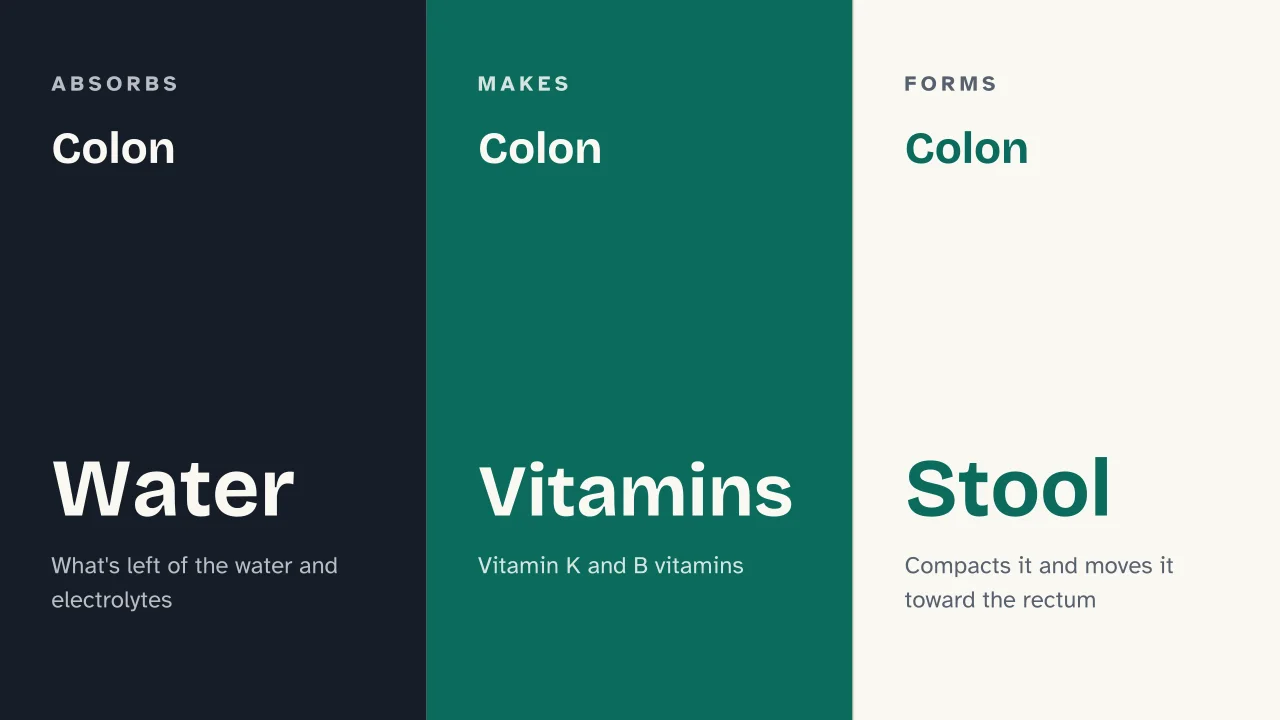   Common myths
Mind mapDrag the background to move around and the nodes to reposition them; use − and + to collapse and expand branches. 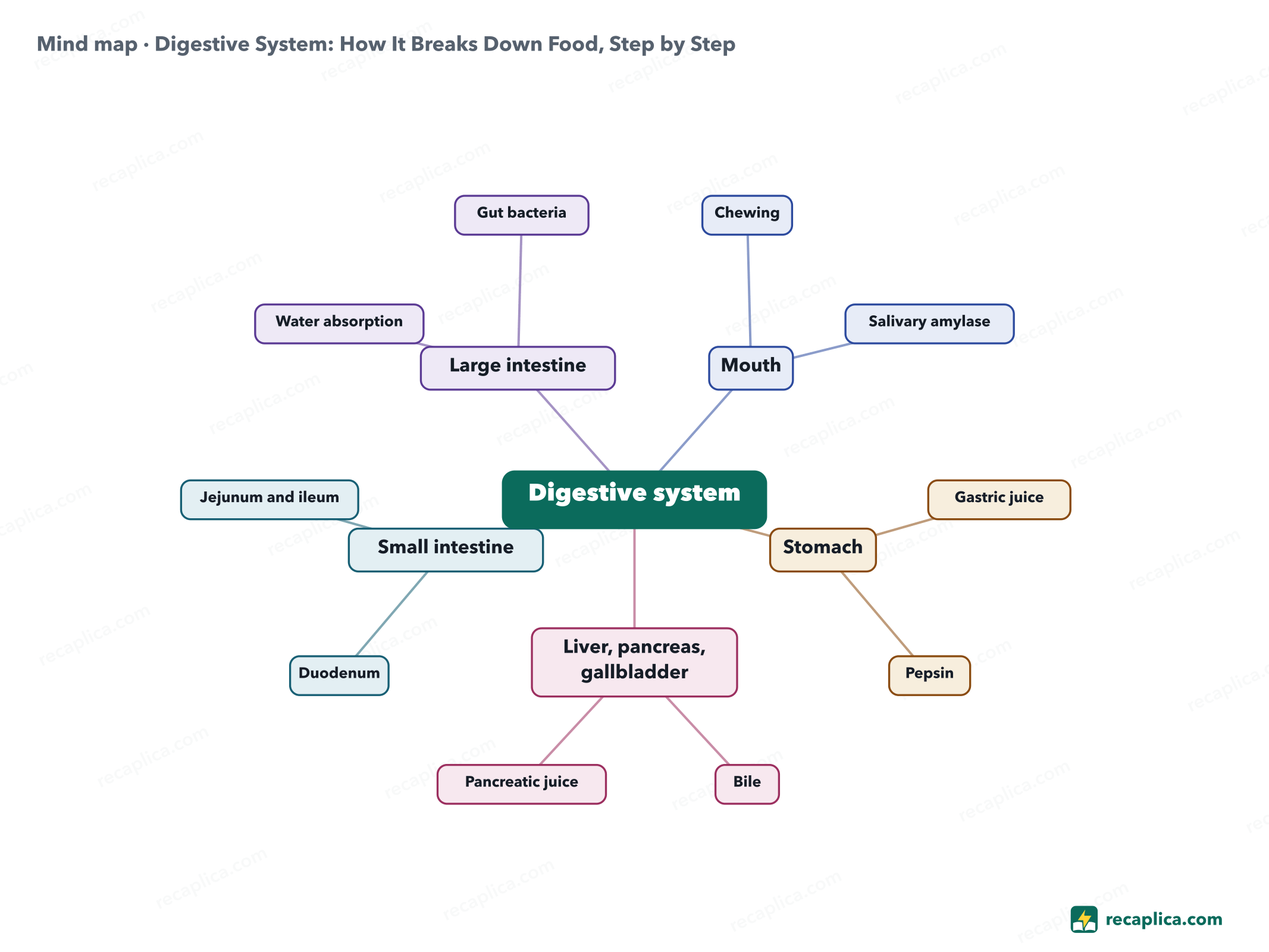
Quiz: test yourselfAnswer the questions to check what you have learned: you get instant feedback and a short explanation. Grade 0/10 0/5
FlashcardsTap the card to flip it and check whether you remember the answer, then move to the next one. 1 / 7 Explain it in your own wordsThe ultimate test: if you can explain it in simple words, you've truly understood it. Write your explanation, then compare it with the Recap. Your explanation is saved only on this device.
Frequently asked questionsHow long is the small intestine?About 7 meters on average, according to a StatPearls review updated in 2024. What's the difference between mechanical and chemical digestion?Mechanical digestion breaks food into pieces through movement, such as chewing or stomach contractions. Chemical digestion breaks it down through juices and enzymes, such as gastric acid, bile, or pepsin. In the body, both work together at every stage of the process. Where are digestive enzymes made?In several places: saliva contains amylase and lingual lipase, the stomach makes pepsin, the pancreas produces amylase, lipase, and the inactive forms of protein-digesting enzymes, and the small intestine adds brush-border enzymes such as maltase and sucrase. What does bile do?It emulsifies fats and certain vitamins, making them easier to digest; the liver makes it, the gallbladder stores it, and it's released into the duodenum when you eat, according to the NIDDK. What role does gut bacteria play in digestion?Bacteria throughout the gastrointestinal tract support digestion generally, according to the NIDDK; in the colon specifically, they produce vitamin K and B vitamins such as biotin as a byproduct of their metabolism, according to StatPearls (2023). Every Recap goes through an independent review before publication. |