Skip to content
recaplica

    One moment: security check

    Cloudflare wants to make sure you're not a robot. Tick the box below and your search will continue on its own.

    IT
    recaplica Fermentation: What It Is and How It Transforms Food
    © 2026 Recaplica · recaplica.com — All rights reserved
    Home › Science Food and cooking

    Fermentation: What It Is and How It Transforms Food

    By Recaplica Newsroom · Updated on September 1, 2026

    What to print

    Page numbers appear when printing with default margins.

    Slides

    Choose a cut

    Flash10 slidesThe essential thread, to present in classFull18 slidesEvery chapter and the deeper detail

    Both come with speaker notes.

    Telegram channel
    recaplica Clear in 30 seconds, yours in 10 minutes.
    In 30 seconds Key points Figures Deep dive Slides Myths Mind map Quiz Flashcards FAQ

    In 30 seconds quick read

    Fermentation is the process by which yeasts, bacteria and even our own muscle cells extract energy from sugars without using oxygen. It yields little, 2 molecules of ATP per glucose against roughly 38 from respiration, but it works wherever oxygen cannot reach. Its waste products, such as alcohol and lactic acid, give food its flavour and protect it from harmful microbes: that is how wine, beer, bread, yogurt and vinegar are born. It was Louis Pasteur who proved, from 1857 onwards, that living microorganisms are behind fermentation.

    Key Points

    • Fermentation is a way of extracting energy from sugars without oxygen: its real job is regenerating the molecules that keep glycolysis running.
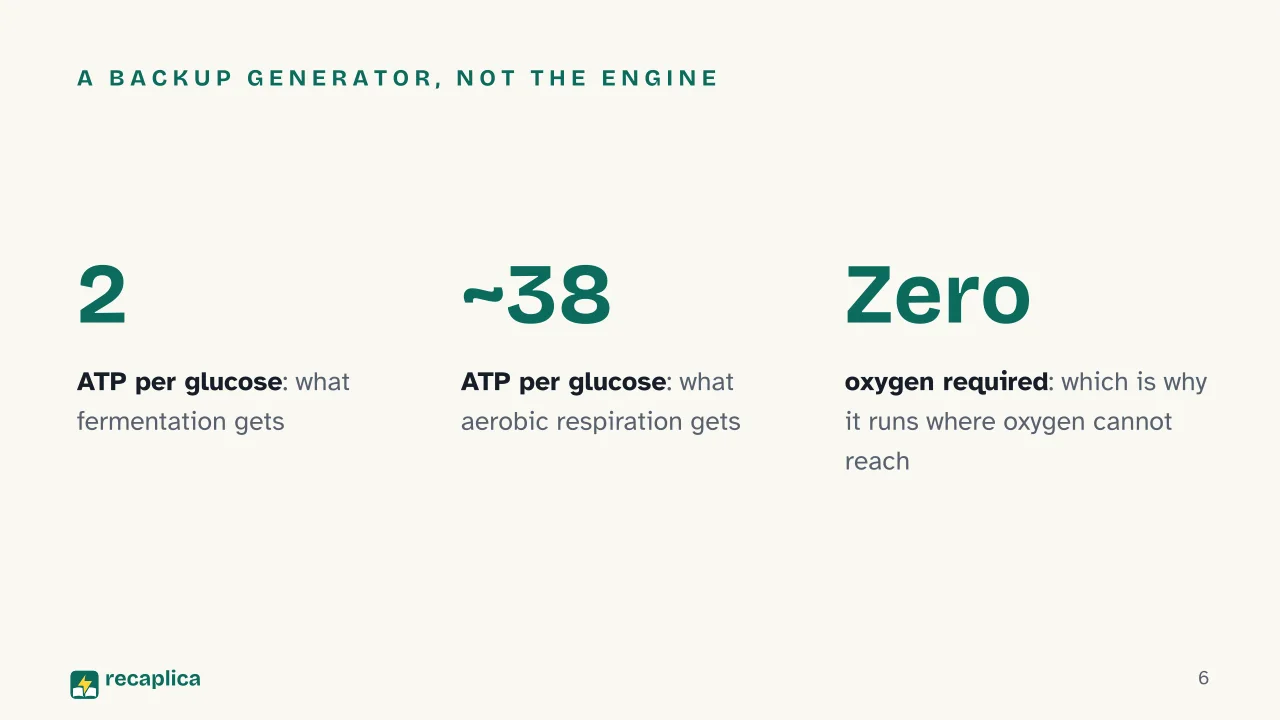
    • It yields little: 2 molecules of ATP per glucose, against roughly 38 from aerobic respiration.
    • Three types to know: alcoholic (wine, beer, bread), lactic (yogurt, sauerkraut, muscles under strain), acetic (vinegar — the only one that needs oxygen).
    • The waste products — alcohol and acids — create a hostile environment for dangerous microbes: that is why fermented foods keep.
    • From 1857 Louis Pasteur proved that living microorganisms do the fermenting; in 1865 he patented pasteurization, invented to save wine.
    • In 1897 Eduard Buchner found that the yeast's enzymes alone (zymase) are enough, no living cells needed: modern biochemistry was born.

    Key figures

    • 2 vs ~38 the ATP molecules extracted from one glucose: fermentation versus aerobic respiration Source: OpenStax Microbiology
    • 1865 the year Pasteur patented pasteurization, invented to save wine from unwanted microbes Source: Science History Institute
    • ≈7,000 years the age of the oldest wine jars found by archaeologists Source: Nature Education

    Deep Dive

    The cell’s backup generator

    When the power goes out at home, a backup generator does not run everything: it keeps the essential lights on. Fermentation is the backup generator of the cell: a way of extracting energy from sugars when oxygen is absent, or simply not enough. It yields very little compared with respiration, but it runs anywhere — at the bottom of a vat of grape must, inside a pot of yogurt, in our muscles during a sprint.

    And like any self-respecting generator, it produces waste. Except that here the waste is ethanol, carbon dioxide and lactic acid: in other words wine, beer, bread, yogurt and vinegar. A good part of what we call “flavour” is the waste product of a microbe at work.

    How it works: it all starts with glycolysis

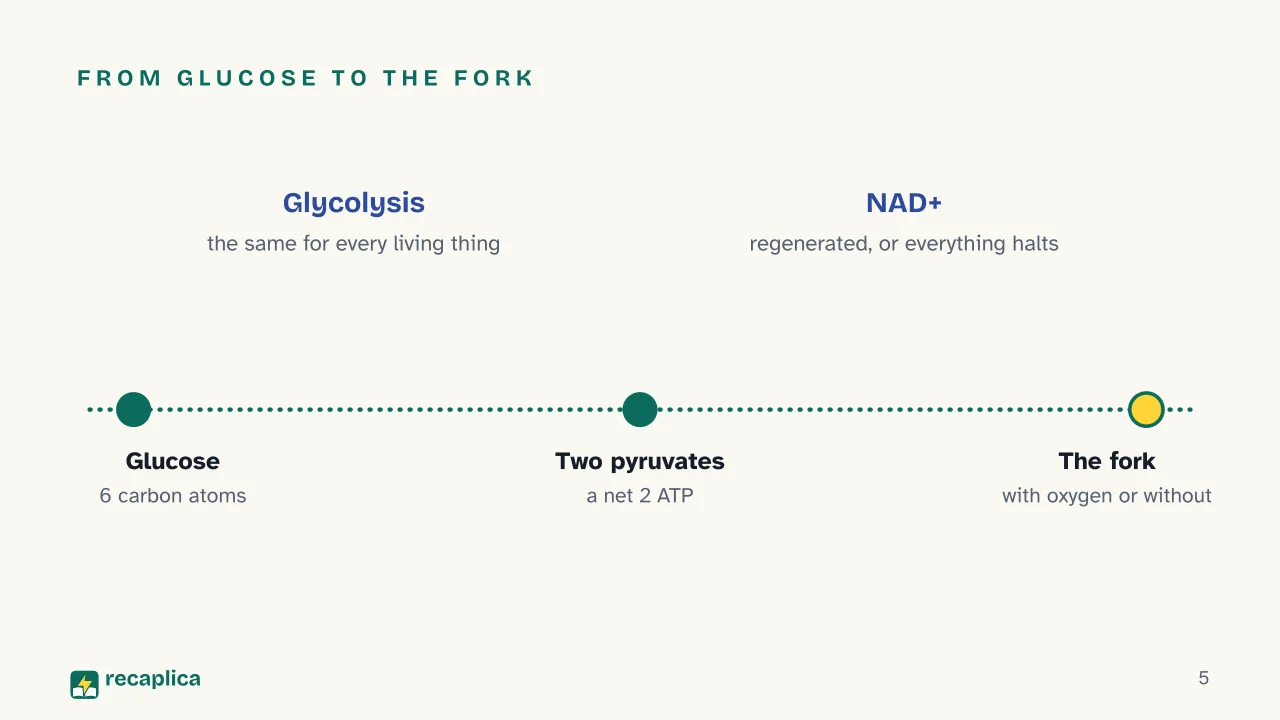
    The first step is the same for every living thing. Through glycolysis, a molecule of glucose (6 carbon atoms) is split into two molecules of pyruvate (3 atoms each). The reward is modest: 2 molecules of ATP, the cell’s “energy currency”. Glycolysis needs no oxygen, but it has a problem: it consumes a shuttle molecule called NAD⁺, which picks up the electrons released as glucose is broken down. When the NAD⁺ runs out, everything grinds to a halt.

    This is where the roads fork.

    • With oxygen, pyruvate enters the mitochondria and is dismantled completely by cellular respiration: the haul rises to roughly 38 ATP per glucose, and NAD⁺ is regenerated by the chain that uses oxygen.
    • Without oxygen, a plan B is needed. Fermentation dumps the electrons back onto the pyruvate itself (or one of its derivatives): NAD⁺ becomes available again, glycolysis restarts, and the cell keeps collecting its 2 ATP at a time. The leftover ethanol or lactic acid is the price to pay.

    In other words: fermentation is not there to make alcohol or acid — those are side effects. It is there to regenerate NAD⁺ and keep the engine from stalling.

    The three fermentations worth knowing

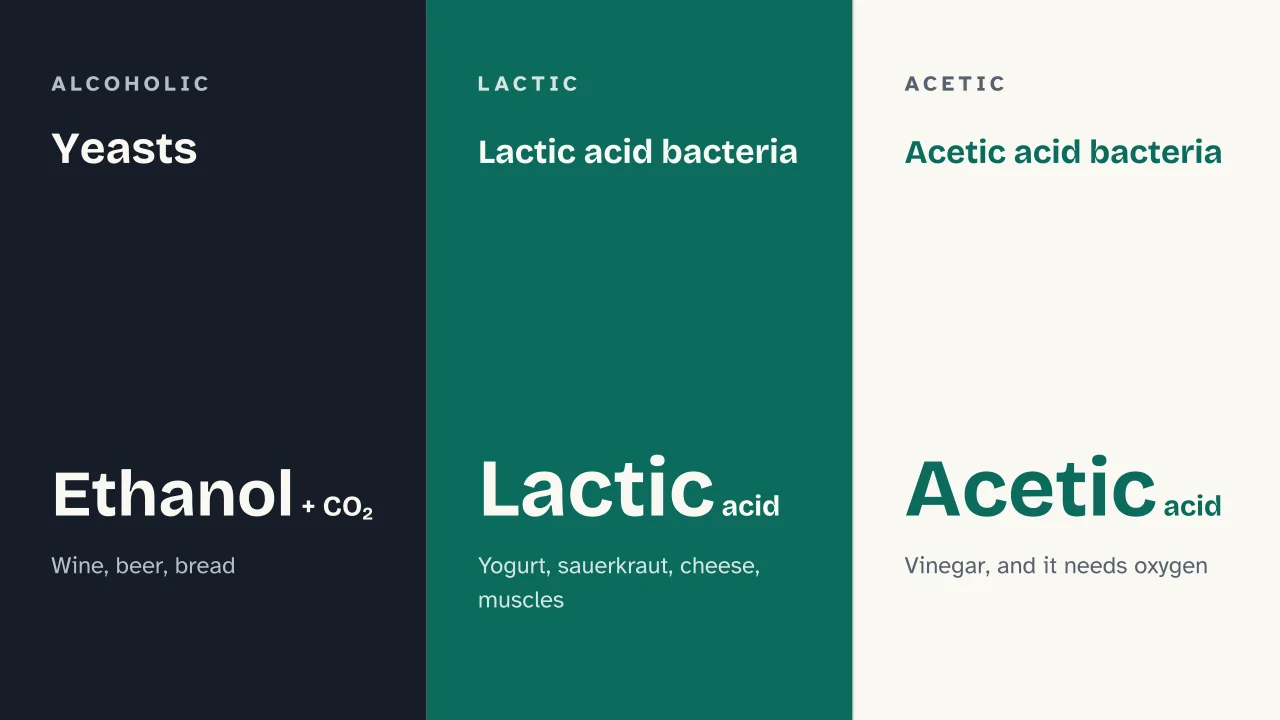
    AlcoholicLacticAcetic
    Who does itYeasts (Saccharomyces cerevisiae)Lactic acid bacteria, muscle cellsAcetic acid bacteria (Acetobacter)
    What it makesEthanol + CO₂Lactic acidAcetic acid
    Needs oxygen?NoNoYes (obligate aerobes)
    Where you meet itWine, beer, breadYogurt, sauerkraut, cheese, musclesVinegar

    Alcoholic: yeasts at work

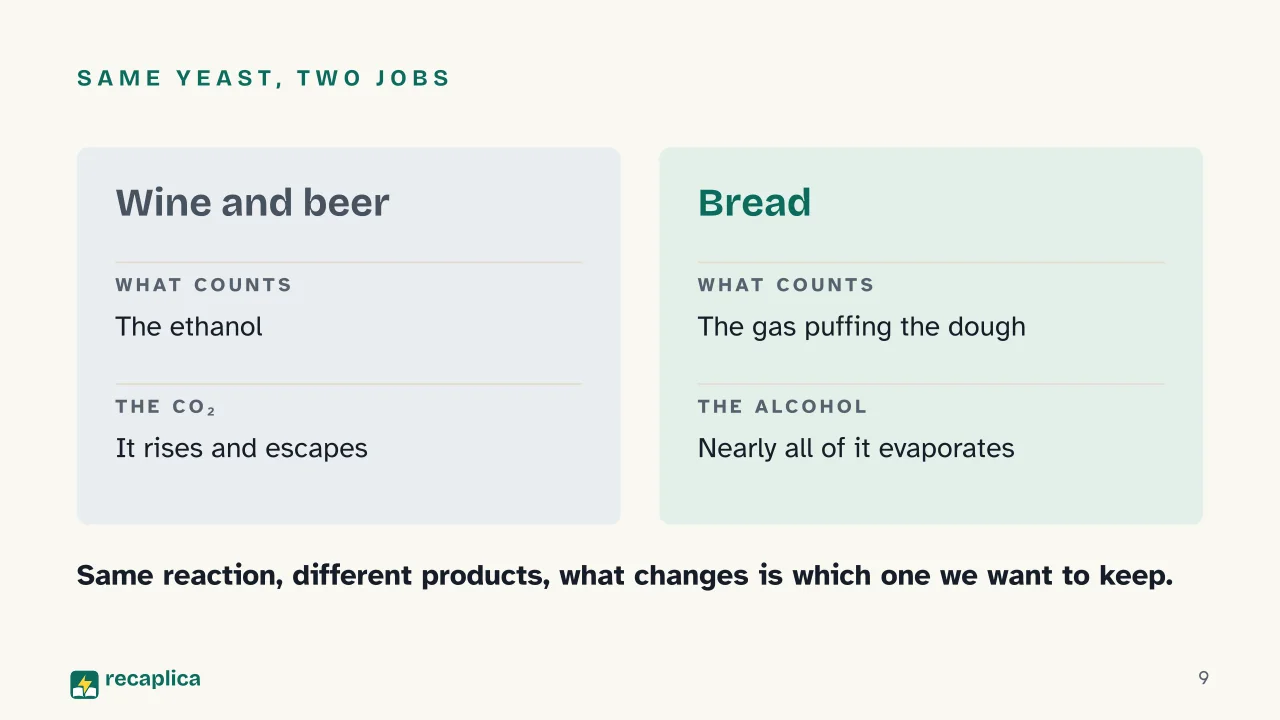
    The star is a microscopic fungus, the yeast Saccharomyces cerevisiae. In the absence of oxygen it turns pyruvate into ethanol, releasing carbon dioxide. The ethanol is what we are after in wine and beer; in bread it is the gas that counts, puffing up the dough as it rises, while the alcohol almost entirely evaporates in the oven.

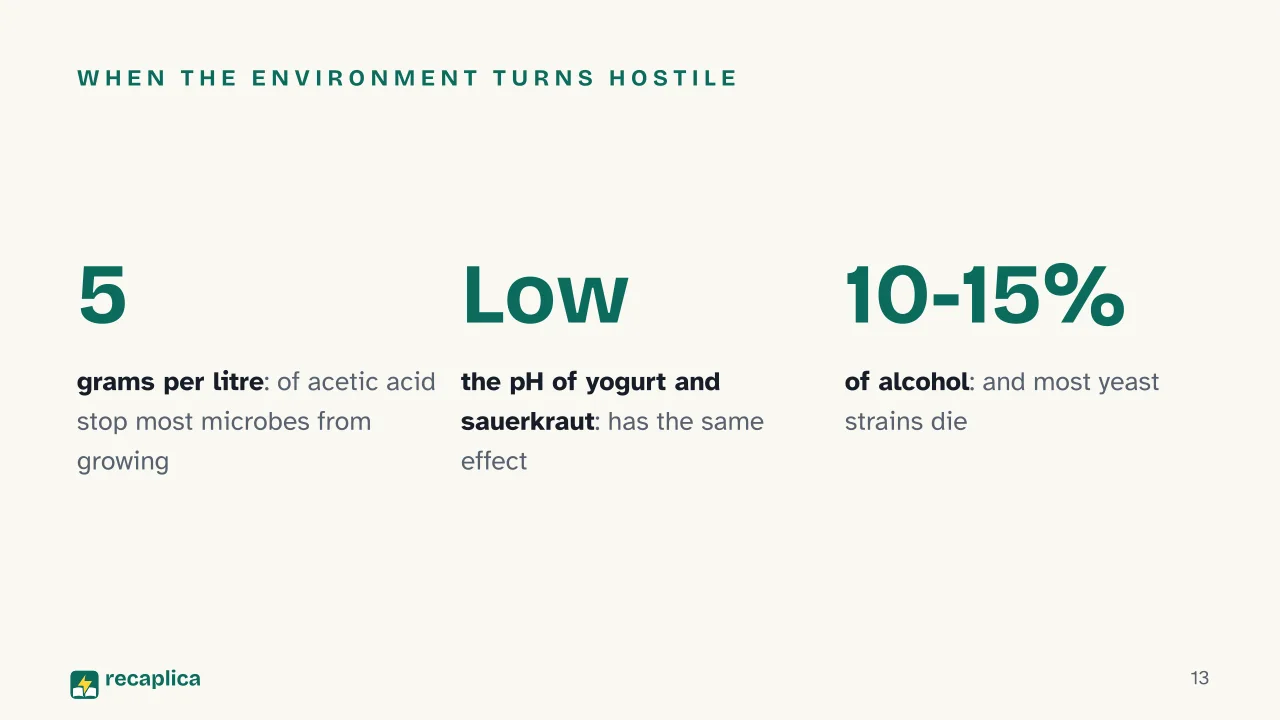
    Yeasts, however, are victims of their own waste: most strains die once the alcohol passes 10-15%. That is why commercial fermented drinks top out between 5 and 21% alcohol: going beyond that takes distillation, which is not a fermentation but a physical separation.

    Practical example: in grape must, the sugars were put there by the vine through photosynthesis. The yeasts naturally present on the skins and in the environment find them and start fermenting: the must “seethes” with rising CO₂, and within days the sugars become alcohol. The wine is done when the yeasts run out of sugar, or when their own alcohol puts them out of action.

    Lactic: from sauerkraut to your muscles

    Here pyruvate is converted straight into lactic acid, in a single step. It is the work of lactic acid bacteria (genera such as Lactobacillus, Streptococcus and Leuconostoc), which turn milk into yogurt and cheese, cabbage into sauerkraut, cucumbers into pickles. Some of these bacteria turn up again in probiotic supplements.

    But it is not a microbes-only affair: our own cells can do it too. During intense effort, when the blood cannot deliver enough oxygen, muscles switch on the backup generator and make ATP by lactic acid fermentation. The accumulated lactate is then carried to the liver, which converts it back into pyruvate. Red blood cells, which have no mitochondria, ferment their glucose all the time.

    Practical example: to make yogurt, lactic acid bacteria are added to milk and the mixture is kept warm for a few hours. The bacteria consume the lactose (the sugar in milk) and release lactic acid: the pH drops, the milk proteins coagulate, and the liquid thickens into a cream. The tangy taste is, quite literally, the taste of the acid they produced.

    Acetic: the “fermentation” that breathes

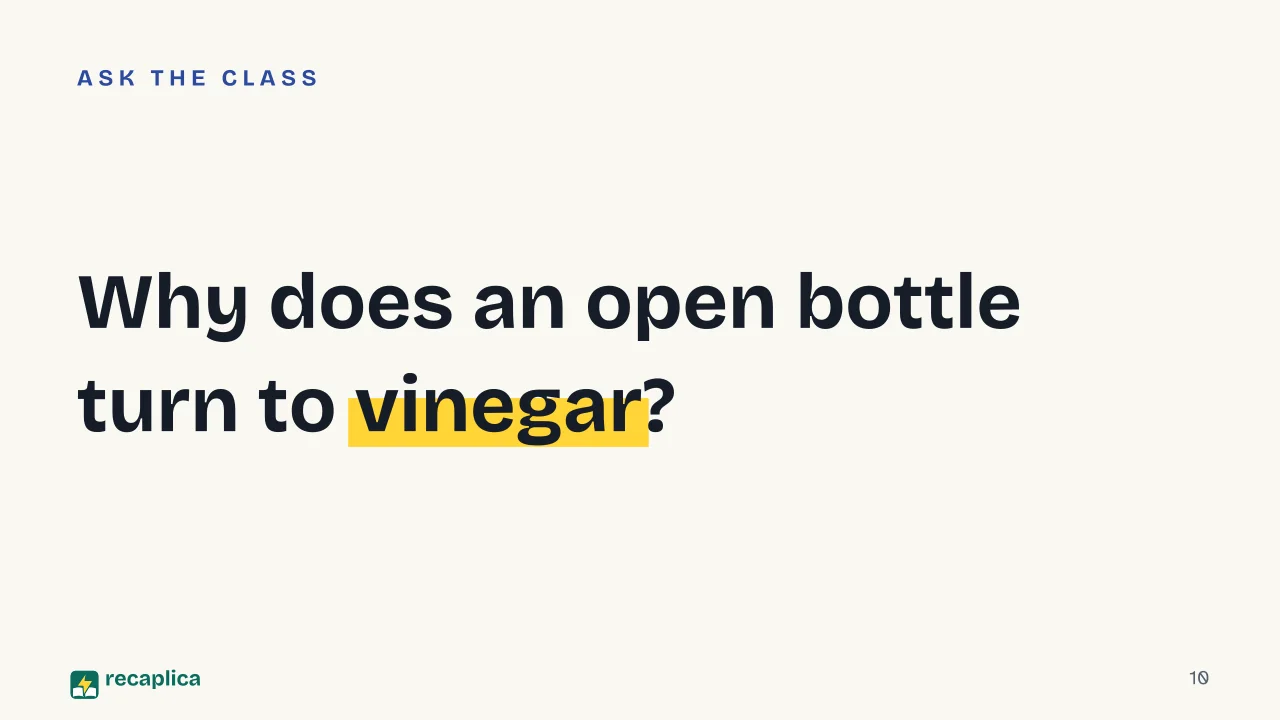
    Vinegar’s name is misleading. Acetic acid bacteria (such as Acetobacter) turn ethanol into acetic acid in two steps, but theirs is not an anaerobic process: they are obligate aerobes, and without oxygen they stop working. Technically they perform an oxidation, not a fermentation; the traditional name simply stuck. This is why a bottle of wine left open to the air turns to vinegar, while a well-corked one does not.

    From mystery to science: the history of fermentation

    Humanity fermented for millennia without knowing what it was doing: the oldest wine jars found by archaeologists are roughly 7,000 years old. For all that time fermentation remained a craft: people knew how to make wine, but not why the must seethed.

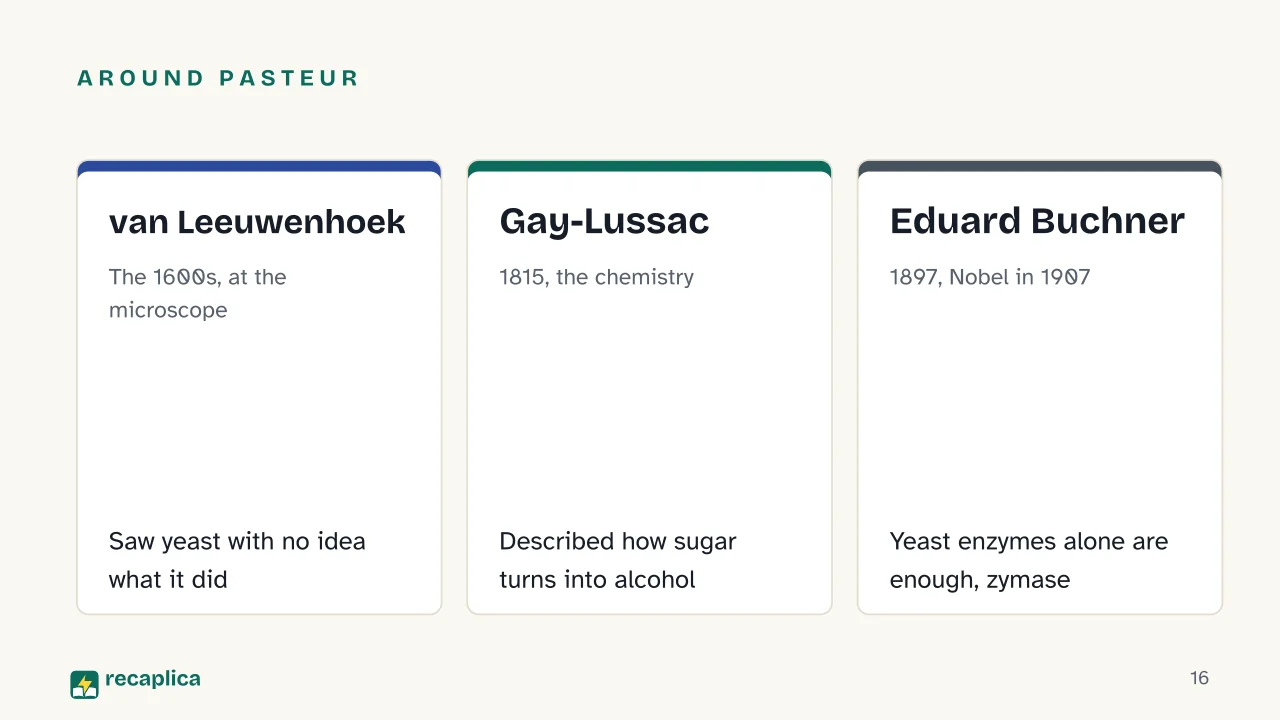
    Science took two centuries to catch up. In the 1600s Antoni van Leeuwenhoek observed yeast under the microscope, with no inkling of its role. In 1815 Gay-Lussac described the chemistry that turns sugar into alcohol. Between 1835 and 1840 several researchers recognized that yeast is a living organism that reproduces, against the view of the most influential chemists of the day, convinced that fermentation was a mere reaction between molecules.

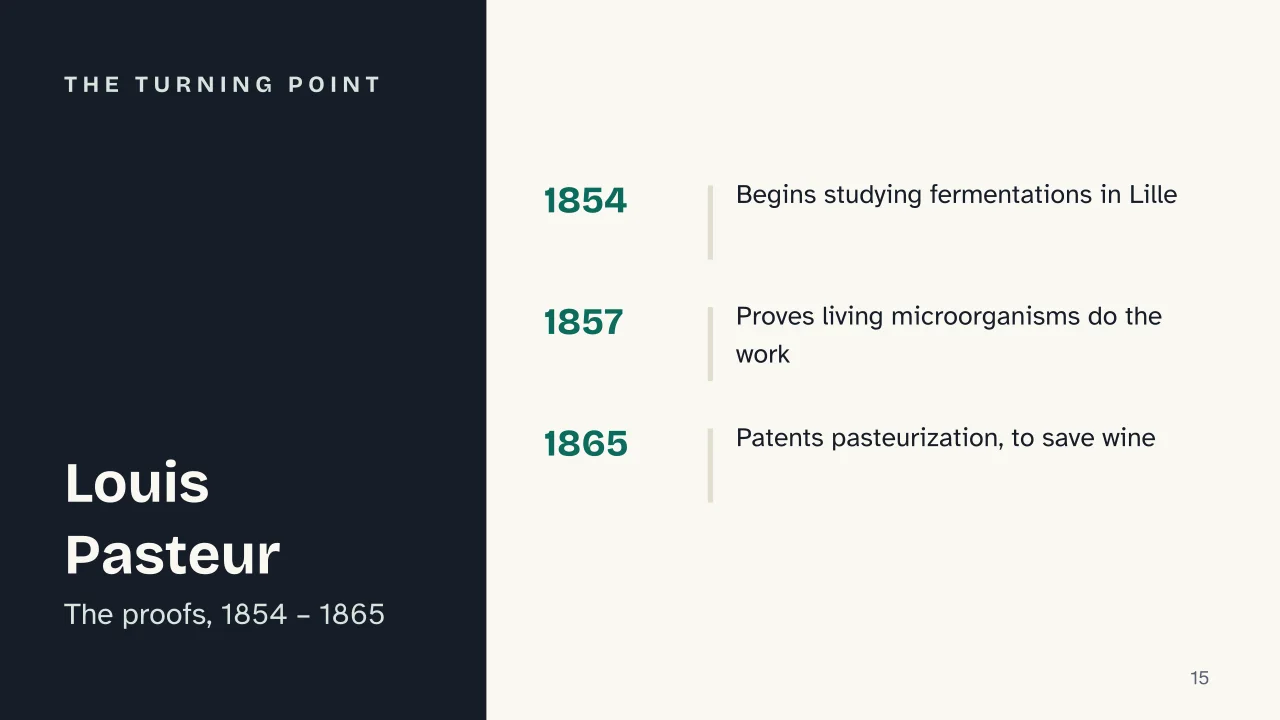
    The turning point came with Louis Pasteur, who had begun studying fermentations in Lille in 1854. From 1857 onwards he proved with rigorous experiments that fermentation proceeds only when the microorganisms are alive and multiplying: first the lactic kind, then the alcoholic. He defined it as “life without air”, and watching certain microbes work only away from oxygen, he coined the concept of the anaerobic organism. His studies on the diseases of wine led in 1865 to pasteurization (patented that year): heating the drink to between 60 and 100 °C to kill unwanted microbes, a technique later extended to the milk we drink today.

    One last question remained: is the living cell itself required, or just something it contains? In 1897 Eduard Buchner made sugar ferment using a yeast extract with no living cells in it: the work is done by zymase, a complex of enzymes, proteins whose instructions are written in the yeast’s DNA. The discovery, rewarded with the Nobel Prize in Chemistry in 1907, closed the circle: Pasteur was right about the who (the microbes), the chemists about the what (the molecules). And it opened a new field: biochemistry.

    Why fermented foods keep

    Before refrigerators, fermenting was one of the few ways to make food last. The mechanism is chemical: the acids and alcohol produced by the “friendly” microbes create an environment the dangerous ones cannot live in. Acetic acid concentrations above 5 grams per litre are enough to stop most microorganisms from growing, and the low pH of yogurt and sauerkraut has the same effect. In practice, the first colonizers claim the territory and make it uninhabitable for anyone arriving later.

    Beyond food

    The same chemistry works outside the kitchen too. Bacterial fermentations produce industrial solvents such as acetone and butanol, along with compounds used in drugs and vitamins. In the lab, fermentation even helps identify bacteria: the dangerous strain E. coli O157:H7, for instance, is recognized precisely because, unlike its harmless relatives, it cannot ferment a particular sugar, sorbitol. A process born to survive without oxygen has become a microbial fingerprint.

    Slide deck

    Slides ready to download and make your own in PowerPoint or Google Slides, with speaker notes. Pick the Flash cut or the Full one.
    Slide 1 of the presentation on Fermentation: FermentationSlide 2 of the presentation on Fermentation: What do wine, bread and yogurt have in common?Slide 3 of the presentation on Fermentation: What we will coverSlide 4 of the presentation on Fermentation: Chapter 01: The cell's backup generatorSlide 5 of the presentation on Fermentation: From glucose to the forkSlide 6 of the presentation on Fermentation: A backup generator, not the engineSlide 7 of the presentation on Fermentation: Chapter 02: The three fermentationsSlide 8 of the presentation on Fermentation: Yeasts · Lactic acid bacteria · Acetic acid bacteriaSlide 9 of the presentation on Fermentation: Same yeast, two jobsSlide 10 of the presentation on Fermentation: Why does an open bottle turn to vinegar?Slide 11 of the presentation on Fermentation: Chapter 03: Food that defends itselfSlide 12 of the presentation on Fermentation: Fermented does not mean gone bad.Slide 13 of the presentation on Fermentation: When the environment turns hostileSlide 14 of the presentation on Fermentation: Chapter 04: From mystery to scienceSlide 15 of the presentation on Fermentation: The turning pointSlide 16 of the presentation on Fermentation: Around Pasteur: van Leeuwenhoek, Gay-Lussac, Eduard BuchnerSlide 17 of the presentation on Fermentation: What are the products of alcoholic fermentation?Slide 18 of the presentation on Fermentation: And now, the review
    Flash10 slidesThe essential thread, to present in classFull18 slidesEvery chapter and the deeper detail

    Common myths

    • ✗ Myth Fermented means gone bad.

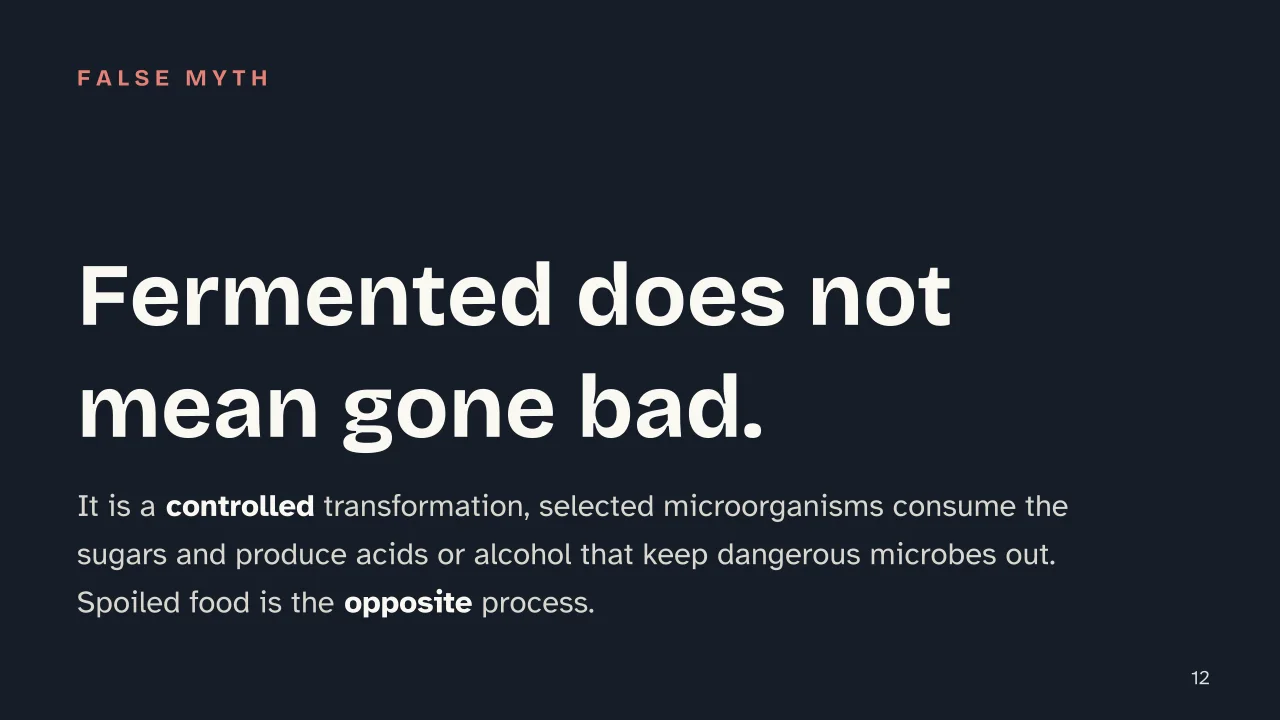
      ✓ Reality Fermentation is a controlled transformation: selected microorganisms consume the sugars and produce acids or alcohol that keep dangerous microbes out. Spoiled food is the result of the opposite process — the uncontrolled growth of unwanted microbes, which the acidic environment of fermented foods holds at bay.

    • ✗ Myth All fermented foods contain alcohol.

      ✓ Reality Only the alcoholic fermentation of yeasts produces ethanol. Yogurt, sauerkraut and pickles come from lactic fermentation, which produces lactic acid: they are sour foods, with no alcohol in them. And in bread, nearly all the alcohol made by the yeast evaporates in the oven.

    • ✗ Myth Pasteur discovered fermentation.

      ✓ Reality Humans had been fermenting for millennia: archaeologists have found wine jars roughly 7,000 years old. Pasteur did not invent fermentation — he explained who carries it out, proving from 1857 that it is the work of living microorganisms rather than a simple chemical reaction, as most chemists then believed.

    Mind map

    Drag the background to move around and the nodes to reposition them; use − and + to collapse and expand branches.
    Customize
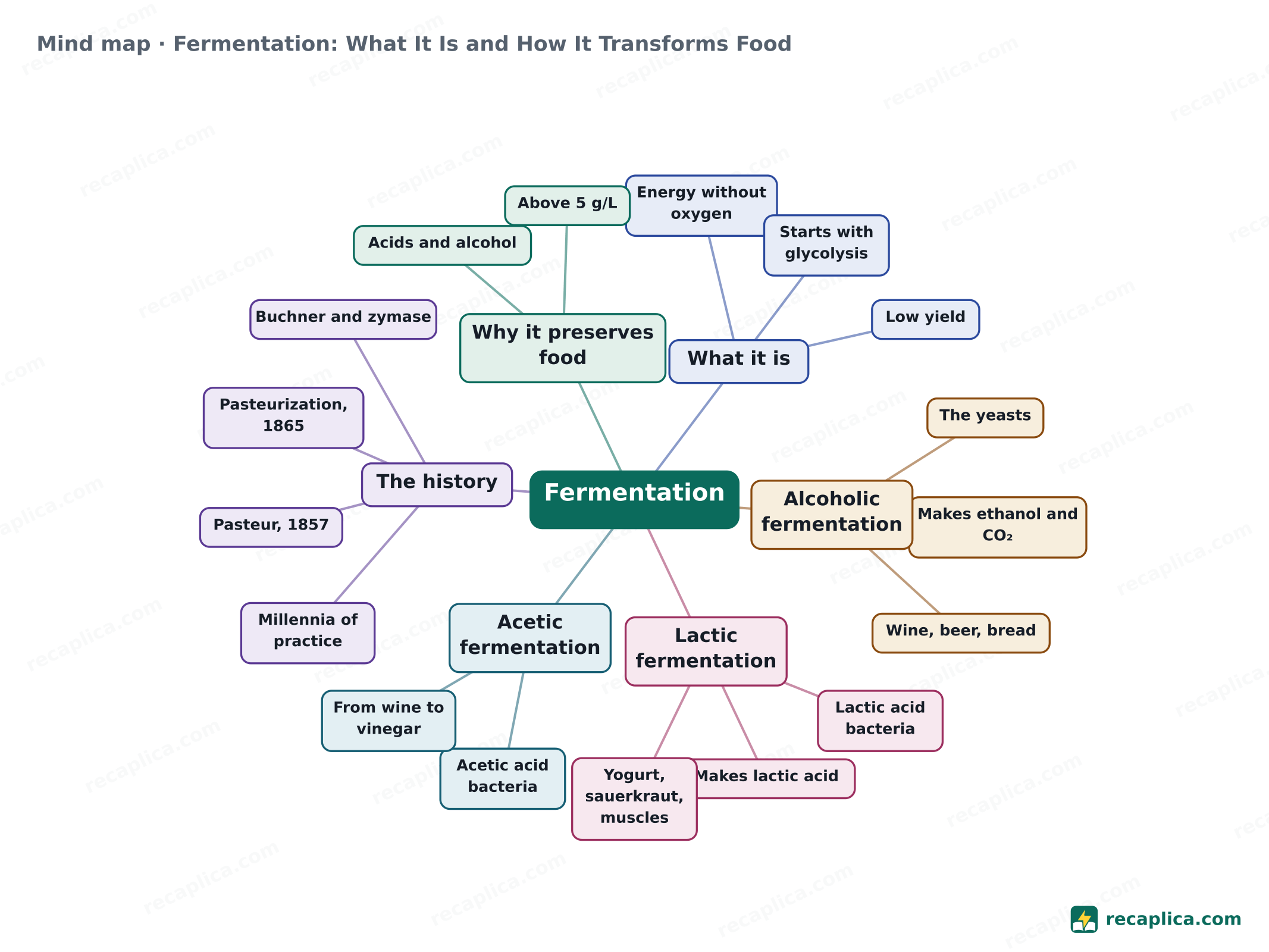
    Mind map: Fermentation: What It Is and How It Transforms Food
    • Fermentation
      • What it is
        • Energy without oxygen A backup generator for the cell.
        • Starts with glycolysis Glucose splits into two pyruvates.
        • Low yield 2 ATP per glucose, against roughly 38 from respiration.
      • Alcoholic fermentation
        • The yeasts The most used is Saccharomyces cerevisiae.
        • Makes ethanol and CO₂
        • Wine, beer, bread In bread the gas matters, not the alcohol.
      • Lactic fermentation
        • Lactic acid bacteria Lactobacillus, Streptococcus and others.
        • Makes lactic acid
        • Yogurt, sauerkraut, muscles Muscles ferment too, under strain.
      • Acetic fermentation
        • Acetic acid bacteria Obligate aerobes, they stop without oxygen.
        • From wine to vinegar They oxidize ethanol into acetic acid.
      • The history
        • Millennia of practice Wine jars 7,000 years old.
        • Pasteur, 1857 Living microorganisms do the fermenting.
        • Pasteurization, 1865
        • Buchner and zymase Enzymes alone are enough, Nobel 1907.
      • Why it preserves food
        • Acids and alcohol They create a hostile environment for pathogens.
        • Above 5 g/L Acetic acid stops most microbes from growing.

    Quiz: test yourself

    Answer the questions to check what you have learned: you get instant feedback and a short explanation.

    Grade 0/10 0/5
    1 What is fermentation for, from a cell's point of view?

    Without oxygen, respiration stops — but glycolysis can carry on as long as the cell regenerates NAD⁺. That is exactly what fermentation does, earning the cell 2 ATP per molecule of glucose in the process.

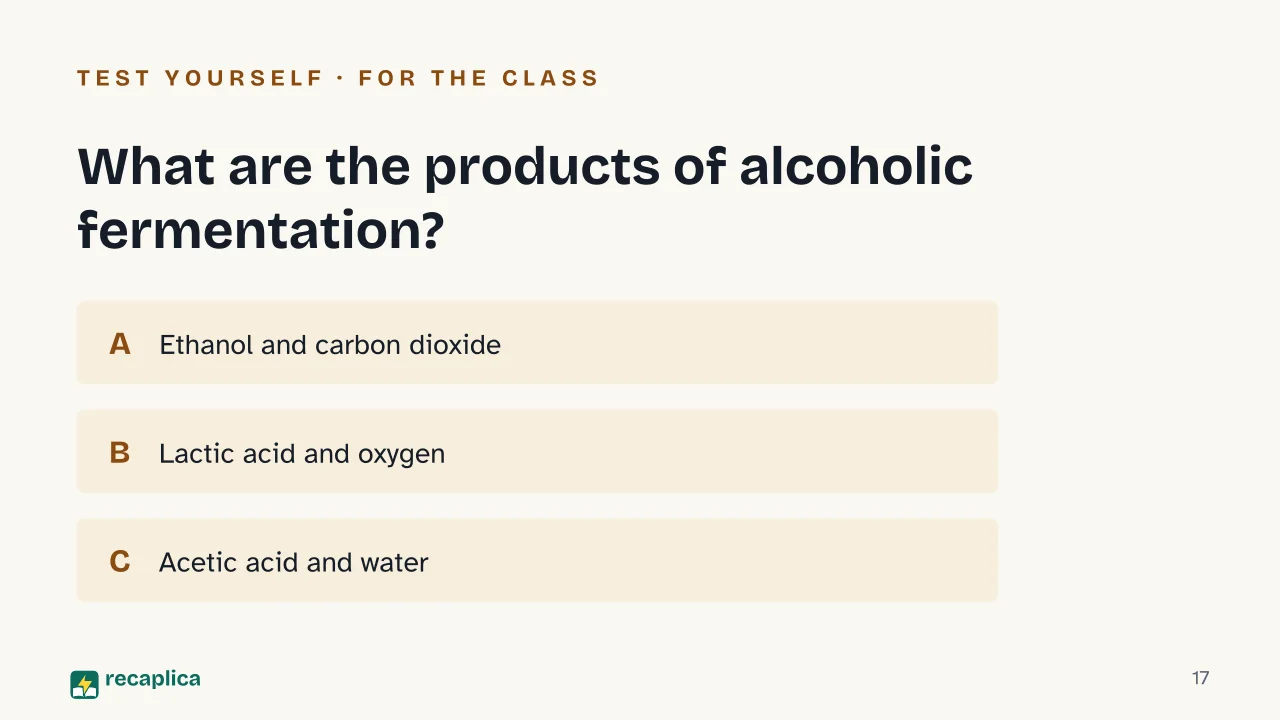
    2 What are the products of alcoholic fermentation?

    Yeasts turn pyruvate into ethanol, releasing CO₂. In wine and beer we are after the alcohol; in bread it is the gas that matters, since it puffs up the dough (the alcohol evaporates during baking).

    3 Who proved that fermentation is the work of living microorganisms?

    Leeuwenhoek saw yeast under the microscope back in the 1600s, but had no idea what it did. It was Pasteur who, from 1857, proved that fermentation only happens when microorganisms are alive and multiplying. Buchner, forty years later, showed their enzymes alone are enough.

    4 True or false: vinegar is made without oxygen, just like wine.

    False: acetic acid bacteria are obligate aerobes — they cannot live without oxygen. 'Acetic fermentation' is really an oxidation of ethanol, which is why wine only turns into vinegar when it stays in contact with air.

    5 How much energy does a cell get from fermentation, compared with aerobic respiration?

    Fermentation stops at glycolysis, which nets 2 ATP per glucose. Aerobic respiration squeezes the same molecule for roughly 38 ATP. It is a backup generator: poor output, but it runs without oxygen.

    Answers: 1-B · 2-A · 3-C · 4-B · 5-C

    Flashcards

    Tap the card to flip it and check whether you remember the answer, then move to the next one.

    1 / 8

    Explain it in your own words

    The ultimate test: if you can explain it in simple words, you've truly understood it. Write your explanation, then compare it with the Recap.

    Your explanation is saved only on this device.

    Fermentation is the process by which yeasts, bacteria and even our own muscle cells extract energy from sugars without using oxygen. It yields little, 2 molecules of ATP per glucose against roughly 38 from respiration, but it works wherever oxygen cannot reach. Its waste products, such as alcohol and lactic acid, give food its flavour and protect it from harmful microbes: that is how wine, beer, bread, yogurt and vinegar are born. It was Louis Pasteur who proved, from 1857 onwards, that living microorganisms are behind fermentation.

    Frequently asked questions

    Do fermented foods always contain alcohol?

    No. Only alcoholic fermentation produces ethanol: yogurt, sauerkraut and cheese come from lactic fermentation, which makes lactic acid and no alcohol. Even in bread, where yeast does produce some ethanol, almost all of it evaporates during baking.

    What is the difference between fermentation and rotting?

    Fermentation is the transformation of sugars by 'friendly' microorganisms, whose products (acids, alcohol) preserve the food. Rotting is the breakdown of proteins by unwanted microbes, producing foul-smelling and potentially toxic compounds. Fermented food is the work of chosen microbes; spoiled food, of microbes that got there by accident.

    Does the human body ferment?

    Yes. During intense effort, when oxygen runs short, muscle cells switch to lactic acid fermentation; the lactate is then carried to the liver, which converts it back into pyruvate. Red blood cells, which have no mitochondria, rely on fermentation all the time.

    Why is yogurt sour and thick?

    Because lactic acid bacteria turn the lactose in milk into lactic acid: the acidity gives the typical tang and makes the milk proteins coagulate, thickening the liquid into a cream.

    Sources

    • OpenStax Microbiology — Fermentation
    • OpenStax Biology 2e — Metabolism without Oxygen
    • Science History Institute — Louis Pasteur
    • Nature Education (Scitable) — Yeast, Fermentation, Beer, Wine
    • Classification of acetic acid bacteria (PMC)

    Every Recap goes through an independent review before publication.

    Every evening, the day's new Recaps on our Telegram channel. Join the channel →

    Keep learning

    • Science How Beer Is Made: The Brewing Process, from Barley to Glass Beer comes from four ingredients — water, malted barley, hops and yeast — combined through four main steps: malting, mashing, boiling and fermentation. During malting, barley germinates and is then dried, developing the enzymes that mashing later uses to turn starch into fermentable sugar. Boiling dissolves the hops' alpha acids, which barely dissolve in water on their own, giving beer its characteristic bitterness. The yeast strain and fermentation temperature then determine whether the result is an ale, a lager, or a spontaneously fermented beer like Belgian lambic. Read the Recap →
    • Science How Wine Is Made: The Winemaking Process, from Grape to Bottle Wine comes from the alcoholic fermentation of grape must, the process in which yeast converts sugar into ethanol and carbon dioxide. Before fermentation, grapes are crushed and destemmed to free the juice from the berries and separate it from the stems. For red wine, the must stays in contact with the skins during maceration, which gives it color and tannins; for white wine, the juice is drawn off almost immediately, so the wine stays pale. After fermentation, wine rests in barrels, oak casks or steel tanks to age before it's filtered and bottled. Under the standard set by the OIV, the international body that regulates the industry, a drink can only be called wine once it reaches a minimum alcohol content. Read the Recap →
    • Science Leavening: what it is and how it works Leavening is the process that inflates a dough from the inside: a gas (almost always carbon dioxide) forms bubbles that get trapped in the stretchy mesh of gluten. The gas can come from living microorganisms that ferment sugars (baker's yeast, sourdough), from a chemical reaction between baking soda and an acid (baking powder), or simply from steam and air expanding in the oven. During baking the bubbles grow one last time, then the structure sets: that is how bread gets its crumb and cakes get their softness. Read the Recap →

    recaplica

    Clear in 30 seconds, yours in 10 minutes.

    Recaps Mind maps Request a Recap Telegram channel Mind map maker Our method About Privacy & cookies Legal notes & terms of use

    © 2026 Recaplica · A project by Curi S.r.l. — VAT IT05472000750

    Statistics, only if you say so

    To learn which Recaps help most we would use Google Analytics, with aggregate, anonymous data. It starts only with your OK, and you can change your mind anytime. Privacy policy