|
recaplica
Why Does Sweat Smell? The Real Cause Isn't the Sweat | ||||||||||||||||||
| © 2026 Recaplica · recaplica.com — All rights reserved | ||||||||||||||||||
Why Does Sweat Smell? The Real Cause Isn't the SweatWhat to print Page numbers appear when printing with default margins. SlidesChoose a cut Flash10 slidesThe essential thread, to present in classFull18 slidesEvery chapter and the deeper detailBoth come with speaker notes. In 30 seconds quick readFresh sweat, straight off the skin, is nearly odorless — the smell doesn't come from the sweat itself but from the bacteria that find it and break it down. Eccrine glands, scattered across the whole body, produce a watery sweat whose only job is cooling us off; apocrine glands, clustered in the armpits and groin and active from puberty on, release an oily fluid packed with proteins and fats instead — a real feast for skin bacteria. Their metabolic waste is what creates the sour, oniony or cheesy smells we associate with sweat. How strongly someone smells then comes down to a mix of factors — genetics, sex, age, diet, hormones and hygiene — none of which explains the whole picture on its own. Key Points
Key figures
Deep DiveThe culprit isn’t the sweatHere’s a fact that surprises almost everyone, and it’s the right place to start: sweat, the moment it leaves the skin, doesn’t smell. It’s a nearly odorless liquid, both the watery kind that cools us down in the heat and the oilier kind that comes from the armpits. The smell we know so well is a secondary product: it appears when bacteria that live permanently on our skin find that liquid and break it down, extracting energy from it and releasing smelly volatile compounds as waste — a mechanism that echoes, loosely, fermentation: microorganisms breaking down organic matter to extract energy from it. Two glands, two very different kinds of sweatSkin doesn’t have just one type of sweat gland — it has two, with different jobs and different chemistry.
Eccrine glands secrete a nutrient-poor liquid directly onto the skin’s surface, not very appealing to bacteria. Apocrine glands, on the other hand, open into hair follicles and release a much richer fluid — a genuine feast for the microorganisms living nearby. It’s no coincidence that body odor is strongest exactly where apocrine glands are most numerous, and that it appears with puberty, when these glands start functioning. Which bacteria actually produce the smellSkin hosts a community of microorganisms that varies from person to person, and even between one armpit and the other on the same person. Among them, a few genera turn up again and again as the main odor-producers: mostly Staphylococcus, Corynebacterium and Cutibacterium (also known as Propionibacterium). In a study of 24 volunteers, nearly all of the bacterial sequences found in the armpits — 96% — belonged to exactly these three genera, with Staphylococcus by far the most abundant. Each leaves its own chemical signature. Some Corynebacterium strains produce acids described as smelling “goat-like” or “cumin-like”; a very common bacterium, Staphylococcus epidermidis, converts an amino acid in sweat into a cheese-smelling compound; another, Staphylococcus hominis, produces thioalcohols responsible for the classic scent of rotten onion or spoiled meat. Not every bacterium makes things worse, though: in the same study, the presence of Cutibacterium acnes was linked to an overall lower odor, not a higher one.
Why the intensity differs from person to personNo single factor explains how strongly someone smells of sweat — it’s really a combination. Genetics is one piece: a variant of the ABCC11 gene, written into DNA and involved in transporting certain molecules across cell membranes, is common in 80-95% of East Asian populations and strongly reduces, or eliminates, armpit sweat odor. Sex matters too: men have on average larger sweat glands and more body hair, which keeps sweat and bacteria in contact with the skin longer, and one study measured a ratio between two odor precursor compounds (one acidic, one sulfur-based) roughly three times higher in men than in women. Among the other factors cited by medical sources are age (with a characteristic compound, 2-nonenal, appearing later in life), diet (sulfur-rich foods like garlic, onion and curry), hormones (menopause, for instance, is associated with a stronger odor) and daily hygiene. What can be done, and when to worryWashing the skin regularly cuts down the number of bacteria available to break down sweat, which is why it’s the first step suggested by the medical sources consulted. Antiperspirants work differently: they contain aluminum chloride, which forms a gel-like plug in the sweat ducts and reduces how much sweat reaches the surface, often alongside antimicrobials. In one study, habitual users had an armpit bacterial load roughly 50 times lower than non-users, along with more acidic skin pH. The effect isn’t always straightforward, though: in some individuals, antiperspirant use favored the growth of other odor-producing bacteria, such as certain Actinobacteria. An unusually strong or changed body odor — bromhidrosis, in medical terms — can in some cases point to something beyond ordinary bacterial activity: medical sources cite uncontrolled diabetes, certain liver or kidney diseases, and thyroid problems among the possible causes. It’s not the norm, but it’s one reason a marked, persistent change with no obvious explanation is worth mentioning to a doctor. Slide deckSlides ready to download and make your own in PowerPoint or Google Slides, with speaker notes. Pick the Flash cut or the Full one.     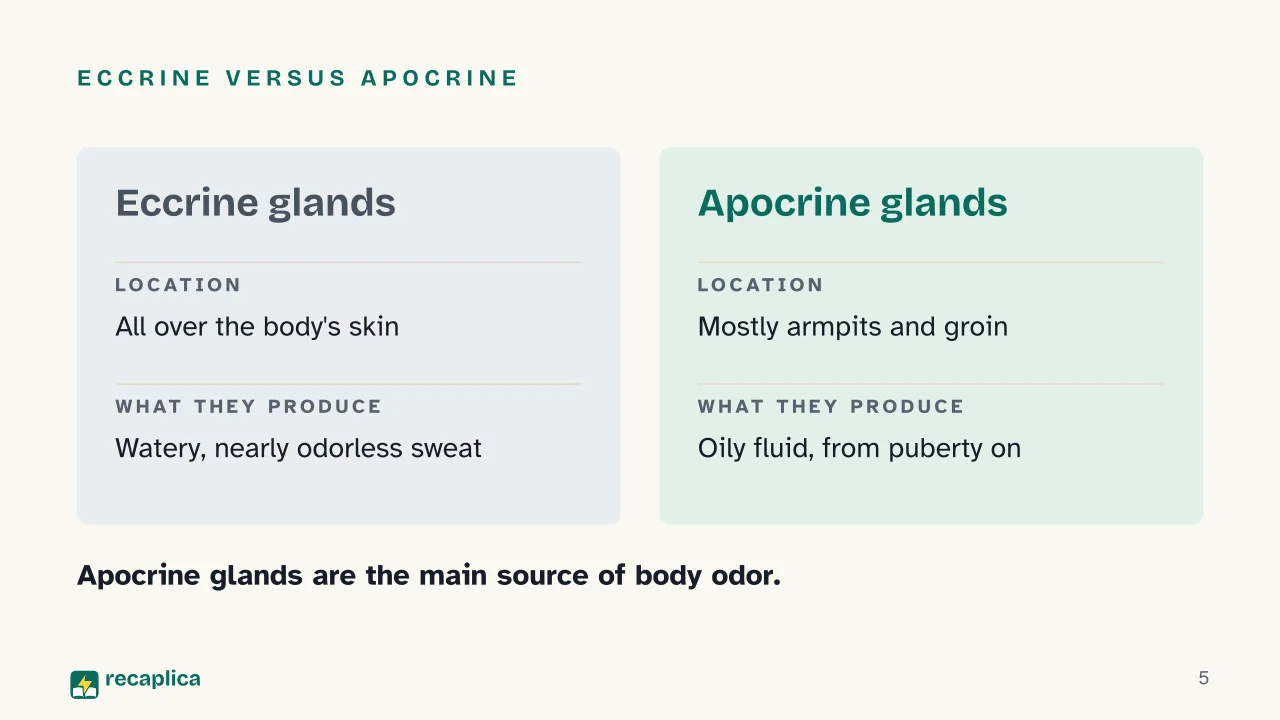 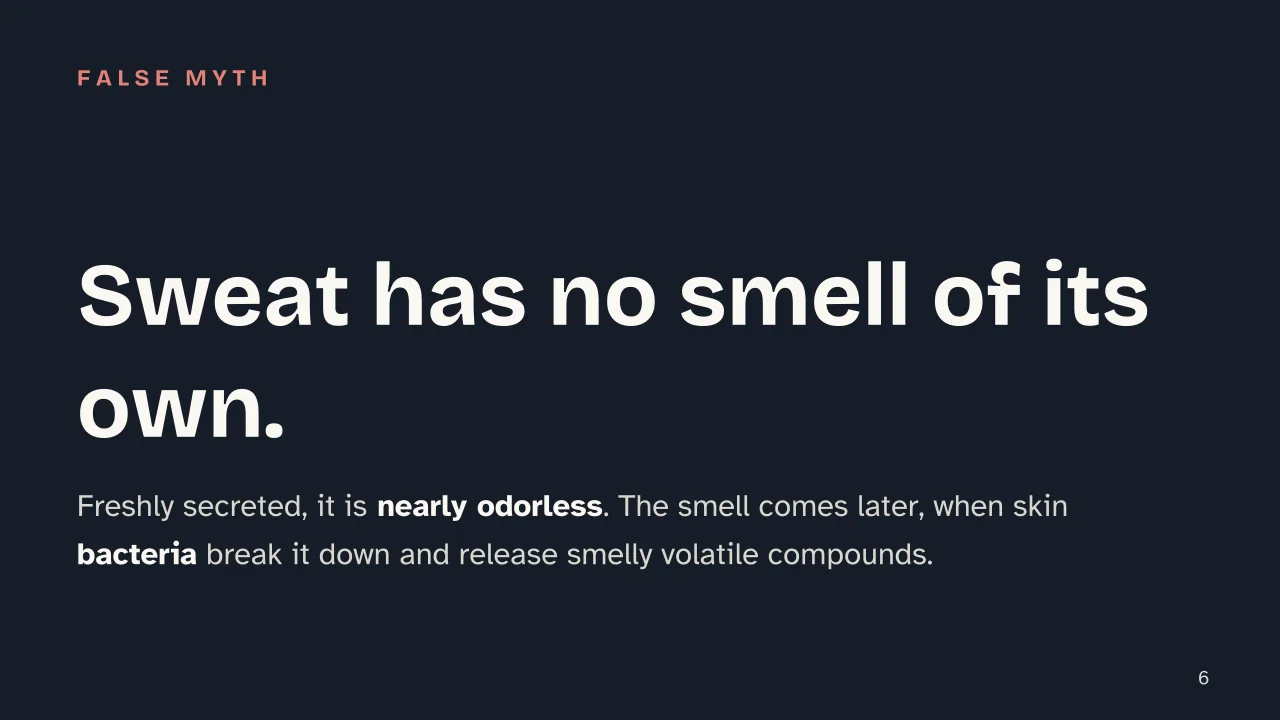  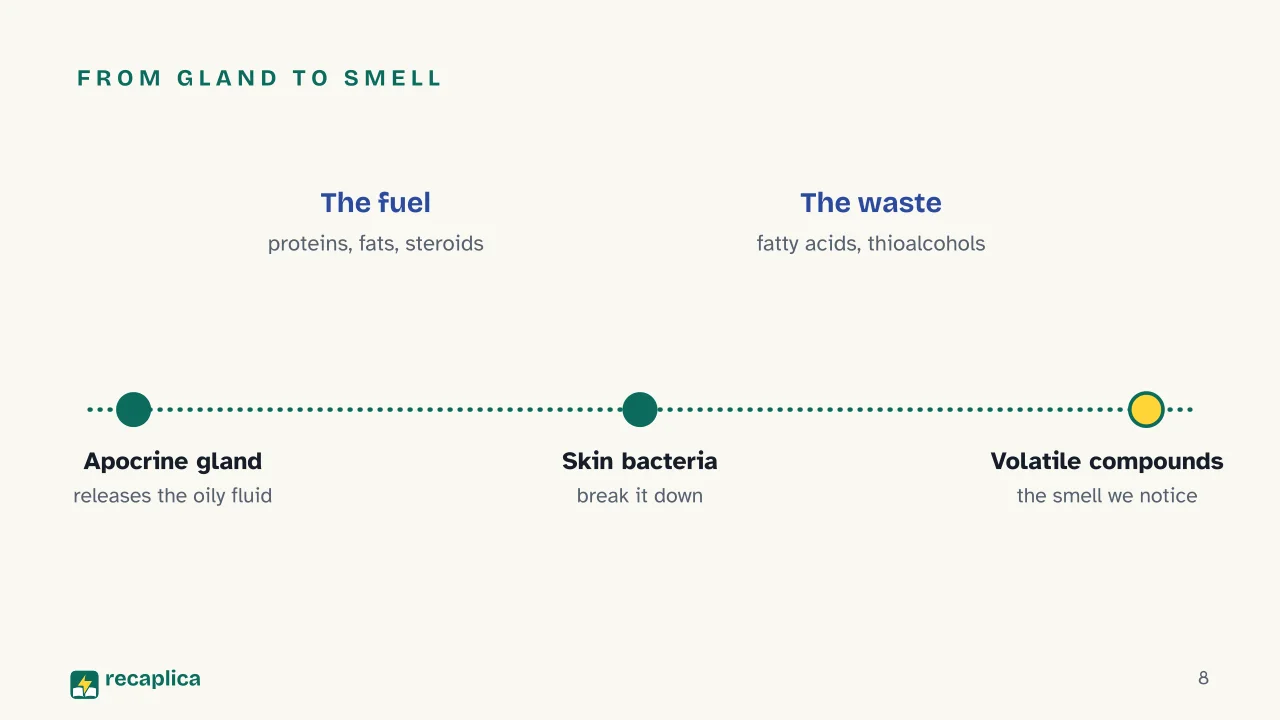 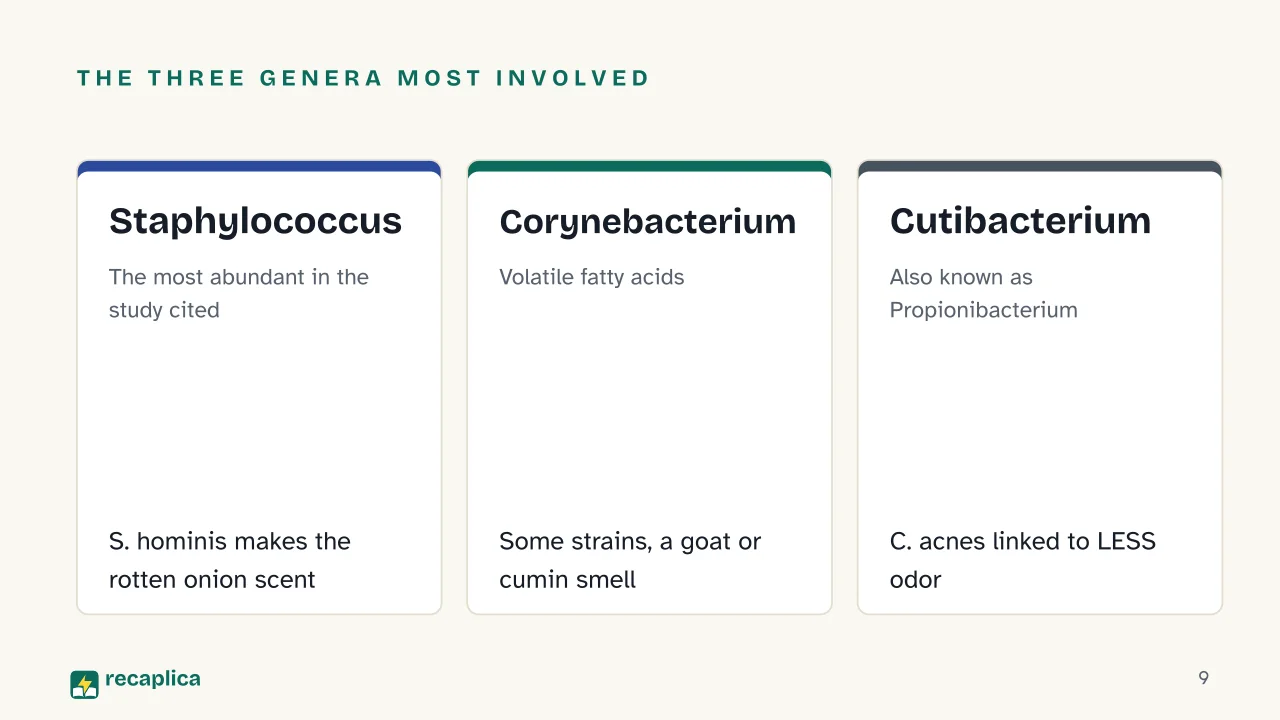   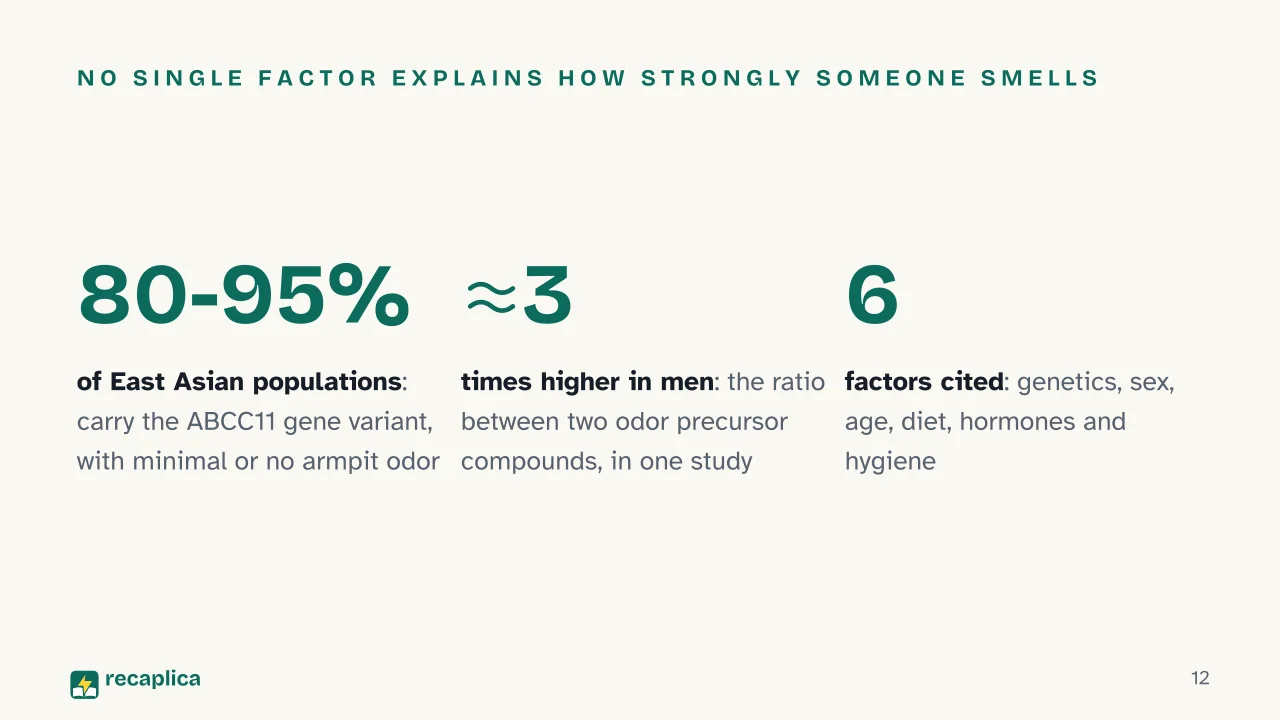   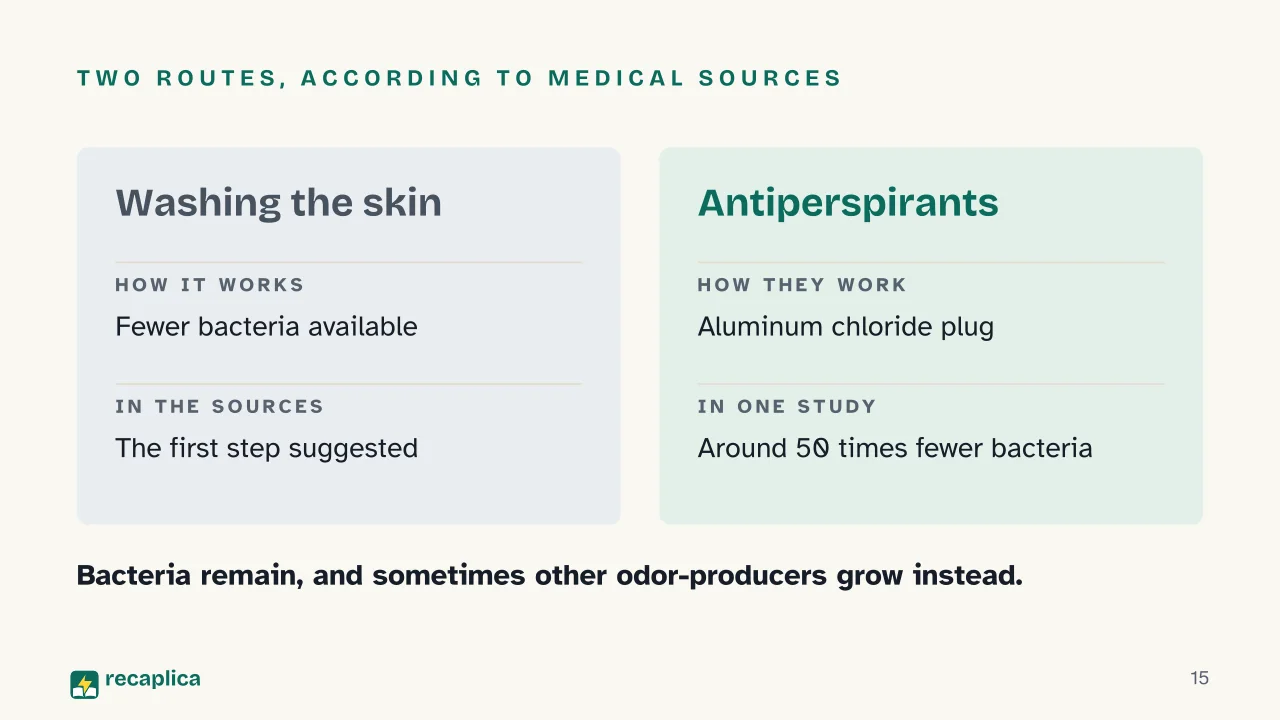 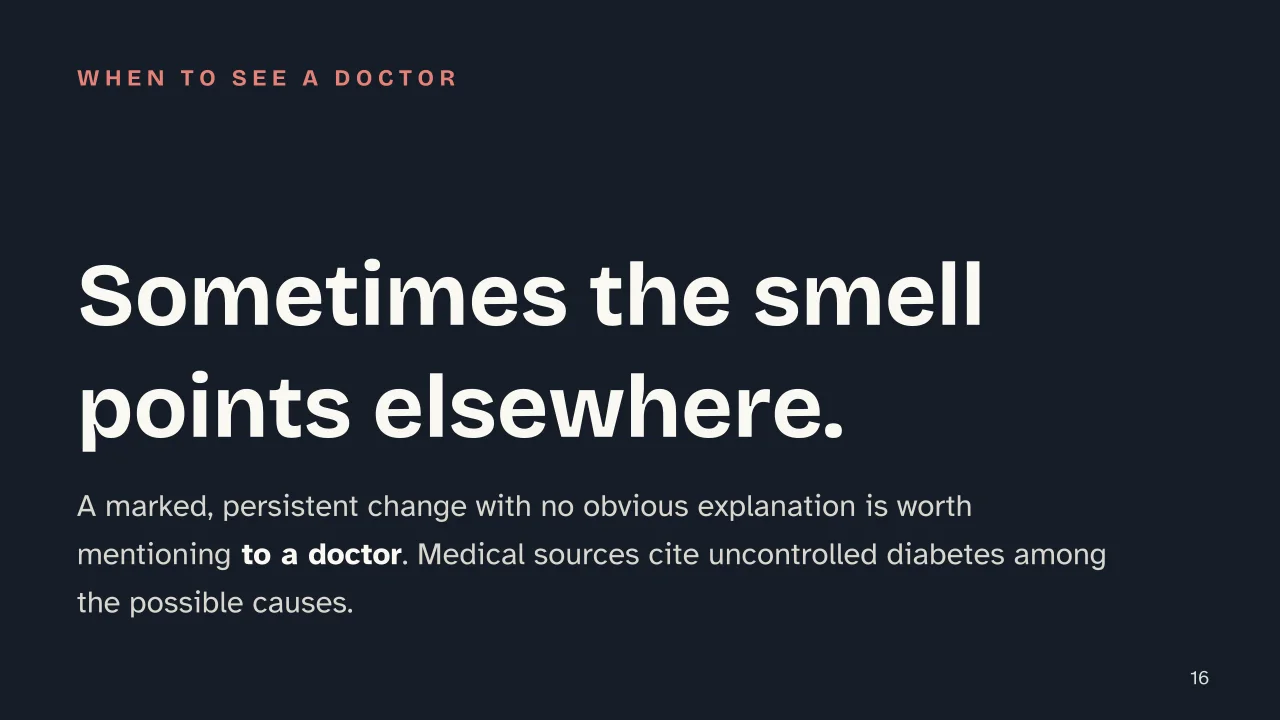 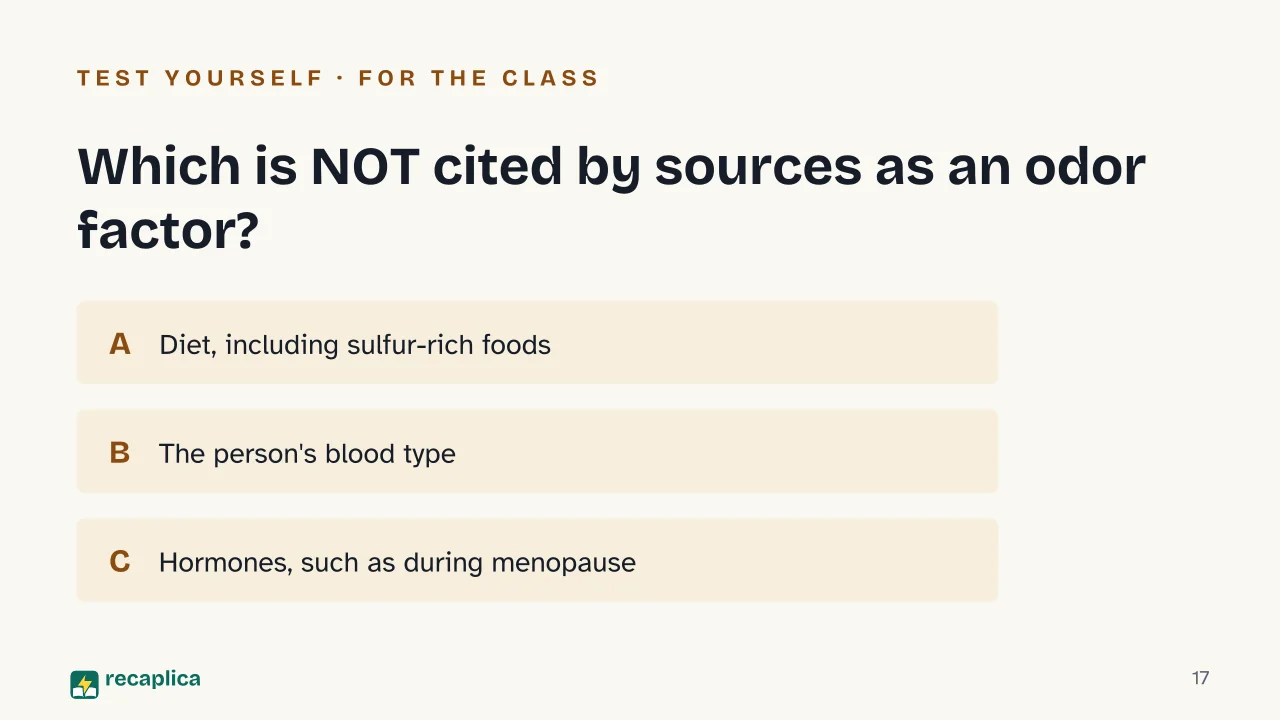  Common myths
Mind mapDrag the background to move around and the nodes to reposition them; use − and + to collapse and expand branches. 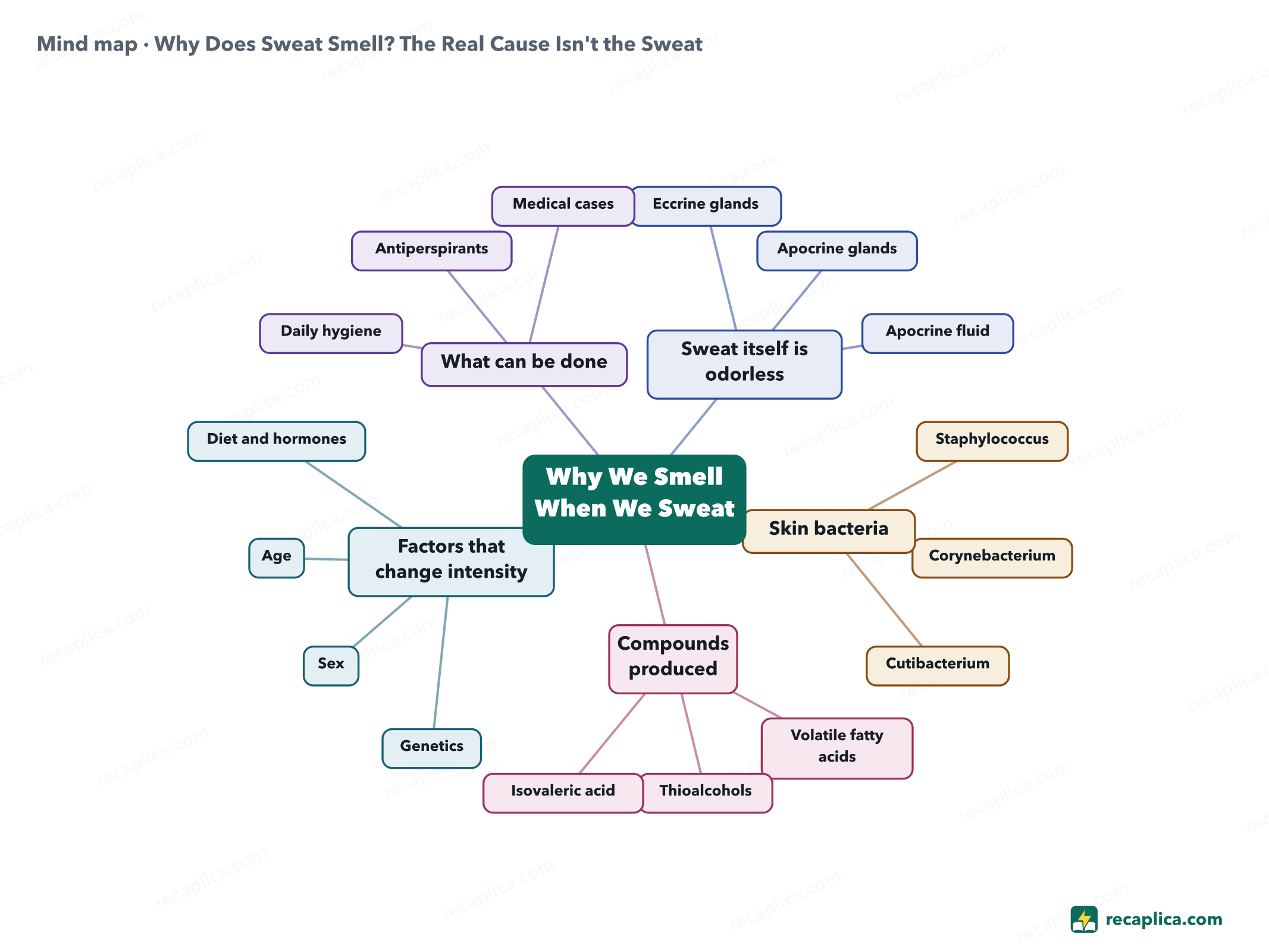
Quiz: test yourselfAnswer the questions to check what you have learned: you get instant feedback and a short explanation. Grade 0/10 0/5
FlashcardsTap the card to flip it and check whether you remember the answer, then move to the next one. 1 / 7 Explain it in your own wordsThe ultimate test: if you can explain it in simple words, you've truly understood it. Write your explanation, then compare it with the Recap. Your explanation is saved only on this device.
Frequently asked questionsWhy does the smell seem stronger under the arms than elsewhere on the body?Because that's where apocrine glands are concentrated, and from puberty on they release an oily fluid rich in proteins and fats — the preferred "food" for skin bacteria. The rest of the body is covered mostly by eccrine glands, which produce a watery, nearly odorless sweat whose only job is cooling the skin. Do men sweat and smell more than women?On average, yes, according to the sources consulted. Men have larger sweat glands and more body hair, which keeps sweat and bacteria in contact with the skin longer; one study also measured a higher armpit bacterial load in men, along with a ratio between two odor precursor compounds (one acidic, one sulfur-based) roughly three times higher than in women. Does body odor change over the course of the day?Yes: in one study, perceived armpit odor intensity was generally higher in afternoon sessions than in morning ones, consistent with bacteria having had more time to metabolize accumulated secretions. Does bad body odor always mean poor hygiene?No, not on its own. Hygiene is one of several factors that shape odor intensity, alongside genetics, sex, age, diet and hormones. In some cases, an unusual or persistent body odor can also be linked to underlying medical conditions — for example uncontrolled diabetes, certain liver or kidney diseases, or thyroid problems — so it's worth having a doctor look into a marked, otherwise unexplained change. Every Recap goes through an independent review before publication. |