|
recaplica
Body fat: what it is, the types, and how it's measured | ||||||||||||||||||||||||||||||||||||||||||||||||||||||||||||||||||||
| © 2026 Recaplica · recaplica.com — All rights reserved | ||||||||||||||||||||||||||||||||||||||||||||||||||||||||||||||||||||
Body fat: what it is, the types, and how it's measuredWhat to print Page numbers appear when printing with default margins. SlidesChoose a cut Flash10 slidesThe essential thread, to present in classFull18 slidesEvery chapter and the deeper detailBoth come with speaker notes. In 30 seconds quick readBody fat is the tissue the body uses to store energy, but that's only part of the job: it also insulates against cold, cushions the organs, and helps regulate hormones and hunger. Not all of it is the same. Most sits just under the skin and appears to cause few known problems, while a smaller share wraps around the abdominal organs and is linked to a higher risk of cardiovascular disease. BMI, the most widely used calculation, doesn't actually measure it: it's just a ratio of weight to height. The most solid reference percentages come from a study that scanned thousands of people with imaging techniques, and they shift with sex and age. Key Points
Key figures
Deep DiveNot just “how much extra you weigh”When people talk about body fat, the most common image is extra weight to shed. Biologically, though, body fat — the technical name is adipose tissue — is tissue in its own right, made of specialised cells that behave a lot like cells in any other organ: they communicate with each other, respond to hormonal signals, and carry out specific jobs, not just storing energy. According to Cleveland Clinic, adipose tissue insulates the body from cold, cushions the organs, helps regulate hunger and satiety, plays a role in glucose and cholesterol metabolism, contributes to insulin sensitivity, produces heat in some of its forms, has a role in immunity, and is involved in the metabolism of certain hormones, including sex hormones. It’s a long list, and it’s why specialists avoid treating body fat as a simple excess to subtract.
White fat and brown fatAdipose tissue isn’t all the same. White fat is the most abundant type and sits under the skin, around the organs and in bone marrow: it’s the reserve depot most people picture. Brown fat is rarer and changes with age: newborns carry a fair amount of it, the share drops as a person grows up, and in adults what’s left concentrates around the upper back. Its job also differs from white fat’s: it produces heat, rather than simply storing energy. Where it collects: subcutaneous and visceralBeyond type, where fat is stored matters just as much. Medical sources distinguish two main zones, with very different health implications.
Visceral fat is the one specialists watch most closely: it isn’t visible to the eye as a “belly”, but sits deep, wrapped around the organs. According to Harvard Health, having a lot of visceral fat can push up several markers tied to heart disease, including blood pressure, blood sugar and cholesterol. Subcutaneous fat, by contrast, the same source notes, causes few known health problems, even though it belongs to the same family of tissue. How it’s measured, in practiceThere’s no single way to estimate body fat, and the most common methods vary widely in precision.
BMI doesn’t measure body fatBMI (body mass index) is the most widely used calculation, but it’s worth being clear about what it actually is: a ratio of weight to height squared, nothing more. The U.S. National Heart, Lung, and Blood Institute (NIH) says so explicitly: BMI doesn’t account for muscle mass, bone density or body composition, and is “just one piece of the puzzle” to weigh alongside other factors. The official NIH/WHO adult thresholds are underweight below 18.5, normal weight 18.5-24.9, overweight 25.0-29.9, and obesity 30.0 and above — thresholds that remain useful at the population level, but need to be read with that limit in mind. Waist circumference and ratiosA more direct way to get a sense of visceral fat is to measure waist circumference with a flexible tape, just above the hip bones. According to Cleveland Clinic, the risk of excess visceral fat rises above 102 cm (40 inches) in men and above 89 cm (35 inches) in women. The men’s threshold is independently confirmed by Harvard Health too. There’s also the waist-to-hip ratio (above 0.90 in men and 0.85 in women indicates abdominal obesity) and the waist-to-height ratio, which should stay under 0.5. DEXA: the research standardDEXA (dual-energy X-ray absorptiometry) is the method scientific studies use as a reference to estimate how much fat, muscle and bone make up a person’s body. It’s accurate, but requires clinical equipment: that’s why, day to day, people more often rely on bioimpedance scales or skinfold calipers, tools that are practical but less precise, and that tend to underestimate body fat compared with DEXA. The reference percentages: what the numbers actually sayThe most solid source on “expected” body fat percentages is a study published in 2000 in the American Journal of Clinical Nutrition by Gallagher and colleagues, which measured 1,626 adults — women and men, of different ethnic backgrounds — using DEXA and, at two of three centres, a 4-compartment model considered even more accurate. The goal was to link NIH and WHO BMI thresholds to expected body fat percentages, broken down by sex and age.
Two things stand out in the table. First: at the same BMI, women consistently show higher fat percentages than men. Second: at the same BMI, the percentage rises with age — the authors state it plainly, once BMI is controlled for, older age is associated with a higher body fat percentage. The same authors caution, though, against treating these as a clinical verdict: the study, they explain, was mainly about working out a statistical method for deriving these thresholds, rather than pinning down final, universal body fat numbers. These are figures tied to BMI thresholds, useful as a general reference, not a limit that applies to any one person.
How much visceral fat matters worldwideThis isn’t just an individual issue. According to the World Health Organization, in 2022 1 in 8 people worldwide were living with obesity, and 2.5 billion adults were overweight, of whom 890 million had obesity — 43% and 16% of the world’s adult population, respectively. Among children and adolescents aged 5-19, also in 2022, over 390 million were overweight and 160 million were living with obesity. Numbers that explain why research into measuring and interpreting body fat — not just weight — remains an active field, spanning the muscular system and adipose tissue alike. What this article doesn’t sayThe percentages and thresholds covered here are statistical tools, built to study whole populations or offer a first point of reference, not to replace a medical assessment. None of the thresholds mentioned settle what’s “right” for any one person: age, sex, medical history, medication and other conditions all change the picture. For any personal assessment — whether a given body fat percentage or BMI should be considered a concern in your specific case — the right reference remains a doctor, a dietitian or another qualified healthcare professional. Slide deckSlides ready to download and make your own in PowerPoint or Google Slides, with speaker notes. Pick the Flash cut or the Full one.     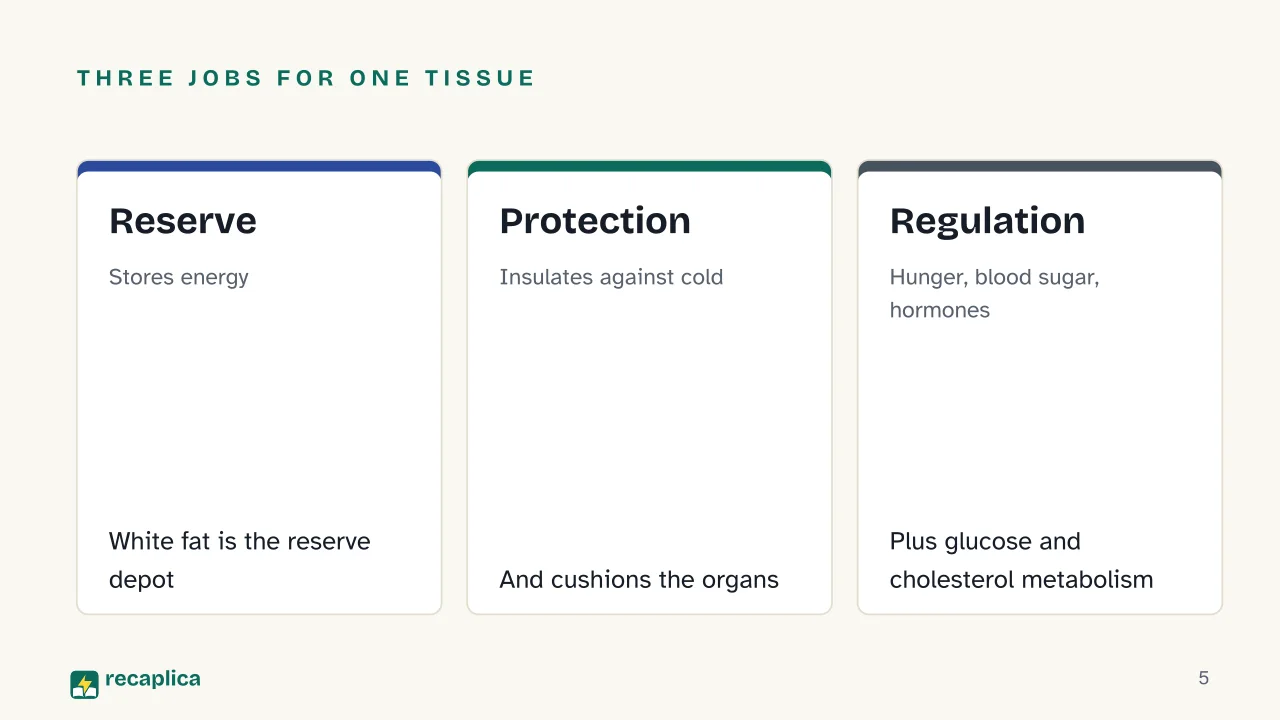   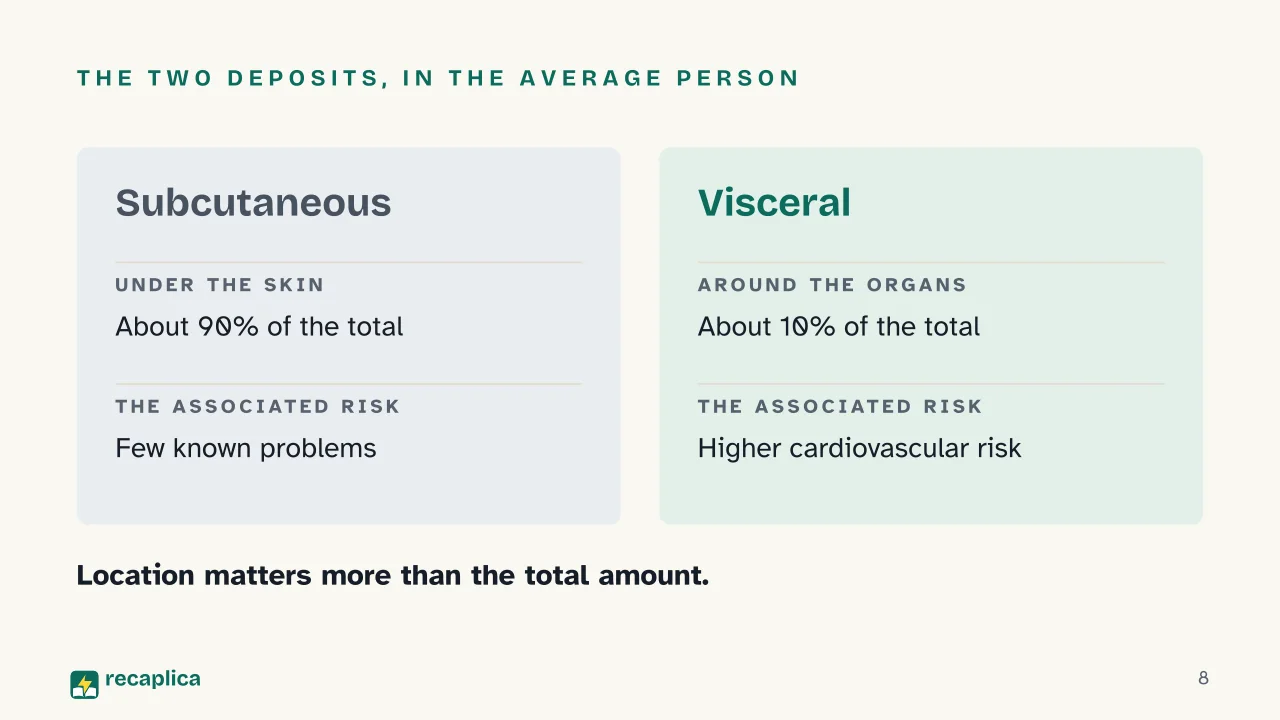  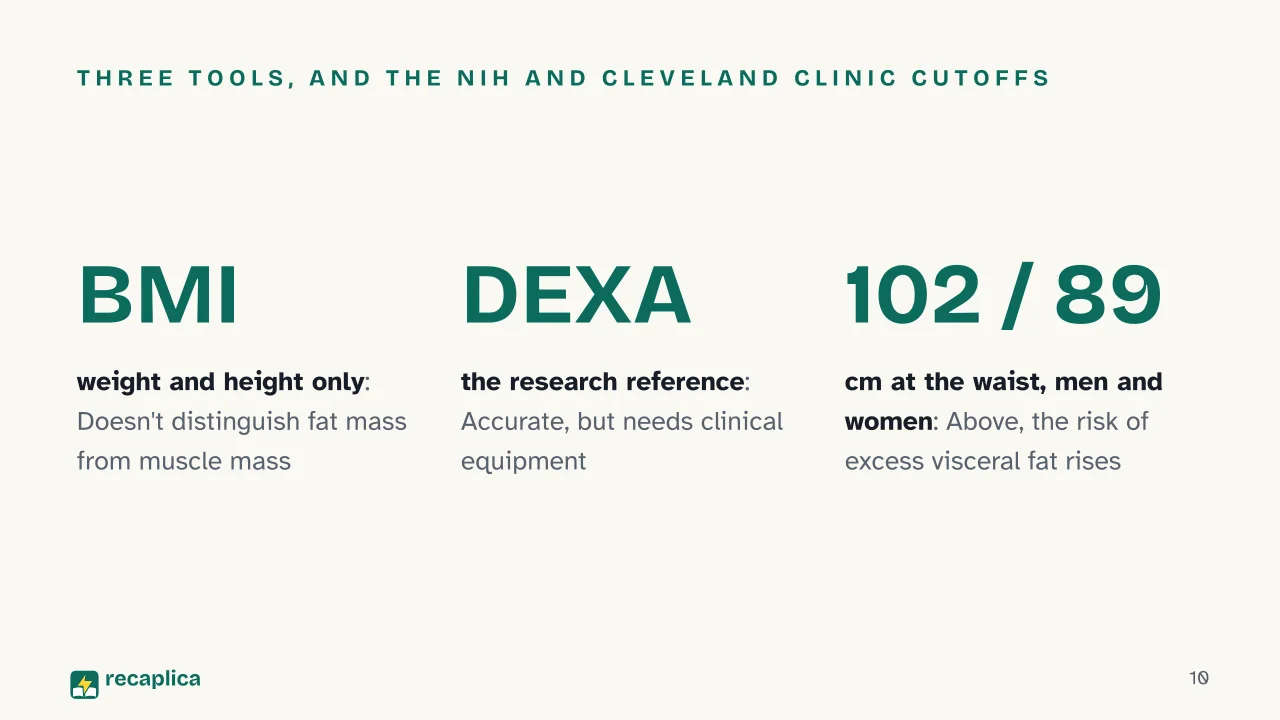 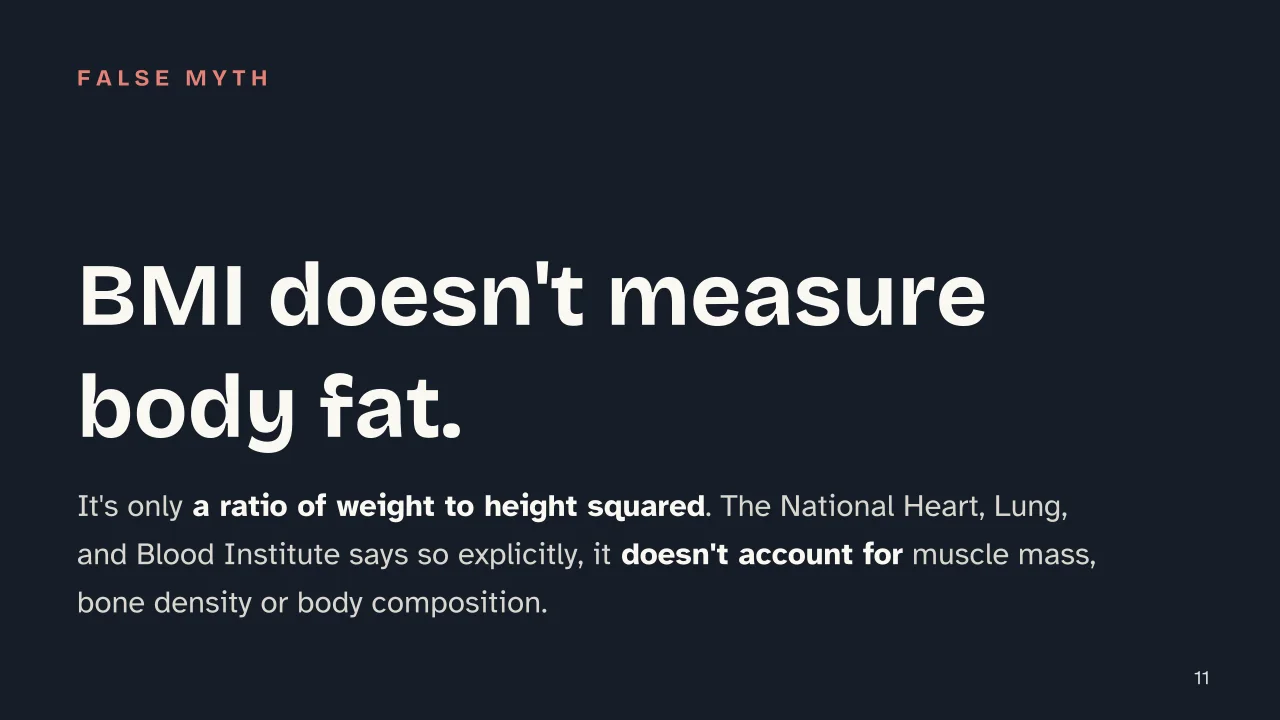 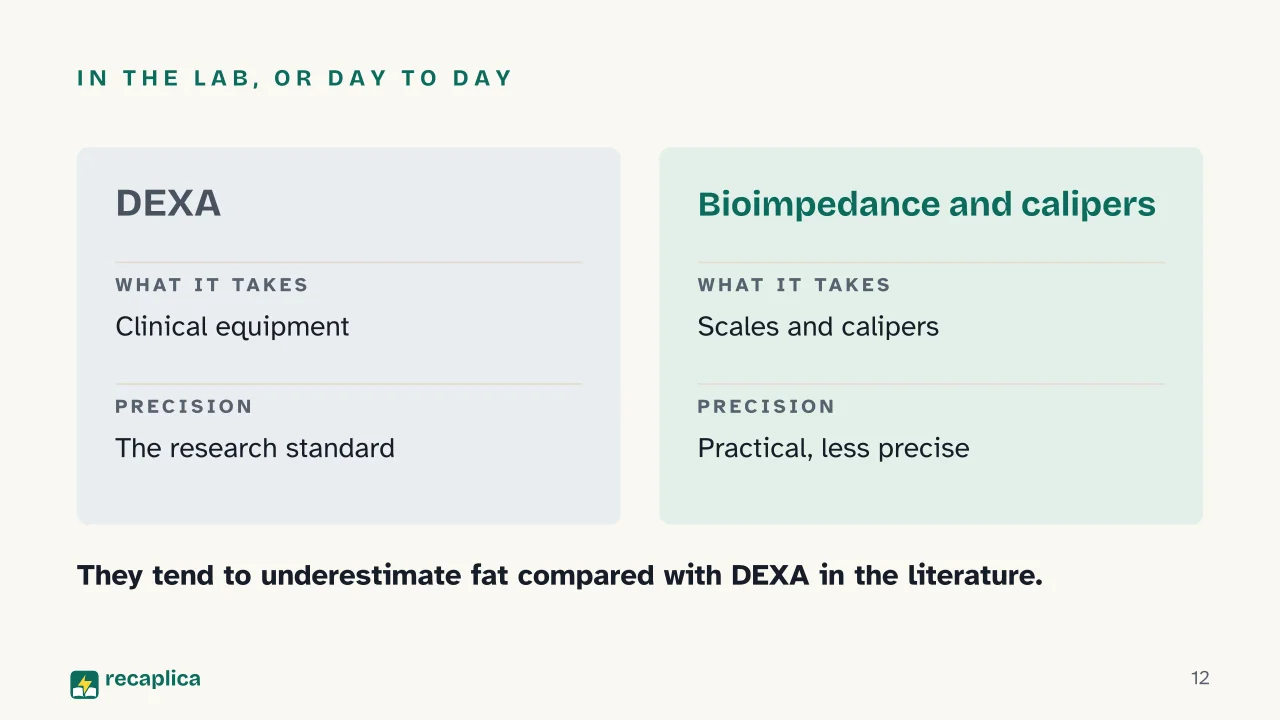  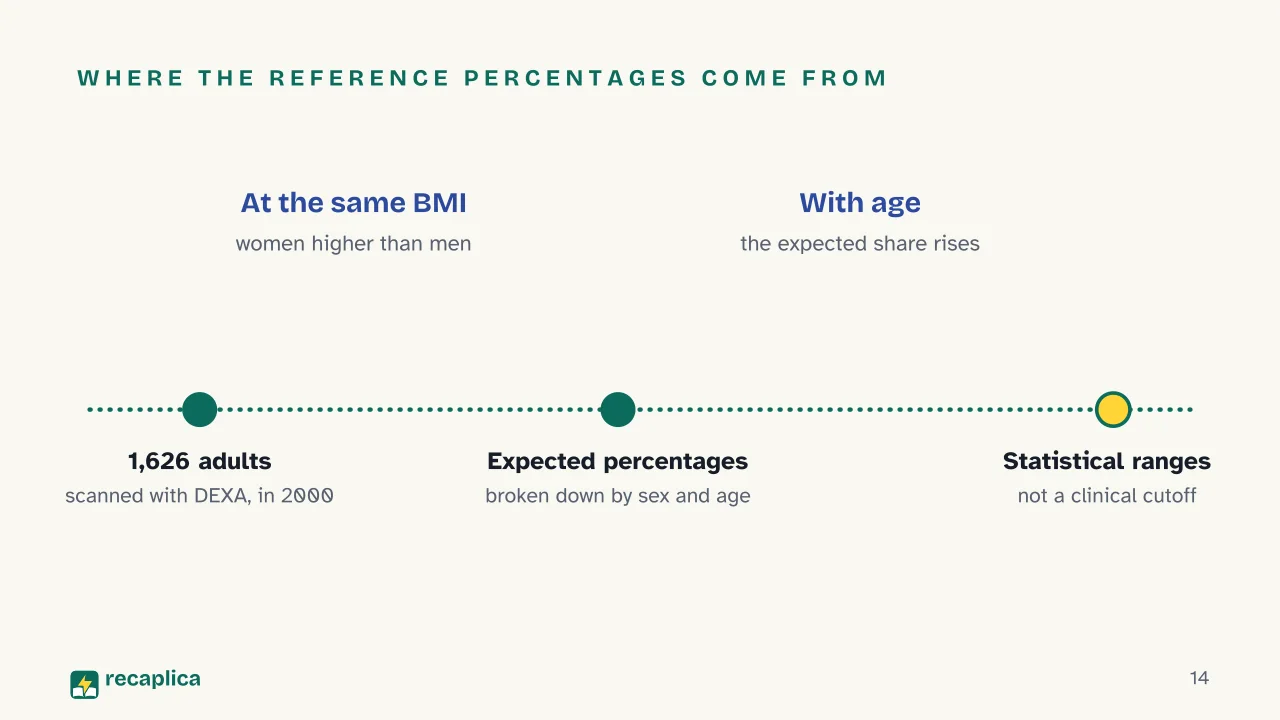 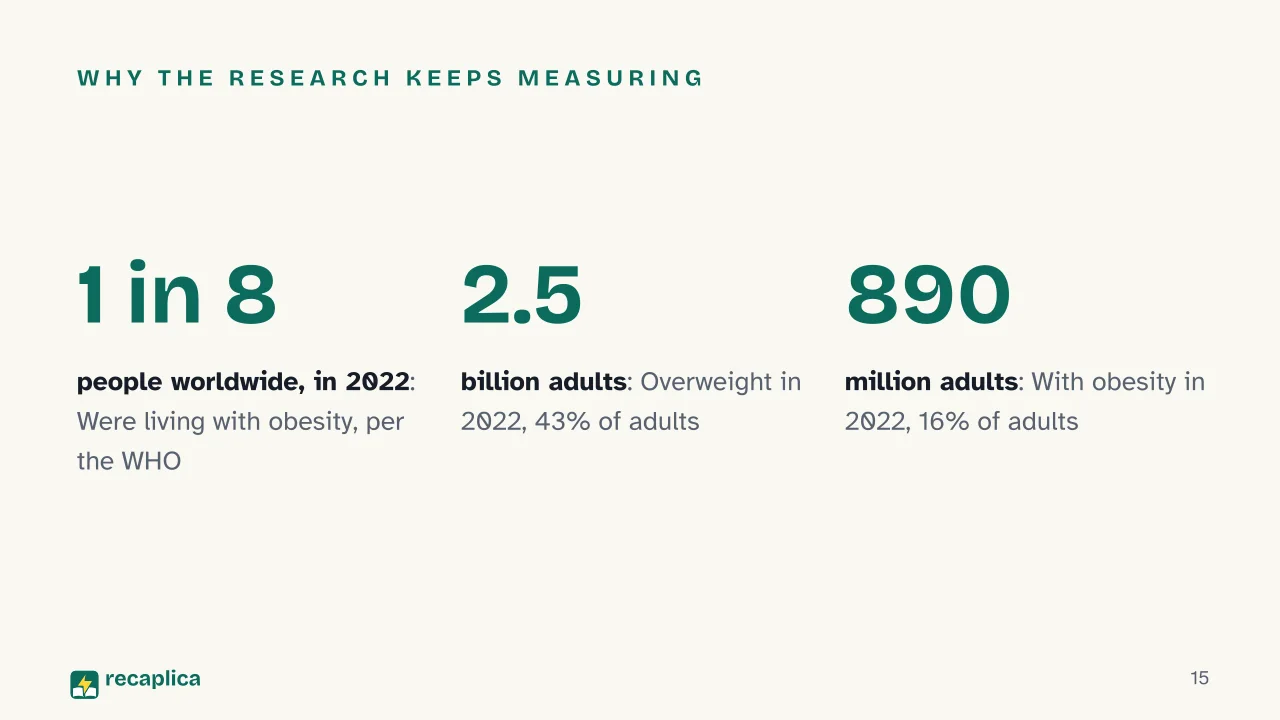 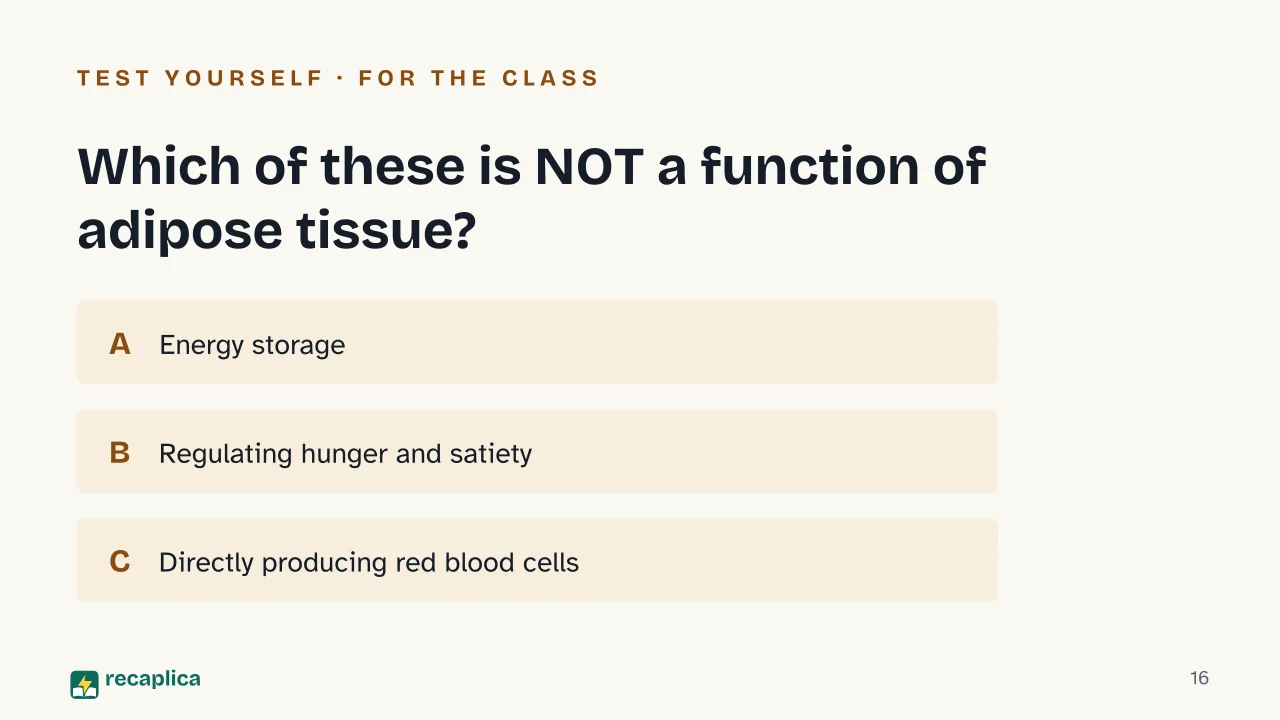 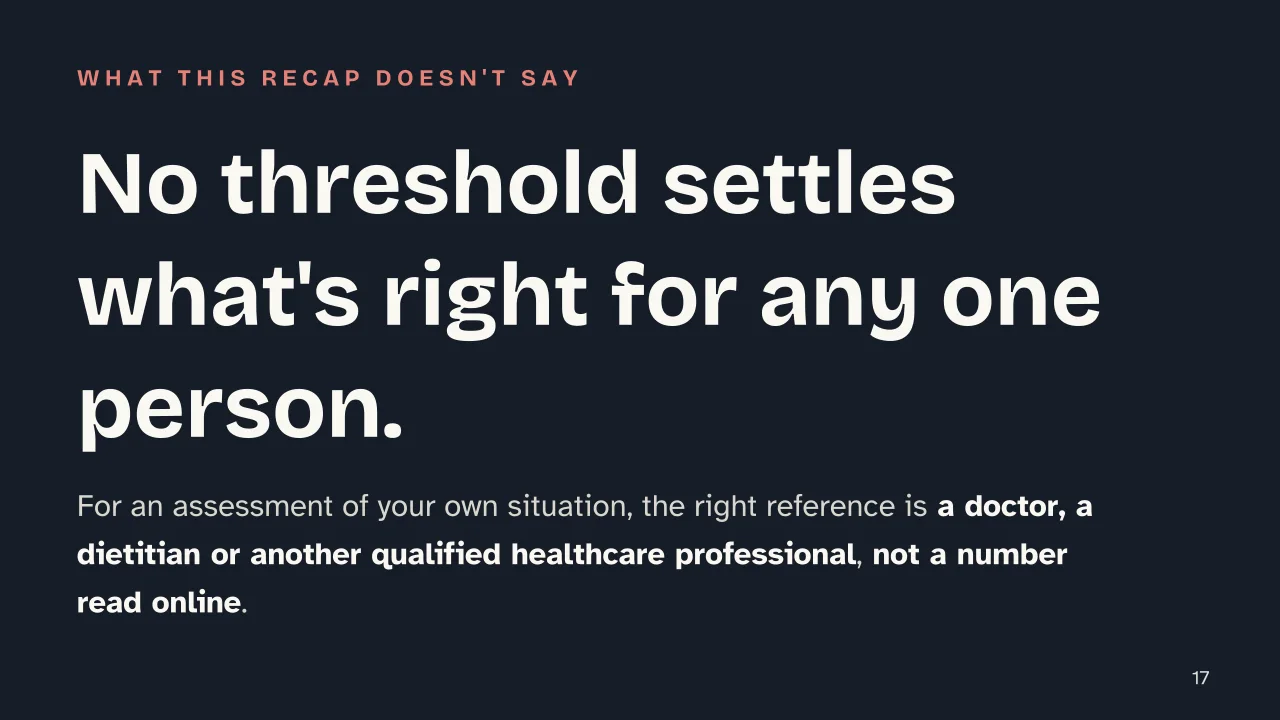  Common myths
Mind mapDrag the background to move around and the nodes to reposition them; use − and + to collapse and expand branches. 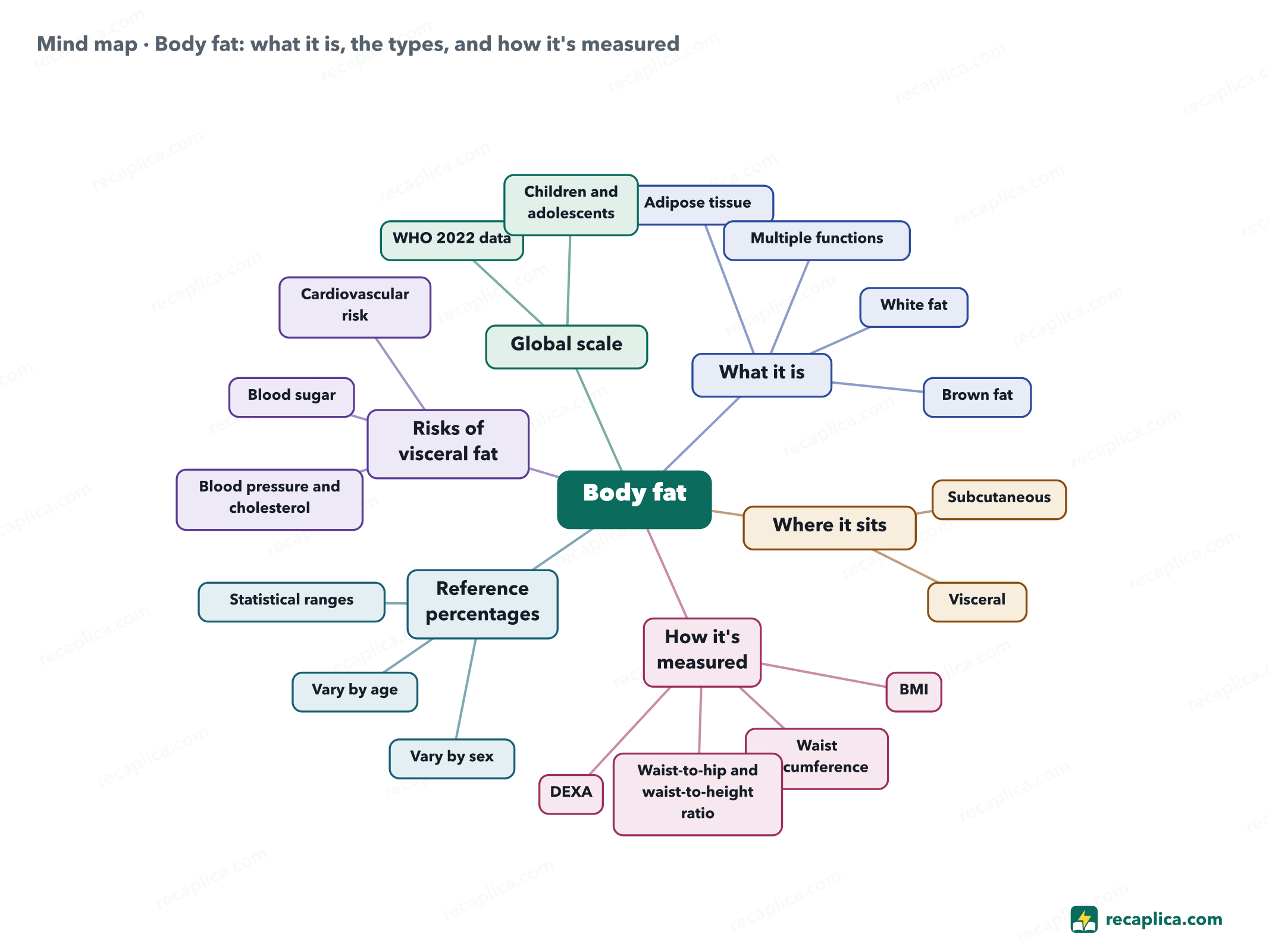
Quiz: test yourselfAnswer the questions to check what you have learned: you get instant feedback and a short explanation. Grade 0/10 0/5
FlashcardsTap the card to flip it and check whether you remember the answer, then move to the next one. 1 / 8 Explain it in your own wordsThe ultimate test: if you can explain it in simple words, you've truly understood it. Write your explanation, then compare it with the Recap. Your explanation is saved only on this device.
Frequently asked questionsWhat's considered a normal body fat percentage?There's no single number that applies to everyone. Cleveland Clinic puts the healthy range at roughly a tenth to just over a third of body weight, depending on age and sex; a more detailed study (Gallagher et al., 2000) links BMI thresholds to different expected percentages by sex and age group, but the same authors describe them as provisional statistical ranges, not an absolute clinical cutoff. For an assessment of your own situation, a doctor or dietitian is still the right reference, not a number read online. Does a high BMI mean too much body fat?Not necessarily. BMI is calculated from weight and height alone and, as the NIH makes clear, doesn't distinguish between fat mass and muscle mass: a very muscular person can have a high BMI while carrying little excess fat. It's a useful indicator at the population level for research, not a direct measurement of one person's body fat. How can visceral fat be estimated without specialist tests?The simplest method is waist circumference: measure it with a flexible tape just above the hip bones. Cleveland Clinic points to a higher risk above 102 cm (40 inches) in men and 89 cm (35 inches) in women. There's also the waist-to-hip ratio (above 0.90 in men and 0.85 in women indicates abdominal obesity) and the waist-to-height ratio, which should stay under 0.5. What's the most precise method for measuring body fat?In scientific research the reference method is DEXA (dual-energy X-ray absorptiometry), which in the Gallagher et al. study was combined with a 4-compartment model to estimate body composition precisely. It's an impractical test for everyday use: day to day, bioimpedance scales or skinfold calipers are used more often, practical tools that are less precise and tend to underestimate body fat compared with DEXA in the scientific literature. Every Recap goes through an independent review before publication. |