recaplica
Clear in 30 seconds, yours in 10 minutes.
In 30 seconds quick read
Mitosis and meiosis are the two ways cells divide. Mitosis produces two cells identical to the parent: it's for growing, repairing tissues and replacing old cells. Meiosis produces four cells with half the chromosomes, each one different: it creates the gametes (eggs and sperm) for reproduction. In short: mitosis copies, meiosis shuffles and halves.
Key Points
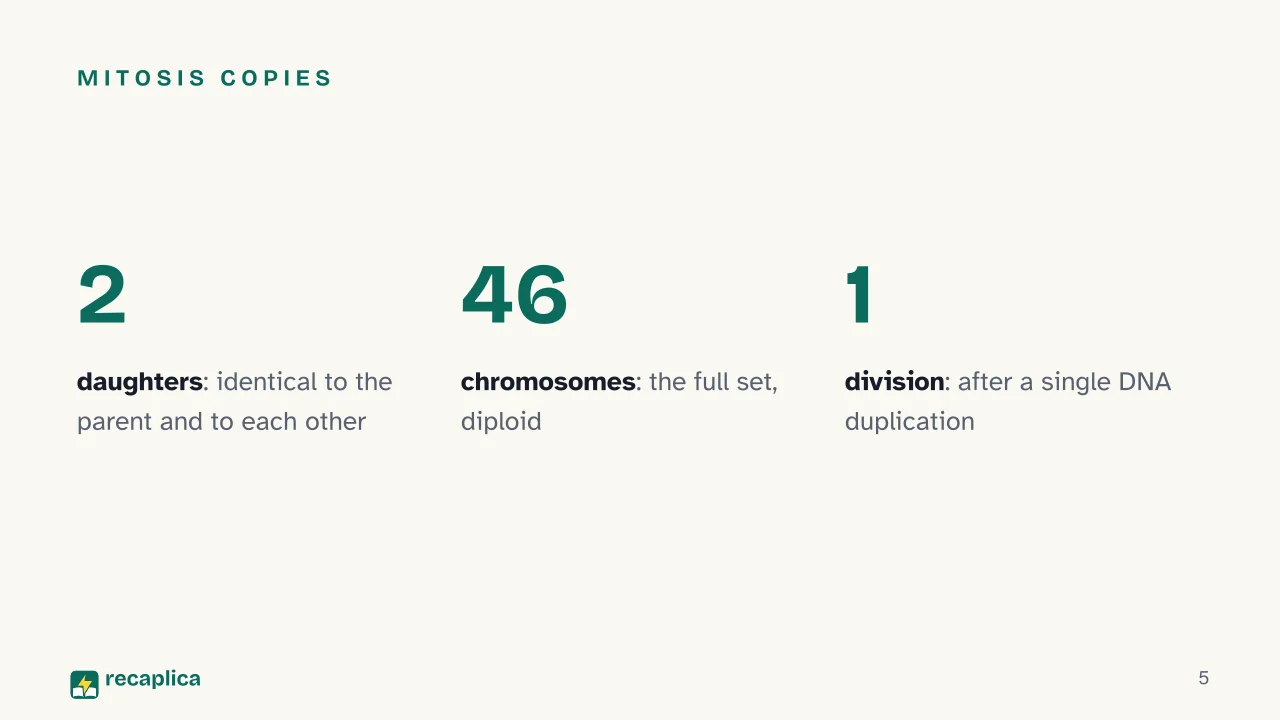
Mitosis: 1 parent cell → 2 identical daughters with a full set (diploid, 46 chromosomes in humans).
Meiosis: 1 parent cell → 4 daughters, all different, with half the set (haploid, 23 chromosomes).
Mitosis serves growth, repair and turnover; meiosis only makes gametes.
In meiosis's crossing over, maternal and paternal chromosomes swap segments: that's where variability is born.
At fertilization, two 23-chromosome gametes merge and restore the new individual's 46.
DNA is duplicated once before dividing: mitosis then divides once, meiosis twice in a row.
Key figures
2 vs 4 the daughter cells produced by mitosis and meiosis
46 → 23 chromosomes go from a double set (diploid) to half (haploid) in human gametes Source: NIH
Deep Dive
Two divisions, two opposite missions
Every cell is born from the division of another cell — but
not all divisions are alike. Nature runs two, with opposite missions:
mitosis is the photocopier: it makes identical copies, to grow the
organism and replace worn-out parts;
meiosis is the shuffler: it makes unique cells with a halved set, to
create the next generation.
Mixing them up is the classic exam mistake. The key to never doing it
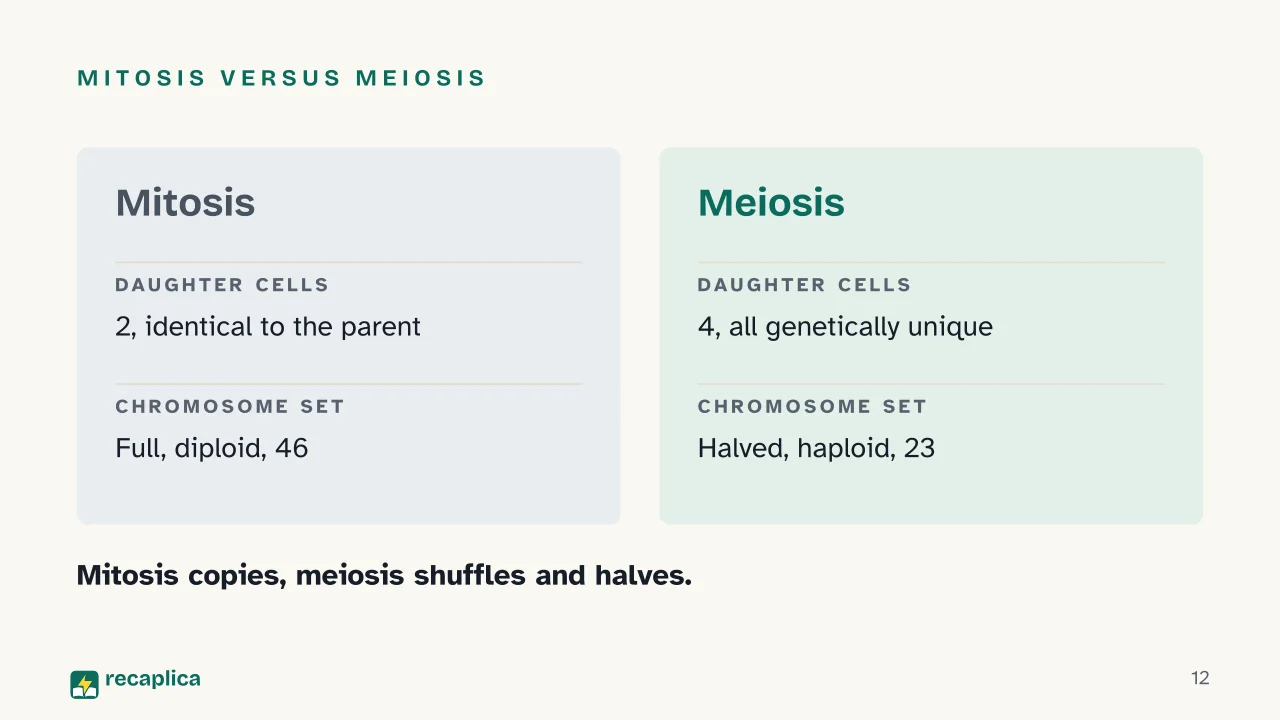
again: mitosis copies, meiosis shuffles and halves.
Mitosis: the body’s photocopier
Right now, billions of your cells are dividing by mitosis: skin renews and
wounds close over; meanwhile the bone marrow churns out new blood cells
by the million. Before dividing,
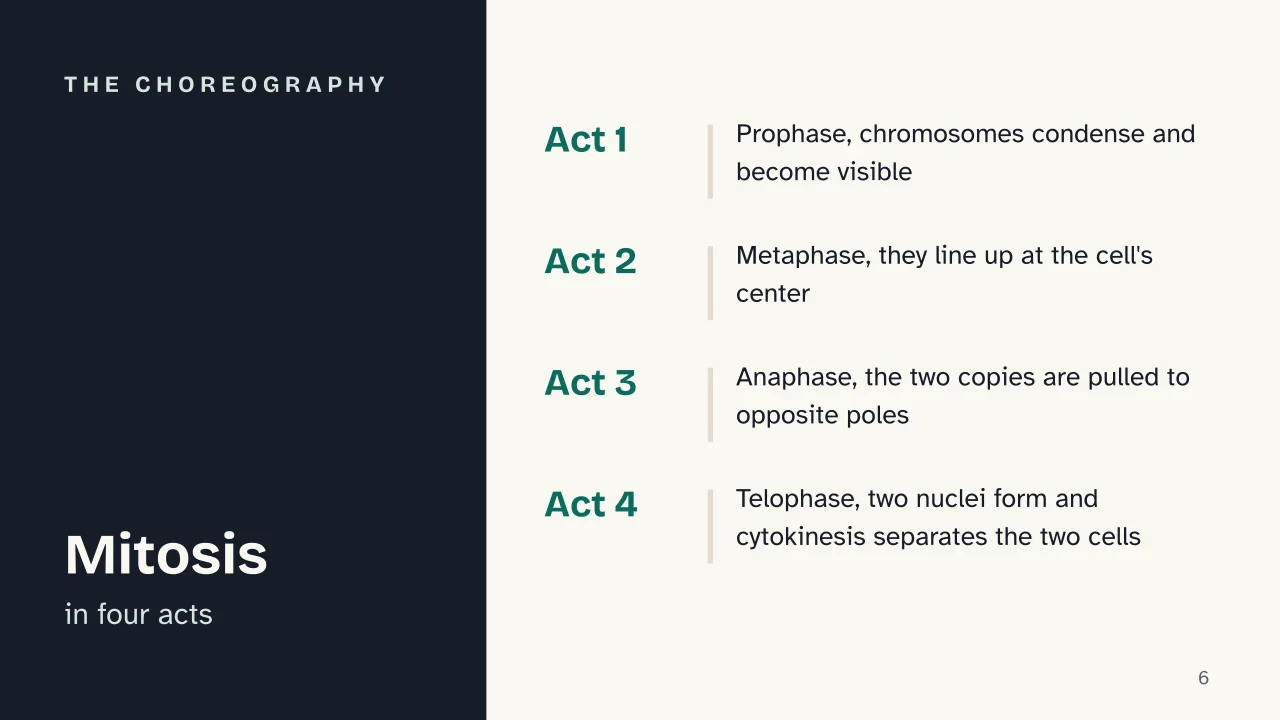
the cell duplicates all of its DNA; then the choreography
unfolds in four acts:
Phase
What happens
Prophase
Chromosomes condense and become visible
Metaphase
They line up at the cell’s center
Anaphase
The two copies of each chromosome are pulled to opposite poles
Telophase
Two nuclei form; cytokinesis separates the two cells
Result: two daughter cells identical to the parent, each with its 46
chromosomes.
Practical example: when you scrape your knee, the skin closes over
within days. Cells at the wound’s edges divide by mitosis, producing
copies of themselves until the gap is filled — a construction site
working from exact copies.
Meiosis: the species’ shuffler
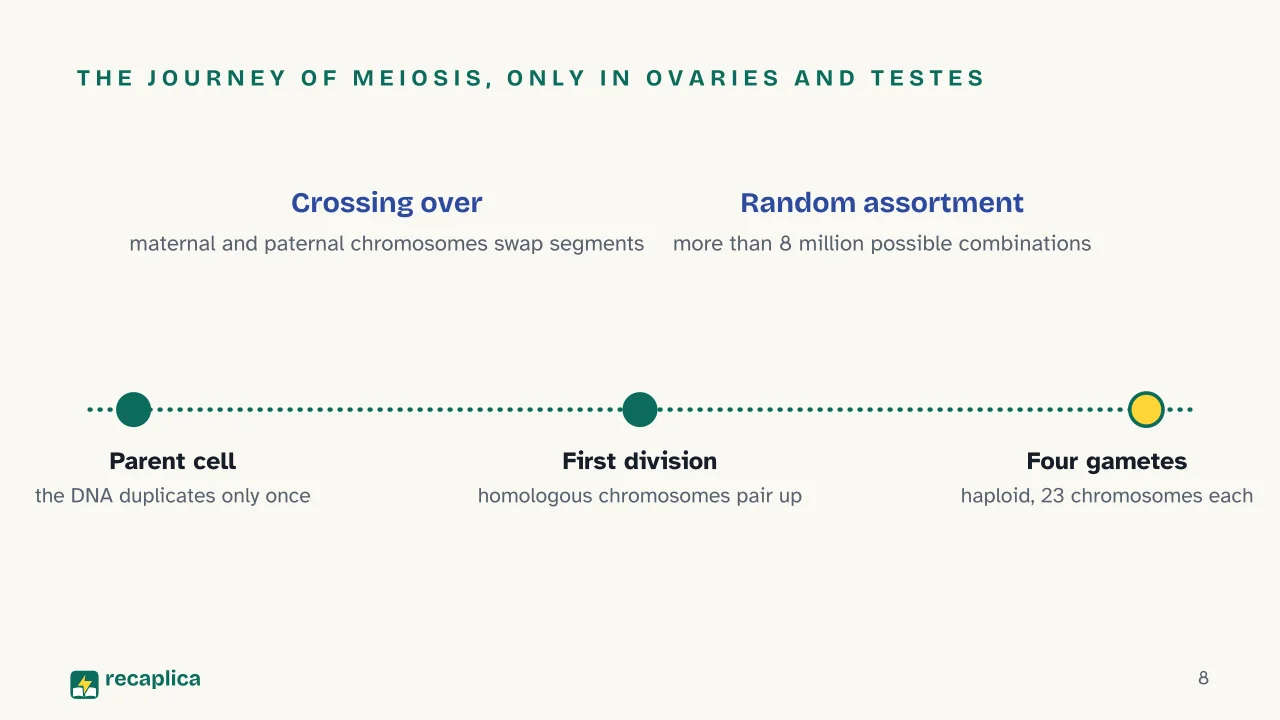
Meiosis happens only in ovaries and testes, with a single purpose:
producing the gametes — eggs and sperm. To do it, the cell runs two
divisions in a row after just one DNA duplication, and the outcome is
radically different: four cells, each genetically unique, with 23
chromosomes each (haploid). One honest footnote: in females, only one of
the four becomes a mature egg — the other three degenerate.
Two mechanisms make each gamete unique:
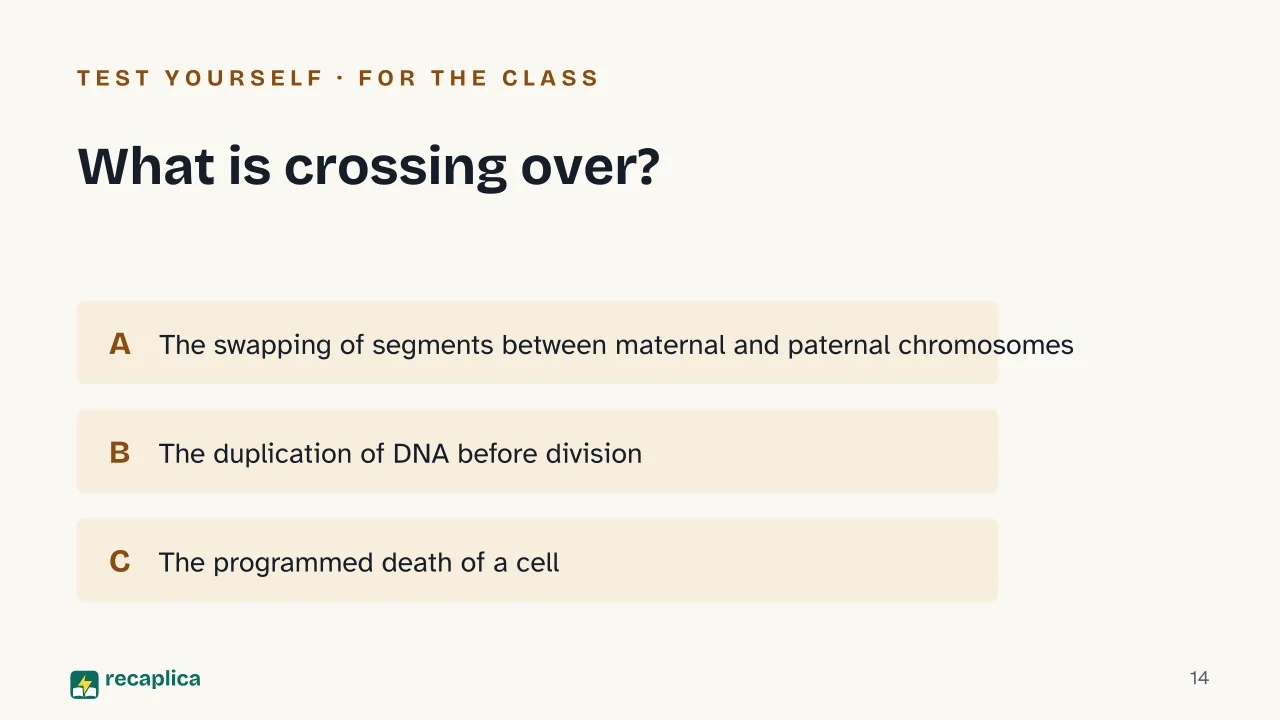
Crossing over: the chromosomes you inherited from your mother and
father pair up and swap segments. Every chromosome that ends up in
a gamete is a brand-new mosaic of your grandparents’ DNA.
Random assortment: which version of each of the 23 pairs lands in
which gamete is up to chance — 2²³, more than 8 million possible
combinations, before crossing over even enters the picture.
Practical example: this is why brothers and sisters, despite having
the same parents, are never copies: each child is dealt a hand from two
freshly shuffled decks.
Why halve? The arithmetic of fertilization
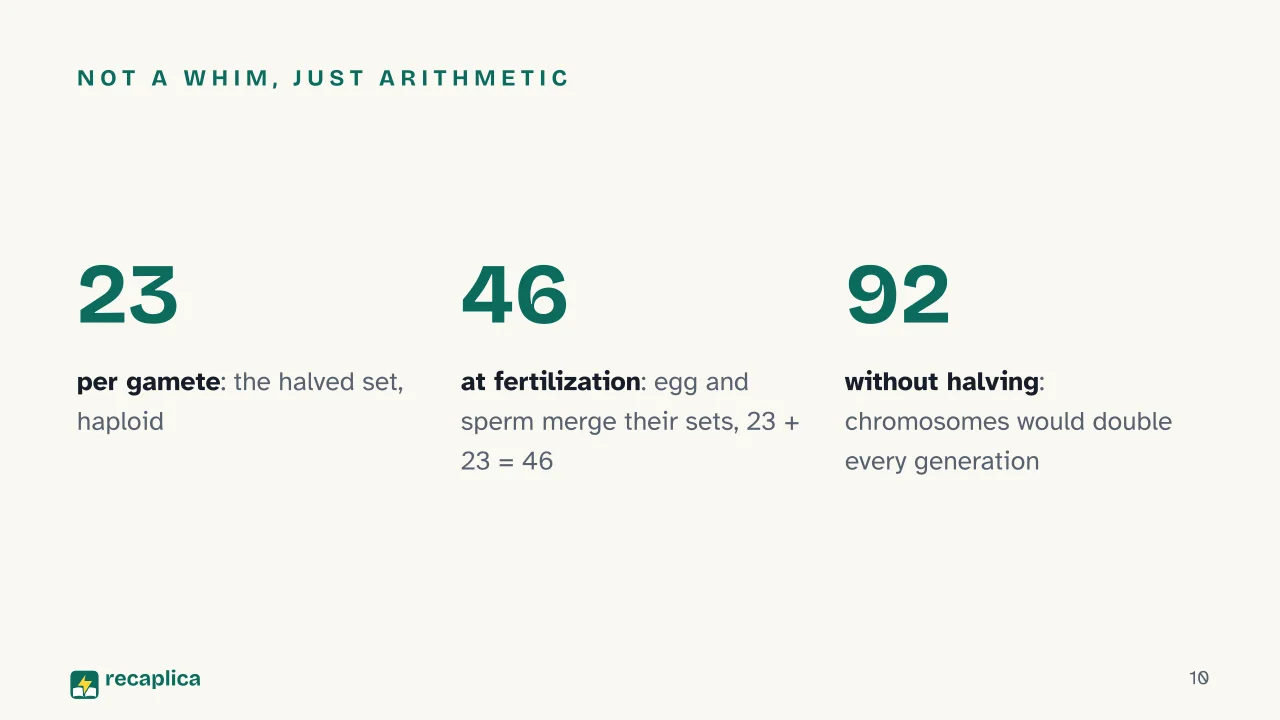
The halving isn’t a whim — it’s arithmetic. At fertilization, egg and
sperm merge their sets: 23 + 23 = 46, and the embryo starts with the
right number. If gametes carried a full set, chromosomes would double
every generation — 92, 184, 368… — a genetic disaster within a few
generations.
The exam-ready table
Mitosis
Meiosis
Daughter cells
2
4
Chromosome set
Full (diploid, 46)
Halved (haploid, 23)
Identical daughters?
Yes, to parent and each other
No, all unique
Where
Throughout the body
Only ovaries and testes
Purpose
Growth, repair, turnover
Making gametes
Crossing over
No
Yes
There’s one final reason meiosis matters so much: all that variability
is the raw material natural selection works with. Without that
reshuffling, evolution would have nothing to select from.
Slide deck
Slides ready to download and make your own in PowerPoint or Google Slides, with speaker notes. Pick the Flash cut or the Full one.
✗ Myth Mitosis and meiosis are two names for the same process.
✓ Reality They're processes with opposite goals: mitosis photocopies a cell for growth and repair; meiosis reshuffles the DNA and halves the chromosomes to create the gametes of reproduction.
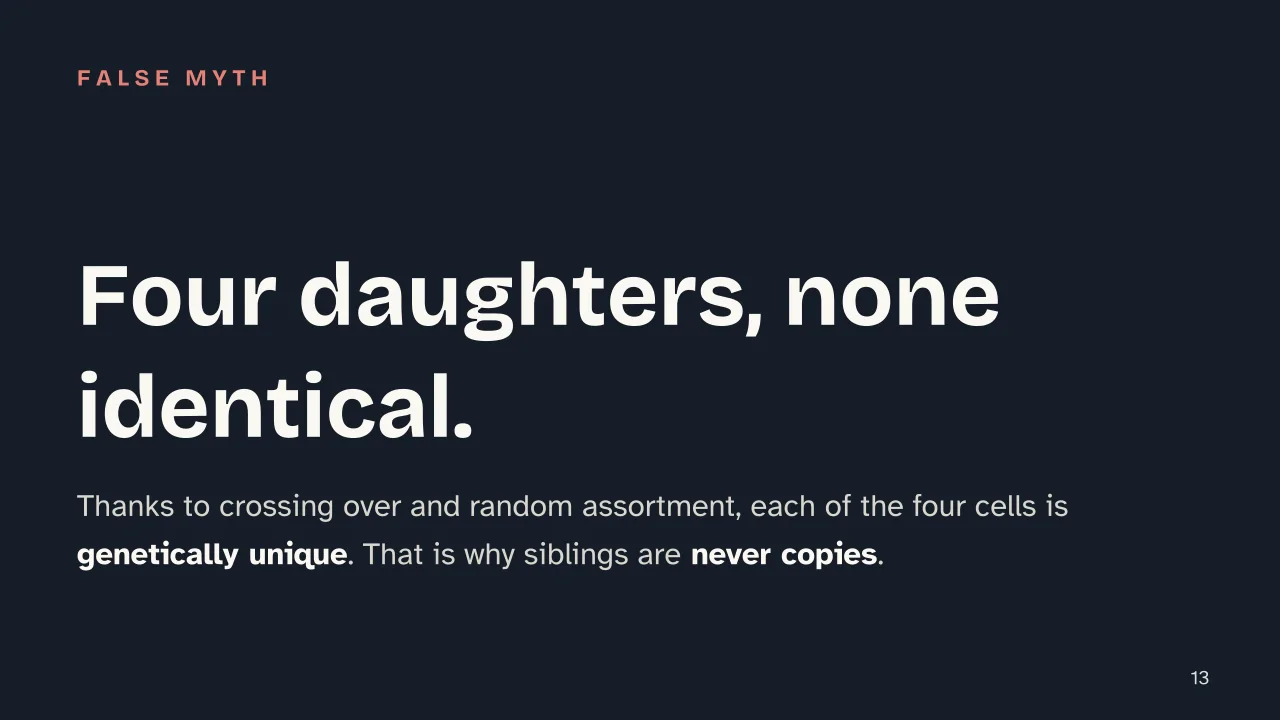
✗ Myth After meiosis, the daughter cells are identical to each other.
✓ Reality Quite the opposite: thanks to crossing over and the random assortment of chromosomes, each of the four cells is genetically unique. That's why siblings are never copies.
✗ Myth Meiosis happens throughout the body.
✓ Reality It only happens in the reproductive organs (ovaries and testes), to produce eggs and sperm. Everywhere else in the body, cells divide by mitosis.
Mind map
Drag the background to move around and the nodes to reposition them; use − and + to collapse and expand branches.
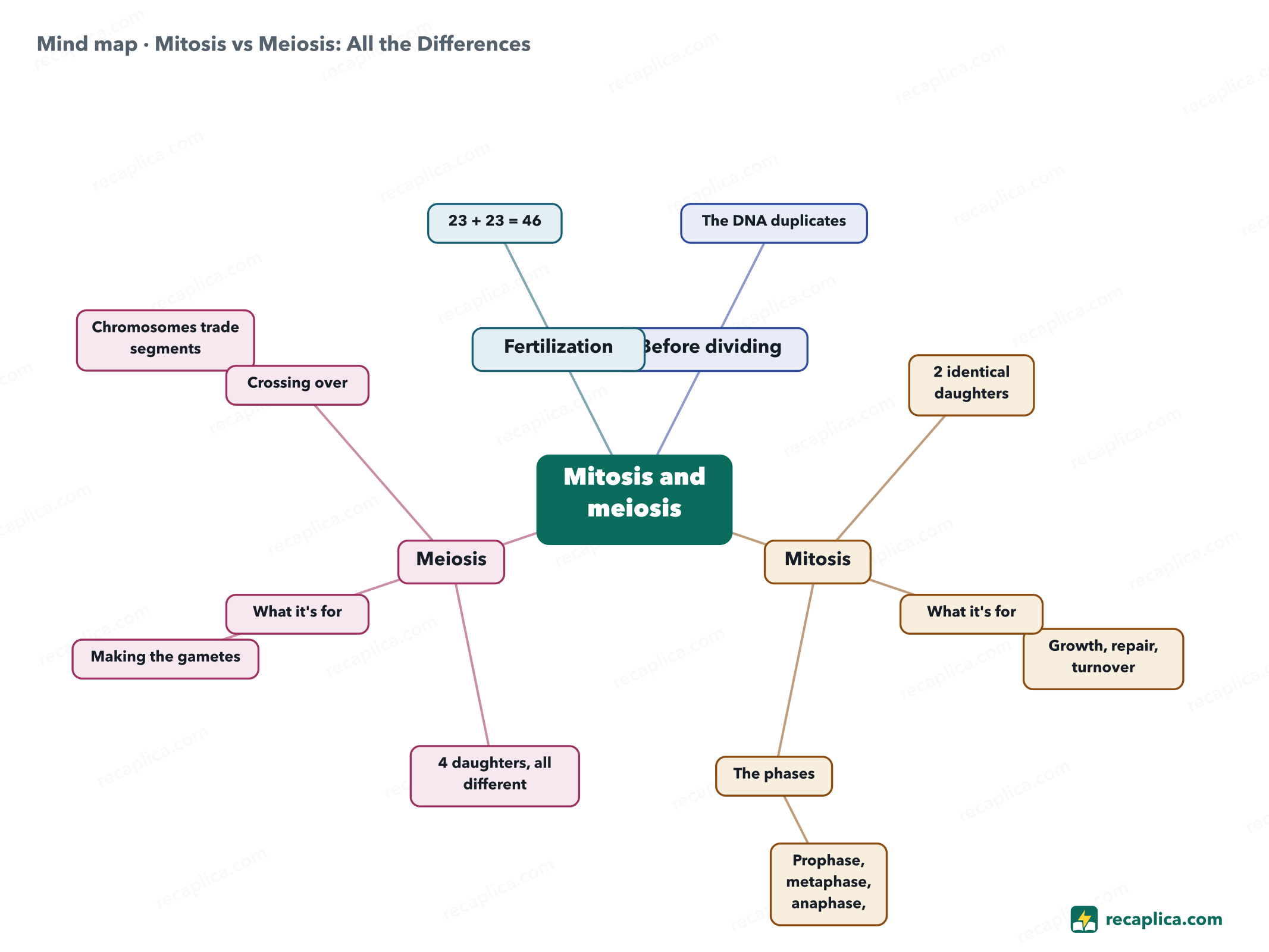
2 identical daughtersSame set as the parent (diploid).
What it's for
Growth, repair, turnover
The phases
Prophase, metaphase, anaphase, telophase
Meiosis
4 daughters, all differentHalved set (haploid).
What it's for
Making the gametes
Crossing over
Chromosomes trade segments
Fertilization
23 + 23 = 46Two gametes restore the full set.
Quiz: test yourself
Answer the questions to check what you have learned: you get instant feedback and a short explanation.
Grade0/100/5
Answers: 1-A · 2-A · 3-A · 4-A · 5-A
Flashcards
Tap the card to flip it and check whether you remember the answer, then move to the next one.
1 / 7
Explain it in your own words
The ultimate test: if you can explain it in simple words, you've truly understood it. Write your explanation, then compare it with the Recap.
Your explanation is saved only on this device.
Mitosis and meiosis are the two ways cells divide. Mitosis produces two cells identical to the parent: it's for growing, repairing tissues and replacing old cells. Meiosis produces four cells with half the chromosomes, each one different: it creates the gametes (eggs and sperm) for reproduction. In short: mitosis copies, meiosis shuffles and halves.
Frequently asked questions
Why aren't siblings identical, if the parents are the same?
Because every gamete is unique: crossing over and the random assortment of chromosomes generate ever-new combinations. Each child draws a different hand from the same two decks.
What are the phases of mitosis?
Four: prophase (chromosomes condense), metaphase (they line up at the center), anaphase (the copies are pulled to opposite poles), telophase (two nuclei form). Then cytokinesis splits the cytoplasm.
What happens if cell division escapes control?
Cells that keep dividing while ignoring stop signals form growing masses: that's the mechanism underlying tumors. It's why the cell cycle has multiple checkpoints.
How are identical twins explained?
Not by meiosis but by a later event: a single embryo, born from one fertilized egg, splits in two within the first days. The two twins therefore share the exact same DNA.
Every Recap goes through an independent review before publication.
Statistics, only if you say so
To learn which Recaps help most we would use Google Analytics, with aggregate, anonymous data. It starts only with your OK, and you can change your mind anytime. Privacy policy