Skip to content
recaplica

    One moment: security check

    Cloudflare wants to make sure you're not a robot. Tick the box below and your search will continue on its own.

    IT
    recaplica How Beer Is Made: The Brewing Process, from Barley to Glass
    © 2026 Recaplica · recaplica.com — All rights reserved
    Home › Science Food and cooking

    How Beer Is Made: The Brewing Process, from Barley to Glass

    By Recaplica Newsroom · Updated on September 15, 2026

    What to print

    Page numbers appear when printing with default margins.

    Slides

    Choose a cut

    Flash10 slidesThe essential thread, to present in classFull15 slidesEvery chapter and the deeper detail

    Both come with speaker notes.

    Telegram channel
    recaplica Clear in 30 seconds, yours in 10 minutes.
    In 30 seconds Key points Figures Deep dive Slides Myths Mind map Quiz Flashcards FAQ

    In 30 seconds quick read

    Beer comes from four ingredients — water, malted barley, hops and yeast — combined through four main steps: malting, mashing, boiling and fermentation. During malting, barley germinates and is then dried, developing the enzymes that mashing later uses to turn starch into fermentable sugar. Boiling dissolves the hops' alpha acids, which barely dissolve in water on their own, giving beer its characteristic bitterness. The yeast strain and fermentation temperature then determine whether the result is an ale, a lager, or a spontaneously fermented beer like Belgian lambic.

    Key Points

    • Beer starts with malted barley, barley that has been germinated and then dried, because germination is what produces the enzymes later needed to break starch down into sugar.
    • During mashing, milled malt is mixed with hot water so its enzymes can convert starch into fermentable sugars, before the resulting liquid, the wort, gets filtered.
    • Boiling the wort with hops dissolves the alpha acids, which barely dissolve in cold water, and only turn bitter once heat isomerizes them.
    • Yeast strain and fermentation temperature separate ales, top fermentation with Saccharomyces cerevisiae, from lagers, bottom fermentation with Saccharomyces pastorianus.
    • In lambic, fermentation is spontaneous, wild microorganisms from the air and from wooden barrels work the wort for one to three years, in stages dominated by different species.
    • The 1516 Bavarian decree limited beer's ingredients to barley, hops and water; the name Reinheitsgebot only arrived in 1918, and the law changed more than once in the following decades.

    Key figures

    • 1516 Bavarian duke William IV issues a decree in Ingolstadt limiting beer's ingredients to barley, hops and water Source: Oxford Companion to Beer, entry Reinheitsgebot
    • 1420 The term bottom fermentation emerges in Bavaria, after brewers found that cold Alpine caves allowed a cleaner fermentation Source: Oxford Companion to Beer, entry bottom fermentation
    • 1883 Chemist Emil Christian Hansen isolates bottom-fermenting yeast in pure culture, naming it Saccharomyces carlsbergensis Source: Oxford Companion to Beer, entry bottom fermentation

    Deep Dive

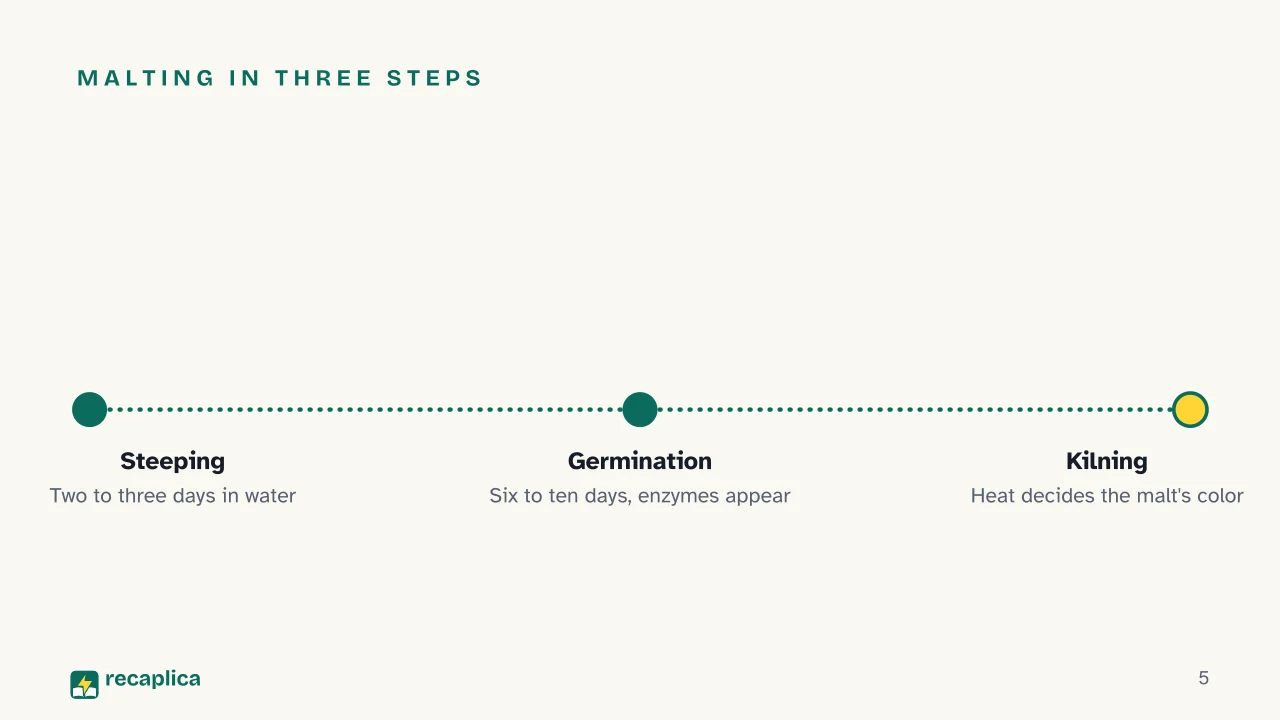
    Everything starts with a grain of barley, but the grain itself never ferments — malt does. During malting, the barley is steeped in water for two or three days, according to the Beer Judge Certification Program’s (BJCP) judge training course, then left to germinate for six to ten days. This is when the grain produces the enzymes, alpha-amylase among them, that will later break starch down into simple sugars. Right after, germination is stopped by raising the temperature: first to around 32°C for a day, then up to 49°C for another twelve hours. That’s kilning, and how hot it gets decides the malt’s color: Vienna malt stops around 63°C, Munich malt climbs to 99-118°C, and the roasted malts used for stouts and porters reach 138-149°C. It’s the malt’s roast level, not an added coloring, that darkens the beer.

    Practical example: a stout and a pale lager can start from the very same barley; what changes is only how long, and at what temperature, the malt gets dried.

    The dried malt is then milled and mixed with hot water: that’s mashing. Here, the enzymes developed during malting work on the malt’s starch, turning it into sugars the yeast will later ferment — the same biochemical principle behind bread leavening, even though there the main actor is a dough rather than a filtered liquid. The resulting sugary liquid, the wort, is then separated from the spent grain, the solid malt remains, by filtration.

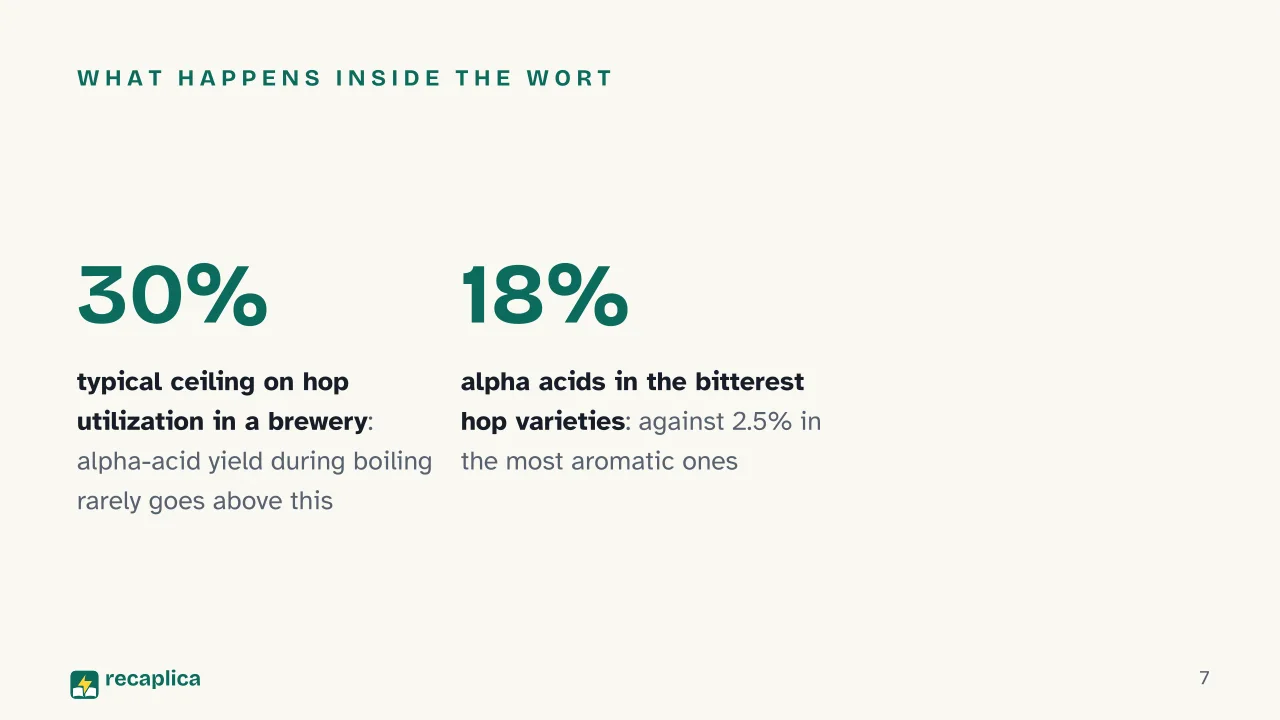
    At this point the wort gets boiled, and that’s when the hops come in. The alpha acids held in the hops’ resin, lupulin, are what give beer its characteristic bitterness, but according to the Oxford Companion to Beer they stay practically insoluble in water until the wort reaches a boil: only heat isomerizes them, making them soluble and bitter. The most aromatic hop varieties contain 2.5-6% alpha acids, dual-purpose ones 6-10%, bittering varieties 10-15%, and super-bittering varieties up to 18%; the share of these acids that actually ends up in the glass still stays low, rarely above 30%, and drops further the later the hops go into the boil.

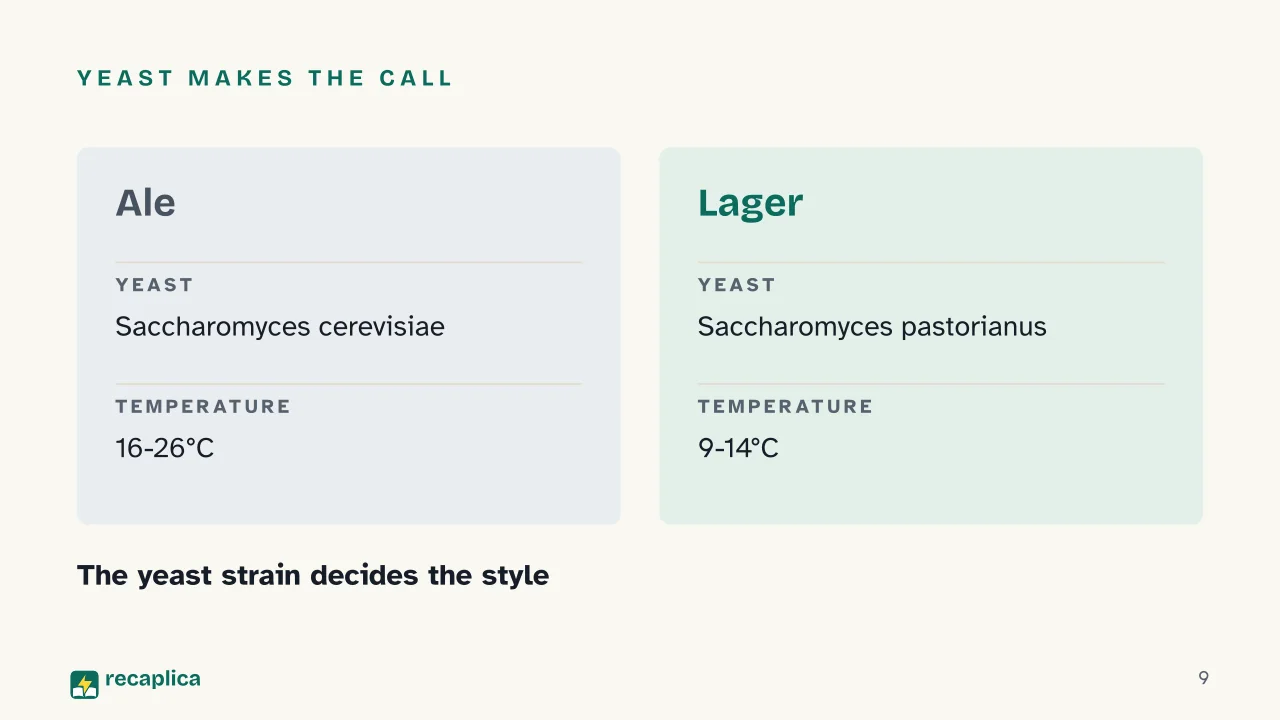
    Once the wort has cooled, the yeast takes over, and this is where the type of beer gets decided. Ales ferment with Saccharomyces cerevisiae, a yeast that, according to the American Homebrewers Association, works best between 16 and 26°C and is called “top-fermenting” because its activity shows on the surface; lagers ferment with Saccharomyces pastorianus, slower, active between 9 and 14°C and barely visible while it works, followed by weeks of maturation at near-freezing temperatures, known as lagering. The warmer temperatures ales ferment at produce more esters and phenols, meaning fruity or spicy notes; lagers, fermenting cold, come out cleaner on the palate.

    AleLager
    YeastSaccharomyces cerevisiaeSaccharomyces pastorianus
    Fermentation temperature16-26°C9-14°C
    FermentationOn the surface, top-fermentingAt the bottom, bottom-fermenting
    FlavorEsters and phenols, fruity notesCleaner, less aromatic

    The line between the two families has blurred somewhat in recent decades. Hybrid strains have emerged that combine traits of both, while still keeping distinct fermentation times and flavor profiles.

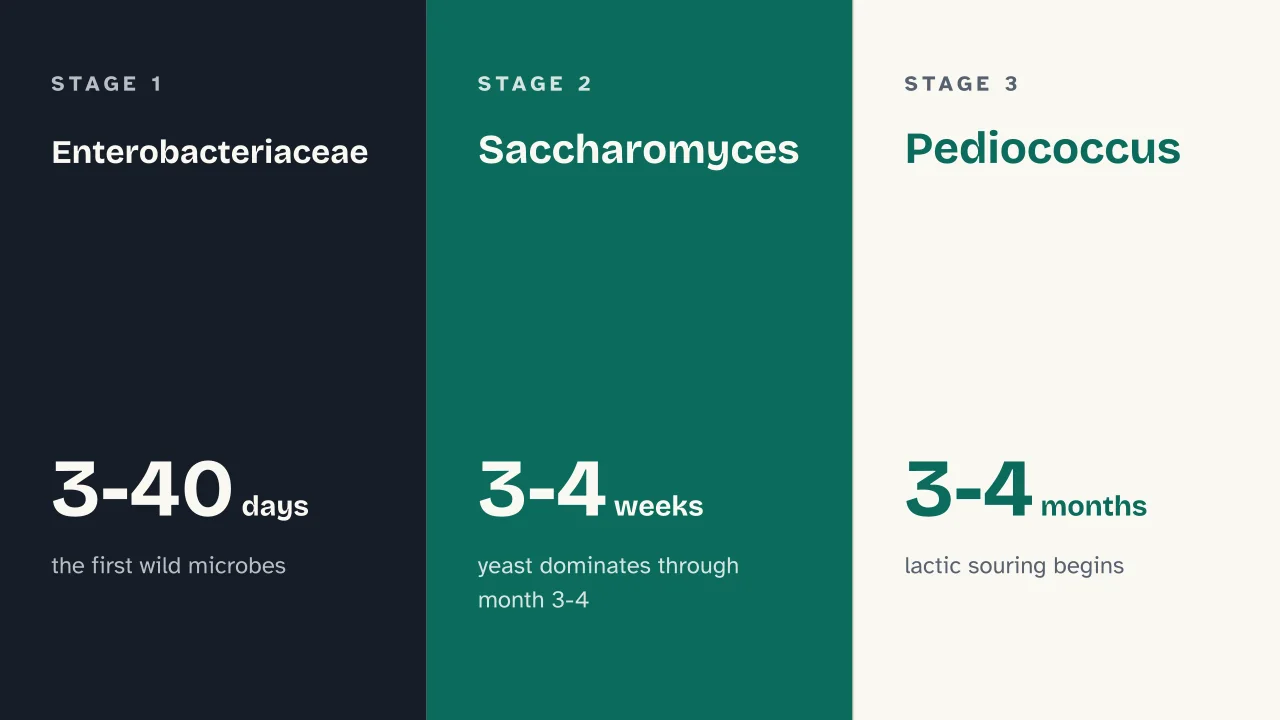
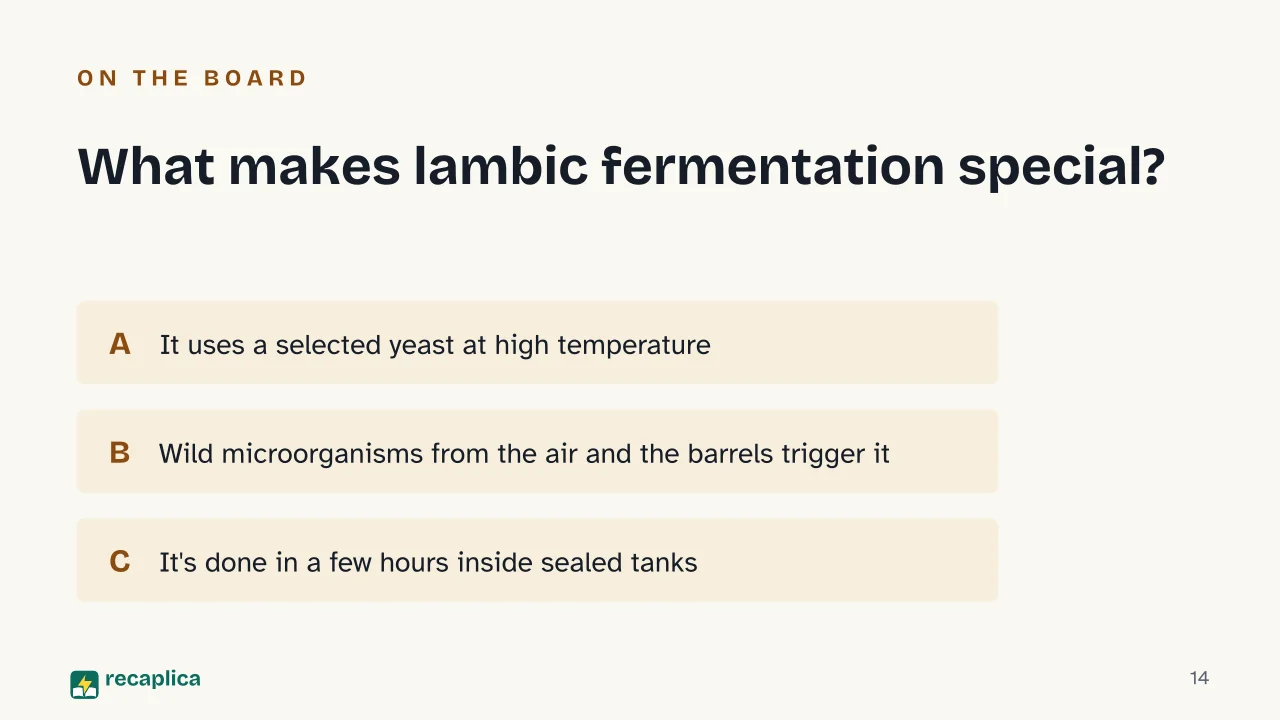
    There’s also a third path, one that skips a selected, deliberately added yeast altogether: spontaneous fermentation. In Belgian lambic, as documented in a 2014 study published in the journal PLoS ONE, the boiled wort is left to cool overnight in shallow, open vessels, the coolship, where it gets colonized by microorganisms arriving from the air and from the wooden barrels the beer will mature in. The sequence follows precise stages: first, bacteria from the Enterobacteriaceae family, for the first 3-40 days; then, from the third or fourth week until the third or fourth month, yeasts of the genus Saccharomyces; next, for three to four months, lactic bacteria such as Pediococcus, which sour the wort; and finally, starting around four to eight months in, the genus Brettanomyces. The whole process, from coolship to finished beer, takes one to three years. Anyone familiar with fermentation in other foods, or with winemaking, where grape must meets yeast inside closed tanks, will recognize the same logic here, applied instead to a wide-open, uncontrolled environment.

    The split between top and bottom fermentation isn’t as old as the usual telling suggests. According to the Oxford Companion to Beer, the term “bottom fermentation” appeared in Bavaria in 1420, once brewers discovered that cold Alpine caves allowed a slower, cleaner fermentation, one in which spoilage bacteria struggled to take hold. The yeast that made that fermentation possible wasn’t isolated in a lab until 1883, nearly five centuries later, by Danish chemist Emil Christian Hansen, who named it Saccharomyces carlsbergensis — later reclassified as Saccharomyces pastorianus.

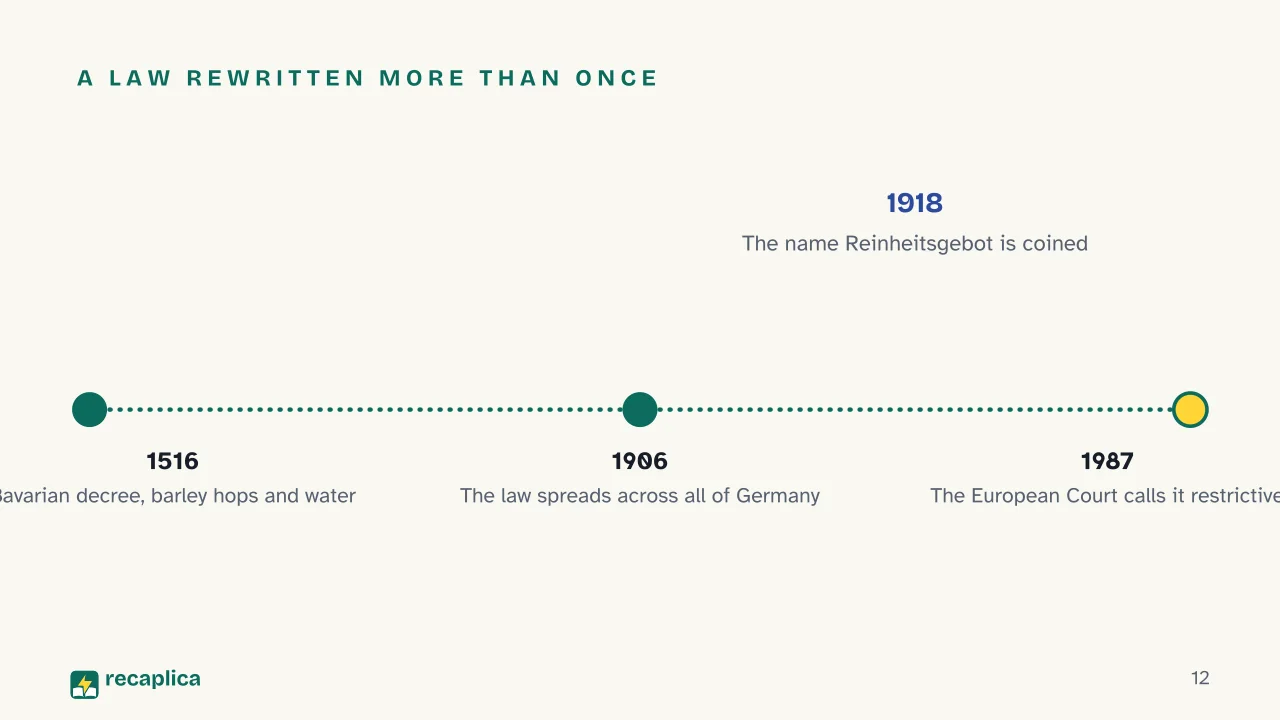
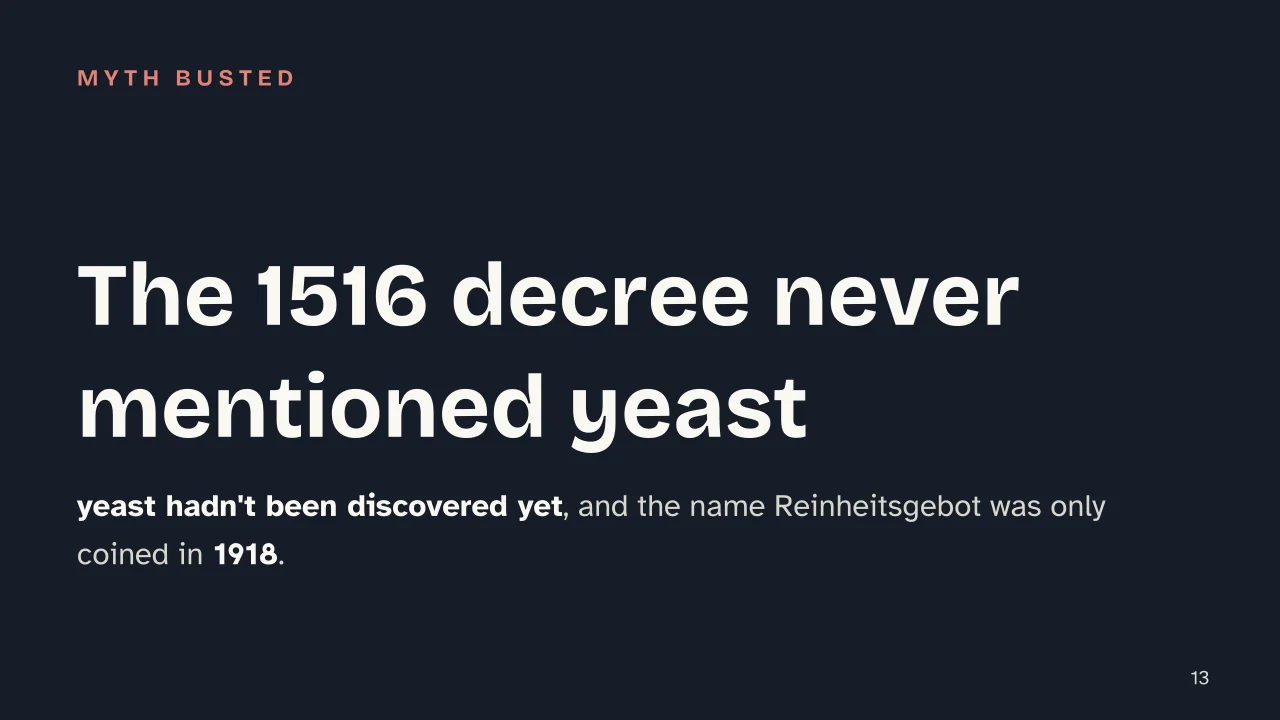
    Beer regulation has just as layered a history. On 23 April 1516, Bavarian duke William IV issued, during an assembly of the Estates in Ingolstadt, a decree limiting beer’s ingredients to barley, hops and water. Yeast went unmentioned, simply because it hadn’t yet been discovered scientifically, even though brewers were already relying on it without knowing it. The name given to that law today, “Reinheitsgebot”, didn’t exist in 1516: it was coined only in 1918, by Hans Rauch. In the meantime, the rule itself had already changed more than once: in 1873 northern Germany legally allowed malt substitutes, in 1906 the German Empire extended the rule to the whole country, and in 1987 the European Court of Justice ruled it an unlawful restriction on the free movement of goods within the common market. Two versions remain in force, a stricter Bavarian one and a more permissive federal German one, both folded into German tax law.

    Slide deck

    Slides ready to download and make your own in PowerPoint or Google Slides, with speaker notes. Pick the Flash cut or the Full one.
    Slide 1 of the presentation on How Beer Is Made: How Beer Is MadeSlide 2 of the presentation on How Beer Is Made: Can raw barley make beer?Slide 3 of the presentation on How Beer Is Made: Four stagesSlide 4 of the presentation on How Beer Is Made: Chapter 01: MaltingSlide 5 of the presentation on How Beer Is Made: Malting in three stepsSlide 6 of the presentation on How Beer Is Made: Chapter 02: MashingSlide 7 of the presentation on How Beer Is Made: What happens inside the wortSlide 8 of the presentation on How Beer Is Made: Chapter 03: FermentationSlide 9 of the presentation on How Beer Is Made: Yeast makes the callSlide 10 of the presentation on How Beer Is Made: Enterobacteriaceae · Saccharomyces · PediococcusSlide 11 of the presentation on How Beer Is Made: Chapter 04: History and rulesSlide 12 of the presentation on How Beer Is Made: A law rewritten more than onceSlide 13 of the presentation on How Beer Is Made: The 1516 decree never mentioned yeastSlide 14 of the presentation on How Beer Is Made: What makes lambic fermentation special?Slide 15 of the presentation on How Beer Is Made: Cheers
    Flash10 slidesThe essential thread, to present in classFull15 slidesEvery chapter and the deeper detail

    Common myths

    • ✗ Myth Beer is made from barley

      ✓ Reality According to the Beer Judge Certification Program's judge training course, raw barley cannot ferment on its own — it first has to germinate for several days and then be dried, becoming malt, because the enzymes germination develops are what break the starch down into sugars yeast can use. It's the roast level reached during drying that gives stouts and porters their dark color and toasted flavor.

    • ✗ Myth Ale and lager are told apart by color, dark or pale

      ✓ Reality According to the American Homebrewers Association, the technical difference is the yeast strain, Saccharomyces cerevisiae for ales and Saccharomyces pastorianus for lagers, together with the fermentation temperature. Dark ales like stout exist, and so do pale and dark lagers, so color alone cannot classify a beer.

    • ✗ Myth The 1516 Reinheitsgebot is a single law, unchanged for five centuries

      ✓ Reality The 1516 text, according to the Oxford Companion to Beer, limited ingredients to barley, hops and water and said nothing about yeast, which had not yet been discovered scientifically. The name Reinheitsgebot itself was only coined in 1918, and the rule was amended in 1873, extended to all of Germany in 1906, and ruled an overly restrictive trade barrier by the European Court of Justice in 1987.

    Mind map

    Drag the background to move around and the nodes to reposition them; use − and + to collapse and expand branches.
    Customize
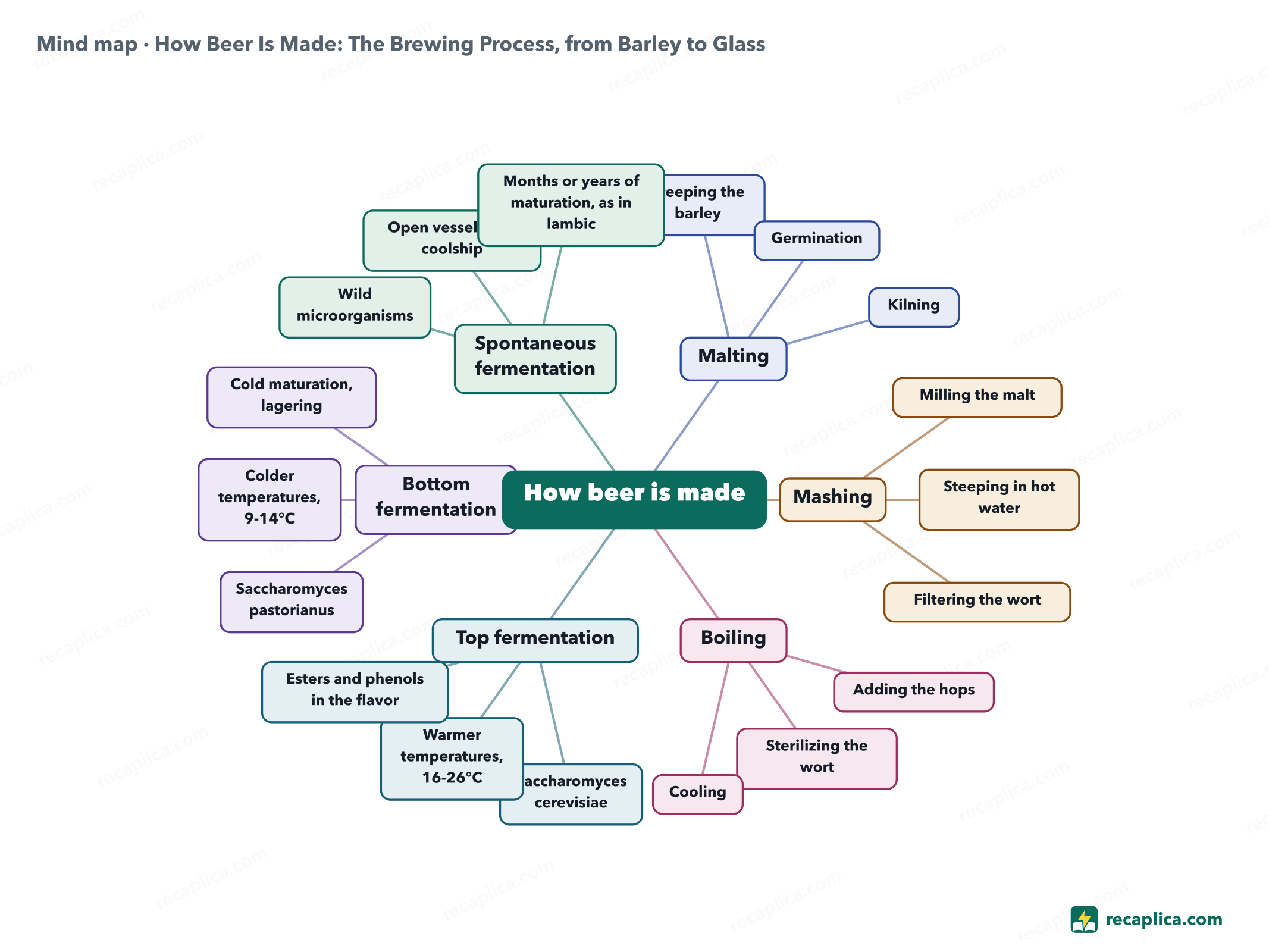
    Mind map: How Beer Is Made: The Brewing Process, from Barley to Glass
    • How beer is made
      • Malting
        • Steeping the barley Two to three days in water, starts germination
        • Germination Six to ten days, develops the enzymes mashing will use
        • Kilning The drying temperature decides the malt's color
      • Mashing
        • Milling the malt
        • Steeping in hot water Enzymes convert starch into fermentable sugars
        • Filtering the wort
      • Boiling
        • Adding the hops Dissolves the alpha acids, source of the bitterness
        • Sterilizing the wort
        • Cooling
      • Top fermentation
        • Saccharomyces cerevisiae
        • Warmer temperatures, 16-26°C
        • Esters and phenols in the flavor
      • Bottom fermentation
        • Saccharomyces pastorianus
        • Colder temperatures, 9-14°C
        • Cold maturation, lagering
      • Spontaneous fermentation
        • Wild microorganisms
        • Open vessels, the coolship
        • Months or years of maturation, as in lambic

    Quiz: test yourself

    Answer the questions to check what you have learned: you get instant feedback and a short explanation.

    Grade 0/10 0/5
    1 What happens to the barley during malting?

    Germination produces the enzymes that mashing will later use to turn starch into fermentable sugars; drying afterward stops germination and, depending on the temperature reached, also decides the malt's color.

    2 What's the point of boiling the wort together with hops?

    Alpha acids stay almost insoluble in cold water, according to the Oxford Companion to Beer; only the heat of boiling isomerizes them, making them soluble and bitter.

    3 Ale and lager are mainly told apart by the beer's color

    The technical distinction is the yeast strain, top-fermenting Saccharomyces cerevisiae for ales and bottom-fermenting Saccharomyces pastorianus for lagers, together with the fermentation temperature. The color comes from the malt's roast level, decided during malting.

    4 What makes lambic fermentation special?

    According to a study published in PLoS ONE in 2014, the wort cooled in open vessels, the coolship, is colonized by wild microorganisms in a sequence of stages that together last one to three years.

    5 What did the 1516 Bavarian decree, the Reinheitsgebot, actually require?

    Yeast was absent from the 1516 text because it had not yet been discovered scientifically; the name Reinheitsgebot only arrived in 1918, and the law changed more than once in the following decades.

    Answers: 1-B · 2-B · 3-B · 4-B · 5-A

    Flashcards

    Tap the card to flip it and check whether you remember the answer, then move to the next one.

    1 / 8

    Explain it in your own words

    The ultimate test: if you can explain it in simple words, you've truly understood it. Write your explanation, then compare it with the Recap.

    Your explanation is saved only on this device.

    Beer comes from four ingredients — water, malted barley, hops and yeast — combined through four main steps: malting, mashing, boiling and fermentation. During malting, barley germinates and is then dried, developing the enzymes that mashing later uses to turn starch into fermentable sugar. Boiling dissolves the hops' alpha acids, which barely dissolve in water on their own, giving beer its characteristic bitterness. The yeast strain and fermentation temperature then determine whether the result is an ale, a lager, or a spontaneously fermented beer like Belgian lambic.

    Frequently asked questions

    What's the difference between barley and malt?

    Barley is the raw grain; malt is barley that has been germinated for several days and then dried. Only during germination do the enzymes develop that can turn the grain's starch into fermentable sugars, which is why beer is always made with malt, never raw barley.

    Why is the wort boiled together with hops?

    Boiling dissolves the hops' alpha acids, which stay almost insoluble in cold water; heat turns them into soluble, bitter compounds, and boiling also sterilizes the wort.

    What's the difference between ale and lager?

    Ales ferment with Saccharomyces cerevisiae at higher temperatures, around 16-26°C, over a shorter time and with more esters and phenols, meaning fruity or spicy notes. Lagers ferment with Saccharomyces pastorianus at lower temperatures, around 9-14°C, for longer, giving a cleaner taste, followed by weeks of cold maturation.

    What's a spontaneously fermented beer like lambic?

    It's a beer whose wort isn't inoculated with a selected yeast, but is instead cooled in open vessels where it's colonized by wild microorganisms from the air and from wooden barrels. The process, documented in a 2014 study on Belgian lambic, lasts one to three years and moves through stages dominated by different microorganisms in sequence.

    What did the 1516 German beer purity law actually say?

    The Bavarian decree of 23 April 1516 limited beer's ingredients to barley, hops and water, without mentioning yeast, which had not yet been discovered scientifically. The name Reinheitsgebot was only coined in 1918, and the law was amended in 1873, extended to all of Germany in 1906, and ruled overly restrictive by the European Court of Justice in 1987.

    Sources

    • American Homebrewers Association, What's the Difference Between Ale and Lager?
    • Oxford Companion to Beer, entry Reinheitsgebot
    • Oxford Companion to Beer, entry bottom fermentation
    • PLoS ONE, Spitaels et al., The Microbial Diversity of Traditional Spontaneously Fermented Lambic Beer
    • Beer Judge Certification Program, Malting
    • Beer Judge Certification Program, Introduction to Beer Styles
    • Oxford Companion to Beer, entry alpha acids

    Every Recap goes through an independent review before publication.

    Every evening, the day's new Recaps on our Telegram channel. Join the channel →

    Keep learning

    • Science How Wine Is Made: The Winemaking Process, from Grape to Bottle Wine comes from the alcoholic fermentation of grape must, the process in which yeast converts sugar into ethanol and carbon dioxide. Before fermentation, grapes are crushed and destemmed to free the juice from the berries and separate it from the stems. For red wine, the must stays in contact with the skins during maceration, which gives it color and tannins; for white wine, the juice is drawn off almost immediately, so the wine stays pale. After fermentation, wine rests in barrels, oak casks or steel tanks to age before it's filtered and bottled. Under the standard set by the OIV, the international body that regulates the industry, a drink can only be called wine once it reaches a minimum alcohol content. Read the Recap →
    • Science Fermentation: What It Is and How It Transforms Food Fermentation is the process by which yeasts, bacteria and even our own muscle cells extract energy from sugars without using oxygen. It yields little, 2 molecules of ATP per glucose against roughly 38 from respiration, but it works wherever oxygen cannot reach. Its waste products, such as alcohol and lactic acid, give food its flavour and protect it from harmful microbes: that is how wine, beer, bread, yogurt and vinegar are born. It was Louis Pasteur who proved, from 1857 onwards, that living microorganisms are behind fermentation. Read the Recap →
    • Science Leavening: what it is and how it works Leavening is the process that inflates a dough from the inside: a gas (almost always carbon dioxide) forms bubbles that get trapped in the stretchy mesh of gluten. The gas can come from living microorganisms that ferment sugars (baker's yeast, sourdough), from a chemical reaction between baking soda and an acid (baking powder), or simply from steam and air expanding in the oven. During baking the bubbles grow one last time, then the structure sets: that is how bread gets its crumb and cakes get their softness. Read the Recap →

    recaplica

    Clear in 30 seconds, yours in 10 minutes.

    Recaps Mind maps Request a Recap Telegram channel Mind map maker Our method About Privacy & cookies Legal notes & terms of use

    © 2026 Recaplica · A project by Curi S.r.l. — VAT IT05472000750

    Statistics, only if you say so

    To learn which Recaps help most we would use Google Analytics, with aggregate, anonymous data. It starts only with your OK, and you can change your mind anytime. Privacy policy