|
recaplica
Combinatorics: The Formulas for Counting Possibilities | ||||||||||||||||||||||||||||
| © 2026 Recaplica · recaplica.com — All rights reserved | ||||||||||||||||||||||||||||
Combinatorics: The Formulas for Counting PossibilitiesWhat to print Page numbers appear when printing with default margins. SlidesChoose a cut Flash10 slidesThe essential thread, to present in classFull17 slidesEvery chapter and the deeper detailBoth come with speaker notes. In 30 seconds quick readCombinatorics counts the ways to order or pick elements from a set, without having to list every one of them. Permutations, arrangements, and combinations answer different questions: whether every element is used or only some of them, whether the order matters, and whether an element can be picked more than once. Each family rests on its own formula, built from the factorial and the multiplication principle. Systematic study of the subject goes back to the seventeenth century, starting with Blaise Pascal's Traité du triangle arithmétique. Key Points
Key figures
Deep DiveAccording to the Treccani Enciclopedia della Matematica, combinatorics deals with counting possibilities: how many arrangements, how many choices, how many orderings a set of elements can produce, without needing to list them one at a time. Underneath sits the multiplication principle: when a first choice has a certain number of outcomes and a second, independent choice has another, the combined outcomes come from multiplying the two numbers. That same logic runs through every formula below, from permutations to combinations with repetition. Permutations: ordering every elementA simple permutation is an ordering that uses every one of the n available objects, as the Statistica e analisi dei dati con Python course notes from the University of Milan explain. Their number is n!, the factorial of n: multiply together every whole number from 1 to n, because the first position has n possible choices, the next has one fewer, and so on down to the last position, which is forced. The factorial is one of the few operations in algebra that outpaces any fixed power, which is why permutation counts explode even with a handful of elements. When some of the n objects are indistinguishable from each other, say two groups of equal elements with n1 and n2 items, the Milan notes call for dividing n! by the product of the factorials of each group’s size; skip that step and orderings that only differ by swapping identical elements get counted more than once. Arrangements: order matters, but not every element is usedArrangements pick only k elements out of the n available, keeping order as what sets outcomes apart. In the version without repetition, an element already chosen cannot come back for the next pick: the Milan notes work out the total as n!/(n-k)!, since it amounts to a permutation stopped after k steps instead of running all the way to n.
In arrangements with repetition, by contrast, the same element can turn up more than once within the same ordered group, as the Treccani Enciclopedia della Matematica also notes. The count then applies the multiplication principle k times in a row, which is n multiplied by itself k times, n raised to k. Math Is Fun walks through this with a combination lock that uses 3 digits drawn from 10 available ones: since any digit can repeat, the possible codes come to one thousand. Arrangements without repetition work the opposite way, since every pick after the first starts from one option fewer than the pick before it: ordering 3 snooker balls out of 16 available ones lands at 3,360 possibilities, far more than the matching combinations, because here every different order of the same three balls counts as its own case. The distinction between ordinal and cardinal numbers is a useful anchor: arrangements answer a question that depends on position, first, second, third, while combinations care only about quantity. Combinations: order no longer mattersTreccani uses a hand of five cards to show the contrast: in a combination, what matters is which cards end up in your hand, not the sequence in which they were drawn, unlike an arrangement. When an element cannot come back a second time, the count is found by dividing the matching arrangements, the number of possible orderings of k elements, by k!; the result is the binomial coefficient “n choose k.” A property of this coefficient, pointed out by Math Is Fun, is its symmetry: picking 3 balls out of 16 gives the same count of possible combinations, 560, as picking the remaining 13 out of 16. Combinations with repetition add the option of picking an element more than once: they’re counted as the binomial coefficient n+k-1 choose k. Math Is Fun applies this by choosing 3 scoops of ice cream from 5 flavors, allowing a flavor to repeat, and the count comes to 35. The Milan notes reach the same kind of formula by rolling 3 indistinguishable six-sided dice where a value can repeat, finding 56 outcomes. Asking instead for the three faces to come up all different changes the question entirely: 120 outcomes if the dice are distinguishable and counted as an arrangement, 20 if they’re indistinguishable and counted as a combination. Which formula applies depends on whether repetition is allowed and whether the dice can be told apart. The formulas at a glance
A story from the 1600s to the 1700sPer the “Analisi combinatoria” entry of the Treccani Enciclopedia Italiana, the first systematic studies on the subject appear in Blaise Pascal’s Traité du triangle arithmétique, from 1654. Gottfried Wilhelm Leibniz devotes his Dissertatio de arte combinatoria to it in 1666, John Wallis covers it in his Treatise of Algebra in 1685, and Bernard Frénicle de Bessy writes the Abrégé des combinaisons in 1693. Jakob Bernoulli returns to it in the Ars coniectandi of 1713, and Abraham de Moivre in The Doctrine of Chances of 1718: six works inside less than seventy years, spanning the late 1600s and the early 1700s. Combinatorics comes back every time an experiment’s possible outcomes need counting, and it’s one of the building blocks behind probability and statistics: knowing how many favorable cases there are against how many total cases is the first step toward working out a probability, including the conditional kind behind the Bayes theorem. Anyone who works with number sets runs into the factorial and the binomial coefficient through these very formulas, well before seeing them applied to probability. Slide deckSlides ready to download and make your own in PowerPoint or Google Slides, with speaker notes. Pick the Flash cut or the Full one.     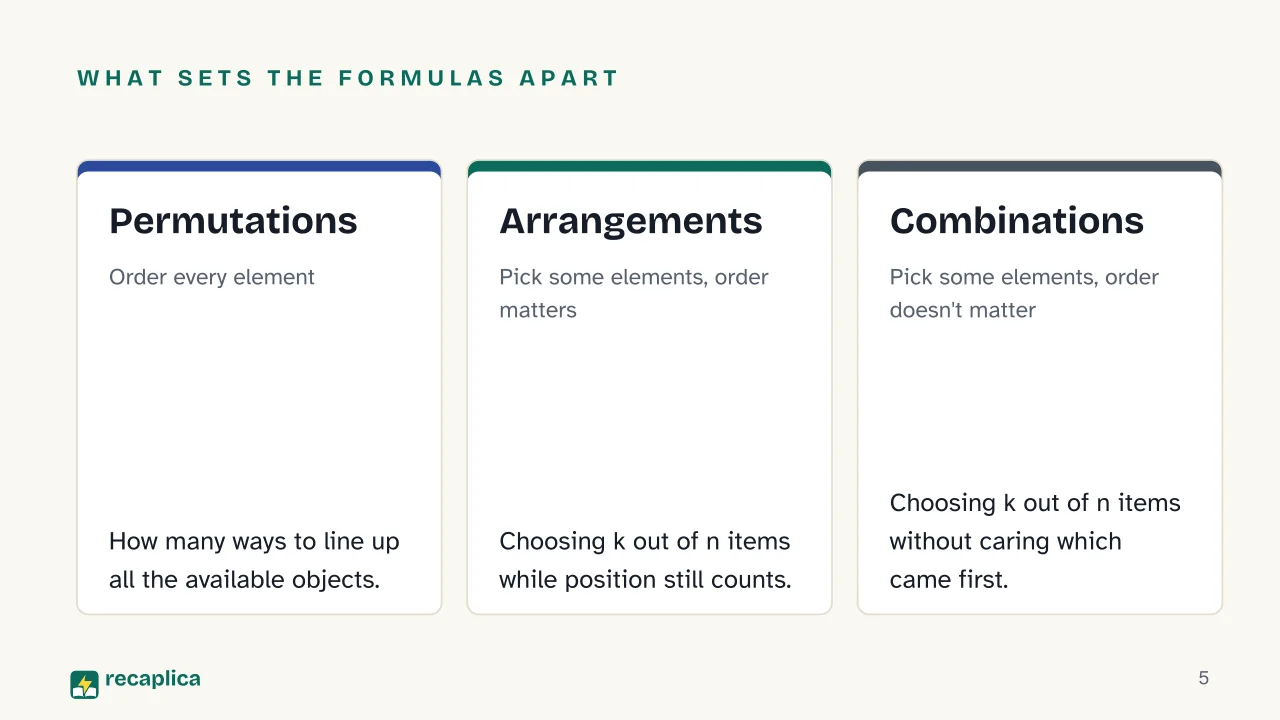    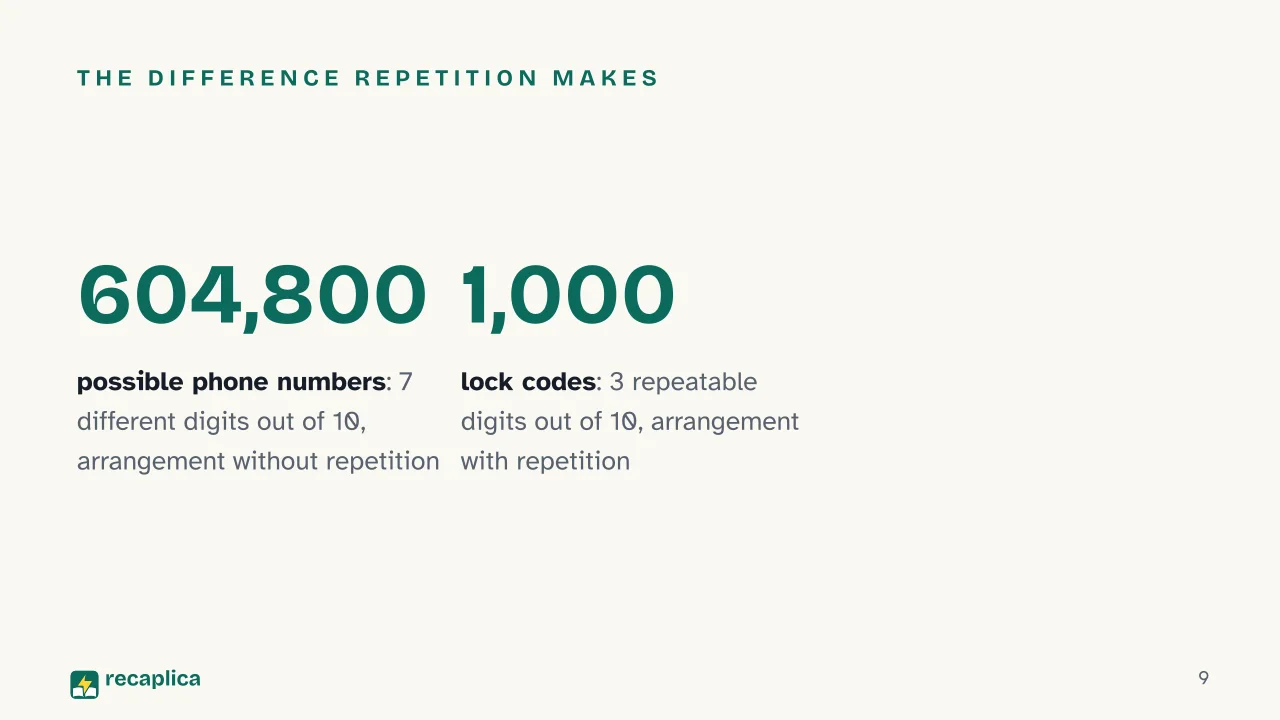  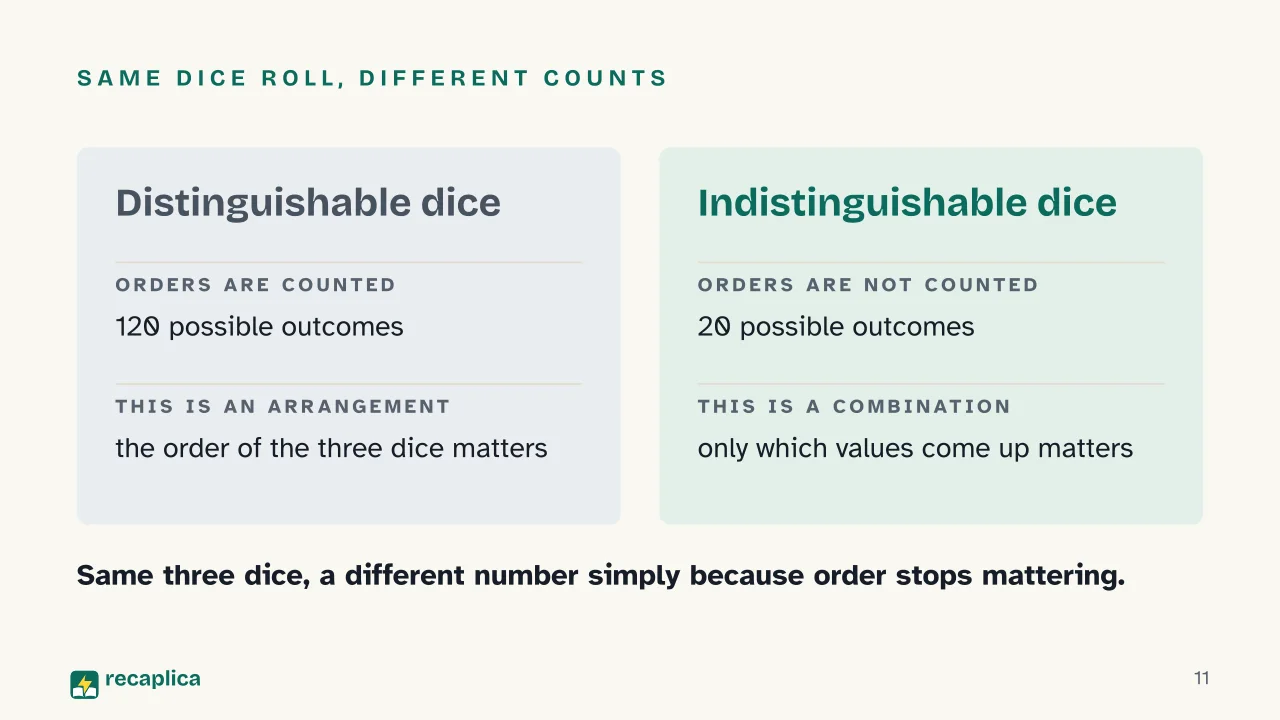 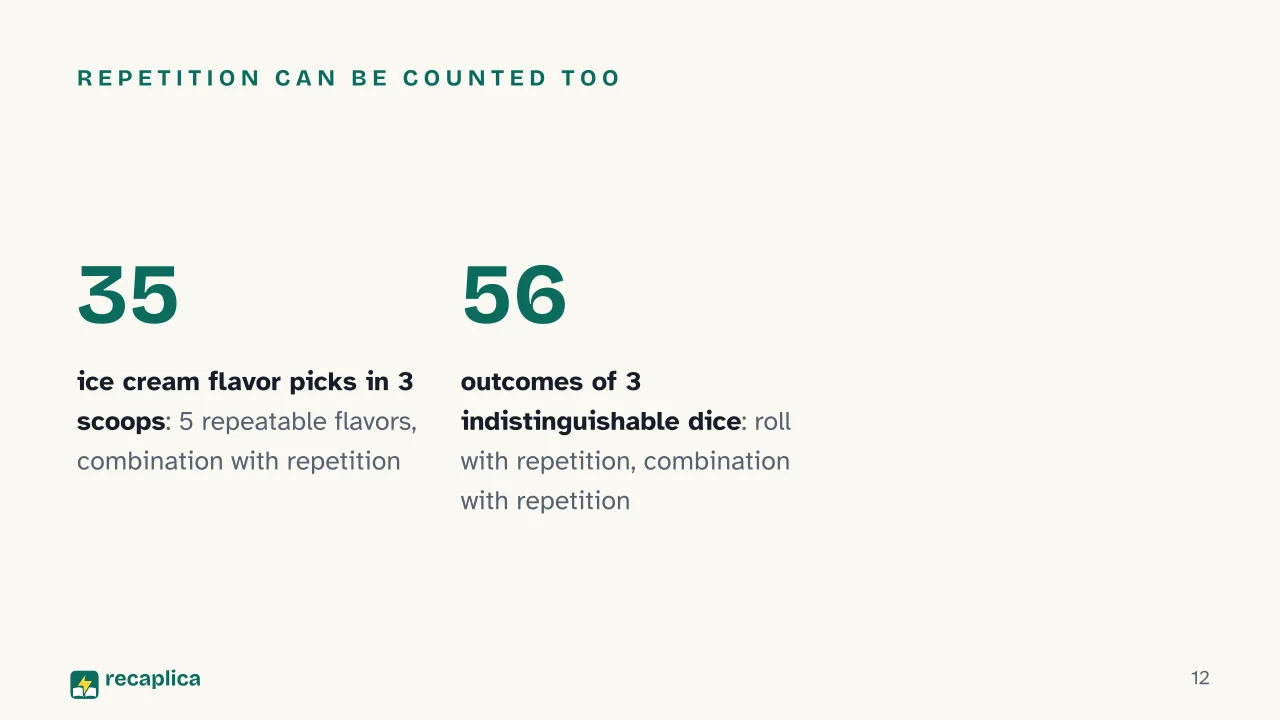  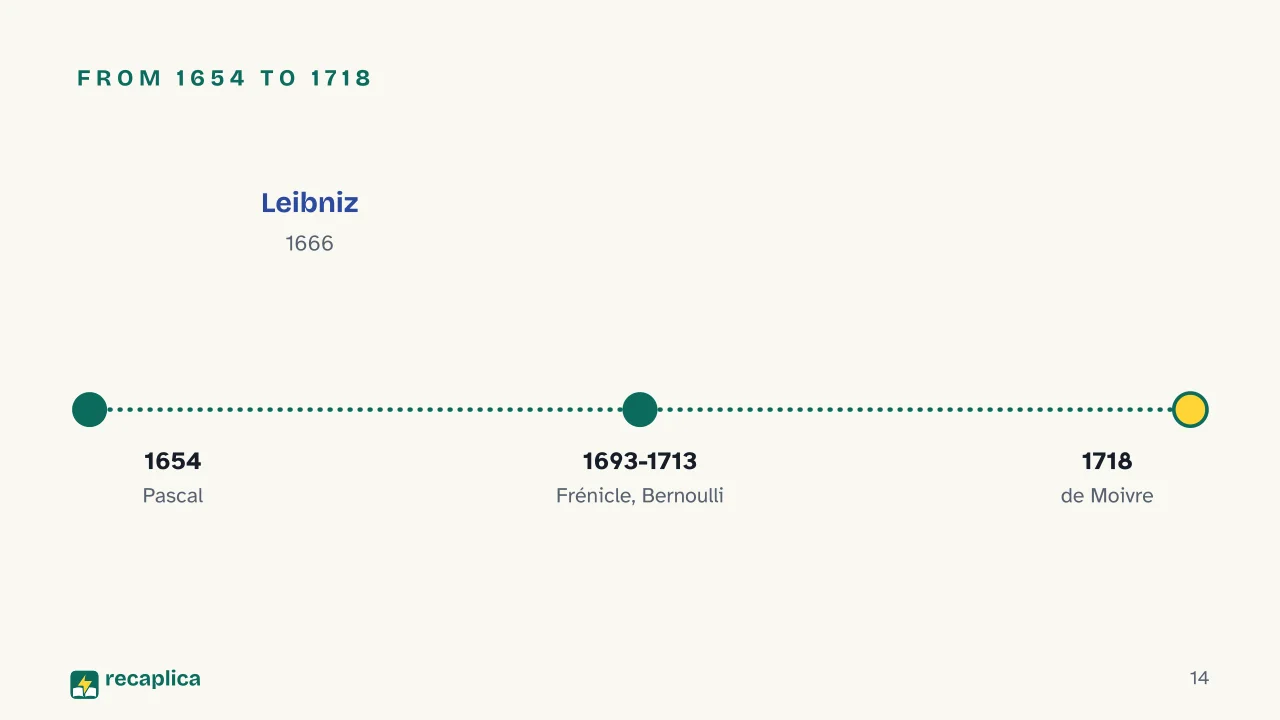 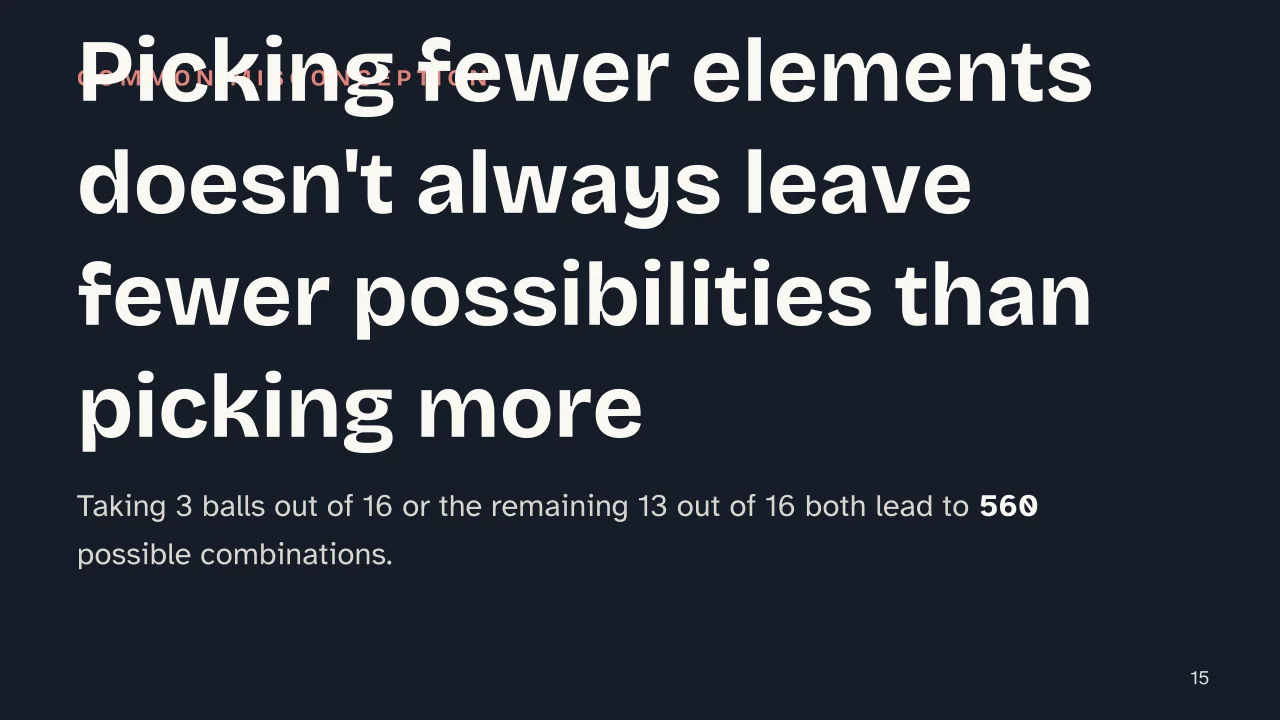 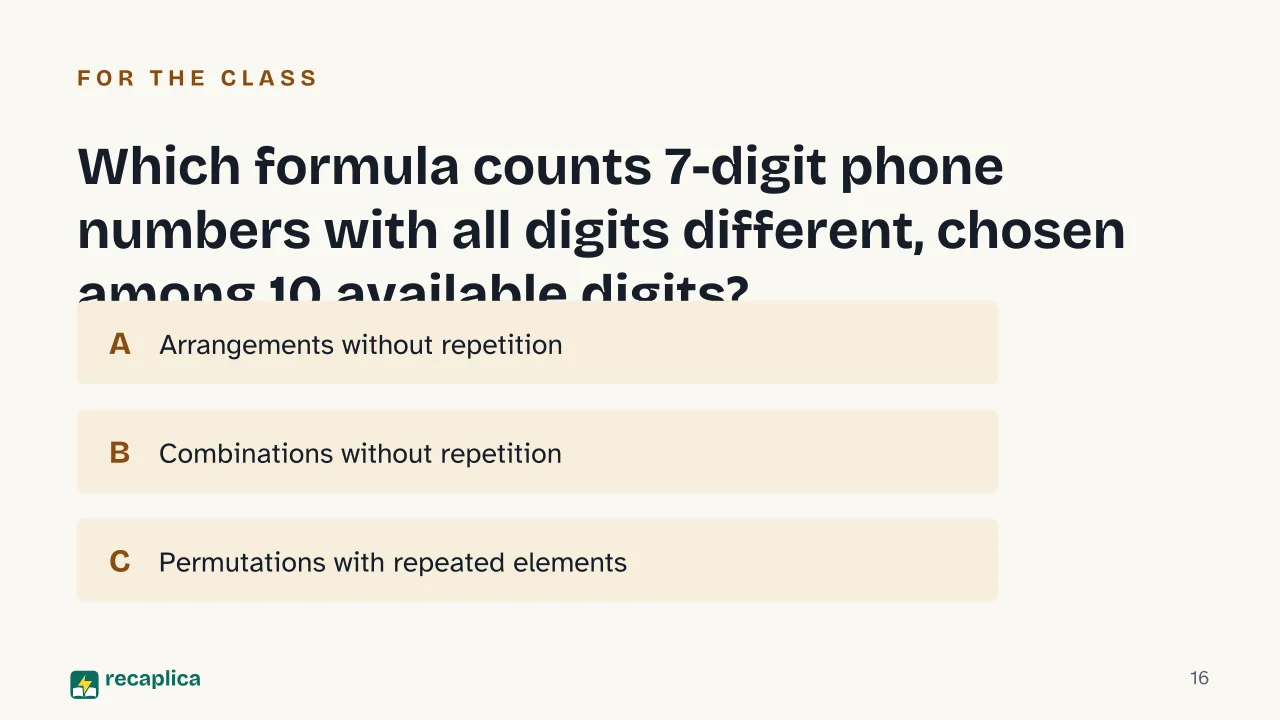  Common myths
Mind mapDrag the background to move around and the nodes to reposition them; use − and + to collapse and expand branches. 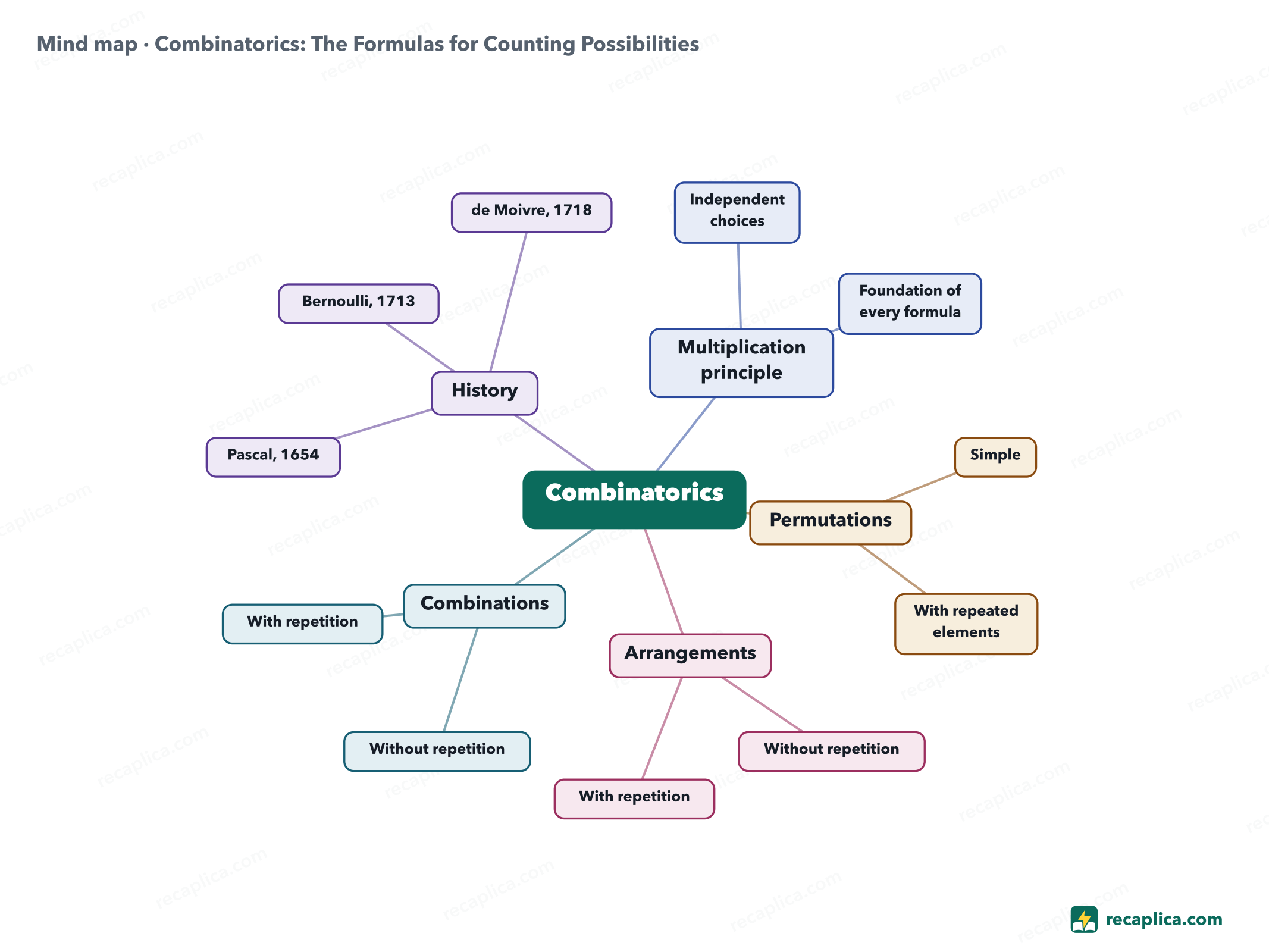
Quiz: test yourselfAnswer the questions to check what you have learned: you get instant feedback and a short explanation. Grade 0/10 0/5
FlashcardsTap the card to flip it and check whether you remember the answer, then move to the next one. 1 / 7 Explain it in your own wordsThe ultimate test: if you can explain it in simple words, you've truly understood it. Write your explanation, then compare it with the Recap. Your explanation is saved only on this device.
Frequently asked questionsWhat's the difference between permutations, arrangements, and combinations?Permutations order every available element. Arrangements pick only some of the elements and the order of the pick matters. Combinations pick some elements too, but order doesn't matter: what changes is which elements end up chosen, not the sequence in which they were picked. How do you calculate the number of permutations of n elements?With the factorial of n, written n!: the product of every whole number from 1 to n, because each position after the first has one fewer available choice than the one before it, down to the last position, which is forced. When are combinations with repetition used?When k elements are chosen out of n, order doesn't matter, and the same element can be picked more than once, for example choosing 3 scoops of ice cream from 5 flavors, with a flavor allowed to repeat. They are calculated as the binomial coefficient n+k-1 choose k. Where does combinatorics come from?The first systematic studies appear in the seventeenth century, with Blaise Pascal's Traité du triangle arithmétique, from 1654, followed in the decades after by the work of Leibniz, Wallis, Frénicle de Bessy, Bernoulli, and de Moivre, through to 1718. Every Recap goes through an independent review before publication. |