|
recaplica
Bohr Model of the Atom Explained: Energy Levels and the Hydrogen Spectrum | ||||||||||||||||||||||||
| © 2026 Recaplica · recaplica.com — All rights reserved | ||||||||||||||||||||||||
Bohr Model of the Atom Explained: Energy Levels and the Hydrogen SpectrumWhat to print Page numbers appear when printing with default margins. SlidesChoose a cut Flash10 slidesThe essential thread, to present in classFull17 slidesEvery chapter and the deeper detailBoth come with speaker notes. In 30 seconds quick readIn 1913 Niels Bohr took Rutherford's atom, a nucleus with electrons circling it, and added a rule from quantum theory: the electron can move only on certain orbits, each with a fixed energy. As long as it stays on one of them it gives off no light. When it drops to a lower orbit it releases a photon carrying the energy difference. Because the levels are fixed, hydrogen emits only certain wavelengths, so its spectrum is a set of separate lines. The model gets hydrogen's energies with great precision, but atoms with more electrons need extra rules, and quantum mechanics later fixed its flaws. Key Points
Key figures
Deep DiveWhy Rutherford’s atom should have collapsedIn Rutherford’s model, almost all of an atom’s mass sits in a tiny positive nucleus, and the electrons stay around it because the nucleus pulls on them. Hydrogen is the simplest case there is: one electron circling a nucleus with a single unit of charge. The result looks like a miniature solar system, with the nucleus as the Sun and the electron as a planet. Maxwell’s theory of electromagnetism spoiled that picture. A charge moving in a circle radiates, so the electron should lose energy on every turn and spiral down onto the nucleus. On the way it would give off a continuous spectrum, like the glow of a red-hot solid. A glowing gas shows separate lines instead. In 1913 Bohr added a second objection: real atoms in their permanent state have perfectly fixed sizes and frequencies, and a system that keeps shrinking could never have them. The presentation speech for the 1922 Nobel Prize put the problem as a choice. Either Rutherford’s model was wrong, or Maxwell’s theory stopped working inside the atom. Bohr kept Rutherford’s atom, which comes just before his own in the sequence of atomic models from Dalton to Schrödinger, and accepted that classical electrodynamics could not describe systems as small as atoms. Bohr’s road to the 1913 paperNiels Bohr was born in Copenhagen on 7 October 1885. He took his physics degree at the University of Copenhagen in 1909 and his doctorate in 1911. That autumn he went to Cambridge, to the Cavendish Laboratory run by J. J. Thomson. By spring 1912 he was working in Ernest Rutherford’s laboratory in Manchester, and there he turned to the structure of atoms, starting from the nucleus his host had discovered. The paper appeared in the Philosophical Magazine in July 1913 under the title “On the Constitution of Atoms and Molecules”. That July instalment was Part I, and Rutherford himself communicated it to the journal. Bohr presented it as an attempt to bring quantum ideas into Rutherford’s atom, and called his own considerations preliminary and hypothetical. He became professor of theoretical physics in Copenhagen in 1916. The 1922 Nobel Prize in Physics went to him alone, for his research on the structure of atoms and the radiation they give off. Bohr’s postulates: stationary states and quantum jumpsPlanck’s quantum theory had introduced a specific idea: some physical quantities can take only separate, discrete values. Bohr carried that idea into the laws of the electron’s motion, along with Planck’s constant h, which he also called the elementary quantum of action. The outcome is a set of allowed orbits, the stationary states. An electron in one of them does not radiate, and it stays there until something from outside disturbs it. The 1913 paper rests on two postulates. According to the first, ordinary mechanics can work out the electron’s equilibrium while it sits in a stationary state, but it cannot describe the passage from one state to another. The second ties each passage to radiation of a single frequency, with the energy given by Planck’s relation E = h·ν, where ν is the frequency of the light. Bohr admitted that this second postulate went against ordinary electrodynamics, and he justified it by the experimental data. Which orbits are allowed? Bohr set the condition through angular momentum: on circular orbits L = m·v·r = n·h/2π, where n is a whole number (1, 2, 3…). Classical physics alone, balancing electric attraction against centripetal force, would let the electron sit at any distance from the nucleus, and the energy would have no steps. The condition on L picks out the radii and, with them, the energies. For hydrogen, the whole number n that counts the orbits is the principal quantum number. The Bohr model of the hydrogen atomQuantizing angular momentum gives the orbit radii. The nth orbit has radius r = n²·a₀, where a₀ is the Bohr radius, about 0.0529 nm. That is the smallest orbit, n = 1, and it sets the scale for the size of every atom. At n = 2 the radius is already four times larger; at n = 3 it is nine times larger. The same calculation yields the energy levels, which follow En = −13.6 eV/n². The ground state, n = 1, sits at −13.6 eV, the first excited state (n = 2) at −3.4 eV and the second at −1.5 eV. The minus sign means the electron is bound to the nucleus, and the energy climbs toward zero as the electron moves farther out. Pulling it free from the ground state takes 13.6 eV, the ionization energy. As n goes to infinity the electron is free and the atom is ionized. Atomic energies are so small that physicists measure them in electronvolts, and NASA’s worksheet gives one electronvolt as about 1.6 × 10⁻¹⁹ joules. For hydrogen’s ionization energy, NIST lists a measured value of 13.598433 eV, just under the 13.6057 eV of the Rydberg constant expressed as energy.
In 1913, using the values of the constants available then, Bohr worked out a ground-state orbit diameter of about 1.1 × 10⁻⁸ cm and a binding energy of about 13 electronvolts. Both were the same order of magnitude as the real size of atoms and their ionization potentials. High states have huge orbits: hydrogen atoms with n = 100 have been observed in vacuum, and the model gives them a diameter of about one micrometre. Change the charge of the nucleus and the same scheme covers ions left with a single electron, such as He⁺ or Li²⁺. How the Bohr model explains the hydrogen spectrumWhen the electron drops from a higher level to a lower one, the energy difference leaves as a photon, and Planck’s relation turns that energy into a frequency. Since the levels are fixed, the possible photon energies are fixed too, which is why hydrogen’s spectrum is made of lines. An excited electron can return to the ground state in one jump or in stages, stopping on levels in between. Those lines had a long history. Kirchhoff and Bunsen introduced spectral analysis in 1860, and the search for rules in spectra began with hydrogen, the simplest gas. In 1885 Johann Balmer, from Switzerland, found a simple formula linking the hydrogen lines known at the time. In Sweden, Rydberg used similar formulas to describe the lines of other elements. A constant appeared in them, later named the Rydberg constant, which CODATA 2022 gives as 10 973 731.568 157 m⁻¹. Bohr’s formula for the energy released in each jump reproduces the law of the lines. Each series is identified by the level where its jumps end:
Paschen’s series had been published in 1908. The series in the extreme ultraviolet and the others in the far infrared were predictions Bohr made in 1913, before anyone had observed them.
The agreement went down to the numbers. Bohr calculated the Rydberg constant from other known quantities, and in 1913 his value matched the observed one within the uncertainty of the constants he had used. The 1922 Nobel presentation speech puts the gap at 1 per cent, later narrowed by further measurements, and recalls that the match at once drew the admiring attention of the scientific world. The model also accounted for less obvious details. Vacuum tubes in 1913 showed at most 12 Balmer lines, while the spectra of some celestial bodies showed 33. Bohr’s reading was that high states have orbits so large they can only exist in very thin gases. Absorption fitted as well. An atom absorbs the same frequencies it emits, yet ordinary hydrogen does not absorb the Balmer lines; they show up in absorption only in glowing hydrogen. Bohr explained this by noting that atoms at rest sit in state 1, while Balmer absorption starts from state 2. And because the levels depend on each element’s nucleus, NASA compares the emitted photons to a fingerprint that reveals which elements are present in a gas, or even in a star. Where the Bohr model breaks downSeen through a very powerful spectroscope, hydrogen’s lines split into several lines packed close together, the fine structure. Sommerfeld explained it within Bohr’s theory by adding elliptical orbits, yet fewer lines are observed than the theory predicts. For helium, with its two electrons, Bohr had to bring in an extra rule, the correspondence principle. Back in 1913 he had already warned that atoms with more than one electron make the treatment very complicated. HyperPhysics points to two basic shortcomings. In the model the electron has a precise radius and momentum at every moment, like “a miniature planet”, and the uncertainty principle forbids knowing position and momentum together. Line brightness is the other gap: the model has nothing to say about why some lines outshine others, and gives no method for working out transition probabilities. The angular momentum condition also only works for circular orbits, and HyperPhysics notes there is generally no reason to assume them. In quantum mechanics it is the components of angular momentum that come in whole multiples of h/2π. Solving the Schrödinger equation for hydrogen gives the same energies as Bohr’s model, and the calculated levels agree with experiment to within a small fraction of an electronvolt. At very high resolution, effects appear that the simple model lacks: the 2p level splits in two through the spin-orbit interaction, and there are also the Lamb shift and hyperfine structure. The bigger change is in how the electron is pictured. Quantum mechanics describes its position as a probability, and the flat orbit gives way to the orbital, a region around the nucleus where the electron has a certain chance of being found. The orbit radius becomes the average distance of this cloud, and Bohr’s orbits read as the most probable values within a wide range. Bohr’s framework, his Nobel biography said, was still of use in explaining the physical and chemical behaviour of the elements in the periodic table, once later work, above all Heisenberg’s ideas of 1925, had refined it. In classrooms it lives on as the Bohr model diagram, which places an element’s electrons in shells around the nucleus. Slide deckSlides ready to download and make your own in PowerPoint or Google Slides, with speaker notes. Pick the Flash cut or the Full one.     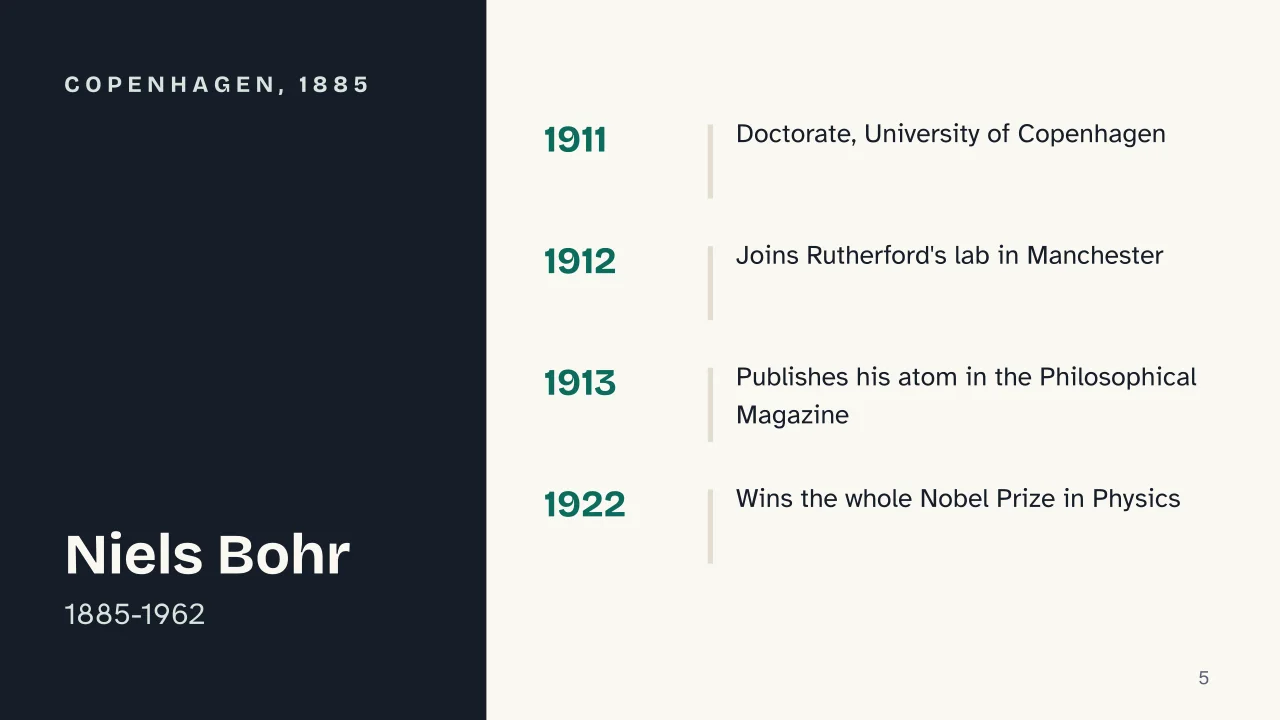 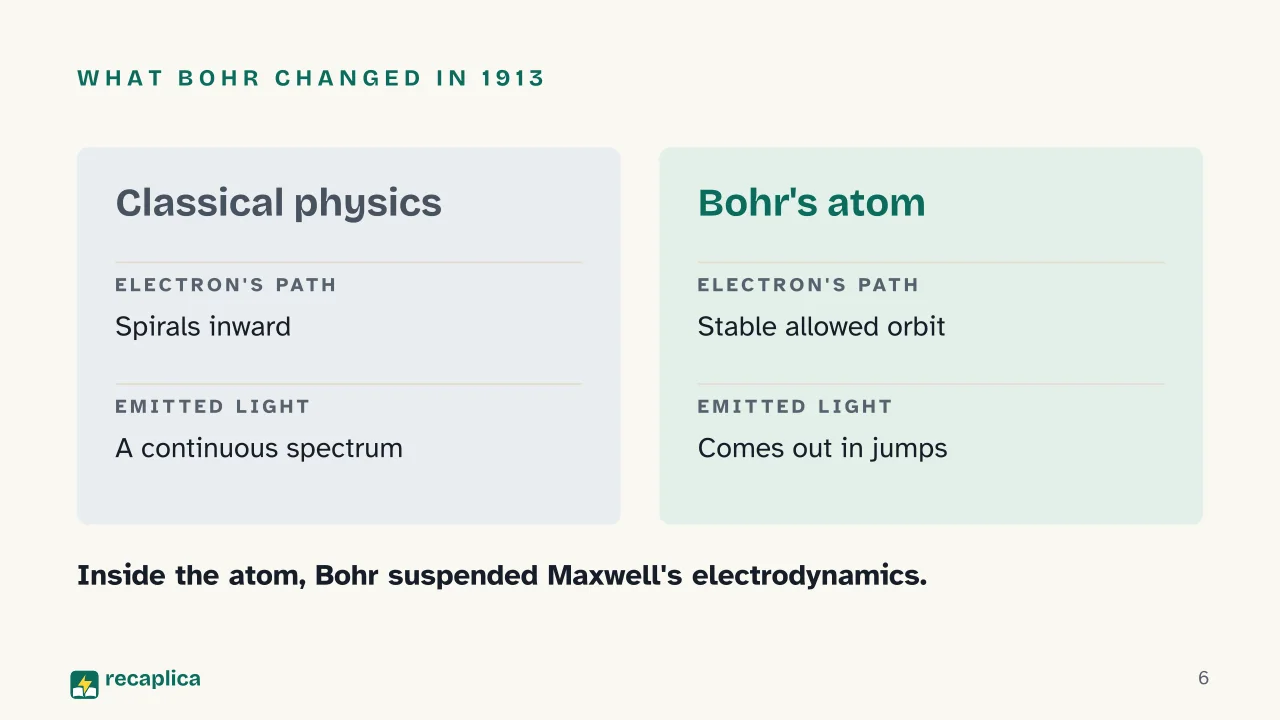  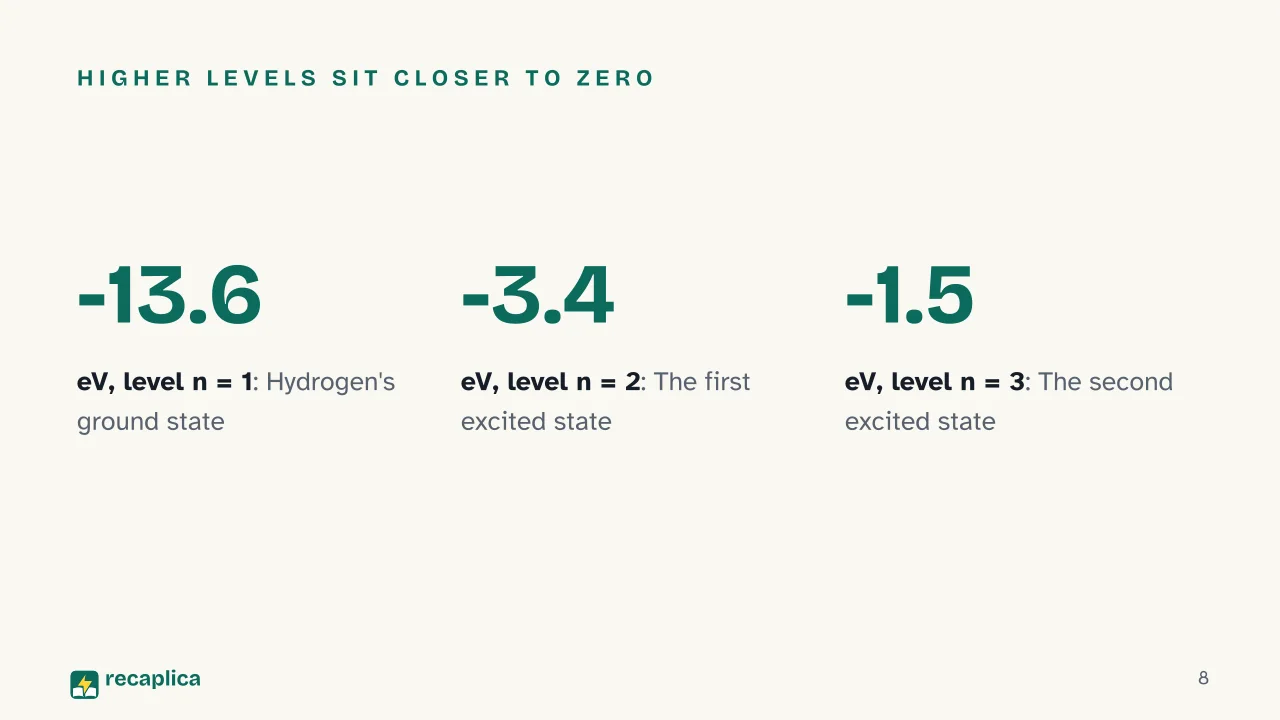   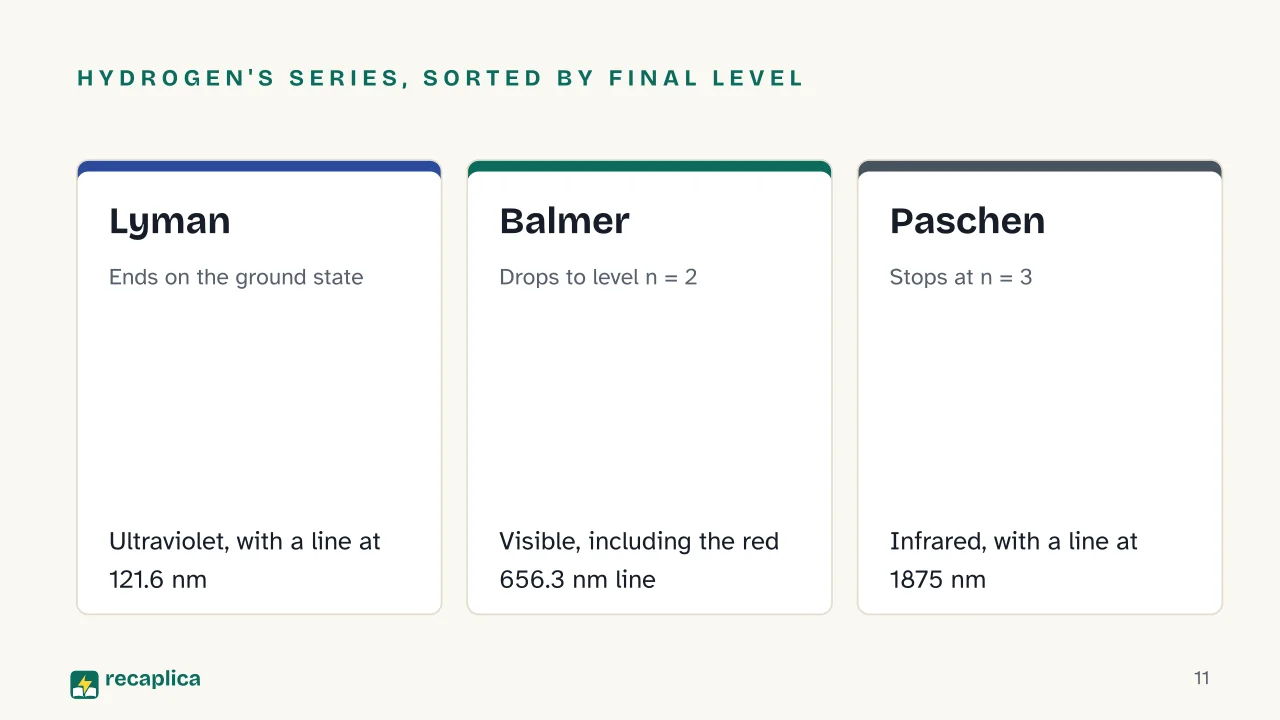 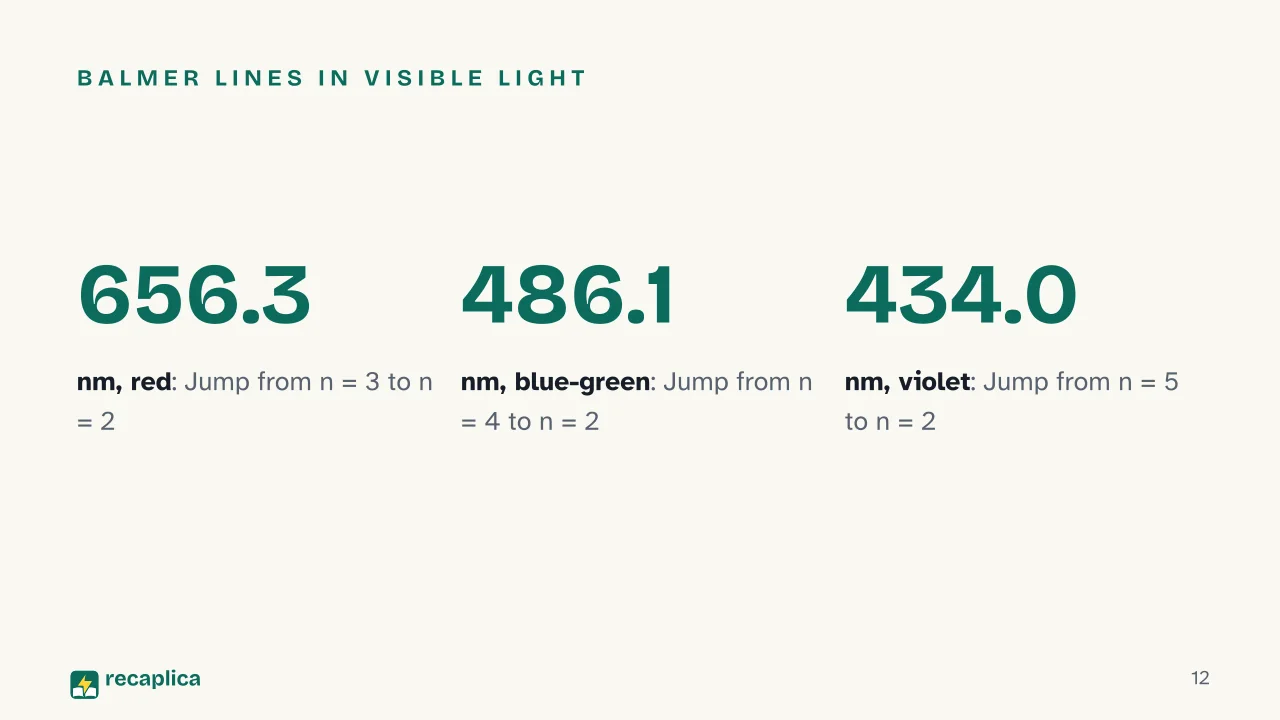 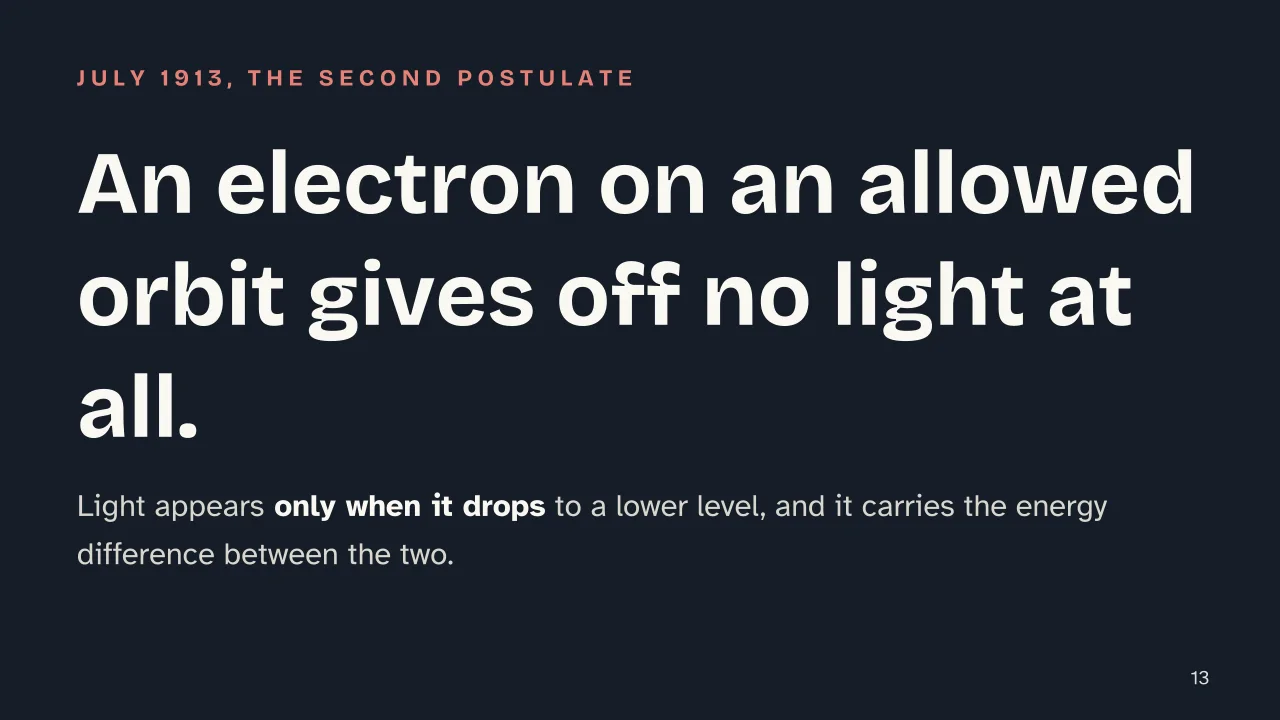  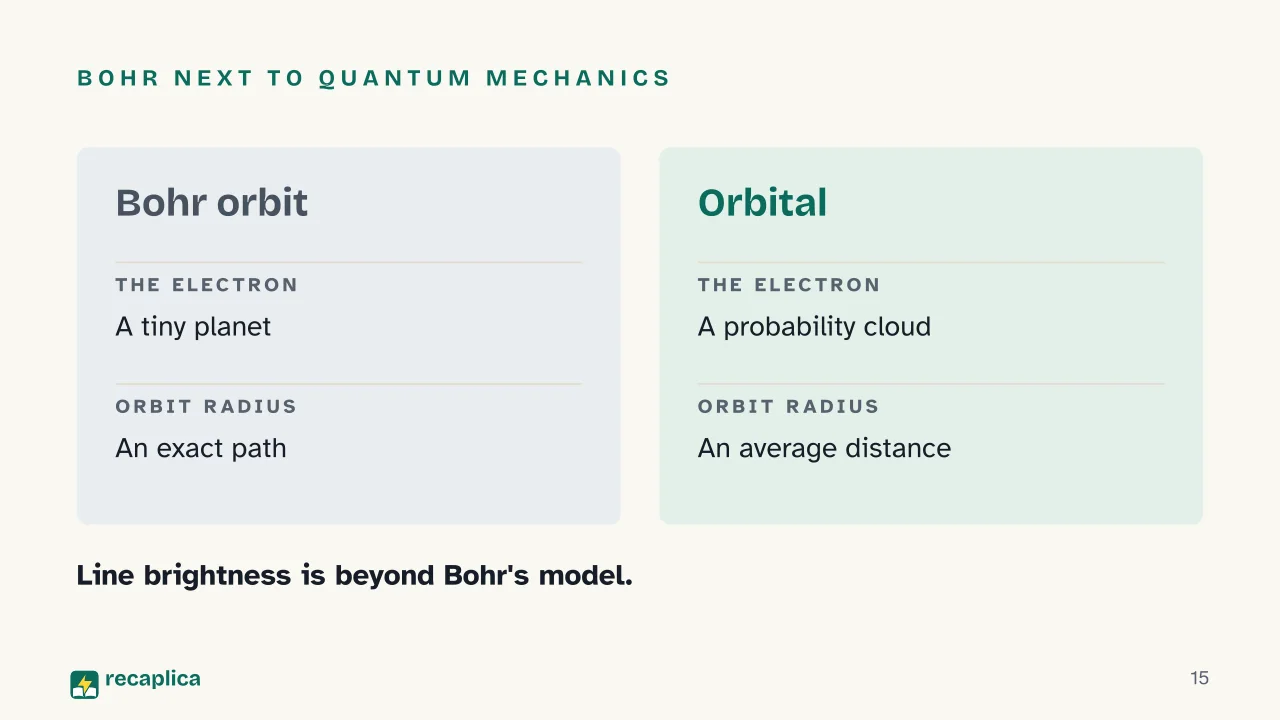   Common myths
Mind mapDrag the background to move around and the nodes to reposition them; use − and + to collapse and expand branches. 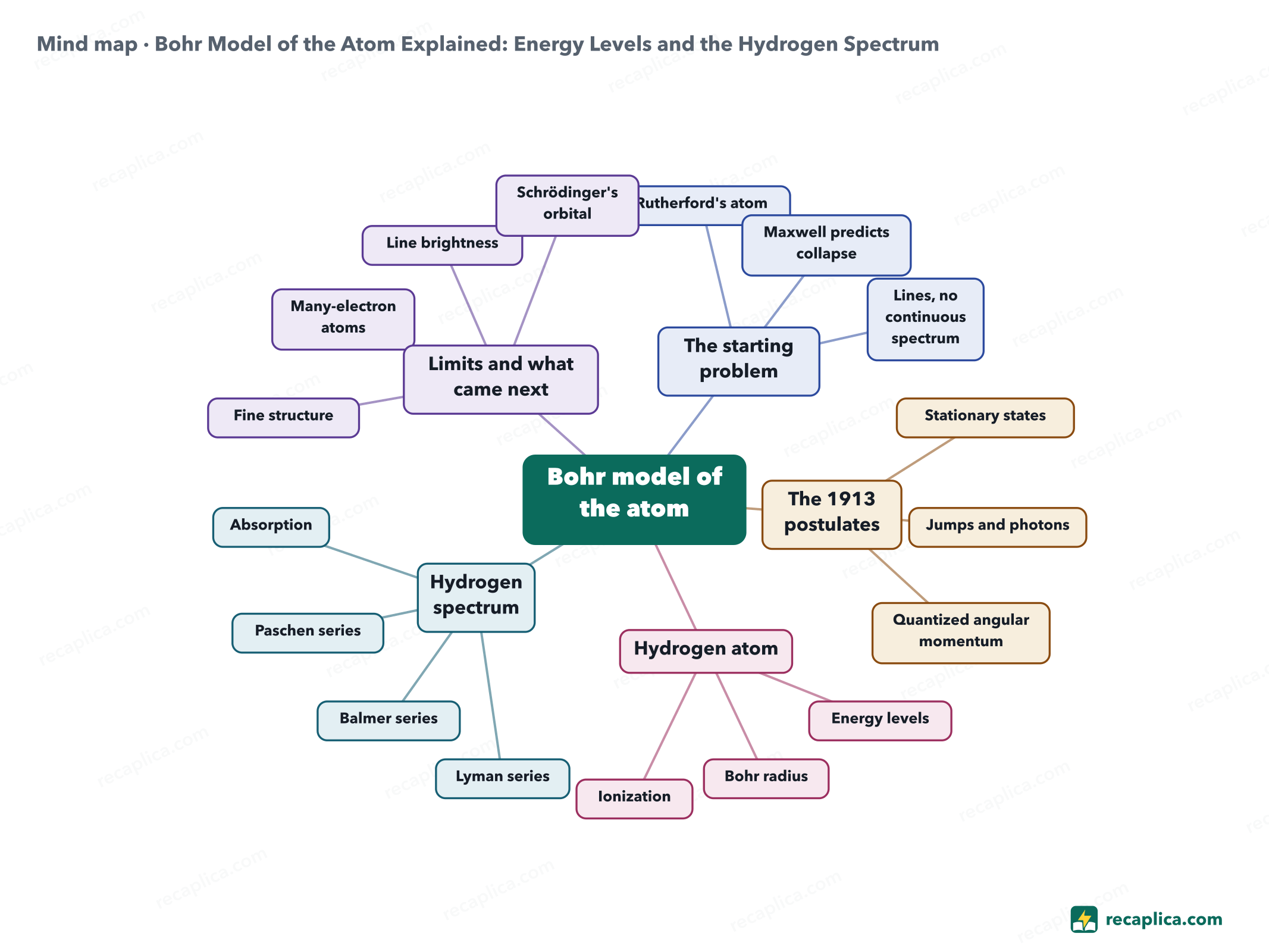
Quiz: test yourselfAnswer the questions to check what you have learned: you get instant feedback and a short explanation. Grade 0/10 0/5
FlashcardsTap the card to flip it and check whether you remember the answer, then move to the next one. 1 / 7 Explain it in your own wordsThe ultimate test: if you can explain it in simple words, you've truly understood it. Write your explanation, then compare it with the Recap. Your explanation is saved only on this device.
Frequently asked questionsCan you explain Bohr's atomic model in simple terms?Bohr published it in 1913. The electron can only be in stationary states, allowed orbits on which it does not radiate, and an orbit is allowed when the electron's angular momentum equals n·h/2π. Moving from one state to another, the electron sends out light of a single frequency ν, with energy E = h·ν. How does the Bohr model describe the hydrogen atom?Hydrogen has a nucleus with charge +1 and a single electron. Its levels follow En = −13.6 eV/n², which gives −13.6 eV in the ground state, −3.4 eV for n = 2 and −1.5 eV for n = 3. The smallest orbit has a radius of about 0.0529 nm, and the larger ones grow as n². Jumps between these levels produce the lines of hydrogen's spectrum. Is the Bohr planetary model how electrons really move?The planetary image goes back to Rutherford's atom, and Bohr kept it, giving every orbit a precise radius and speed. Modern quantum mechanics does not track a path. It works out how likely the electron is to be found in each zone close to the nucleus, and that zone is the orbital. Why was the Bohr model replaced?It works well for hydrogen's energies. It cannot explain how bright the lines are, it needs extra rules for atoms with more than one electron, and it gives the electron a definite position and momentum at the same time, which the uncertainty principle forbids. The Schrödinger equation found the same energies and corrected those flaws. Why did Bohr win the Nobel Prize?He received the whole 1922 Nobel Prize in Physics for his work on how atoms are built and on the radiation they emit. The presentation speech noted that his calculation of the Rydberg constant was only 1 per cent away from the observed value. Every Recap goes through an independent review before publication. |