|
recaplica
Atomic Models Timeline: From Dalton to Schrödinger | ||||||||||||||||||||||||||||||
| © 2026 Recaplica · recaplica.com — All rights reserved | ||||||||||||||||||||||||||||||
Atomic Models Timeline: From Dalton to SchrödingerWhat to print Page numbers appear when printing with default margins. SlidesChoose a cut Flash10 slidesThe essential thread, to present in classFull14 slidesEvery chapter and the deeper detailBoth come with speaker notes. In 30 seconds quick readBetween 1803 and 1926 the atom was pictured in five different ways, and nearly every new picture began with a result the old one could not explain. Dalton described an indivisible particle. Thomson found electrons, and Rutherford found the nucleus by firing alpha particles at gold foil. Bohr gave the electrons fixed positions, and quantum mechanics later turned those positions into zones of probability called orbitals. Key Points
Key figures
Deep DiveAccording to the Stanford Encyclopedia of Philosophy, the ancient atomists held that everything is made of minimal indivisible bodies moving in an infinite void. Only second-hand testimony survives for Democritus, sometimes conflicting, so the details attributed to him should be treated with caution. A scientific model of the atom appears only in 1803. Since then the picture has changed several times, and almost every change began with an experimental result that the model in use could not explain. Dalton and the indivisible atomFor Rutherford, writing in 1915, the first definite formulation of atomic theory as a scientific hypothesis is Dalton’s, made in Manchester in 1803. It was meant to explain why elements combine in multiple proportions. The first table of atomic weights is in Dalton’s notebook for September 1803. The paper with the weights appeared in 1805, the methods for obtaining them were explained only in 1808, and the same year the book A New System of Chemical Philosophy set out the theory, with the part on the atom in its last pages. ChemTeam reports that modern scholarship has identified four basic ideas: elements are made of atoms; atoms of the same element have the same mass; atoms of different elements have different masses; and they combine in small whole-number ratios. The result is a tiny, distinct, indivisible and indestructible particle. For the historian Thackray, whom ChemTeam quotes, what sets Dalton apart from his predecessors is an effective way of deriving the relative weights of the particles from the chemical data available. In schools Dalton’s atom is shown as a structureless billiard ball. Dalton himself never ruled out that the atom had an inside, but nobody in his day could probe it. Isotopes, a concept that arose more than a century after 1803, show that not all atoms of an element weigh the same. Thomson’s plum pudding modelThe next step comes from a discharge tube. Crookes had concluded that cathode rays were a stream of fast negative particles. After a controversy of about twenty years, their nature was shown in 1897, independently, by the experiments of Wiechert and of J. J. Thomson. Thomson asked whether those particles were atoms, molecules, or matter divided still more finely. The mass-to-charge ratio he measured did not change when the gas in the tube changed, and it was much smaller than that of the hydrogen ion, the smallest known until then. From Lenard’s data he inferred that the carrier was small compared with ordinary molecules. He named it a “corpuscle”, and the word electron became established later. According to the Nobel Foundation, Thomson announced the discovery in a lecture at the Royal Institution on 30 April 1897. In 1915 Rutherford puts the mass of that particle at about 1/1800 of a hydrogen atom. Because electrons could be freed from many kinds of matter, the chemical atom looked like an aggregate of corpuscles and was no longer indivisible. How the charges were arranged remained a conjecture. Negative charge existed in tiny units, while positive charge had never been found attached to a mass smaller than that of hydrogen. Lord Kelvin had imagined a uniform sphere of positive charge with the electrons distributed inside it, and Thomson developed the idea through calculation. In English it is the plum pudding model, after the dessert studded with dried fruit. Rutherford recalls that for many years the model was useful: it gave a concrete picture of the atom and lent itself to calculation. It accounted for electrons and for a divisible atom. Rutherford’s gold foil experiment and the nucleusIn 1909, in Manchester, Rutherford and Hans Geiger needed a research task for a student, Ernest Marsden. Rutherford, who would not skip any direction of observation, asked him to check whether any alpha particles bounced backward. A radioactive source fired alpha particles at thin gold foil. The deflected ones landed on a zinc sulphide screen, which sparks a tiny flash at every hit from a charged particle. Most passed through almost undisturbed, but a few came back at an angle greater than a right angle. In the observations of Geiger and Marsden as Rutherford reported them in 1911, about one alpha particle in 20,000 was deflected by 90 degrees on average in crossing gold foil about 0.00004 cm thick. Rutherford recalls in 1915 that Geiger was the first to point out the effect, entirely unexpected, and compares it to the surprise of an artillery man whose shells now and then bounced back toward the gun from a light target.
The large deflections turned out to come from a single encounter with a single atom. Thomson’s theory instead assumes that the deflection in one encounter is small, and its positive charge is too diffuse to produce fields that strong. Rutherford proposed concentrating the positive charge and most of the mass in a very small volume, the nucleus, with the negative electrons around it. The paper with the results appeared in the Philosophical Magazine in 1911. Geiger and Marsden then counted the particles deflected at various angles using foils of aluminium, silver and gold, and the results agreed very well with the theory. According to the Nobel biography, Rutherford regarded the nucleus as his greatest contribution to physics. The picture that emerged is electrons circling the nucleus the way planets circle the Sun, known as the planetary model. In 1911 Rutherford noted that Nagaoka had already studied in 1904 a “Saturnian” atom, a central mass surrounded by rings of electrons, and he set aside the question of stability. An electron in circular orbit should radiate energy and fall onto the nucleus, according to Maxwell’s equations. Meanwhile the nucleus was finding a place in the periodic table. Van den Broek and Bohr suggested that its charge equals the element’s ordinal number, and Moseley’s X-ray spectra in 1913 showed that the atomic number is exactly the number of units of positive charge in the nucleus. Bohr’s stationary statesBohr joined Rutherford in Manchester in 1912. The open question was how a nucleus with a single electron, in hydrogen, could produce such a complex spectrum. In three papers of 1913, Bohr combined the nucleus with the quantum ideas of Planck and Einstein. In the Bohr model the electron can occupy only certain stationary positions, and when it passes from one to another it emits radiation of a well-defined frequency. In Rutherford’s 1915 account, this hypothesis explained the spectral series of hydrogen and let the value of Balmer’s constant be derived from the theory. Bohr’s work on the structure of atoms earned him the 1922 Nobel Prize. The theory described the hydrogen spectrum well and needed further development for more complicated atoms and molecules, according to the Nobel Foundation. The quantum mechanical model: from orbit to orbitalHeisenberg published his quantum mechanics in 1925, aged 23, resting it only on what can be observed: the radiation the atom emits. According to the Nobel biography, he concluded that an electron does not always have a position that can be assigned at a given instant and cannot always be followed along an orbit, so Bohr’s planetary orbits might not really exist. He then formulated the uncertainty principle: the errors in determining a particle’s position and momentum have a product no smaller than the quantum constant h, a limit that cannot be ignored when studying the atom. In the first half of 1926, in Zurich, Schrödinger discovered his wave equation. It grew out of dissatisfaction with the quantum condition in Bohr’s theory of orbits. Max Born showed that the equation should be read as a source of statistical, not exact, predictions, and he received the Nobel Prize in 1954 for it. Electron cloud model: orbit and orbitalIn the Royal Society of Chemistry’s description (2024), Bohr’s electron sits on an orbit at a precise distance from the nucleus. The quantum model gives instead the probability of finding it in a given region, the electron cloud, and calls the zone where that probability is highest an orbital. The atomic models compared
Slide deckSlides ready to download and make your own in PowerPoint or Google Slides, with speaker notes. Pick the Flash cut or the Full one.     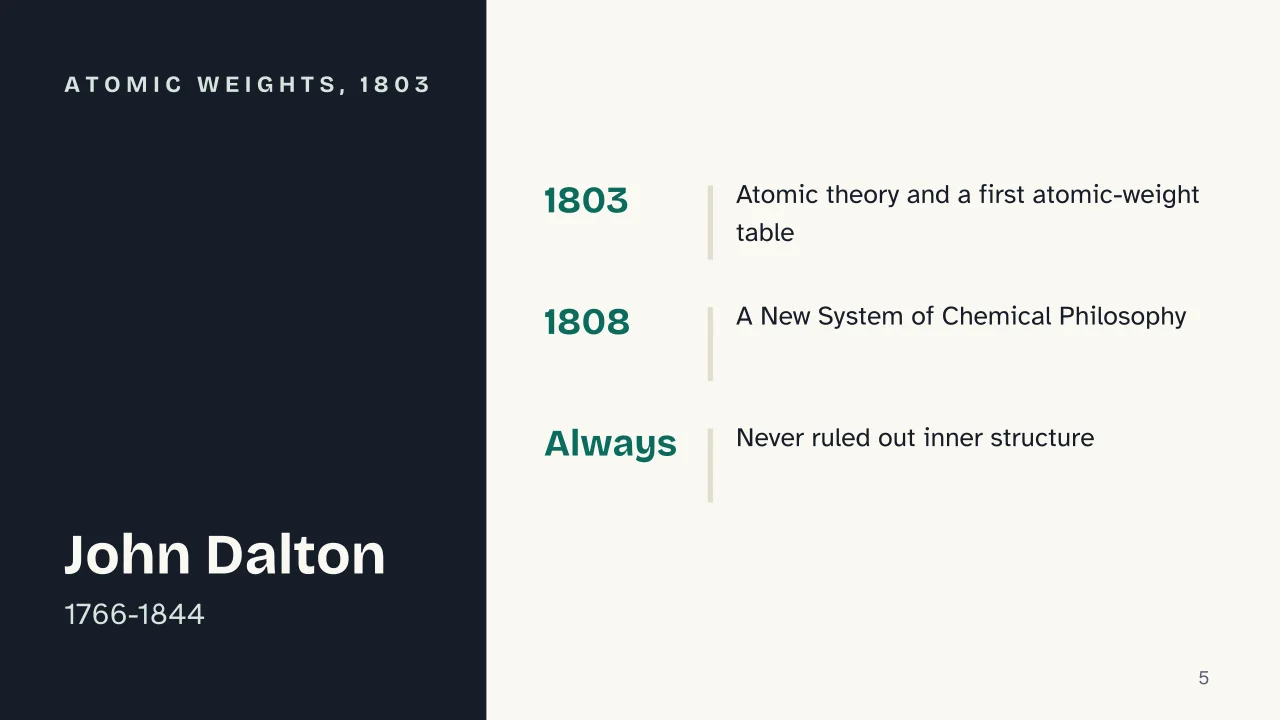  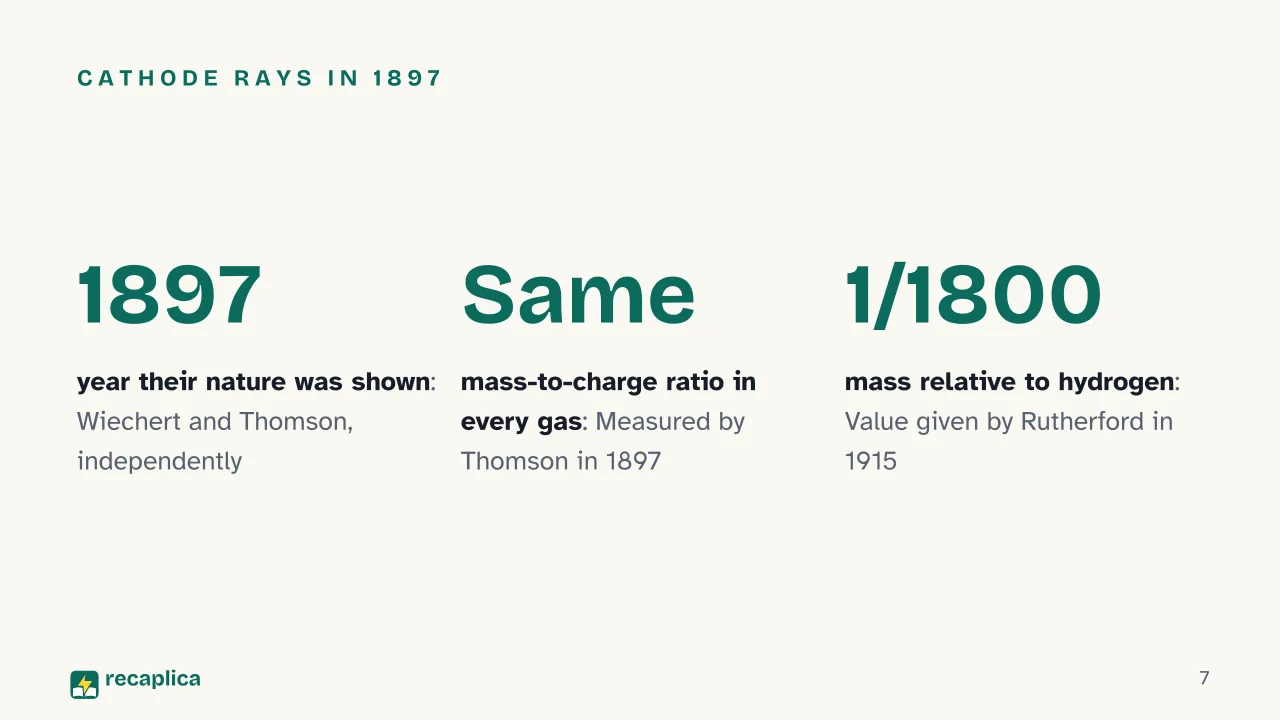  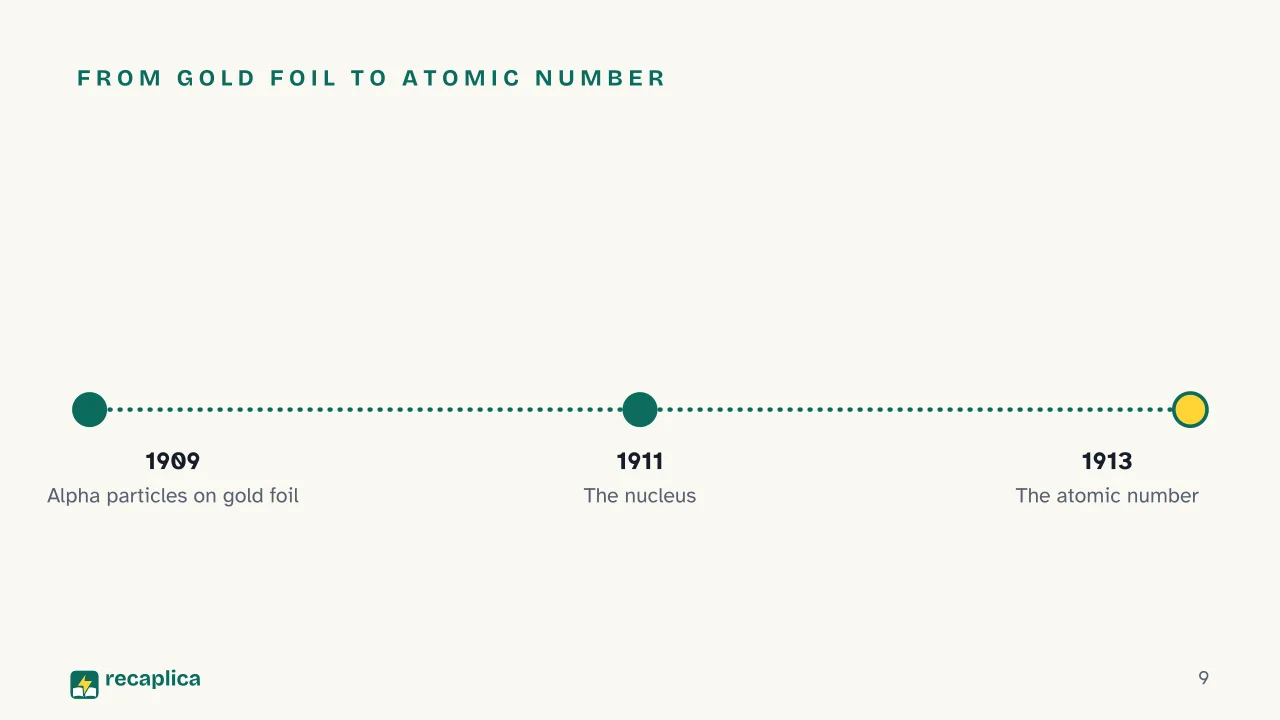   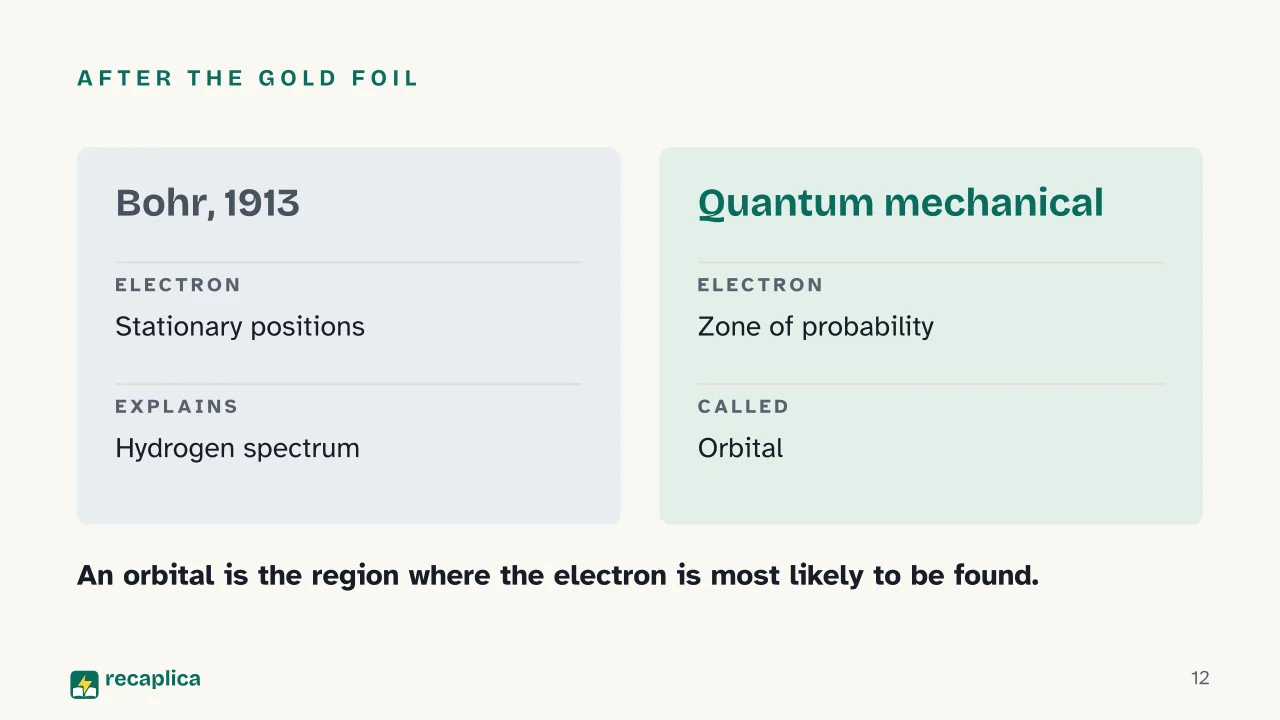 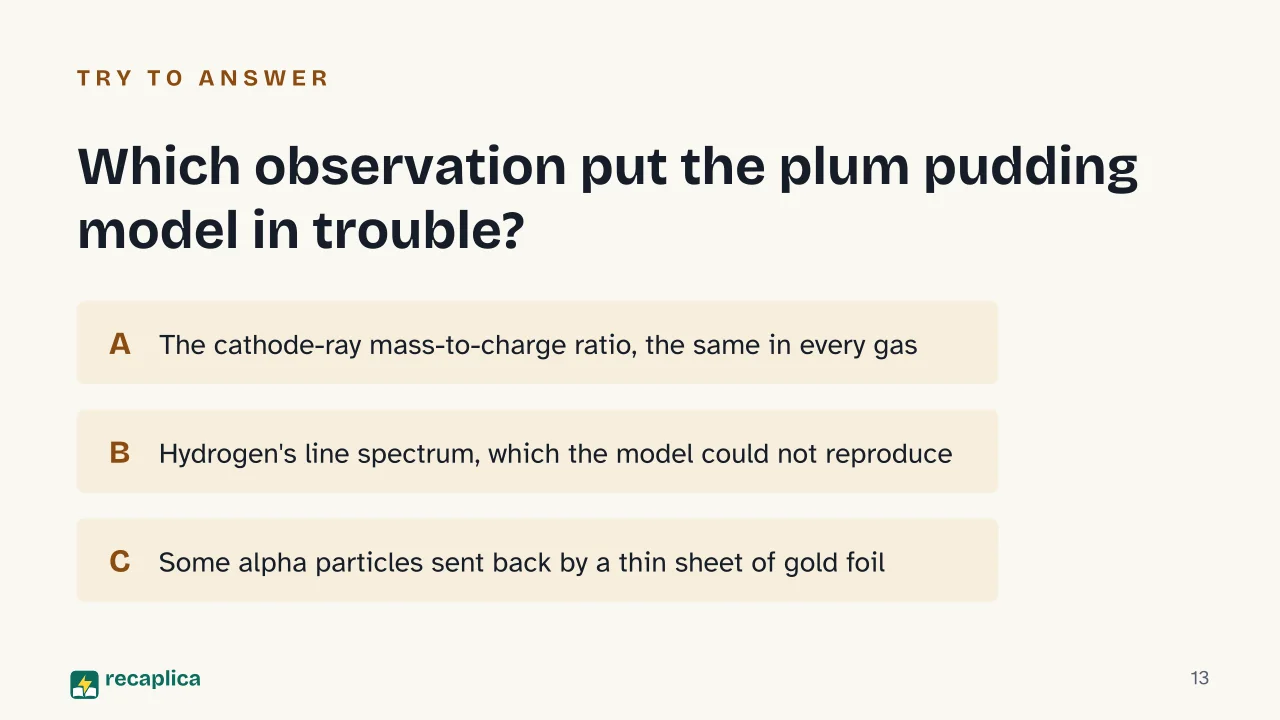  Common myths
Mind mapDrag the background to move around and the nodes to reposition them; use − and + to collapse and expand branches. 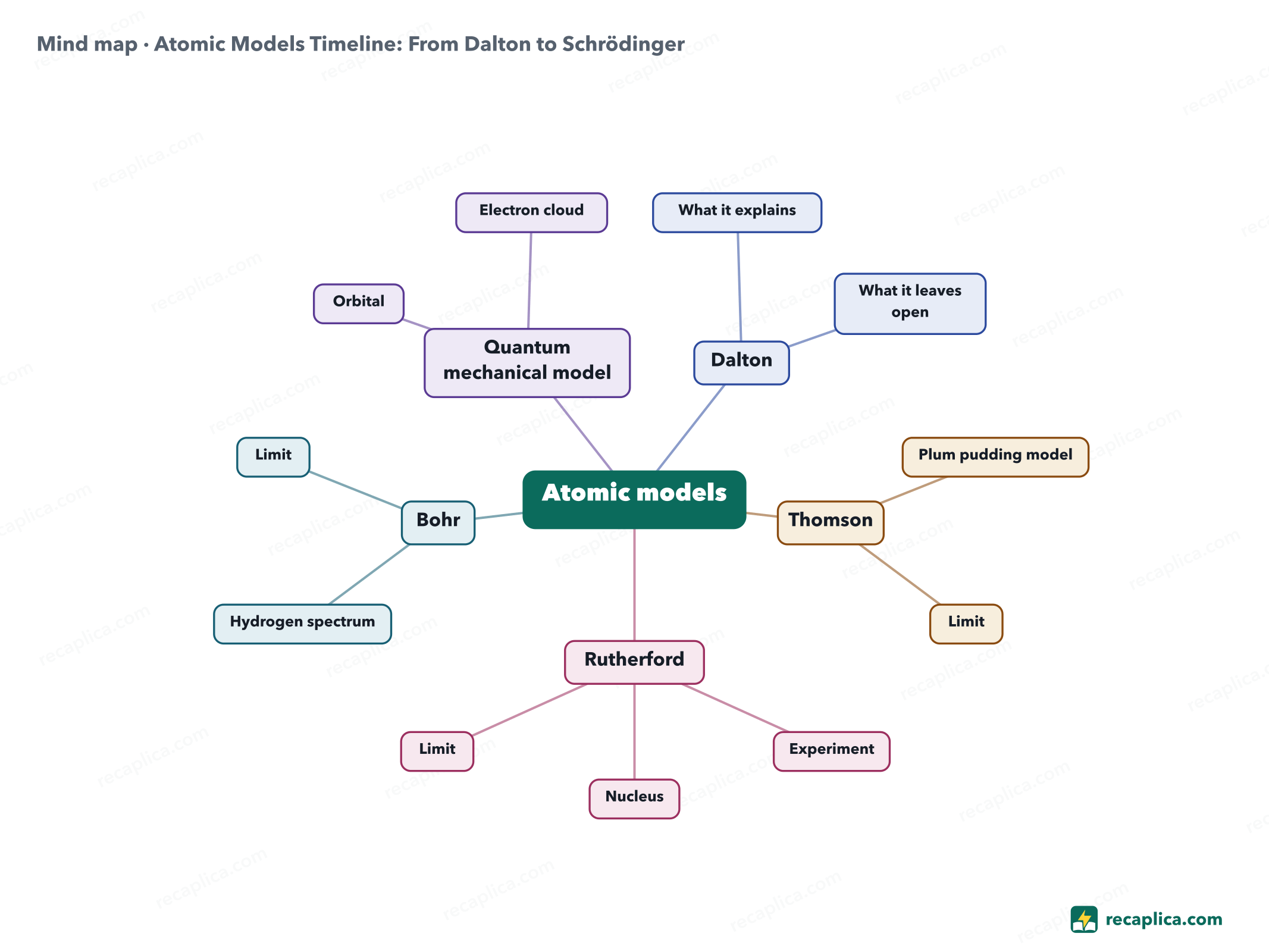
Quiz: test yourselfAnswer the questions to check what you have learned: you get instant feedback and a short explanation. Grade 0/10 0/5
FlashcardsTap the card to flip it and check whether you remember the answer, then move to the next one. 1 / 7 Explain it in your own wordsThe ultimate test: if you can explain it in simple words, you've truly understood it. Write your explanation, then compare it with the Recap. Your explanation is saved only on this device.
Frequently asked questionsWhat is Thomson's plum pudding model of the atom?It is the model in which electrons are scattered inside a uniform mass of positive charge, like plums in a pudding. Lord Kelvin had already imagined the positive sphere, and J. J. Thomson developed it mathematically after showing in 1897 that cathode rays are made of electrons. What did Rutherford's gold foil experiment show?When alpha particles were fired at thin gold foil, nearly all went through unhindered, yet a few were thrown back. A result like that does not fit a positive charge spread out as in Thomson's model. In 1911 Rutherford proposed a tiny nucleus holding the charge and nearly all the mass. What is the electron cloud model?It is the quantum mechanical model, in which electrons do not follow exact orbits. Instead the model gives the probability of finding them in a given region, the electron cloud. The region where an electron is most likely to be is called an orbital. The model grew out of Heisenberg's quantum mechanics (1925) and Schrödinger's wave equation (1926), which Born read statistically. What did Dalton's atom model say?Dalton proposed that every element is built from tiny indivisible atoms, all alike in mass for a given element and unlike those of other elements. Atoms combine in small whole-number ratios, which is how he accounted for multiple proportions. Molecules are the result of those combinations. Who came up with the idea of the atom?The idea comes from the Greek philosophers. The Stanford Encyclopedia of Philosophy describes the ancient atomists as proposing that all things consist of minimal indivisible bodies moving in a void, though only second-hand testimony survives for Democritus. As a scientific hypothesis, according to Rutherford, the first definite formulation is Dalton's, in 1803. Every Recap goes through an independent review before publication. |