Skip to content
recaplica

    One moment: security check

    Cloudflare wants to make sure you're not a robot. Tick the box below and your search will continue on its own.

    IT
    recaplica Bohr Model Diagram: How to Draw an Atom's Electron Shells
    © 2026 Recaplica · recaplica.com — All rights reserved
    Home › Science

    Bohr Model Diagram: How to Draw an Atom's Electron Shells

    By Recaplica Newsroom · Updated on October 22, 2026

    What to print

    Page numbers appear when printing with default margins.

    Slides

    Choose a cut

    Flash10 slidesThe essential thread, to present in classFull16 slidesEvery chapter and the deeper detail

    Both come with speaker notes.

    Telegram channel
    recaplica Clear in 30 seconds, yours in 10 minutes.
    In 30 seconds Key points Figures Deep dive Slides Myths Mind map Quiz Flashcards FAQ

    In 30 seconds quick read

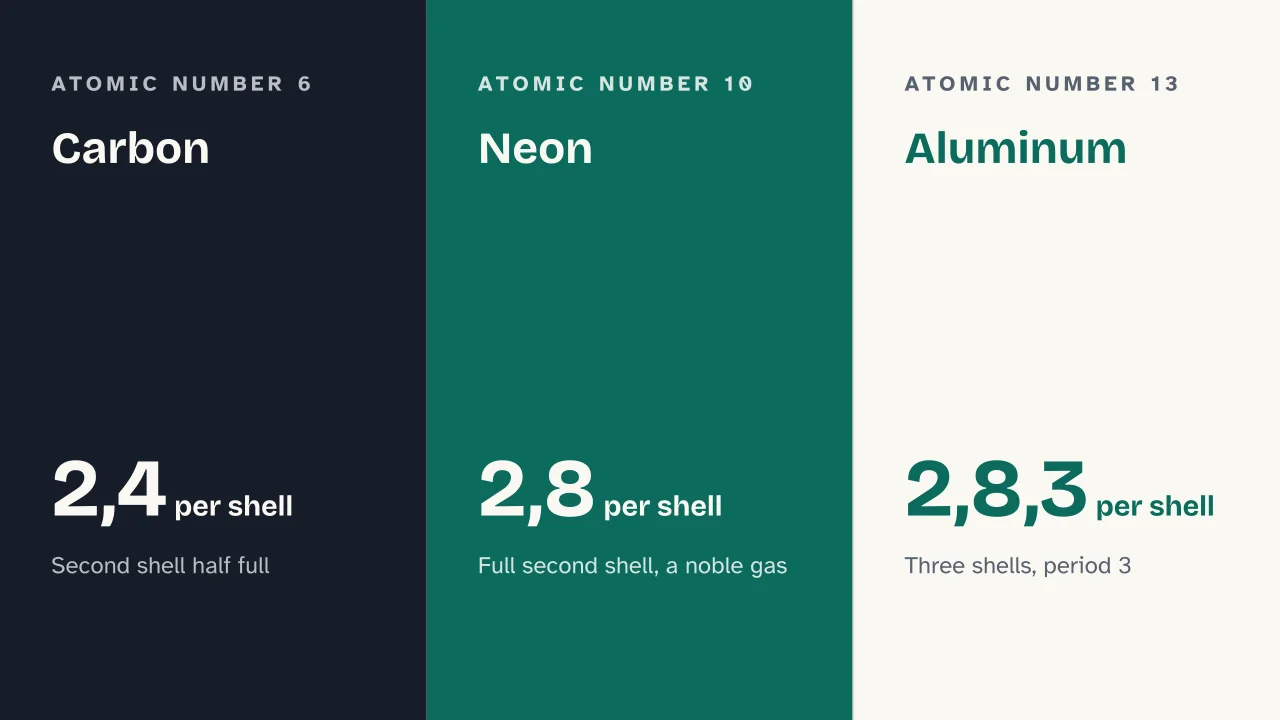
    A Bohr diagram draws an atom as a small nucleus surrounded by circles, the shells, with one dot for each electron. You start from the atomic number, which in a neutral atom equals the number of electrons, and fill the shells from the one nearest the nucleus outward. Under the rule taught in school the first shell holds at most 2 electrons and the second and third hold 8 each, which makes carbon 2,4, neon 2,8 and aluminum 2,8,3. The circles stand for energy levels, and electrons don't travel around them like planets.

    Key Points

    • The atomic number counts the protons; a neutral atom has the same number of electrons, and those are the dots you draw.
    • Each electron takes the lowest shell that still has room: in the school version the first shell tops out at 2 electrons, the second and third at 8.
    • The number of shells gives the element's period, its row in the periodic table.
    • A Lewis symbol is a cut-down Bohr diagram that keeps only the outer-shell electrons, known as valence electrons.
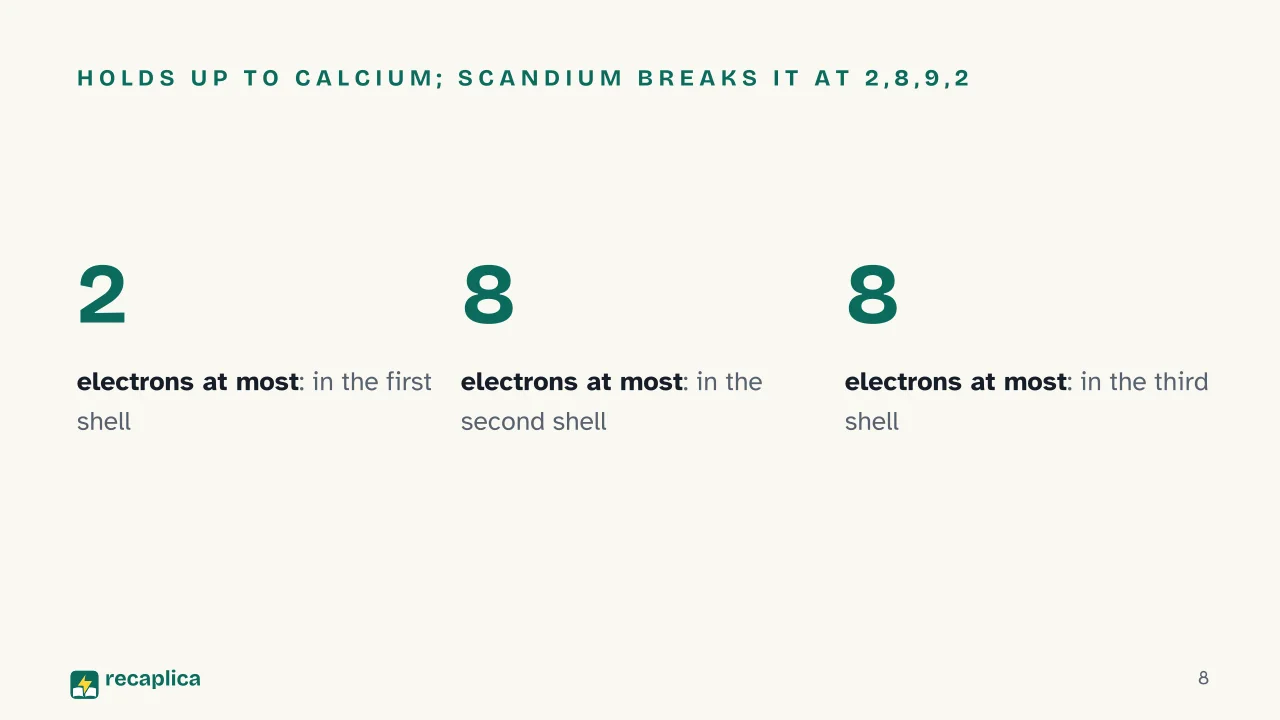
    • The 2, 8, 8 rule holds up to calcium, atomic number 20: scandium already has a different structure, 2,8,9,2.

    Key figures

    • 1913 The year Niels Bohr proposed that electrons sit in fixed shells, or energy levels Source: Royal Society of Chemistry; NobelPrize.org
    • 20 The number of elements, counting from hydrogen, that the RSC's shell-drawing method is designed for Source: Royal Society of Chemistry, RSC Education

    Deep Dive

    What a Bohr diagram shows

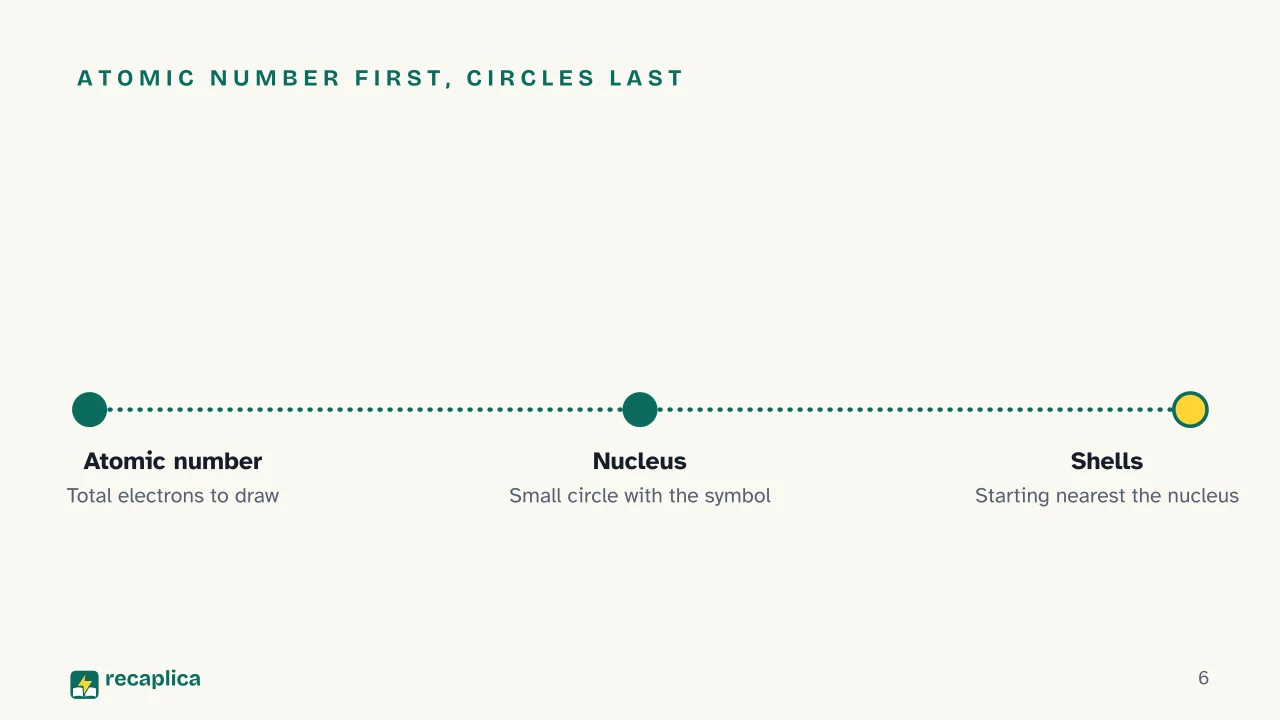
    According to the Royal Society of Chemistry (RSC), an electron configuration diagram is a model of where the electrons are around the nucleus. You draw the nucleus as a small circle with the element’s symbol inside. Around it go concentric circles, the shells, and each shell gets a dot or a cross for every electron it holds. The same drawing sometimes goes by the name Bohr model, or “solar system” model.

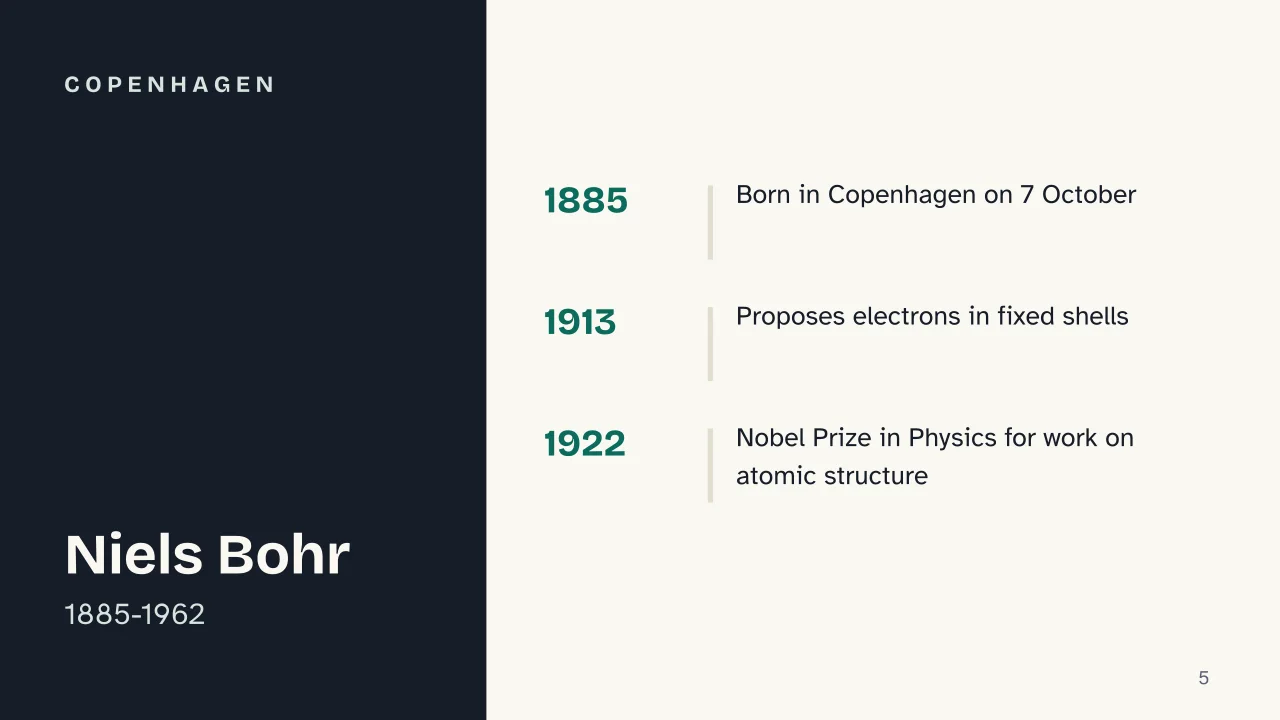
    The name comes from Niels Bohr, who in 1913 was the first to propose electrons arranged in fixed shells. Why he got there, and how the idea accounted for the light hydrogen gives off, is covered in the Recap on the Bohr model of the atom and its spectral lines. This page is practical: pick an element and draw it.

    A word on vocabulary. In school chemistry “electron shell” and “energy level” mean the same thing, and the RSC advises picking one and sticking with it inside a single explanation.

    Step one: count the electrons from the atomic number

    The atomic number is the number of protons in the nucleus. A neutral atom has as many electrons as protons, so the same number also tells you how many dots to draw in total: potassium, atomic number 19, gets 19.

    An atom that gains or loses electrons becomes an ion, and the total changes. Every example below uses neutral atoms.

    How to fill the shells

    There is one basic rule. Each electron goes into the lowest shell that still has space, the one closest to the nucleus, and you only move outward once that shell is full. Energy is lowest in the first shell and rises the farther a shell sits from the nucleus.

    How many electrons fit in a shell? In the version of the model the RSC uses with students aged 14 to 16, the first shell holds at most 2, the second 8 and the third 8. Calcium, element 20, puts its last two electrons in the fourth shell; potassium, just before it, puts only one there.

    To avoid drawing every time, there is a shorthand: the number of electrons in each shell, innermost first, separated by commas or dots. Nitrogen is written 2,5 and calcium 2,8,8,2.

    The RSC designed its method for the first 20 elements of the periodic table. Chemguide also recommends building up the electron structures of those 20 elements one energy level at a time, on a diagram with the levels drawn as stairs.

    How to draw the Bohr model of carbon

    Practical example: carbon has atomic number 6, so a neutral atom has 6 electrons. Draw a small circle with a C in it. The first shell takes 2 electrons and is full; the remaining 4 go on the second circle, which could hold as many as 8. In shorthand, carbon is 2,4.

    You can check the count against the configuration PubChem lists for carbon, [He] 2s² 2p². The [He] stands for the 2 electrons of the first level, the ones helium has, and 2s² and 2p² are the 4 in the second.

    Neon: a full second shell

    Practical example: neon has atomic number 10. Two electrons go in the first shell and eight in the second: 2,8. The second circle is full, and nothing is left over for a third.

    HyperPhysics calls this complete shell the “stable octet”, and neon is a noble gas. Helium shows the same thing one step earlier: its 2 electrons fill the first level, and it too is a chemically inert noble gas. Fluorine, one electron short of an octet, tends to pick one up. Sodium has one too many and tends to give it away, and both end up with neon’s arrangement.

    How to draw the Bohr model of aluminum

    Practical example: aluminum has atomic number 13. The first shell takes 2 electrons, the second takes 8, and 3 are left for the third: 2,8,3. The drawing has three circles, with 3 dots on the outermost one.

    PubChem gives aluminum the configuration [Ne] 3s² 3p¹. The [Ne] block is neon’s 10 electrons, the third level adds 3 more, and the total agrees with the count made using the rule.

    The same procedure works for every element up to calcium. In the table below, the configuration comes from PubChem; the electrons-per-shell column was worked out here by applying the rule, and for nitrogen and calcium it matches the figures printed by the RSC.

    ElementAtomic numberConfiguration (PubChem)Electrons per shell
    Hydrogen (H)11s¹1
    Helium (He)21s²2
    Carbon (C)6[He] 2s² 2p²2,4
    Nitrogen (N)7[He] 2s² 2p³2,5
    Oxygen (O)8[He] 2s² 2p⁴2,6
    Neon (Ne)10[He] 2s² 2p⁶2,8
    Sodium (Na)11[Ne] 3s¹2,8,1
    Magnesium (Mg)12[Ne] 3s²2,8,2
    Aluminum (Al)13[Ne] 3s² 3p¹2,8,3
    Chlorine (Cl)17[Ne] 3s² 3p⁵2,8,7
    Argon (Ar)18[Ne] 3s² 3p⁶2,8,8
    Potassium (K)19[Ar] 4s¹2,8,8,1
    Calcium (Ca)20[Ar] 4s²2,8,8,2

    What a finished diagram tells you

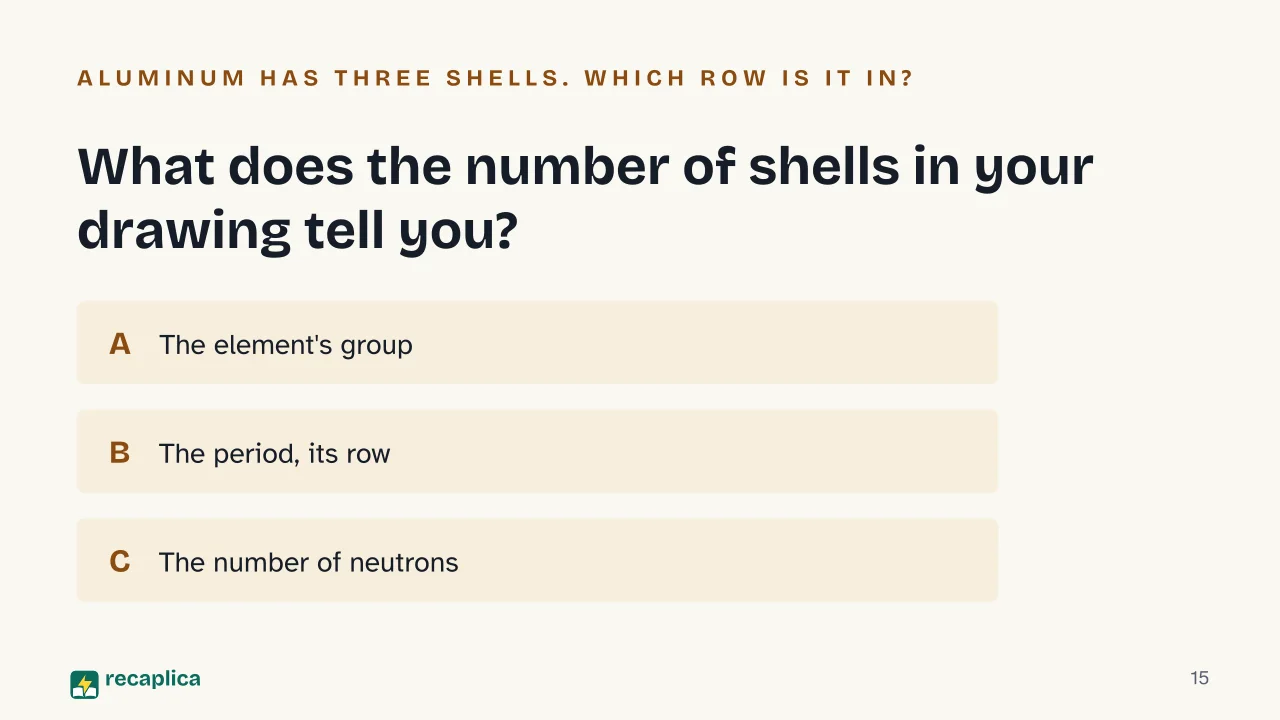
    A finished diagram also shows where the element sits. According to the RSC, the number of shells gives the period, meaning the row of the periodic table, while the electrons in the outer shell point to the group. Aluminum, with its three shells, belongs to period 3. Group 1 elements all have a single electron in the outer shell; in the table above, that applies to hydrogen, sodium and potassium.

    The electrons in the outer shell are called valence electrons. The LibreTexts module notes that those in full inner shells don’t contribute to an element’s chemical properties. Sodium, for example, has one electron outside a closed shell, and HyperPhysics puts the energy needed to remove it at 5.14 electron volts; chlorine is one electron short of a full shell and releases 3.62 electron volts when it gains one. That is how the Na+ and Cl- ions form, and their mutual attraction is the ionic bond.

    From Bohr diagram to Lewis symbol

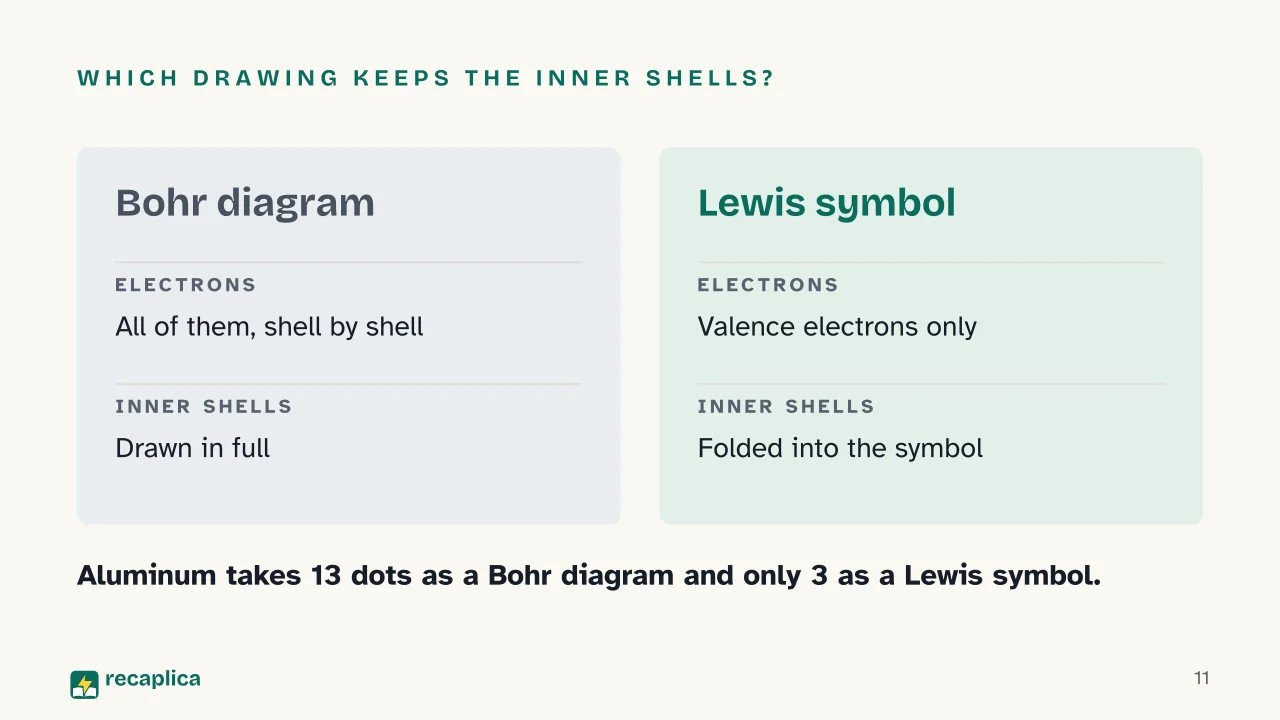
    Keep only the outer-shell electrons of a Bohr diagram and what remains is the Lewis symbol, which LibreTexts describes as a simplified version of it. The complete inner shells vanish into the element’s symbol, and the valence dots are arranged around it in four groups of one or two. Eight dots mean a closed shell, the configuration of a noble gas.

    Practical example: the aluminum diagram has three circles and 13 dots. Its Lewis symbol is Al with 3 dots around it, the electrons from the third shell.

    Bohr diagramLewis symbol
    NucleusSmall circle with the symbolJust the symbol
    Inner shellsDrawn, with all their dotsAbsorbed into the symbol
    Outer shellA circle with its dotsDots in four groups of one or two
    What it’s forSeeing how the atom is built upKeeping track of valence electrons

    What the circles stand for

    Chemguide flatly rejects the planetary atom of popular illustrations, the one with electrons wheeling around the nucleus. The circle diagram stays useful as long as you understand that each circle is an energy level and that electrons do not move along it. The same sodium diagram can be redrawn with its levels straightened out into a row of steps, and the sense of motion disappears.

    How electrons actually move inside an atom is unknown, and the theory Chemguide relies on says it cannot be known. Put simply, Heisenberg’s uncertainty principle means nobody can pin down an electron’s position and its next move with certainty at once, which leaves no orbit to draw. The RSC warns that students may picture exactly this miniature solar system, or imagine shells as rigid structures that electrons sit in.

    HyperPhysics accepts that the “planetary” model describes electrons poorly, yet still finds it a good aid for following how heavier atoms are built up. According to the official Nobel biography, published in 1965, the elements’ physical and chemical properties could still be explained with Bohr’s picture, after improvements that came mainly from Heisenberg’s ideas in 1925.

    Where the 2, 8, 8 rule stops

    In the more advanced model each shell splits into subshells, which in turn are made of orbitals. An orbital is a region of space where an electron is likely to be found (Chemguide sets the cutoff at a 95% probability), and it holds at most two electrons, with opposite spins.

    The first level has 1 orbital, the second 4 and the third 9: one 3s, three 3p and five 3d. Doing the arithmetic, nine orbitals of two electrons each give the third shell room for 18, far more than the 8 allowed by the school rule. Potassium and calcium still put electrons in the fourth shell because, in these two elements, the 3d orbitals are higher in energy than 4s, which therefore fills first. Scandium, atomic number 21, is where the two swap places in energy, and one of its electrons ends up in a 3d orbital. Its structure is 2,8,9,2, where the school rule would have predicted 2,8,8,3. In period 4, HyperPhysics explains, ten elements known as transition elements slot in between 4s and 4p, because the d subshell takes 10 electrons.

    For this reason the RSC recommends presenting the 2,8,8,2 scheme as exactly what it is, a model and a rule of thumb, useful but limited to the surface of what goes on inside the atom.

    Slide deck

    Slides ready to download and make your own in PowerPoint or Google Slides, with speaker notes. Pick the Flash cut or the Full one.

    Slide 1 of the presentation on Bohr Model Diagram: The Bohr model diagramSlide 2 of the presentation on Bohr Model Diagram: How many electrons does an aluminum atom have?Slide 3 of the presentation on Bohr Model Diagram: How do you draw an atom?Slide 4 of the presentation on Bohr Model Diagram: Chapter 01: Count the electronsSlide 5 of the presentation on Bohr Model Diagram: CopenhagenSlide 6 of the presentation on Bohr Model Diagram: Atomic number first, circles lastSlide 7 of the presentation on Bohr Model Diagram: Chapter 02: Fill the shells from the inside outSlide 8 of the presentation on Bohr Model Diagram: Holds up to calcium; scandium breaks it at 2,8,9,2Slide 9 of the presentation on Bohr Model Diagram: Chapter 03: Carbon, neon and aluminumSlide 10 of the presentation on Bohr Model Diagram: Carbon · Neon · AluminumSlide 11 of the presentation on Bohr Model Diagram: Which drawing keeps the inner shells?Slide 12 of the presentation on Bohr Model Diagram: Chapter 04: What the drawing leaves outSlide 13 of the presentation on Bohr Model Diagram: Electrons travel along the circles.Slide 14 of the presentation on Bohr Model Diagram: Why isn't scandium 2,8,8,3?Slide 15 of the presentation on Bohr Model Diagram: What does the number of shells in your drawing tell you?Slide 16 of the presentation on Bohr Model Diagram: The full Recap, with the quiz and the concept map
    Flash10 slidesThe essential thread, to present in classFull16 slidesEvery chapter and the deeper detail

    Common myths

    • ✗ Myth Electrons travel around the circles of the diagram, like planets around the Sun.

      ✓ Reality Each circle stands for an energy level, and the one closest to the nucleus has the lowest energy. Chemguide suggests redrawing the same diagram with the levels laid out as steps, which removes any hint of movement around the nucleus. Heisenberg's uncertainty principle says an electron's location and where it goes next cannot both be known for sure, so there is no path to trace.

    • ✗ Myth Shells are real layers, like the skins of an onion, with electrons resting on them.

      ✓ Reality The RSC flags it as one of the mistaken pictures students can form. A shell is one of the energy levels an electron is allowed to have, and the circle on paper is there to count electrons and keep them in order.

    • ✗ Myth The 2, 8, 8 rule works for every element.

      ✓ Reality It holds for the first 20 elements, up to calcium (2,8,8,2). Scandium, atomic number 21, comes out as 2,8,9,2, because one of its electrons goes into a 3d orbital in the third shell. The RSC asks teachers to tell students plainly that 2,8,8,2 is a model.

    Mind map

    Drag the background to move around and the nodes to reposition them; use − and + to collapse and expand branches.
    Customize
    Mind map: Bohr Model Diagram: How to Draw an Atom's Electron Shells
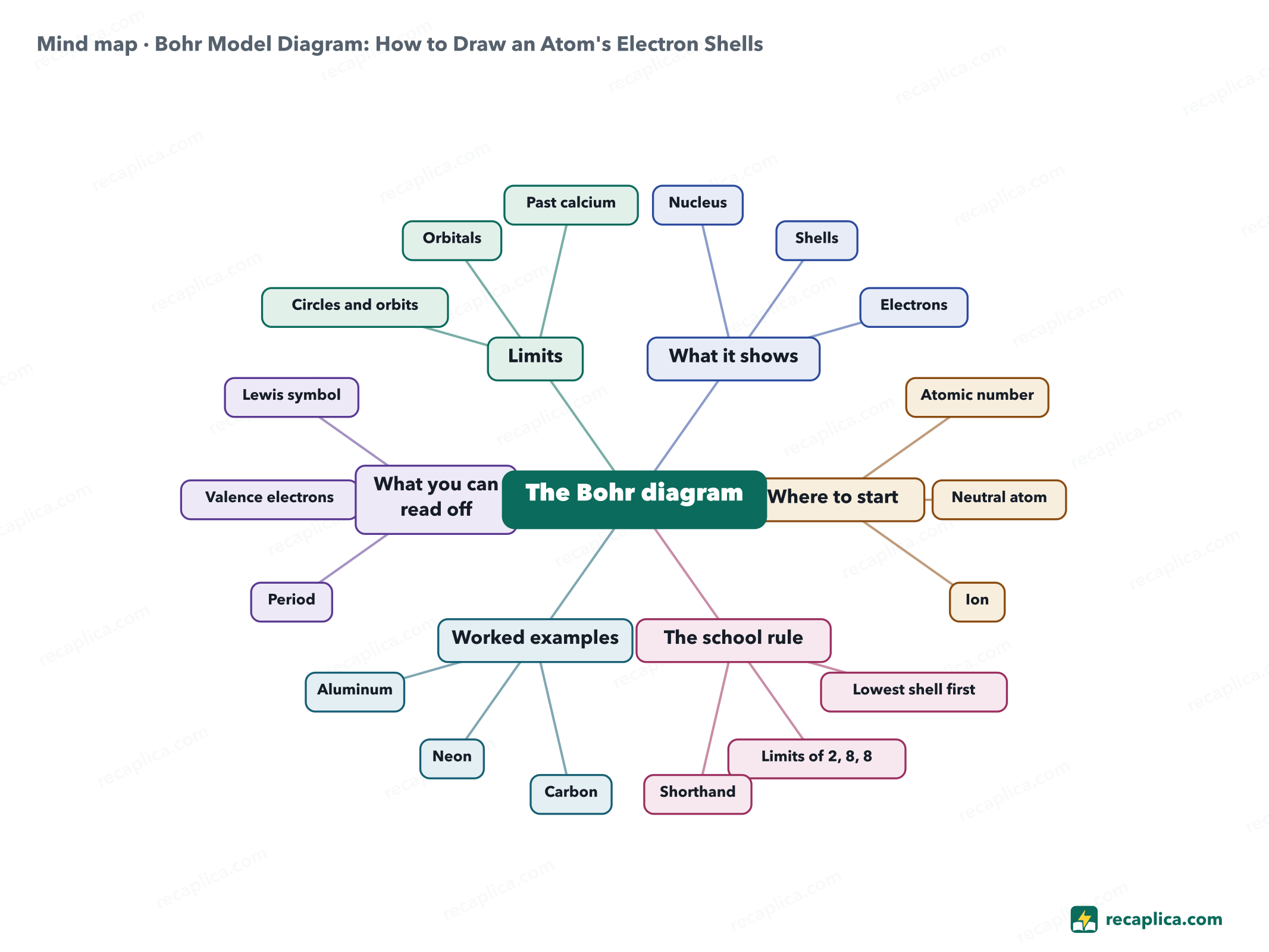
    • The Bohr diagram
      • What it shows
        • Nucleus A small circle with the element's symbol
        • Shells Concentric circles, one per energy level
        • Electrons One dot or cross each
      • Where to start
        • Atomic number The number of protons
        • Neutral atom As many electrons as protons
        • Ion An atom that has gained or lost electrons
      • The school rule
        • Lowest shell first Each electron goes in the free shell nearest the nucleus
        • Limits of 2, 8, 8 First, second and third shell
        • Shorthand Numbers separated by commas, such as 2,5 for nitrogen
      • Worked examples
        • Carbon 6 electrons, 2,4
        • Neon 10 electrons, 2,8, second shell full
        • Aluminum 13 electrons, 2,8,3
      • What you can read off
        • Period The number of shells
        • Valence electrons The ones in the outer shell
        • Lewis symbol Valence dots only, around the symbol
      • Limits
        • Circles and orbits Each one marks an energy level
        • Orbitals Regions where an electron is likely to be found
        • Past calcium Scandium is 2,8,9,2

    Quiz: test yourself

    Answer the questions to check what you have learned: you get instant feedback and a short explanation.

    Grade 0/10 0/5
    1 How many dots go in the Bohr diagram of a neutral aluminum atom?

    Aluminum's atomic number is 13, which counts its protons. In a neutral atom the electrons match the protons one for one, so 13 dots are spread across the shells: 2 in the first, 8 in the second and 3 in the third.

    2 Using the school rule, how are carbon's 6 electrons arranged?

    Every electron goes into the lowest free shell, so the first shell fills up first, and it takes 2 at most. The other 4 move to the second shell, which has space for up to 8.

    3 What does the number of shells in your drawing tell you?

    Each extra shell moves the element down one row: three shells, as in aluminum, means period 3. The group comes from the electrons in the outer shell.

    4 True or false? The circles in the diagram are the paths electrons follow around the nucleus.

    For Chemguide each circle represents an energy level, and the same diagram works just as well with the levels lined up like stairs.

    5 What is left of the Bohr diagram in a Lewis symbol?

    A Lewis symbol keeps the dots for the valence electrons, the ones in the outermost shell. The complete inner shells are treated as part of the element's symbol.

    Answers: 1-B · 2-A · 3-C · 4-B · 5-D

    Flashcards

    Tap the card to flip it and check whether you remember the answer, then move to the next one.

    1 / 6

    Explain it in your own words

    The ultimate test: if you can explain it in simple words, you've truly understood it. Write your explanation, then compare it with the Recap.

    Your explanation is saved only on this device.

    A Bohr diagram draws an atom as a small nucleus surrounded by circles, the shells, with one dot for each electron. You start from the atomic number, which in a neutral atom equals the number of electrons, and fill the shells from the one nearest the nucleus outward. Under the rule taught in school the first shell holds at most 2 electrons and the second and third hold 8 each, which makes carbon 2,4, neon 2,8 and aluminum 2,8,3. The circles stand for energy levels, and electrons don't travel around them like planets.

    Frequently asked questions

    How do you draw a carbon Bohr model?

    Carbon has atomic number 6, so a neutral atom has 6 electrons. Draw a small circle with C in the middle, put 2 dots on the first ring and the remaining 4 on the second. Written in shorthand, that's 2,4.

    How many electrons go in each shell?

    For the first 20 elements the school rule applies: at most 2 in the first shell and 8 in the second and third. In the orbital model the third shell has nine orbitals of two electrons each, enough room for 18, and that is where the exceptions after calcium come from.

    What's the difference between a Bohr diagram and a Lewis symbol?

    A Bohr diagram shows every shell with all of its electrons. A Lewis symbol writes just the element's symbol and, around it, the outer-shell dots in four groups of one or two.

    Does the Bohr diagram work for every element?

    The shell method is meant for the first 20 elements, hydrogen through calcium. Scandium, atomic number 21, already puts an extra electron in the third shell (2,8,9,2), something the school rule doesn't allow for.

    Sources

    • Royal Society of Chemistry, RSC Education — How to draw electron configuration diagrams
    • Royal Society of Chemistry, RSC Education — Use post-16 atomic models to inform 14–16 understanding
    • Royal Society of Chemistry, RSC Education — How to teach atomic structure at 14–16
    • Royal Society of Chemistry, RSC Education — How to teach electron configurations
    • HyperPhysics (Georgia State University) — Lewis symbols
    • HyperPhysics (Georgia State University) — Electron orbitals and the periodic table
    • HyperPhysics (Georgia State University) — Sodium chloride, ionic bond
    • HyperPhysics (Georgia State University) — Aluminum
    • Chemguide (Jim Clark) — Orbits and orbitals
    • Chemguide (Jim Clark) — Atomic orbitals
    • NobelPrize.org — Niels Bohr, Nobel Prize in Physics 1922, facts
    • NobelPrize.org — Niels Bohr, biographical
    • Chemistry LibreTexts (C. Ophardt, Elmhurst College) — Lewis Symbols
    • PubChem (NCBI, NIH) — Periodic Table, electron configurations

    Every Recap goes through an independent review before publication.

    Every evening, the day's new Recaps on our Telegram channel. Join the channel →

    Keep learning

    • Science Balancing Redox Reactions: Half-Reaction and Oxidation Number Methods A redox reaction is balanced when every element has the same number of atoms on both sides and the total charge is the same too. There are two routes. With the half-reaction method you write oxidation and reduction separately, add water, H⁺ and electrons, and then add the two halves together. With the oxidation number method you look at how much each element's number rises and falls, and pick coefficients that make the total rise equal the total fall. In basic solution you start as in acid, and at the end the H⁺ ions are turned into water with OH⁻. Read the Recap →
    • Science Brønsted-Lowry theory: definition of acids, bases and conjugate pairs In 1923 Johannes Brønsted and Thomas Lowry, working independently, defined an acid as a species that gives away a proton and a base as a species that takes one in. An acid-base reaction is therefore a transfer of a proton, and every transfer produces two conjugate pairs. Water can act as either an acid or a base, and ammonia is a base even though its formula has no OH-. The theory generalizes Arrhenius's, which holds only for water solutions. Read the Recap →
    • Science Chemical Equilibrium: Definition, the Constant K and the Reaction Quotient Q A reversible reaction can run in either direction, and in a closed system it reaches a point where the amounts of reactants and products stop changing. At that point the forward and reverse reactions keep going at the same rate. The equilibrium constant K depends on temperature. Comparing the reaction quotient Q with K shows which way the reaction is heading. An ICE table handles the calculations. Read the Recap →

    recaplica

    Clear in 30 seconds, yours in 10 minutes.

    Recaps Mind maps Request a Recap Telegram channel Mind map maker Our method About Privacy & cookies Legal notes & terms of use

    © 2026 Recaplica · A project by Curi S.r.l. — VAT IT05472000750

    Statistics, only if you say so

    To learn which Recaps help most we would use Google Analytics, with aggregate, anonymous data. It starts only with your OK, and you can change your mind anytime. Privacy policy