Skip to content
recaplica

    One moment: security check

    Cloudflare wants to make sure you're not a robot. Tick the box below and your search will continue on its own.

    IT
    recaplica Arithmetic and Geometric Sequences: The Formulas Explained
    © 2026 Recaplica · recaplica.com — All rights reserved
    Home › Science

    Arithmetic and Geometric Sequences: The Formulas Explained

    By Recaplica Newsroom · Updated on October 12, 2026

    What to print

    Page numbers appear when printing with default margins.

    Slides

    Choose a cut

    Flash10 slidesThe essential thread, to present in classFull16 slidesEvery chapter and the deeper detail

    Both come with speaker notes.

    Telegram channel
    recaplica Clear in 30 seconds, yours in 10 minutes.
    In 30 seconds Key points Figures Deep dive Slides Myths Mind map Quiz Flashcards FAQ

    In 30 seconds quick read

    A sequence is an ordered list of numbers that follows a fixed rule. In an arithmetic sequence, each term is the previous one plus the same fixed number, the common difference; in a geometric sequence, each term is the previous one times the same fixed number, the common ratio. Two formulas are enough to find any term or the sum of many terms without writing them all out. The same logic of repeated multiplication explains why compound interest, or the wheat and chessboard problem, grows so fast.

    Key Points

    • In an arithmetic sequence the difference between a term and the one before it stays constant and is called the common difference, like the 2 in 5, 7, 9, 11, 13, 15.
    • The nth term of an arithmetic sequence is a_n = a1 + (n-1)d, with a1 the first term and d the common difference.
    • The sum of the first n terms of an arithmetic sequence is S_n = n(a1+an)/2: the number of terms times the sum of the first and last, divided by two.
    • In a geometric sequence each term, from the second on, is the previous one multiplied by the common ratio, like the 3 in 2, 6, 18, 54.
    • The nth term of a geometric sequence is a_n = a1 · q^(n-1); the sum of the first n terms (with q different from 1) is S_n = a1(1-q^n)/(1-q).
    • When the absolute value of the common ratio is below 1, the sum of infinitely many terms of a geometric sequence stays finite and equals a1/(1-q).

    Key figures

    • 1256 Year of the earliest known written version of the wheat and chessboard problem, attributed to Ibn Khallikan: the classic example of a geometric sequence with common ratio 2. Source: Wikipedia, Wheat and chessboard problem
    • 2^64 - 1 Total grains predicted across the 64 squares in the 1256 problem, starting from 1 grain and doubling at every square: 18,446,744,073,709,551,615, over 18 quintillion. Source: Wikipedia, Wheat and chessboard problem

    Deep Dive

    What a numerical sequence is

    Line up any set of numbers in order and you get a sequence. Among the number sets studied in school, a sequence becomes a progression when that order follows a fixed rule: not random, but generated by one operation repeated identically from term to term. There are two main families: the arithmetic sequence, where the operation linking one term to the next is addition, and the geometric sequence, where it’s multiplication.

    The arithmetic sequence: the common difference that adds up

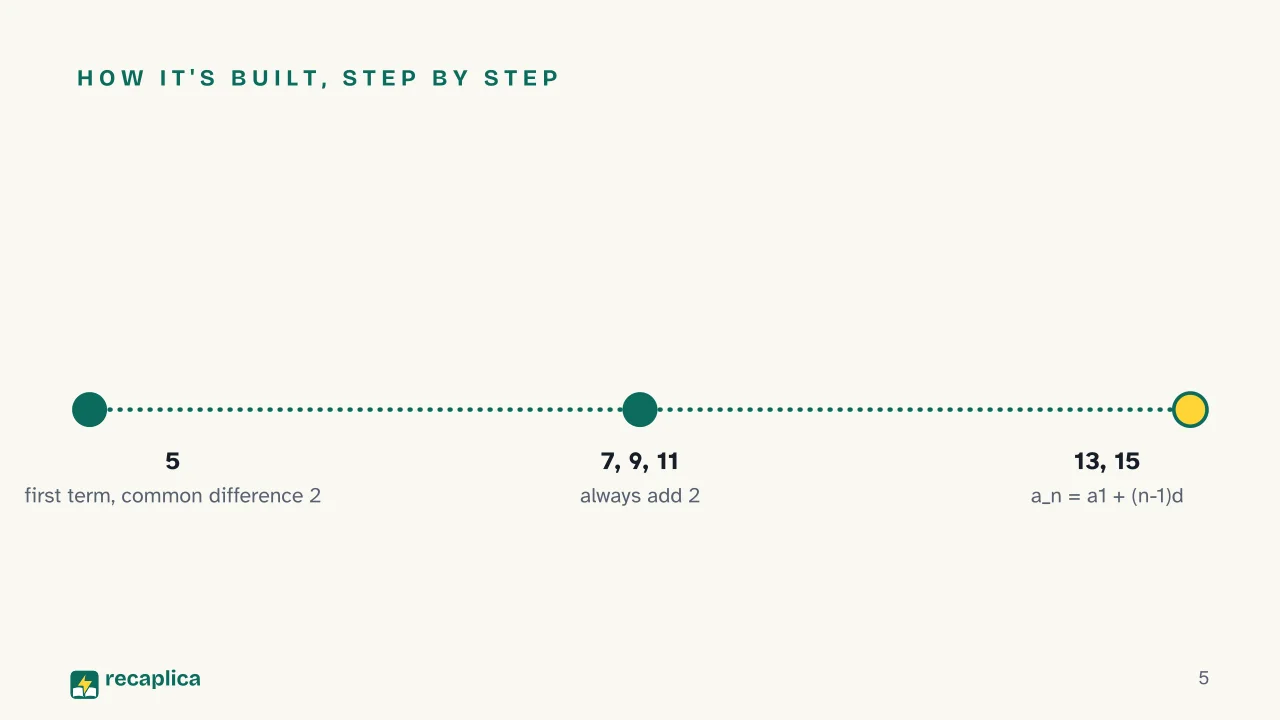
    An arithmetic sequence keeps one quantity fixed: the gap between any two consecutive terms, called the common difference. In 5, 7, 9, 11, 13, 15 that gap is 2.

    An nth term formula gets around having to write the sequence out one number at a time: a_n = a1 + (n-1)d, where a1 is the first term, d is the common difference, and n is the position of the term being sought. Writing a rule with letters standing in for numbers is the same move studied in algebra: a formula that holds for any position, not just the one written out by hand.

    Adding up an arithmetic sequence

    Adding many arithmetic terms one by one isn’t necessary: S_n = n(a1+an)/2 does it in one move — the count of terms times the first plus the last, halved.

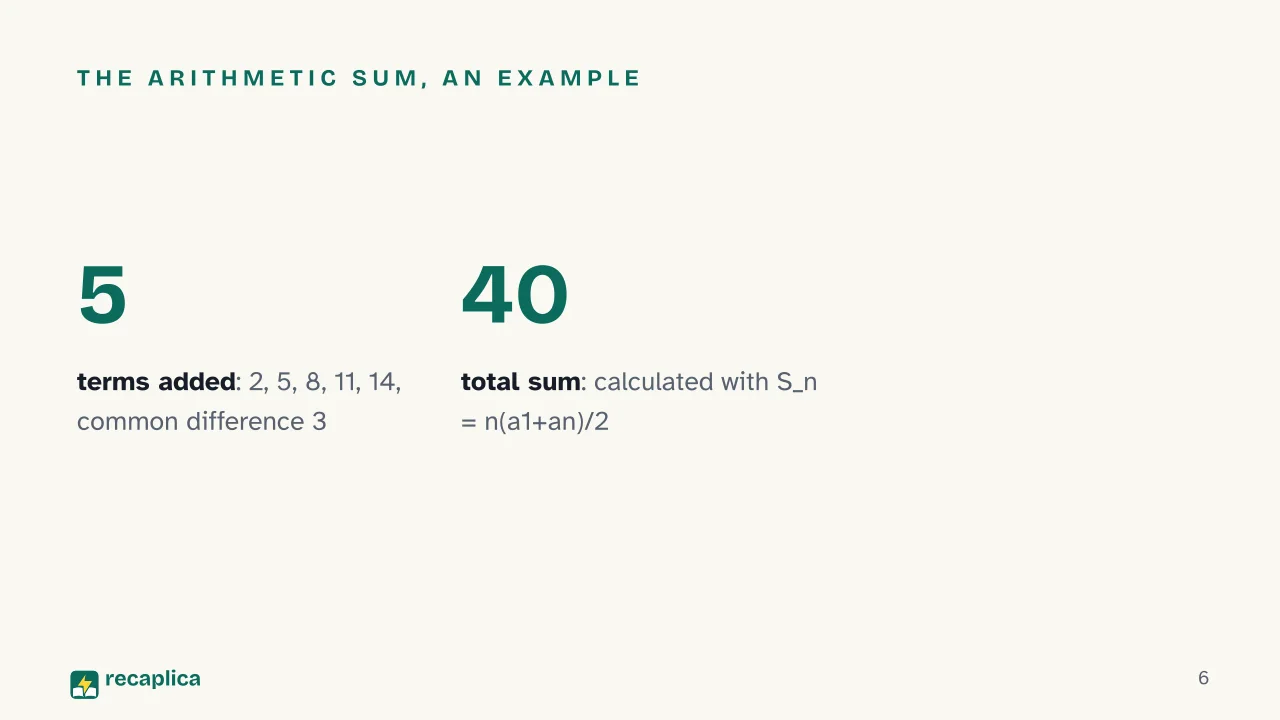
    Worked example: in the sequence 2, 5, 8, 11, 14 (five terms, common difference 3), the sum works out like this: S_5 = 5 × (2+14) / 2 = 5 × 16 / 2 = 40. There’s no need to add the five numbers one by one: the first term, the last term, and the count are enough.

    The geometric sequence: the common ratio that multiplies

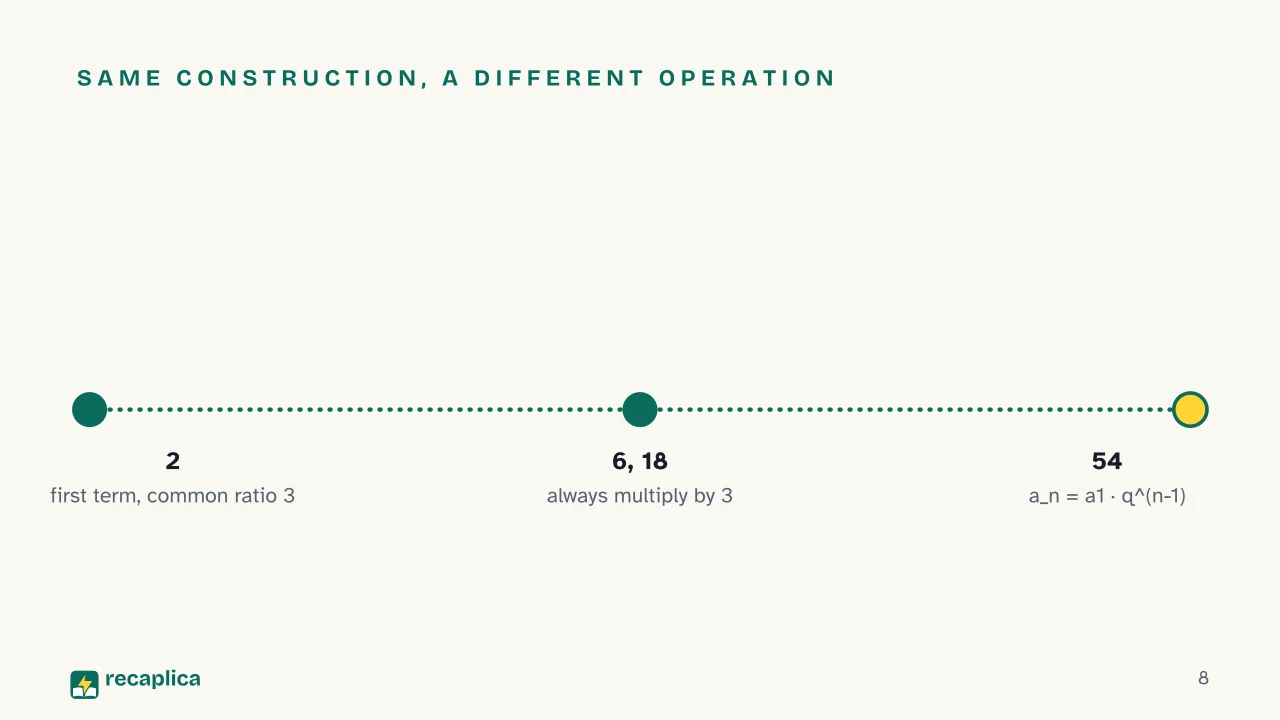
    In a geometric sequence the numbers are never zero, and moving from one term to the next means multiplying by the same fixed number every time: the common ratio. In the sequence 2, 6, 18, 54 the common ratio is 3, because each term is the previous one multiplied by 3.

    The nth term of a geometric sequence is a_n = a1 · q^(n-1), with a1 the first term and q the common ratio. Depending on the value of q, the sequence represents exponential growth, when q is above 1, or exponential decay, when q sits between 0 and 1: the same behavior found when studying exponentials and logarithms.

    Adding up a geometric sequence, finite and infinite

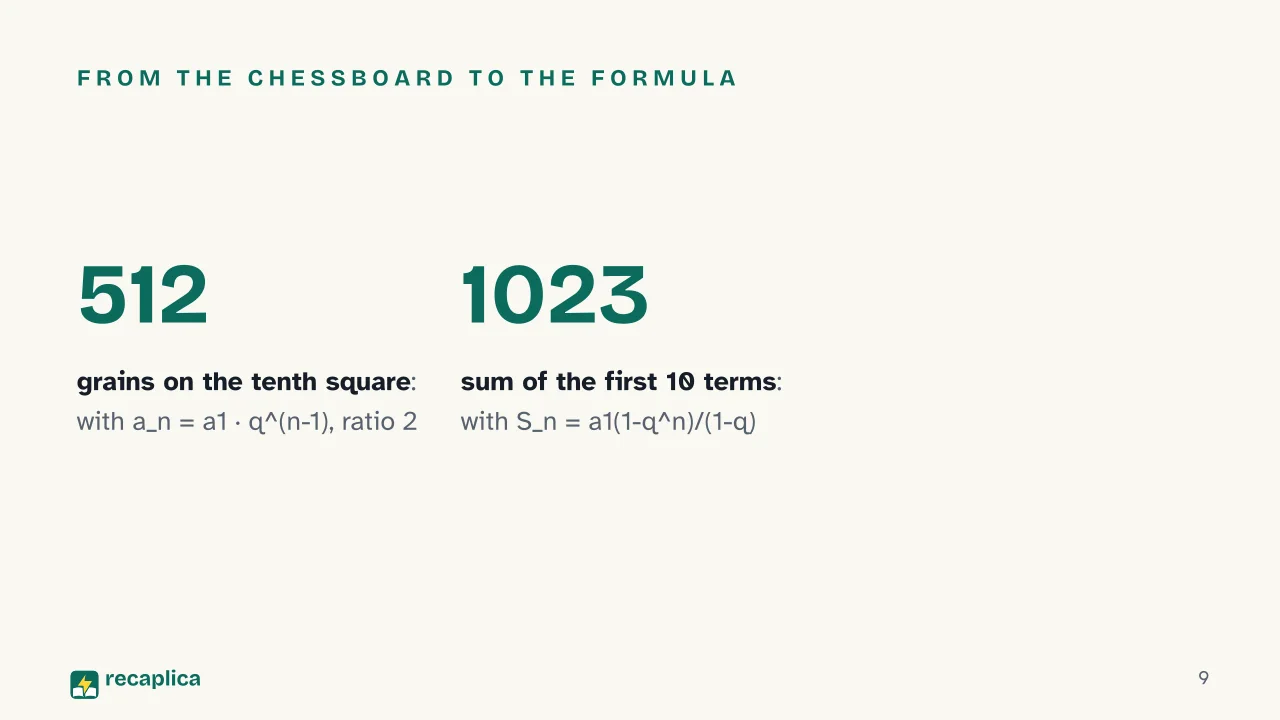
    With a common ratio different from 1, the total of the first n terms of a geometric sequence is given by S_n = a1 · (1-q^n) / (1-q).

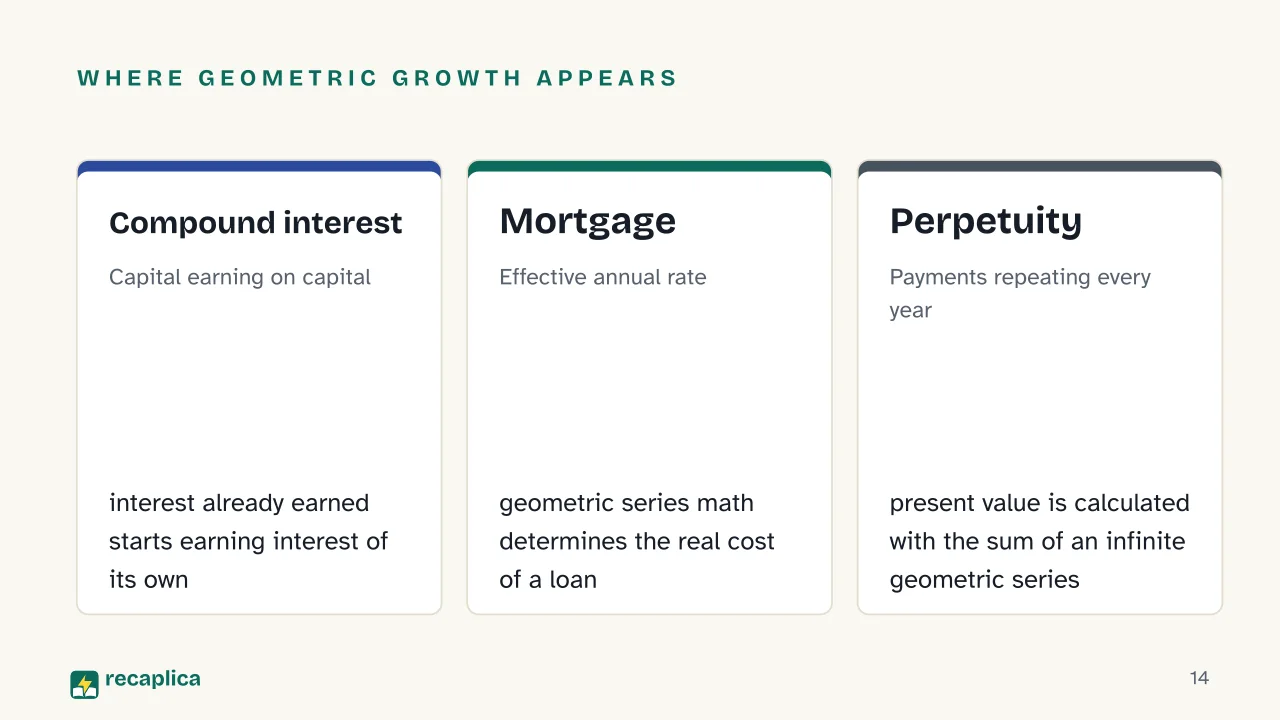
    But keep q between -1 and 1, and something happens that can never happen in an arithmetic sequence, no matter how small its common difference gets: even adding infinitely many terms, one after another forever, without ever stopping, the result stays a finite number rather than growing without bound. In that case the sum of the whole sequence equals a1 / (1-q), because each new term is smaller than the one before it, and the running total keeps approaching a ceiling it never quite reaches. That’s the calculation behind, for example, the present value of a perpetuity, a payment that repeats every year forever: an infinite stream of future money that still adds up, today, to a single finite figure.

    When the ratio is above 1: the wheat and chessboard problem

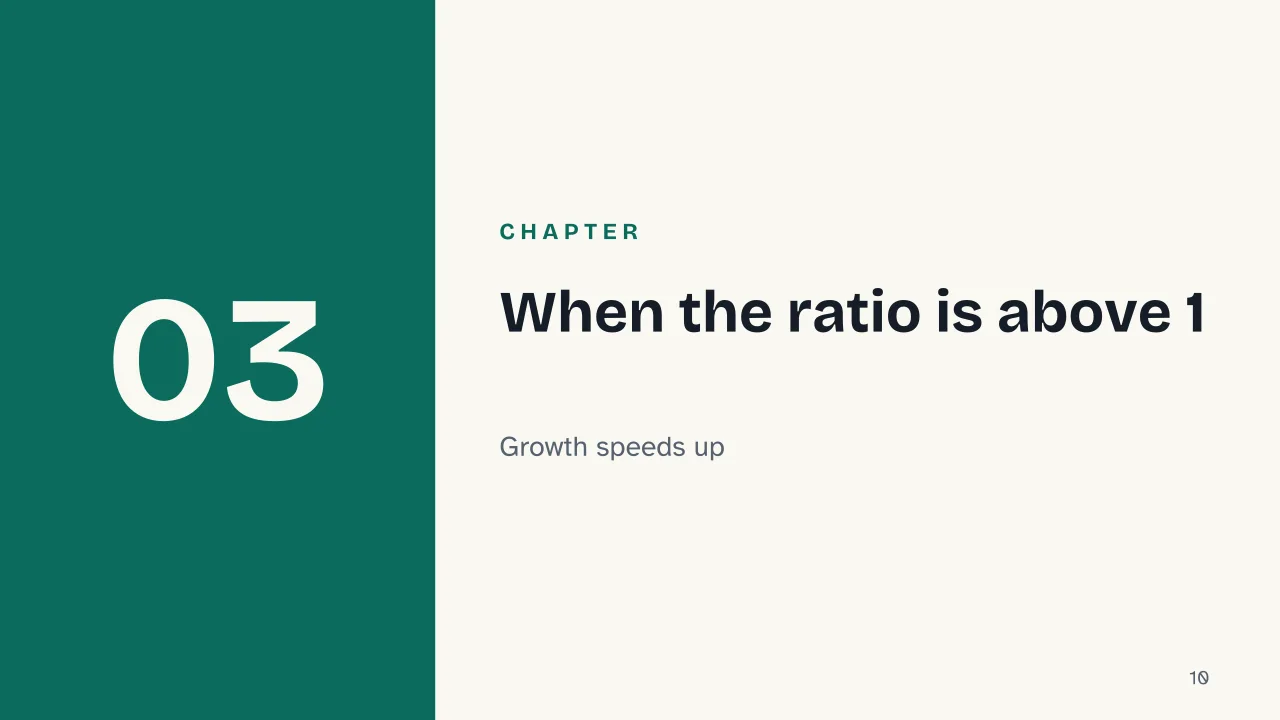
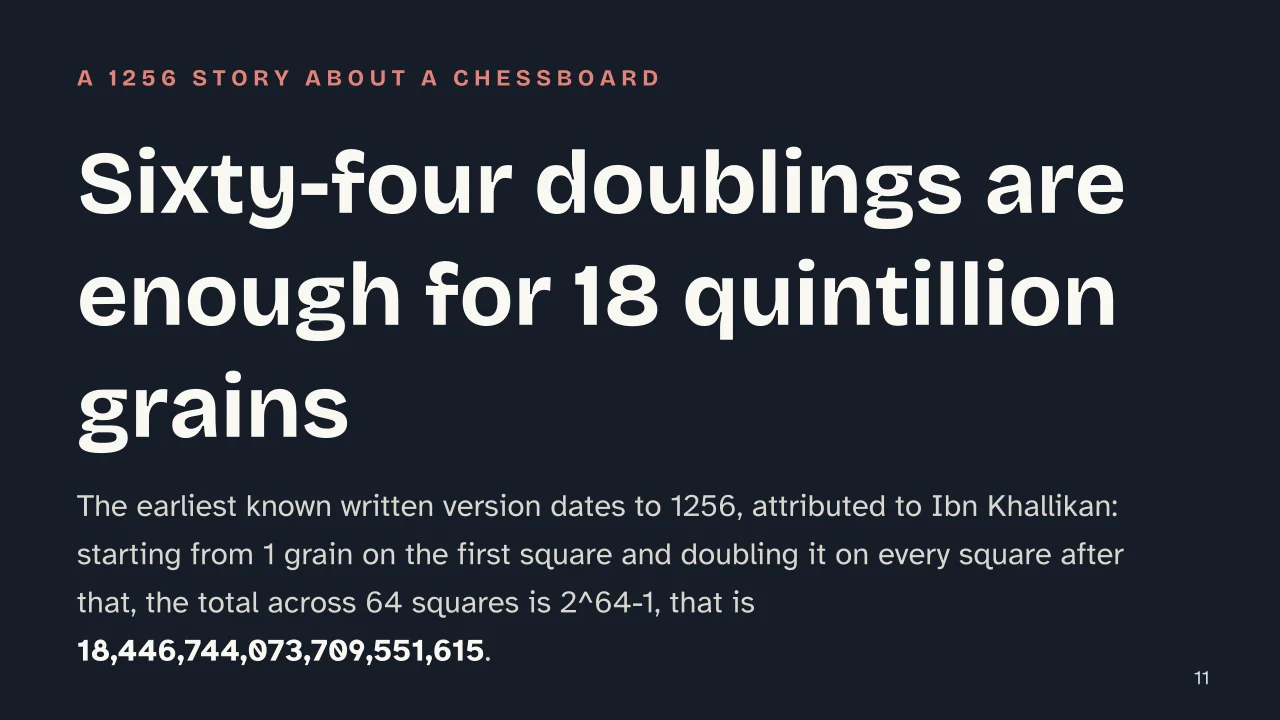
    The opposite case, a ratio above 1, produces growth that quickly outruns everyday intuition. The classic problem shows it well: place 1 grain of wheat on the first square of a chessboard and double it on every square after that, up to the sixty-fourth. The earliest known written version of this story dates to 1256, attributed to Ibn Khallikan.

    The total across the 64 squares is 2^64 - 1, that is 18,446,744,073,709,551,615: a number that a formula writes out in seconds, but that no one could ever count by hand. It’s a special case of the same geometric sum seen above, with first term 1 and ratio 2, and it’s still a direct way to show just how fast geometric sequences grow once the ratio climbs above 1.

    The same kind of growth, though much slower, governs compound interest: interest isn’t calculated only on the initial capital but also on whatever has already accrued in earlier periods, and year after year the added interest starts earning interest of its own. The same mechanism, applied to the cost of a loan such as a mortgage, is what determines its effective annual rate.

    Arithmetic versus geometric: same structure, a different operation

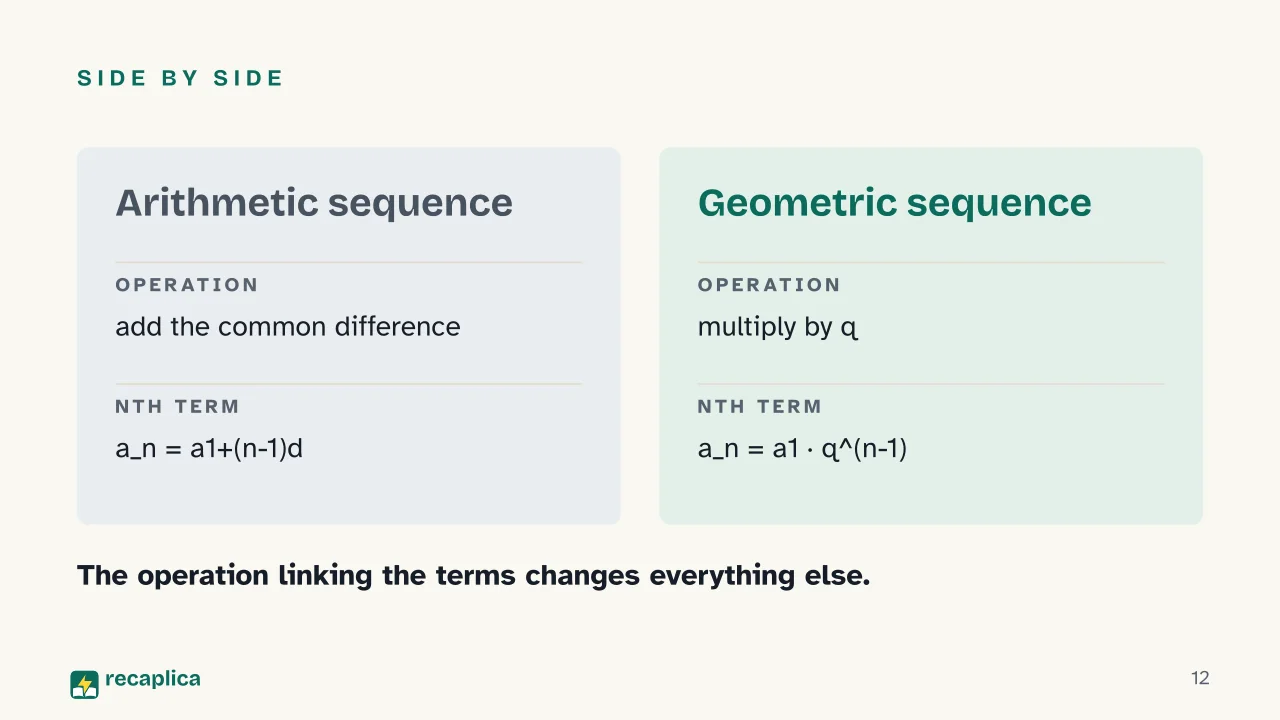
    The two families of sequences share a scaffolding — a first term, a common difference or ratio, an nth term formula, a sum — but the operation linking one term to the next changes everything about how the sequence behaves.

    AspectArithmetic sequenceGeometric sequence
    Operation between a term and the nextadd the common differencemultiply by the common ratio
    Example5, 7, 9, 11, 13, 15 (common difference 2)2, 6, 18, 54 (common ratio 3)
    nth terma_n = a1 + (n-1)da_n = a1 · q^(n-1)
    Sum of the first n termsS_n = n(a1+an)/2S_n = a1(1-q^n)/(1-q), with q ≠ 1
    Sum of infinitely many termsno finite value existsfinite if the absolute value of q is below 1

    Anyone who has already met another recursive rule, the Fibonacci sequence, finds a third case useful for comparison: there, each term depends not on a single fixed common difference or ratio, but on the sum of the two previous terms — neither a constant addition nor a constant multiplication.

    Slide deck

    Slides ready to download and make your own in PowerPoint or Google Slides, with speaker notes. Pick the Flash cut or the Full one.
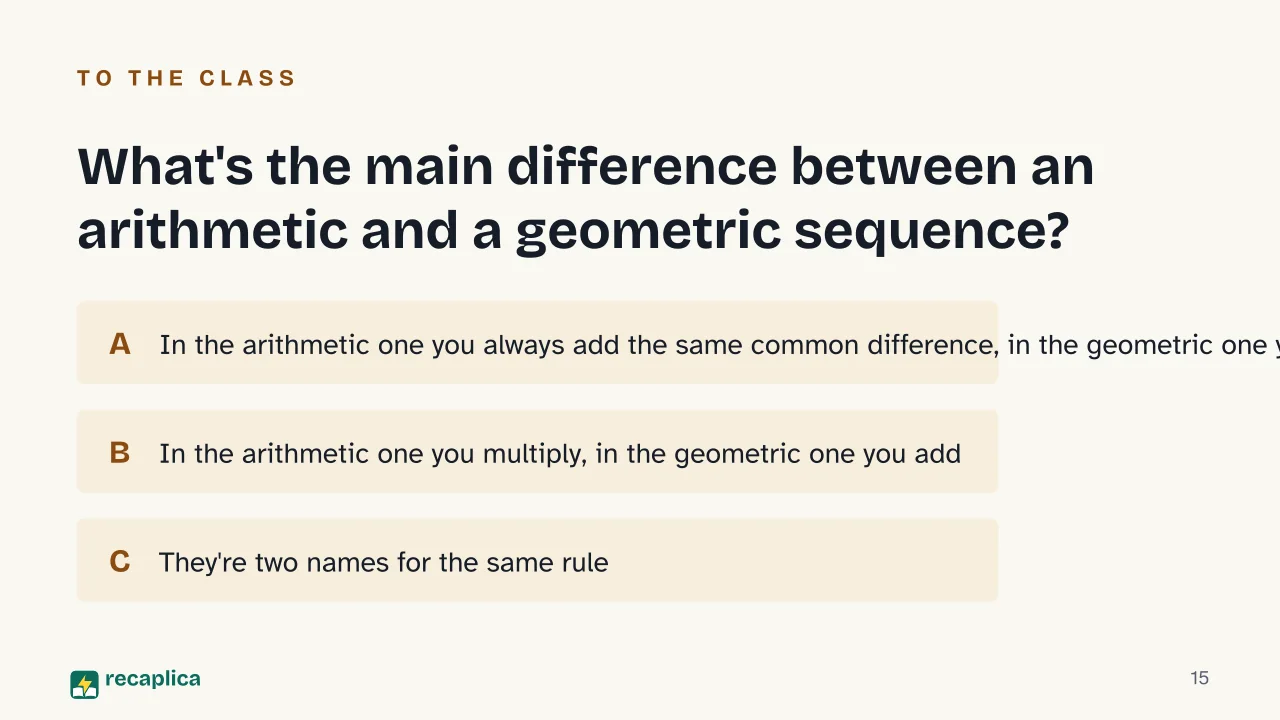
    Slide 1 of the presentation on Arithmetic and Geometric Sequences: Arithmetic and Geometric SequencesSlide 2 of the presentation on Arithmetic and Geometric Sequences: How many grains after sixty-four doublings?Slide 3 of the presentation on Arithmetic and Geometric Sequences: The rule behind every termSlide 4 of the presentation on Arithmetic and Geometric Sequences: Chapter 01: The arithmetic sequenceSlide 5 of the presentation on Arithmetic and Geometric Sequences: How it's built, step by stepSlide 6 of the presentation on Arithmetic and Geometric Sequences: The arithmetic sum, an exampleSlide 7 of the presentation on Arithmetic and Geometric Sequences: Chapter 02: The geometric sequenceSlide 8 of the presentation on Arithmetic and Geometric Sequences: Same construction, a different operationSlide 9 of the presentation on Arithmetic and Geometric Sequences: From the chessboard to the formulaSlide 10 of the presentation on Arithmetic and Geometric Sequences: Chapter 03: When the ratio is above 1Slide 11 of the presentation on Arithmetic and Geometric Sequences: Sixty-four doublings are enough for 18 quintillion grainsSlide 12 of the presentation on Arithmetic and Geometric Sequences: Side by sideSlide 13 of the presentation on Arithmetic and Geometric Sequences: Chapter 04: Where it shows up in real lifeSlide 14 of the presentation on Arithmetic and Geometric Sequences: Where geometric growth appears: Compound interest, Mortgage, PerpetuitySlide 15 of the presentation on Arithmetic and Geometric Sequences: What's the main difference between an arithmetic and a geometric sequence?Slide 16 of the presentation on Arithmetic and Geometric Sequences: The full Recap
    Flash10 slidesThe essential thread, to present in classFull16 slidesEvery chapter and the deeper detail

    Common myths

    • ✗ Myth The sum of the first n terms of a geometric sequence can be calculated with the same formula as an arithmetic one, the number of terms times the sum of the first and last, divided by two.

      ✓ Reality The two formulas are not interchangeable. The arithmetic one works because terms grow by repeated addition, while a geometric sequence grows by repeated multiplication: it needs S_n = a1(1-q^n)/(1-q). Applying the arithmetic formula by mistake to 2, 6, 18, 54 gives a result far from the correct one.

    • ✗ Myth In a geometric sequence the common ratio has to be greater than 1, otherwise the sequence doesn't grow and isn't valid.

      ✓ Reality The common ratio can be any number other than zero. With a ratio between 0 and 1 the sequence decreases toward zero, and it's precisely when its absolute value is below 1 that the sum of infinitely many terms stays finite: a sequence with ratio 0.5 is just as valid as one with ratio 3, only the behavior changes.

    • ✗ Myth A geometric sequence with a negative common ratio doesn't exist, because multiplying by a negative number wouldn't make sense in a sequence.

      ✓ Reality A negative common ratio is allowed and produces a sequence with alternating signs, for example 3, -6, 12, -24. The nth term formula a_n = a1 · q^(n-1) works the same way: the only difference is that the sign of the result flips at every step.

    Mind map

    Drag the background to move around and the nodes to reposition them; use − and + to collapse and expand branches.
    Customize
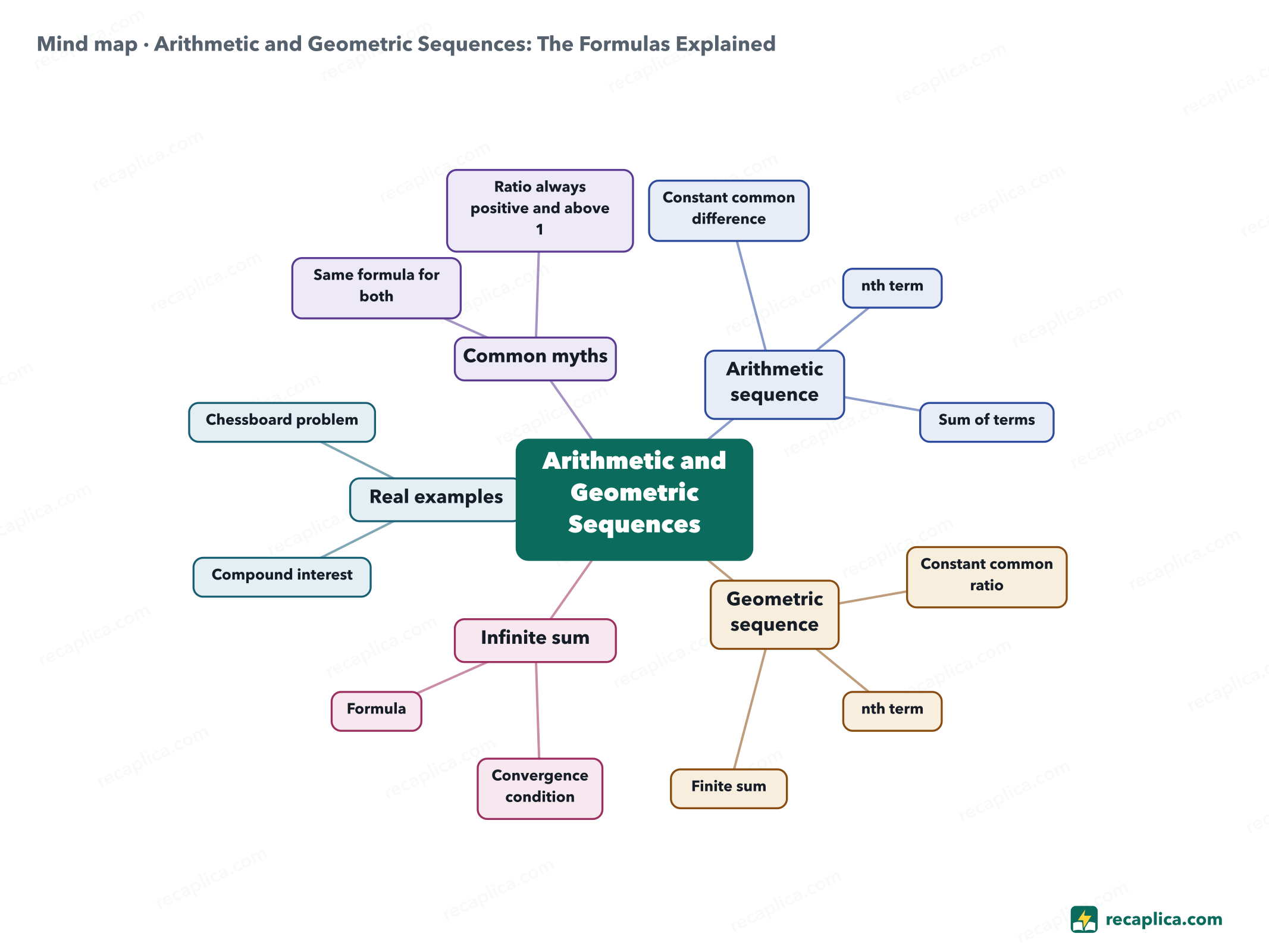
    Mind map: Arithmetic and Geometric Sequences: The Formulas Explained
    • Arithmetic and Geometric Sequences
      • Arithmetic sequence
        • Constant common difference the same number is always added
        • nth term a_n = a1 + (n-1)d
        • Sum of terms S_n = n(a1+an)/2
      • Geometric sequence
        • Constant common ratio the same number is always multiplied
        • nth term a_n = a1 · q^(n-1)
        • Finite sum S_n = a1(1-q^n)/(1-q), with q different from 1
      • Infinite sum
        • Convergence condition absolute value of the common ratio below 1
        • Formula a1/(1-q)
      • Real examples
        • Compound interest geometric growth of capital
        • Chessboard problem 2 to the power 64 minus 1 grains, in the 1256 story
      • Common myths
        • Same formula for both false, the sums are calculated differently
        • Ratio always positive and above 1 false, it can be negative or below 1

    Quiz: test yourself

    Answer the questions to check what you have learned: you get instant feedback and a short explanation.

    Grade 0/10 0/5
    1 What's the main difference between an arithmetic and a geometric sequence?

    In an arithmetic sequence the common difference is added to every term; in a geometric sequence the common ratio multiplies the previous term.

    2 In the sequence 5, 7, 9, 11, 13, 15, what is the common difference?

    The difference between each term and the one before it is always 2, so the common difference d equals 2.

    3 What is the nth term formula of a geometric sequence?

    The nth term of a geometric sequence is the first term multiplied by the common ratio raised to n-1: a_n = a1 · q^(n-1).

    4 When is the sum of infinitely many terms of a geometric sequence a finite number?

    An infinite geometric series converges, meaning it gives a finite sum, only if the absolute value of q is below 1: as n grows the terms shrink toward zero.

    5 In the wheat and chessboard problem, doubling the grains square after square across 64 squares gives a relatively small number. True or false?

    False: the total is 2^64 - 1, that is 18,446,744,073,709,551,615. The story, attributed to Ibn Khallikan, dates to 1256.

    Answers: 1-A · 2-B · 3-B · 4-C · 5-B

    Flashcards

    Tap the card to flip it and check whether you remember the answer, then move to the next one.

    1 / 8

    Explain it in your own words

    The ultimate test: if you can explain it in simple words, you've truly understood it. Write your explanation, then compare it with the Recap.

    Your explanation is saved only on this device.

    A sequence is an ordered list of numbers that follows a fixed rule. In an arithmetic sequence, each term is the previous one plus the same fixed number, the common difference; in a geometric sequence, each term is the previous one times the same fixed number, the common ratio. Two formulas are enough to find any term or the sum of many terms without writing them all out. The same logic of repeated multiplication explains why compound interest, or the wheat and chessboard problem, grows so fast.

    Frequently asked questions

    What are arithmetic and geometric sequences?

    They're two types of numerical sequences built from a fixed rule. In an arithmetic sequence the same common difference is always added to the previous term; in a geometric sequence the previous term is always multiplied by the same common ratio. The first grows (or shrinks) linearly, the second exponentially.

    What's the difference between a sequence and a progression?

    A numerical sequence is simply an ordered list of numbers. An arithmetic or geometric progression is a sequence that also follows a fixed rule, such as always adding the same common difference or always multiplying by the same common ratio. In English the two words are often used interchangeably for these cases.

    How do you find the nth term of a sequence?

    For an arithmetic sequence, use a_n = a1 + (n-1)d, with a1 the first term and d the common difference. For a geometric sequence, use a_n = a1 · q^(n-1), with q the common ratio. In both cases, knowing the first term, the common difference or ratio, and the position n is enough to find any term without writing out the whole sequence.

    How do you add up an arithmetic or geometric sequence?

    To add many terms without summing them one by one, two different formulas apply: for an arithmetic sequence, S_n = n(a1+an)/2; for a geometric one (common ratio different from 1), S_n = a1(1-q^n)/(1-q). If the absolute value of the common ratio is below 1, even the total of infinitely many terms stays finite and equals a1/(1-q).

    Why is the wheat and chessboard problem an example of a geometric sequence?

    Because it starts from 1 grain and doubles it square after square up to the 64th: that's exactly the pattern of a geometric sequence with common ratio 2, and the final total is 2^64-1, that is 18,446,744,073,709,551,615. The story, in its earliest known written version, is attributed to Ibn Khallikan and dates to 1256.

    Sources

    • Arithmetic progression — Wikipedia
    • Geometric progression — Wikipedia
    • Geometric series — Wikipedia
    • 6.04: Compound Interest — Contemporary Mathematics, LibreTexts/OpenStax
    • Wheat and chessboard problem — Wikipedia

    Every Recap goes through an independent review before publication.

    Every evening, the day's new Recaps on our Telegram channel. Join the channel →

    Keep learning

    • Science Correlation: What It Means and How to Read the Coefficient Correlation measures how closely two variables move together, and the most common way to put a number on it is the correlation coefficient, which runs from -1 to +1. A value near +1 means the two variables rise together, near -1 means one rises while the other falls, and near 0 means no linear relationship stands out. The coefficient only captures the strength of a straight-line relationship, and a single unusual data point can push it up or down by a lot. Even when it's strong, a correlation between two variables never shows that one causes the other. Read the Recap →
    • Science Light Refraction: What It Is, the Laws Behind It, and Examples A surface that separates two transparent materials sends some light back, reflecting it, and lets the rest through while bending it toward a new direction. The law of reflection keeps the incoming and outgoing angles equal, both measured from the normal to the surface. Snell's law governs refraction instead, linking the index of each material to how much the ray tilts before and after it crosses over. These two laws alone explain mirrors, lenses, prisms and everyday sights such as a pencil that appears to snap inside a glass of water. Read the Recap →
    • Science Total Internal Reflection and the Critical Angle: Definition and Formula Total internal reflection is what happens when a light ray stops being able to leave a transparent medium and gets sent back inside it completely. It takes place past a specific angle of incidence, called the critical angle, calculated with Snell's law by comparing the refractive indices of the two materials involved. It only happens under one precise condition: the ray must be traveling from an optically denser medium into a less dense one, such as from water into air or from glass into air. Optical fibers and, in part, the sparkle of diamonds rely on this same principle. Read the Recap →

    recaplica

    Clear in 30 seconds, yours in 10 minutes.

    Recaps Mind maps Request a Recap Telegram channel Mind map maker Our method About Privacy & cookies Legal notes & terms of use

    © 2026 Recaplica · A project by Curi S.r.l. — VAT IT05472000750

    Statistics, only if you say so

    To learn which Recaps help most we would use Google Analytics, with aggregate, anonymous data. It starts only with your OK, and you can change your mind anytime. Privacy policy