|
recaplica
Logarithms Explained: What Exponentials and Logarithms Are Really For | |||||||||||||||
| © 2026 Recaplica · recaplica.com — All rights reserved | |||||||||||||||
Logarithms Explained: What Exponentials and Logarithms Are Really ForWhat to print Page numbers appear when printing with default margins. In 30 seconds quick readAn exponential raises a fixed base to a power that changes; a logarithm runs the same path backward, asking which power the base must reach to produce a given number. John Napier published logarithms in 1614 to replace tedious multiplication and division with simple addition. They describe phenomena that grow or shrink by a constant factor, such as radioactive decay, and they read scales that squeeze huge numbers into a handful of steps, such as earthquake magnitude, pH and decibels. The link between the two operations is why they keep showing up together, in physics, chemistry and acoustics. Key Points
Key figures
Deep DiveTwo sides of the same functionAn exponential starts from a fixed base and an exponent that changes: 2 raised to x doubles the result with every extra step on the exponent. A logarithm runs the opposite path: it asks which power the base must reach to arrive at a given number. If 2 cubed is 8, the logarithm of 8 in base 2 is 3. Applied one after the other, the two operations cancel each other out. That link is not an exercise detail. It is the reason a logarithm shows up whenever something grows or shrinks by multiplying by the same factor at each step, rather than by adding the same amount every time. Napier and the burden of calculationJohn Napier published logarithms in 1614, in the Mirifici Logarithmorum Canonis Descriptio, as the MacTutor History of Mathematics biography of Napier records. Napier explained that he had devised them to remove the burden of calculating with large numbers: multiplication, division and root extraction. The idea was to replace numbers that require multiplication and division with other numbers — logarithms — that reach the same result through plain addition and subtraction. The symbolic manipulation that makes those numbers workable is the same groundwork covered in Algebra: What It Is and How Symbolic Notation Works. When growth is a factor, not a sumAccording to the physics notes of College Physics (Lumen Learning/OpenStax), radioactive decay follows an exponential law: N = N0 · e^(-λt), where the number of remaining nuclei N falls over time from the starting number N0. The half-life is the time it takes for half the nuclei in a sample to decay.
The logarithm enters here as a way to invert the exponential: knowing how much radioactive material is left, it lets you work out the elapsed time directly, instead of testing one value after another. Isolating an unknown sitting in the exponent, step by step, is the technique covered in Exponential Equations: How to Solve Them, With Worked Examples. When the scale itself is logarithmicSome measurement scales are built as logarithms from the start, to compress numbers that would otherwise range from tiny fractions to billions. For earthquakes, according to the USGS Yellowstone Volcano Observatory, each extra unit on the magnitude scale corresponds to seismic waves with 10 times the amplitude: a magnitude-4 earthquake produces waves 10 times the amplitude of a magnitude-3 one. The original magnitude relation was defined by Richter and Gutenberg in 1935, for local earthquakes. In terms of energy released, rather than amplitude alone, USGS publications put a magnitude-7 earthquake at roughly 30 times the energy of a magnitude-6 one, and a magnitude-8 earthquake at roughly 900 times as much: the effect multiplies by about 30 for every unit of magnitude. The mechanism behind those waves is covered in Volcanoes and Earthquakes: Why the Earth Shakes. pH works the same way. According to the EPA’s CADDIS, pH is the negative base-10 logarithm of the hydrogen ion concentration in an aqueous solution: each one-unit change corresponds to a factor of 10 in concentration, so a two-unit difference means a factor of 100. The decibel is also a logarithmic unit. OSHA notes that a small change in the decibel count corresponds to a large change in sound pressure: doubling the physical sound power adds only 3 dB to the scale, and sound pressure drops by 6 dB every time the distance from a point source doubles.
Where they meet againExponentials and logarithms belong to the toolkit covered in Calculus: What It Is and How It Works, alongside limits and derivatives. The Richter scale, pH and the decibel share the same structure: a small number on the scale corresponds to a large factor in the underlying quantity it describes. Common myths
Mind mapDrag the background to move around and the nodes to reposition them; use − and + to collapse and expand branches. 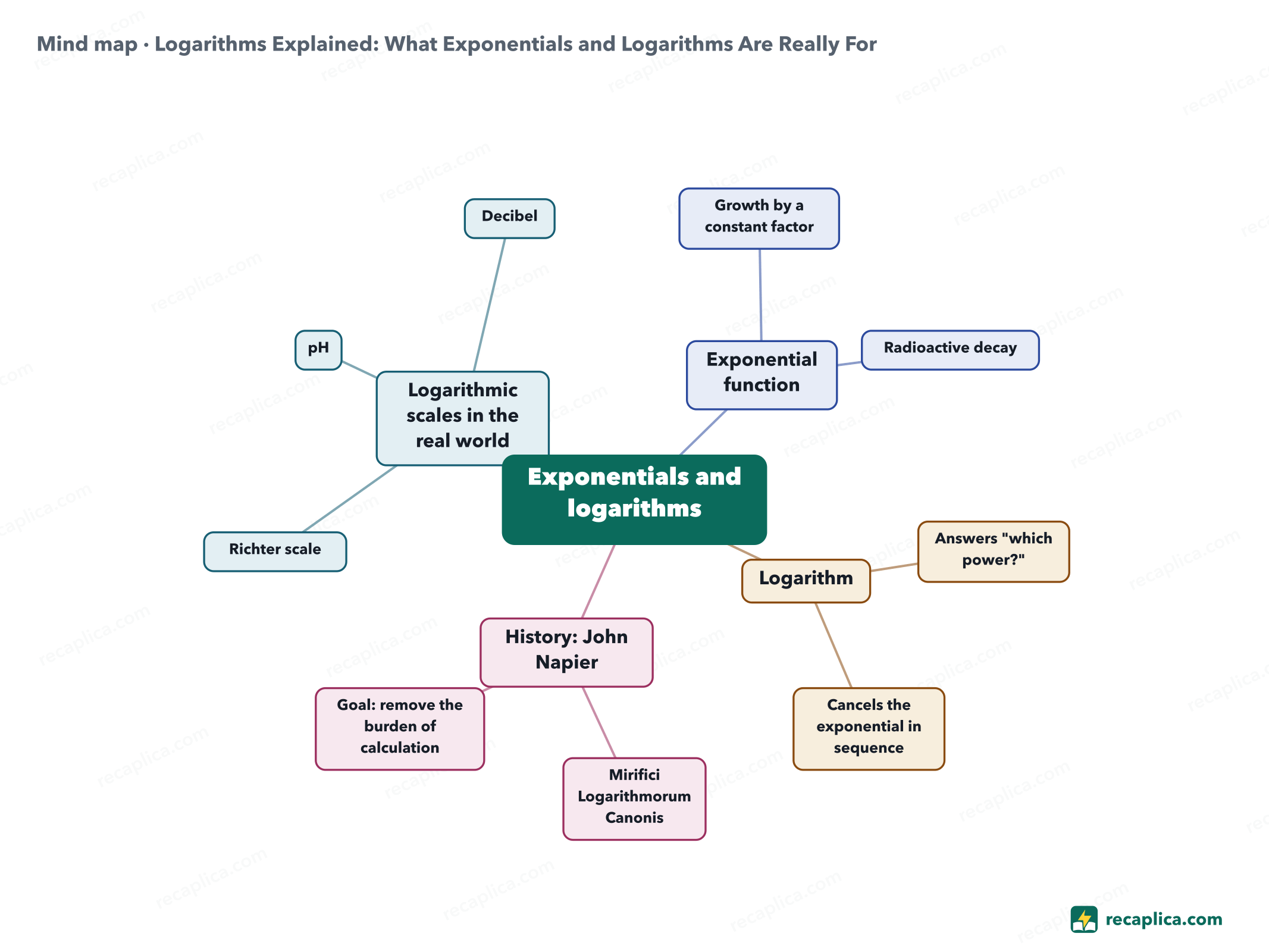
Quiz: test yourselfAnswer the questions to check what you have learned: you get instant feedback and a short explanation. Grade 0/10 0/5
FlashcardsTap the card to flip it and check whether you remember the answer, then move to the next one. 1 / 8 Explain it in your own wordsThe ultimate test: if you can explain it in simple words, you've truly understood it. Write your explanation, then compare it with the Recap. Your explanation is saved only on this device.
Frequently asked questionsWhat is the difference between an exponential and a logarithm?They are inverse operations. The exponential starts from a base and an exponent and returns a number; the logarithm starts from that number and the base, and returns the exponent that connects them. What are logarithms really used for in real life?They read quantities that vary over enormous ranges with a compressible scale. Earthquake magnitude, the pH of solutions and sound decibels are all logarithmic scales, built to make numbers manageable when the smallest and largest values would otherwise differ by dozens of digits. What is an exponential function, in practice?A function of the form a raised to the x, where the variable x sits in the exponent: it describes growth, or decay if the base is smaller than 1, where each step multiplies by the same fixed factor. How do you solve an exponential equation using logarithms?You apply a logarithm to both sides of the equation, moving the unknown from the exponent into a multiplying factor. The concrete steps, with worked examples, are in the Recap on Exponential Equations (/en/science/exponential-equations/). Why are logarithms and exponentials called inverse functions?Because applying them in sequence, in the right order, cancels the effect out: the logarithm in base b of b raised to x simply returns x, and the same works in reverse. Every Recap goes through an independent review before publication. |