|
recaplica
Giuseppe Parini: Life, The Day, and the Satire of the Nobility |
| © 2026 Recaplica · recaplica.com — All rights reserved |
Giuseppe Parini: Life, The Day, and the Satire of the NobilityWhat to print Page numbers appear when printing with default margins. SlidesChoose a cut Flash10 slidesThe essential thread, to present in classFull16 slidesEvery chapter and the deeper detailBoth come with speaker notes. In 30 seconds quick readGiuseppe Parini was born in Bosisio in 1729, became a priest without a real calling in 1754, and taught eloquence in Milan at the Scuole Palatine. His major work, The Day, tells in unrhymed verse the story of one day in the life of a Milanese nobleman, the «giovin signore», from waking to sleep, using the solemn style of epic poetry to expose how empty that day really is. Alongside the poem he wrote the Odes, developed over nearly forty years, and the Dialogue on Nobility, a direct attack on the privileges of birth. Close to, but never fully aligned with, Pietro Verri's Enlightenment circle at the Caffè, he left behind a model of committed poetry that Foscolo and Manzoni would each take up in their own way. Key Points
Deep DiveGiuseppe Parini was born in Bosisio on 23 May 1729, the son of a silk merchant. He studied at the Barnabite schools in Milan, and at twenty-three published Alcune poesie di Ripano Eupilino (1752), a debut that opened the doors of the Accademia dei Trasformati, a circle of gentlemen and men of letters open to the ideas of progress. It was there, from 1754 onward, that Parini crossed paths with Pietro and Alessandro Verri and Cesare Beccaria, who were at the same time pursuing radical proposals for legal and economic reform. In 1754 he was ordained a priest, without any real calling: an income arranged for him by an aunt let him take his vows. It was the first of a series of posts that marked out his life in Milan: tutor to the duchess Vittoria Serbelloni from 1754 to 1762, editor of the Gazzetta di Milano in 1768, holder of the chair of eloquence at the Scuole Palatine from 1769, and superintendent of public schools from 1791. He died in Milan on 15 August 1799, in his own apartment at Palazzo Brera. That morning he dictated, then copied out by hand, the sonnet Predaro i Filistei; he died in the afternoon. The Day: the satire of the giovin signoreThe Day is the poem that secured Parini’s place in the history of Italian literature. Originally planned in three parts and later split into four, it belongs to the genre of the didactic poem and is written in unrhymed hendecasyllables. Its protagonist is the “giovin signore”, a Milanese nobleman whose day the poem follows from waking to sleep: getting up, breakfast, having his wig arranged, paying visits. The satirical effect comes from a precise gap: Parini narrates these trivial, everyday gestures in the lofty style of epic poetry, a heavily classical vocabulary applied to it. The giovin signore’s ordinary acts are painted as though they were the feats of an epic character.
Parini published only two of the poem’s four parts in his lifetime: Morning in 1763, which contains the opening statement of the poem and the address to the young nobleman, and Midday in 1765, where the setting widens and more characters gather around the protagonist. A third part, first conceived as a single unit, later split into Evening and Night: both stayed unfinished at Parini’s death in 1799 and were published posthumously in 1801. Odes and Dialogue on Nobility: the other worksAlongside The Day, Parini spent nearly forty years working on his Odes, from Rustic Life in 1757 to The Muse in 1795. The surviving prints and manuscripts show a more or less extensive process of revision on each ode: Parini kept reworking them over time. The Dialogue on Nobility, a prose work from 1757, is his most direct attack on inherited privilege: Treccani’s introduction to the Classici Ricciardi edition calls it the text in which Parini’s polemic against the nobility reaches its most forceful form. The aim is close to that of The Day - dismantling the claim that noble birth means superiority - but the register changes: here there is no mediation through epic irony, the argument is stated directly. Parini and the Lombard EnlightenmentIn the Milan of Maria Theresa of Austria, Enlightenment ideas - encouraged by the historical scholarship of Ludovico Antonio Muratori and welcomed by the empress’s enlightened absolutism - fostered a committed strand of progressive thought, and the Accademia dei Trasformati was one of its meeting places. It was there that Parini came to know Pietro and Alessandro Verri and Cesare Beccaria. His relationship with Pietro Verri, though, was not a good one precisely during the years of the journal Il Caffè, the publication that gave voice to Milan’s most radical Enlightenment group. Parini nonetheless remained within Lombard progressive circles, sharing their demand for “things, not words”. The difference lies in how he applied that demand to literature: he rejected the empty, purely formal revival of classical tradition typical of much exhausted Arcadian poetry, and sought instead an active reappropriation of that tradition, renewing the use of classical form. The legacy on Foscolo and ManzoniParini’s reputation in the nineteenth century passed through two exceptional readers. Ugo Foscolo, in the Ultime lettere di Jacopo Ortis, celebrates him as a pre-Risorgimento figure. Alessandro Manzoni, in the Carme in morte di Carlo Imbonati, names him instead as a model of disinterested poetic commitment, of a literature driven by useful, social aims - the same tension that runs through The Day and the Dialogue on Nobility. These are two different readings of the same author: where Foscolo sees an early stirring of national feeling, Manzoni sees an ethical model of civic poetry. Both converge on the point that makes Parini a reference for the generation after him: he put poetry in service of a moral judgment on the society of his time. Readers who want to follow how this idea of committed literature took different paths in the following decades can read the Recap on Ugo Foscolo and on Last Letters of Jacopo Ortis, or the one on Alessandro Manzoni and The Betrothed. For the theatrical side of the same eighteenth-century Milan, the Recap on Carlo Goldoni and the Reform of Comedy tells another face of the same century. Slide deckSlides ready to download and make your own in PowerPoint or Google Slides, with speaker notes. Pick the Flash cut or the Full one.   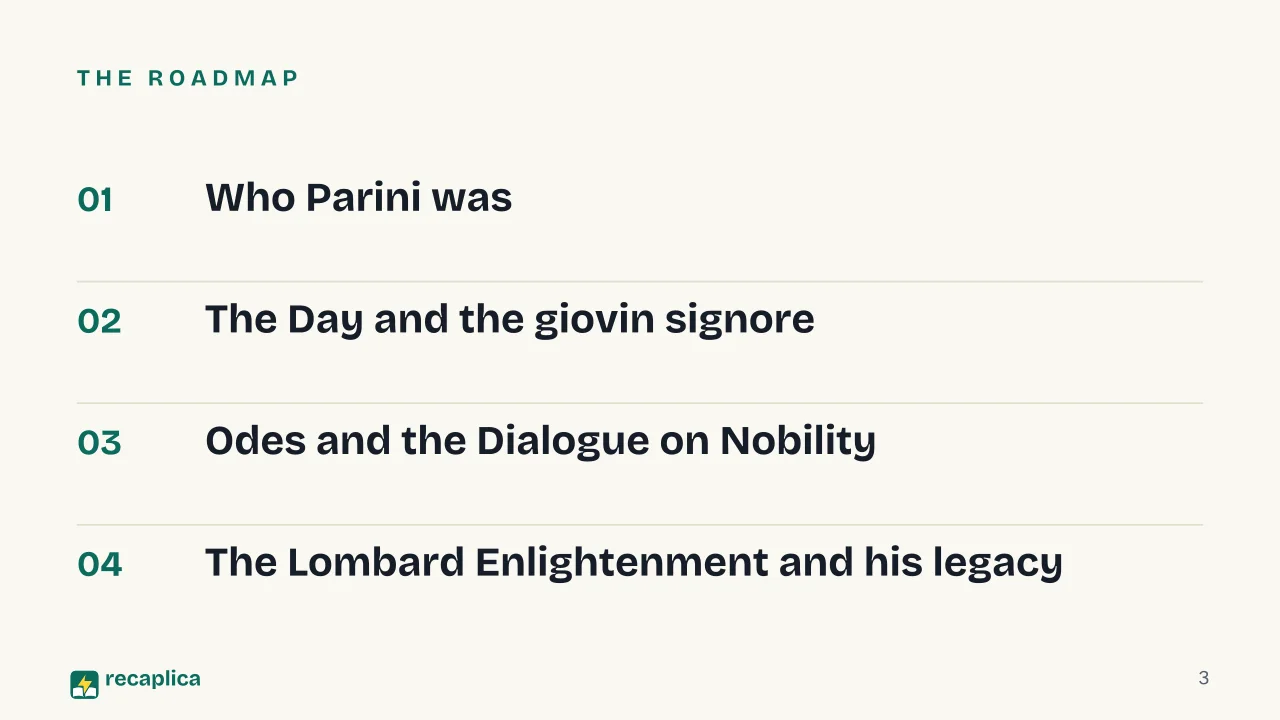  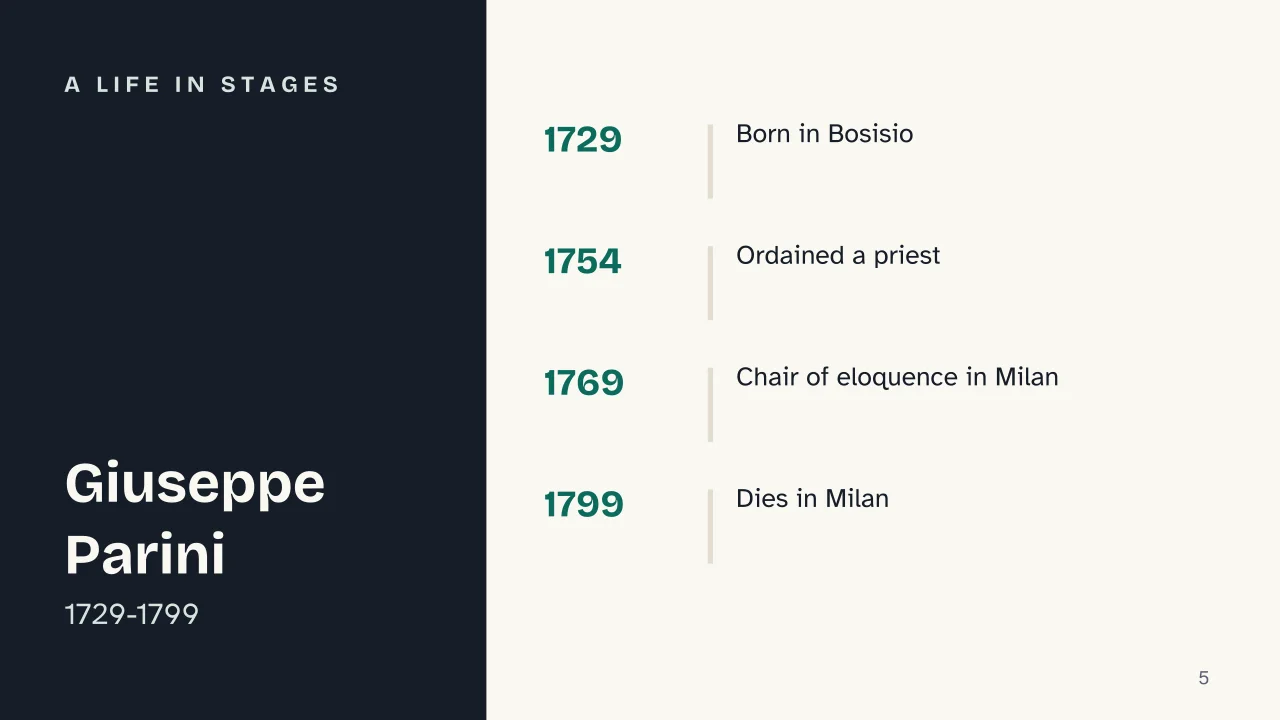  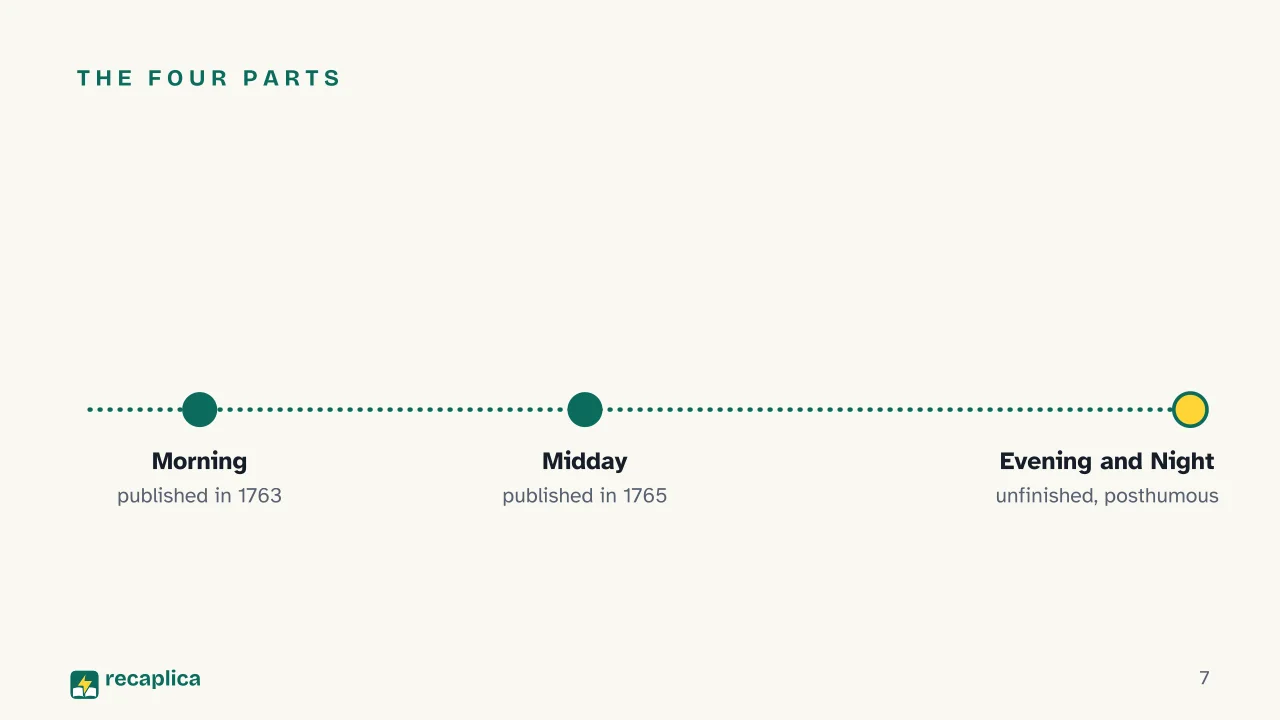 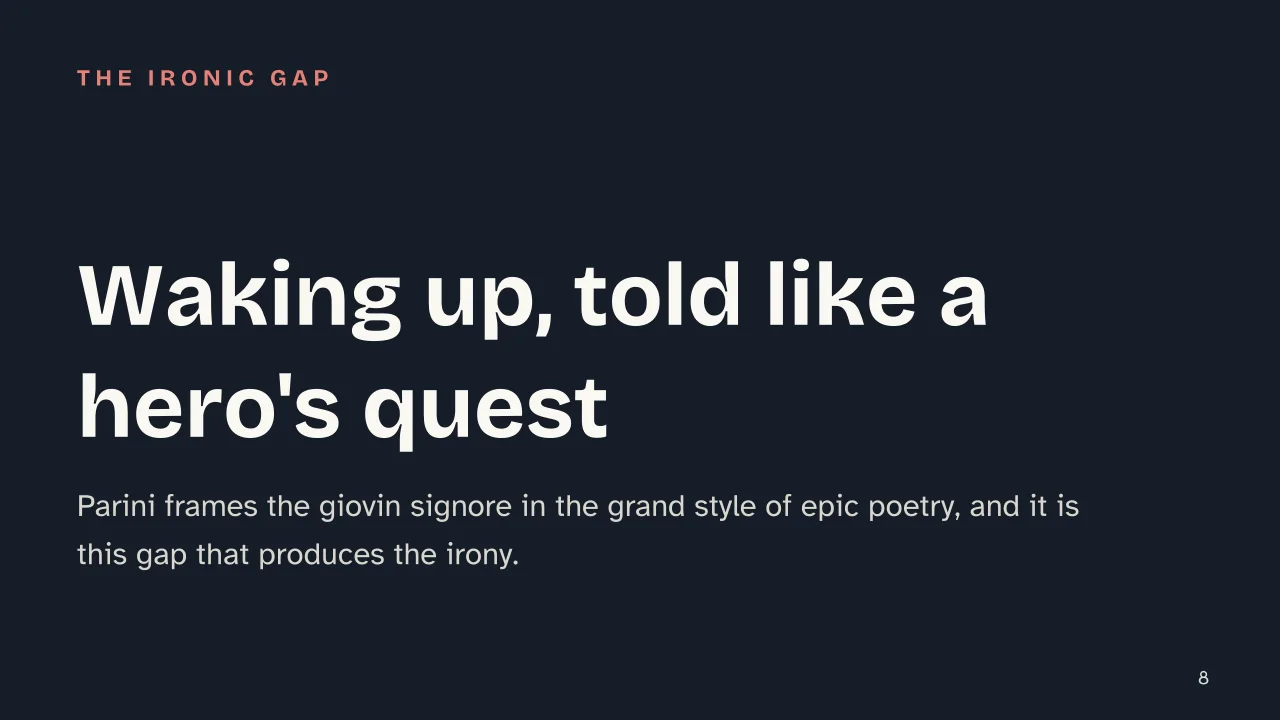  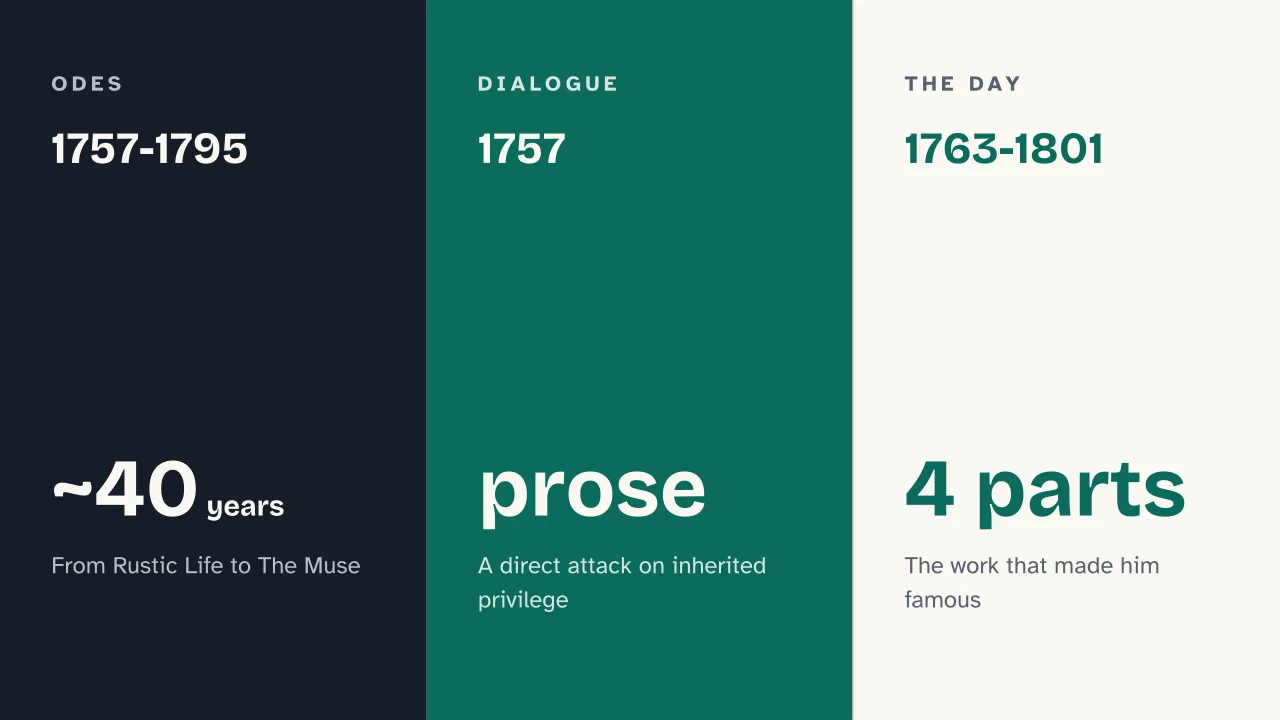  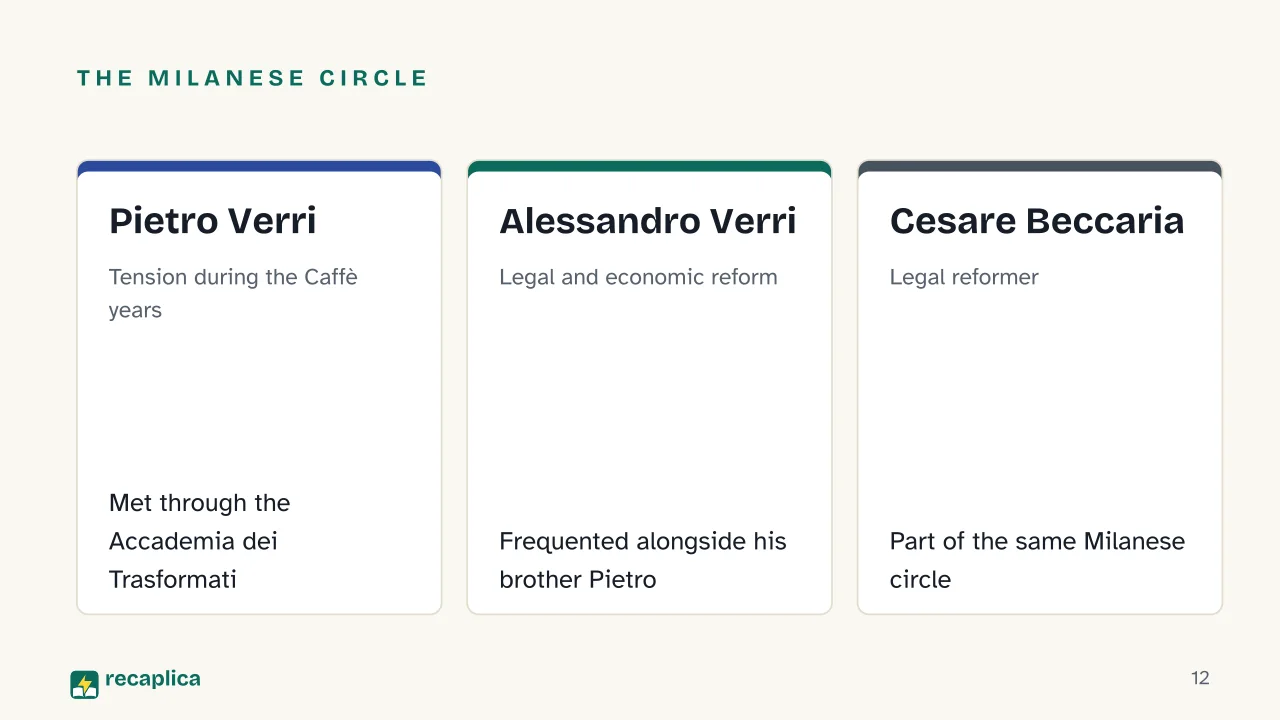 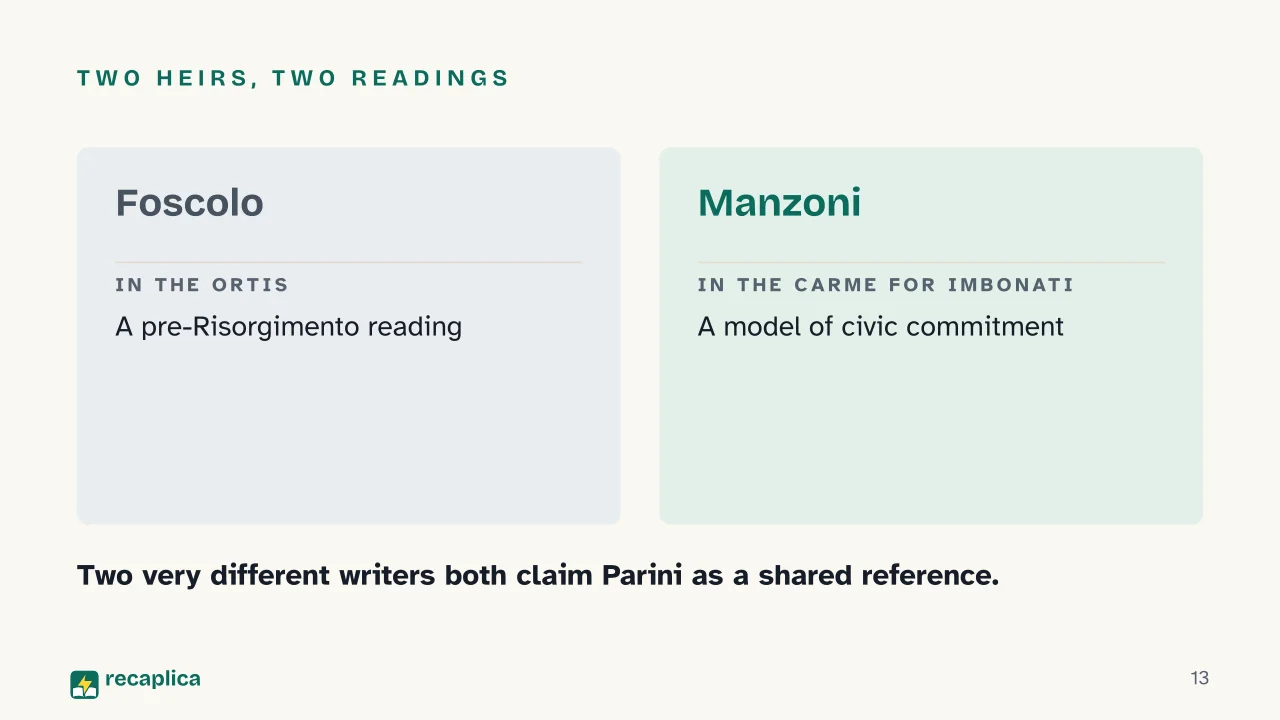 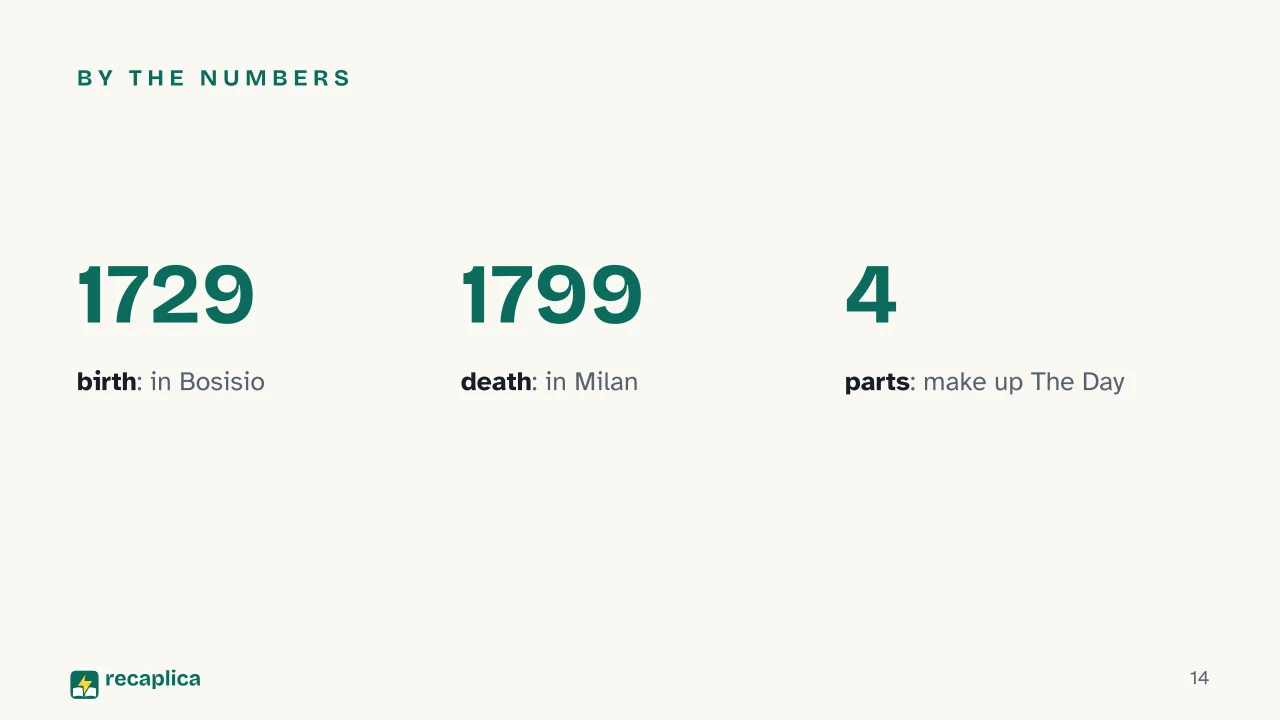 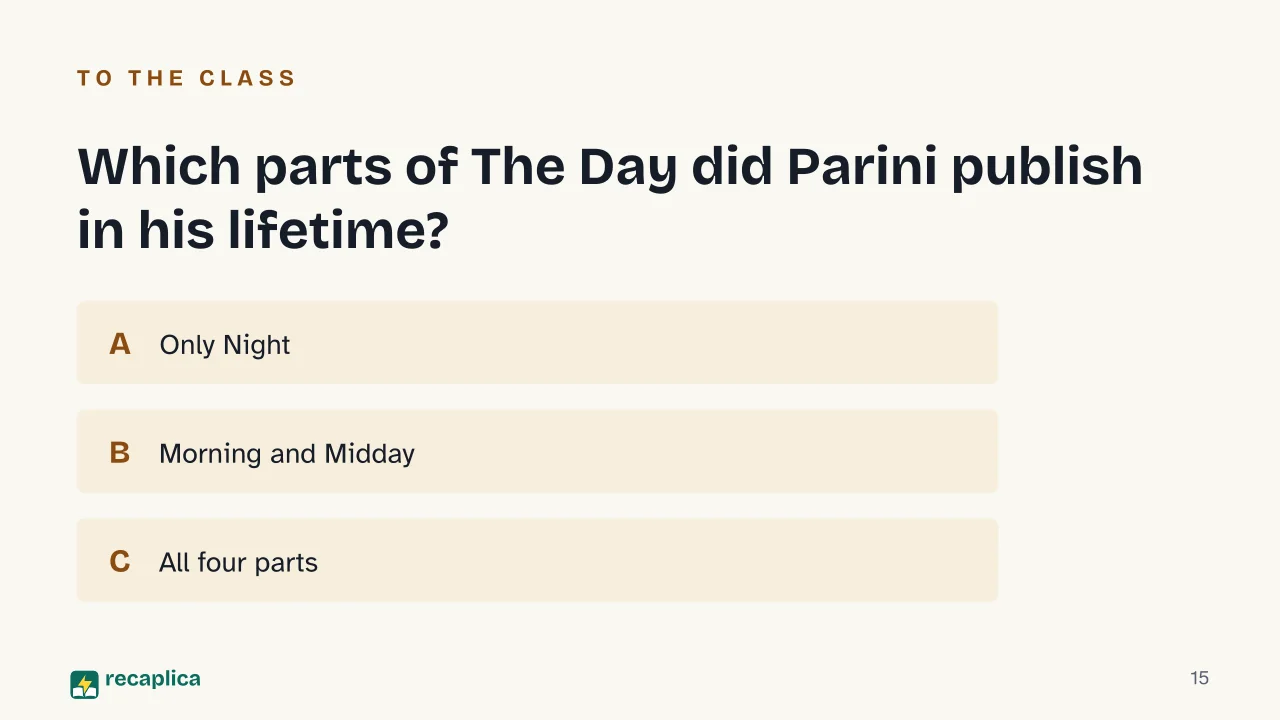  Common myths
Mind mapDrag the background to move around and the nodes to reposition them; use − and + to collapse and expand branches. 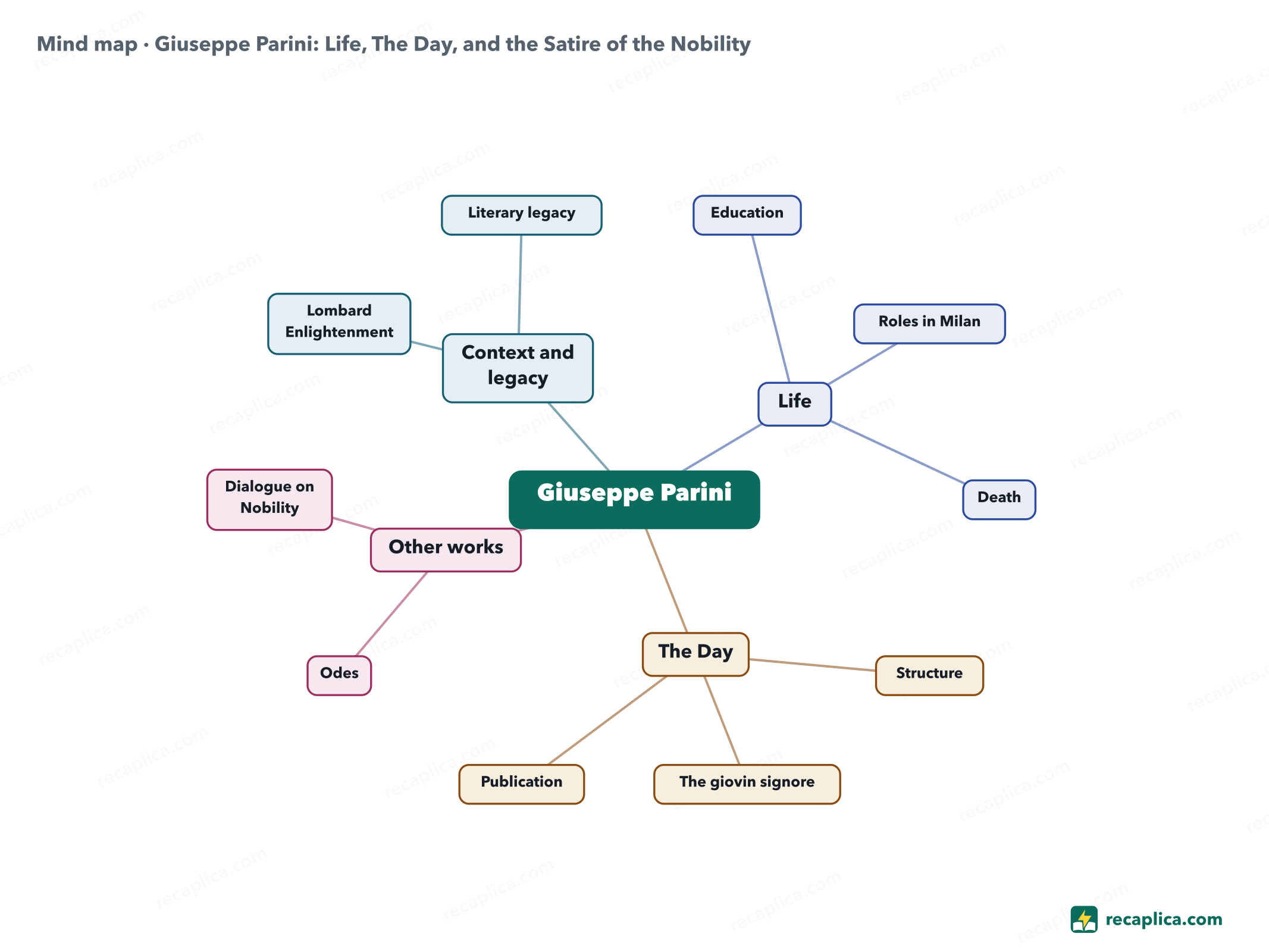
Quiz: test yourselfAnswer the questions to check what you have learned: you get instant feedback and a short explanation. Grade 0/10 0/5
FlashcardsTap the card to flip it and check whether you remember the answer, then move to the next one. 1 / 8 Explain it in your own wordsThe ultimate test: if you can explain it in simple words, you've truly understood it. Write your explanation, then compare it with the Recap. Your explanation is saved only on this device.
Frequently asked questionsWho was Giuseppe Parini?A Milanese poet and priest (Bosisio 1729 - Milan 1799), author of The Day and teacher of eloquence at Milan's Scuole Palatine from 1769. He embraced the Enlightenment program in the sense of poetry as a force for public usefulness, while remaining critical of any purely formal revival of classical tradition. What is Giuseppe Parini's The Day about?It follows one day of a nobleman, the «giovin signore», from waking to sleep: getting up, breakfast, having his wig arranged, paying visits. The style is lofty and full of classical vocabulary, but applied to trivial gestures: that gap is what creates the irony with which Parini dismantles the vices of the Milanese nobility. What are Giuseppe Parini's main works besides The Day?The Odes, composed between 1757 and 1795, and the Dialogue on Nobility, a 1757 prose work whose attack on inherited privilege is even more direct than the poem's. What is Giuseppe Parini's Dialogue on Nobility?A 1757 prose work in which Parini stages a polemic against the nobility's privileges of birth, in what critics describe as the most forceful of his writings. What was Parini's relationship with the Lombard Enlightenment?He attended the Accademia dei Trasformati together with Pietro and Alessandro Verri and Cesare Beccaria, protagonists of Milan's legal and economic reforms, but during the years of the journal Il Caffè his relationship with Pietro Verri cooled: Parini stayed within Lombard progressive circles without sharing every one of its positions, especially on the relationship with classical literary tradition. Every Recap goes through an independent review before publication. |