|
recaplica
Orlando Furioso: Plot, Characters and Summary | ||||||||||||
| © 2026 Recaplica · recaplica.com — All rights reserved | ||||||||||||
Orlando Furioso: Plot, Characters and SummaryWhat to print Page numbers appear when printing with default margins. SlidesChoose a cut Flash10 slidesThe essential thread, to present in classFull16 slidesEvery chapter and the deeper detailBoth come with speaker notes. In 30 seconds quick readOrlando Furioso is the chivalric romance that Ludovico Ariosto first publishes in 1516 and brings to its final shape in 1532, in forty-six cantos. It follows knights and ladies at the court of Charlemagne, and centers on the paladin Orlando, who loses his mind for love of Angelica — the source of the poem's title. Ariosto writes in ottava rima, the eight-line stanza typical of Italian narrative poetry, and takes as his starting point the unfinished Orlando Innamorato by Matteo Maria Boiardo. Key Points
Key figures
Deep DiveA courtier in the service of the Este familyLudovico Ariosto is born in Reggio Emilia on 8 September 1474, the son of Niccolò and Daria Malaguzzi Valeri. His family, originally from Bologna, had moved to Ferrara before 1347: it is there that Ariosto grows up, and there that he likes to call himself, throughout his life, a “noble Ferrarese”. He enters the service of the Este court very early: already in 1494, with his father still alive, he can draw cloth and provisions from the court’s stores in his own name. Administrative posts follow one after another over the years. From 1501 to 1503 he serves as commander of the fortress of Canossa. In 1522 he reluctantly accepts the governorship of the Garfagnana: he leaves for Castelnuovo on 20 February and stays there until March 1525. He dies in Ferrara on 6 July 1533, just short of his fifty-ninth birthday, closing a life spent almost entirely in the service of the same family. From an idea to a printed book: three editions in sixteen yearsThe idea for the poem takes shape in 1504, or shortly after, while Ariosto is already a man of the court. A first draft, in forty cantos, is finished in 1509, but the text reaches bookshops only years later: in Ferrara, in April 1516, the first printed edition appears. The chivalric romance, with its arms and enchantments, belongs to a tradition of epic verse narrative that in Italian literature has another peak in Dante’s Divine Comedy, and reaches further back to Virgil’s Aeneid. Ariosto does not stop at the first printing. In February 1521 he publishes a second edition, with mostly linguistic corrections; he then returns to the text one last time, and in 1532 the final edition appears, this time in forty-six cantos, six more than the 1516 printing. Almost three decades pass between the first idea and the final version. One poem continuing another, without picking up its threadThe poem is conceived as an ideal continuation of Matteo Maria Boiardo’s Orlando Innamorato, left unfinished. It is not, however, a direct sequel: Ariosto carries over five main characters from Boiardo’s work — Angelica, Rinaldo, Ferraù, Sacripante and Bradamante — but he does not resume the story from the exact point where Boiardo’s narrative had broken off. Around them, he builds a story of his own.
What the poem is about: ladies, knights and Orlando’s madnessAriosto states the subject of his story from the very first lines: “Le donne, i cavallier, l’arme, gli amori, le cortesie, l’audaci imprese io canto” — “Of ladies, knights, arms, loves, of courtesies, of daring deeds I sing” (opening of Canto I). He announces not only the war between Agramante and Charlemagne, but a wider weave of stories about love and arms. At the center of that weave is the story that gives the poem its title. Orlando, Charlemagne’s paladin, loves Angelica to the point that this love turns into a passion so deep and burning that he loses his reason: from this moment the story follows him in his fury, amid the events of the other knights and ladies. The opening itself announces it in a second passage: “Dirò d’Orlando in un medesmo tratto cosa non detta in prosa mai, né in rima: che per amor venne in furore e matto” — “I will tell, in the same breath, of Orlando a thing never told in prose or rhyme before: how love drove him to fury and madness.”
Ottava rima and styleThe poem is written in ottava rima, the most widespread narrative verse form in the Italian tradition: eight hendecasyllables per stanza, with rhyme scheme ABABABCC, three couplets of alternating rhyme followed by a closing rhyming couplet. It is a different measure from the Petrarchan sonnet, which binds fourteen lines into a scheme of its own. A project by the Accademia della Crusca dedicated to the Italian language describes Ariosto’s ottava as “a harmonious microcosm born from a masterful fusion of syntax and meter”, capable of giving each stanza both unity and movement. Reprinted throughout the sixteenth centuryAfter the Ferrara edition of 1521, the Furioso is reprinted three times in Milan, once in Florence and ten times in Venice; after the final edition of 1532, reprints continue, many of them, for the rest of the century. Slide deckSlides ready to download and make your own in PowerPoint or Google Slides, with speaker notes. Pick the Flash cut or the Full one.  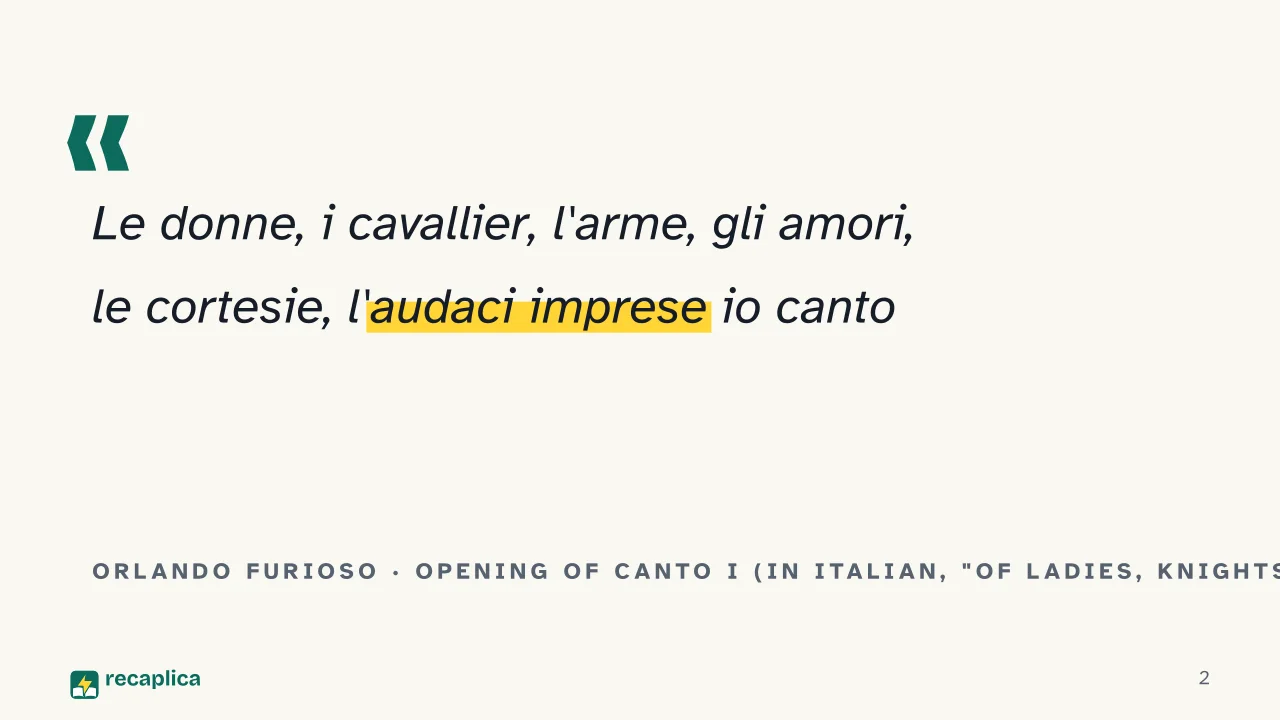   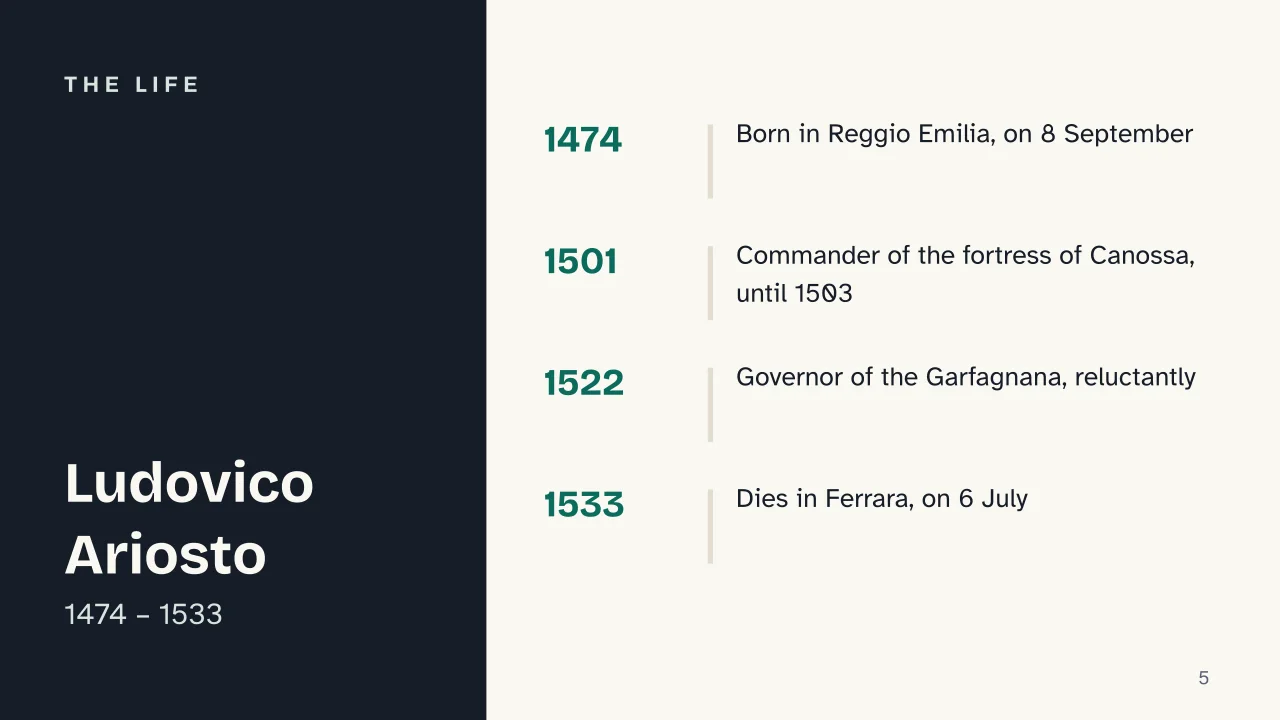  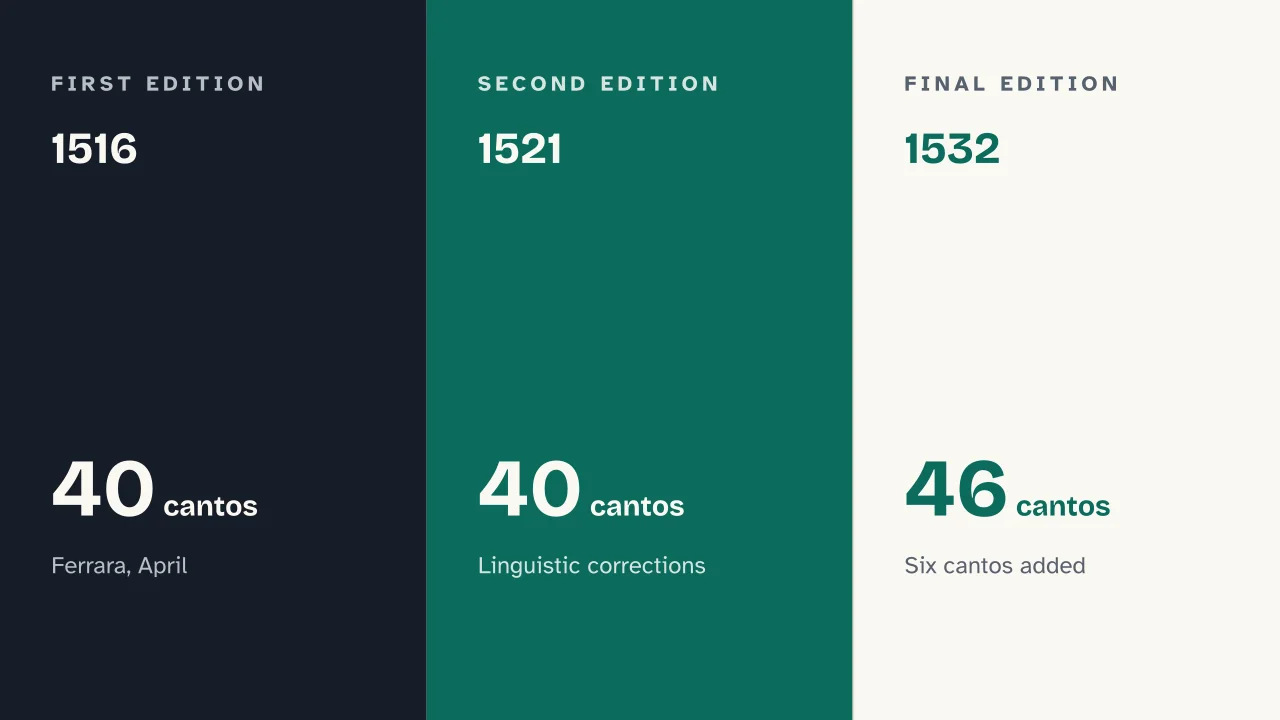  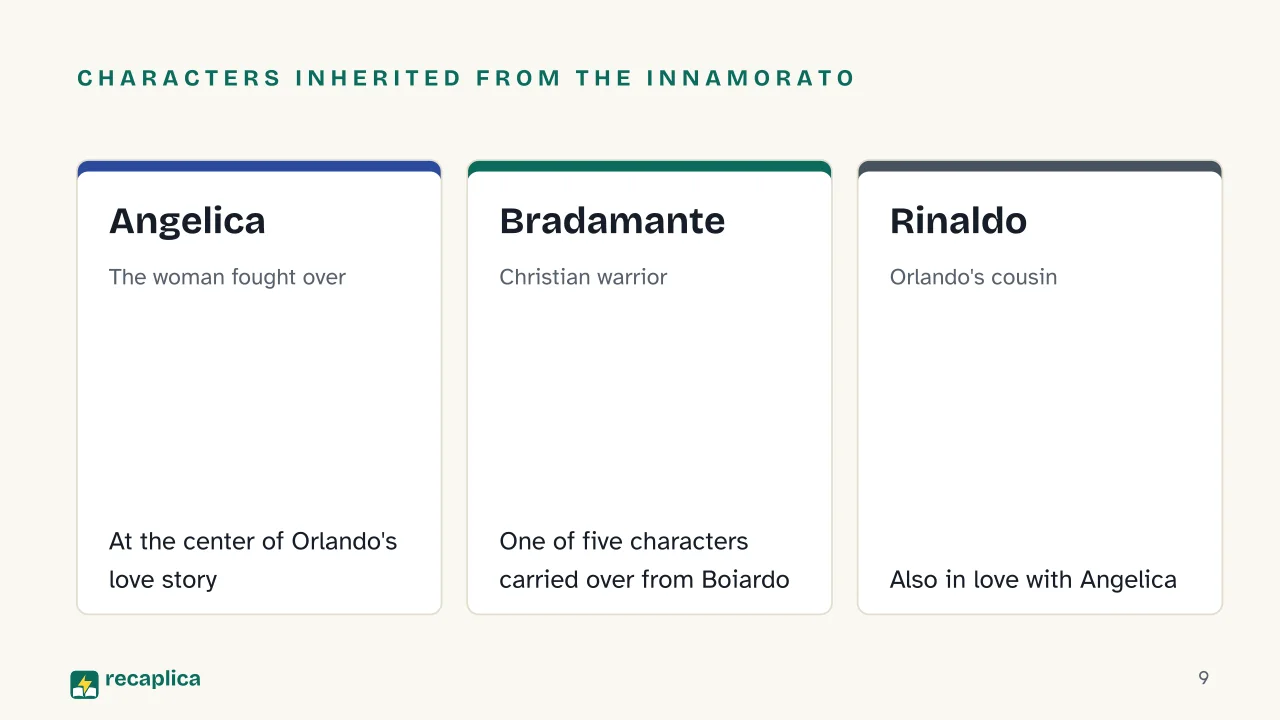 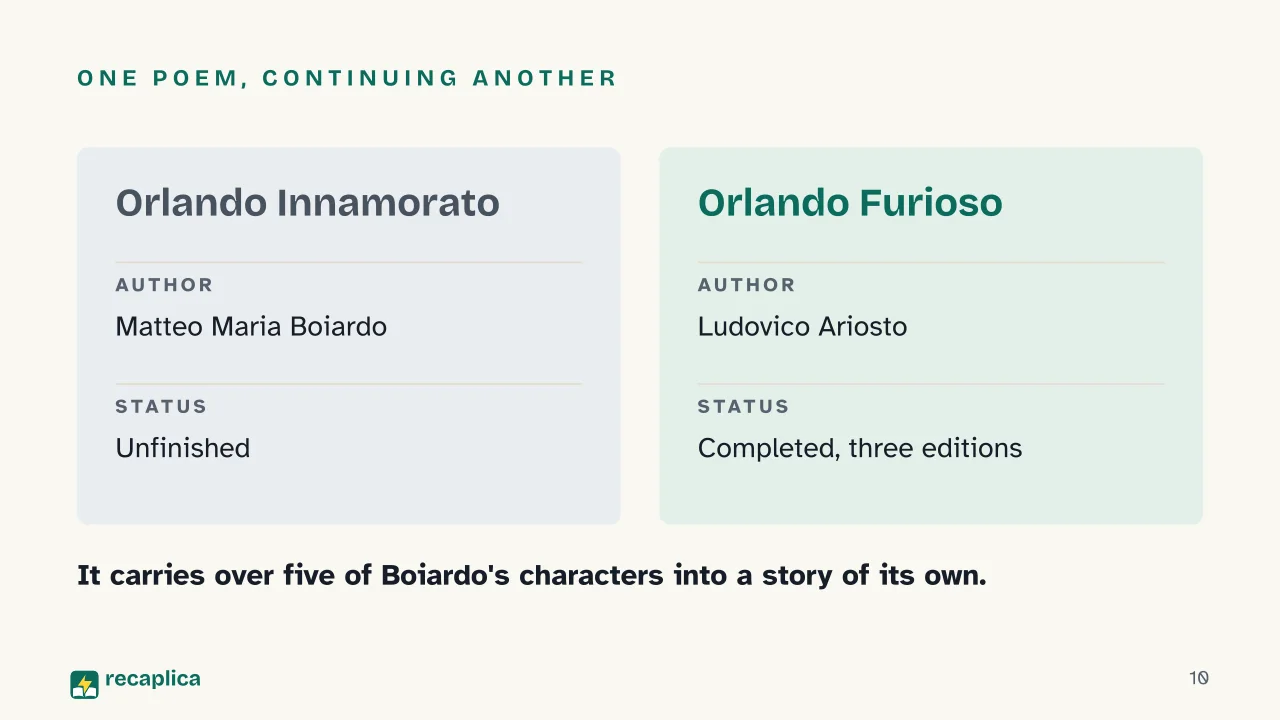 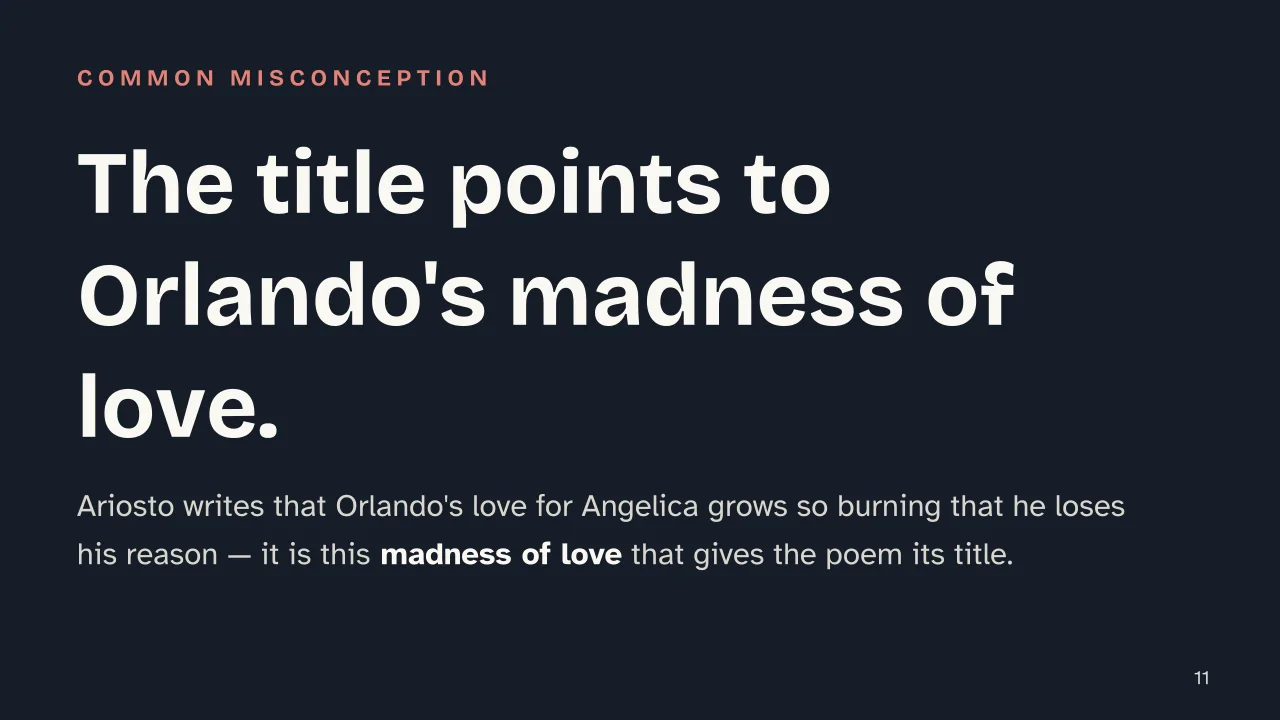  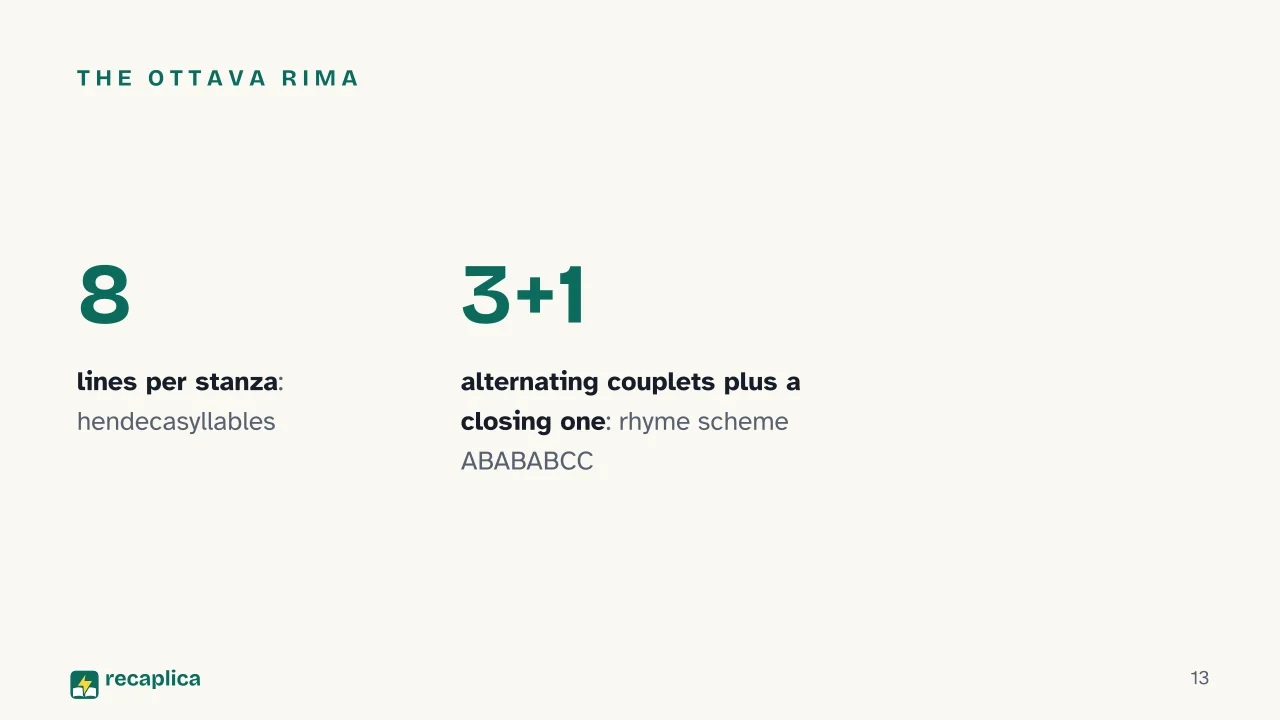 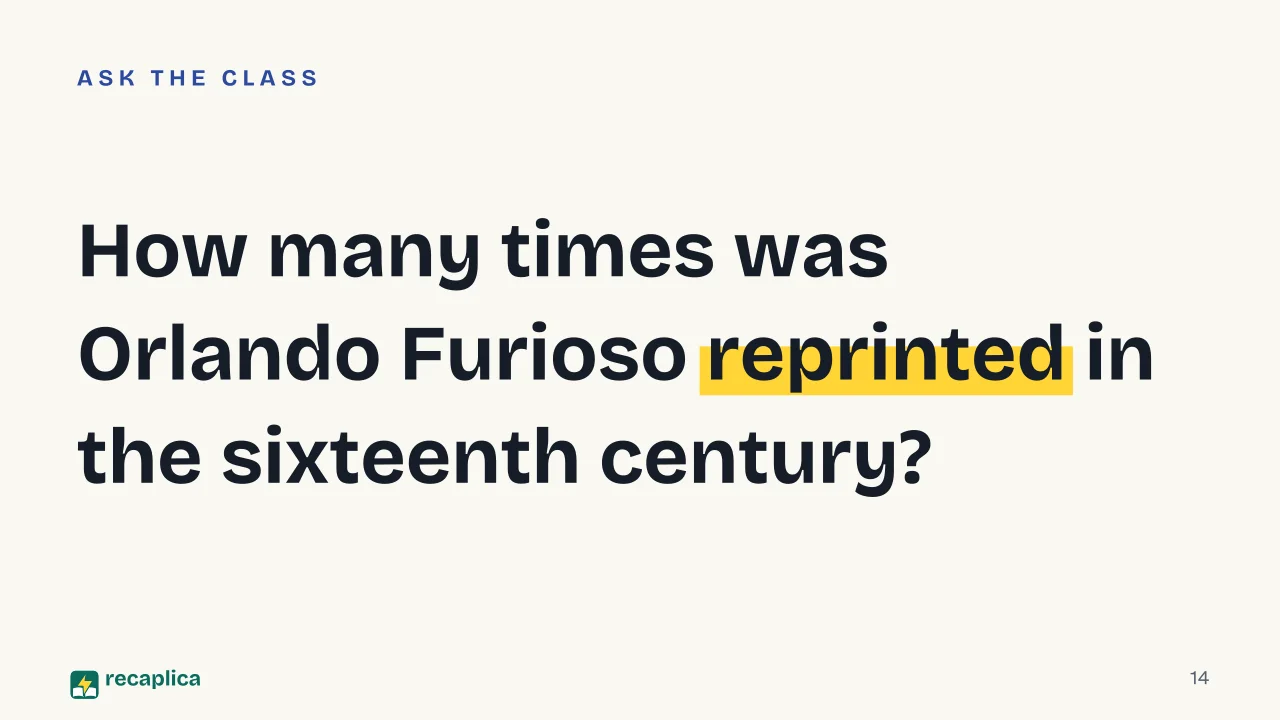 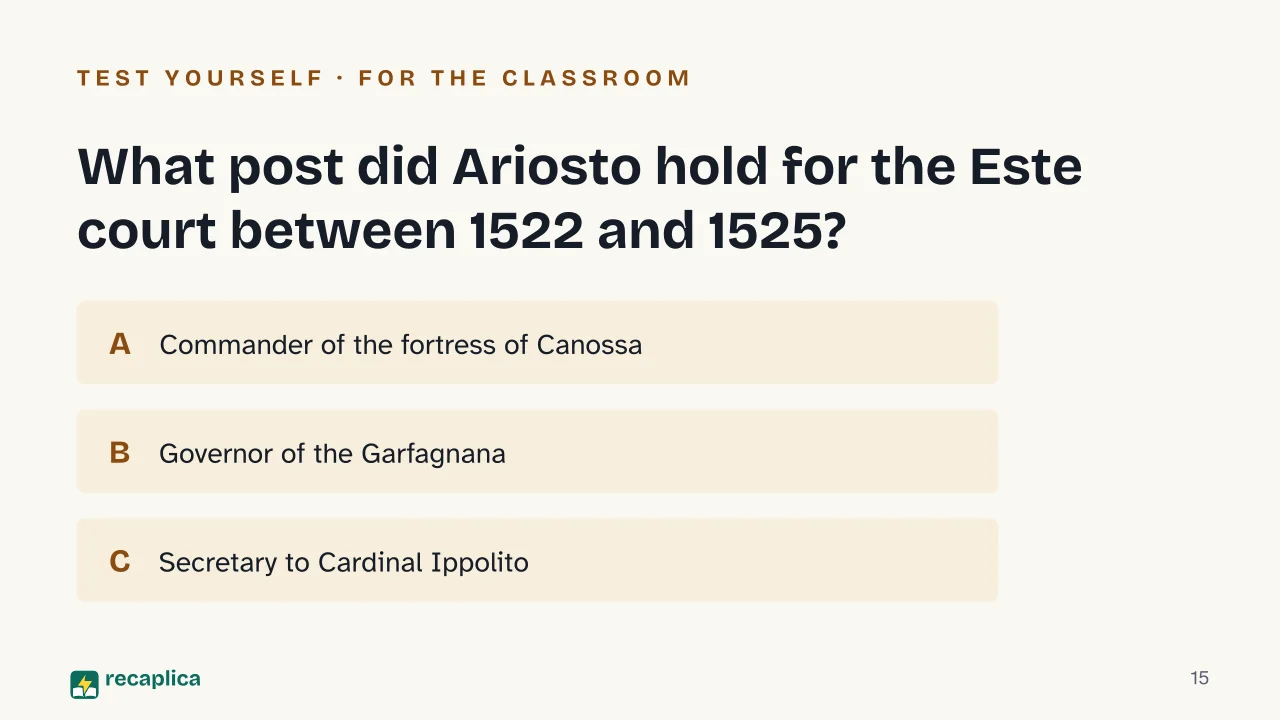  Common myths
Mind mapDrag the background to move around and the nodes to reposition them; use − and + to collapse and expand branches. 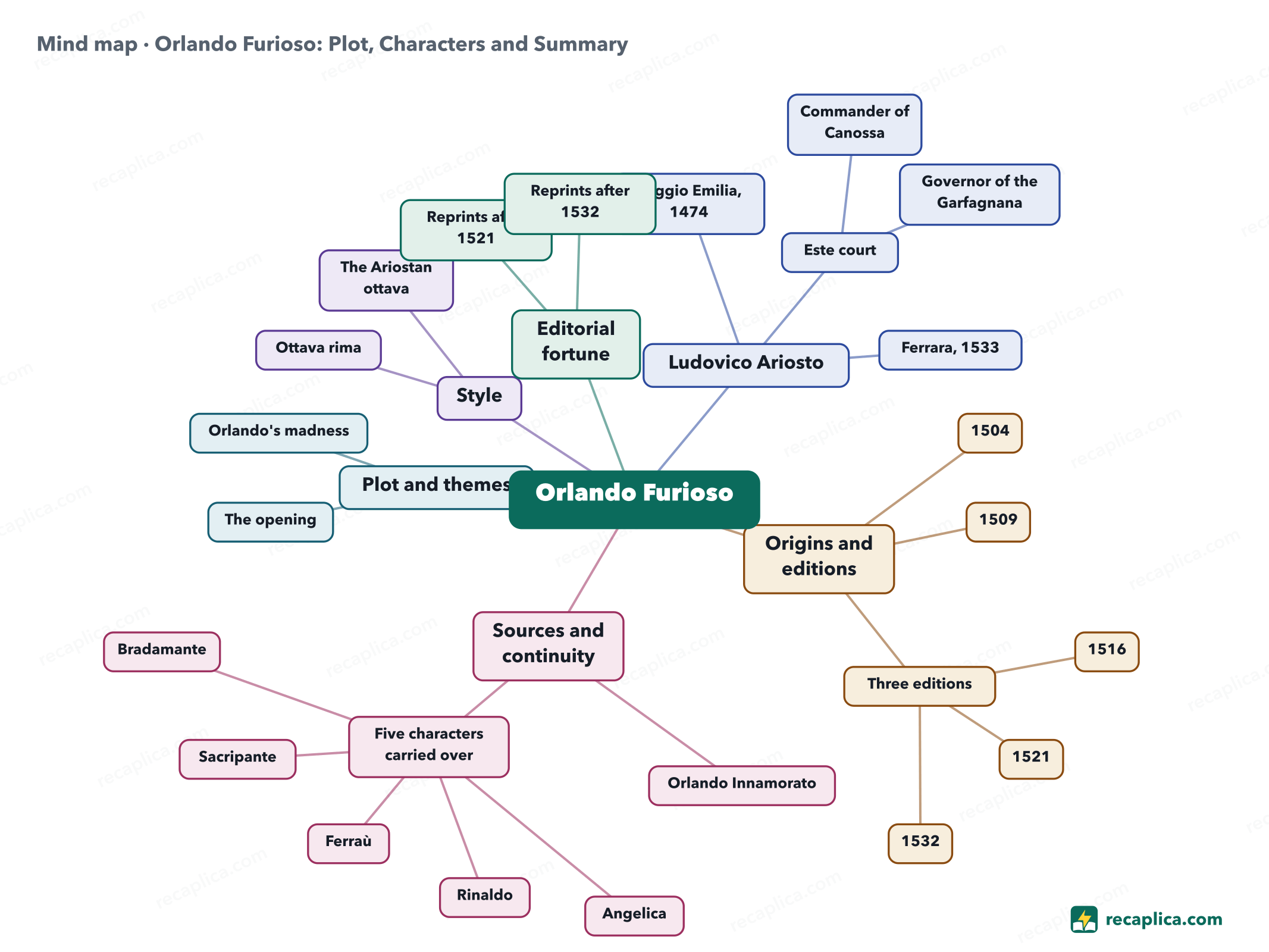
Quiz: test yourselfAnswer the questions to check what you have learned: you get instant feedback and a short explanation. Grade 0/10 0/5
FlashcardsTap the card to flip it and check whether you remember the answer, then move to the next one. 1 / 8 Explain it in your own wordsThe ultimate test: if you can explain it in simple words, you've truly understood it. Write your explanation, then compare it with the Recap. Your explanation is saved only on this device.
Frequently asked questionsWhat is Orlando Furioso about?Knights, ladies and adventures at the court of Charlemagne, woven together with stories of love and magic. At the center is Orlando, one of the emperor's paladins, who loses his reason for love of Angelica; around him move dozens of other characters, including the warrior Bradamante and his cousin Rinaldo. Who wrote Orlando Furioso, and when?Ludovico Ariosto. The idea takes shape in 1504 or shortly after, a first draft in forty cantos is finished in 1509, but the poem is printed only in April 1516, in Ferrara. Ariosto revises it twice more, reaching the final edition of 1532, in forty-six cantos. What is the difference between Orlando Furioso and Orlando Innamorato?Orlando Innamorato, by Matteo Maria Boiardo, comes earlier and was left unfinished. Ariosto's Orlando Furioso is its ideal sequel, carrying over five of its characters — Angelica, Rinaldo, Ferraù, Sacripante and Bradamante — into a story of its own, different from the one Boiardo had left. What meter is Orlando Furioso written in?In ottava rima, the most widespread narrative verse form in the Italian tradition: eight hendecasyllables per stanza, with rhyme scheme ABABABCC. Why is the poem called "Furioso"?Because of Orlando's madness of love. His love for Angelica grows into a passion so deep that he loses his reason, and it is this state that the title announces from the very opening of Canto I. Every Recap goes through an independent review before publication. |