|
recaplica
The Aeneid by Virgil: Summary, Plot and Characters | ||||||||||||||||||||||||||||||||||
| © 2026 Recaplica · recaplica.com — All rights reserved | ||||||||||||||||||||||||||||||||||
The Aeneid by Virgil: Summary, Plot and CharactersWhat to print Page numbers appear when printing with default margins. SlidesChoose a cut Flash10 slidesThe essential thread, to present in classFull18 slidesEvery chapter and the deeper detailBoth come with speaker notes. In 30 seconds quick readThe Aeneid is the epic poem that Publius Vergilius Maro wrote in Latin during the final years of his life, roughly between 29 and 19 BCE, telling in twelve books the journey of Aeneas from burning Troy all the way to Italy. The first half follows the hero's wanderings across the Mediterranean, modeled on the Odyssey; the second recounts the war he must fight in Latium, echoing the Iliad. Virgil died in 19 BCE without finishing the final revision and asked, in vain, that the manuscript be destroyed: the work was published after his death on the orders of Augustus. At the heart of the story lies the legendary founding of Rome, a theme also tied to the family of Augustus himself. Key Points
Key figures
Deep DiveA poem written to tell the story of Rome’s originsThe Aeneid isn’t just an adventure story. Virgil wrote it over the last ten years of his life, roughly between 29 and 19 BCE, at a moment when Rome was emerging from decades of civil war and finding itself under the rule of a single man, Augustus. The poem follows the story of Aeneas, a Trojan prince and son of Venus, from the destruction of his city to his landing in Italy: a journey that, in poetic fiction, lays the groundwork for the future birth of Rome. The bond with Augustus isn’t just a matter of atmosphere. Augustus’s family, the gens Iulia, claimed descent from Iulus, another name for Aeneas’s son Ascanius: telling the story of the Trojan forefather’s deeds meant, indirectly, lending luster to the origins of the family ruling Rome. It’s no surprise that Augustus, who claimed descent from Aeneas, was reportedly delighted with the work. The plot, from the escape from Troy to the war in LatiumThe poem opens in medias res, with Aeneas already at sea, tossed by storms toward the coast of Carthage. Only in Book II, through Aeneas’s own account, does the story flash back to the night Troy falls: the city is taken through the trick of the wooden horse, despite the unheeded warning of the priest Laocoön. Aeneas flees through the flames, carrying his elderly father Anchises on his shoulders, holding his son Ascanius by the hand and saving the Penates, the household gods; his wife Creusa, instead, is lost in the confusion of the escape and vanishes.
From there the journey across the Mediterranean begins. In Carthage Aeneas is welcomed by Queen Dido, who falls in love with him; but the call of the gods, determined to push him onward, forces him to leave. Dido, devastated by the abandonment, takes her own life and, before dying, curses her lover’s descendants: an image ancient readers also read as a foreshadowing of the future Punic Wars between Rome and Carthage. Later, during a stop in Sicily, old Anchises also dies, and Aeneas holds funeral games in his honor. The poem’s central moment comes in Book VI: Aeneas descends into the world of the dead and meets both his father and Dido. It’s here that Anchises shows him, as in a vision, the future protagonists of Roman history, from Romulus all the way to Augustus himself: Aeneas’s personal journey widens, for a moment, into the anticipated story of Rome as a whole. In the second half of the poem, once he reaches Latium, Aeneas is promised in marriage to Lavinia, daughter of King Latinus; but Turnus, king of the Rutuli, claims her too, and the dispute turns into open war. The Aeneid ends abruptly, with the duel between the two rivals: Turnus falls wounded, and Aeneas, after a moment’s hesitation, finishes him off. The main characters
Furor and pietas, a common classroom readingTextbooks often read the Aeneid through the clash between two opposing forces: furor, the irrational, violent passion that overwhelms whoever feels it, and pietas, the virtue that instead defines Aeneas. Characters like Dido and Turnus are read as embodiments of furor, overwhelmed by love or rage until they collide with the design of fate; Aeneas, by contrast, repeatedly gives up his own desires to carry out the task assigned to him, in the name of the gods, his family, and the people he must found. This reading, though, isn’t as simple as it looks at first glance. In the poem’s final scene, with Turnus disarmed on the ground, Aeneas hesitates for a moment, moved by a flicker of pity for his defeated enemy; but then he sees on Turnus’s body the belt of young Pallas, killed earlier by that same Turnus, and rage over his friend’s death takes over. The poem ends right on this unresolved tension between furor and pietas, offering no easy answer. The relationship with the Iliad and the OdysseyVirgil builds the Aeneid by looking explicitly at the two poems attributed to Homer, but he flips them into a Roman perspective.
A work born unfinishedVirgil never had the chance to revise the Aeneid the way he wanted. In 19 BCE he set out for Greece and the East precisely to gather material for the final revision, but fell ill and had to turn back; he died in Brindisi shortly after landing. On his deathbed he asked for the manuscript to be burned, just as he had already asked his friend Varius Rufus once before, and both times he was refused. The work was published after his death on the orders of Augustus, edited by the poet’s friends Varius Rufus and Plotius Tucca. The clearest sign of that never-completed revision is the 53 lines left unfinished, the so-called tibicines, along with a few small inconsistencies in the story that nobody, after the author’s death, took the liberty of fixing. Its legacy through the centuries, from Dante to modern translationsIn the Middle Ages and beyond, the Aeneid never stopped being read. Dante knew it thoroughly and chose Virgil himself as his guide through the Inferno and most of Purgatorio, until the moment Dante reaches the Earthly Paradise and the guide passes to someone else. In the Convivio he goes as far as calling him “our greatest poet.” Readers curious about this bond between two towering figures of Italian and Latin literature can also read our piece on Luigi Pirandello, another author who left a deep mark on Italian literature, even in an era worlds apart from Virgil’s. Over the centuries the work kept circulating well beyond Italy and the Latin-speaking world: Annibal Caro’s Italian translation, from 1581, is still the best known in Italy today, while in English John Dryden’s version dates to 1697. From the Middle Ages onward there was no shortage of satirical rewrites either, a sign that the poem had become such a shared reference point that it could be mocked without losing its authority. Anyone curious to compare the Aeneid with other ancient civilizations that built their own founding stories around a divine origin might also find our piece on ancient Egypt a good place to start. Slide deckSlides ready to download and make your own in PowerPoint or Google Slides, with speaker notes. Pick the Flash cut or the Full one.     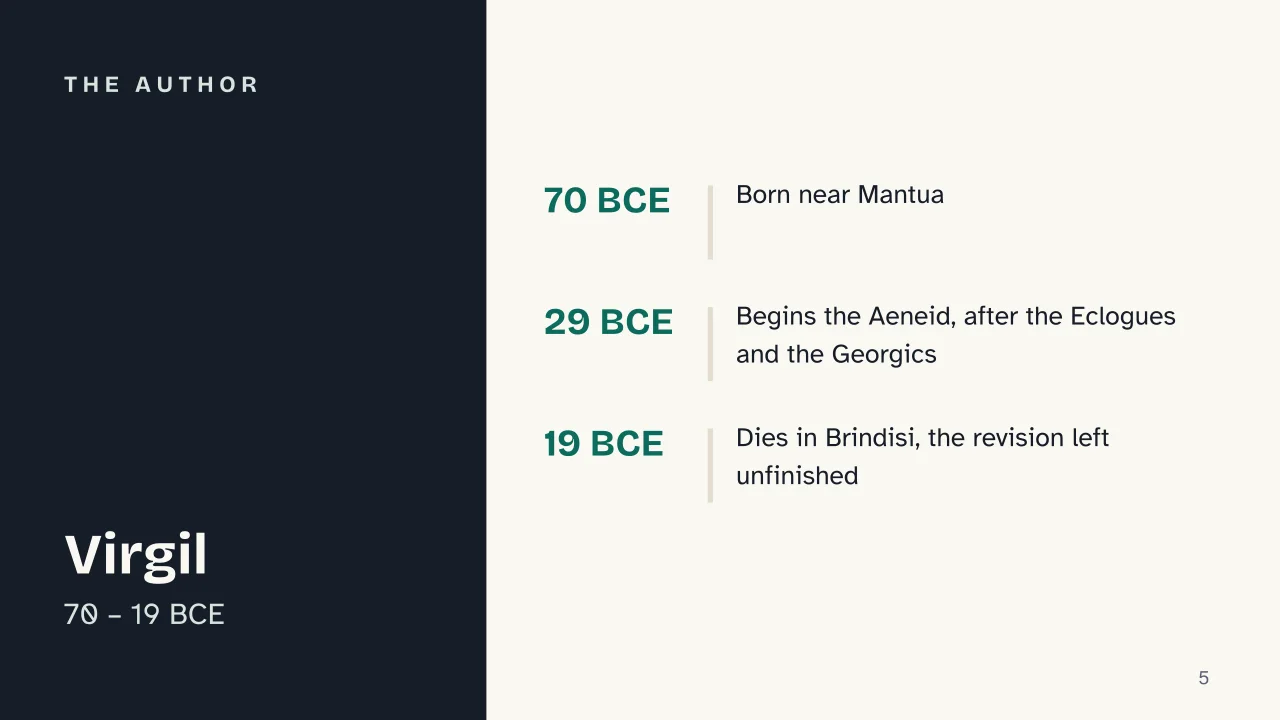 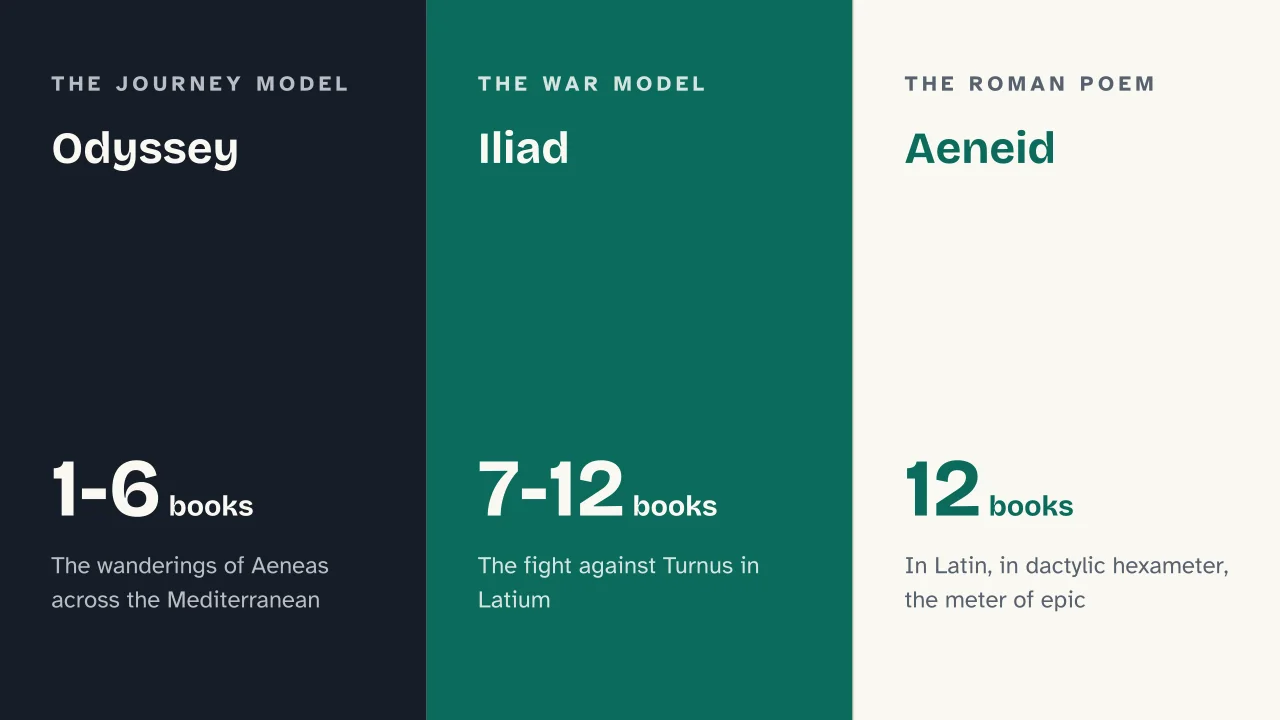  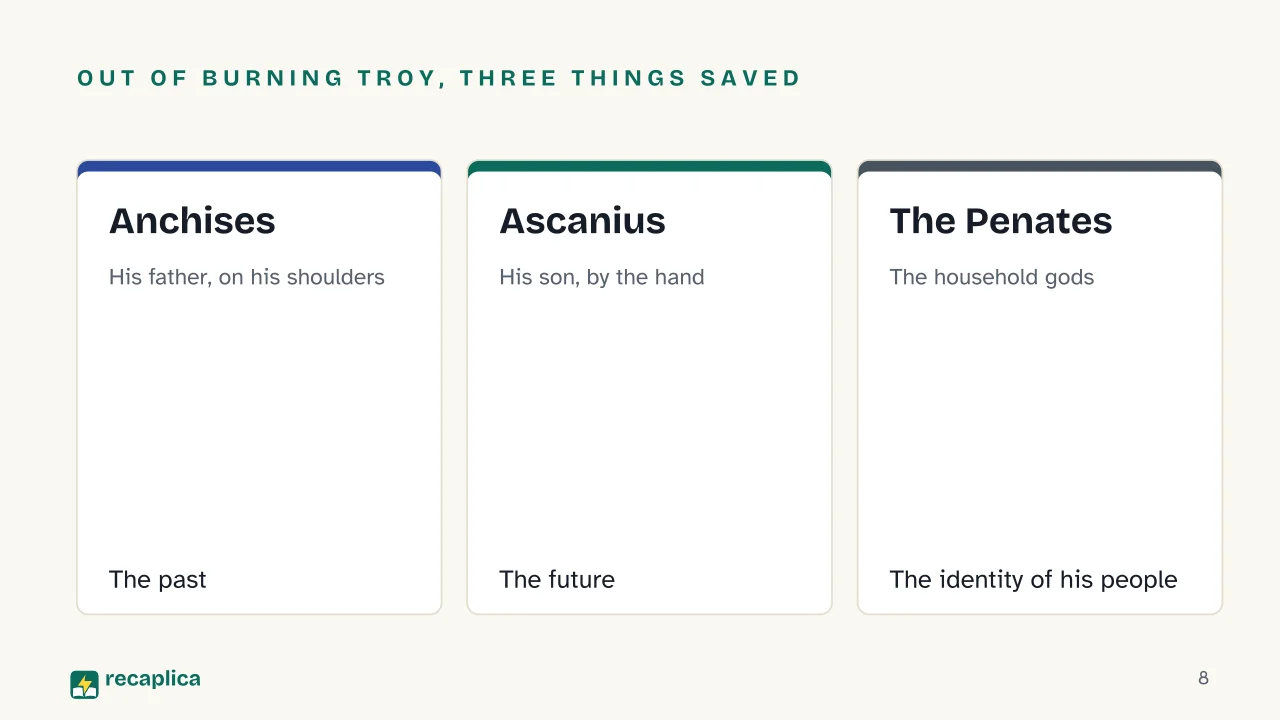 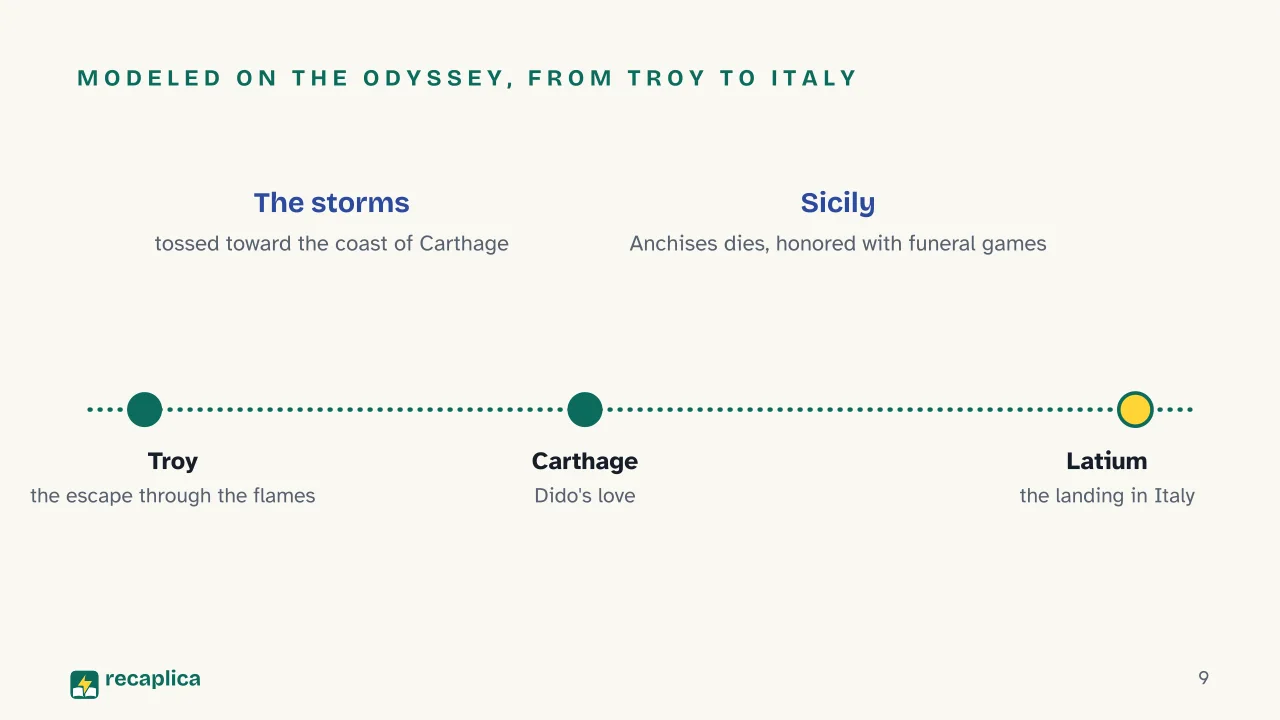   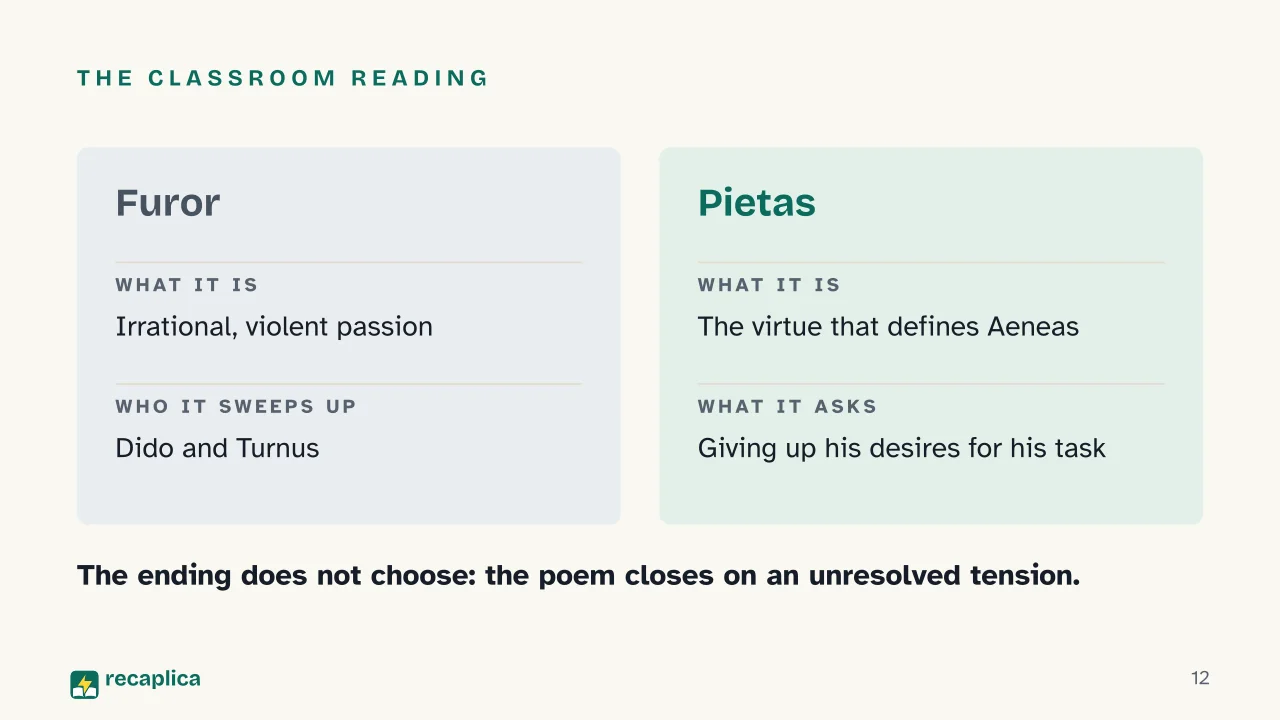  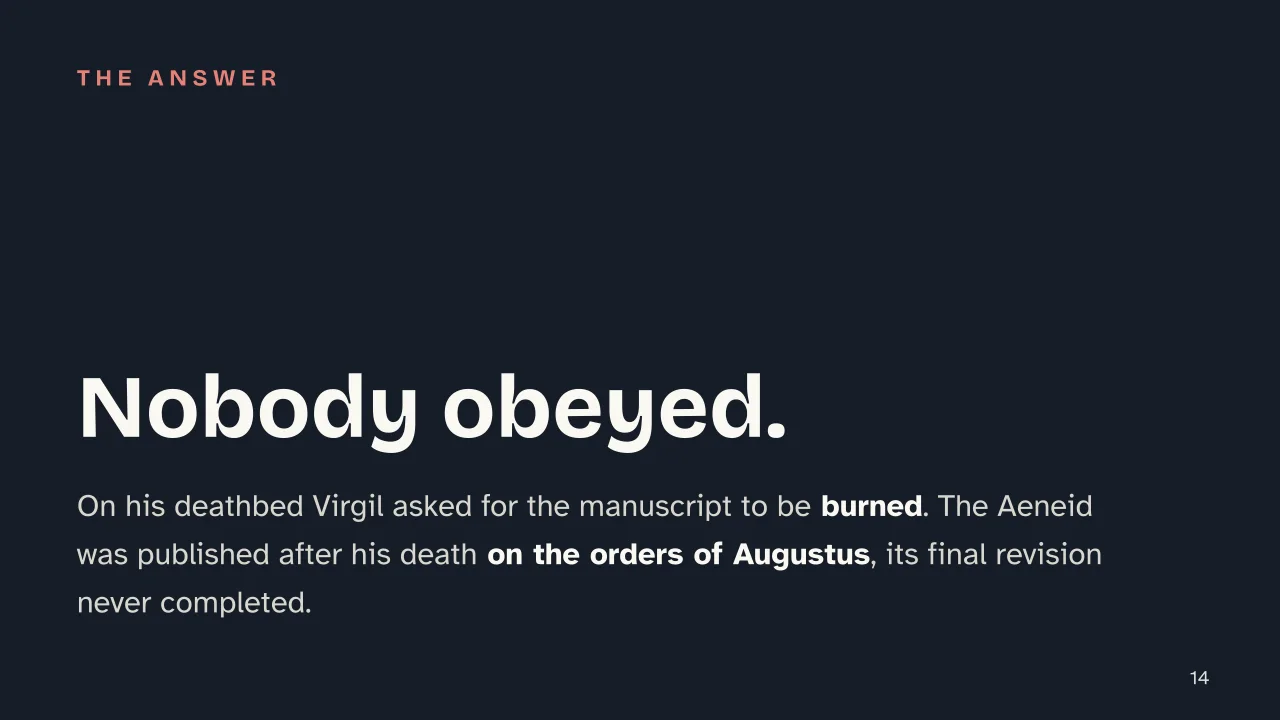 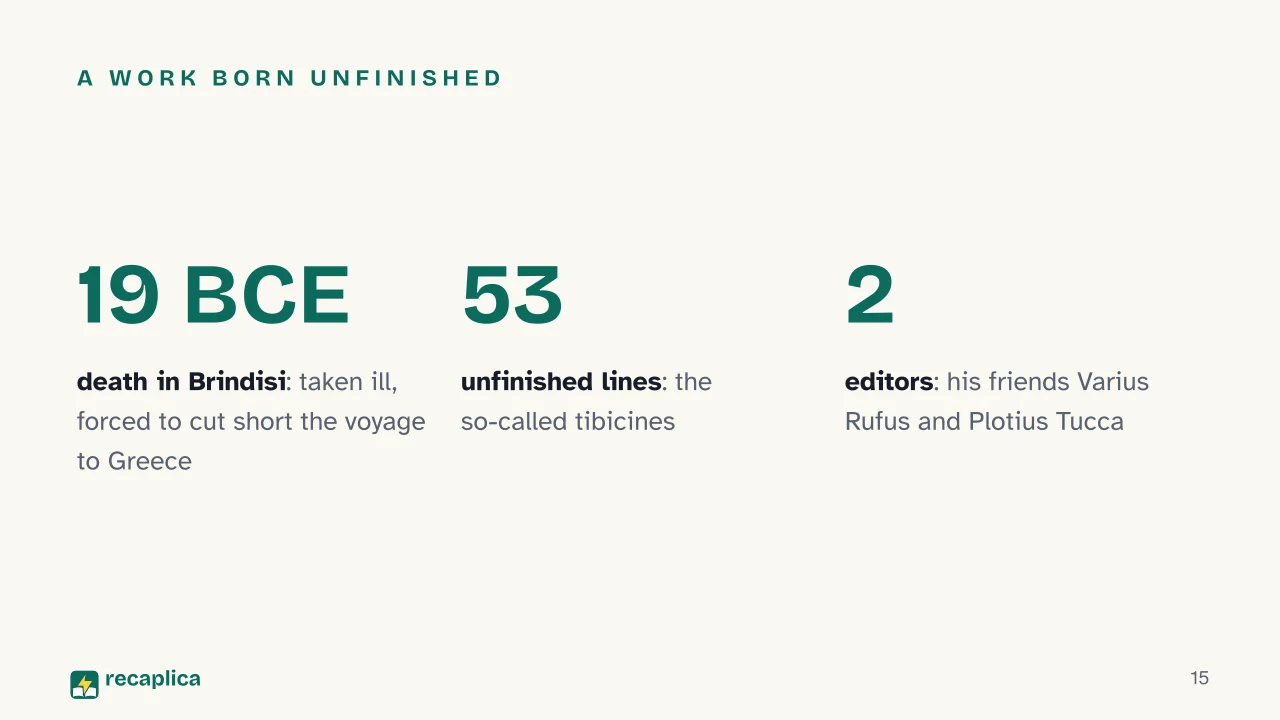 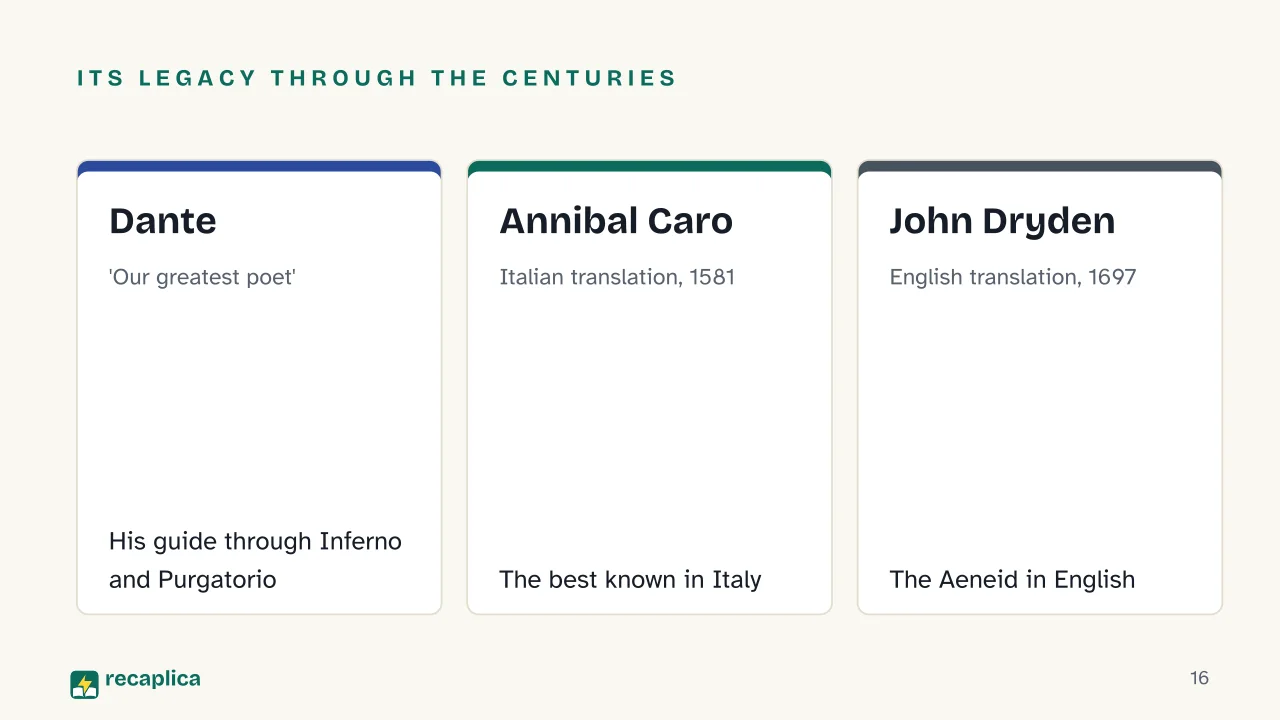   Common myths
Mind mapDrag the background to move around and the nodes to reposition them; use − and + to collapse and expand branches. 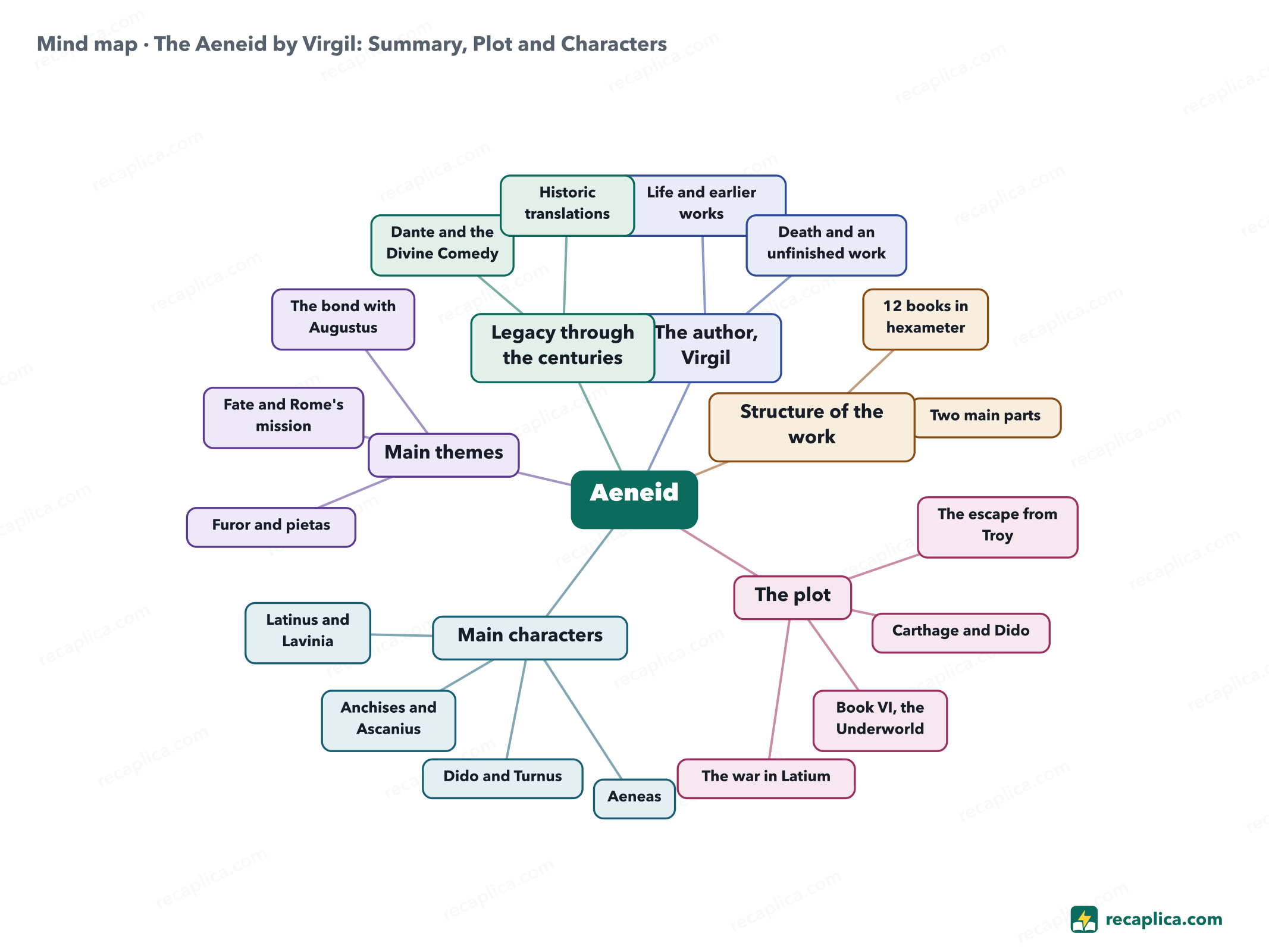
Quiz: test yourselfAnswer the questions to check what you have learned: you get instant feedback and a short explanation. Grade 0/10 0/5
FlashcardsTap the card to flip it and check whether you remember the answer, then move to the next one. 1 / 8 Explain it in your own wordsThe ultimate test: if you can explain it in simple words, you've truly understood it. Write your explanation, then compare it with the Recap. Your explanation is saved only on this device.
Frequently asked questionsWhat is the Aeneid about?It tells the story of Aeneas, a Trojan hero, journeying from the fall of Troy to Italy, where, according to legend, he gives rise to the people from whom Rome will descend. The first half of the poem follows his wanderings across the Mediterranean, the second the war he must fight in Latium against Turnus and the Rutuli. Who wrote the Aeneid, and when?It was written by Publius Vergilius Maro, a Latin poet, over the last ten years of his life, roughly between 29 and 19 BCE; he died before he could give it a final revision. How does the Aeneid end?With the duel between Aeneas and Turnus, king of the Rutuli, both of whom had claimed the hand of Lavinia. Turnus is wounded and, in the end, killed by Aeneas: the poem closes abruptly right on this scene. Why is the Aeneid an unfinished work?Because Virgil died in 19 BCE, in Brindisi, before completing the final revision of the text. The poem still contains 53 unfinished lines today and a few small inconsistencies; on his deathbed Virgil asked for the manuscript to be burned, but nobody obeyed, and the work was published after his death on the orders of Augustus. What's the difference between the Aeneid, the Iliad and the Odyssey?The Iliad and the Odyssey are older Greek poems attributed to Homer; the Aeneid is a Latin poem written centuries later by Virgil, who draws on both: the first six books recall the Odyssey's journey, the last six the Iliad's war. The biggest difference lies in purpose: the Aeneid doesn't just tell a heroic story, it builds the legendary origins of Rome. Every Recap goes through an independent review before publication. |