Skip to content
recaplica

    One moment: security check

    Cloudflare wants to make sure you're not a robot. Tick the box below and your search will continue on its own.

    IT
    recaplica Cesare Beccaria: Life and Ideas in On Crimes and Punishments
    © 2026 Recaplica · recaplica.com — All rights reserved
    Home › Literature

    Cesare Beccaria: Life and Ideas in On Crimes and Punishments

    By Recaplica Newsroom · Updated on September 27, 2026

    What to print

    Page numbers appear when printing with default margins.

    Slides

    Choose a cut

    Flash10 slidesThe essential thread, to present in classFull16 slidesEvery chapter and the deeper detail

    Both come with speaker notes.

    Telegram channel
    recaplica Clear in 30 seconds, yours in 10 minutes.
    In 30 seconds Key points Figures Deep dive Slides Myths Mind map Quiz Flashcards FAQ

    In 30 seconds quick read

    Cesare Beccaria was born in Milan in 1738 and died in the same city in 1794. In 1764 he anonymously published On Crimes and Punishments, a short treatise written within the Academy of Fists, the Milanese circle led by the Verri brothers. The book argues that punishment should be proportionate to the harm a crime does to the public good, that its purpose is to prevent further offenses, and it condemns judicial torture and the death penalty. Within a few years it was translated into French and English, and it found readers such as Catherine II of Russia, John Adams and Thomas Jefferson.

    Key Points

    • Cesare Beccaria was born in Milan in 1738 and died in the same city in 1794.
    • He published On Crimes and Punishments in 1764, anonymously, drafted within the Academy of Fists led by the Verri brothers.
    • Chapter VI argues that punishment should be proportionate to the harm a crime does to the public good.
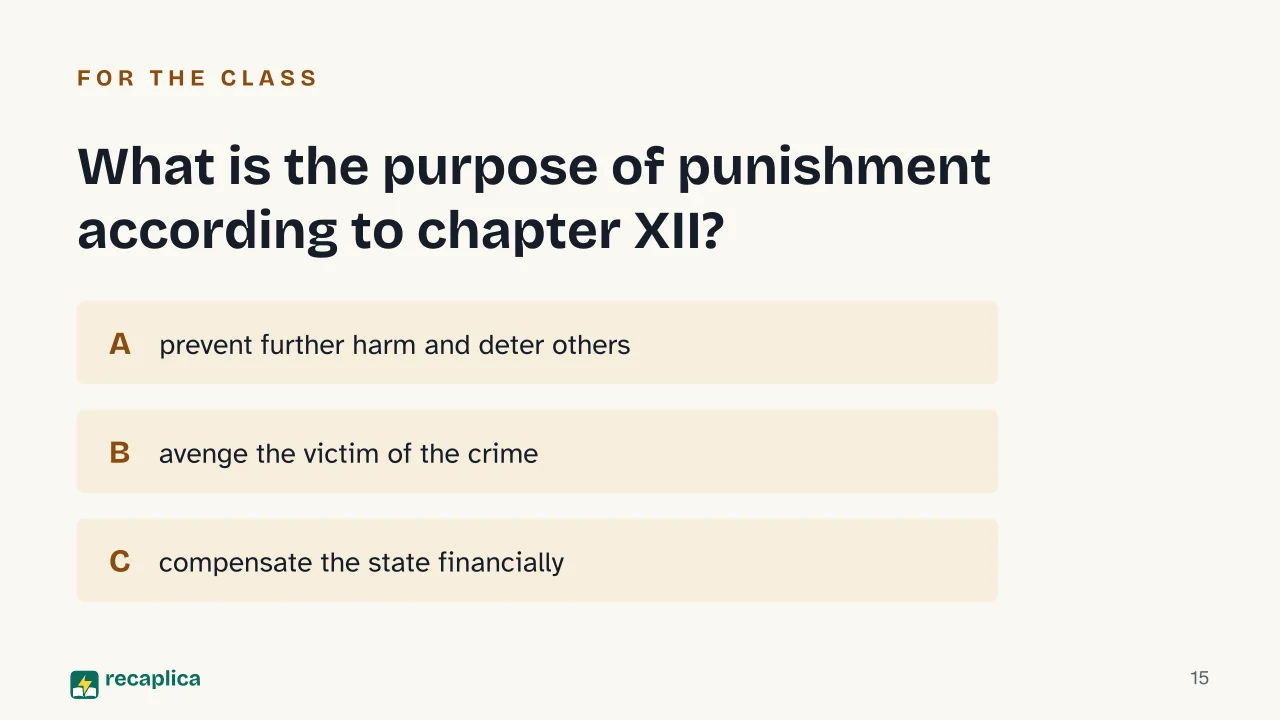
    • Chapter XII holds that the purpose of punishment is to prevent further harm and deter others from doing the same.
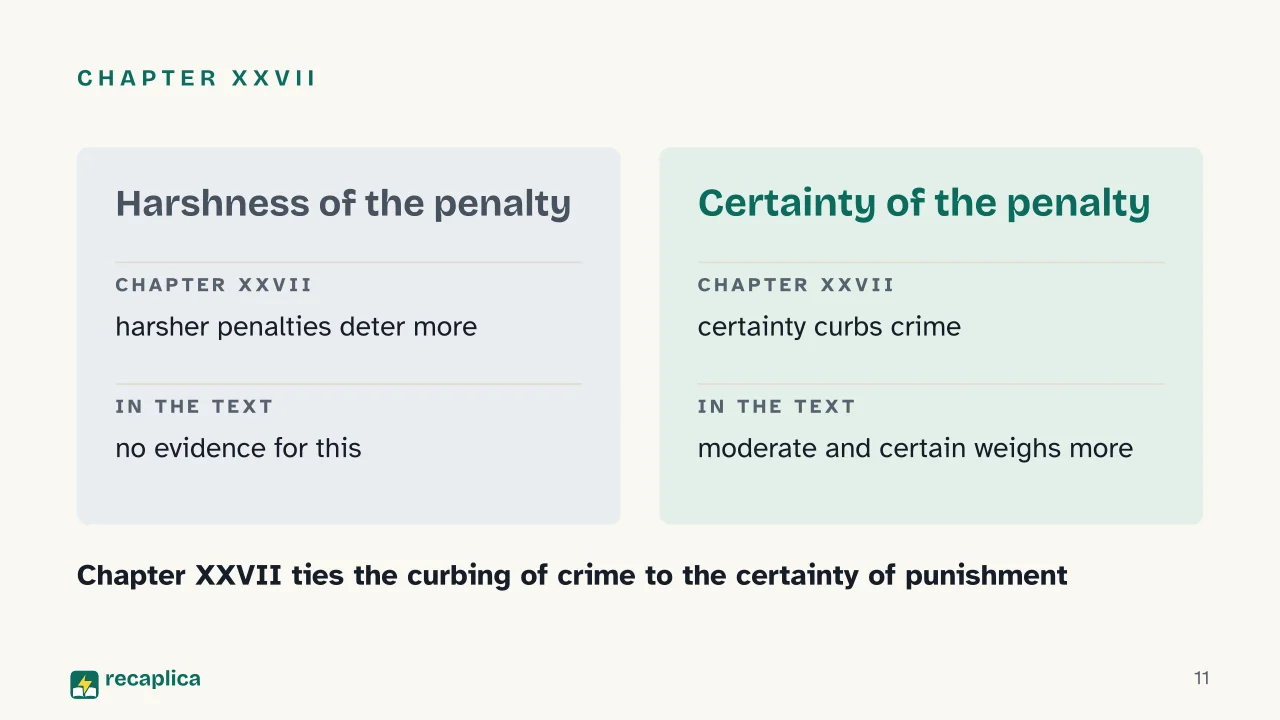
    • Chapter XXVII ties the deterrent force of punishment to its certainty, meaning how inescapable the penalty is.
    • Chapters XVI and XXVIII condemn judicial torture and the death penalty, respectively.

    Key figures

    • 1764 the year On Crimes and Punishments was published; the manuscript reached the Livorno printer on 12 April and copies were circulating by July Source: Treccani, Dizionario Biografico degli Italiani
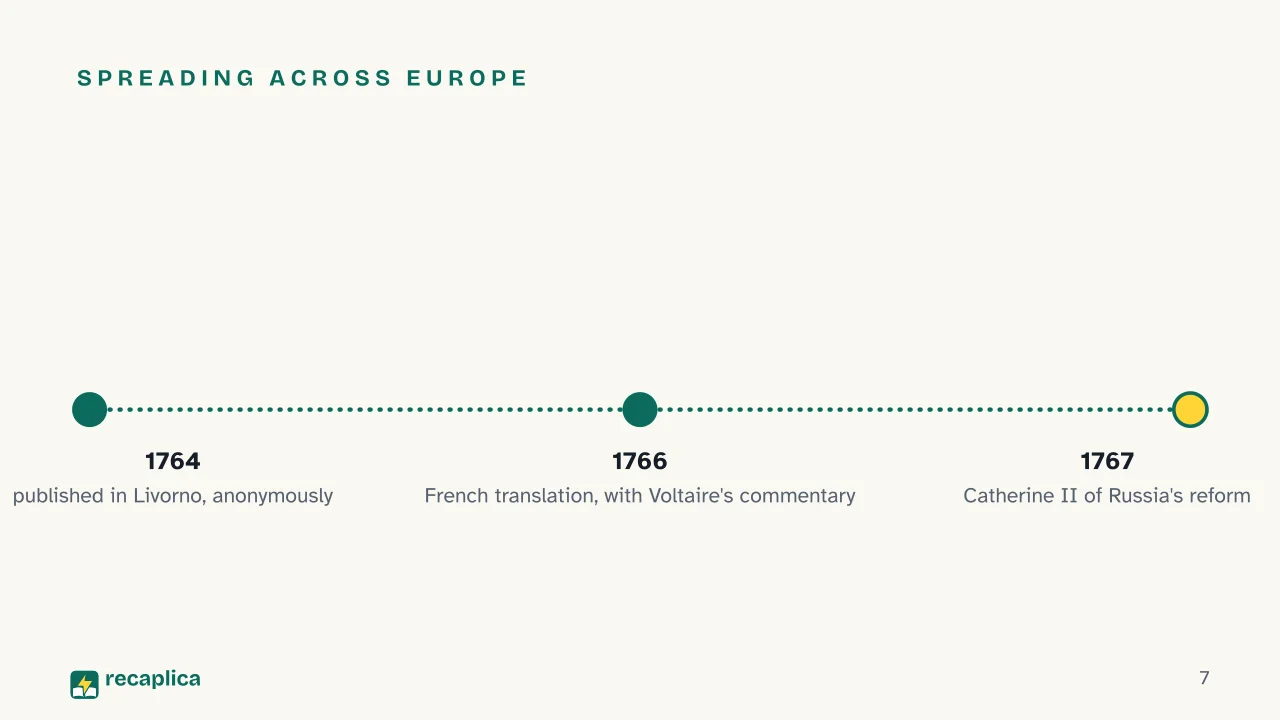
    • 1767 the year of Catherine II of Russia's judicial reform, inspired by Beccaria's thinking for its criminal-law part Source: Treccani, Dizionario Biografico degli Italiani

    Deep Dive

    Cesare Beccaria was born in Milan on 15 March 1738, the son of Marquis Giovanni Saverio and Maria Visconti di Saliceto; his full name at birth was Cesare Beccaria Bonesana, Marquis of Gualdrasco and Villareggio, though he is known by the shorter Beccaria. Between 1763 and early 1764 he took part in the Academy of Fists, the Milanese circle led by the brothers Pietro and Alessandro Verri, and it was there that he drafted On Crimes and Punishments. He died in Milan on 28 November 1794.

    On Crimes and Punishments: publication and circulation

    The manuscript reached the printer Giuseppe Aubert, in Livorno, on 12 April 1764; the first copies began circulating in July of that same year. Beccaria published it anonymously, because its criticism of the legal system then in force risked drawing retaliation from those in power. Within two years the book went through six editions, all printed in Tuscany but carrying false places of publication — Monaco, Lausanne, Harlem — to further shield the author.

    The book is not an abstract treatise: it is organized into short numbered chapters, each devoted to one aspect of the penal system. Chapter VI, Proportion between Crimes and Punishments, argues that the obstacles keeping people from crime must be stronger the more an action goes against the public good: punishment, in other words, should be matched to the harm done to the community, not left to a judge’s discretion.

    Practical example: in a classroom, what actually discourages misbehavior isn’t the threat of a harsh punishment rarely enforced, but the certainty that every infraction gets noticed and dealt with, even with a mild consequence — the same principle chapter XXVII applies to the penal system.

    The ideas of On Crimes and Punishments: proportion, purpose, certainty

    Chapter XII, Purpose of Punishments, sets the point that separates the book from earlier criminal law: the purpose of punishment “is nothing other than to prevent the offender from doing further harm to fellow citizens and to deter others from doing the same.” It is a preventive function, aimed at the future, not a retributive one aimed at avenging what has already happened — a distinction that comes up often in literature and history-of-ideas exams.

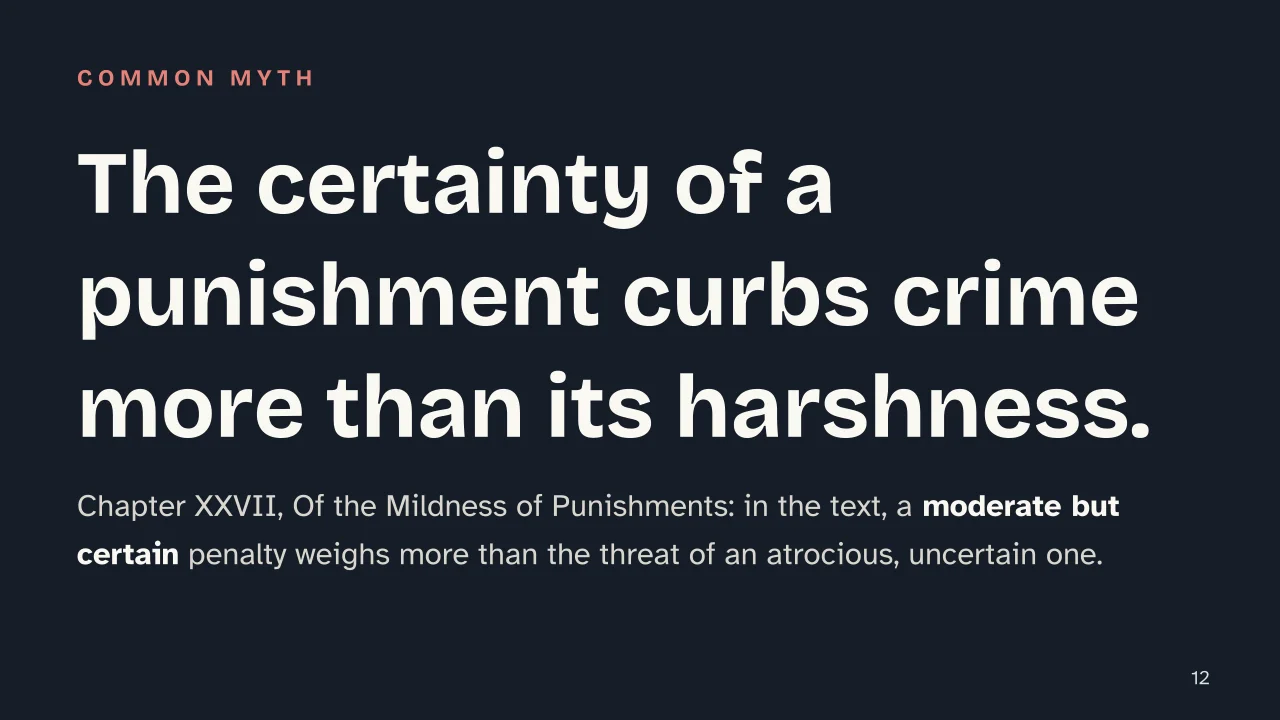
    Chapter XXVII, Of the Mildness of Punishments, adds a second principle, one students often mix up with the opposite idea: “one of the greatest checks on crime is not the cruelty of punishments, but their inevitability.” A certain punishment, even a moderate one, weighs more heavily on the decision to commit a crime than the threat of an atrocious penalty that is hard to enforce, because “even minor harms, when certain, always frighten the human mind.”

    ChapterTitleIdea
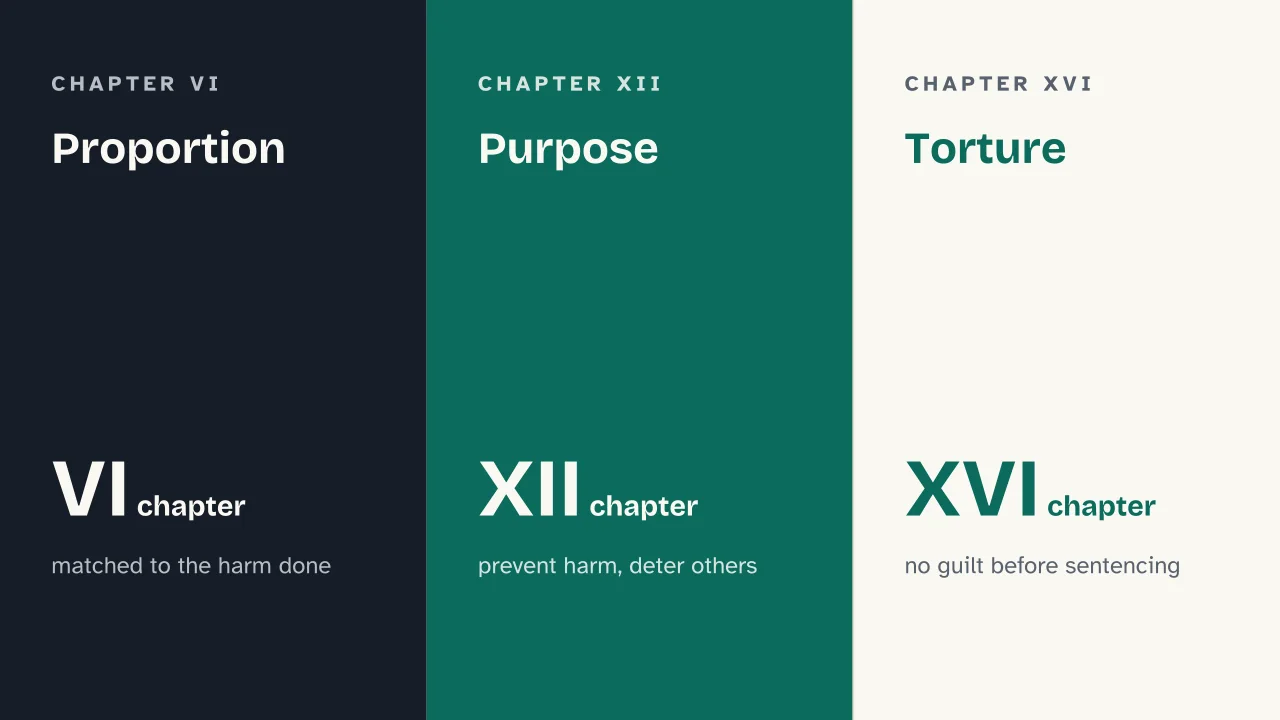
    VIProportion between Crimes and Punishmentspunishment grows with the harm an action does to the public good
    XIIPurpose of Punishmentsprevent further harm and deter others, not avenge the offense
    XVIOf Torturean accused person is not guilty before the judge’s sentence
    XXVIIOf the Mildness of Punishmentsthe certainty of punishment curbs crime more than its cruelty
    XXVIIIOf the Death Penaltyno man has the right to slaughter his fellow man

    In chapter XVI, Of Torture, Beccaria starts from a procedural principle: “a man cannot be called guilty before the judge’s sentence, nor can society withdraw its public protection from him.” From there follows his condemnation of judicial torture, which he writes “confuses all relations” between accuser and accused, forcing the latter to prove innocence through pain before any judgment has even been reached.

    Cesare Beccaria and the death penalty

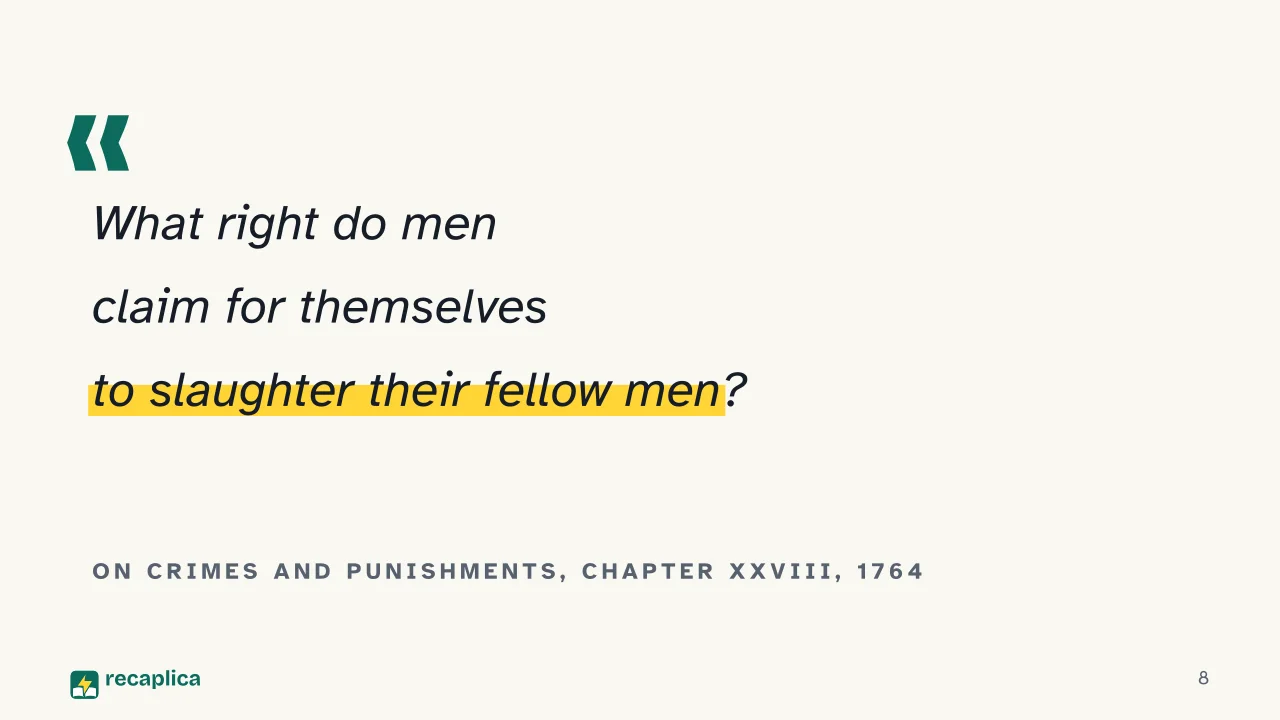
    Chapter XXVIII, Of the Death Penalty, opens with a question: “What right do men claim for themselves to slaughter their fellow men?” Beccaria argues that it is not the intensity of a punishment that has the greatest effect on the mind of someone who might commit a crime, but its duration over time: for this reason he points to life imprisonment, with “the long and painful example of a man deprived of freedom,” as a stronger deterrent against crime than capital punishment.

    The topic also resurfaces in the book’s circulation across Europe. The French translation, published in 1766 with a commentary by Voltaire, made it known among French intellectuals; the English translation followed in 1767. Wikipedia reports that the reforms Beccaria advocated led to the abolition of the death penalty in the Grand Duchy of Tuscany, the first state in the world to take that step, without giving a precise year for it.

    Cesare Beccaria’s legacy

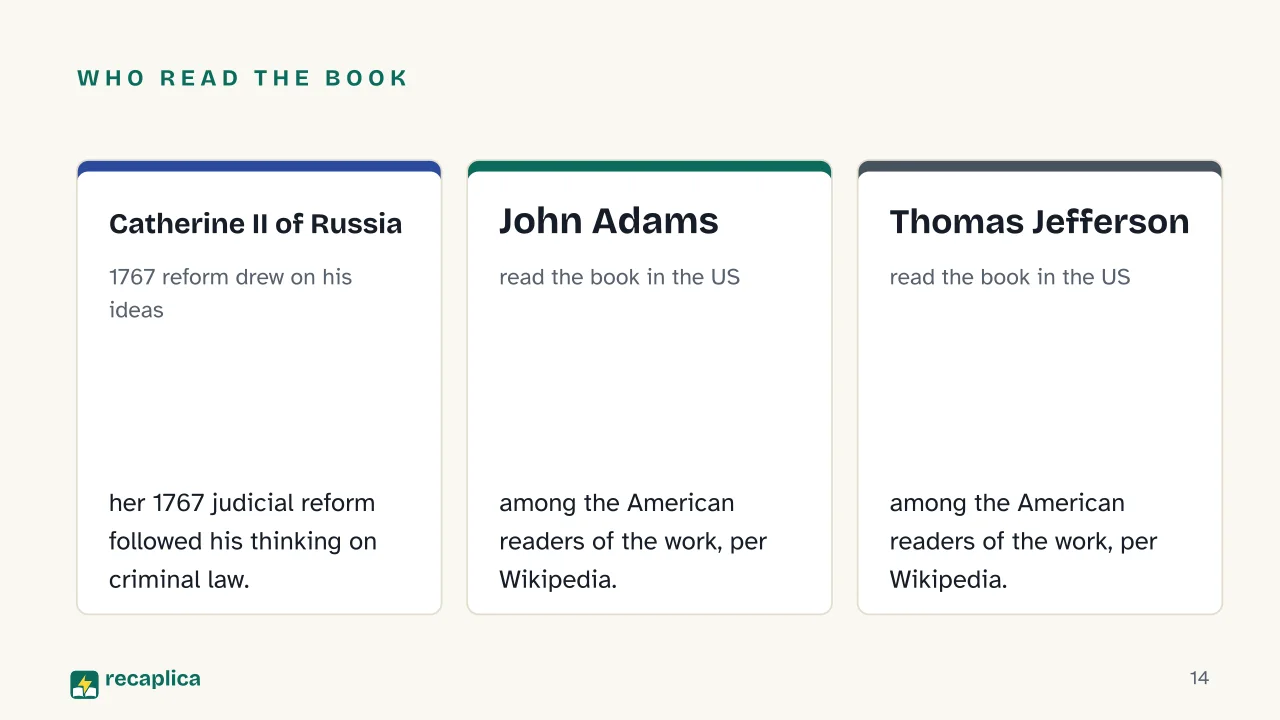
    In 1767 the judicial reform pursued by Catherine II of Russia drew on Beccaria for its criminal-law part, even though the empress initially knew little about him: she believed he lived in Florence and thought he was an abbot, while still admiring his book a great deal, according to Treccani.

    Beccaria was also the maternal grandfather of Alessandro Manzoni, the author of The Betrothed: a family tie, not a shared subject, since the two works stand far apart in period and topic. Centuries earlier, another Italian political thinker, Machiavelli, in The Prince, had turned an unsparing, for its time, analysis onto the ruler’s power; Beccaria applies that same direct scrutiny to the system of punishment.

    Outside Italy, the influence shows up best in its readers. Among those who read the book are John Adams and Thomas Jefferson, central figures in the American Revolution and in drafting the United States’ founding legal texts.

    Slide deck

    Slides ready to download and make your own in PowerPoint or Google Slides, with speaker notes. Pick the Flash cut or the Full one.
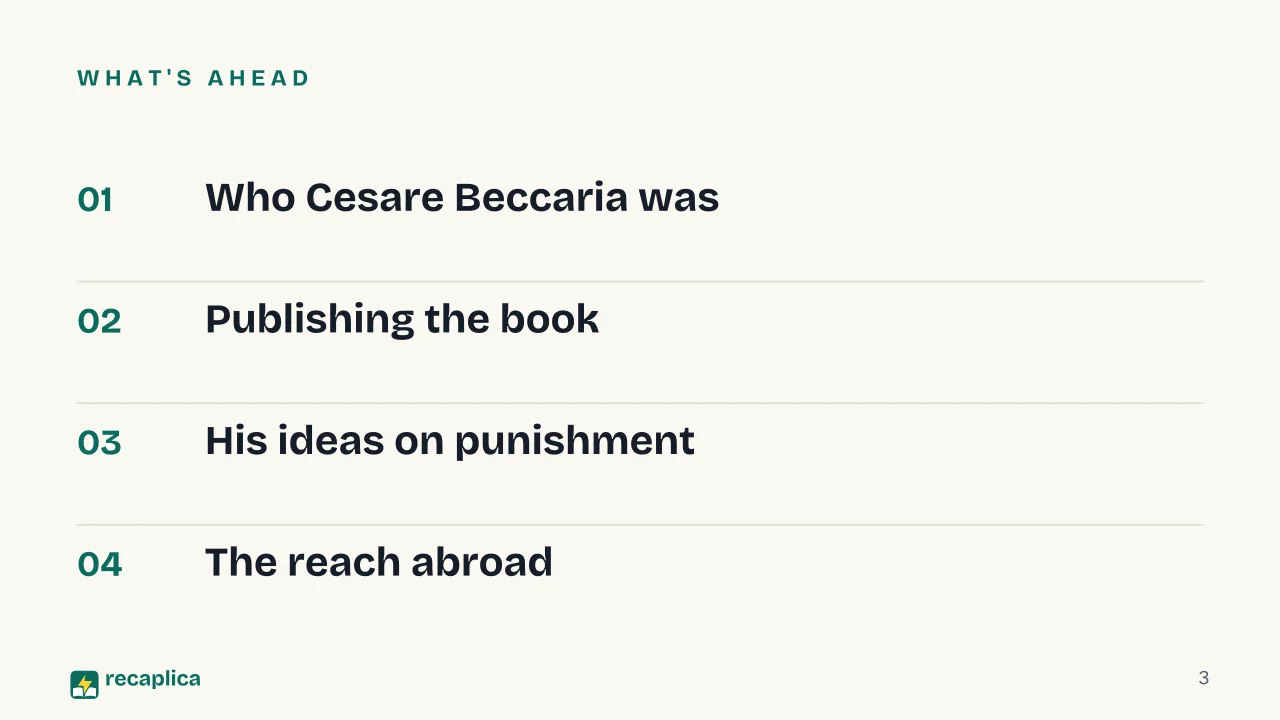
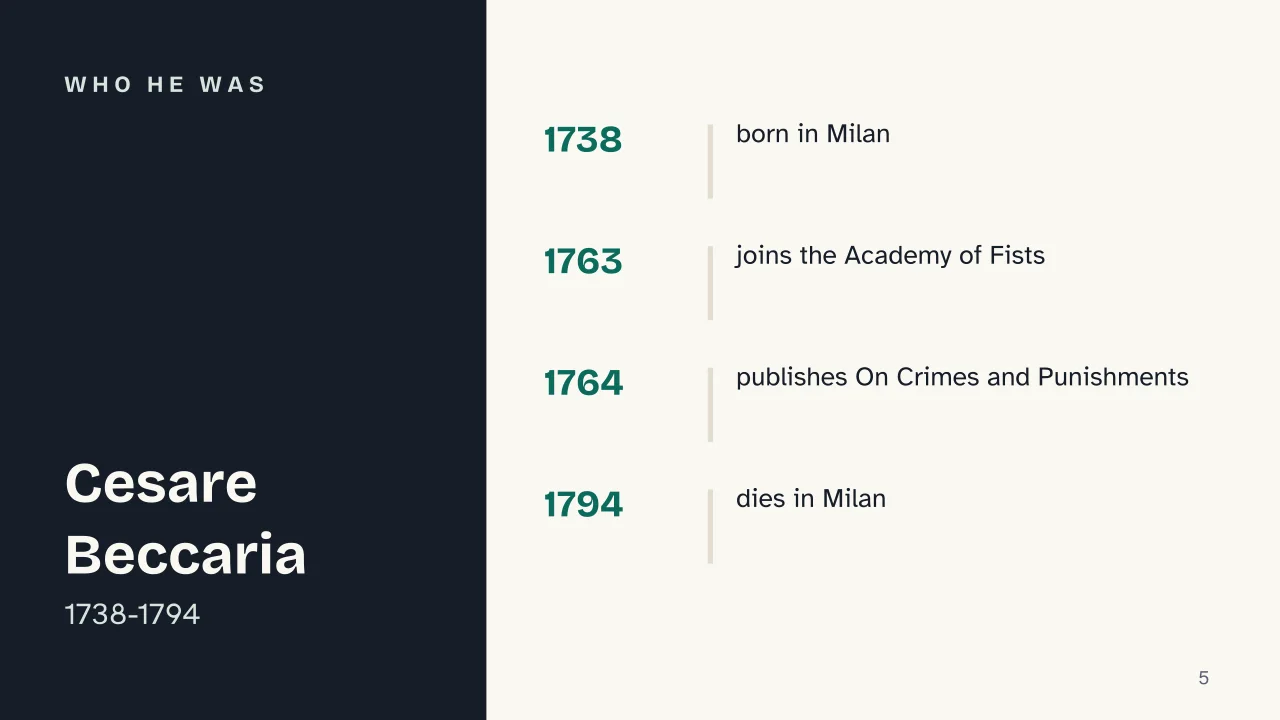
    Slide 1 of the presentation on Cesare Beccaria: Cesare BeccariaSlide 2 of the presentation on Cesare Beccaria: What right does one man have to kill another?Slide 3 of the presentation on Cesare Beccaria: What's aheadSlide 4 of the presentation on Cesare Beccaria: Chapter 01: Who Cesare Beccaria wasSlide 5 of the presentation on Cesare Beccaria: Who he wasSlide 6 of the presentation on Cesare Beccaria: Chapter 02: Publishing the bookSlide 7 of the presentation on Cesare Beccaria: Spreading across EuropeSlide 8 of the presentation on Cesare Beccaria: On Crimes and Punishments, chapter XXVIII, 1764Slide 9 of the presentation on Cesare Beccaria: Chapter 03: His ideas on punishmentSlide 10 of the presentation on Cesare Beccaria: Proportion · Purpose · TortureSlide 11 of the presentation on Cesare Beccaria: Chapter XXVIISlide 12 of the presentation on Cesare Beccaria: The certainty of a punishment curbs crime more than its harshness.Slide 13 of the presentation on Cesare Beccaria: Chapter 04: The reach abroadSlide 14 of the presentation on Cesare Beccaria: Who read the book: Catherine II of Russia, John Adams, Thomas JeffersonSlide 15 of the presentation on Cesare Beccaria: What is the purpose of punishment according to chapter XII?Slide 16 of the presentation on Cesare Beccaria: The full Recap
    Flash10 slidesThe essential thread, to present in classFull16 slidesEvery chapter and the deeper detail

    Common myths

    • ✗ Myth Beccaria wanted harsher punishments to deter crime.

      ✓ Reality chapter XXVII, Of the Mildness of Punishments, argues the opposite: it is the certainty of punishment, not its severity, that curbs crime; in the text, a moderate but unfailing penalty weighs more than the threat of a cruel and uncertain one.

    • ✗ Myth On Crimes and Punishments came out under Beccaria's own name from the start.

      ✓ Reality it was published anonymously in 1764, because its criticism of the legal system in place risked drawing retaliation; the author's name became known only afterward.

    Mind map

    Drag the background to move around and the nodes to reposition them; use − and + to collapse and expand branches.
    Customize
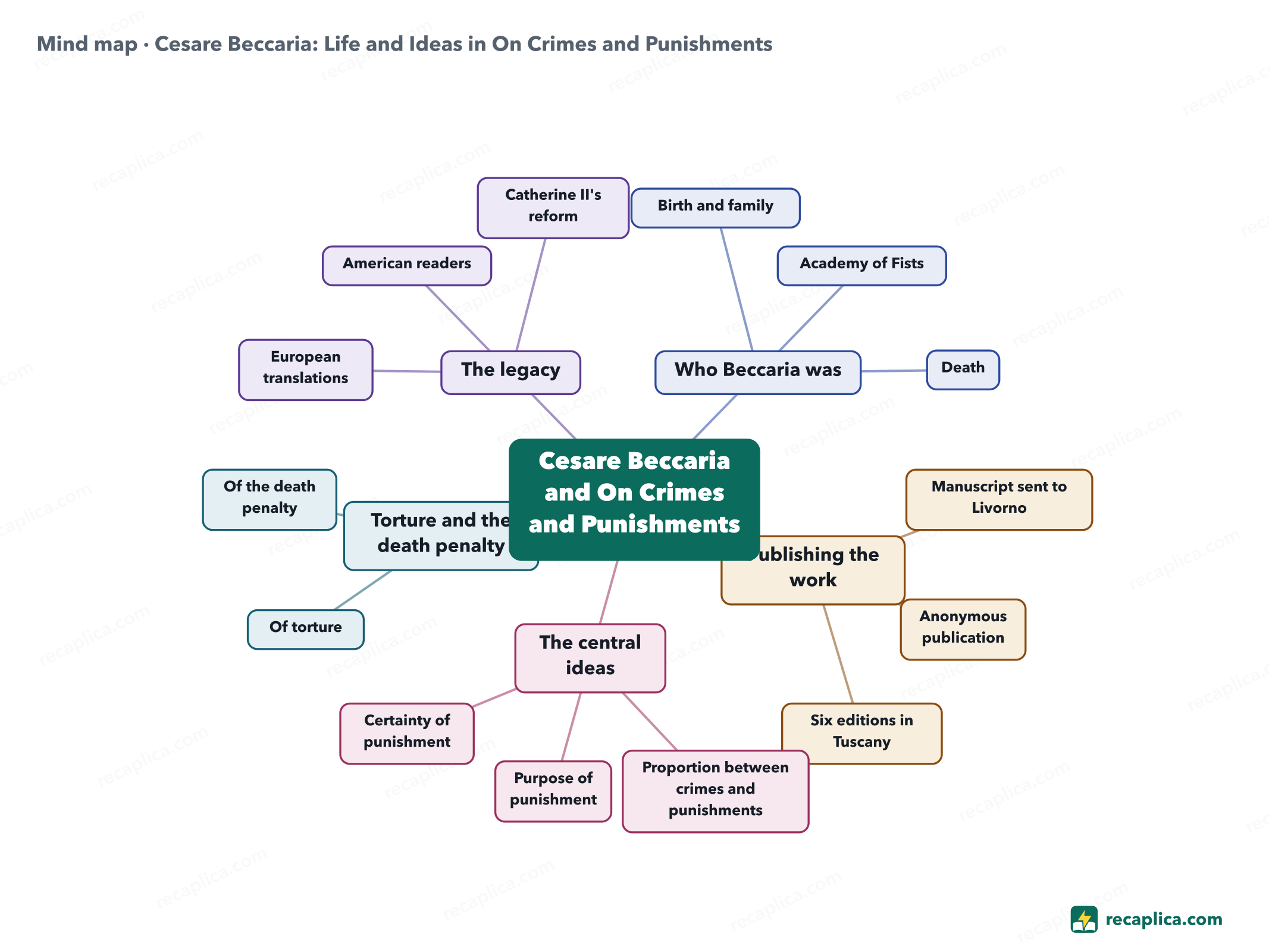
    Mind map: Cesare Beccaria: Life and Ideas in On Crimes and Punishments
    • Cesare Beccaria and On Crimes and Punishments
      • Who Beccaria was
        • Birth and family Milan, 1738, son of Marquis Giovanni Saverio
        • Academy of Fists the Verri brothers' circle, 1763-1764
        • Death Milan, 1794
      • Publishing the work
        • Manuscript sent to Livorno reached the printer on 12 April 1764
        • Anonymous publication out of fear of retaliation
        • Six editions in Tuscany within two years, under false printing locations
      • The central ideas
        • Proportion between crimes and punishments chapter VI
        • Purpose of punishment chapter XII, preventing further harm
        • Certainty of punishment chapter XXVII
      • Torture and the death penalty
        • Of torture chapter XVI
        • Of the death penalty chapter XXVIII
      • The legacy
        • European translations French in 1766, with Voltaire's commentary
        • American readers John Adams and Thomas Jefferson
        • Catherine II's reform Russia, 1767

    Quiz: test yourself

    Answer the questions to check what you have learned: you get instant feedback and a short explanation.

    Grade 0/10 0/5
    1 Where and when was Cesare Beccaria born?

    Beccaria was born in Milan on 15 March 1738, the son of Marquis Giovanni Saverio and Maria Visconti di Saliceto, as Treccani reports.

    2 In what year was On Crimes and Punishments published?

    The manuscript reached the Livorno printer on 12 April 1764, and the first copies began circulating in July of that same year.

    3 According to chapter XXVII, what actually deters crime?

    Chapter XXVII, Of the Mildness of Punishments, ties the curbing of crime to the certainty of the penalty, meaning the assurance that every offense will be punished, even with a moderate penalty.

    4 According to chapter XII, what is the purpose of punishment for Beccaria?

    Chapter XII, Purpose of Punishments, states that the purpose is to prevent the offender from doing further harm to fellow citizens and to deter others from doing the same.

    5 What is Beccaria's position on the death penalty, set out in chapter XXVIII?

    Chapter XXVIII opens by asking what right men claim when they slaughter their fellow men: the condemnation of the death penalty opens the chapter.

    Answers: 1-A · 2-A · 3-A · 4-A · 5-A

    Flashcards

    Tap the card to flip it and check whether you remember the answer, then move to the next one.

    1 / 8

    Explain it in your own words

    The ultimate test: if you can explain it in simple words, you've truly understood it. Write your explanation, then compare it with the Recap.

    Your explanation is saved only on this device.

    Cesare Beccaria was born in Milan in 1738 and died in the same city in 1794. In 1764 he anonymously published On Crimes and Punishments, a short treatise written within the Academy of Fists, the Milanese circle led by the Verri brothers. The book argues that punishment should be proportionate to the harm a crime does to the public good, that its purpose is to prevent further offenses, and it condemns judicial torture and the death penalty. Within a few years it was translated into French and English, and it found readers such as Catherine II of Russia, John Adams and Thomas Jefferson.

    Frequently asked questions

    What is Cesare Beccaria's On Crimes and Punishments about?

    Published in 1764, the book argues that punishment should be proportionate to the harm a crime does to the public good (chapter VI), holds that its purpose is to prevent further harm and deter others from doing the same (chapter XII), and condemns judicial torture (chapter XVI) and the death penalty (chapter XXVIII).

    What was Cesare Beccaria's full name at birth?

    Cesare Beccaria Bonesana, Marquis of Gualdrasco and Villareggio — usually shortened to Cesare Beccaria, the family name under which he wrote On Crimes and Punishments in 1764.

    What is Cesare Beccaria's position on the death penalty?

    In chapter XXVIII, Of the Death Penalty, Beccaria opens by asking what right men claim when they slaughter their fellow men: the condemnation comes at the very start of the chapter, in a work published in 1764.

    Why was On Crimes and Punishments published anonymously?

    Beccaria published the work without his name in 1764 out of fear of retaliation, since its ideas criticized the legal system in force at the time.

    What influence did On Crimes and Punishments have outside Italy?

    Within a few years it was translated into French in 1766, with a commentary by Voltaire, and into English in 1767; its readers included John Adams and Thomas Jefferson in the United States, and Catherine II of Russia's 1767 judicial reform drew on it for the criminal-law part.

    Sources

    • BECCARIA, Cesare — Dizionario Biografico degli Italiani (Treccani)
    • Cesare Beccaria, Dei delitti e delle pene (1764) — full text, Liber Liber mirror
    • On Crimes and Punishments — Wikipedia
    • Cesare Beccaria — Wikipedia

    Every Recap goes through an independent review before publication.

    Every evening, the day's new Recaps on our Telegram channel. Join the channel →

    Keep learning

    • Literature Giuseppe Parini: Life, The Day, and the Satire of the Nobility Giuseppe Parini was born in Bosisio in 1729, became a priest without a real calling in 1754, and taught eloquence in Milan at the Scuole Palatine. His major work, The Day, tells in unrhymed verse the story of one day in the life of a Milanese nobleman, the «giovin signore», from waking to sleep, using the solemn style of epic poetry to expose how empty that day really is. Alongside the poem he wrote the Odes, developed over nearly forty years, and the Dialogue on Nobility, a direct attack on the privileges of birth. Close to, but never fully aligned with, Pietro Verri's Enlightenment circle at the Caffè, he left behind a model of committed poetry that Foscolo and Manzoni would each take up in their own way. Read the Recap →
    • Literature The Servant of Two Masters: Plot and Characters The Servant of Two Masters is a play by Carlo Goldoni, also staged under the title Arlecchino, Servant of Two Masters: it begins life as a scenario in 1745, written for the actor Antonio Sacchi, and becomes a full script only in 1753. The story is set in Venice, in the house of the merchant Pantalone de' Bisognosi, and turns on a mix-up: the servant Truffaldino ends up secretly serving two masters, Beatrice Rasponi disguised as a man and her lover Florindo, simply to get enough to eat. It is the last of Goldoni's plays to bring commedia dell'arte masks on stage, marking the shift toward the character-driven comedy of his reform. In the twentieth century, Giorgio Strehler's productions, starting in 1947, remain among its most remembered stagings. Read the Recap →
    • Literature Carlo Goldoni: The Playwright Who Rewrote Italian Comedy Carlo Goldoni was born in Venice in 1707 and died in Paris in 1793, after training as a lawyer in Padua and practicing law in Venice. Before him, Italian comic theater relied mostly on commedia dell'arte: unscripted scenarios and fixed stock characters such as Harlequin. Goldoni moved the genre toward fully written plays with characters drawn from real life instead of stereotypes, a shift that begins with "La donna di garbo" ("The Woman of Good Sense") and spreads through his work in the 1750s. The change happened gradually: some transitional plays kept only three or four fully scripted scenes per act, with the rest still improvised. Read the Recap →

    recaplica

    Clear in 30 seconds, yours in 10 minutes.

    Recaps Mind maps Request a Recap Telegram channel Mind map maker Our method About Privacy & cookies Legal notes & terms of use

    © 2026 Recaplica · A project by Curi S.r.l. — VAT IT05472000750

    Statistics, only if you say so

    To learn which Recaps help most we would use Google Analytics, with aggregate, anonymous data. It starts only with your OK, and you can change your mind anytime. Privacy policy