Skip to content
recaplica

    One moment: security check

    Cloudflare wants to make sure you're not a robot. Tick the box below and your search will continue on its own.

    IT
    recaplica Machiavelli's The Prince: Virtue, Fortune and the Real Cesare Borgia
    © 2026 Recaplica · recaplica.com — All rights reserved
    Home › Literature

    Machiavelli's The Prince: Virtue, Fortune and the Real Cesare Borgia

    By Recaplica Newsroom · Updated on September 22, 2026

    What to print

    Page numbers appear when printing with default margins.

    Slides

    Choose a cut

    Flash10 slidesThe essential thread, to present in classFull14 slidesEvery chapter and the deeper detail

    Both come with speaker notes.

    Telegram channel
    recaplica Clear in 30 seconds, yours in 10 minutes.
    In 30 seconds Key points Deep dive Slides Myths Mind map Quiz Flashcards FAQ

    In 30 seconds quick read

    The Prince is the political treatise Niccolò Machiavelli wrote in 1513, during the forced exile that followed his arrest. In a few dozen pages he lays out how a new ruler wins and holds on to power, built around two central ideas: virtue, meaning the skill to adapt one's conduct to circumstance, and fortune, the unpredictable share of events every prince has to reckon with. The book wasn't printed until 1532, five years after Machiavelli's death. It should be kept separate from the meaning the word "Machiavellian" picked up over time, a later addition the work itself never claimed.

    Key Points

    • Machiavelli wrote The Prince in 1513, after being dismissed from office and imprisoned when the Medici returned to power in Florence.
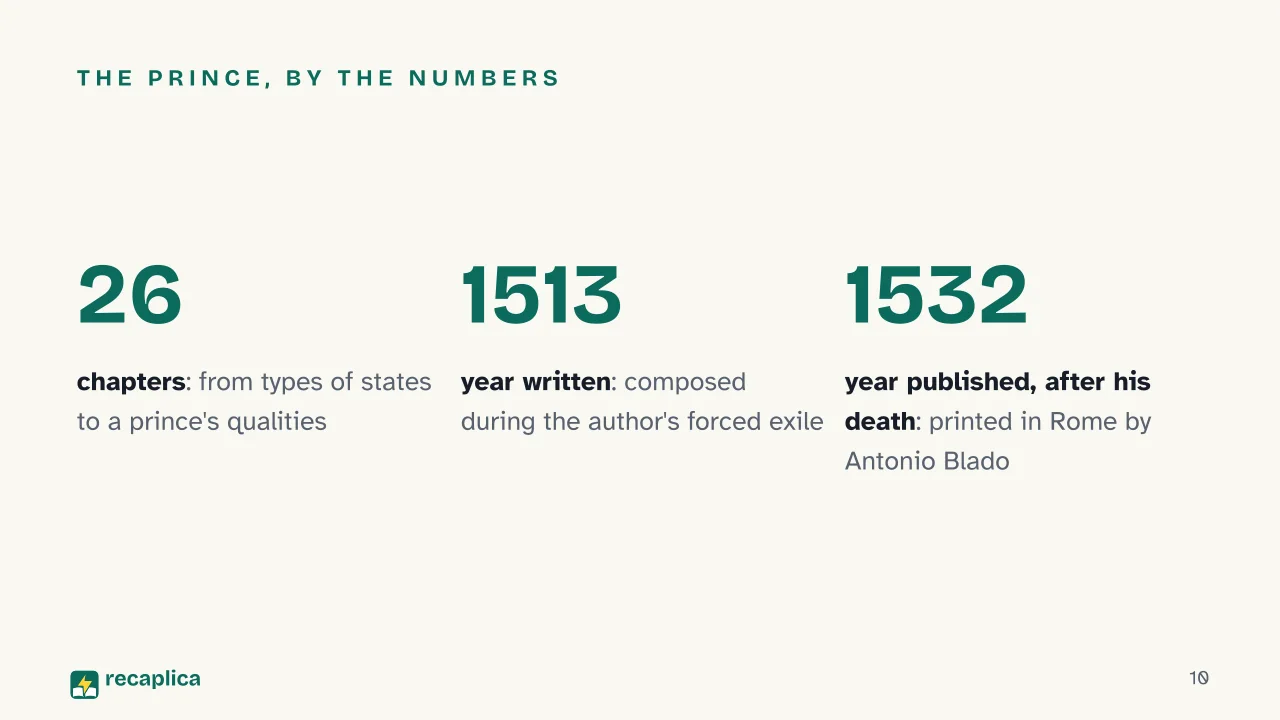
    • The work is organized into 26 chapters: first the types of states and how they're acquired, then armies, then the qualities a prince needs and the role of fortune.
    • Virtue and fortune are the book's two central concepts: a prince's own abilities on one side, the unpredictability of events on the other.
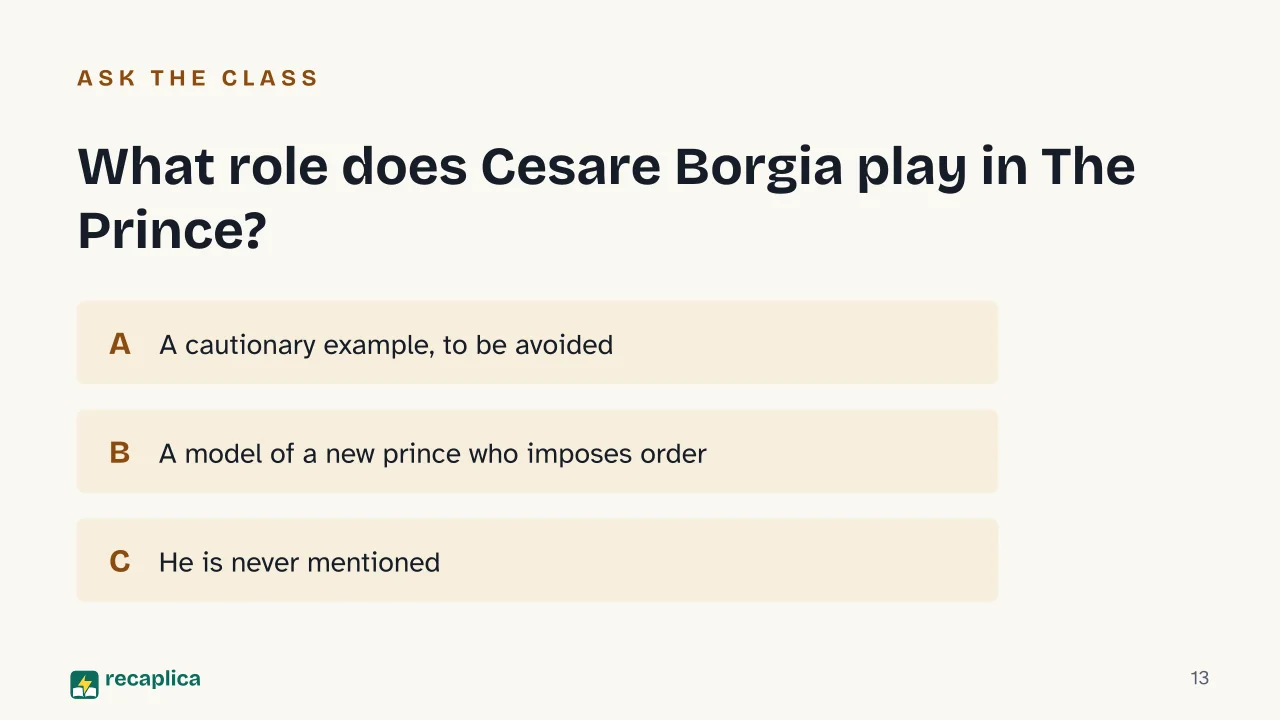
    • Cesare Borgia, whom Machiavelli observed firsthand in 1502, appears as an example of a new prince capable of imposing order through sheer determination.
    • The Prince wasn't published until 1532, after Machiavelli's death: he had called it 'De Principatibus' in a 1513 letter.
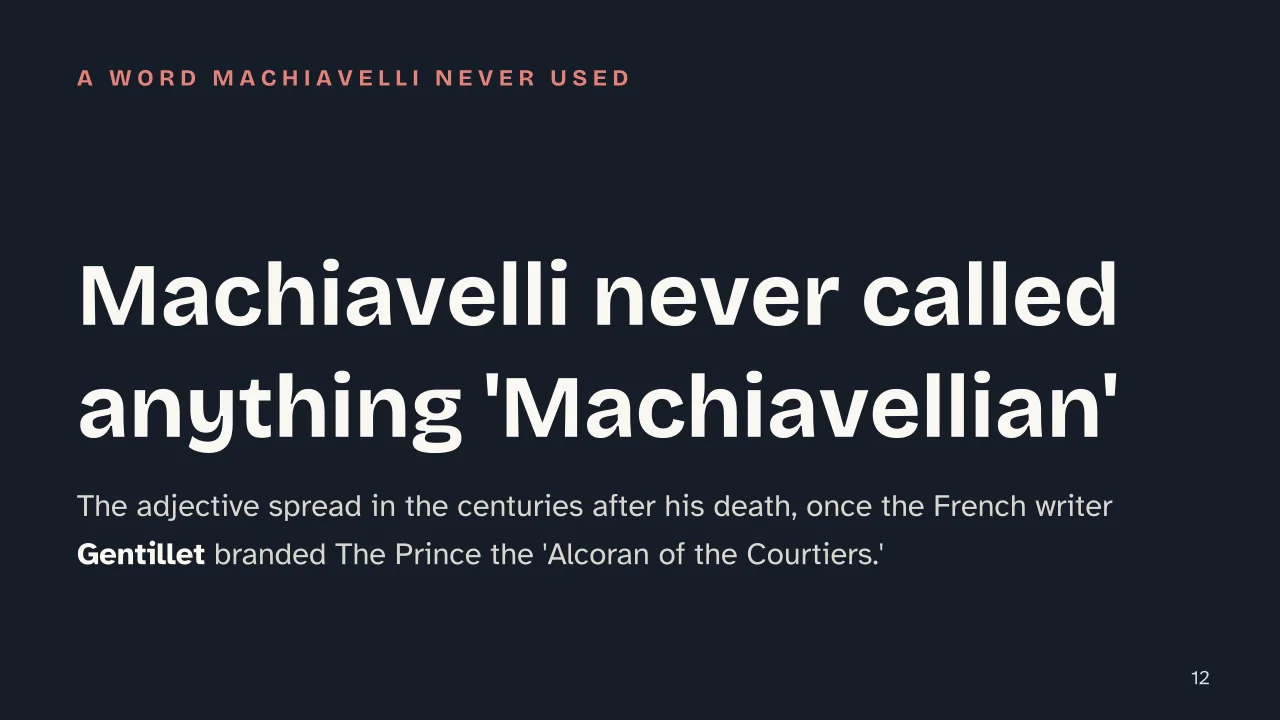
    • The adjective 'Machiavellian' doesn't come from the book itself: it spread in later centuries, starting with an accusation from the Frenchman Gentillet.

    Deep Dive

    Who Niccolò Machiavelli Was

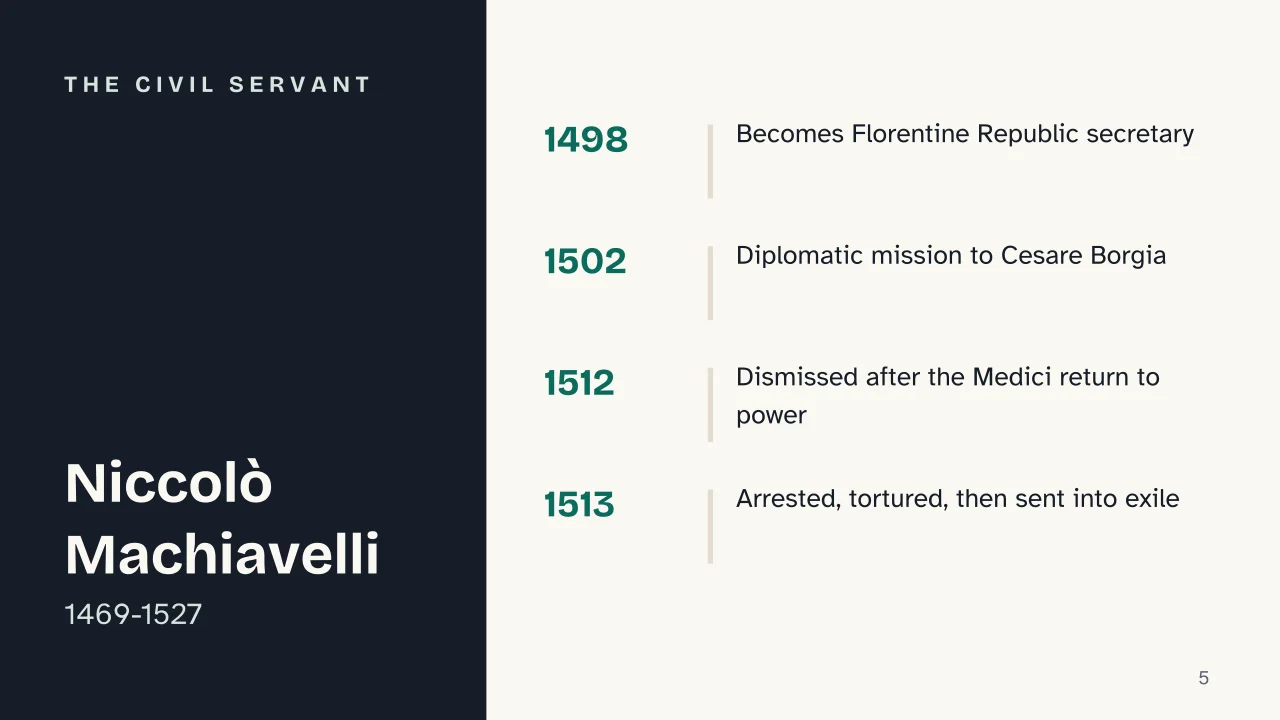
    Niccolò Machiavelli was born in Florence on May 3, 1469, and died on either June 21 or June 22, 1527, depending on the source. From June 1498 he served as a secretary to the Florentine Republic, first as Second Chancellor and later with duties tied to the chancery and the city militia. For fourteen years he carried out diplomatic missions on Florence’s behalf: at the French court, before Emperor Maximilian’s imperial curia, and in Italy’s main centers of power. In 1502 he was sent to Romagna to deal with Cesare Borgia, an experience that would later become central to The Prince. Between 1506 and 1512 he also oversaw Florence’s military reform, becoming chancellor of the Nine Officers of the Militia.

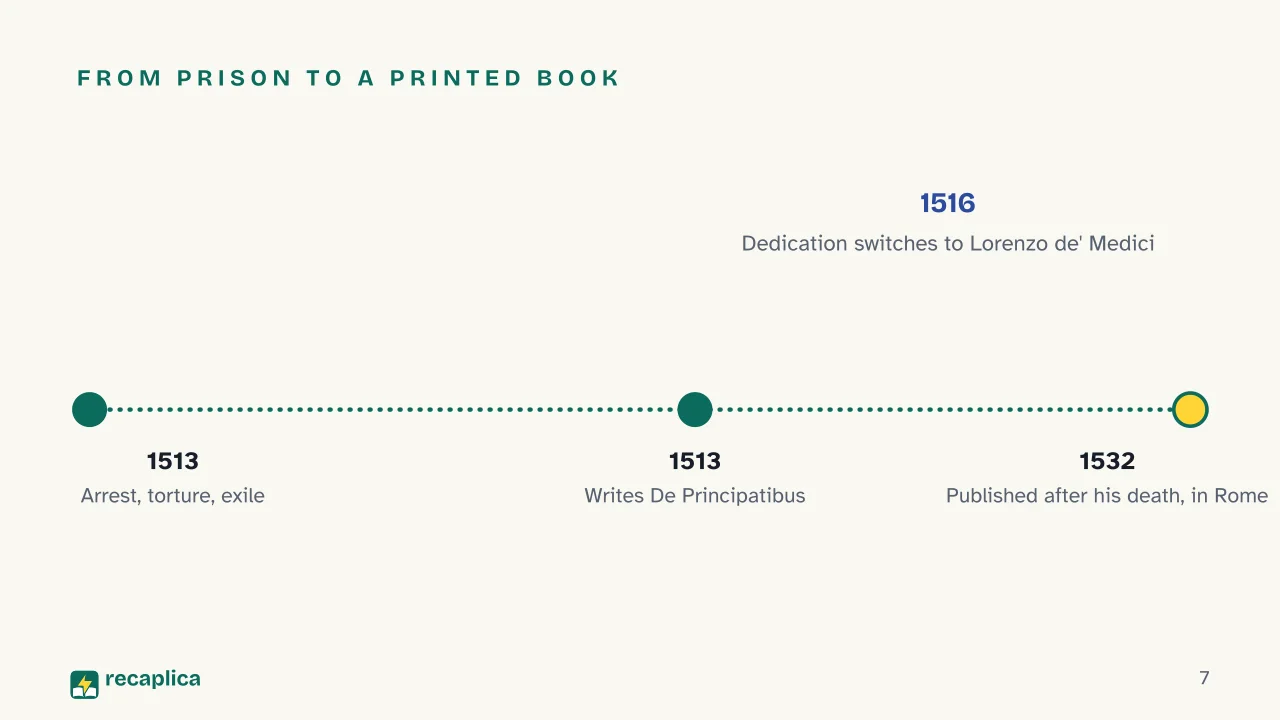
    His career broke off abruptly in 1512, when Spanish and papal troops brought the Medici back to power and defeated the civic militia Machiavelli himself had organized. He was dismissed and sentenced to a year’s confinement; in February 1513 he was arrested and tortured on suspicion of involvement in a plot against the Medici. It was during this period of forced isolation, cut off from the public offices that had filled his life for fourteen years, that The Prince was born.

    This same restless, faction-torn Florence had already produced one exile two centuries earlier: Dante Alighieri, whose banishment from the city runs through the Divine Comedy — a reminder that political exile shaped more than one landmark of Italian literature.

    How The Prince Came to Be

    Sources agree on the year of composition, 1513, but differ on the exact window:

    DetailStanford Encyclopedia of PhilosophyTreccani, Dizionario di StoriaTreccani, Enciclopedia Italiana
    Compositionlate 1513, perhaps early 1514autumn 1513-April 1514July-December 1513
    Author’s deathJune 21, 15271527June 22, 1527

    Machiavelli didn’t call his work “The Prince”: in a letter to his friend Francesco Vettori dated December 10, 1513, he calls it “De Principatibus.” The text was originally dedicated to Giuliano de’ Medici; the dedication was later switched to Lorenzo de’ Medici the Younger, in 1516, who almost certainly never read the book addressed to him. The Prince remained a manuscript passed privately from hand to hand for nearly twenty years: it wasn’t printed until 1532, in Rome, by the printer Antonio Blado, five years after the author’s death.

    It should be kept separate from Machiavelli’s other major political work, the Discourses on Livy, probably begun around 1514 or 1515 and finished in 1518 or 1519, also published posthumously, in 1531. Where The Prince focuses on the power of a single ruler, the Discourses lay out the principles of republican government, using a commentary on Livy’s history of Rome as the pretext.

    The Book’s Structure, Chapter by Chapter

    The Prince runs 26 chapters, grouped into thematic blocks. The first eleven (chapters I-XI) classify the types of states and how they’re acquired: hereditary, mixed, new, won with someone else’s weapons or with one’s own skill. Three chapters on armies follow, distinguishing mercenary, auxiliary, one’s own, and mixed troops. The closing chapters cover the qualities a prince needs, the political crisis facing Italy at the time, and the role of fortune, ending with an appeal to the Medici to free Italy from foreign armies.

    Virtue and Fortune, the Ideas at the Book’s Core

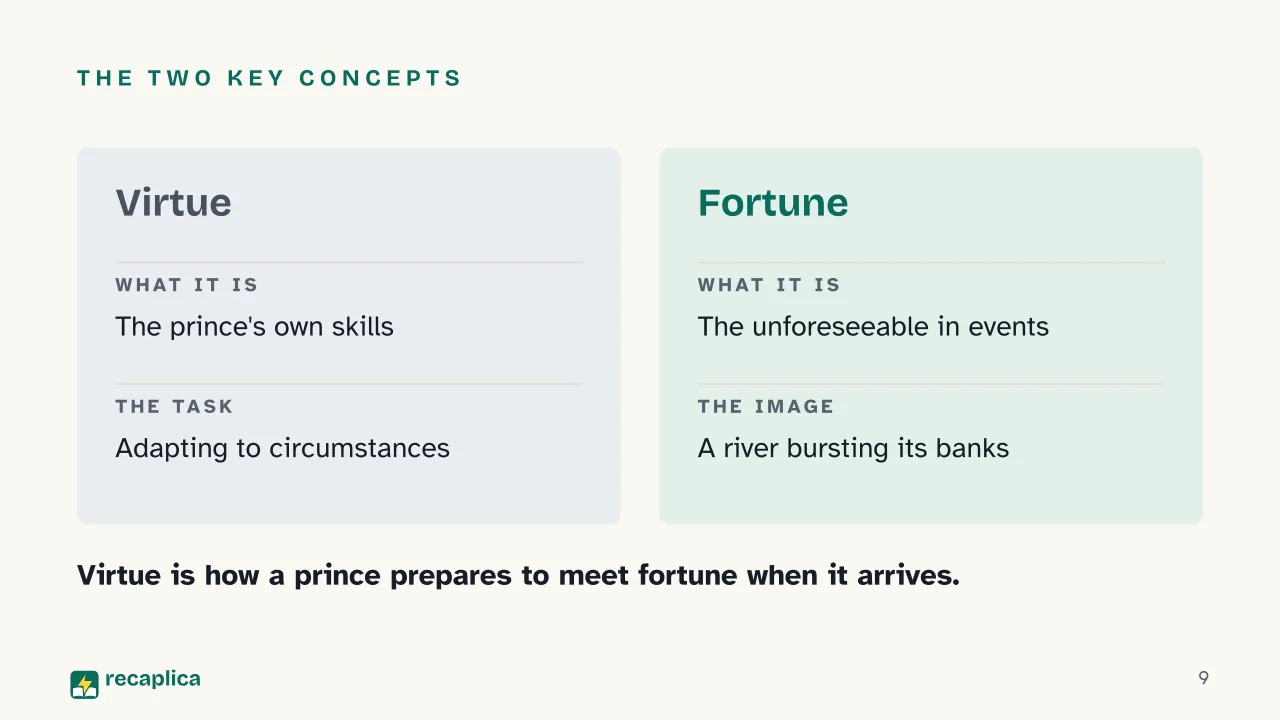
    Two concepts run through the entire treatise: virtue and fortune. For Machiavelli, virtue is the set of practical qualities that let a prince “maintain his state” and achieve great things: above all, the skill to vary one’s conduct according to circumstance, rather than sticking to one way of acting in every situation.

    Fortune is the unpredictable share of events, the part a prince doesn’t control. In chapter 25, Machiavelli compares it to one of those rivers that, when they flood, submerge plains and knock down trees and buildings — a danger that can only be contained by taking precautions before the water rises. From this image follows the idea that fortune is better met head-on than with a passive, wait-and-see approach.

    To back this up, Machiavelli invokes what he calls “effectual truth”: the principle that politics should be judged by how people actually behave.

    Practical example: when Machiavelli describes Cesare Borgia’s actions in Romagna, he doesn’t measure them against a moral yardstick — he examines the method: how territory marked by feudal anarchy was brought back to order through determined conduct. That’s effectual truth applied to a real case: looking at what worked, not at what would have been desirable.

    Cesare Borgia, the Model Prince

    Machiavelli witnessed Cesare Borgia’s actions firsthand — the man known as Duke Valentino — during a 1502 diplomatic mission in Romagna. He wrote about it in an almost documentary account, the Description of the Method Used by Duke Valentino to Kill Vitellozzo Vitelli: a short text, free of personal commentary, built as an objective narration of events.

    In The Prince, Borgia becomes the example of the qualities a new prince needs — someone seizing power he didn’t previously hold: his actions, in Machiavelli’s telling, proved it was possible to tame the instability of territory marked by feudal anarchy through ruthless determination.

    Why “Machiavellian” Isn’t Machiavelli

    In everyday use, “Machiavellian” describes someone who pursues their own ends through cunning and disloyalty, without scruple. It’s a label that spread in the centuries after the author’s death, not a term Machiavelli used to define his own thinking. A decisive moment in this history was an attack by the French writer Gentillet, who branded The Prince the “Alcoran of the Courtiers” — an accusation that shaped the book’s reputation for generations, often more than its actual pages ever did.

    Separating the historical work from its later use as a byword for cynicism also helps read it for what it is: an attempt to describe power the way Machiavelli had watched it work up close, across years of diplomatic missions and then in the forced exclusion from that same world.

    Slide deck

    Slides ready to download and make your own in PowerPoint or Google Slides, with speaker notes. Pick the Flash cut or the Full one.
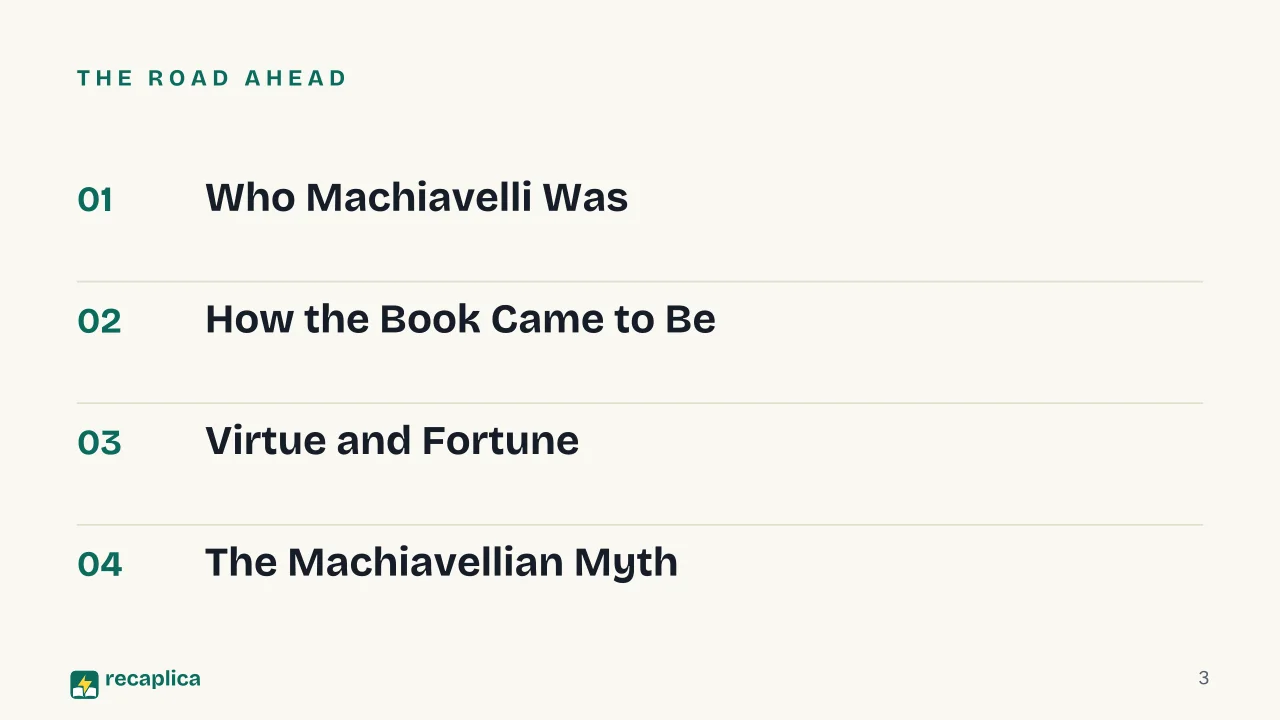
    Slide 1 of the presentation on Machiavelli's The Prince: Machiavelli's The PrinceSlide 2 of the presentation on Machiavelli's The Prince: What book did Machiavelli write right after prison?Slide 3 of the presentation on Machiavelli's The Prince: The road aheadSlide 4 of the presentation on Machiavelli's The Prince: Chapter 01: Who Machiavelli WasSlide 5 of the presentation on Machiavelli's The Prince: The civil servantSlide 6 of the presentation on Machiavelli's The Prince: Chapter 02: How the Book Came to BeSlide 7 of the presentation on Machiavelli's The Prince: From prison to a printed bookSlide 8 of the presentation on Machiavelli's The Prince: Chapter 03: Virtue and FortuneSlide 9 of the presentation on Machiavelli's The Prince: The two key conceptsSlide 10 of the presentation on Machiavelli's The Prince: The Prince, by the numbersSlide 11 of the presentation on Machiavelli's The Prince: Chapter 04: The Machiavellian MythSlide 12 of the presentation on Machiavelli's The Prince: Machiavelli never called anything 'Machiavellian'Slide 13 of the presentation on Machiavelli's The Prince: What role does Cesare Borgia play in The Prince?Slide 14 of the presentation on Machiavelli's The Prince: To learn more
    Flash10 slidesThe essential thread, to present in classFull14 slidesEvery chapter and the deeper detail

    Common myths

    • ✗ Myth Machiavelli titled his work 'The Prince.'

      ✓ Reality In a letter to his friend Francesco Vettori dated December 10, 1513, Machiavelli himself calls his work 'De Principatibus': the title we know it by today came later.

    • ✗ Myth The Prince circulated and shaped Florentine politics while Machiavelli was still alive.

      ✓ Reality The book wasn't printed until 1532 in Rome, five years after Machiavelli's death in 1527: for nearly two decades it existed only as a manuscript passed privately from hand to hand.

    • ✗ Myth The word 'Machiavellian' describes how Machiavelli himself defined his own thinking.

      ✓ Reality The term spread in the centuries after his death as a byword for political disloyalty; it was the Frenchman Gentillet who branded The Prince the 'Alcoran of the Courtiers.'

    Mind map

    Drag the background to move around and the nodes to reposition them; use − and + to collapse and expand branches.
    Customize
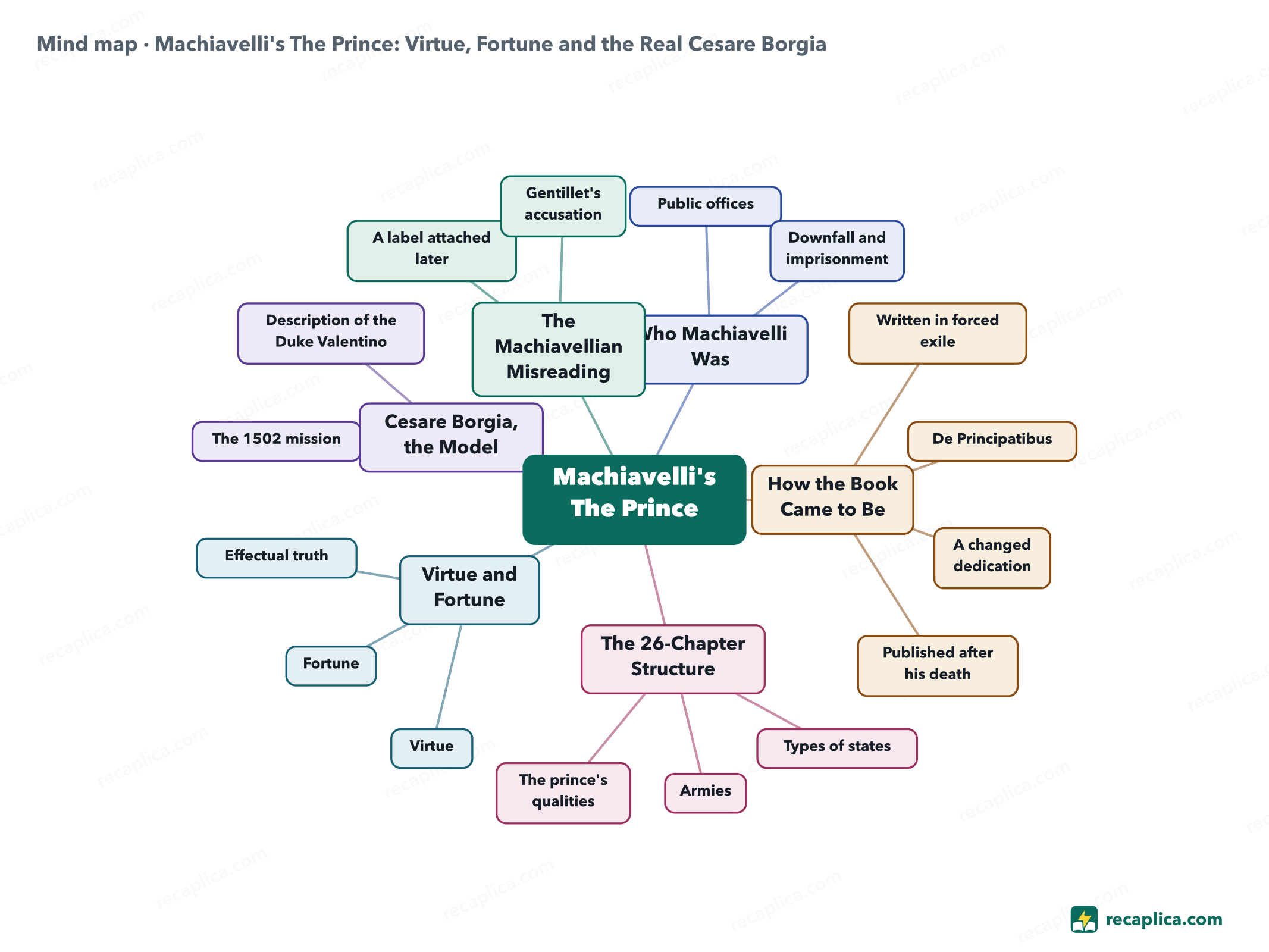
    Mind map: Machiavelli's The Prince: Virtue, Fortune and the Real Cesare Borgia
    • Machiavelli's The Prince
      • Who Machiavelli Was Official and diplomat of the Florentine Republic
        • Public offices Secretary from 1498, fourteen years of diplomatic missions
        • Downfall and imprisonment Dismissed in 1512, arrested and tortured in 1513
      • How the Book Came to Be
        • Written in forced exile Composed in 1513, during his confinement after the arrest
        • De Principatibus The Latin title Machiavelli used in a December 1513 letter
        • A changed dedication From Giuliano to Lorenzo de' Medici the Younger, in 1516
        • Published after his death Printed in Rome in 1532, five years after the author died
      • The 26-Chapter Structure
        • Types of states Chapters I-XI, on how power is acquired
        • Armies Mercenary, auxiliary, one's own and mixed troops
        • The prince's qualities Closing chapters, with fortune and the appeal to the Medici
      • Virtue and Fortune
        • Virtue The qualities that let a prince adapt conduct to circumstance
        • Fortune In chapter 25, compared to a river that floods when it swells
        • Effectual truth Judging politics by how people actually behave
      • Cesare Borgia, the Model
        • The 1502 mission Machiavelli observes him closely in Romagna
        • Description of the Duke Valentino A chronicle of events, without the author's personal comments
      • The Machiavellian Misreading
        • A label attached later The adjective spread in the centuries after Machiavelli's death
        • Gentillet's accusation The Frenchman called the work the 'Alcoran of the Courtiers'

    Quiz: test yourself

    Answer the questions to check what you have learned: you get instant feedback and a short explanation.

    Grade 0/10 0/5
    1 In what year did Machiavelli write The Prince?

    Machiavelli composed the work in 1513 (sources differ on the exact month, between late 1513 and early 1514), during the forced exile that followed his arrest.

    2 What Latin title did Machiavelli give his work in a 1513 letter?

    In a letter to Francesco Vettori dated December 10, 1513, Machiavelli calls the work he had just finished 'De Principatibus.'

    3 How many chapters does The Prince have?

    The treatise is divided into 26 chapters, from the types of states to the qualities of a prince and the role of fortune.

    4 What role does Cesare Borgia play in The Prince?

    Machiavelli, who observed him closely in Romagna in 1502, holds him up as proof of the qualities a new prince needs to tame unstable territory.

    5 True or false: Machiavelli himself coined the adjective 'Machiavellian' to describe his own approach.

    False: the term spread in the centuries after the author's death, starting with an accusation from the Frenchman Gentillet, who branded The Prince the 'Alcoran of the Courtiers.'

    Answers: 1-B · 2-A · 3-C · 4-B · 5-B

    Flashcards

    Tap the card to flip it and check whether you remember the answer, then move to the next one.

    1 / 7

    Explain it in your own words

    The ultimate test: if you can explain it in simple words, you've truly understood it. Write your explanation, then compare it with the Recap.

    Your explanation is saved only on this device.

    The Prince is the political treatise Niccolò Machiavelli wrote in 1513, during the forced exile that followed his arrest. In a few dozen pages he lays out how a new ruler wins and holds on to power, built around two central ideas: virtue, meaning the skill to adapt one's conduct to circumstance, and fortune, the unpredictable share of events every prince has to reckon with. The book wasn't printed until 1532, five years after Machiavelli's death. It should be kept separate from the meaning the word "Machiavellian" picked up over time, a later addition the work itself never claimed.

    Frequently asked questions

    Can The Prince be summarized chapter by chapter?

    Yes. The first eleven chapters explain the types of states and how they're won; three chapters cover armies, distinguishing mercenary, auxiliary, one's own and mixed troops; the closing chapters address the qualities of a prince, Italy's political crisis, and the role of fortune, ending with an appeal to the Medici to free Italy.

    What is virtue for Machiavelli?

    It's the set of practical qualities a prince needs to win and hold power: above all, the skill to vary one's conduct according to circumstance, rather than sticking to a single way of acting in every situation.

    Why does Cesare Borgia matter in The Prince?

    Machiavelli observed him directly in Romagna in 1502 and wrote about him in an almost documentary account. In The Prince he holds Borgia up as an example of a new prince: his actions showed that it was possible to impose order on territory marked by instability through sheer determination.

    What does 'Machiavellian' actually mean?

    In everyday use it signals disloyalty and political cynicism, but it's a label that emerged in the centuries after Machiavelli's death, not a term the author used for himself: it was the Frenchman Gentillet who branded The Prince the 'Alcoran of the Courtiers.'

    When and where was The Prince published?

    In 1532, in Rome, printed by Antonio Blado: a posthumous publication that arrived five years after Machiavelli's death in 1527.

    Sources

    • Stanford Encyclopedia of Philosophy — Niccolò Machiavelli
    • Treccani, Dizionario di Storia — Niccolò Machiavelli
    • Treccani, Enciclopedia Italiana — Niccolò Machiavelli

    Every Recap goes through an independent review before publication.

    Every evening, the day's new Recaps on our Telegram channel. Join the channel →

    Keep learning

    • Literature Carlo Goldoni: The Playwright Who Rewrote Italian Comedy Carlo Goldoni was born in Venice in 1707 and died in Paris in 1793, after training as a lawyer in Padua and practicing law in Venice. Before him, Italian comic theater relied mostly on commedia dell'arte: unscripted scenarios and fixed stock characters such as Harlequin. Goldoni moved the genre toward fully written plays with characters drawn from real life instead of stereotypes, a shift that begins with "La donna di garbo" ("The Woman of Good Sense") and spreads through his work in the 1750s. The change happened gradually: some transitional plays kept only three or four fully scripted scenes per act, with the rest still improvised. Read the Recap →
    • Literature Torquato Tasso: The Poet Behind Jerusalem Delivered Torquato Tasso was born in Sorrento in 1544 and died in Rome in 1595, having spent most of his adult life at the Este court in Ferrara. His masterwork is Jerusalem Delivered, a twenty-canto poem about the First Crusade and the fall of Jerusalem, published in its final form in 1581 after more than two decades of work. The story follows Godfrey of Bouillon as he leads the Christian army, but it keeps breaking away into private tales of love and duty: the knight Tancred, the sorceress Armida, the paladin Rinaldo. In 1593 Tasso issued a stricter revision titled Jerusalem Conquered, which never won over readers the way the original did. Read the Recap →
    • Literature Orlando Furioso: Plot, Characters and Summary Orlando Furioso is the chivalric romance that Ludovico Ariosto first publishes in 1516 and brings to its final shape in 1532, in forty-six cantos. It follows knights and ladies at the court of Charlemagne, and centers on the paladin Orlando, who loses his mind for love of Angelica — the source of the poem's title. Ariosto writes in ottava rima, the eight-line stanza typical of Italian narrative poetry, and takes as his starting point the unfinished Orlando Innamorato by Matteo Maria Boiardo. Read the Recap →

    recaplica

    Clear in 30 seconds, yours in 10 minutes.

    Recaps Mind maps Request a Recap Telegram channel Mind map maker Our method About Privacy & cookies Legal notes & terms of use

    © 2026 Recaplica · A project by Curi S.r.l. — VAT IT05472000750

    Statistics, only if you say so

    To learn which Recaps help most we would use Google Analytics, with aggregate, anonymous data. It starts only with your OK, and you can change your mind anytime. Privacy policy