|
recaplica
Thomas Aquinas: Faith, Reason, and the Five Ways to God | ||||||||||||||||||
| © 2026 Recaplica · recaplica.com — All rights reserved | ||||||||||||||||||
Thomas Aquinas: Faith, Reason, and the Five Ways to GodWhat to print Page numbers appear when printing with default margins. SlidesChoose a cut Flash10 slidesThe essential thread, to present in classFull10 slidesEvery chapter and the deeper detailBoth come with speaker notes. In 30 seconds quick readThomas Aquinas was born around 1224-1226 in the castle of Roccasecca, near Naples, and joined the Dominican order as a teenager, against his family's wishes. He trained in Paris and Cologne under Albert the Great, then taught theology at the University of Paris and later in Naples, writing his two major works along the way: the Summa Theologiae and the Summa contra Gentiles. He is best known for the Five Ways, five arguments that build from the observable world toward the existence of God. For Aquinas, the truths of faith and the truths of reason cannot truly contradict one another, though some of them stay knowable only through revelation. He died in 1274 while travelling to the Council of Lyon, and was later canonized and named a Doctor of the Church. Key Points
Key figures
Deep DiveA calling against the family’s wishesThomas Aquinas was born in the castle of Roccasecca, near Naples. The sources disagree on the exact year: Treccani gives “around 1226”, the Stanford Encyclopedia of Philosophy “around 1225”, and the Internet Encyclopedia of Philosophy a range between 1224 and 1226. The safest way to put it is “around 1224-1226”. At 19 he joined the Dominican order, the Order of Preachers, in Naples. His family objected: the Internet Encyclopedia of Philosophy notes the order was then new and not without controversy, and Treccani confirms the choice ran against his relatives’ wishes. Thomas held to his decision regardless. Trained by Albert the Great, between Paris and CologneAfter entering the order, Thomas studied under Albert the Great at the University of Paris for three years. In 1248 he was sent to Cologne, still under Albert’s supervision, where he completed his theological training. The Internet Encyclopedia of Philosophy places the Paris years between 1245 and 1248, before the move to Germany. It was one long apprenticeship, split across two cities: logic and philosophy in Paris, theology in Cologne. Master in Paris, author of the two SummaeFrom 1256 to 1259 Thomas held the chair of regent master of theology at the University of Paris: at 32 he was teaching, preaching, and commenting on Scripture. Treccani places the high point of his output during a second stint of teaching in Paris, between 1269 and 1272, after which he moved to Naples, teaching there from the autumn of 1272 until the start of 1274. These years of teaching, preaching, and academic disputation produced his two major works, the Summa Theologiae and the Summa contra Gentiles. The Stanford Encyclopedia of Philosophy generally treats the Summa Theologiae as the fullest statement of his mature views on each topic it covers; Aquinas himself says in the text that he wrote it for students just beginning theology. Treccani calls its structure systematic to the point of comparing it with the Gothic cathedrals of the era — a judgment from that source, reported here as such. The Summa contra Gentiles was begun in Paris and finished after 1259. Its first three books, according to the Internet Encyclopedia of Philosophy, were meant by Aquinas as works of natural theology: arguments reason can develop on its own, before turning to revelation. The Five Ways: proving God through reasonThe argument Aquinas is best known for, according to the Internet Encyclopedia of Philosophy, is the Five Ways: five arguments, laid out in the Summa Theologiae, meant to demonstrate God’s existence. Each one closes with a version of the same line, “this is what everyone understands to be God.” The first three, the Stanford Encyclopedia of Philosophy notes, are cosmological arguments resting on the impossibility of an infinite chain of causes.
The philosophical background behind these arguments sits with Aristotle: cause, act, potency, the vocabulary Aquinas leans on throughout. Faith and reason, without a real conflictFor Aquinas, in principle, faith and reason cannot genuinely clash. The Stanford Encyclopedia of Philosophy reports that some truths lie beyond human reason’s reach: knowing them requires divine revelation, since Aquinas held them necessary for salvation. A philosopher who reaches conclusions at odds with faith, in his reading, has simply misused philosophy. Treccani describes this framework as an organic link between theology and philosophy, a methodical partnership between the two disciplines. The same source credits Aquinas with building a Christian Aristotelianism: folding Aristotle’s thought into a Christian theological frame. For the broader scholastic method this project belongs to, see the articles on scholasticism and medieval philosophy; for a comparison with another major theological-philosophical system of the period, see Saint Augustine of Hippo. The legacy: canonization and Doctor of the ChurchThomas died on 7 March 1274 at the Cistercian abbey of Fossanova, near Terracina, while traveling to the Council of Lyon. According to Treccani, Pope John XXII canonized him in 1323; in 1567 Pope Pius V named him a Doctor of the Church. The two dates, nearly three centuries apart, mark the start of an influence the Catholic Church has recognized formally, each time at its own pace. Slide deckSlides ready to download and make your own in PowerPoint or Google Slides, with speaker notes. Pick the Flash cut or the Full one.   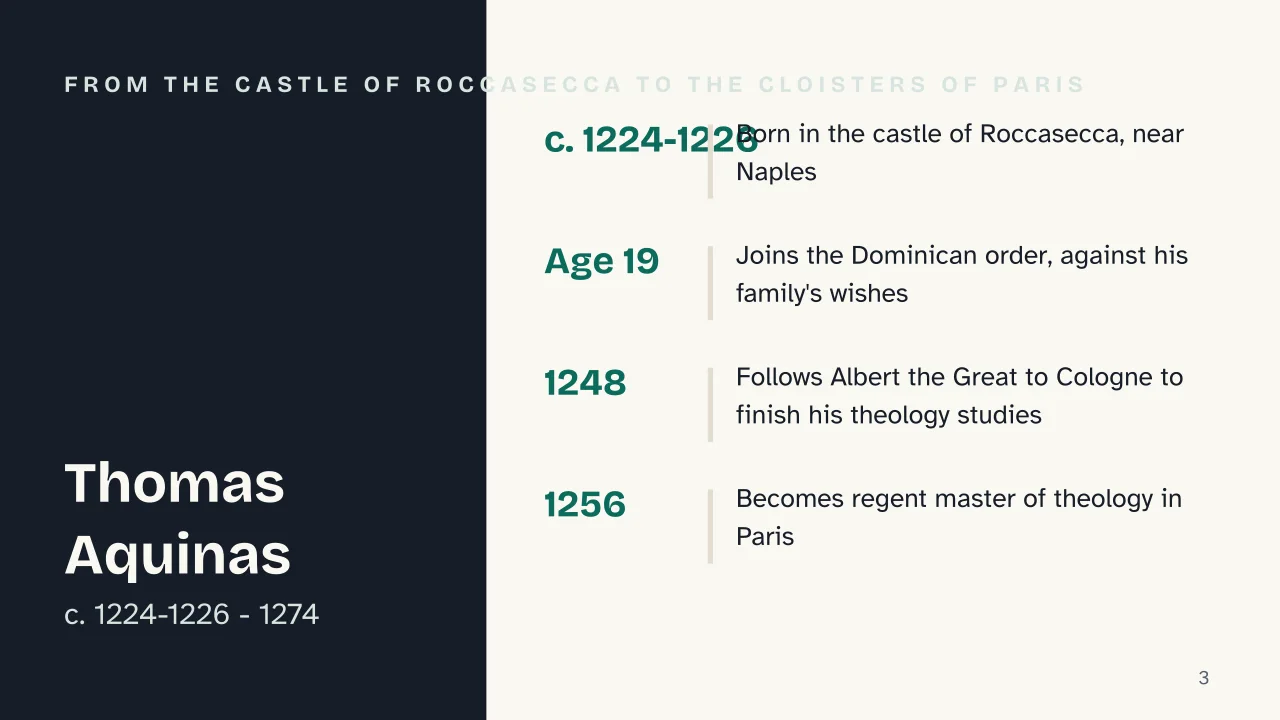  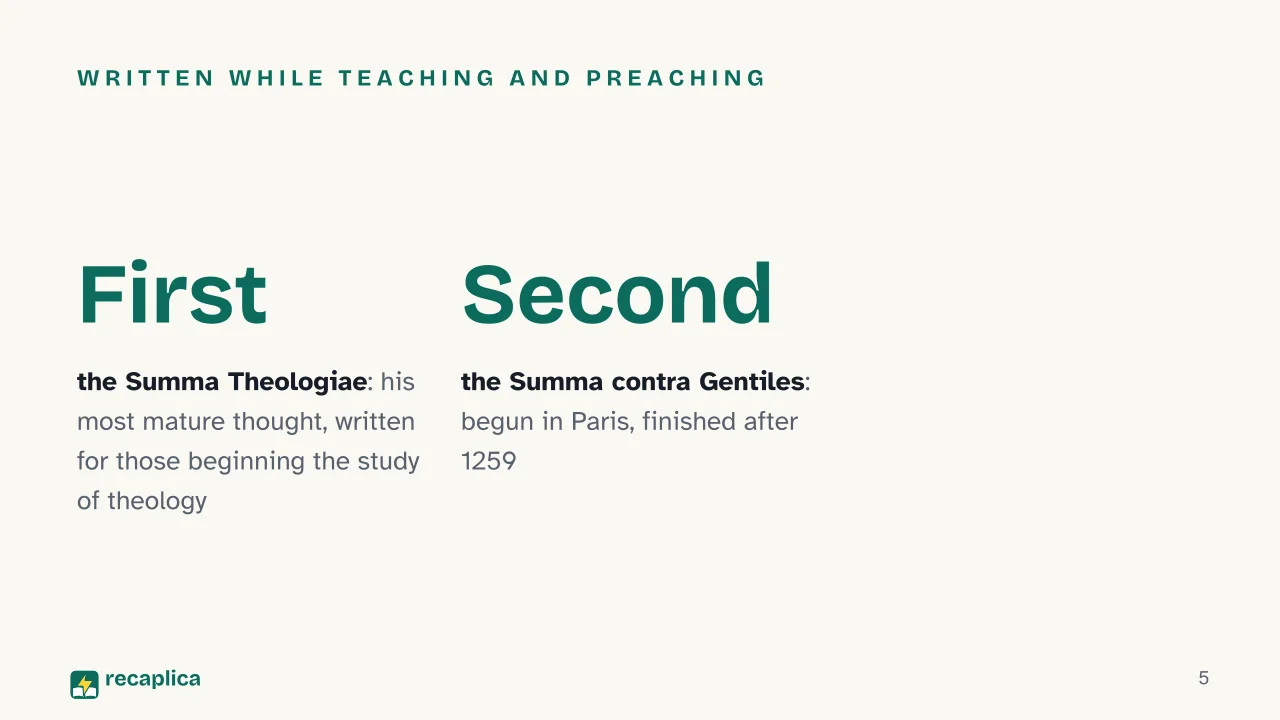 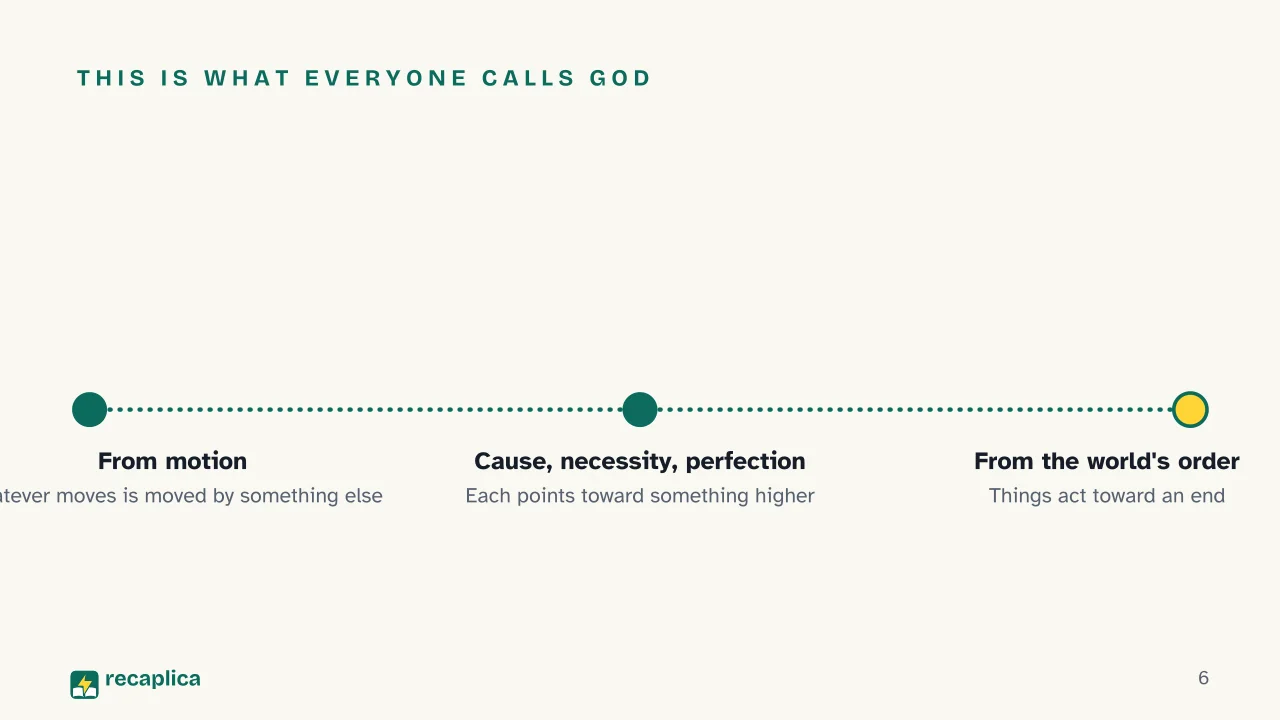 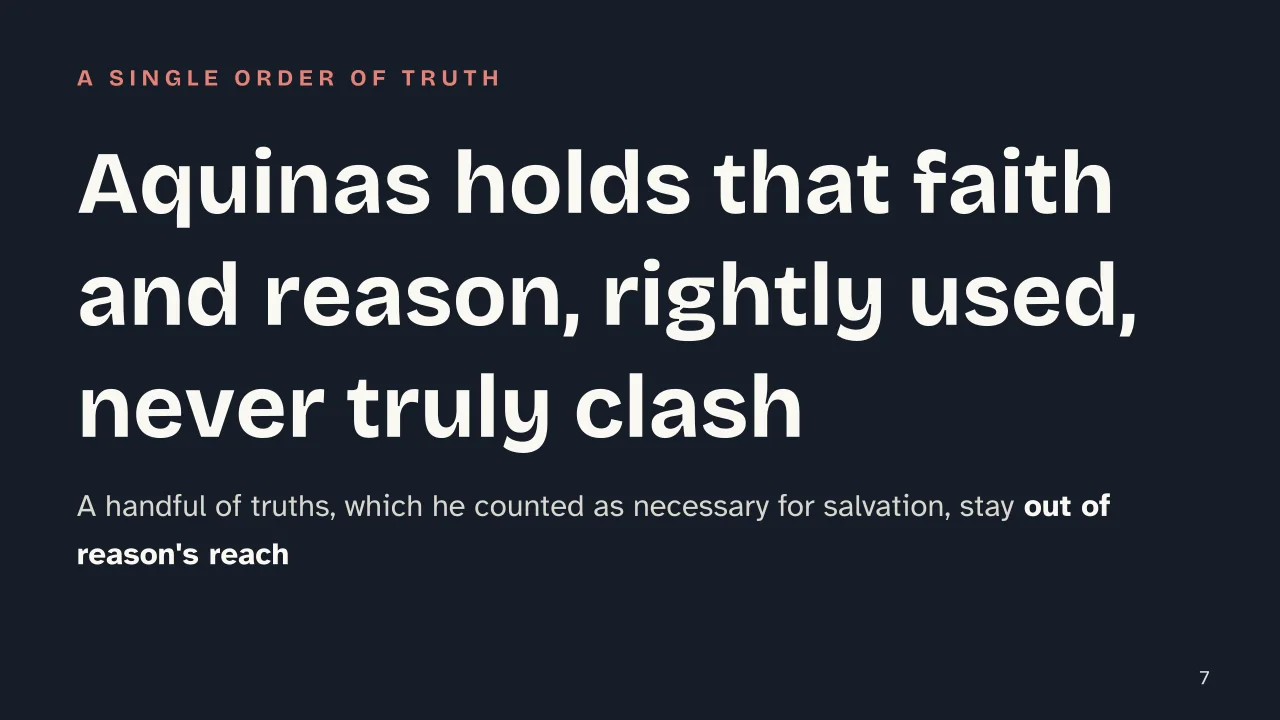 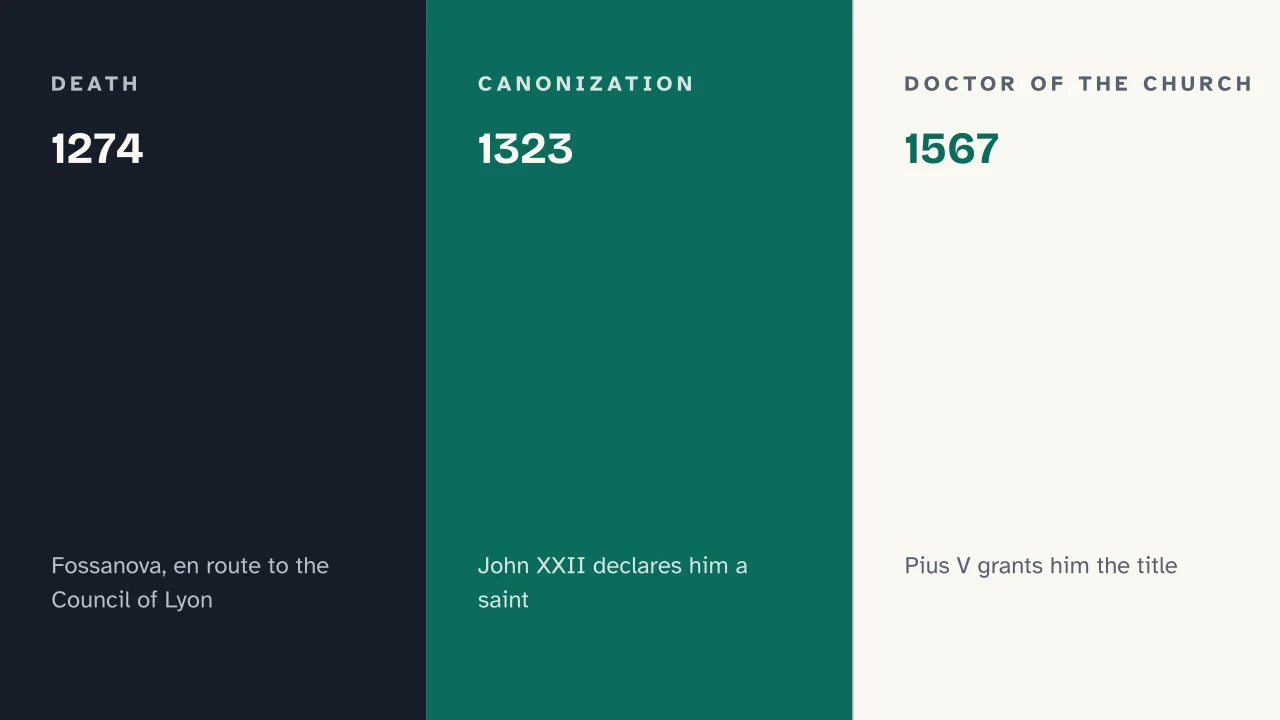 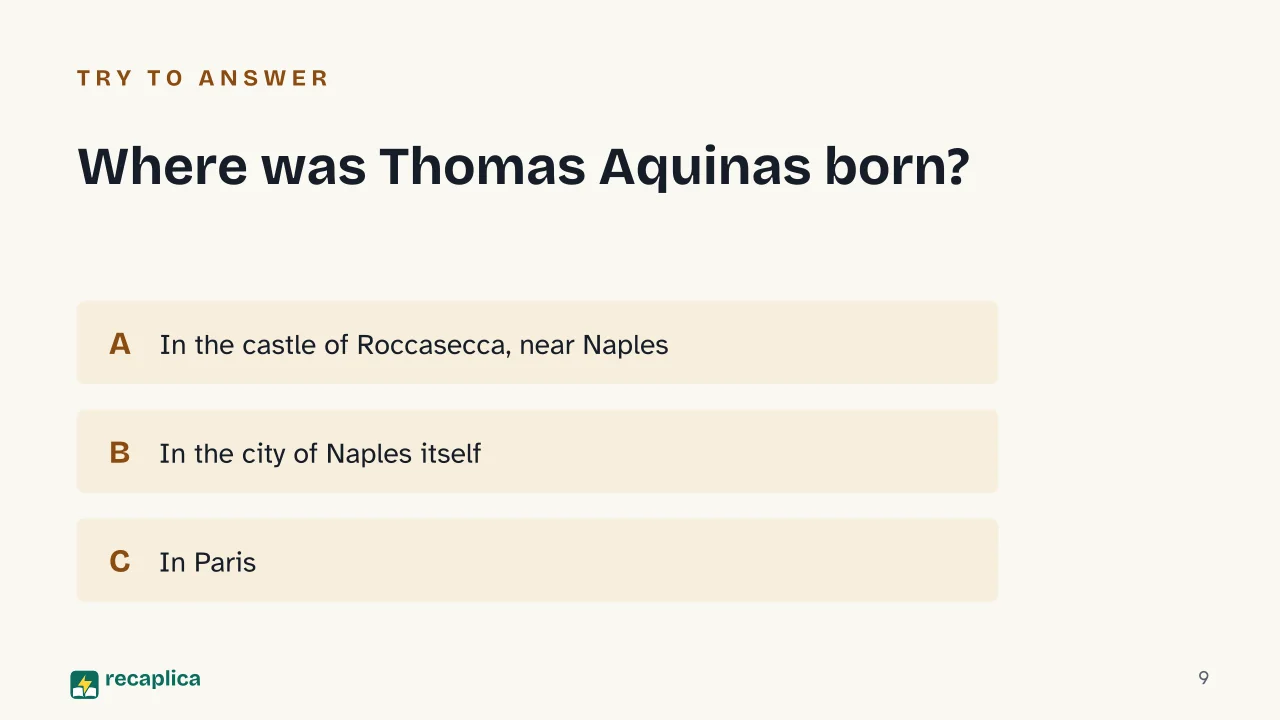  Common myths
Mind mapDrag the background to move around and the nodes to reposition them; use − and + to collapse and expand branches. 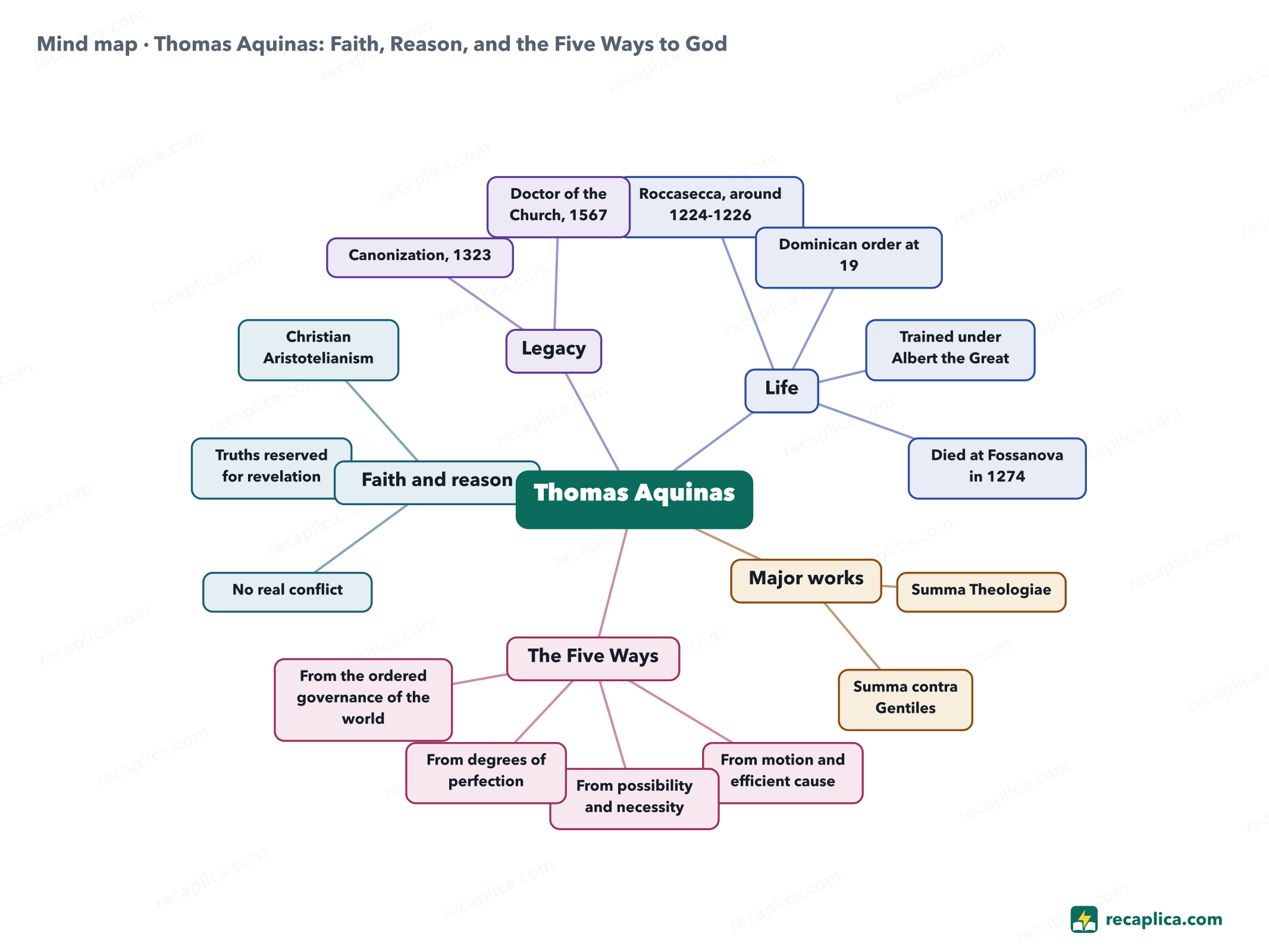
Quiz: test yourselfAnswer the questions to check what you have learned: you get instant feedback and a short explanation. Grade 0/10 0/5
FlashcardsTap the card to flip it and check whether you remember the answer, then move to the next one. 1 / 8 Explain it in your own wordsThe ultimate test: if you can explain it in simple words, you've truly understood it. Write your explanation, then compare it with the Recap. Your explanation is saved only on this device.
Frequently asked questionsWho was Thomas Aquinas?A Dominican philosopher and theologian born around 1224-1226 at Roccasecca, near Naples, author of the Summa Theologiae and the Summa contra Gentiles, who died in 1274. What are the Five Ways of Thomas Aquinas?Five arguments, set out in the Summa Theologiae, through which Aquinas tries to demonstrate God's existence starting from observations about the world: motion, efficient causation, the contingency of things, degrees of perfection, and the order found in nature. What is the difference between the Summa Theologiae and the Summa contra Gentiles?The Summa Theologiae was written for those beginning the study of theology and gathers Aquinas's most mature thought; the Summa contra Gentiles, in its first three books, deals with natural theology, arguments reason alone can support. What is the relationship between faith and reason according to Thomas Aquinas?For Aquinas, faith and reason describe compatible truths: those that go beyond what human reason can reach, which he held necessary for salvation, stay knowable only through revelation. When was Thomas Aquinas canonized?In 1323, at the request of Pope John XXII; in 1567 Pope Pius V also named him a Doctor of the Church (source: Treccani). Every Recap goes through an independent review before publication. |