|
recaplica
What Is Sociology? The Main Sociological Theories and Thinkers | ||||||||||||||||||||||||
| © 2026 Recaplica · recaplica.com — All rights reserved | ||||||||||||||||||||||||
What Is Sociology? The Main Sociological Theories and ThinkersWhat to print Page numbers appear when printing with default margins. SlidesChoose a cut Flash10 slidesThe essential thread, to present in classFull17 slidesEvery chapter and the deeper detailBoth come with speaker notes. In 30 seconds quick readSociology studies social phenomena: what causes them, what effects they have and how they connect. Auguste Comte coined the name in his Course of Positive Philosophy, published between 1830 and 1842, and the discipline took shape in nineteenth-century Europe. Its theories give different answers to one underlying question: how far society shapes people, and how far people build society. Durkheim and functionalism begin with society, Weber with individual actors and their motives, and symbolic interactionism with everyday encounters. Conflict theory, from Marx to Dahrendorf, looks at clashes between classes and between those in charge and those beneath them. Key Points
Key figures
Deep DiveWhat sociology studiesAccording to the Treccani online encyclopedia, sociology deals with social phenomena: what gives rise to them, what consequences they have and how they connect to one another. The U.S. Bureau of Labor Statistics describes the job as research work, in which sociologists plan studies that put theories about social problems to the test. They collect data through interviews and observation and analyze it with tools that include statistical software. Much of that work starts where common sense runs out. Robert K. Merton held that many of the most fruitful hypotheses in sociology came from trying to explain observations that common sense left unexplained; everyday knowledge does its job in daily life, though it holds only within the group that shares it. Auguste Comte and the birth of the wordAuguste Comte (1798-1857), the philosopher who founded positivism, coined the word sociology. It first appears in lecture 47 of his Course of Positive Philosophy, six volumes published between 1830 and 1842. The word mixes two languages: Latin socius and societas (companion, society) and Greek logos (discourse, study). According to the Stanford Encyclopedia of Philosophy, Comte also invented another word that stayed in everyday use, altruism. At first Comte called the new discipline social physics. He split it into statics and dynamics and pictured society as an organism made of smaller organisms, such as the family, businesses, associations and political institutions. Drawing on ideas from Saint-Simon, he looked for laws of social development. The best known is the law of three stages (theological, metaphysical, positive), which he had already set out in an essay of 1825. In his ranking of the sciences sociology came last, and its task was to coordinate all knowledge. Many people in his day thought social phenomena were too complex to become the subject of a science. Comte’s second major work, the System of Positive Polity, came out in four volumes between 1851 and 1854. People in Europe began to speak of sociology around the middle of the nineteenth century, and over the following decades more and more scholars called themselves sociologists. The Treccani online encyclopedia ties the discipline’s independence to the Industrial Revolution. In his entry for Treccani’s Encyclopedia of the Social Sciences, Alessandro Cavalli links the need for a science of society to three turning points of the modern world: the French Revolution, the Industrial Revolution and the rise of modern science. Structure or action: the question behind every sociological theoryCavalli sorts the classic thinkers into two families. Some begin with the problem of order, like Comte, Spencer and Durkheim; others begin with conflict, like Marx, Weber and Pareto. Behind this split lie two ways of explaining what people do. The structural paradigm begins with society: individuals do make choices, but in a narrow space marked out by the social structure. It is a holistic approach, which takes society as its unit of analysis and treats individuals as the channel through which society shows itself. The action paradigm, whose founding is credited to Max Weber, rests on two principles. Large-scale phenomena are explained by tracing them back to the actions of individuals, and explaining an action means knowing the motives of whoever performs it. The method that goes with it is methodological individualism, the opposite of holism, and here the word individualism names a way of working with no moral judgement attached. In this view people pick among several paths within the constraints they find, and by acting they produce the structure itself. Institutions become actions that have settled over time, which other actions can change. The same split shows up in the levels of analysis. For Talcott Parsons the micro level runs from the personality to a small group such as the family, and the macro level reaches as far as the world system of states. Structuralist and systems theories belong to macrosociology. Microsociology, which Treccani calls the sociology of everyday life, deals with individuals and their relationships and is largely tied to the action paradigm. The two views exclude each other only in their extreme forms, with a society that determines everything or an individual free of every constraint. Field research often combines them. For Cavalli several competing paradigms coexist in the social sciences, and whichever one prevails holds a lead that is always partial and temporary. Durkheim and social factsÉmile Durkheim (1858-1917) is the French sociologist credited with founding, or refounding, sociology as an empirical science that brings theory and data together. At Bordeaux he published The Division of Labour in Society (1893), The Rules of Sociological Method (1895) and Suicide (1897). For Durkheim society is a reality of its own kind, sui generis, which does not reduce to the sum of individuals. Its building blocks are social facts: ways of acting, thinking and feeling that lie outside the individual person and push them in a certain direction. Examples include a society’s language and money. Its laws and religious beliefs count too, as do its way of dressing and its ideas of beauty. Durkheim thought they could be studied in the same spirit in which a physicist studies the physical world. According to the Internet Encyclopedia of Philosophy, social facts are external and internal to the individual at once, because they exist only through people, and this point has often been misunderstood.
In the Rules Durkheim argues that society comes before individuals and that a social fact has to be explained by other social facts, since the psychology of individuals is not enough. His study of suicide tested this idea on an act that looks purely individual: using the statistics available at the time, Durkheim showed that social causes are at work there too. Those causes explain why the likelihood of suicide rises when a person is less integrated into their networks of relationships, though on their own they cannot fully explain any single case. Durkheim also distinguishes two forms of solidarity. In societies with little differentiation people resemble one another, and he calls the bond that grows from likeness mechanical. In modern societies different trades and functions depend on one another, and solidarity built on that interdependence is called organic. Functionalism: Parsons and MertonIn the 1930s the Chicago School lost ground to functionalism, and in 1937 Talcott Parsons published The Structure of Social Action. Parsons’s American structural functionalism treats society as an integrated system of roles, structures and functions. In 1949 Robert K. Merton introduced two distinctions. The first separates manifest functions from latent ones, and the latent function builds on an idea of Weber’s, the unintended effect. The second separates functions from dysfunctions, because the same thing can serve one system and harm another. Treccani therefore speaks of a relative functionalism, in which social actions also have unforeseen effects. Merton also proposed middle-range theories, which suit empirical research better than grand general theories do.
In 1959 C. Wright Mills, who coined the sociological imagination, attacked Parsons’s functionalism as too abstract and formalistic. Other critiques charged it with an underlying conservative ideology and a poor grasp of change, conflict and domination. Conflict theories in sociology: from Marx to DahrendorfIn the Communist Manifesto (1848) Karl Marx and Friedrich Engels read all past history as a history of class struggles. For Marx, conflict between classes is what drives social change. Cavalli points out that strictly speaking Marx is not a classic of sociology, since other disciplines claim him just as much, but he was a forerunner of it. Weber widened the field. In his view classes are one of the structures around which opposing interests organize, and by no means the main one: people also fight in religion, in law, in politics, and for honor and prestige. Conflict is the normal condition of society, and unlike Marx, Weber foresaw no end of history in which conflicts would cease. In 1957 Ralf Dahrendorf criticized Marx for basing classes on property alone. For Dahrendorf there is conflict, open or hidden, in every public or private organization with a line of command, where some hold authority and the rest must comply. Georg Simmel and Lewis Coser (1956) looked at the other side. Conflict breaks social bonds and also creates them, for instance by strengthening cohesion within the groups that clash. Weber and interpretive sociologyMax Weber was born in Erfurt, Prussia, in 1864 and died suddenly in Munich in 1920, of pneumonia, probably brought on by the Spanish flu. According to the Stanford Encyclopedia of Philosophy, his work drove the emergence of sociology as an academic discipline and changed religious studies, law, political science and economics. Weber separates behavior, which can be counted with no regard for motives, from action, which can be understood only by interpreting the meaning the actor gives it. Cavalli calls this the intended meaning of the action. Grasping it requires understanding, the Verstehen of interpretive sociology. According to the Stanford Encyclopedia of Philosophy, Weber did not mean an intuitive act of empathy. Verstehen becomes valid knowledge when meanings are also explained as causes, as means chosen for an end. Unlike Dilthey, Weber saw understanding and explaining as complementary.
Weber distinguishes instrumentally rational action, geared to a goal (Zweckrationalität), from value-rational action (Wertrationalität). Alongside these he places affectual action and traditional action, which are not rational. In this line of theory human beings are capable of acting rationally, though nature does not make them so. One of Weber’s typical tools is the ideal type, a deliberately fictional construct that makes no claim to copy reality. According to the Stanford Encyclopedia of Philosophy he used three of them for legitimate authority, based on charisma, on tradition and on legal rationality. In The Protestant Ethic and the Spirit of Capitalism (1904-1905) Weber pointed to the Calvinist doctrine of predestination as a factor that Treccani calls decisive for the rise of modern capitalism. Mead and symbolic interactionismThe ideas behind symbolic interactionism took shape in Chicago in the first decades of the twentieth century. Between 1910 and 1920 the Chicago School formed around the university’s sociology department, and George Herbert Mead is regarded as one of the movement’s founding fathers. Mead was born in South Hadley, Massachusetts, on February 27, 1863 and died in Chicago on April 26, 1931. He never published a book. His students pieced his volumes together after his death, from stenographic notes of his lectures and from unpublished papers, and Mind, Self and Society appeared posthumously in 1934, edited by Charles W. Morris. According to the Internet Encyclopedia of Philosophy, his account of how mind and self emerge from social communication became the basis of symbolic interactionism. The self forms through interaction with others, above all through language, and it has two sides: the “me” is the social side, and the “I” is the person’s own response to it. A child first sees itself through the eyes of particular people, then through those of the generalized other, the attitudes of everyone taking part with the child in a rule-governed activity. The school’s name came later. Herbert Blumer, Mead’s student, coined it in 1937, and for him people act toward things on the basis of the meaning those things have for them. Treccani places W.I. Thomas in the same area of microsociology: he argued that a situation people define as real becomes real in its consequences. The movement spread above all in the 1960s and 1970s. Erving Goffman holds a place of his own, close to symbolic interactionism and to ethnomethodology. He looked for the foundation of social order in face-to-face encounters, where unspoken agreements frame the situation and give it meaning. Some writers fold his dramaturgical approach into interactionism, a choice the Treccani entry considers partly arbitrary. A recurring criticism of symbolic interactionism is that it does a poor job of explaining conflict and power. On method it leads the interpretive sociologies, which with some exceptions reject quantitative analysis. The main sociological perspectives compared
Slide deckSlides ready to download and make your own in PowerPoint or Google Slides, with speaker notes. Pick the Flash cut or the Full one.   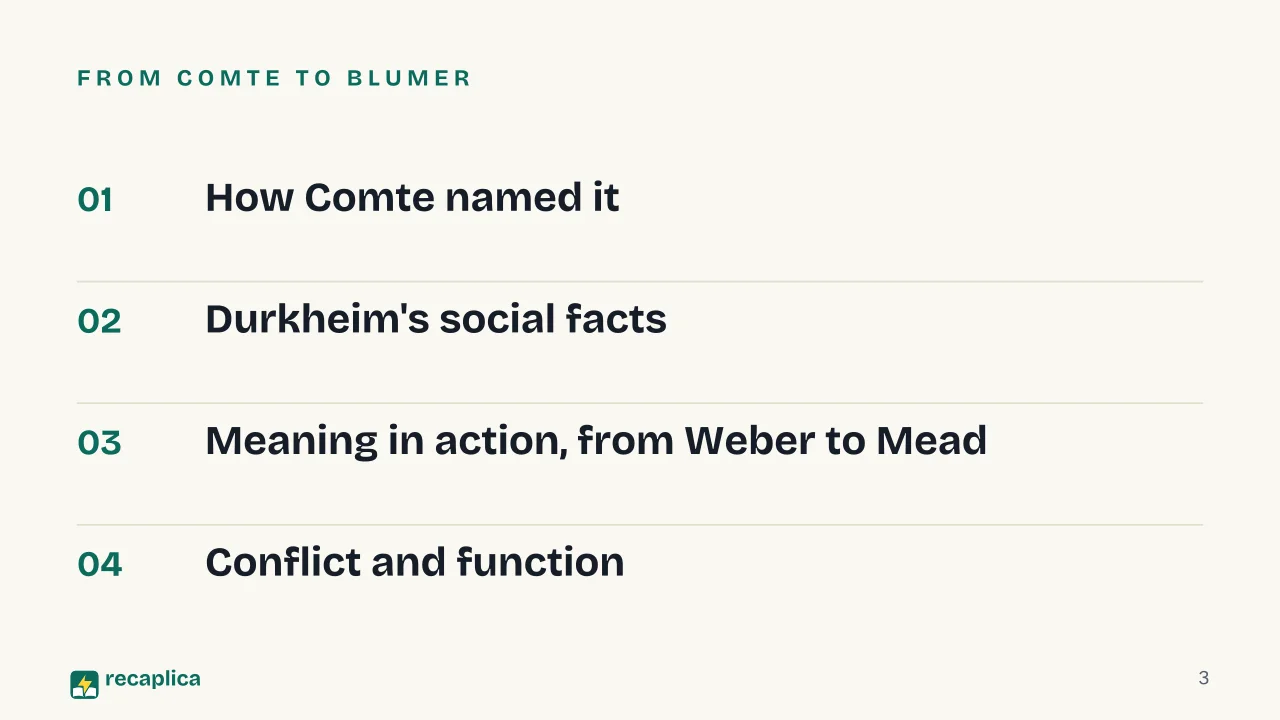  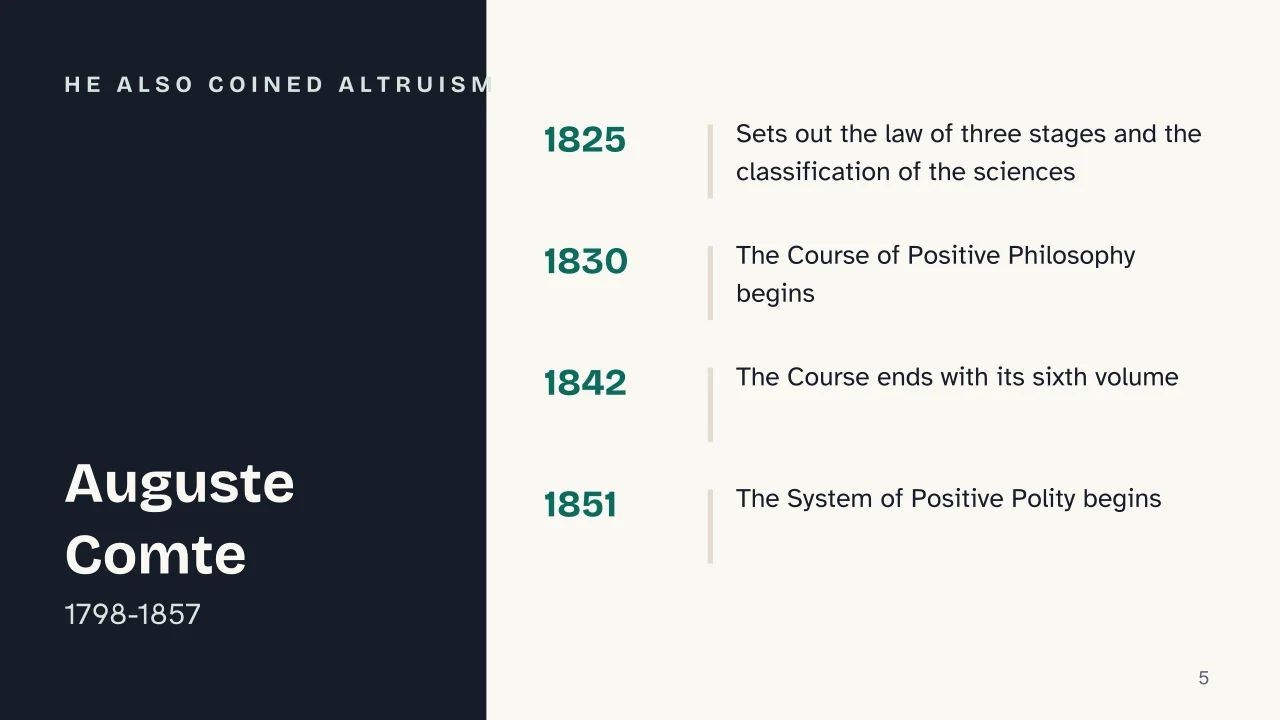  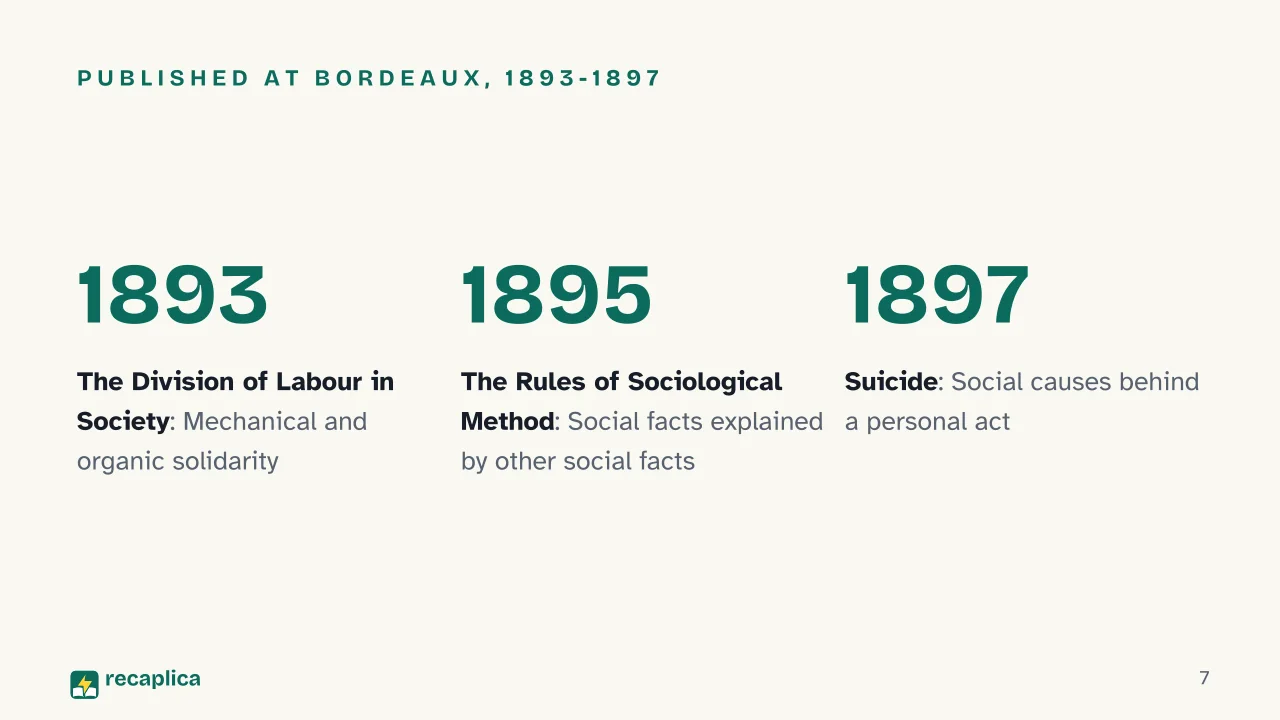 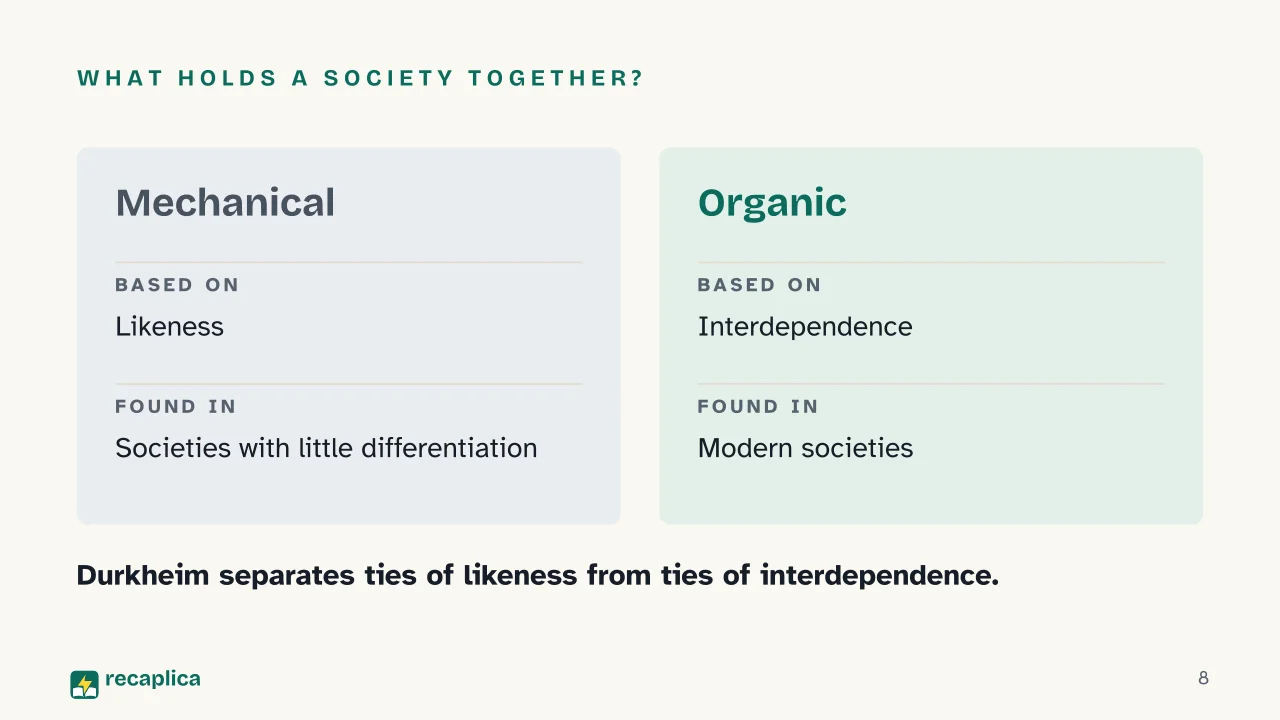   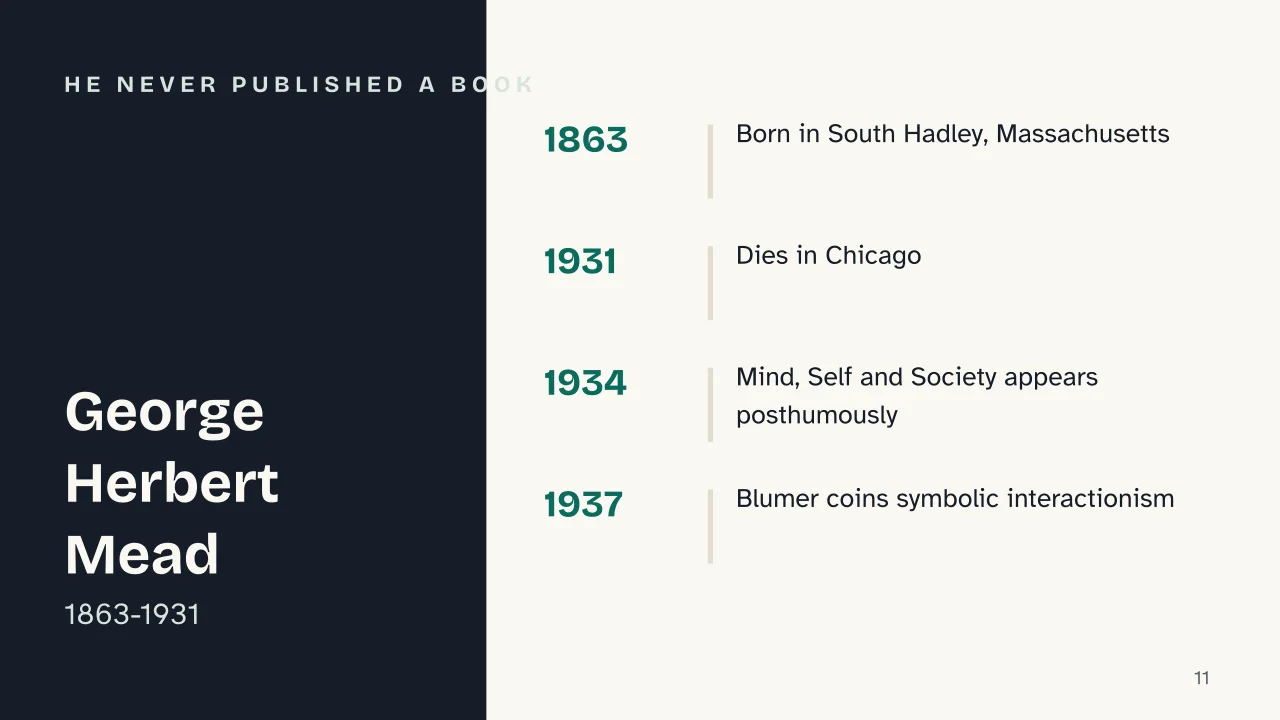   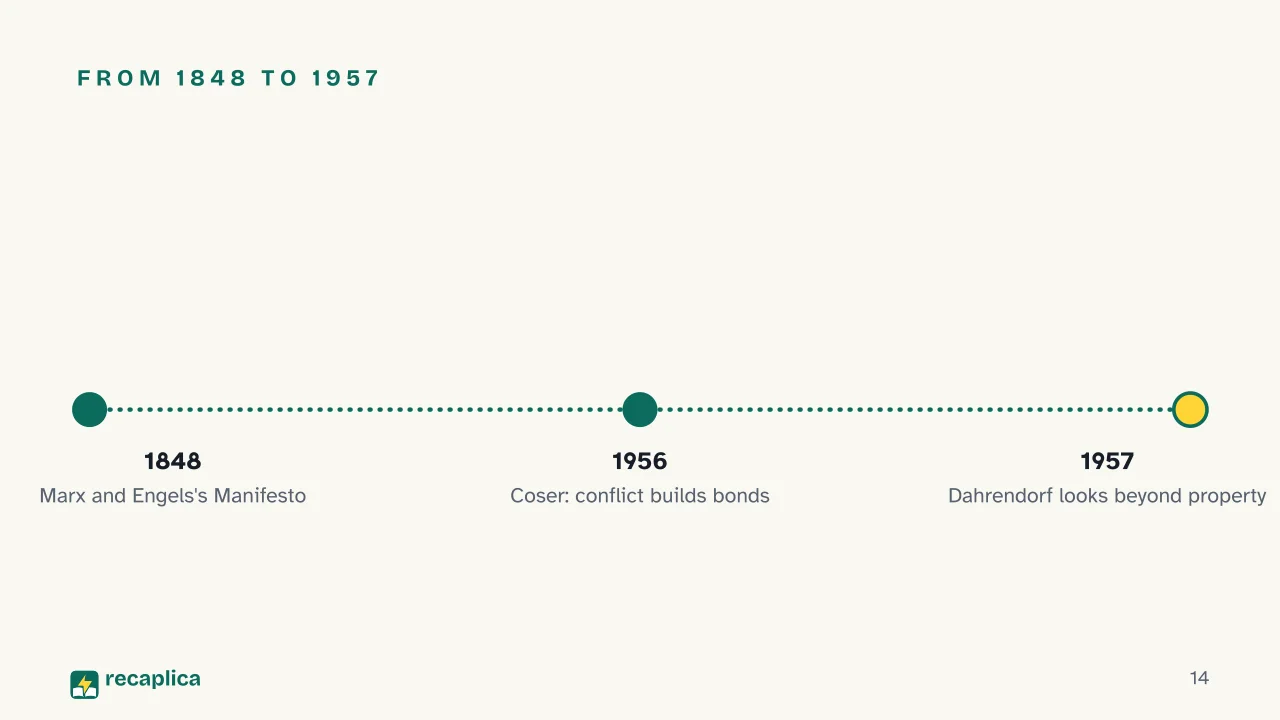 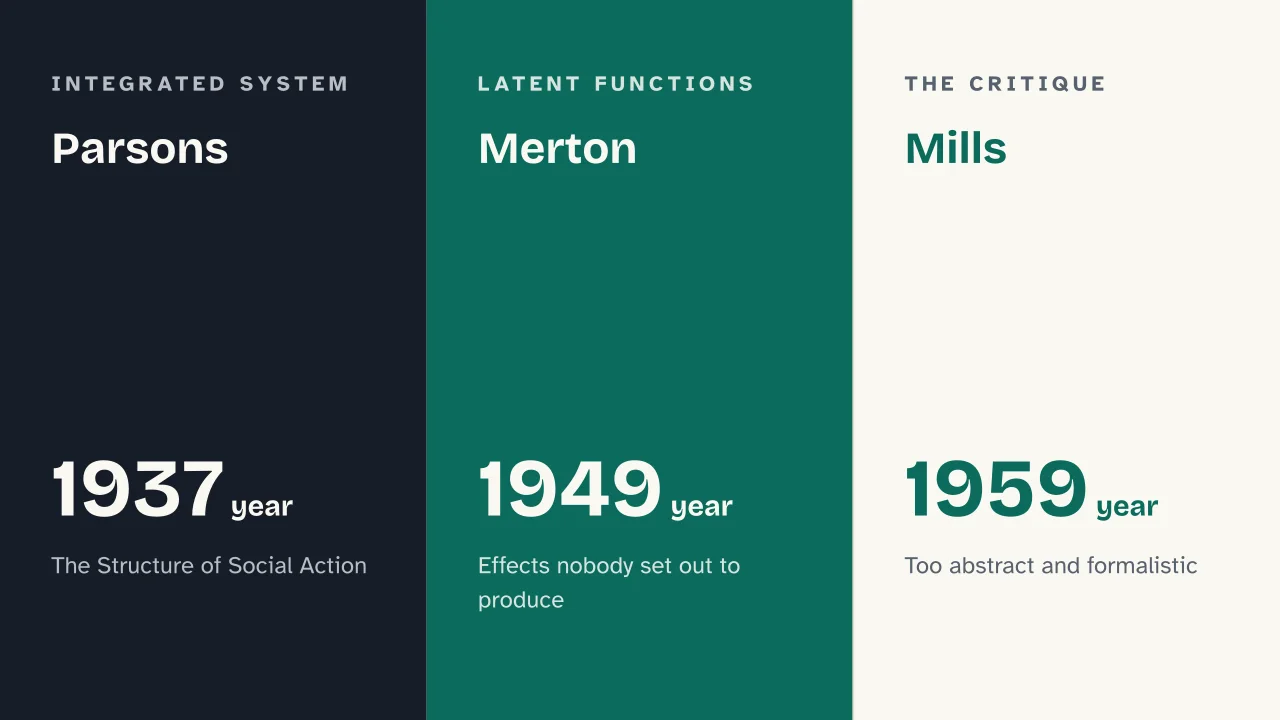 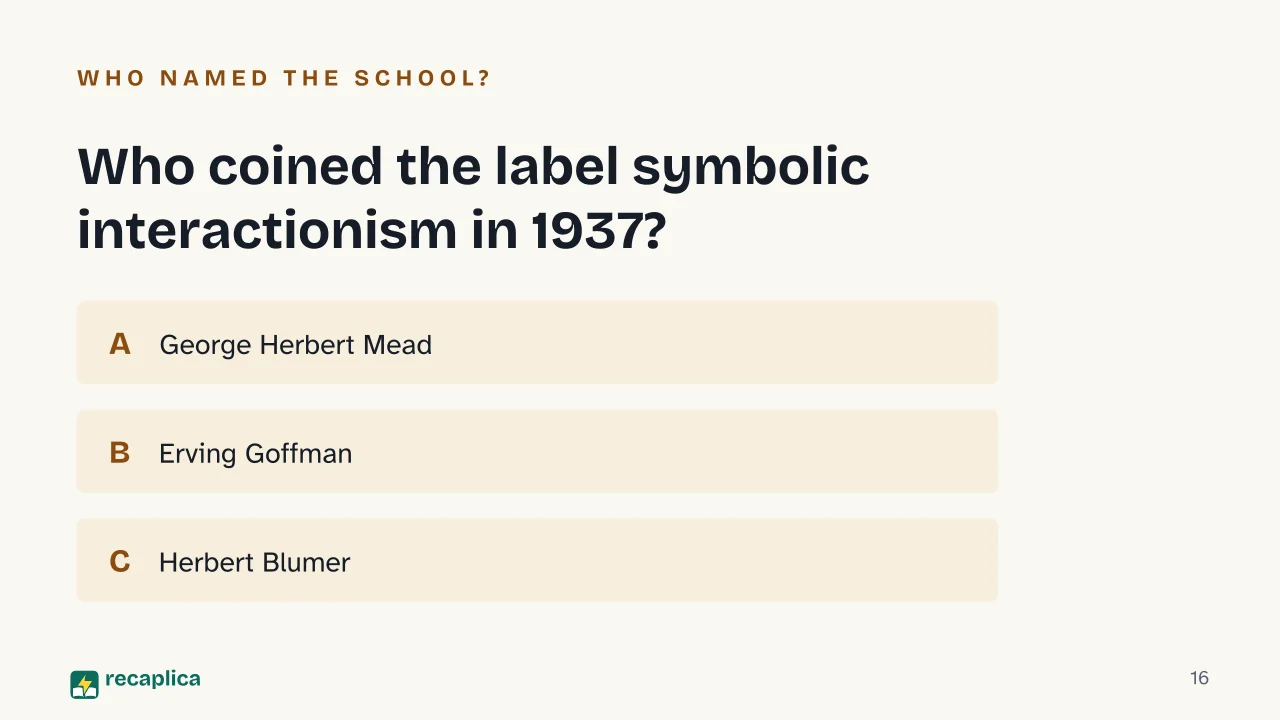  Common myths
Mind mapDrag the background to move around and the nodes to reposition them; use − and + to collapse and expand branches. 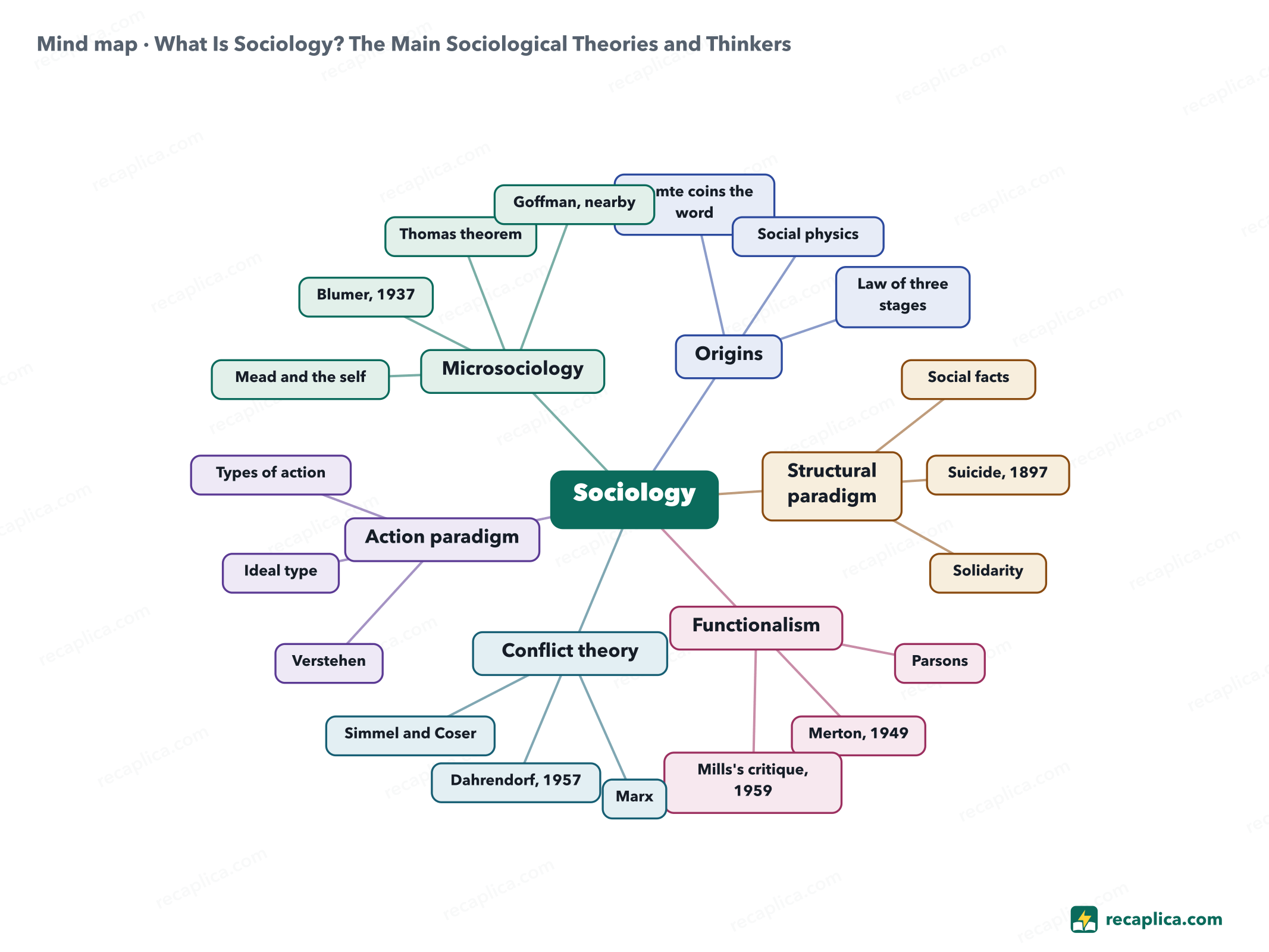
Quiz: test yourselfAnswer the questions to check what you have learned: you get instant feedback and a short explanation. Grade 0/10 0/5
FlashcardsTap the card to flip it and check whether you remember the answer, then move to the next one. 1 / 7 Explain it in your own wordsThe ultimate test: if you can explain it in simple words, you've truly understood it. Write your explanation, then compare it with the Recap. Your explanation is saved only on this device.
Frequently asked questionsWhat does sociology study?Sociology studies social phenomena, meaning whatever happens when people live together: their causes, their consequences and the links between one phenomenon and another. Sociologists work with field research, interviews, observation and statistical analysis of data. Who are the famous sociologists to know?The classics include Auguste Comte, who coined the word, Émile Durkheim and Max Weber. Treccani's entry on sociology calls Karl Marx a forerunner of the discipline. In the twentieth century the big names are Talcott Parsons and Robert K. Merton for functionalism, George H. Mead and Herbert Blumer for symbolic interactionism, Ralf Dahrendorf for conflict theory and Erving Goffman for the study of face-to-face encounters. What is the difference between macrosociology and microsociology?Macrosociology studies large structures and includes structuralist and systems theories. Microsociology looks at everyday life, meaning people and the relationships they form. Talcott Parsons placed everything from the personality up to a small group, such as the family, at the micro level, and stretched the macro level as far as the world system of states. What is symbolic interactionism in simple terms?It is the perspective that says the way we treat an object, a gesture or a person depends on what it means to us, and that the self forms through exchanges with others, above all through language. Its ideas began in Chicago in the early twentieth century with George H. Mead, and Herbert Blumer named it in 1937. What is a social fact according to Durkheim?It is any habit of action, thought or feeling that lives outside the individual person and steers them in a direction: language, money, religious beliefs, ideas of beauty. Durkheim believed social facts could be studied the way physicists study the physical world. Every Recap goes through an independent review before publication. |