|
recaplica
Conflict Theory in Sociology: What It Is, from Marx to Dahrendorf | ||||||||||||||||
| © 2026 Recaplica · recaplica.com — All rights reserved | ||||||||||||||||
Conflict Theory in Sociology: What It Is, from Marx to DahrendorfWhat to print Page numbers appear when printing with default margins. SlidesChoose a cut Flash10 slidesThe essential thread, to present in classFull16 slidesEvery chapter and the deeper detailBoth come with speaker notes. In 30 seconds quick readConflict theory reads society as a place where individuals and groups pursue their own interests and compete for scarce resources, so that conflict explains social relations better than agreement does. It is not a single school. Marx ties conflict to a group's position in production, Weber separates class, status and party, and Coser asks what a clash is good for. Ralf Dahrendorf, in the book that appeared in English in 1959, turns to authority: in every organization some people command and others obey. Durkheim, by contrast, saw society as a body that works. Key Points
Key figures
Deep DiveAccording to Charles Tilly, in the entry “Conflitto sociale” in the Treccani encyclopedia (1992), ordinary competition becomes conflict when one of the competitors openly makes claims that may damage the interests of others. For Tilly conflict is a special case of competition, one in which the parties pursue advantages that rule each other out. For the wider picture, with functionalism and interactionism alongside, see the Recap on sociology and its main theories. Conflict theory: definition and starting ideasIn sociology “conflict” does not necessarily mean open violence: in the Italian Wikipedia entry it also takes in tension, hostility, competition and disagreement over aims and values. In the English Wikipedia entry on conflict theories, individuals and groups interact on the basis of conflict more than agreement, and the theory tries to analyze society at the macro level. It is a set of perspectives, summed up in three assumptions. Humans act out of interest, societies live with a constant scarcity of resources, and conflict is widespread and unavoidable within social groups and between them. According to the Italian entry, power, wealth and prestige are always scarce and demand outruns supply, and social order rests on force or the threat of it, with widespread consensus counting for less. Conflict theorists do not see conflict as necessarily destructive, since it can bring about changes that would not otherwise happen. The precursors come from the nineteenth and early twentieth centuries. Ludwig Gumplowicz, in his Grundriss der Soziologie, describes civilization as a product of clashes among cultures and ethnic groups. Georg Simmel, according to Wikipedia, was among the first sociologists to use conflict formally as a framework for understanding social change, in a book of 1908. American sociology, the Italian entry recalls, neglected this perspective until the 1960s. C. Wright Mills is described as the founder of modern conflict theory, and in his reading the American power elite grew out of a fusion of the corporate elite, the Pentagon and the government. Marx: interests follow position in productionTilly names Marx as the most typical example of someone who reads social life as a struggle between groups. In Tilly’s reading of Marx, the interests of individuals and groups depend on their position in the system of production, nearly all systems of production contain opposed interests, and open conflict arises mostly from these. The Stanford Encyclopedia of Philosophy adds that Marx saw history as a succession of modes of production marked by more or less open class struggles, leading humanity toward communism. According to the entry, class struggle is often held to be central to his theory of history, though G. A. Cohen’s interpretation gives it a smaller role. In the Communist Manifesto of 1848, Marx and Engels open the historical section by saying that the history of every society so far is the history of class struggles. In the English Wikipedia entry, a worker who recognizes himself as part of a united class against the capitalists has reached “class consciousness”, a term the entry credits to Engels. For the man and his works, see the Recap on Karl Marx. Weber: class, status and partyWeber developed a multidimensional approach to stratification that holds wealth, prestige and power together, according to the English Wikipedia entry on the subject. A person’s power shows in status within the social order, in class within the economic one and in party within the political one. The essay appeared posthumously in 1922, inside Economy and Society. In the summary of Weber given by course notes from the University of Regina (1999), classes are economic entities, determined by position in the market. Honour, meaning status, is the distinction and esteem that others grant a person. Parties are organizations that pursue an aim in a planned way. The same notes add that Weber does not reduce power relations to owning the means of production, and doubts that a shared market position produces collective action. A class consciousness in Marx’s sense would therefore be unlikely. Coser: the functions of conflictLewis Coser’s The Functions of Social Conflict was published in 1956. According to Wikipedia, Coser was among the first sociologists to try to join structural functionalism with conflict theory, looking for what social clashes do. In the Beyond Intractability summary, Coser starts from Simmel and his essay Conflict. On this reading, conflict fixes the boundaries between groups and strengthens members’ awareness of being distinct from others. It “clears the air” and lets hostility be expressed openly, the reading known as the safety valve. For Coser, what threatens social structures is their rigidity, and conflict tends to be dysfunctional only where tolerance or institutions for handling it are lacking. According to Wikipedia, the functions of conflict also include communication. Dahrendorf: classes and conflict around authorityRalf Dahrendorf, a German sociologist who later became a British citizen, was born in Hamburg in 1929 and died in Cologne in 2009. According to Treccani he directed the London School of Economics from 1974 to 1984. His work on social classes and class conflict in industrial society came out in German in 1957 and, heavily reworked, in English in 1959 as Class and Class Conflict in Industrial Society. The Italian translation dates from 1963. Treccani writes that Dahrendorf did not accept Marx’s view of social conflict, since the industrial society he studied was no longer that of the nineteenth century. To grasp its conflicts, the entry says, one has to look at the unequal distribution of power and authority in every social structure, rather than stopping at property or relations of production. In the English Wikipedia entry’s reconstruction, society is made up of several units, the “imperatively coordinated associations”, and social conflict is the opposition between dominant and subordinate groups inside them. With the spread of the joint-stock company, according to the entry, the owner of a firm is not necessarily the person who controls it, and that is one reason Dahrendorf leaves property aside. He proposes instead to form classes by who exercises authority and who is excluded from it: one class commands and one obeys.
Inside these associations, again according to Wikipedia, “quasi-groups” are sets of people who occupy positions with the same role interests. Interest groups grow out of them, with members, an organization and a programme. For Dahrendorf the unequal distribution of authority always determines systematic social conflicts. Dahrendorf held that Marxism could not explain the plain fact of social integration and that structural functionalism left little room for conflict, so neither was enough alone. In his view consensus and conflict presuppose each other. Coser sees conflict as a force that preserves, while Dahrendorf also treats it as a driver of change in the social structure. His best-known works are Class and Class Conflict in Industrial Society (1959) and Essays in the Theory of Society (1968). The Modern Social Conflict dates from 1988, with an Italian translation in 1989. Marx, Weber and Dahrendorf compared
Conflict theory and functionalismDurkheim (1858-1917), according to the English Wikipedia entry, saw society as a body that works. He also held that crime is a factor in public health and belongs to every healthy society (The Rules of Sociological Method, English edition of 1938). The New World Encyclopedia describes functionalism as the view that each individual and group has a specific role, like the organs of a body, and says conflict theory stands against it. It says the theory was developed in the United Kingdom by Max Gluckman and John Rex, in the United States by Lewis Coser and Randall Collins, and in Germany by Ralf Dahrendorf. Coser, as seen above, tried to hold the two perspectives together. Conflict theory examples: education, crime and genderFor conflict theory, according to the Wikipedia entry on the sociology of education, schooling keeps inequality in place and preserves the power of dominant groups. Bowles and Gintis argued that schools directly reproduce the social and economic inequalities of capitalism, passing them off as meritocracy. Bourdieu and Passeron introduced the concept of cultural capital in the 1970s to explain persistent inequalities in school results. On crime, the Wikipedia entry on conflict criminology reports that George Vold, in Theoretical Criminology (1958), reads crime as a product of conflict between groups within the same culture: the group best at controlling political processes gets laws that restrict the behaviour of the others. Austin Turk (Criminality and Legal Order, 1969) draws on Dahrendorf and argues that those in power turn their own cultural norms into law. Course notes from UMSL credit Richard Quinney, with a Marxist version in which law and the state are instruments of the ruling class. On gender, the New World Encyclopedia reports that feminist conflict theorists argue that women have been oppressed throughout history so that men could profit from holding power, wealth and status. Criticisms of conflict theoryAccording to the English Wikipedia entry, one criticism is that the theory is too politicized, because of its link to Marx and its use by many causes and movements. Other critics say it underrates the unity of society and gives a negative picture of it. The most common criticism of Dahrendorf is that his theory takes only a macro-sociological perspective. Slide deckSlides ready to download and make your own in PowerPoint or Google Slides, with speaker notes. Pick the Flash cut or the Full one.     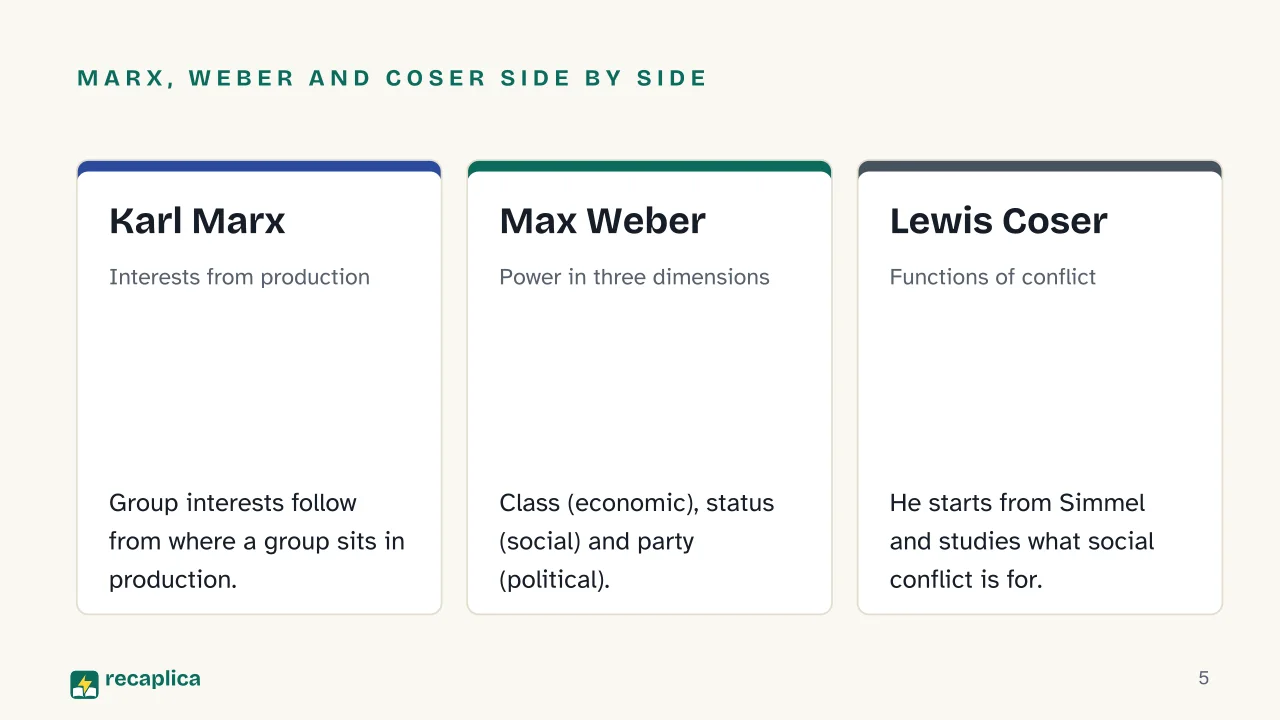 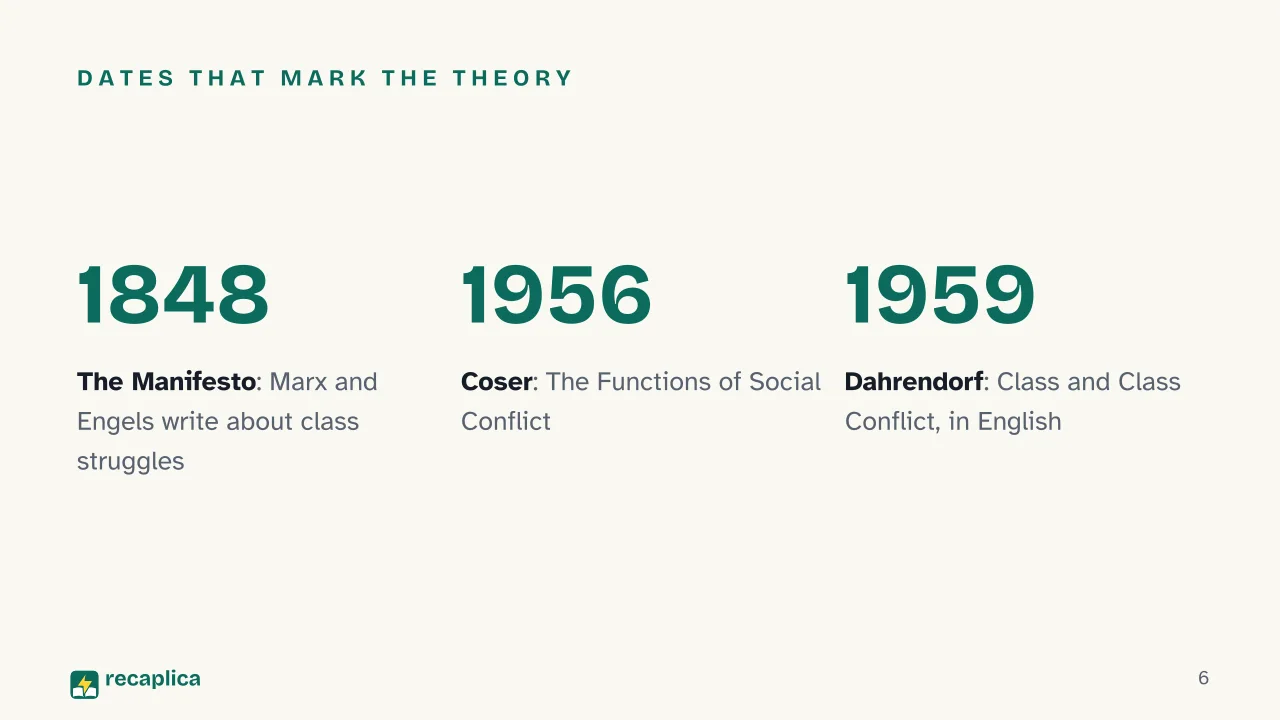  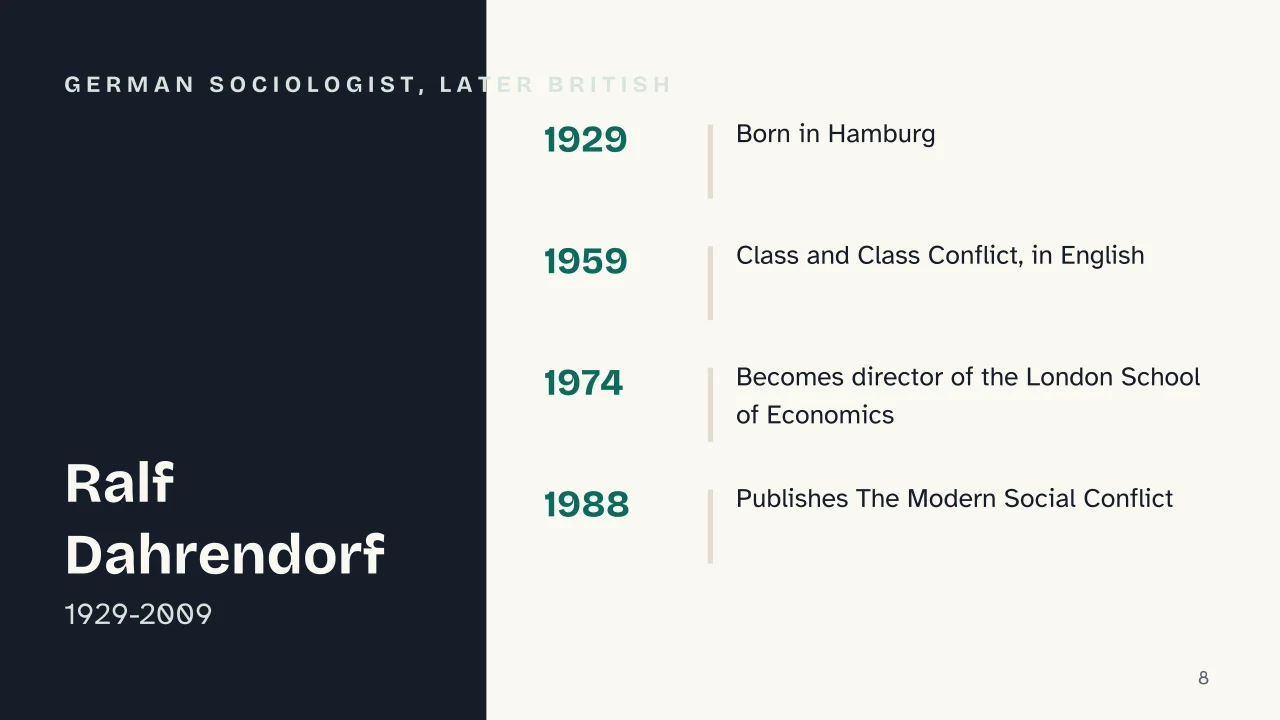 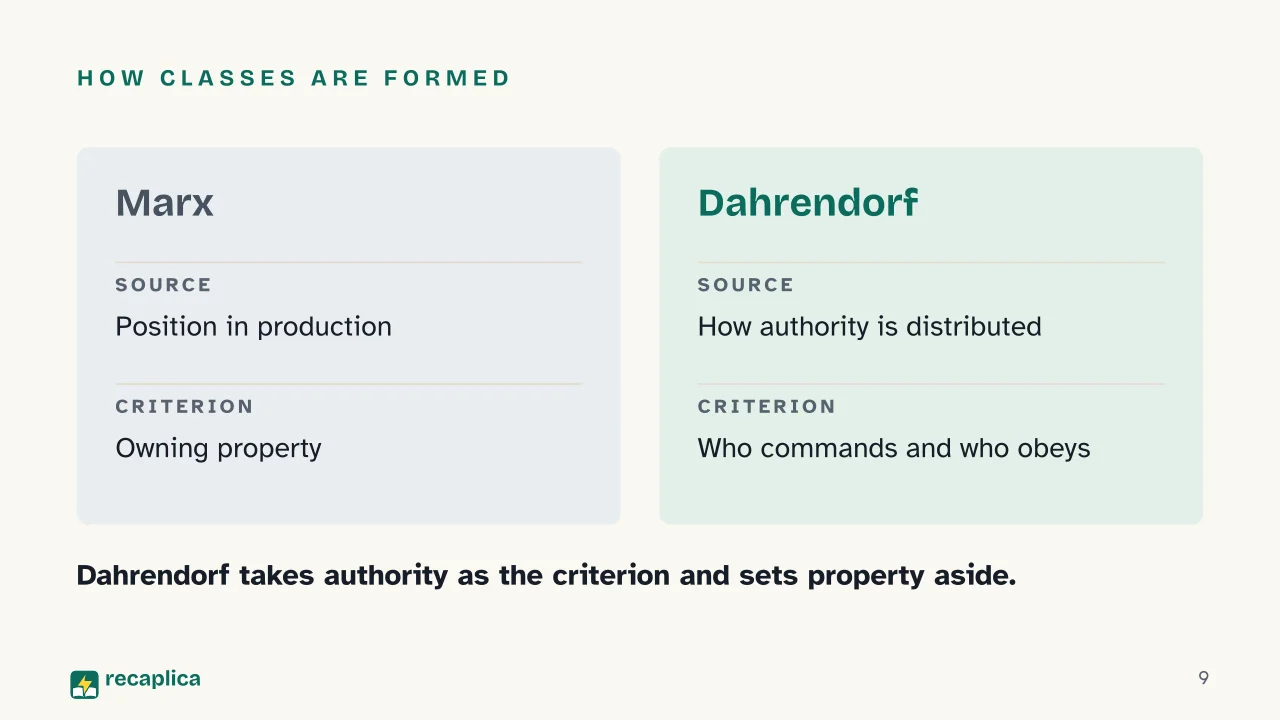  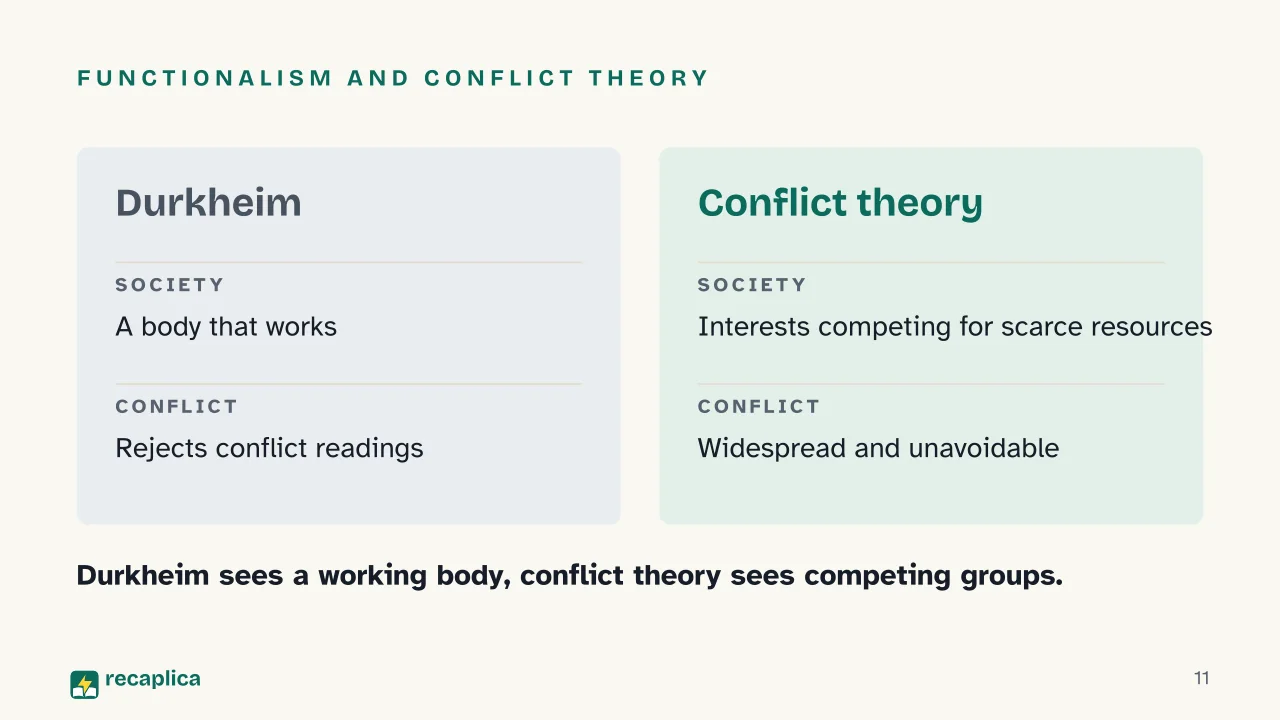 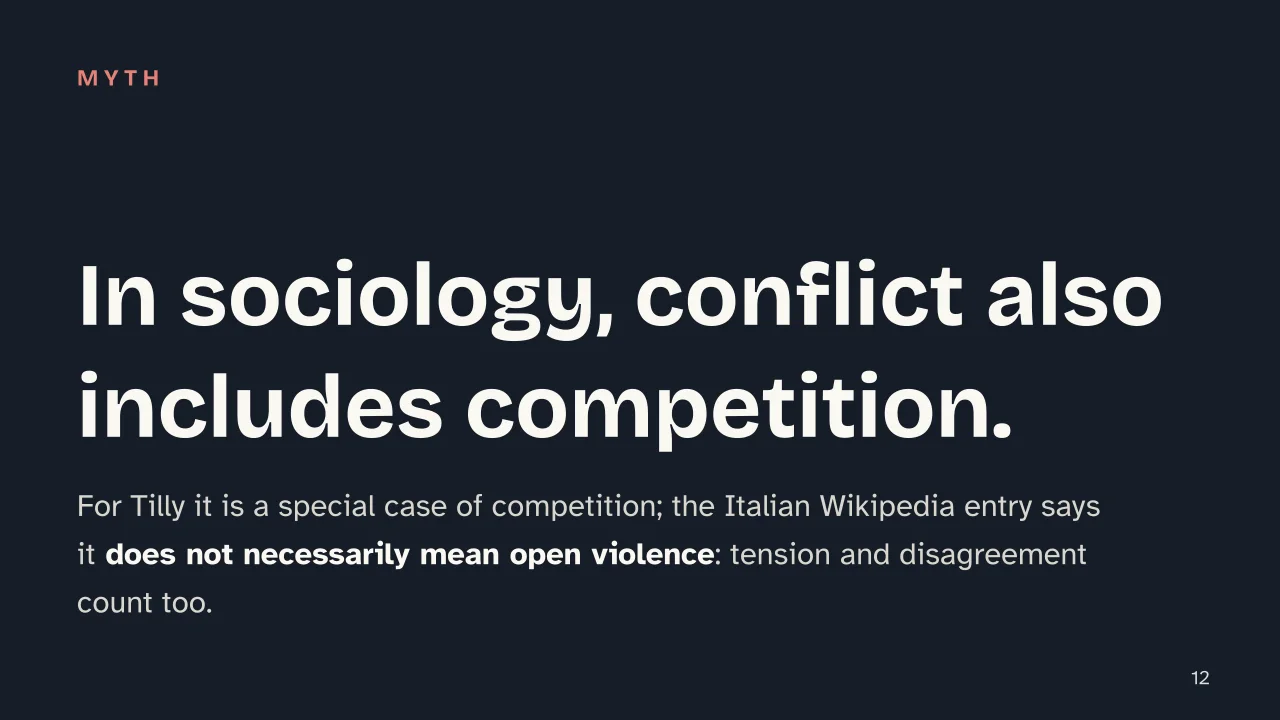     Common myths
Mind mapDrag the background to move around and the nodes to reposition them; use − and + to collapse and expand branches. 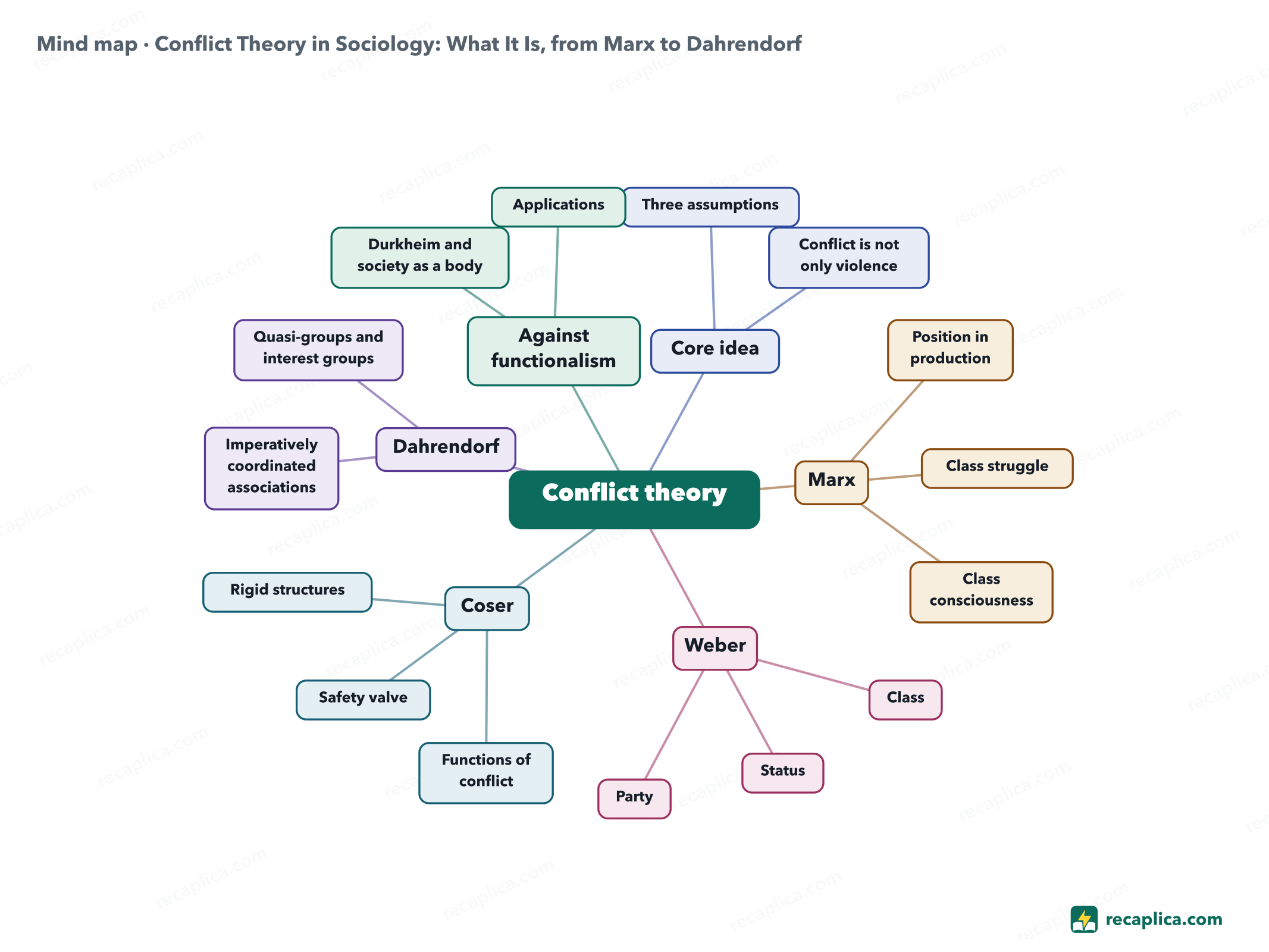
Quiz: test yourselfAnswer the questions to check what you have learned: you get instant feedback and a short explanation. Grade 0/10 0/5
FlashcardsTap the card to flip it and check whether you remember the answer, then move to the next one. 1 / 7 Explain it in your own wordsThe ultimate test: if you can explain it in simple words, you've truly understood it. Write your explanation, then compare it with the Recap. Your explanation is saved only on this device.
Frequently asked questionsWhat is conflict theory in sociology?It is a set of perspectives that analyzes society at the macro level. It starts from the idea that individuals and groups act out of interest and compete for scarce resources, and that conflict is widespread. The Italian Wikipedia entry lists it beside functionalism and interactionism as one of the three main strands of sociology. What is the difference between Marx and Dahrendorf?For Marx, what counts is position in the system of production. Dahrendorf shifts attention to who exercises authority and who is shut out of it, and builds his classes on that. What does Dahrendorf say about conflict?In the English Wikipedia entry's account, differences in how authority is distributed always produce systematic social conflicts, and consensus and conflict presuppose each other. His main book on the subject, Class and Class Conflict in Industrial Society, appeared in English in 1959. What does conflict theory say about education?These theories hold that education serves to keep inequality in place and to protect the power of dominant groups, according to Wikipedia's sociology of education article. Bowles and Gintis argued that schools reproduce the inequalities of capitalism and present them as meritocracy. What does Coser mean by the functions of conflict?Building on Simmel, Coser argues that a clash draws the line between one group and another, gives its members a sharper sense of themselves and lets hostility find an outlet. For him the real danger lies in rigid structures. Every Recap goes through an independent review before publication. |