|
recaplica
Ancient Greek Art: The Periods, Statues and Temples From Kouroi to the Hellenistic Age | ||||||||||||||||||||||||
| © 2026 Recaplica · recaplica.com — All rights reserved | ||||||||||||||||||||||||
Ancient Greek Art: The Periods, Statues and Temples From Kouroi to the Hellenistic AgeWhat to print Page numbers appear when printing with default margins. SlidesChoose a cut Flash10 slidesThe essential thread, to present in classFull14 slidesEvery chapter and the deeper detailBoth come with speaker notes. In 30 seconds quick readGreek art is usually split into four periods, from Geometric to Hellenistic, with the Severe style as the bridge between the two in the middle. Statues begin as the stiff kouroi of the sixth century BC, turn into the moving bodies of the Classical age and end as the theatrical groups of the Hellenistic world. Temples such as the Parthenon give sculpture its places: pediments, friezes and metopes. The dates are a teaching convention, because the changes were never sharp. Key Points
Key figures
Deep DiveHow Greek art is divided: the four periodsArt historians usually split Greek production into four style periods: Geometric, Archaic, Classical and Hellenistic. Between the Archaic and the Classical sits the Severe style, a phase of heavy experimentation. The scheme goes back to Winckelmann’s studies in the eighteenth century. It is a teaching convention, useful for finding your way around but not enough on its own to understand the history. The boundaries lean on political events. The Persian Wars separate Archaic from Classical, the reign of Alexander the Great (336-323 BC) separates Classical from Hellenistic, and the battle of Actium in 31 BC closes the Hellenistic age (some sources say 30 BC, with the conquest of Ptolemaic Egypt). The changes from one period to the next were never sharp.
The dates in the table are approximate, and the Severe style has no firm chronology. The one fixed point is the group of the Tyrannicides by Kritios and Nesiotes, dated by an inscription to 477/6 BC. From the Geometric vase to the first templesBefore 700 BC Greek buildings were made of perishable materials: mud brick, wood, thatch. What remains of that world is mostly vases. Minoan and Mycenaean art are normally left out of Greek art in the strict sense, which begins after the Mycenaean civilisation ended. In the Protogeometric and Geometric ages painted pottery was one of the few art forms in practice, and its decoration was abstract. Around 750 BC the Dipylon Master and other potters bring in highly stylised human and animal figures, drawn as silhouettes, with horses the most frequent subject. From the eighth century BC the small figures in clay, ivory and bronze have long limbs and a triangular torso, like those on the vases. Monumental sculpture and painting are born in the seventh century BC. According to the World History Encyclopedia, Greek sculpture looks to the monumental art of Egypt and the Near East. The oldest stone sculptures (in limestone) date to the middle of the century and come from Thera, and marble appears at the start of the sixth century with the first life-size statues. Around 580 BC, probably at Corfu, the temple of Artemis is the first Doric temple built entirely of stone. Archaic Greek sculpture: kouroi, korai and the smileThe first large statues were offerings to the gods in sanctuaries, or markers on graves. The model is the kouros, the standing nude youth, next to the kore, the clothed female figure. Between 600 and 480 BC Greek cemeteries and sanctuaries filled up with these marble statues. The first large examples are as stiff as monumental Egyptian statues. The face shows nothing, the gaze is fixed straight ahead, the arms hang down and the feet nearly touch. The kouroi of Argos, Cleobis and Biton, dedicated at Delphi around 580 BC, are one example. After about 575 BC male and female figures wear the so-called Archaic smile, which stays the same whoever the person is and whatever the situation. Greek female statues: the koreThe kore is always clothed, and the kouros is nude. On the Phrasikleia kore (about 550-530 BC) much of the red of the dress remains, one of the rare traces of original colour. Kouroi and korai show an idealised youthful perfection. Kouroi are always young, even on the graves of people who were presumably old, and they all look very much alike; the rank of the person who commissioned one showed in its size. Painted vases: from black figures to redMature black-figure work begins in Corinth at the start of the seventh century BC and reaches Attica about a generation later; by the middle of the sixth century Corinth and the other local schools give up the market to Attic pottery. Red-figure is an Athenian invention of around 530 BC, often credited to the Andokides Painter. Figure and ground trade places. In red-figure it is the background of the vase that is covered with black slip, while the figures keep the red-orange of the clay. Details are drawn with black brush lines and no longer have to be incised as in black-figure. Red-figure shows expression and anatomy better. The Severe style and Classical Greek artAround 500 BC, according to the World History Encyclopedia, sculptors leave behind the rigid rules of Archaic art, which represented concepts, and begin to reproduce what they observe. By about 480 BC the last kouroi are more natural: the weight shifts to the left leg, the right hip drops and a hint of a smile appears. In the late Archaic period a more natural proportion also settles, with the head fitting into the body seven times. This is the Severe style, which dominates sculpture from about 490 to 450 BC. The Kritios Boy (about 480 BC) is the earliest known statue with contrapposto, and it is an original Greek marble. In contrapposto the figure rests its weight on one leg while shoulders and arms turn against the hips and legs. Older bronzes probably used it already, but none has survived. The god from Cape Artemision and the two Riace warriors are bronzes of 460-450 BC recovered from the sea, and the first, in the words of the World History Encyclopedia, is a work in transition between Archaic and Classical.
After 480 BC Athens enters a period of great creativity, with the Acropolis complex commissioned by Pericles (the city’s story is in the Recap on ancient Greece). In the Classical period statues are lifelike and life-sized, they celebrate the human body, above all the male nude, and faces take on expression. Clothing clings to the body in what is called «wet drapery» or the «wind-blown» effect. Polykleitos, the sculptor of the Doryphoros (the spear-bearer), wrote the Canon, a treatise on the proportions of the body, but the text is lost and only what others report of it is known. The typical Greek hero is the nude youth standing with his weight on one leg and the other set slightly forward, a pose Polykleitos made canonical. The resting arm is on the side of the supporting leg and the active arm on the side of the free leg: the crossing is called chiasmus, after the Greek letter chi. The Discobolus, attributed to Myron (about 450 BC), is among the most copied statues of antiquity and freezes a powerful movement for an instant. What temples didFrom the late sixth century BC sculpture is used to decorate temples and treasuries, on pediments, friezes and metopes. In the Parthenon and the temple of Zeus at Olympia the friezes are carved in relief, while the pediments are filled with free-standing statues.
Late Classical: new proportions and the female nudeThe Late Classical period runs from 400 to 323 BC, and art keeps developing in spite of the wars. In the fourth century BC a new ideal of the figure appears, with a longer torso and limbs and a smaller head. The Apoxyomenos, the athlete scraping himself clean, is the example, and the Arts 101 textbook lists it as a work of Lysippos. Tradition credits Lysippos of Sicyon with fifteen hundred statues. Around the middle of the fourth century BC Praxiteles makes the Aphrodite of Knidos, the first fully nude female statue, which turns at the shoulders and hips in an S-curve. According to an undergraduate thesis at the University of Colorado, very few originals of the fourth century survive, so one has to rely heavily on Roman copies, used with care. Hellenistic art: realism and theatrical groupsHellenistic art is usually dated from the death of Alexander the Great in 323 BC. Sculpture becomes mostly private, less tied to cult and to social functions, and returns to a growing naturalism. Sculptors show men and women of every age realistically, and domestic scenes, children, animals and ordinary people become accepted subjects. Classical taste, more austere, would have allowed less sensuality and less emotion than these works show. The style is often called «Baroque», with twisting poses and intense faces, and the multi-figure group is a Hellenistic innovation, perhaps of the third century BC. Among the best-known works are the Nike of Samothrace, of uncertain date (the Arts 101 textbook proposes about 190 BC), the Dying Gaul and the Laocoön. The Laocoön was found in Rome in 1506, in the middle of the Renaissance, and Michelangelo saw it at once. The new Hellenistic cities wanted statues of gods and heroes in quantity: sculpture became an industry, with standardisation and some loss of quality. From Winckelmann’s eighteenth century into the twentieth, scholars spoke of the Hellenistic age as a time of decline and decadence. Materials, colour and copies: what has reached usAt first sculptors used mostly bronze and porous limestone. Bronze never went out of fashion, but the favourite stone became marble. Bronzes were mostly made by lost-wax casting: wax was modelled over a core, covered in clay and melted out, and molten bronze was poured in its place. Most sculptures were painted, often in colours that look garish to modern taste. The bright tints reached the details, from eyebrows and lips to the patterns on the clothes, as well as skin and hair. The eyes were often inlaid, in bone, crystal or glass. Finds and studies since the nineteenth century show that architecture was polychrome too. Bronze was melted down again in later centuries and broken marble stayed where it lay, so marble has survived better. According to the World History Encyclopedia, at most a dozen original Greek bronzes survive, an estimate from the source with no year attached. For many masterpieces we therefore have copies made in Roman times (the Roman Empire produced them in large numbers), and these have limits of their own: they lack the master’s hand. They sometimes change material, from bronze to marble, and now and then they mix up parts of the body, the heads most of all.
Slide deckSlides ready to download and make your own in PowerPoint or Google Slides, with speaker notes. Pick the Flash cut or the Full one.   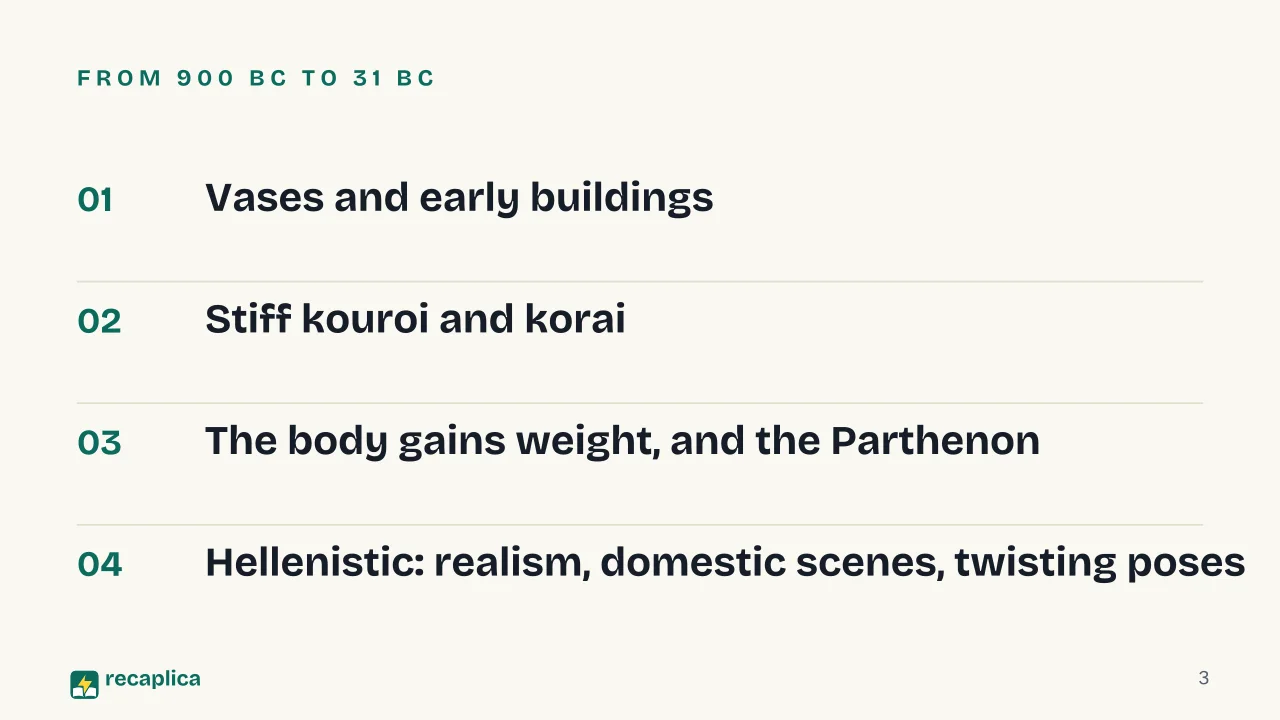  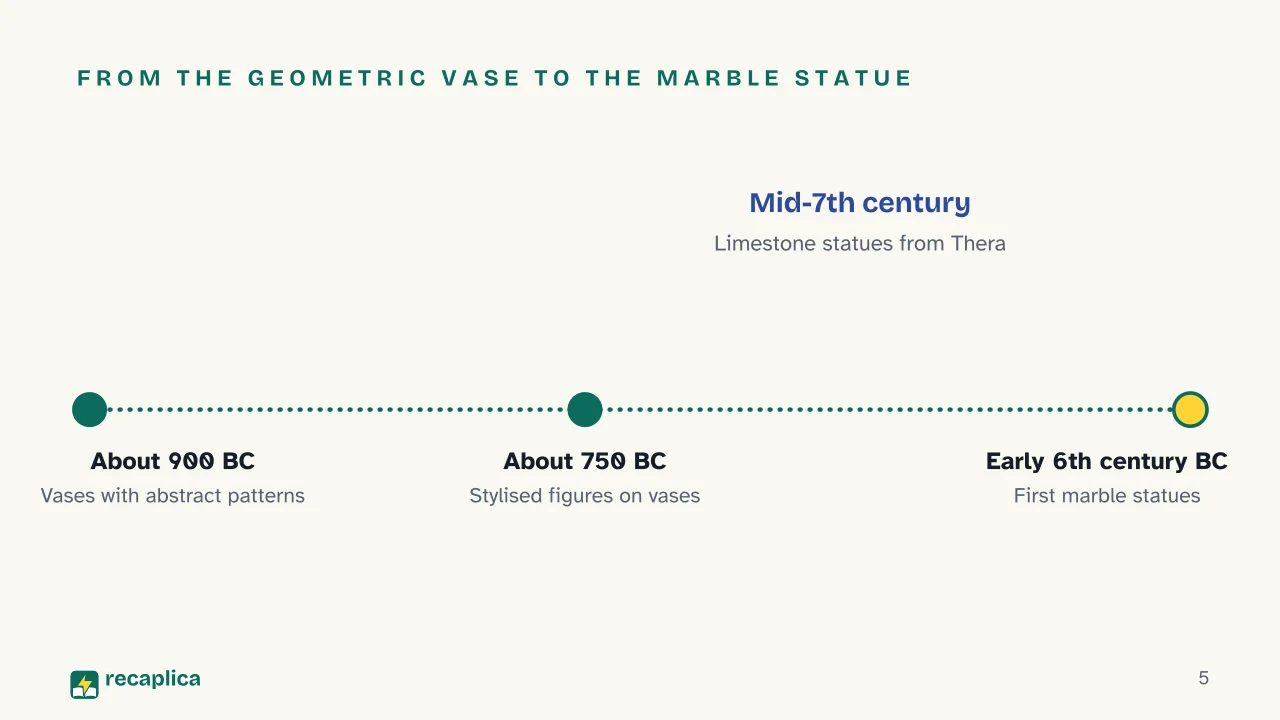  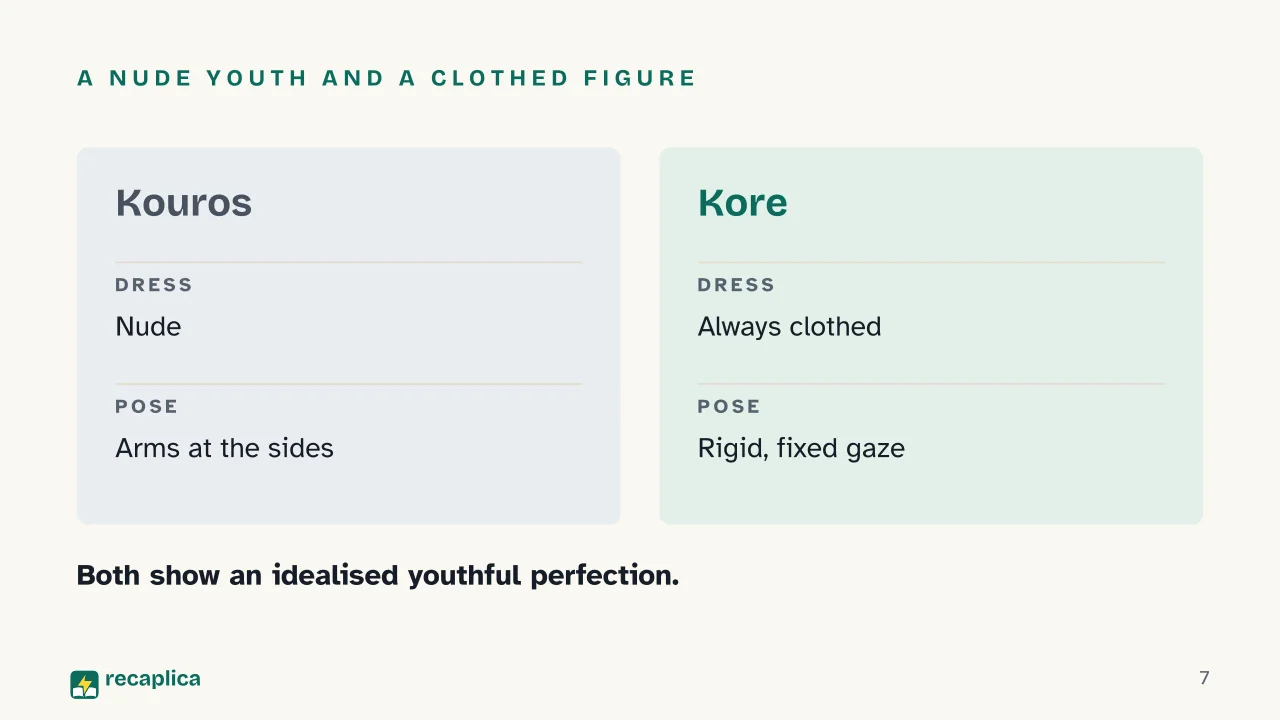 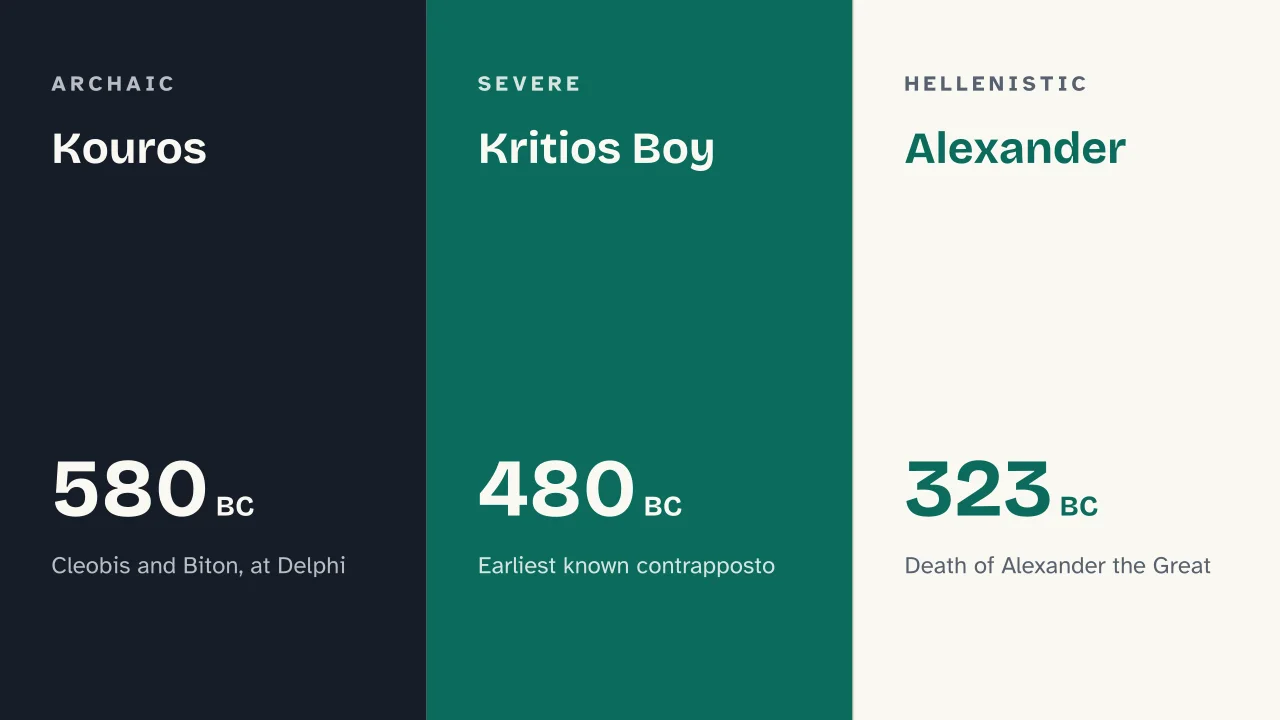  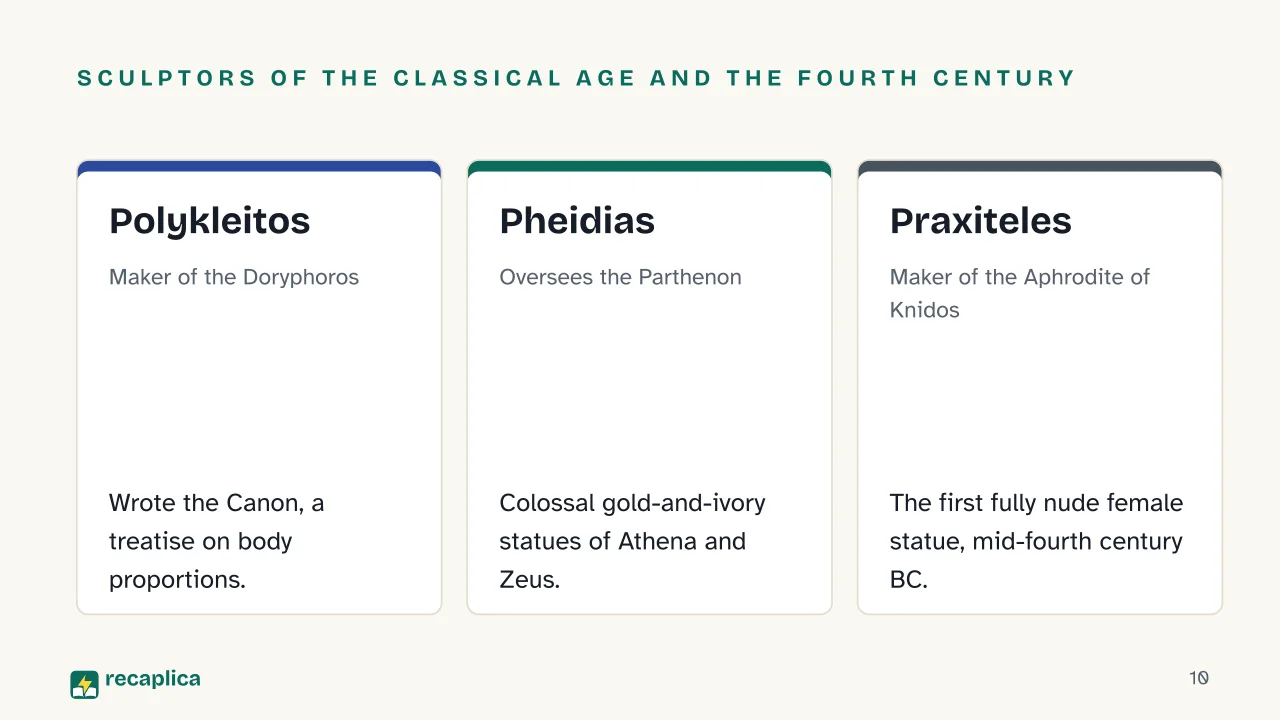  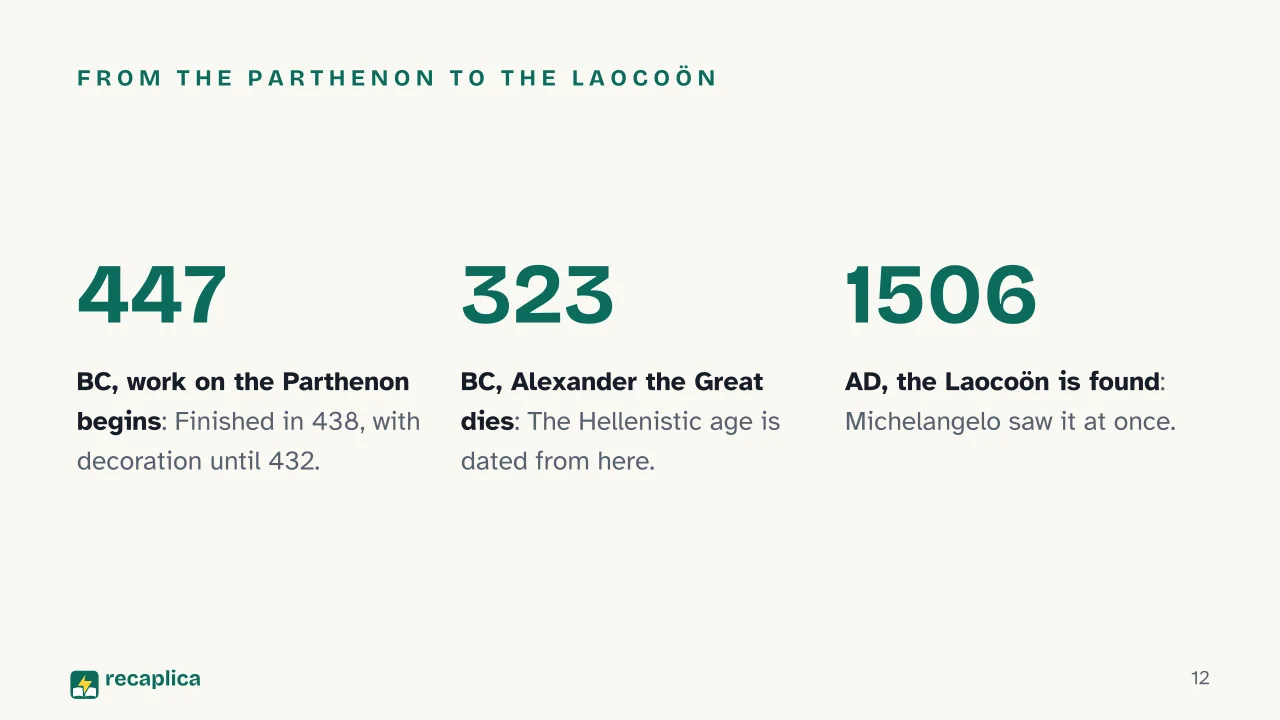 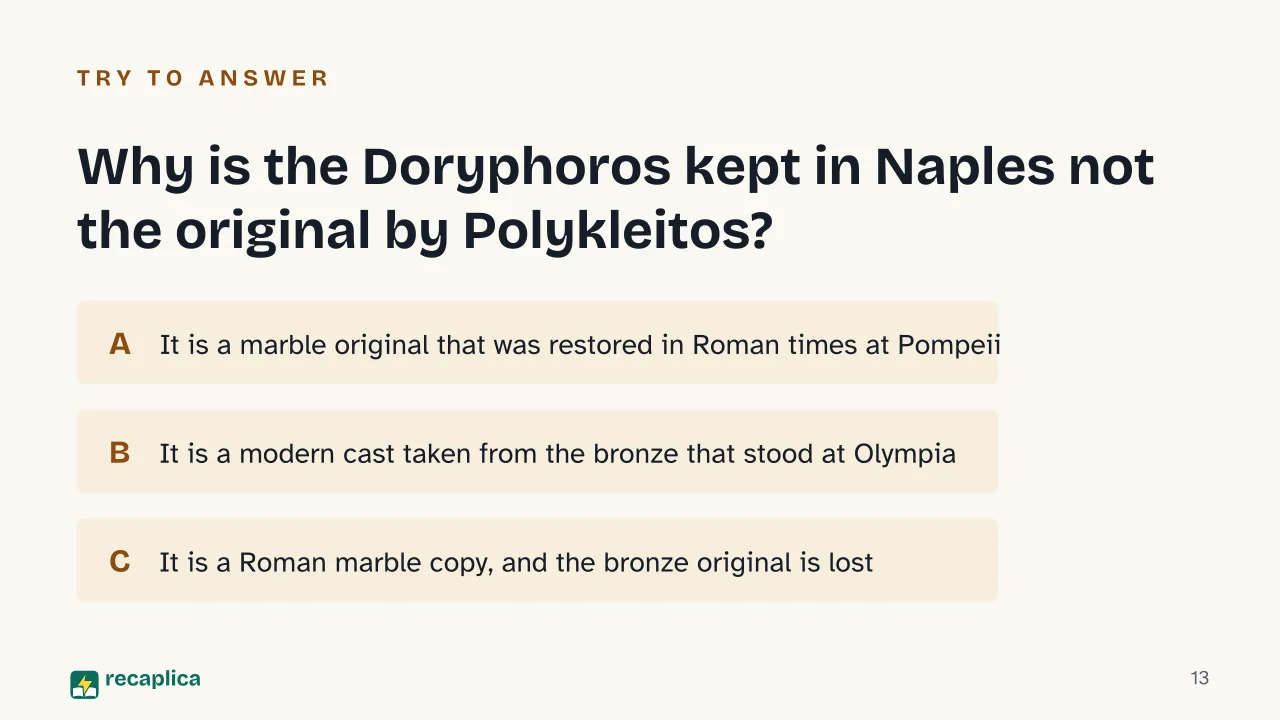  Common myths
Mind mapDrag the background to move around and the nodes to reposition them; use − and + to collapse and expand branches. 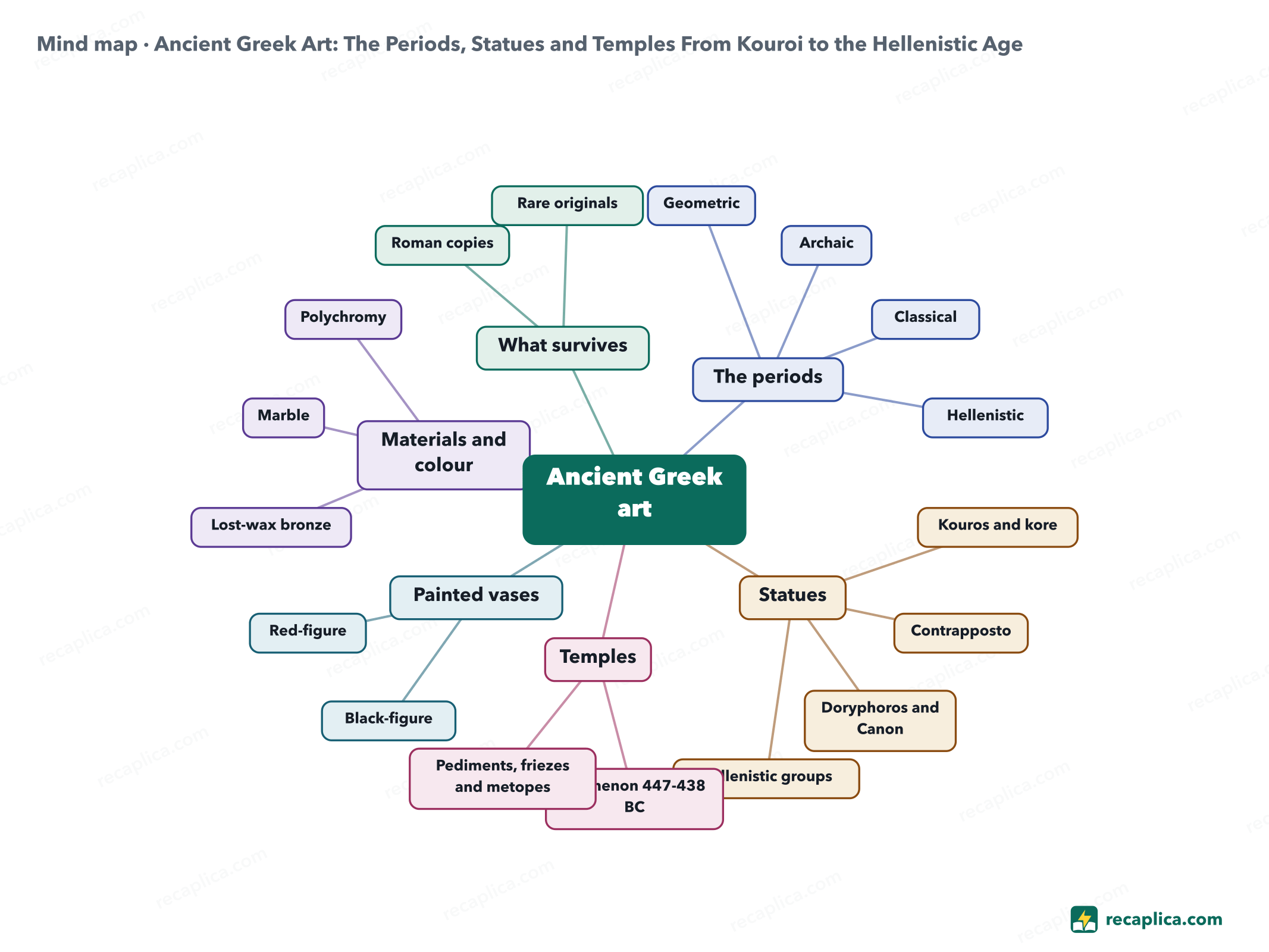
Quiz: test yourselfAnswer the questions to check what you have learned: you get instant feedback and a short explanation. Grade 0/10 0/5
FlashcardsTap the card to flip it and check whether you remember the answer, then move to the next one. 1 / 7 Explain it in your own wordsThe ultimate test: if you can explain it in simple words, you've truly understood it. Write your explanation, then compare it with the Recap. Your explanation is saved only on this device.
Frequently asked questionsWhat are the periods of ancient Greek art, and how do you recognise them?They are the Geometric (vases with abstract patterns, from about 900 BC), the Archaic (stiff kouroi and korai, the Archaic smile), the Classical (natural, idealised bodies, contrapposto, wet drapery) and the Hellenistic (from 323 BC, with realism, everyday subjects and theatrical poses). The Severe style, about 490-450 BC, sits between Archaic and Classical. The dates are a teaching convention. What is the difference between Archaic and Classical Greek sculpture?Archaic statues stand still, with a fixed gaze, following strict rules that stand for ideas. Around 500 BC sculptors start to reproduce what they actually see, and in the Classical period figures are life-sized, with expressive faces, clinging clothes and a mood of their own. What are korai, the Greek female statues?Korai are statues of clothed female figures, common in the Archaic period in sanctuaries and cemeteries, often as grave markers. Unlike the kouros, the kore is never nude. They represented an ideal of youthful perfection. How do you recognise Hellenistic art?By its growing naturalism: men and women of every age shown realistically, with children, animals and domestic scenes as subjects. The most famous works, labelled Baroque, twist their figures and give them intense faces. Historians start the period at the death of Alexander the Great in 323 BC. Every Recap goes through an independent review before publication. |