|
recaplica
Symbolic Interactionism: What It Is and the Ideas of Mead, Blumer and Goffman | |||||||||||||||||||||||||||||||||||||||||
| © 2026 Recaplica · recaplica.com — All rights reserved | |||||||||||||||||||||||||||||||||||||||||
Symbolic Interactionism: What It Is and the Ideas of Mead, Blumer and GoffmanWhat to print Page numbers appear when printing with default margins. SlidesChoose a cut Flash10 slidesThe essential thread, to present in classFull14 slidesEvery chapter and the deeper detailBoth come with speaker notes. In 30 seconds quick readSymbolic interactionism started in the United States and studies how people interpret the behavior of others in order to interact with them. According to the Stanford Encyclopedia of Philosophy, many regard George Herbert Mead as the father of the school, although he never used the name. Herbert Blumer coined it and set out three premises about meaning. Erving Goffman, trained at Chicago in the 1940s, took the same outlook to everyday life and read it as a performance in front of an audience. Key Points
Deep DiveWhat is symbolic interactionism?According to Treccani, symbolic interactionism is a current of sociology born in the United States that studies social action as the thing that connects individuals to one another. Its main object is the interpretation of what the behavior of others means. The current took shape in the Chicago school, most active in the 1930s, and spread widely only in the 1950s and 1960s. It is one of the main theories of sociology. Symbolic interactionist perspective: the definition of the situationTreccani singles out the “definition of the situation”, the way individuals interpret the actions of others in order to react. The University of Minnesota Duluth teaching page credits W. I. Thomas with introducing the concept. People interpret one another so that they can interact, and the entry’s author, Roberto Cipriani, sees in the current an attention to individual action more than to the society that conditions it. That reading belongs to Cipriani. Mead’s symbolic interactionism: Mind, Self and SocietyThe Stanford Encyclopedia of Philosophy describes George Herbert Mead (1863-1931) as an American philosopher and social theorist, usually counted among the greats of classical pragmatism alongside James, Peirce and Dewey. Many regard him as the father of the school, though he never used that name. He never published a proper book of philosophy. His most famous work, Mind, Self, and Society, appeared after his death (the original edition is from 1934, edited by Charles W. Morris) and collects student notes and passages of unpublished manuscripts. Meaning, for Mead, takes shape in exchange. In his example of two dogs, the meaning of a growl lies in the response the other animal gives to the first. A gesture becomes a significant symbol if it calls up in the person making it the response it calls up, or is meant to call up, in others. Vocal gestures, that is words, let people hear their own voice more or less as others hear it. The mind appears when an organism can indicate meanings to others and to itself. Mead called it absurd to study the mind only in the single organism. Its center lies there, he held, but it is essentially a social phenomenon. The self does not coincide with the individual. It is tied to self-awareness and starts to develop when a person interacts with others and plays roles. For Mead the growth of the self is closely bound up with the growth of language. A role, in this sense, is a set of behaviors that answer the behaviors of other people, and playing one requires taking on the attitudes or point of view of others (role-taking).
From play to game and the generalized otherWikipedia’s entry on Mead describes understanding of the social world as coming in two phases: first play, free play, then the game, organized play. In play the child imitates adult roles in order to grasp them, such as the police officer and the thief or the doctor and the patient. In the game the child takes the role of all the participants, and the roles must stand in a definite relation to one another.
To take part in a game, a player has to know the behaviors tied to every position on the field. The responses of individual people are not enough. By the generalized other Mead means the community or organized group that gives unity to a person’s self, and Wikipedia’s entry describes it as the child’s first encounter with the organized whole of others. It carries the attitude of the entire community.
I and Me, the two phases of the selfIn the Stanford Encyclopedia’s reading, Mead’s “I” and “Me” are functional distinctions, not metaphysical ones: they are phases of the self. The Me arises in relation to a generalized other and is an object that can be known, grasped only afterwards by reflecting on it. Every response of the I is new to some degree, which is why the I gives the sense of freedom and initiative.
As soon as the actions of the I are recognized and known, they become, by definition, a Me. The continuous stream of self-awareness comes from the Me’s ongoing commentary on what the I has done, and the I observing itself live plays no part in it. The new responses of the I can become part of a Me, so Mes change over time. They also arise in relation to several systems of behavior and several generalized others: the Me is, by definition, plural. The entry recalls a precedent. In 1890 William James wrote that a person has one social self for each person who recognizes them and carries an image of them in mind. Blumer and symbolic interactionism: the three premisesThe term “symbolic interactionism” was coined by Herbert Blumer, who studied under Mead and interpreted his work, and who gave the approach an influential synthesis, according to Wikipedia and the Minnesota Duluth page. He did so in 1937, in an overview article on social psychology in the volume Man and Society, according to Wikipedia and Encyclopedia.com; the 1969 book is the one where Treccani sees him use the notion in a specific way. Wikipedia’s entry credits the conception to Mead and Cooley, whose “looking-glass self” influenced Mead’s theory of the self, and counts W. I. Thomas among its representatives. Blumer’s premises, in the version reported by the Minnesota Duluth page and Wikipedia’s entry, number three.
In Blumer’s account, what a thing means to someone is built up from how others act toward that person about it. Interpreting means reshaping meanings as the situation and the action unfold: some are picked, some set aside, others checked and regrouped. The first act of interpretation is to indicate to oneself the things toward which one acts and which have meaning for one. Wikipedia’s entry sums up Mead’s position as “stimulus, interpretation, response” in place of simple stimulus-response, and reports that interactionists describe thought as an inner conversation. Blumer distinguishes three classes of objects: physical, social and abstract. He also insists that the empirical world answers back to our images of it and resists them, so meanings are limited by that reality. Goffman and symbolic interactionism: life as a performanceErving Goffman, born in Alberta (Canada), earned his doctorate at the University of Chicago in 1953. According to Encyclopedia.com he led the turn toward the microsociology of everyday life. The Oxford Dictionary of Sociology recalls that during his doctoral studies at Chicago in the 1940s he was shaped by the symbolic interactionists, in particular Everett Hughes and Herbert Blumer. The Presentation of Self in Everyday LifeIn his book The Presentation of Self in Everyday Life, Goffman reads social life through the metaphor of the theater and studies how people play roles and handle the impressions they leave on others. The book drew on his observations of daily life in a community of crofters on the Shetland Islands. The date runs from 1956 to 1959, depending on the source: Treccani gives 1956, with an Italian translation in 1969, Encyclopedia.com 1959. Wikipedia’s entry credits Goffman with bringing the term “dramaturgy” into sociology from the theater and developing much of its vocabulary. He used “presentation of self” for each person’s performance: whatever someone does to leave others with particular impressions, also called impression management. The actor may believe the part or not, may be sincere or cynical, and the audience can only try to guess.
Example of symbolic interactionism: the waiter
Goffman also proposed the concept of “total institutions”, places where every aspect of life falls under a total authority that leaves no private back stage. Asylums came out in 1961, and in Italian in 1968, according to Treccani. In the readings reported by Encyclopedia.com, mental illness is a social enactment more than a trait of the individual. In Randall Collins’s reading, the Encyclopedia.com entry credits Goffman with the idea that there is no essential self, only a continuous social construction. For him social order is accommodative at its base: the ritual constraints of each situation have to be largely respected, or no social reality gets built. The Dictionary of Sociology calls him hard to classify, read at times as a symbolic interactionist, at times as a formalist in the manner of Simmel, at times as a functionalist of the micro order. Criticisms of symbolic interactionismAmong the frequent criticisms, Wikipedia’s entry reports research methods judged too impressionistic and theories that are not systematic enough. Others point to how hard the theory is to test, since it is a theoretical framework more than a theory in the strict sense. Little attention to social structure and to emotions is also noted. Most of these objections arose in the 1970s in the United States, when quantitative approaches dominated, and the best known is Alvin Gouldner’s. The objections reach individual authors too. The Minnesota Duluth page notes that Blumer overlooks how direct observation can alter the data through the researcher’s own presence. For Goffman, the Dictionary of Sociology recalls unclear sources and fieldwork that seems minimal, along with the charge of neglecting social structure, class and the economy. Gouldner, in his book on the crisis of Western sociology, portrayed him as an apologist for capitalism. He also judged him too cynical and fixed on trivial things. Slide deckSlides ready to download and make your own in PowerPoint or Google Slides, with speaker notes. Pick the Flash cut or the Full one.     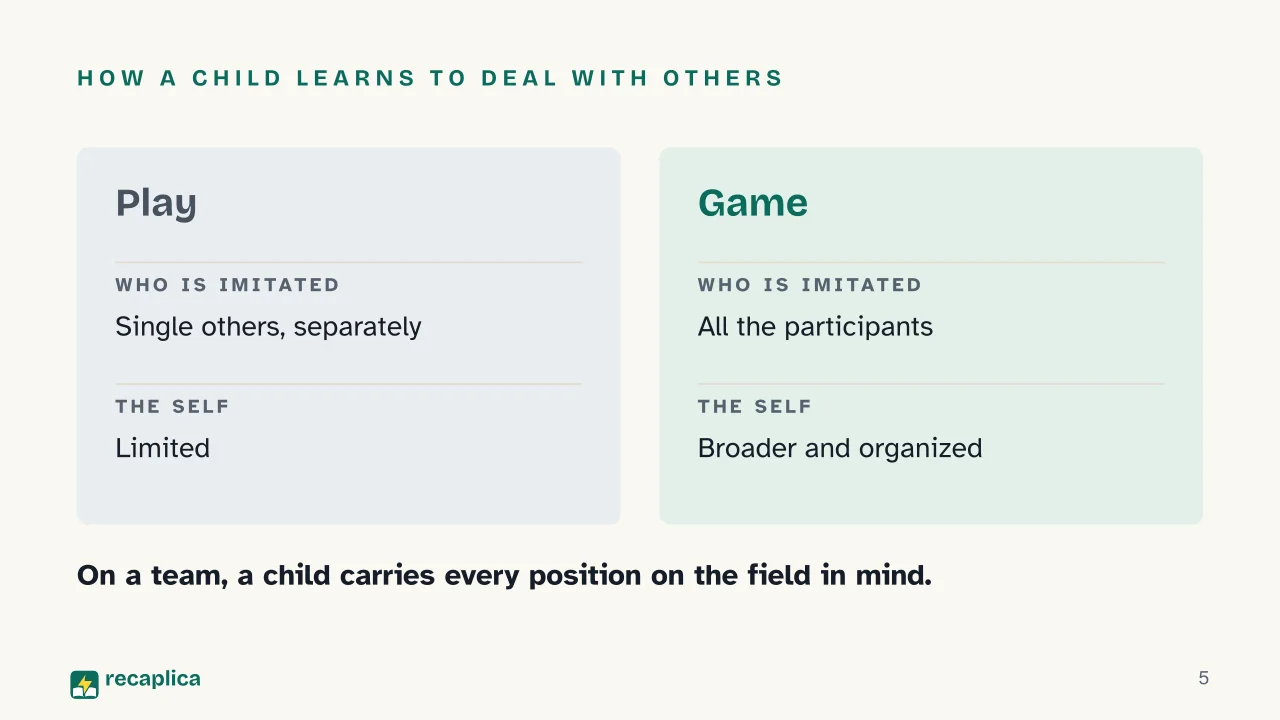  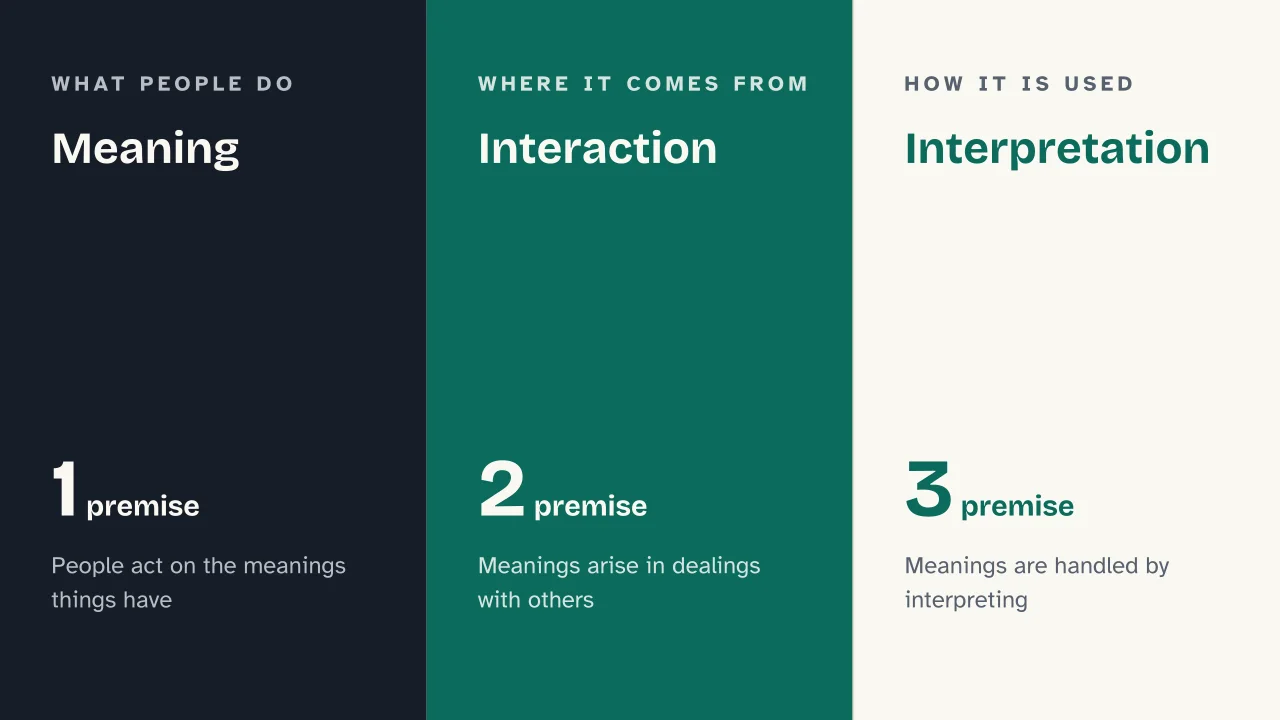  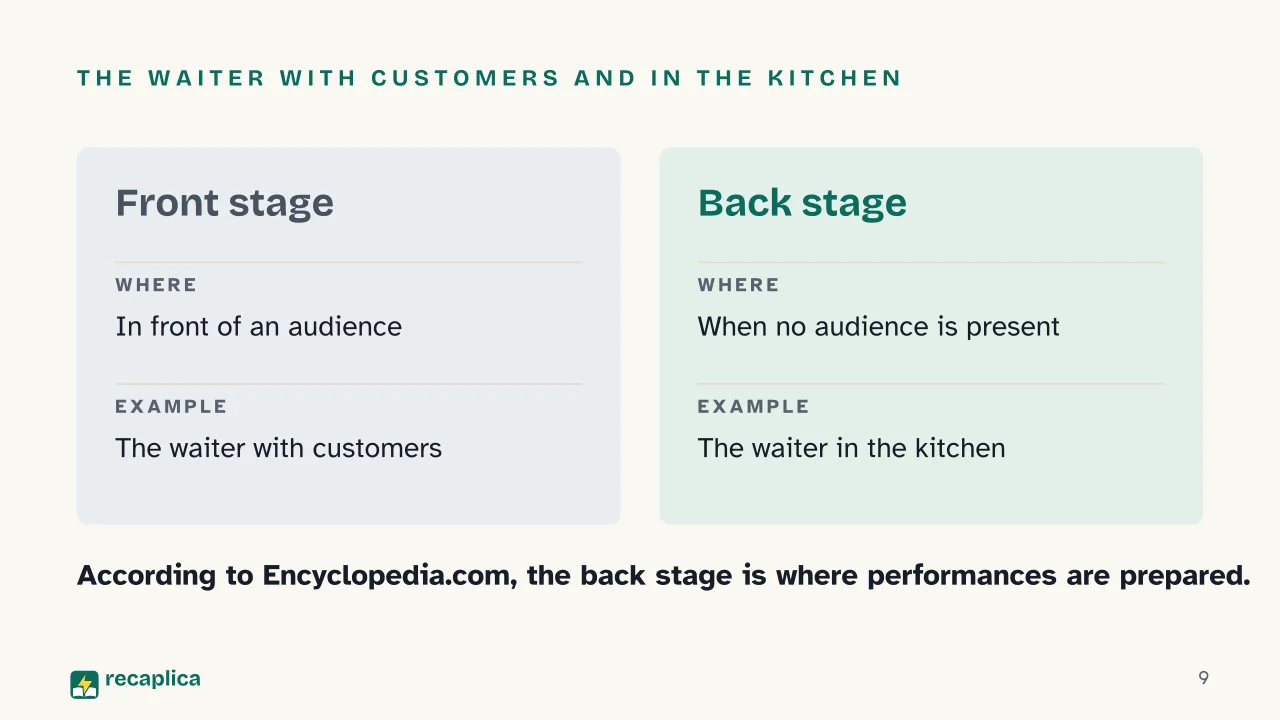      Common myths
Mind mapDrag the background to move around and the nodes to reposition them; use − and + to collapse and expand branches. 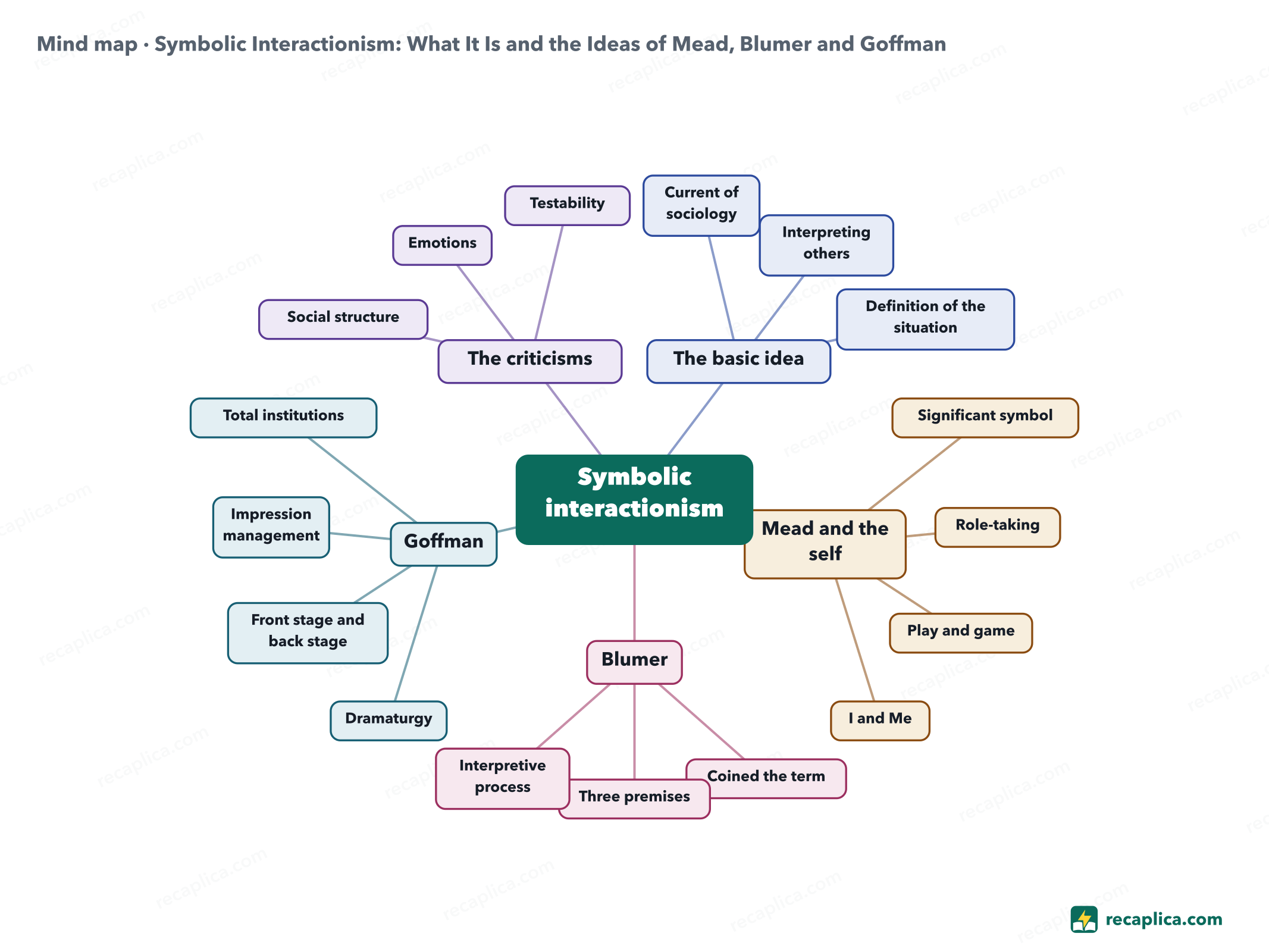
Quiz: test yourselfAnswer the questions to check what you have learned: you get instant feedback and a short explanation. Grade 0/10 0/5
FlashcardsTap the card to flip it and check whether you remember the answer, then move to the next one. 1 / 7 Explain it in your own wordsThe ultimate test: if you can explain it in simple words, you've truly understood it. Write your explanation, then compare it with the Recap. Your explanation is saved only on this device.
Frequently asked questionsWhat is symbolic interactionism, and what is the symbolic interactionist perspective?Treccani describes a sociological current that began in the United States. Its starting point is simple: to act together, each person interprets what the behavior of others means. According to Treccani this is the main object of the current. For Blumer the meaning of things arises in the relations between people. What is Mead's symbolic interaction theory, in Mind, Self and Society?The name was never Mead's, yet he is often called the father of the school. For him the mind is essentially a social phenomenon, and the self develops through contact with others and by playing roles. He then distinguishes two phases of the self, the I and the Me, and the passage from play to game. What did Blumer say about symbolic interactionism?Blumer coined the term and summed it up in three premises: people act toward things on the basis of meanings, meanings derive from social interaction, and they are used and modified through an interpretive process. He coined it in 1937 according to Wikipedia and Encyclopedia.com; Treccani cites his 1969 book as a specific use of the notion. How is Goffman linked to symbolic interactionism?During his doctoral studies at Chicago in the 1940s, Goffman was influenced by the symbolic interactionists, in particular Everett Hughes and Herbert Blumer. According to the Oxford Dictionary of Sociology he remains hard to classify: some read him as a symbolic interactionist, others as a formalist in the manner of Simmel or as a functionalist of the micro order. What are the criticisms of symbolic interactionism?According to Wikipedia's entry, its research methods were judged too impressionistic and its theories not systematic enough. Other objections point to how hard it is to test, and to the little attention paid to emotions and social structure. The objections came mostly from the United States of the 1970s, where quantitative approaches dominated. Every Recap goes through an independent review before publication. |