recaplica
Clear in 30 seconds, yours in 10 minutes.
In 30 seconds quick read
In Ptolemy's system the Earth sat at the center of the cosmos, and the movements of the planets were explained by combining circles. Copernicus moved the Earth, which also called Aristotle's physics into question. Tycho Brahe, the greatest observer before the telescope, found none of the parallax that the Copernican model implied, and he proposed a compromise. Kepler's ellipses came in 1609 and Galileo's telescope discoveries in 1610, followed by Galileo's condemnation in 1633.
Key Points
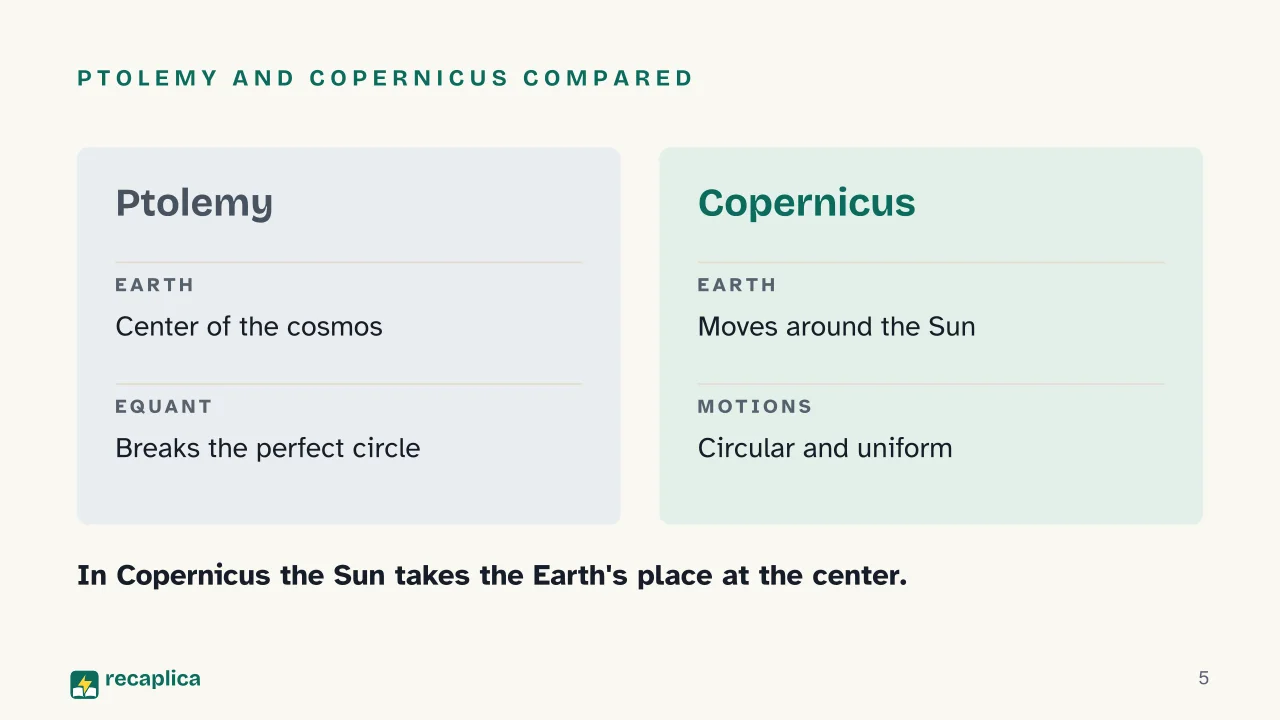
Ptolemy used an eccentric, an epicycle and an equant to describe planetary motion, with the Earth at the center of the cosmos.
The equant broke the principle of perfect circular motion, which troubled many thinkers.
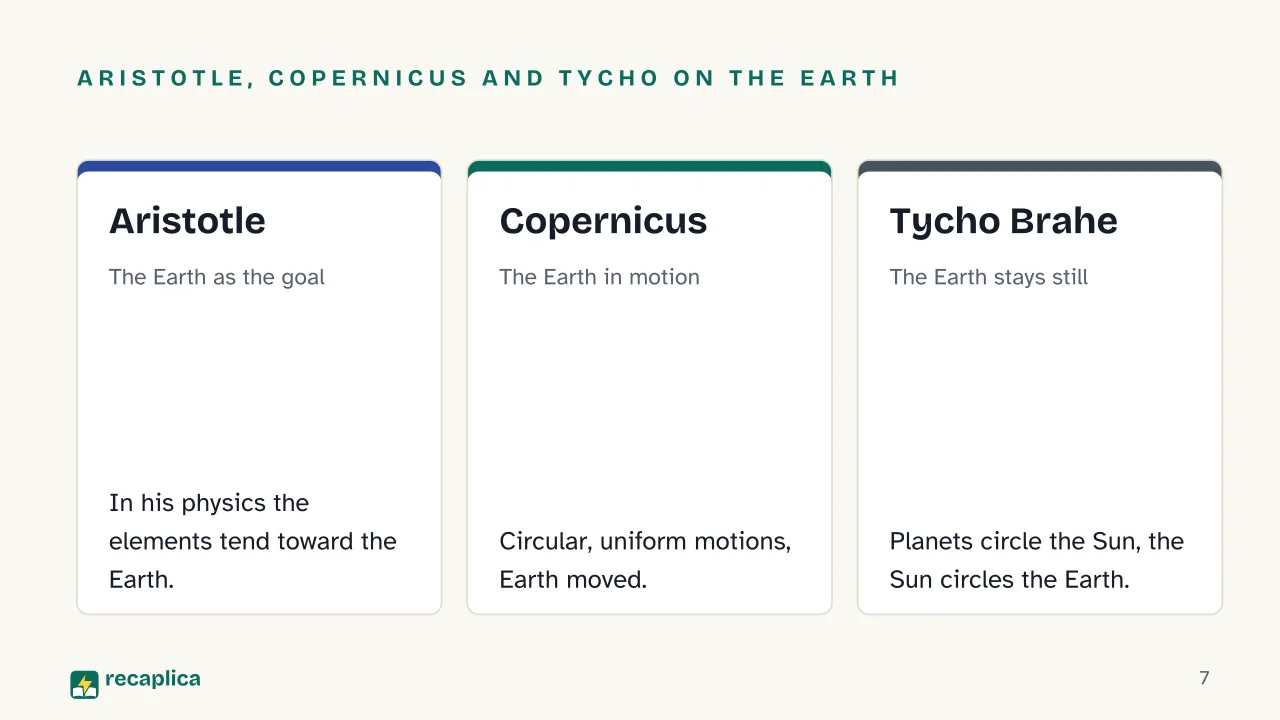
Copernicus held that celestial motions must be circular and uniform, and moved the Earth, which challenged Aristotle's physics, where the elements tend toward the Earth.
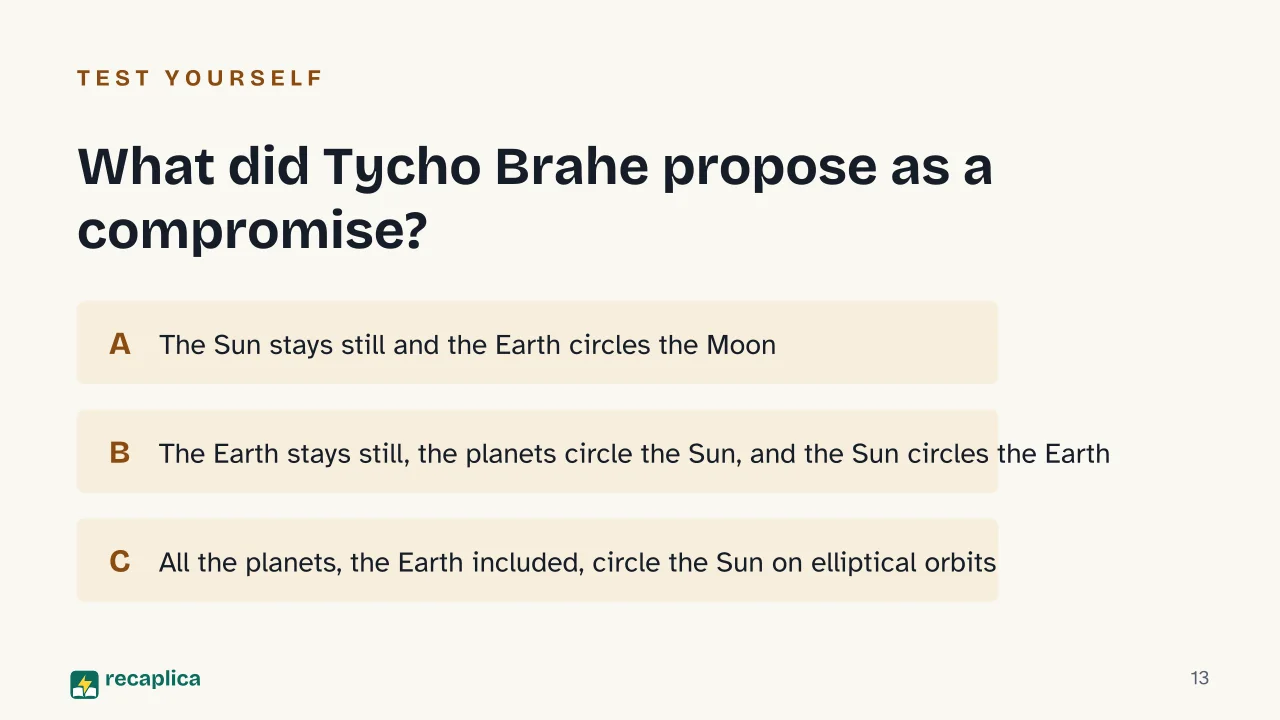
Tycho Brahe detected no parallax and proposed a compromise: the planets circle the Sun, and the Sun and planets circle a motionless Earth.
Kepler published the first law in 1609, an elliptical orbit with the Sun at one focus; in 1610 Galileo announced four moons of Jupiter.
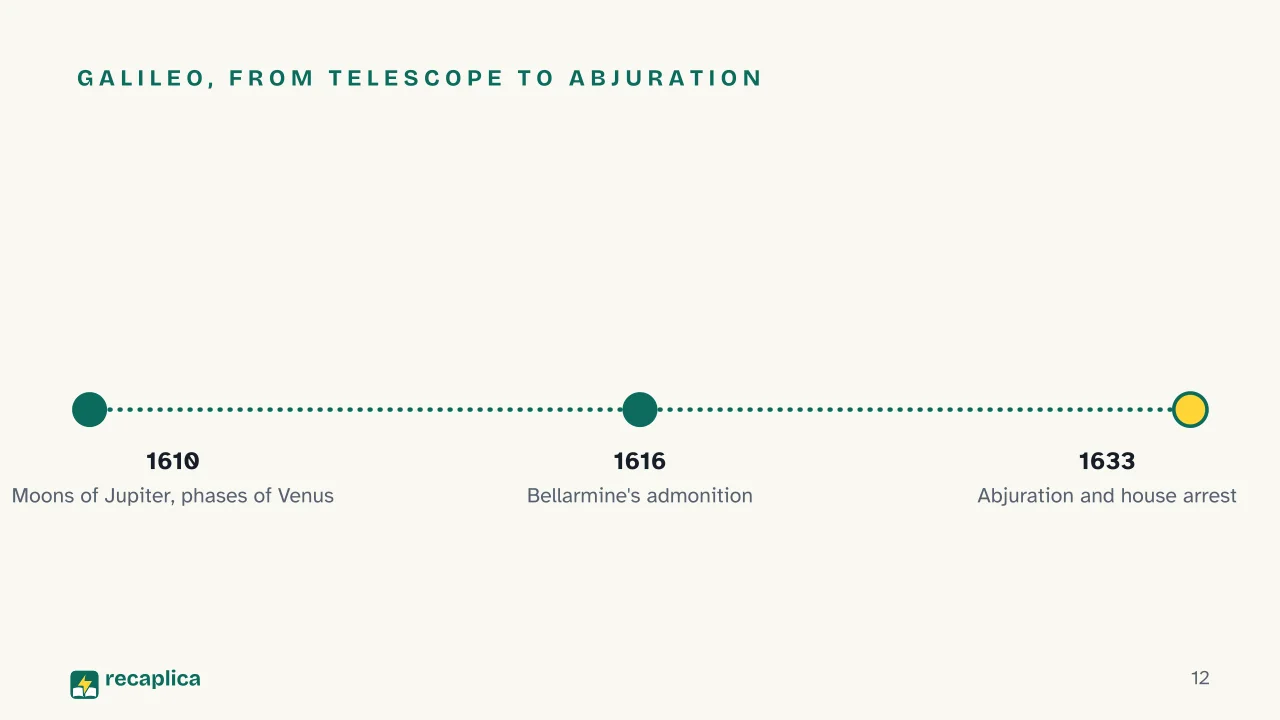
In 1616 Galileo received Bellarmine's admonition, and in 1633 he was found guilty of vehement suspicion of heresy.
Key figures
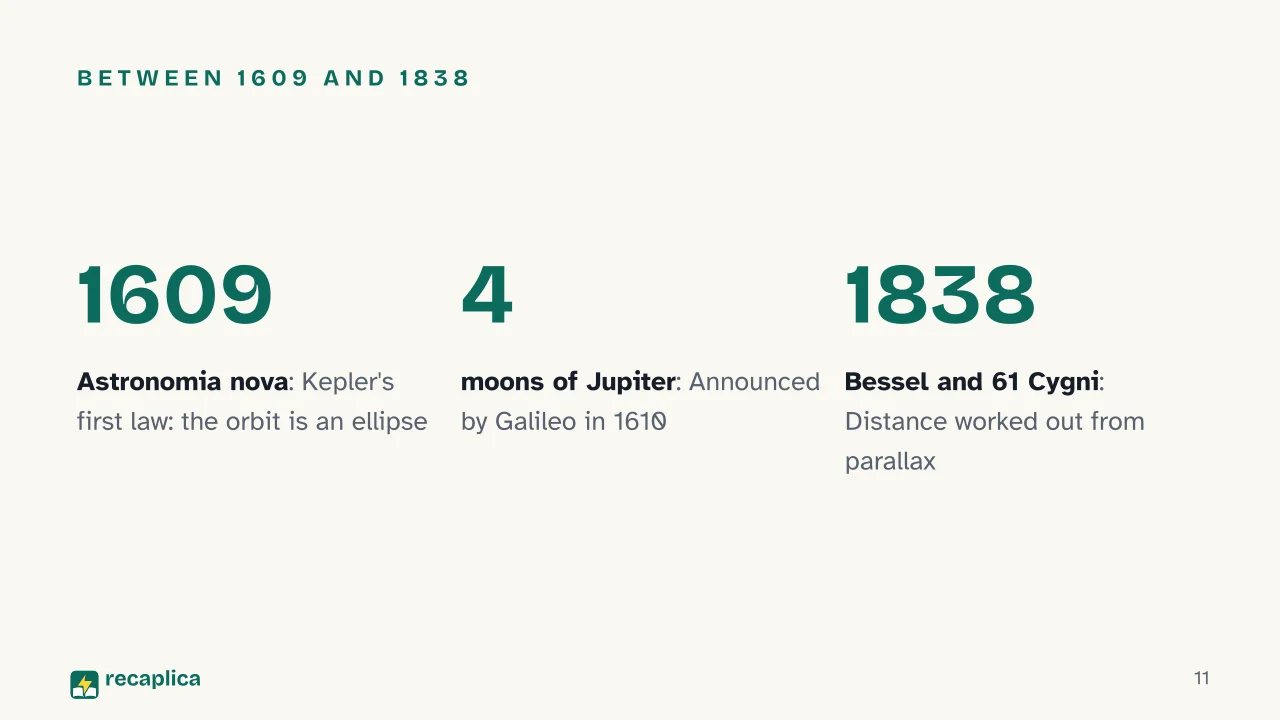
4 Moons of Jupiter that Galileo announced in the Sidereus Nuncius, in 1610. Source: Stanford Encyclopedia of Philosophy, Galileo Galilei
1609 The year Kepler's Astronomia nova set out the first two laws. Source: Stanford Encyclopedia of Philosophy, Johannes Kepler
1838 The year Bessel announced the distance to 61 Cygni, worked out from parallax. Source: MacTutor, Wilhelm Bessel
Deep Dive
Ptolemy’s geocentric model of the solar system
In the geocentric model the Earth sits at the center of the cosmos. To account for the paths of the planets, Ptolemy used three geometric devices, the eccentric, the epicycle and the equant, built to reduce a tangled path to a sum of perfect circular motions. With the eccentric and the epicycle, the planets’ motions were not centered exactly on the Earth. The equant caused a separate trouble: it contradicted the very principle of perfect circular motion, and for that reason it bothered many thinkers.
Practical example: faced with a planet on a tangled path, the astronomer looked for circles that could add up to it. The eccentric and the epicycle belonged to that work, while the equant broke the rule of the perfect circle.
The Copernicus heliocentric model
In Book I of De revolutionibus, Copernicus holds that the motions of the heavenly bodies must be circular and uniform. In his heliocentric model of the universe the Earth moves around the Sun. Rheticus oversaw most of the printing of the work.
Moving the Earth was more than a geometric tweak. In the physics of Aristotle, the physical elements tended toward the Earth as their center, and putting it anywhere else challenged that whole picture.
Practical example: anyone who accepted Copernicus had one more question to answer. If the Earth is not the center, what do the physical elements tend toward?
Ptolemaic vs Copernican model, with Tycho’s compromise
Aspect
Ptolemy
Copernicus
Tycho Brahe
Earth
At the center of the cosmos
Moves around the Sun
Still at the center, with the Moon in orbit
Planets
Motions split into eccentric, epicycle and equant
Circular, uniform motions
Circle the Sun
Sun
Circles the Earth
Center of the planets’ motions
Circles the Earth, carrying the planets
The Tychonic system is a compromise. Tycho could not adopt the Copernican system, so he kept the Earth still at the center.
Tycho and the missing parallax
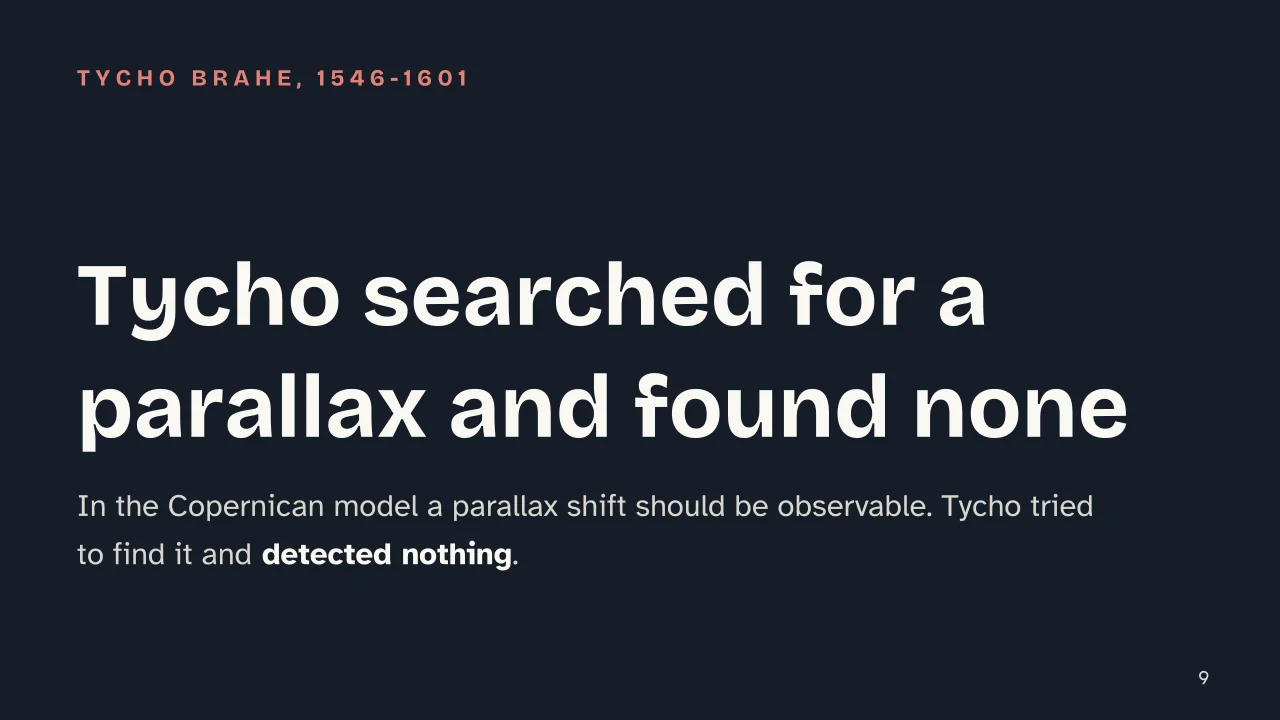
Tycho Brahe (1546-1601) was the greatest astronomical observer before the telescope was invented. In the Copernican model a parallax shift should be observable, and Tycho, though he tried, detected none. In his own system the other planets circle the Sun, while the Earth, with the Moon in orbit, stays still at the center of the Universe. In 1838 Bessel announced the distance to 61 Cygni, worked out from parallax.
Practical example: the Copernican model implies a parallax. Tycho looks for it with his instruments, and the result is zero.
Kepler and Galileo: ellipses and the telescope
In 1609 Kepler’s Astronomia nova appeared, with the first two of his laws. The first says that a planet’s orbit is an ellipse with the Sun at one focus, whereas Ptolemy and Copernicus had built their motions from circles. In that book Kepler relies heavily on Tycho’s observations. In the Sidereus Nuncius of 1610, Galileo announced that Jupiter has four moons, known as the Galilean moons. Later that year he saw that Venus shows phases, a sign that it circles the Sun. Following the sunspots, he found that the Sun rotates on an axis, as the Earth does in the Copernican view.
Practical example: Galileo observed Venus and saw its phases, a sign that the planet circles the Sun.
1616 and 1633
In 1616 the proceedings against Galileo ended with Cardinal Bellarmine admonishing him neither to defend nor to hold the Copernican doctrine.
At the 1633 trial Galileo was found guilty of vehement suspicion of heresy and had to recite and sign an abjuration. The sentence of formal imprisonment was commuted to house arrest.
Slide deck
Slides ready to download and make your own in PowerPoint or Google Slides, with speaker notes. Pick the Flash cut or the Full one.
✗ Myth Copernicus put the Sun at the center and Ptolemy's system collapsed at once.
✓ Reality Not everyone followed Copernicus. Moving the Earth put Aristotle's physics in question, and Tycho Brahe, the greatest observer before the telescope, looked for a parallax shift and found none. Tycho could not adopt the Copernican system and proposed a compromise that kept the Earth still.
✗ Myth Copernicus did away with Ptolemy's circles.
✓ Reality Copernicus too kept the heavenly motions circular and uniform, as Book I of De revolutionibus holds. The elliptical orbit arrives in 1609 with Kepler, who relies heavily on Tycho's observations in the Astronomia nova.
✗ Myth Galileo went to prison for defending Copernicus.
✓ Reality In 1633 the verdict was guilty of vehement suspicion of heresy, with an order to recite and sign an abjuration. The prison term he was sentenced to was then turned into house arrest.
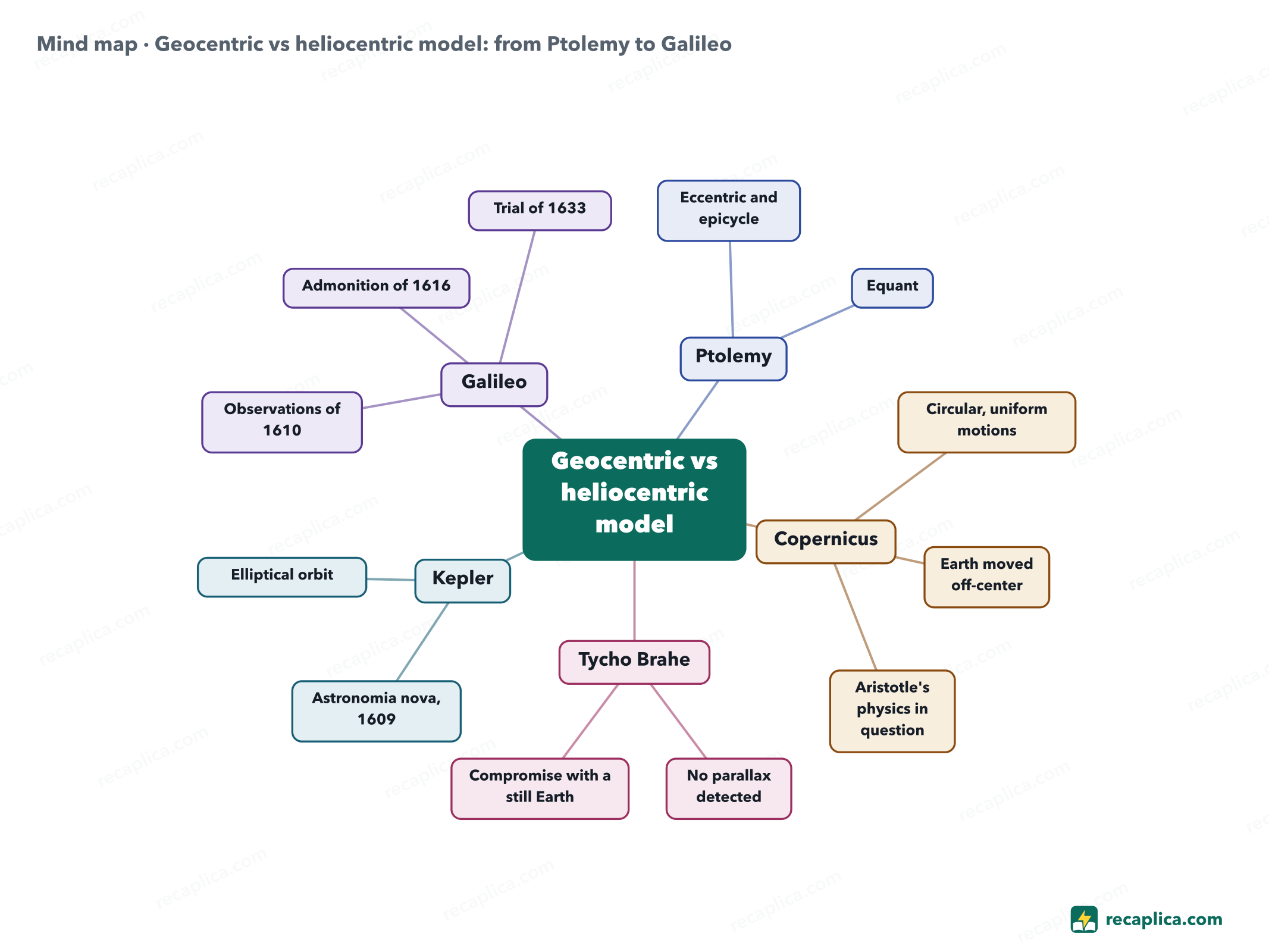
Mind map
Drag the background to move around and the nodes to reposition them; use − and + to collapse and expand branches.
Answer the questions to check what you have learned: you get instant feedback and a short explanation.
Grade0/100/5
Answers: 1-C · 2-A · 3-D · 4-B · 5-C
Flashcards
Tap the card to flip it and check whether you remember the answer, then move to the next one.
1 / 6
Explain it in your own words
The ultimate test: if you can explain it in simple words, you've truly understood it. Write your explanation, then compare it with the Recap.
Your explanation is saved only on this device.
In Ptolemy's system the Earth sat at the center of the cosmos, and the movements of the planets were explained by combining circles. Copernicus moved the Earth, which also called Aristotle's physics into question. Tycho Brahe, the greatest observer before the telescope, found none of the parallax that the Copernican model implied, and he proposed a compromise. Kepler's ellipses came in 1609 and Galileo's telescope discoveries in 1610, followed by Galileo's condemnation in 1633.
Frequently asked questions
What is the difference between the geocentric and the heliocentric model?
Geocentric means the Earth is the center of the cosmos, and it is Ptolemy's model. Heliocentric means the Sun is the center of the planets' motions, the Earth included, and it is the model of Copernicus.
What is the Tychonic system?
It is the compromise proposed by Tycho Brahe. The Earth, accompanied by the Moon, stays motionless at the center of the Universe; the Sun circles it and carries the other planets along.
Did Tycho Brahe adopt the Copernican heliocentric theory?
No. His own system kept the Earth still. The Copernican model implied a parallax shift, which he looked for without detecting any.
What did Galileo discover with the telescope?
In 1610 the Sidereus Nuncius announced four moons of Jupiter. Later that year the phases of Venus told Galileo that it circles the Sun, and following the sunspots showed that the Sun rotates on an axis.
What did Bessel announce in 1838?
The distance to 61 Cygni, worked out from parallax.
Every Recap goes through an independent review before publication.
Statistics, only if you say so
To learn which Recaps help most we would use Google Analytics, with aggregate, anonymous data. It starts only with your OK, and you can change your mind anytime. Privacy policy