|
recaplica
Sigmund Freud's Interpretation of Dreams: What It Is and How It Works |
| © 2026 Recaplica · recaplica.com — All rights reserved |
Sigmund Freud's Interpretation of Dreams: What It Is and How It WorksWhat to print Page numbers appear when printing with default margins. SlidesChoose a cut Flash10 slidesThe essential thread, to present in classFull14 slidesEvery chapter and the deeper detailBoth come with speaker notes. In 30 seconds quick read«The Interpretation of Dreams» is the book in which Sigmund Freud proposed reading a dream as a form of thinking that can be decoded. Freud writes that he composed it in 1899, while the Freud Museum London and the Internet Encyclopedia of Philosophy date the first publication to 1900. The book turns on a distinction between the dream a person remembers on waking and the thoughts that produced it below the surface. For the Freud Museum London, interpreting a dream means undoing what the dream-work has built. Whether the theory counts as science is still argued over, and the Internet Encyclopedia of Philosophy sets out that argument through Karl Popper's criterion of falsifiability. Key Points
Deep DiveA book Freud ties to his father’s deathIn the preface to the third edition of «The Interpretation of Dreams» Freud speaks of the book as something he wrote in 1899, and offers it as part of a self-analysis that began in reaction to his father’s death. That loss, he writes, is the gravest in a man’s life. The Internet Encyclopedia of Philosophy places the publication after a long stretch of self-analysis and treats the volume as Freud’s major work, written in the years when the birth of psychoanalysis was taking shape. The theoretical frame and the dream book grew together, which is why the volume reads as a treatise and as a disguised autobiography at once. The Freud Museum London ranks it among the twentieth century’s most important books. It also credits the book with something less obvious, the start of a literary genre that tells a life through the dreams of the person who lived it. 1899 or 1900, and why two dates circulateStudents meet both figures and suspect a mistake. The two years in fact cover two moments of the same book. 1899 is the year Freud has in mind when he recalls writing it, in the preface to the third edition. 1900 is the year the Freud Museum London and the Internet Encyclopedia of Philosophy give for the first publication, which is why that figure turns up most often. In an exam either answer works, provided you say what each one dates. “Written in 1899, published in 1900” is a sharper answer than either year on its own. Manifest content and latent contentThe Freud Museum London defines manifest content as the dream as we remember it. The latent content is instead the underlying dream-thoughts out of which that dream is built, and the wishes living in them reach the waking account in disguise. A straightforward formula helps hold them apart: manifest is what you tell, latent is what you look for. The Internet Encyclopedia of Philosophy sums up the same pair in other words: on one side how a dream looks on the surface, on the other the repressed unconscious wishes the encyclopedia treats as its real target.
The dream-work, and the interpretation that undoes itThe Freud Museum London page on the dream-work credits Freud with the idea that a dream is a particular form of thinking, produced by that work. Interpreting a dream then consists in undoing what the dream-work has built, travelling in the opposite direction from the dream itself. The museum also defines two of the mechanisms behind the construction. In condensation several dream elements merge into one, whether themes, images, figures or ideas. In displacement importance changes place, passing from an element of the latent content to a marginal element of the manifest one, and in the other direction a detail that looks insignificant can end up in the foreground. The same museum quotes a line of Freud’s that shows where he was looking. By his own account the theory stands on what the work of interpretation uncovers behind a dream, and not on the dream as it is remembered. The waking account only supplies the material to start from. Dream symbols, and why no dictionary followsIn bookshops the volumes that promise the meaning of every object dreamed of often carry Freud’s name on the cover, and they stand on the far side of the line just quoted. A list of fixed meanings would stop at the waking account, the level Freud declared he was setting aside, and a symbol that always means the same thing would make the work of interpretation pointless. There is also a difference of standing here with respect to empirical research. Anyone coming to psychological science runs straight into procedures built to be checked by other people, and research methods in psychology lists the tools used to do the checking. Scientific standing in dispute, and Popper’s criterionThe Internet Encyclopedia of Philosophy explains why one current in the philosophy of science has disputed the scientific standing of the psychoanalytic theory of dreams, and it does so by raising Karl Popper’s criterion of falsifiability. On that formulation a scientific theory has to clash with some possible observation; one that fits whatever happens is left outside. That objection is about the shape of the theory, and it did nothing to limit the book’s reach. Across the same century psychoanalysis was moving into novels, and readers can find it gently mocked in Italo Svevo’s Zeno’s Conscience, where a patient writes his own story for the doctor treating him. Slide deckSlides ready to download and make your own in PowerPoint or Google Slides, with speaker notes. Pick the Flash cut or the Full one.     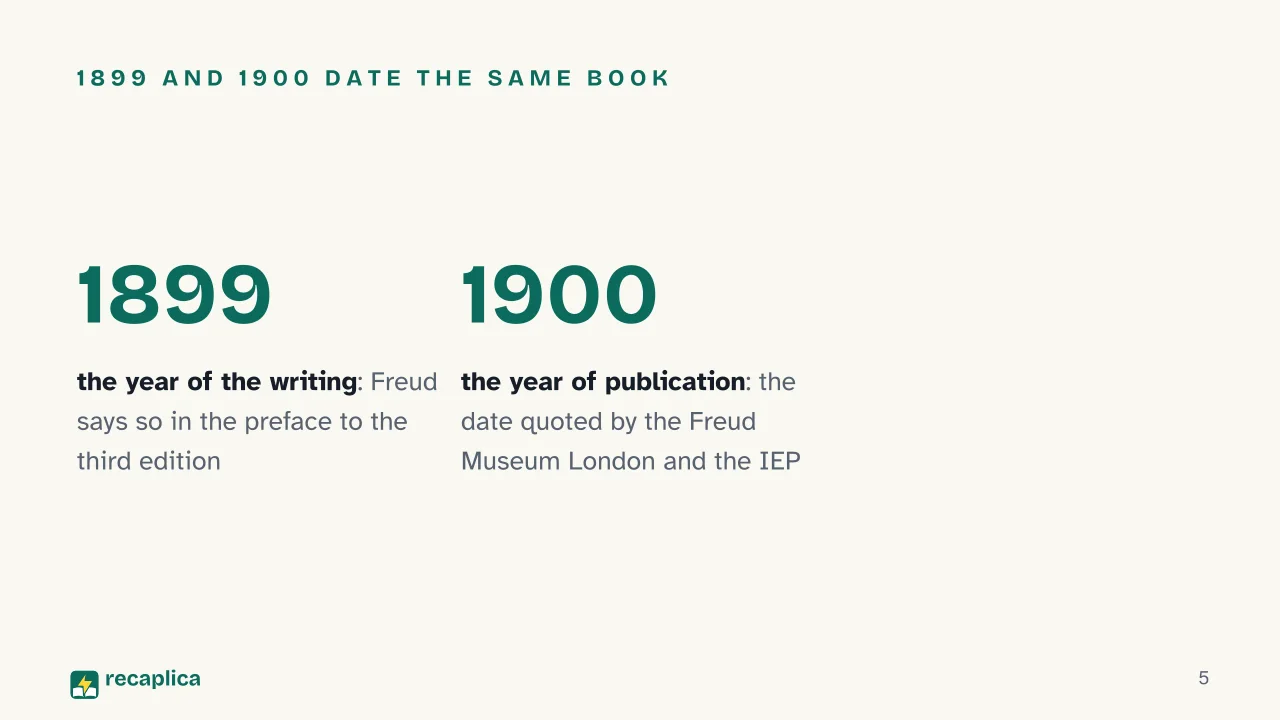 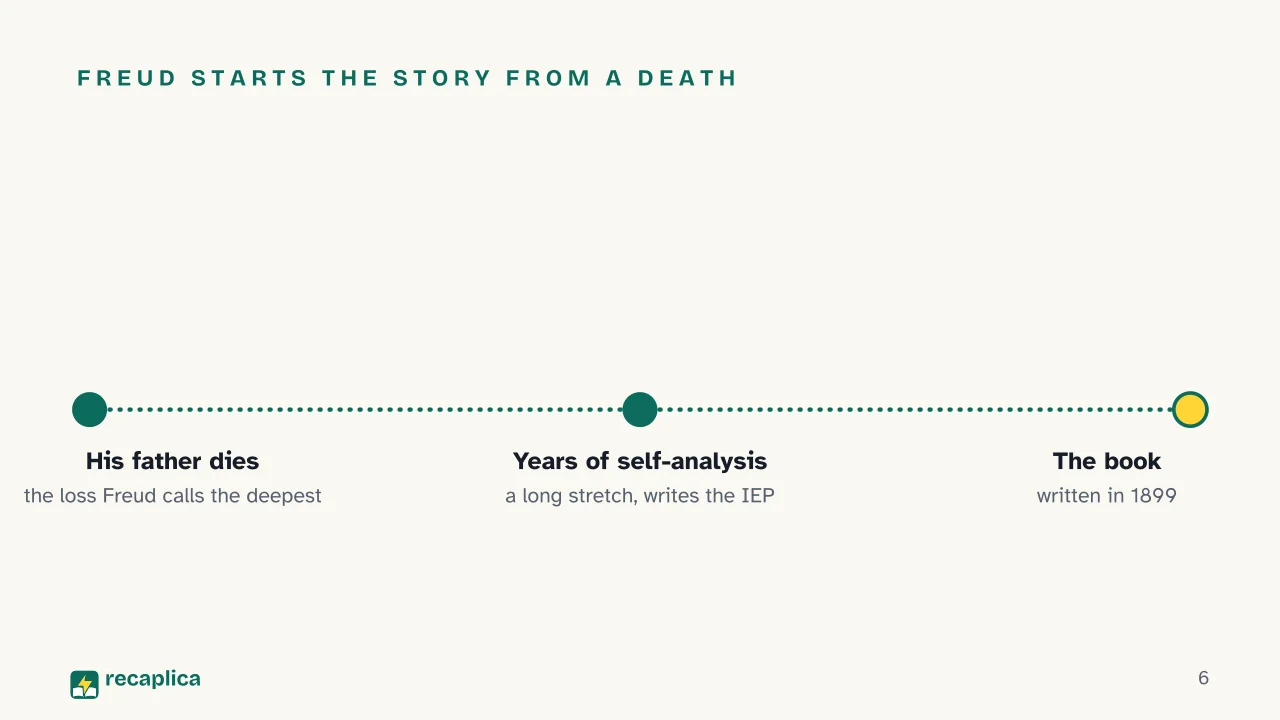  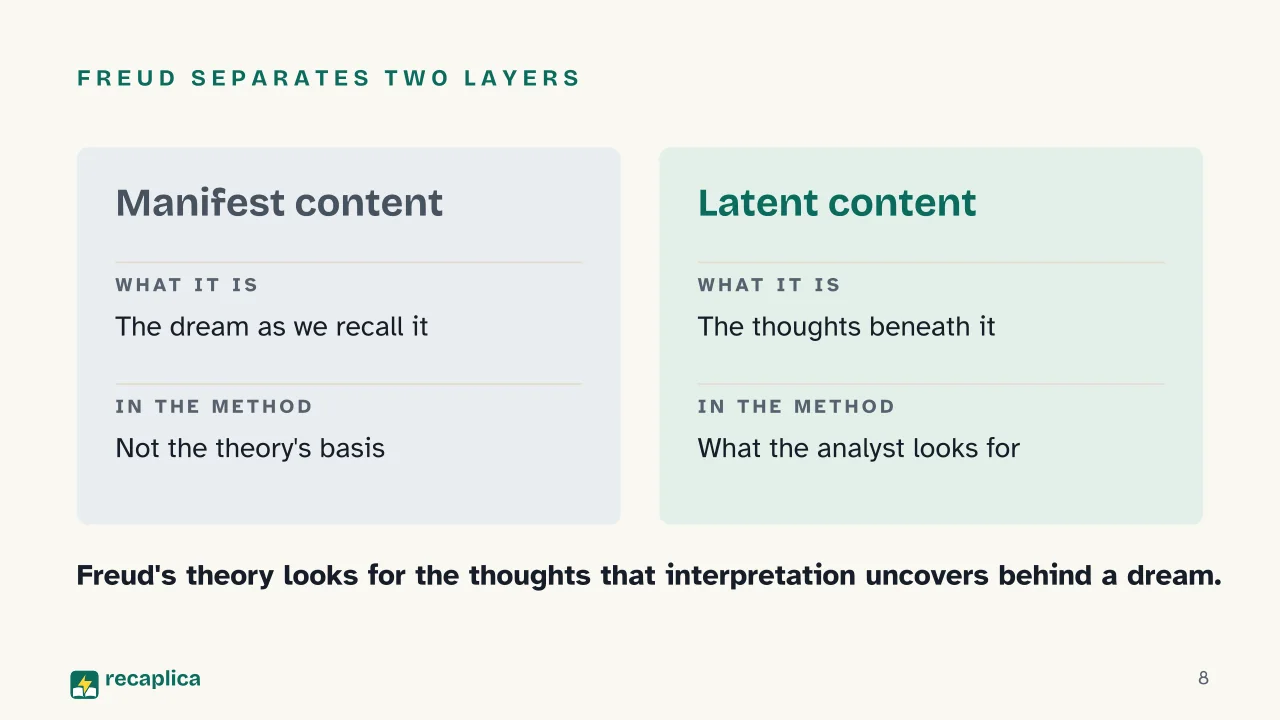       Common myths
Mind mapDrag the background to move around and the nodes to reposition them; use − and + to collapse and expand branches. 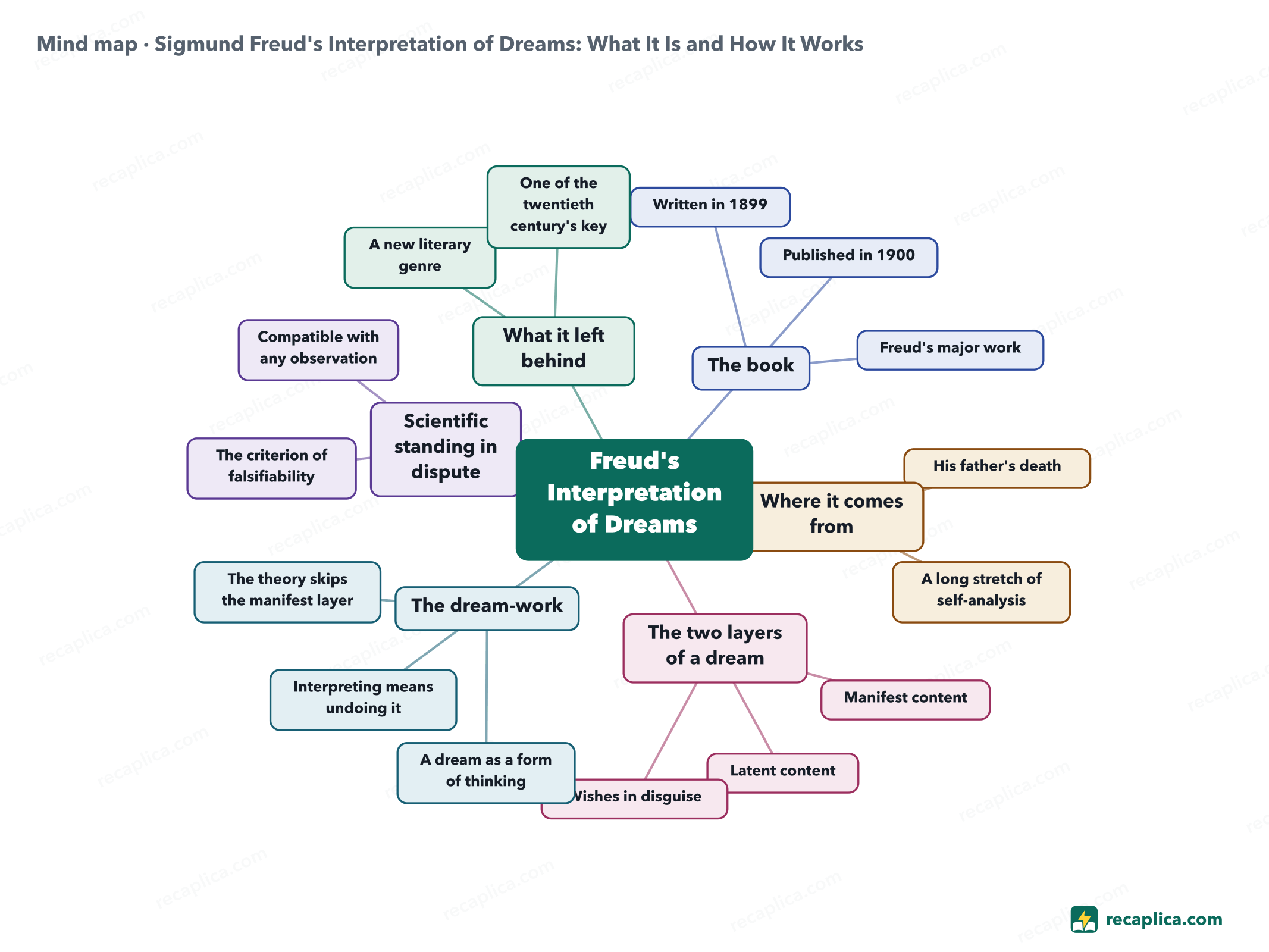
Quiz: test yourselfAnswer the questions to check what you have learned: you get instant feedback and a short explanation. Grade 0/10 0/5
FlashcardsTap the card to flip it and check whether you remember the answer, then move to the next one. 1 / 8 Explain it in your own wordsThe ultimate test: if you can explain it in simple words, you've truly understood it. Write your explanation, then compare it with the Recap. Your explanation is saved only on this device.
Frequently asked questionsWhat did Freud mean by manifest content and latent content?The manifest is the version of the dream a person remembers and recounts on waking. The latent is the layer of thoughts underneath, where wishes live, and in the retelling they arrive disguised. Both definitions come from the Freud Museum London, while the Internet Encyclopedia of Philosophy describes the same step as a dream appearing on the surface on one side and repressed unconscious wishes on the other. When was Freud's book on dreams published?That depends on what you are dating. Writing the preface to the third edition, Freud assigns the composition to 1899. The Freud Museum London and the Internet Encyclopedia of Philosophy date the first publication to 1900, and that is the year most often quoted for the book. Is Freud's interpretation of dreams considered scientific?The question stays open and debated. The Internet Encyclopedia of Philosophy explains that part of the philosophy of science questioned whether the theory is scientific at all, pointing to Karl Popper's test of falsifiability, for which what counts is whether observations exist that could contradict what a theory claims. Is there a Freudian dictionary of dream symbols?The books that promise a fixed meaning for every object dreamed of do not come from here. According to the Freud Museum London, Freud declared that he grounded the theory on what the work of interpretation brings to light behind a dream, setting the remembered account aside. Why is the book considered important?The Freud Museum London puts it among the major books of the twentieth century and credits it with inventing a genre, the biography built out of a dreamer's own nights. The Internet Encyclopedia of Philosophy treats it as Freud's major work. Every Recap goes through an independent review before publication. |