Skip to content
recaplica

    One moment: security check

    Cloudflare wants to make sure you're not a robot. Tick the box below and your search will continue on its own.

    IT
    recaplica Research Methods in Psychology: Tests, Interviews, and Observation
    © 2026 Recaplica · recaplica.com — All rights reserved
    Home › Science

    Research Methods in Psychology: Tests, Interviews, and Observation

    By Recaplica Newsroom · Updated on October 5, 2026

    What to print

    Page numbers appear when printing with default margins.

    Slides

    Choose a cut

    Flash10 slidesThe essential thread, to present in classFull15 slidesEvery chapter and the deeper detail

    Both come with speaker notes.

    Telegram channel
    recaplica Clear in 30 seconds, yours in 10 minutes.
    In 30 seconds Key points Deep dive Slides Myths Mind map Quiz Flashcards FAQ

    In 30 seconds quick read

    Scientific psychology gathers data with three main tools: the test, the interview, and observation. A test measures a trait with standardized questions or tasks, an interview is a conversation guided by a research purpose, and observation records behavior as it happens. Each tool has its own limits: an observer can shape what gets recorded, and two people can read the same interview question in different ways. That is why every tool is also judged on two specific qualities, reliability and validity, and why the data it produces describes relationships between variables rather than their cause.

    Key Points

    • A psychological test measures a trait with questions or tasks that are identical for everyone; it is checked for internal consistency among its items, and Cronbach's alpha is the usual statistic for that.
    • An interview is a conversation built around a research purpose: it can be unstructured, semi-structured, or structured, depending on how much the questions are fixed in advance.
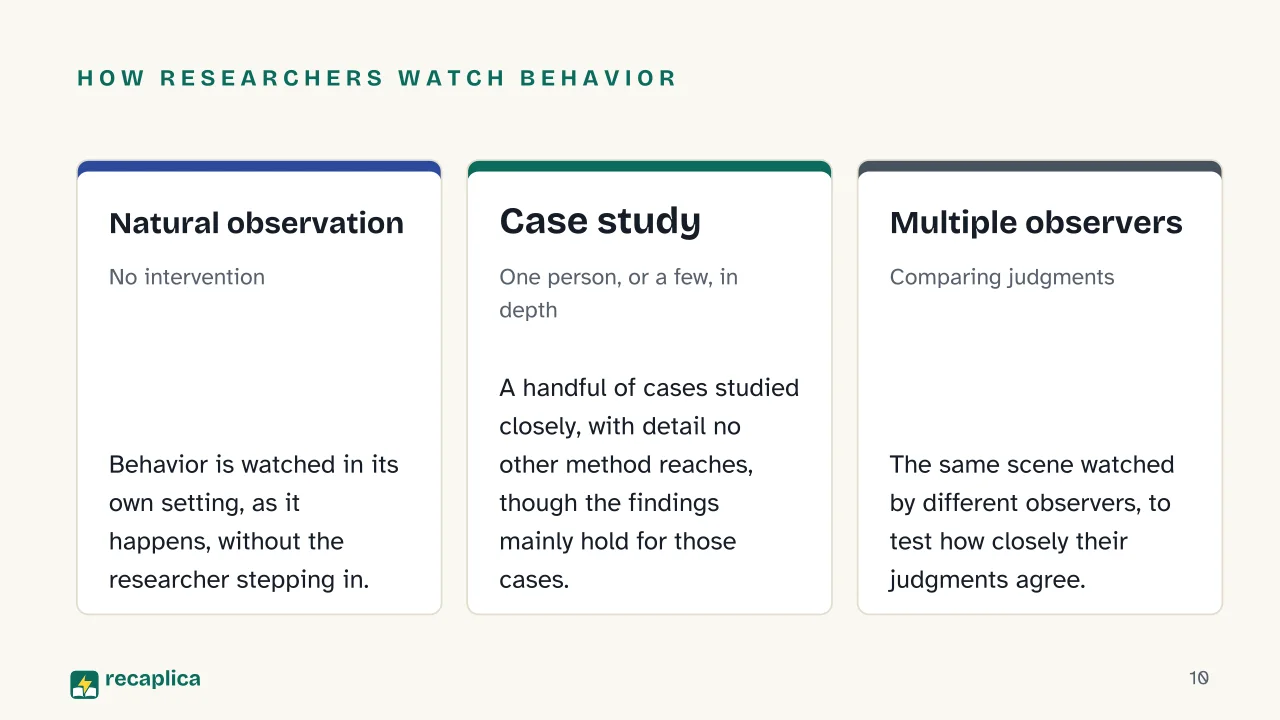
    • Naturalistic observation records behavior in its own setting without the researcher stepping in; a case study looks closely at one person or a few.
    • Observers can unintentionally distort what they record, which is why researchers compare notes across several observers, a check called inter-observer reliability.
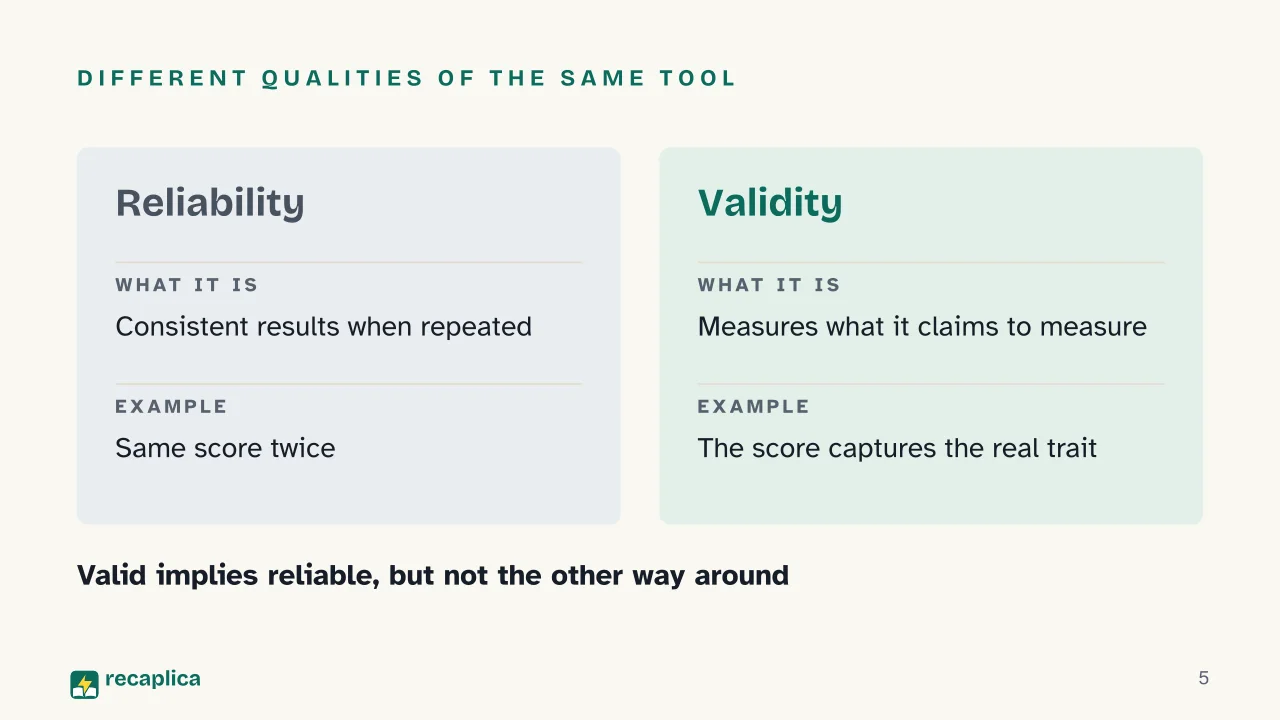
    • Reliability is how consistent a measure stays when it is repeated; validity is how well it actually captures the trait it claims to measure.
    • An observed behavior, an interview answer, or a test score shows that two things occur together; working out why they occur together is a separate research question.

    Deep Dive

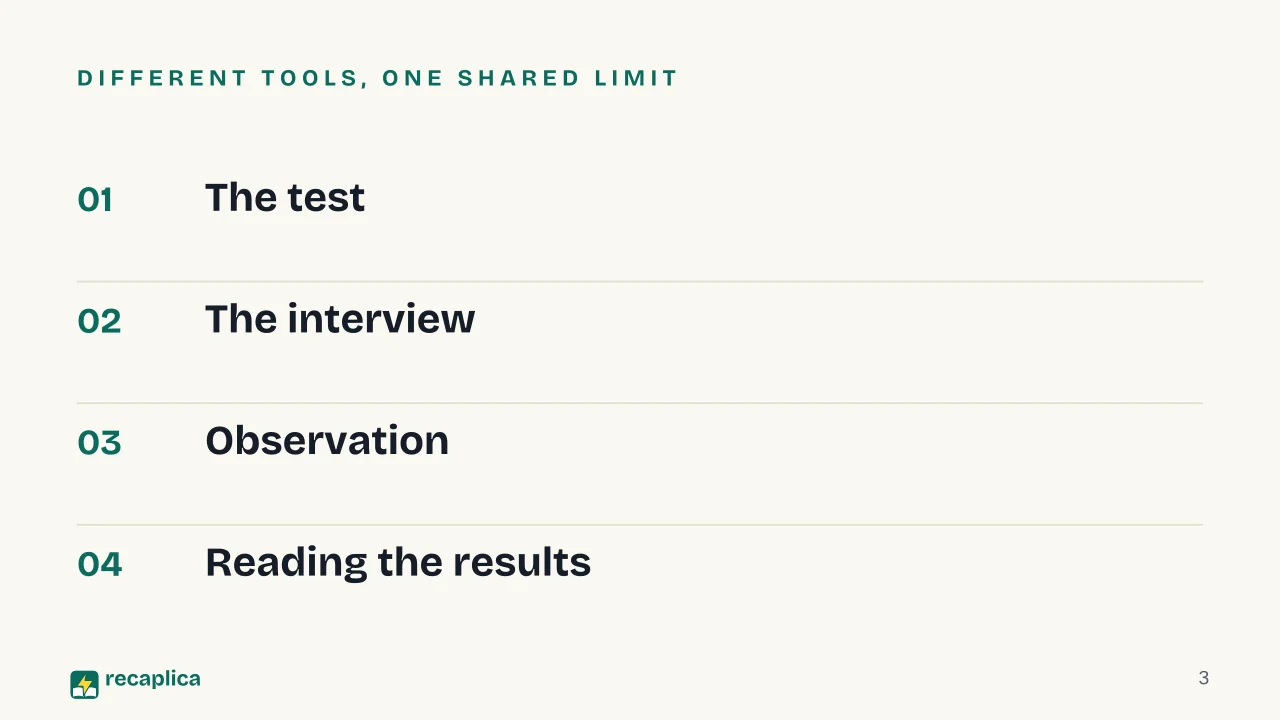
    Scientific psychology does not just watch everyday life unfold: it gathers data with tools built for the purpose, and each one plays by its own rules. To see how a study ends up saying something about how we think or behave, as explained in psychological science: what it is and how it works, it helps to start with the three methods a researcher has on hand for collecting data about a psychological phenomenon: the test, the interview, and observation.

    The psychological test

    A psychological test asks everyone the same questions or the same tasks, in the same way, to measure a trait. It is judged on two separate properties, reliability and validity, and mixing them up is the most common mistake.

    Reliability is about the consistency of a measure: if the test is repeated, does it give similar results? One specific form of reliability is internal consistency, meaning how well a person’s answers hold together across the different items of the same test; the usual statistic for it is Cronbach’s alpha. Validity is a different question, about content: does the test actually measure what it claims to measure, or something else entirely? One way to check it is criterion validity, which compares the test’s scores against other external measures linked to the same trait.

    That is why, in psychology, the two properties are checked separately even when a test seems to work well in practice. The same principle applies to intelligence tests, covered in human intelligence: theories and tests: a score that stays stable over time still needs an independent check before anyone can say the test is capturing the right ability.

    Practical example: someone fills out an anxiety questionnaire twice, a month apart, and gets similar scores: that makes it reliable. The problem shows up when those scores have no link at all to other signs of that person’s anxiety, say the accounts given by people close to them: in that case the questionnaire fails the test of validity, because the score has no external backing.

    The interview

    The interview is the most widely used data-collection method in the social sciences, psychology included. It is defined as a conversation between two people, verbal and non-verbal, with a research purpose set in advance that sets it apart from ordinary small talk.

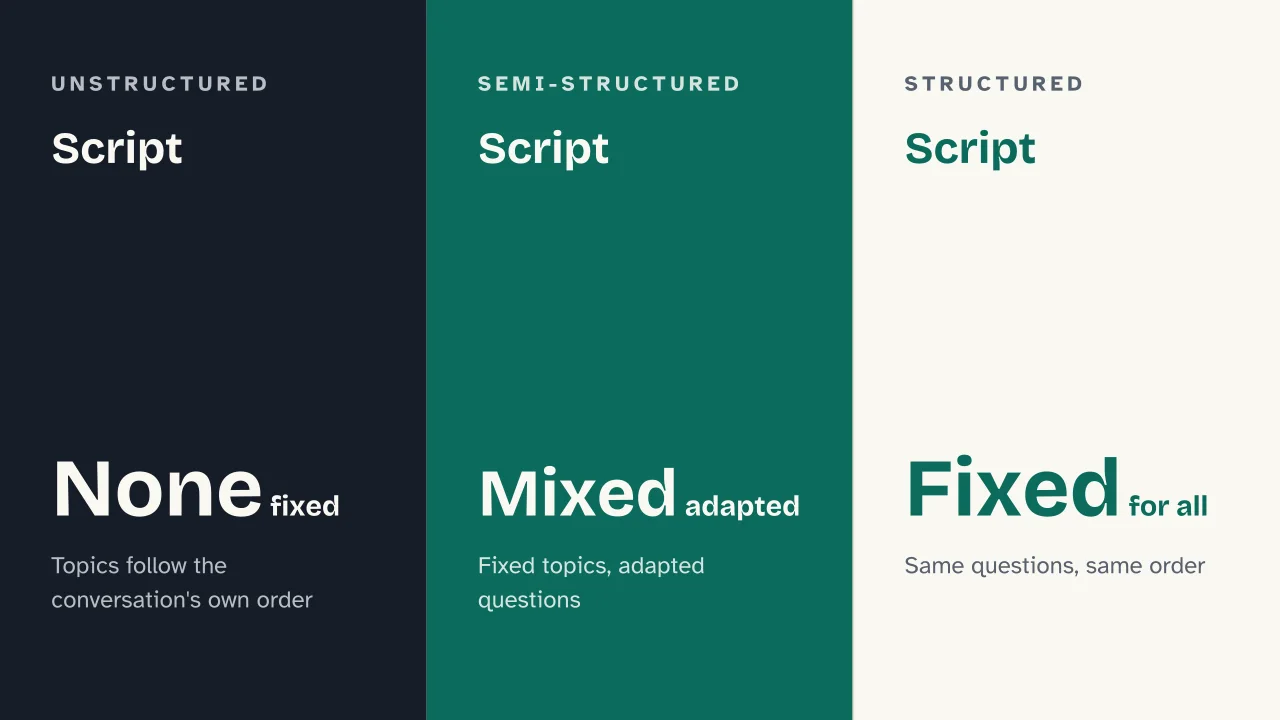
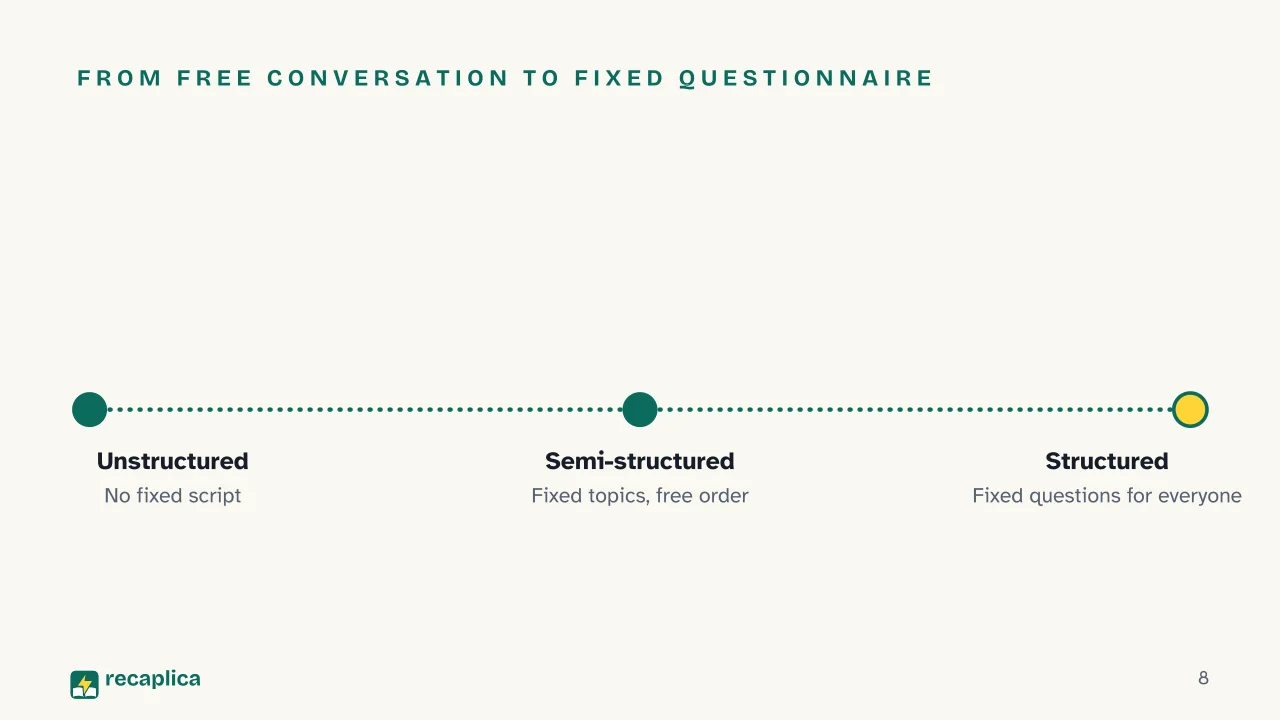
    The three types of interview differ in how much the questions are already decided before the conversation even starts. In an unstructured interview, the interviewer follows topics in whatever order they come up during the conversation, with no fixed script. In a semi-structured interview, the topics are chosen in advance and the interviewer adapts the wording and order of the questions to the person in front of them. A structured interview instead uses an identical questionnaire for everyone, the same questions in the same order for every respondent.

    Every type carries the same underlying limit. The same question can be understood differently by different people, which introduces subjectivity into the answers that the researcher does not fully control. There is also the interviewer effect: how the person asking questions behaves calls up roles and habits the respondent has already learned in other social settings, and that can shape what they say.

    Observation

    Watching looks like the simplest method of all: just look, and no one has to answer a question. In psychology, though, it comes with forms and limits just as precise as the other two tools.

    Naturalistic observation follows behavior within its usual setting without the researcher stepping in to change it. A case study instead looks deeply at a single person, or a small group: the level of detail it reaches has no equal, precisely because it focuses on so few cases, which do not represent the wider population.

    Whoever is observing, though, is part of the research being carried out, and that alone can be enough to unintentionally change what gets recorded: it is a limit on the side of the watcher, not just the watched. To keep it in check, the same event is often followed by several observers, and researchers then check how closely their notes match: this is inter-observer reliability.

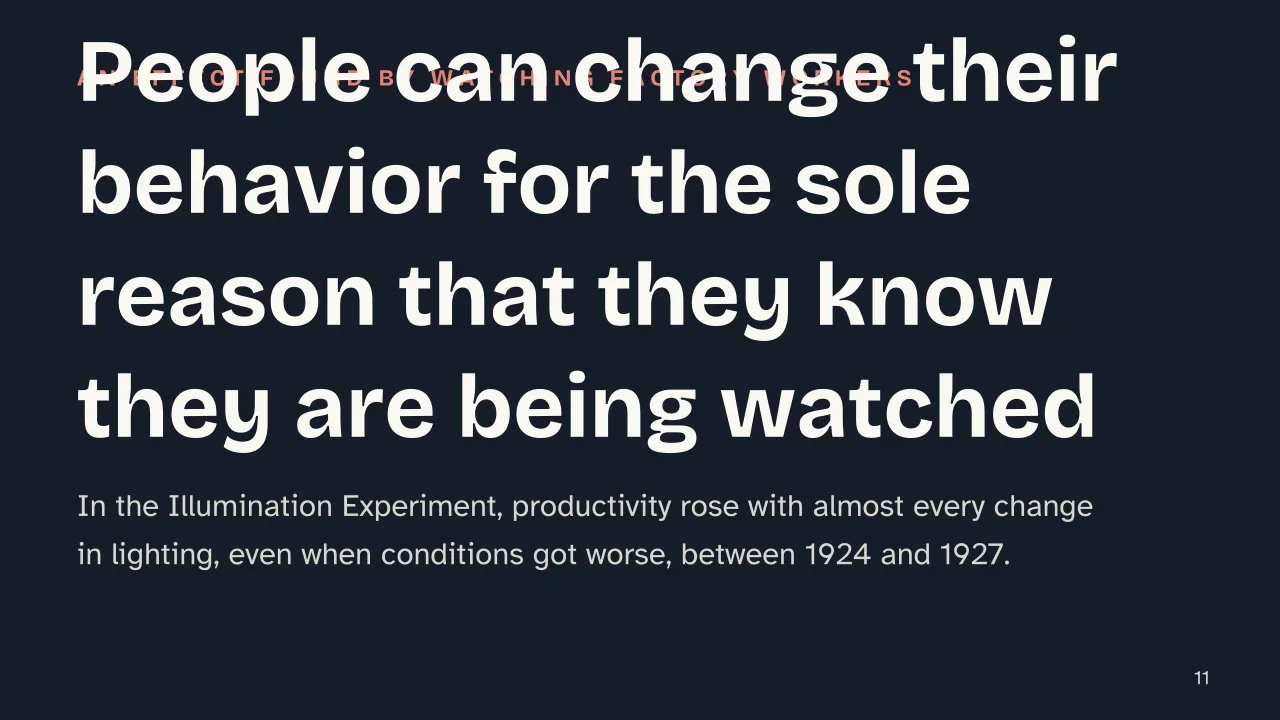
    There is a second limit, this time on the side of the people being observed: simply knowing you are being watched can be enough to make people act differently from usual. In the Hawthorne studies, carried out in a factory between 1924 and 1927 and remembered as the Illumination Experiment, productivity rose with almost every change in lighting, whether brighter or dimmer, and stayed high even when conditions worsened again. Researchers attributed the rise to the workers’ awareness of being observed.

    Reliability and validity: two different things

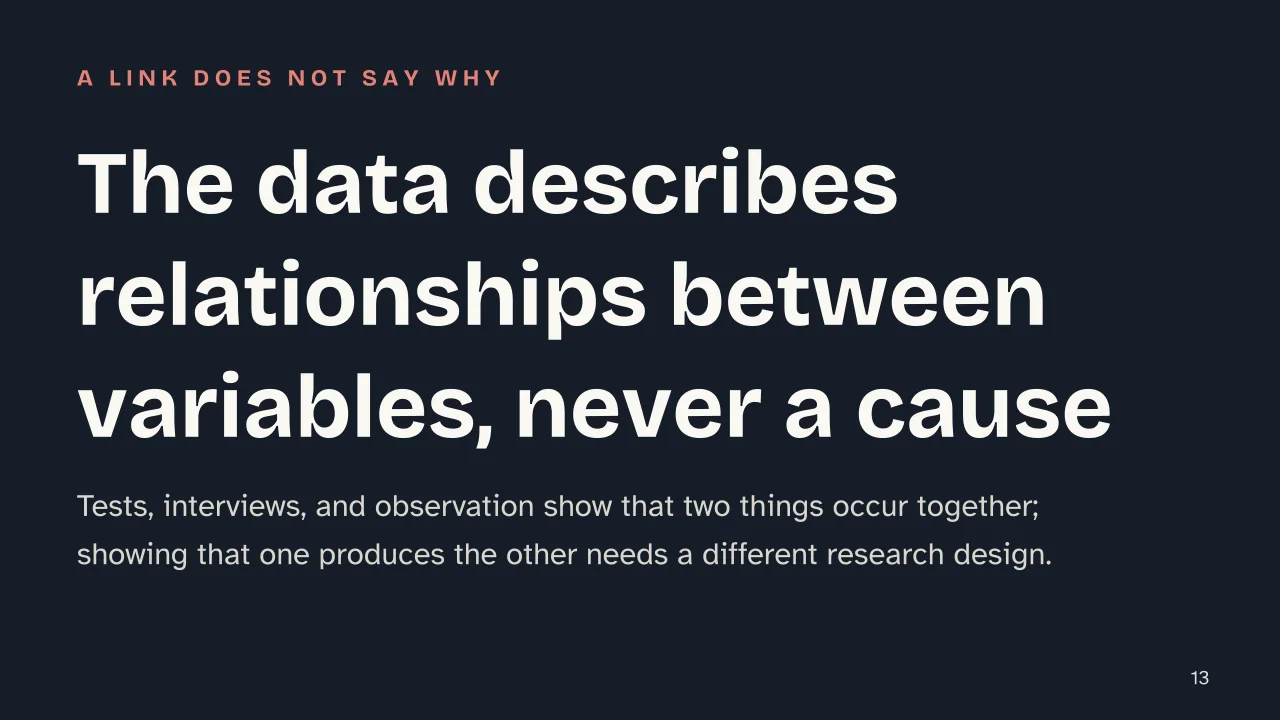
    Tests, interviews, and observation share this much: the data they produce can describe relationships between variables, for instance that two things tend to occur together or that a behavior recurs in certain situations. Saying that one causes the other calls for a different research design.

    This holds no matter how well the tool is built. A reliable and valid test gives sturdier results; the same holds when an interview is carefully conducted or when several people confirm the same observation. The question of why a phenomenon happens still remains, in most cases, territory that needs other research tools.

    Slide deck

    Slides ready to download and make your own in PowerPoint or Google Slides, with speaker notes. Pick the Flash cut or the Full one.
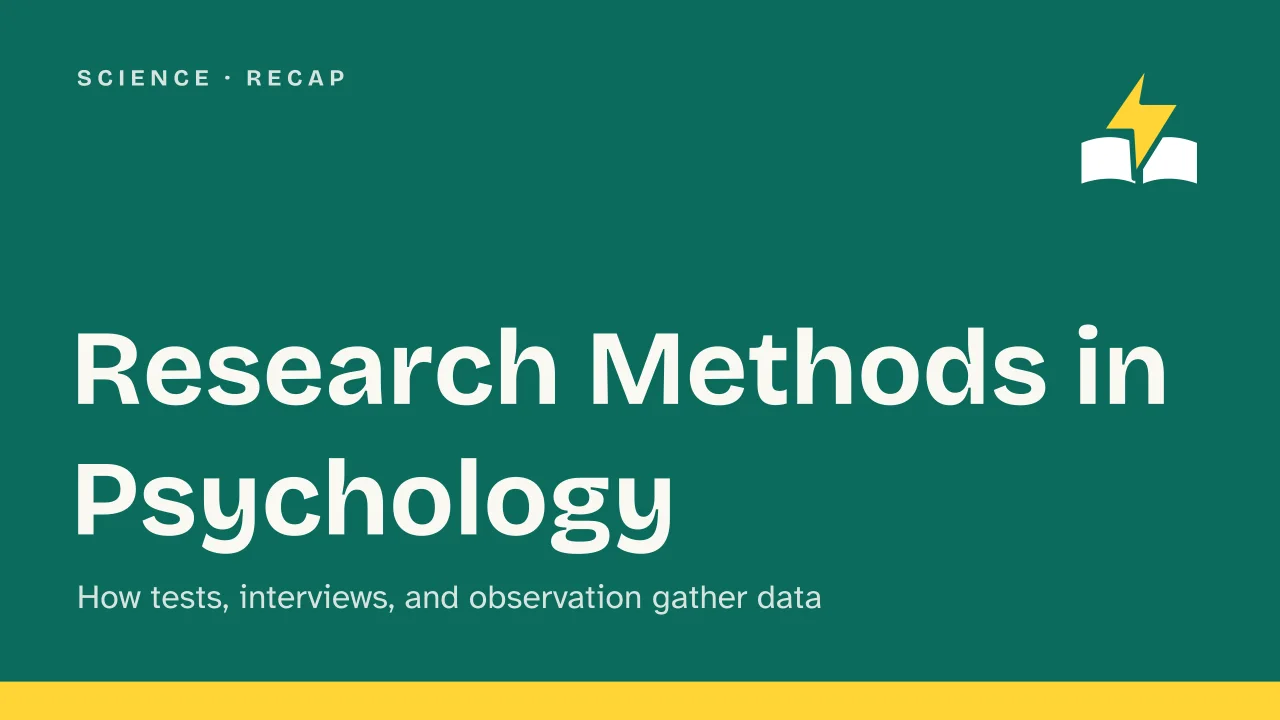
    Slide 1 of the presentation on Research Methods in Psychology: Research Methods in PsychologySlide 2 of the presentation on Research Methods in Psychology: How can you actually measure someone's mind?Slide 3 of the presentation on Research Methods in Psychology: Different tools, one shared limitSlide 4 of the presentation on Research Methods in Psychology: Chapter 01: The testSlide 5 of the presentation on Research Methods in Psychology: Different qualities of the same toolSlide 6 of the presentation on Research Methods in Psychology: Chapter 02: The interviewSlide 7 of the presentation on Research Methods in Psychology: Script · Script · ScriptSlide 8 of the presentation on Research Methods in Psychology: From free conversation to fixed questionnaireSlide 9 of the presentation on Research Methods in Psychology: Chapter 03: ObservationSlide 10 of the presentation on Research Methods in Psychology: How researchers watch behavior: Natural observation, Case study, Multiple observersSlide 11 of the presentation on Research Methods in Psychology: People can change their behavior for the sole reason that they know they are being watchedSlide 12 of the presentation on Research Methods in Psychology: Chapter 04: Reading the resultsSlide 13 of the presentation on Research Methods in Psychology: The data describes relationships between variables, never a causeSlide 14 of the presentation on Research Methods in Psychology: A test gives the same score every time it is repeated: does that also make it a valid test?Slide 15 of the presentation on Research Methods in Psychology: Now for the recap
    Flash10 slidesThe essential thread, to present in classFull15 slidesEvery chapter and the deeper detail

    Common myths

    • ✗ Myth Someone observing a behavior always records it exactly as it happened, without influencing it

      ✓ Reality The observer is part of the situation under study, and that alone can be enough to slightly change what gets noticed or written down. The usual fix is to have several people watch the same scene and then compare their notes, a check known as inter-observer reliability.

    • ✗ Myth Knowing you are being watched does not change how a person behaves

      ✓ Reality In the Hawthorne studies, a group of factory workers' productivity rose every time something in their working conditions changed, whether the change was for the better or the worse: the one constant was the researchers' presence.

    • ✗ Myth If a test always gives the same result, then it must also be a valid test

      ✓ Reality These are two separate checks on a tool: giving the same result every time is about reliability, capturing the right trait is about validity. A test can pass the first check and fail the second.

    Mind map

    Drag the background to move around and the nodes to reposition them; use − and + to collapse and expand branches.
    Customize
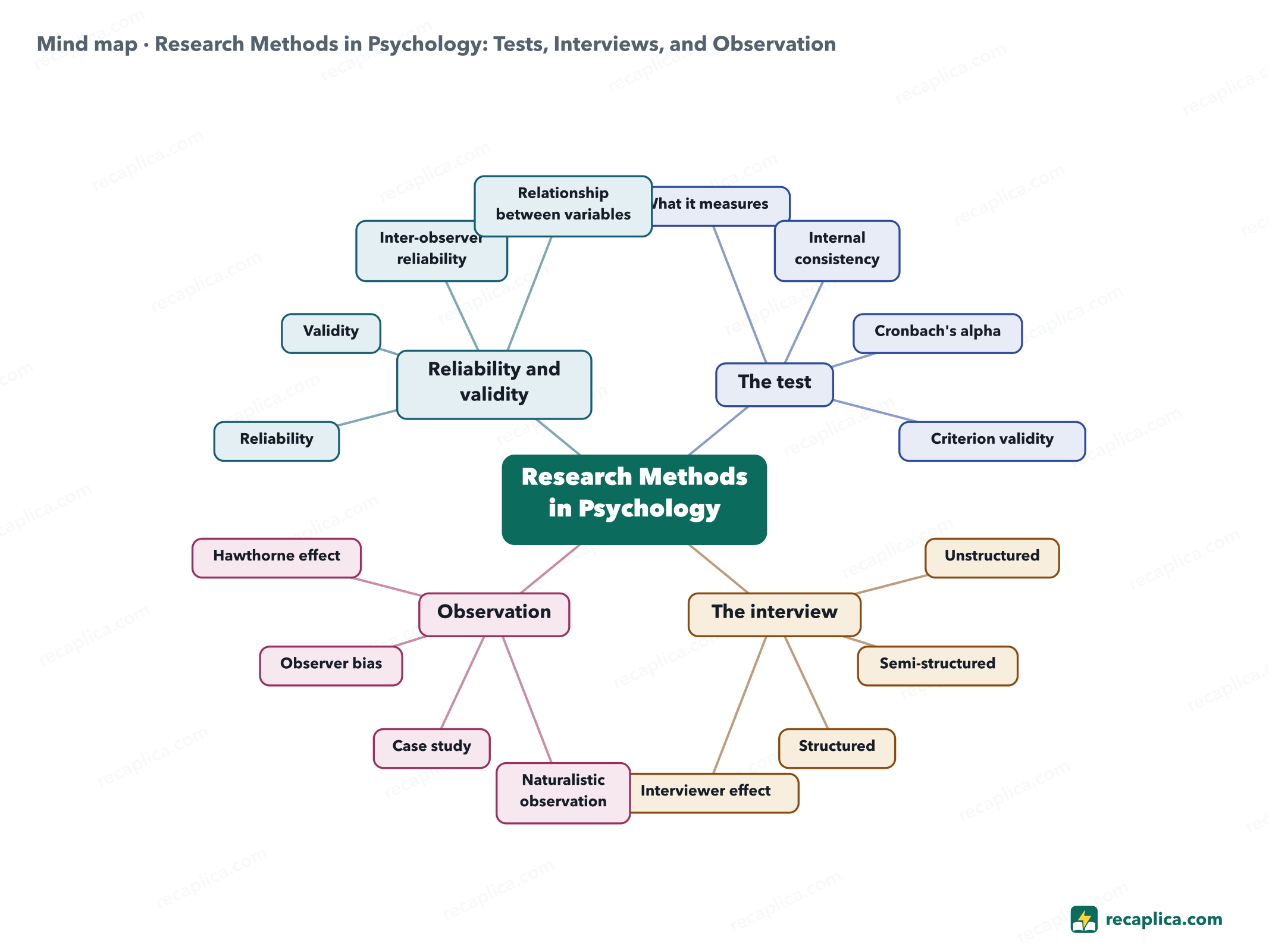
    Mind map: Research Methods in Psychology: Tests, Interviews, and Observation
    • Research Methods in Psychology
      • The test
        • What it measures A psychological trait with questions or tasks identical for everyone
        • Internal consistency How well answers agree across the items of the same test
        • Cronbach's alpha The most used statistic for internal consistency
        • Criterion validity Comparing test scores against other related external measures
      • The interview
        • Unstructured Topics follow the order in which they come up in conversation
        • Semi-structured Topics fixed in advance, questions adapted to the respondent
        • Structured Fixed questionnaire, identical for everyone
        • Interviewer effect The interviewer's manner shapes the answers given
      • Observation
        • Naturalistic observation In the real setting, with no intervention from the researcher
        • Case study One person, or a few, observed in depth
        • Observer bias Observers can unintentionally shape what they record
        • Hawthorne effect Behavior changes just because people know they are being watched
      • Reliability and validity
        • Reliability Consistent results when the measure is repeated
        • Validity Genuinely measures the trait it claims to measure
        • Inter-observer reliability Agreement between different observers of the same event
        • Relationship between variables All three methods describe links between variables observed together

    Quiz: test yourself

    Answer the questions to check what you have learned: you get instant feedback and a short explanation.

    Grade 0/10 0/5
    1 What is the difference between reliability and validity in a psychological test?

    Reliability looks at how consistent results stay over time. Validity asks a different question: whether the score actually matches the real trait the test is meant to capture.

    2 What marks a structured interview?

    It is the most standardized interview format: the questionnaire stays the same from one respondent to the next, while in the other two forms the order or the questions themselves can shift.

    3 True or false: naturalistic observation requires the researcher to step in and change the behavior being observed.

    False: the defining feature of this method is that the observer does not intervene, recording behavior exactly as it unfolds in its real setting.

    4 What does the Hawthorne effect show?

    The Hawthorne studies found that output climbed with nearly every shift in working conditions, including shifts for the worse: the only explanation researchers could settle on was the workers' awareness of being watched.

    5 Why is a case study a limited way to generalize findings to everyone?

    A case study goes deep on one person or a small group: precisely because the sample is so small, the findings mostly hold for the cases actually observed.

    Answers: 1-B · 2-A · 3-B · 4-B · 5-A

    Flashcards

    Tap the card to flip it and check whether you remember the answer, then move to the next one.

    1 / 8

    Explain it in your own words

    The ultimate test: if you can explain it in simple words, you've truly understood it. Write your explanation, then compare it with the Recap.

    Your explanation is saved only on this device.

    Scientific psychology gathers data with three main tools: the test, the interview, and observation. A test measures a trait with standardized questions or tasks, an interview is a conversation guided by a research purpose, and observation records behavior as it happens. Each tool has its own limits: an observer can shape what gets recorded, and two people can read the same interview question in different ways. That is why every tool is also judged on two specific qualities, reliability and validity, and why the data it produces describes relationships between variables rather than their cause.

    Frequently asked questions

    What is the difference between reliability and validity in a psychological test?

    They are two separate properties of the same tool. Reliability is about consistency: repeat the test, and the results stay similar. Validity is about content: whether the score genuinely matches the psychological trait the test claims to measure.

    What is the Hawthorne effect?

    It is the tendency to change behavior simply because you know you are being observed. The name comes from a series of studies run in a factory, where worker productivity rose with almost every change to working conditions, whether those changes made things better or worse.

    What types of interview are used in psychological research?

    They differ in how much freedom the person asking questions has. In a free-flowing conversation, the order of topics emerges on the spot; in a middle ground, the topics are set in advance but the wording adapts to the person answering; in the most rigid version, everyone gets exactly the same questions in the same order.

    Is observation in psychology always an objective method?

    Not entirely. Whoever carries out the observation is involved in the situation being observed, and can unintentionally record events in a slightly different way from how they actually unfolded. That is why several observers watch the same event and researchers then check how closely their notes agree: this is inter-observer reliability.

    Can a test, an interview, or an observation prove that one thing causes another?

    No. These three methods show links between variables that occur together. Establishing why a link exists requires a research design built specifically to isolate it.

    Sources

    • Psychology 2e (OpenStax), 2.3 Approaches to Research
    • Intervista, Enciclopedia delle Scienze Sociali (Treccani)
    • Research Methods in Psychology, 4.3 Reliability and Validity of Measurement
    • Hawthorne Effect In Psychology: Experimental Studies (Simply Psychology)

    Every Recap goes through an independent review before publication.

    Every evening, the day's new Recaps on our Telegram channel. Join the channel →

    Keep learning

    • Science Correlation: What It Means and How to Read the Coefficient Correlation measures how closely two variables move together, and the most common way to put a number on it is the correlation coefficient, which runs from -1 to +1. A value near +1 means the two variables rise together, near -1 means one rises while the other falls, and near 0 means no linear relationship stands out. The coefficient only captures the strength of a straight-line relationship, and a single unusual data point can push it up or down by a lot. Even when it's strong, a correlation between two variables never shows that one causes the other. Read the Recap →
    • Science Light Refraction: What It Is, the Laws Behind It, and Examples A surface that separates two transparent materials sends some light back, reflecting it, and lets the rest through while bending it toward a new direction. The law of reflection keeps the incoming and outgoing angles equal, both measured from the normal to the surface. Snell's law governs refraction instead, linking the index of each material to how much the ray tilts before and after it crosses over. These two laws alone explain mirrors, lenses, prisms and everyday sights such as a pencil that appears to snap inside a glass of water. Read the Recap →
    • Science Total Internal Reflection and the Critical Angle: Definition and Formula Total internal reflection is what happens when a light ray stops being able to leave a transparent medium and gets sent back inside it completely. It takes place past a specific angle of incidence, called the critical angle, calculated with Snell's law by comparing the refractive indices of the two materials involved. It only happens under one precise condition: the ray must be traveling from an optically denser medium into a less dense one, such as from water into air or from glass into air. Optical fibers and, in part, the sparkle of diamonds rely on this same principle. Read the Recap →

    recaplica

    Clear in 30 seconds, yours in 10 minutes.

    Recaps Mind maps Request a Recap Telegram channel Mind map maker Our method About Privacy & cookies Legal notes & terms of use

    © 2026 Recaplica · A project by Curi S.r.l. — VAT IT05472000750

    Statistics, only if you say so

    To learn which Recaps help most we would use Google Analytics, with aggregate, anonymous data. It starts only with your OK, and you can change your mind anytime. Privacy policy