|
recaplica
Sigmund Freud and the Birth of Psychoanalysis |
| © 2026 Recaplica · recaplica.com — All rights reserved |
Sigmund Freud and the Birth of PsychoanalysisWhat to print Page numbers appear when printing with default margins. SlidesChoose a cut Flash10 slidesThe essential thread, to present in classFull15 slidesEvery chapter and the deeper detailBoth come with speaker notes. In 30 seconds quick readSigmund Freud was born in 1856 and died in 1939; he enrolled at the University of Vienna's medical school in 1873 and graduated in 1881. Psychoanalysis grew out of his collaboration with Josef Breuer and the clinical case of Anna O., the patient Breuer treated starting in late 1880, who coined the term "talking cure" for the method herself. From that clinical experience, the two men co-published Studies on Hysteria in 1895, setting out for the first time the cathartic method and the idea that neuroses stem from traumatic experiences. Freud went on to develop the method of free association, which he believed followed a logic similar to the one at work in dream interpretation, the subject of his best-known book, published in 1900. His relationship with the Swiss psychiatrist Carl Gustav Jung, which began in 1906, broke down in 1913, driven above all by their disagreement over the role of sexuality in the theory of the libido. Key Points
Deep DiveAn arm that will not obey commands, a cough that will not clear, a vision problem with no visible cause: in late-19th-century Vienna, medicine had little to offer against symptoms like these. It was a clinical case followed by Freud’s older colleague, Josef Breuer, that gave shape to the method from which psychoanalysis eventually grew. From medical school to meeting BreuerSigmund Freud was born in 1856 and died in 1939. During his training, he enrolled at the Vienna medical school in 1873 and graduated in 1881. According to the Internet Encyclopedia of Philosophy, Freud worked out the first theories of psychoanalysis in close collaboration with Josef Breuer. The case of Anna O. and the cathartic methodBreuer’s treatment of Anna O., the name under which Bertha Pappenheim became known, began near the end of November 1880; a later and critical phase ran from December 1881 to June 1882. Among the symptoms of her condition were a nervous cough, a squint, partial paralysis, visual disturbances, and loss of sensation in her right arm, with shifting states of consciousness over the course of the illness. It was Anna O. herself, according to Encyclopedia.com, who named this early method the “talking cure.” She also jokingly called it “chimney sweeping.”
Anna O.’s real identity was only made public in 1953, by the biographer Ernest Jones in his biography of Freud. For more than seventy years, the most cited clinical case in early psychoanalysis had carried only a single initial. From Breuer to Studies on HysteriaBreuer described his treatment method to his younger colleague Freud on two occasions, on 18 November 1882 and again in July 1883. According to Encyclopedia.com, psychoanalysis has its roots in the cathartic method Breuer developed. Working together, Freud and Breuer arrived at the idea that many neuroses originate in deeply traumatic experiences: a clinical hypothesis, grounded in the observation of real patients more than in philosophical reflection. A precise written record of that work survives in Studies on Hysteria, published jointly by Freud and Breuer in 1895: it is there that the cathartic method first takes classic shape, with the case of Anna O. as the book’s first clinical example. From hypnosis to free associationFreud’s clinical path began with the use of hypnosis, in the early years of psychoanalysis, and led to what became his “golden rule”: the method of free association. Freud argued that even behavior that looks irrational or unconscious deserves to be treated as something with a traceable cause, rather than dismissed as meaningless. The idea already had an echo in philosophy before Freud: Schopenhauer had described a blind, pre-rational will underlying human experience, though his framework was wholly philosophical, far removed from the clinical one Freud would build. Within the logic of free association, Freud found the same principle he would later apply to dream interpretation. In 1900 he published The Interpretation of Dreams: its specific mechanics deserve a separate treatment, in the Recap on Freud’s Interpretation of Dreams, and here the book stands only as the destination of the clinical path that began with Breuer. Freud welcomed followers such as Alfred Adler and Carl Gustav Jung, and the disappointment came only later, once both went on to build currents of thought distinct from his own. Vienna, across those same decades, remained a workshop of ideas about science and rationality that would also produce the Vienna Circle, a project of a different kind of rigor born out of the same cultural setting. Meeting Jung, and the breakIn 1906 the Swiss psychiatrist Carl Gustav Jung received a collection of essays from Freud: their first contact. Freud and Jung met in person for the first time in Vienna in 1907, and their first conversation lasted more than 13 hours. Despite shared interests and mutual respect, the relationship between Freud and Jung broke down abruptly in 1913. Many of the collaborators who drifted away from Freud did so, according to this source, chiefly over a disagreement about sexuality, and Jung followed the same pattern: from the start he doubted that sexuality was the sole source of psychic energy, the libido, and came to think of it instead as a broader psychic energy. Freud, for his part, traced phenomena such as religiosity and the occult back to the sexual libido as well. The theoretical rift between the two was already widening by 1912; after a congress in Munich in 1913, Freud and Jung rarely spoke again. The dispute over the libido remained the main strand behind the break, though not the only one. Slide deckSlides ready to download and make your own in PowerPoint or Google Slides, with speaker notes. Pick the Flash cut or the Full one.     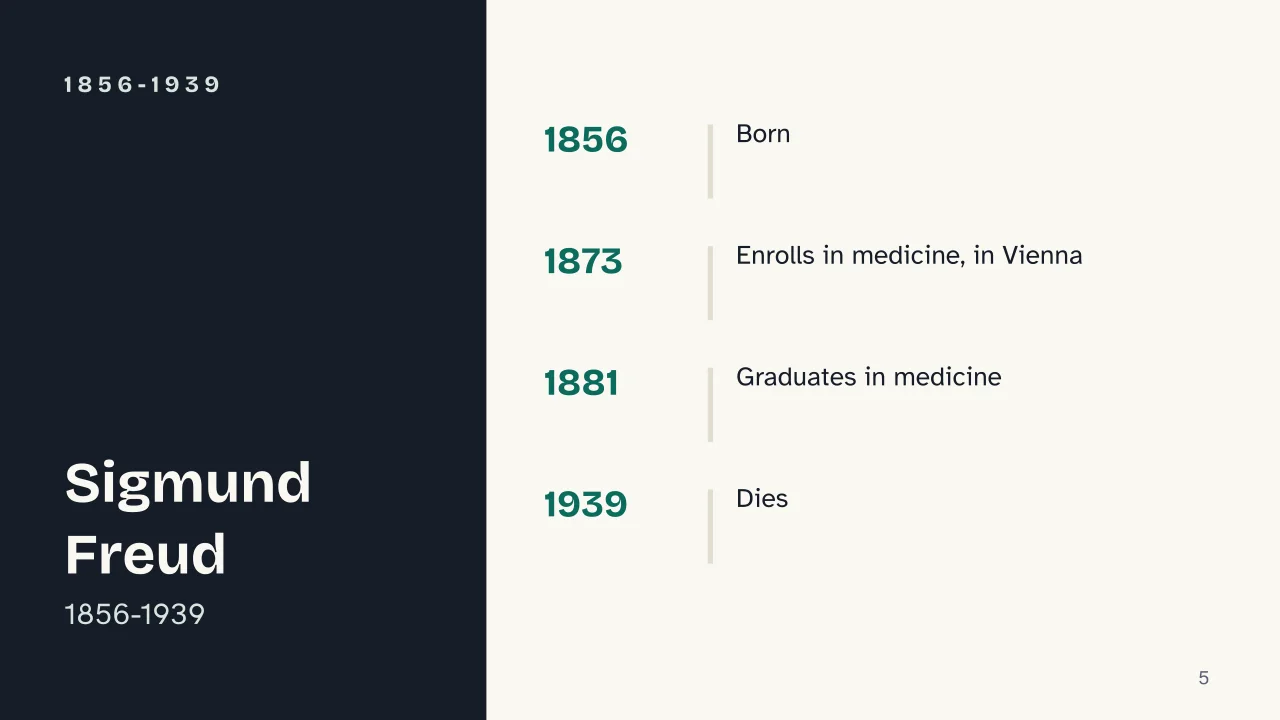  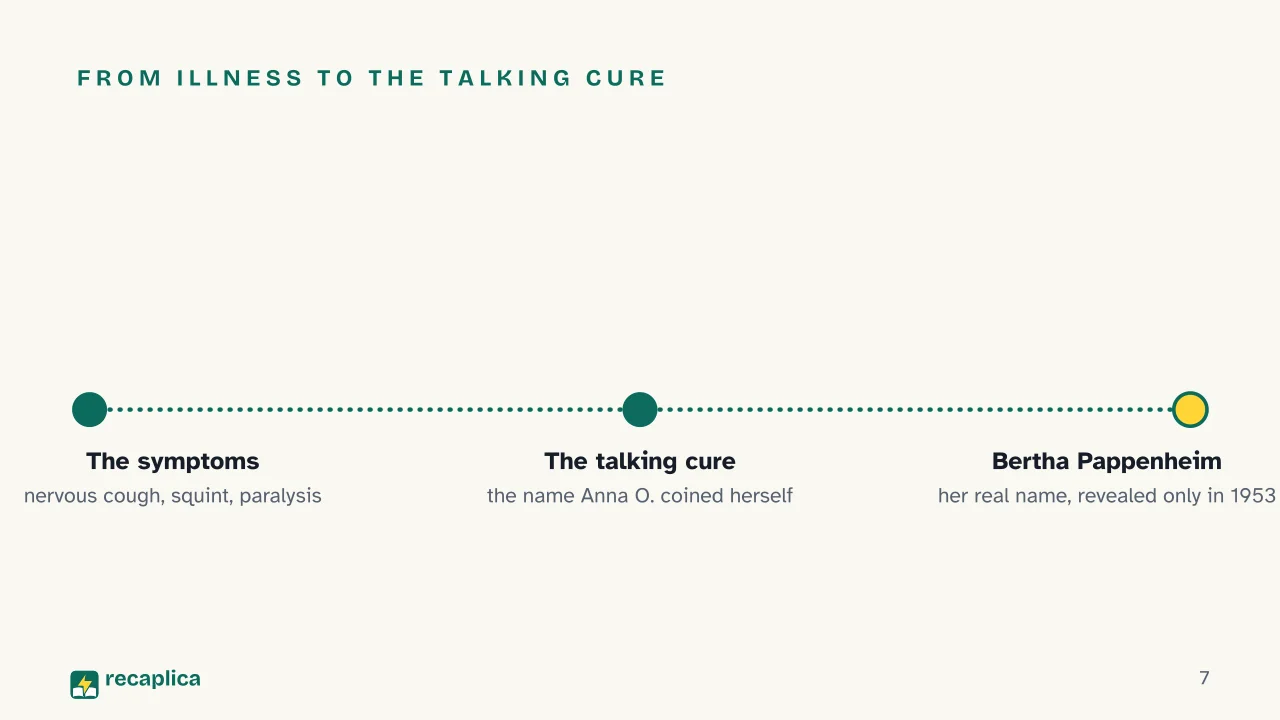 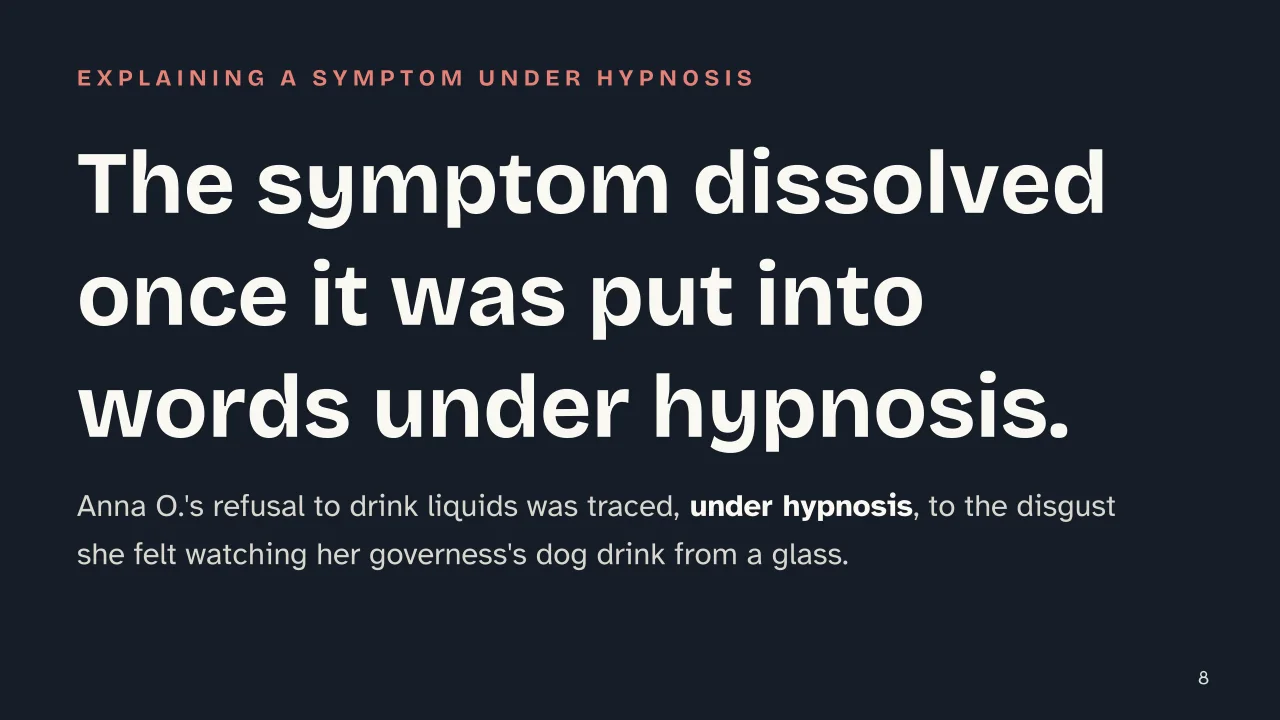  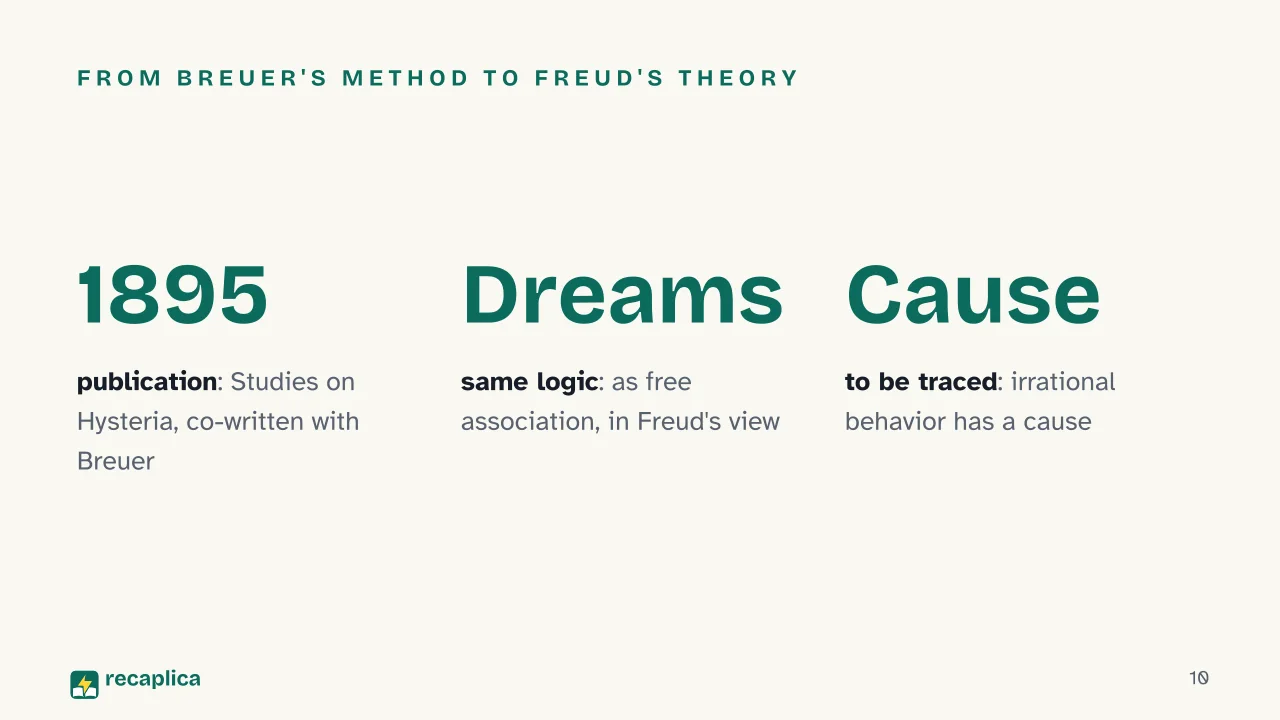  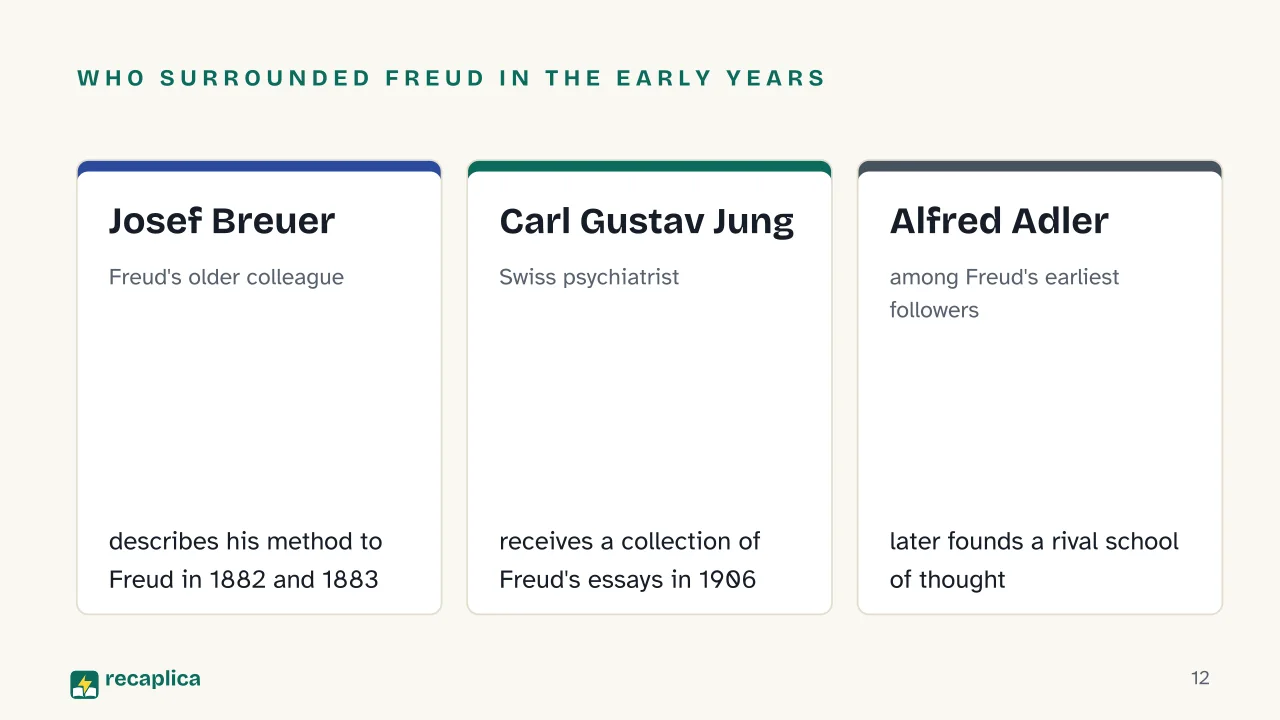 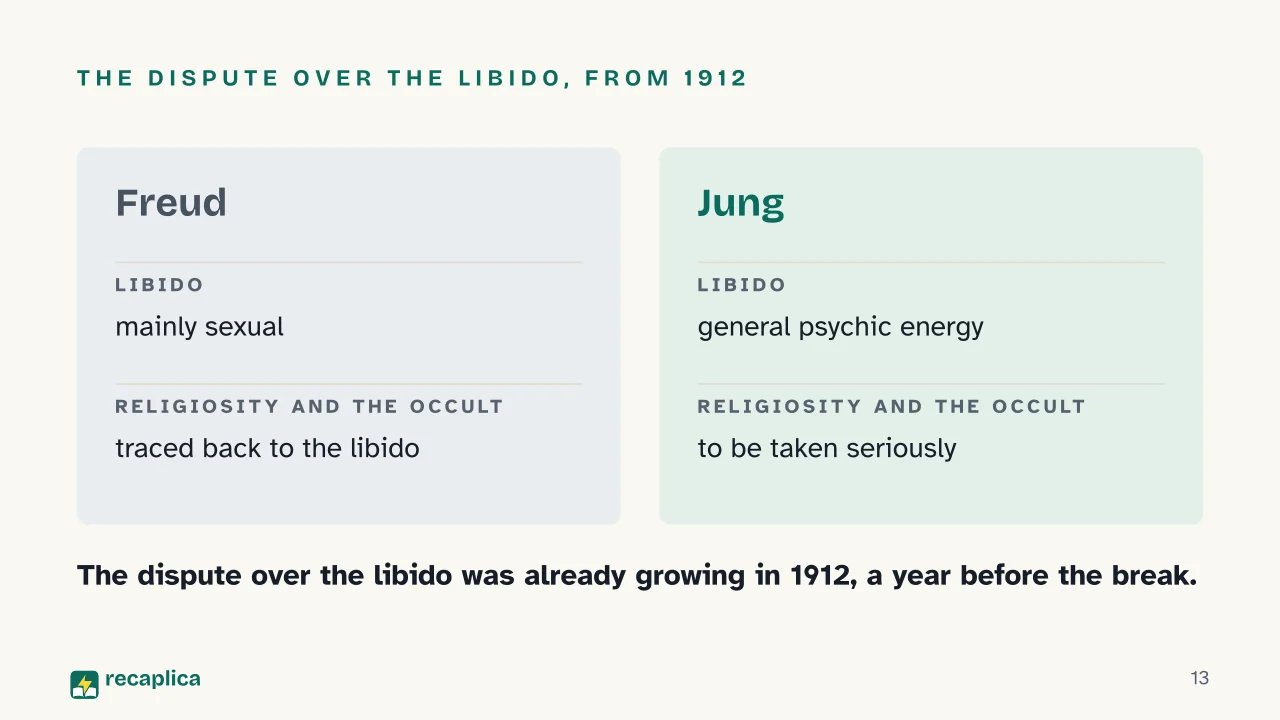 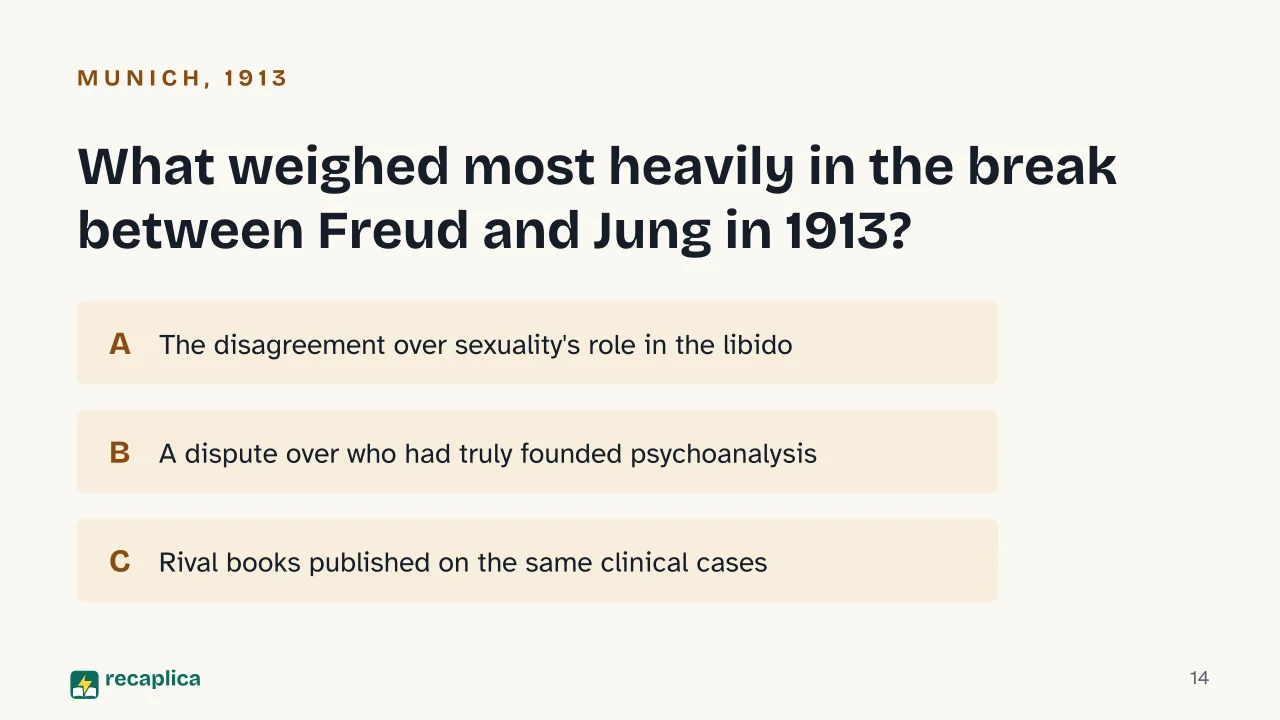  Common myths
Mind mapDrag the background to move around and the nodes to reposition them; use − and + to collapse and expand branches. 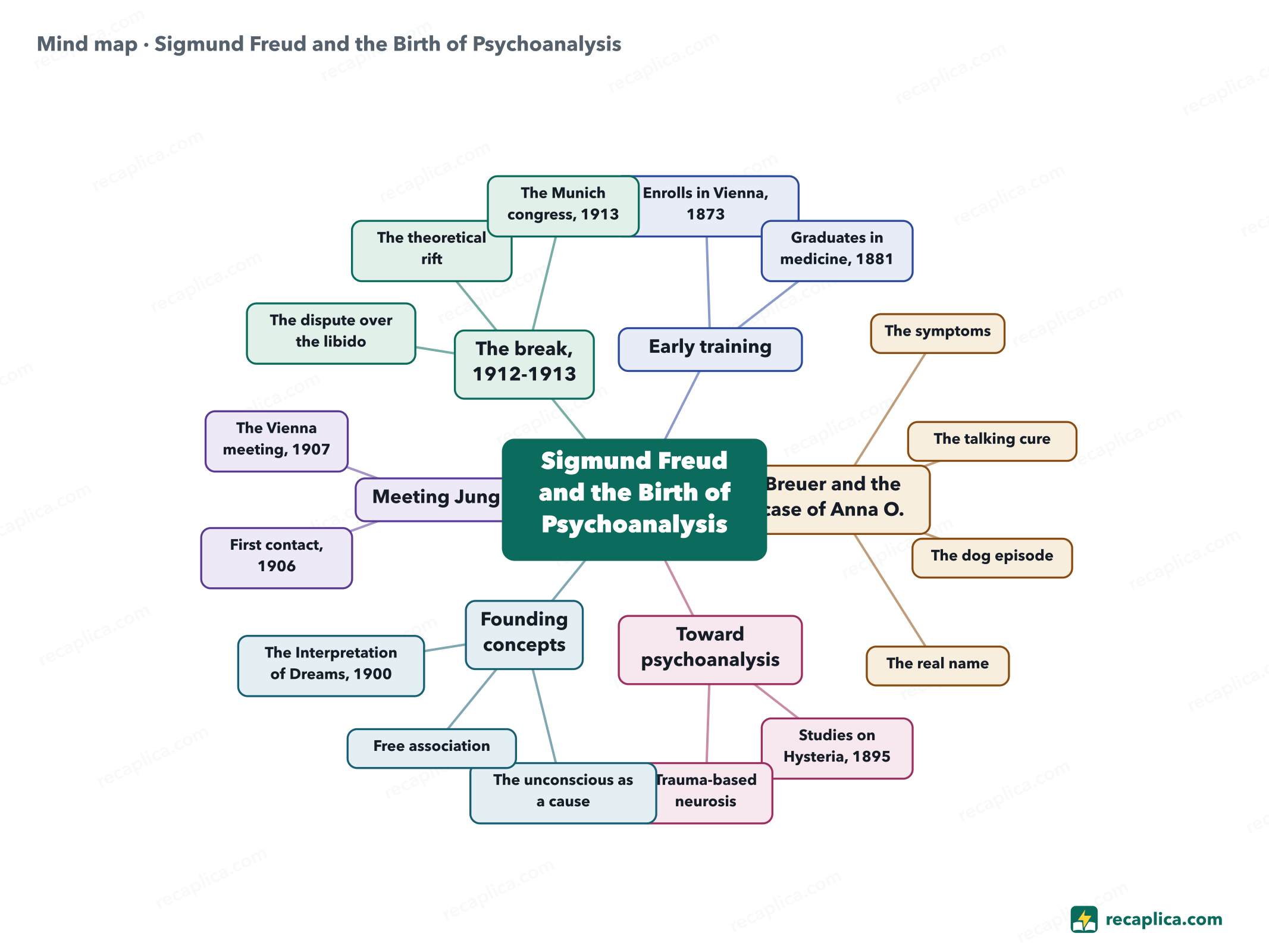
Quiz: test yourselfAnswer the questions to check what you have learned: you get instant feedback and a short explanation. Grade 0/10 0/5
FlashcardsTap the card to flip it and check whether you remember the answer, then move to the next one. 1 / 7 Explain it in your own wordsThe ultimate test: if you can explain it in simple words, you've truly understood it. Write your explanation, then compare it with the Recap. Your explanation is saved only on this device.
Frequently asked questionsWho was Anna O., really?She was Bertha Pappenheim, a patient of Josef Breuer, not of Freud. Her real name stayed hidden until 1953, when the biographer Ernest Jones revealed it in his biography of Freud. Who discovered the method behind psychoanalysis first?Psychoanalysis has its roots in the cathartic method devised by Josef Breuer, who described it to the younger Freud in 1882 and 1883. It was out of that collaboration, formalized in Studies on Hysteria in 1895, that Freud went on to build psychoanalytic theory. What is Freud's method of free association?The clinical method with which Freud replaced the hypnosis used in the early years of psychoanalysis: the patient reports whatever comes to mind without filtering it, following, in Freud's view, a logic similar to the one at work in dream interpretation. Why did the relationship between Freud and Jung break down?The main dispute concerned the libido: Jung doubted sexuality was its sole source and proposed reading it as general psychic energy, while Freud saw religiosity and the occult as further expressions of that same libido. The rift was already widening by 1912, and after a congress in Munich in 1913, the two men rarely spoke again. What is Freud's The Interpretation of Dreams?The book Freud published in 1900, generally regarded as his most important work. It arrived five years after Studies on Hysteria, as a further development of the clinical method born with Breuer. Every Recap goes through an independent review before publication. |