|
recaplica
Zeno's Conscience (Confessions of Zeno): Summary and Analysis | ||||||||||||||||||||||||||||
| © 2026 Recaplica · recaplica.com — All rights reserved | ||||||||||||||||||||||||||||
Zeno's Conscience (Confessions of Zeno): Summary and AnalysisWhat to print Page numbers appear when printing with default margins. SlidesChoose a cut Flash10 slidesThe essential thread, to present in classFull17 slidesEvery chapter and the deeper detailBoth come with speaker notes. In 30 seconds quick readZeno's Conscience is the novel Italo Svevo published in 1923, the third and last of his major novels after A Life (1892) and As a Man Grows Older (1898). The book takes the shape of a memoir that Zeno Cosini writes at his psychoanalyst's urging, working through his life not in chronological order but chapter by chapter, each one built around a separate theme: smoking, his father's death, his marriage to Augusta, an affair with his lover Carla, and a business partnership with his brother-in-law Guido Speier. Zeno's account can't be taken at face value, since it passes through his own subjective memory and self-deceptions he never intended. Svevo paid to publish the book himself, and it barely sold in Italy at first; it found an audience only years later, after his friend James Joyce brought it to the attention of two French critics. Key Points
Deep DiveFrom Ettore Schmitz to Italo SvevoItalo Svevo is the pen name of Ettore Schmitz, born in Trieste in 1861 to a German-Jewish merchant and an Italian mother. He studied business in Bavaria and in Trieste, where he worked first at a bank and later ran the Veneziani company, a maker of underwater paint: for most of his life, writing stayed a second job, done after hours. His work carries a declared autobiographical streak, in prose Treccani calls anti-literary: Svevo mixes Triestine dialect and German into his pages, and builds his novels around interior monologue, a technique that places him close to the European novel of analysis. In 1907 he hired James Joyce, newly arrived in Trieste, as a private English tutor; the two became friends, and Joyce let him read still-unpublished pages of Dubliners. It was after that meeting that Svevo, tentatively, took up writing again. Before Zeno’s Conscience he had already published two novels, both met with little success: A Life in 1892, in which the protagonist Alfonso Nitti, a bank clerk, is driven to suicide less by the world’s hostility than by his own ineptitude, and As a Man Grows Older in 1898, where Emilio Brentani, a failed man of letters, comes out defeated by love and slides into an early spiritual decline. After As a Man Grows Older, Svevo spent over twenty years on business alone. The Plot of Zeno’s Conscience, Chapter by ChapterZeno’s Conscience came out in 1923, published at Svevo’s own expense like the novels before it. The book follows episodes from the life of Zeno Cosini, a wealthy man from Trieste, but it doesn’t lay them out on a continuous timeline: it groups them into thematic chapters, each devoted to a different piece of his life. The first, Smoke, retraces his failed resolutions to quit smoking. The Death of My Father brings back the conflict with his father, who slaps him on his deathbed. The Story of My Marriage tells how Zeno, in love with Ada, is turned down by her, briefly turns his attention to Alberta, and ends up marrying Augusta instead — Ada, Augusta, and Alberta are three of the four Malfenti sisters, and Augusta is not a random consolation prize but one of that same foursome. Wife and Mistress follows the secret affair with Carla, carried on despite the marriage to Augusta. The Story of a Business Partnership covers the business collaboration with Guido Speier, Ada’s husband. The final chapter, Psychoanalysis, closes the memoir with Zeno abandoning the treatment and declaring himself cured thanks to the success he has found in business.
The Characters: Zeno, Augusta, Ada, Guido, and CarlaZeno Cosini is the narrator and protagonist: a man Treccani describes as apathetic, lacking a will of his own. He writes his own memoir at his psychoanalyst’s urging, mixing grotesque, paradoxical episodes — starting with his never-resolved relationship with smoking — with an admitted, ordinary mediocrity. Four figures orbit around him. Ada is the first woman Zeno falls for: she turns him down and marries Guido Speier. Augusta, Ada’s sister, becomes Zeno’s wife instead, described as a model wife, practical and attentive to the family’s everyday well-being. Guido Speier, Zeno’s business partner, comes across as confident, handsome, and easygoing — the opposite of Zeno — but turns out more fragile than he seemed. Carla is Zeno’s secret lover; she ends the affair out of mutual guilt.
Zeno, the Unreliable NarratorOne of the most discussed aspects of the novel is the gap between the man who writes and the man who lived through the events: Zeno-the-writer, who composes the memoir for Doctor S., is not the same as Zeno-the-man, who actually went through those events. According to Skuola.net, his story is “filtered through his own memory and his own subjective point of view,” and that is what makes him an unreliable narrator. In the memoir, Zeno tries to justify himself by bending events in his own favor. But his self-deceptions are not intentional: they grow out of “deep and unconscious processes” that build, again according to Skuola.net, a “fictional reality” meant to justify him. It is a form of introspection unlike the confessional lyricism found elsewhere in Italian literature: not verses that probe an openly stated feeling, but the deliberately partial reconstruction of an entire life. Svevo’s Irony and the Sveviano “Inetto”The key to reading that gap, according to Skuola.net, is the irony with which Svevo looks at the world, which lets him question every fixed certainty. Zeno himself comes to see his own “illness” as a form of superior awareness, one he prefers to conforming to bourgeois society. Svevo had rejected the Decadent model associated with D’Annunzio from the start, choosing instead to portray the ordinary man, without qualities: his protagonists — Alfonso Nitti, Emilio Brentani, Zeno Cosini — are anti-heroes marked by inertia and an inability to act. It is the thread that runs through all three novels and has entered literary history as the “sveviano inetto,” the inept man of Svevo’s fiction. The novel came out, moreover, during the period of Marcel Proust’s and James Joyce’s great fame and a growing interest in psychoanalysis, a context that makes Svevo’s choice to build an entire novel around the form of a report for a psychoanalyst less of an outlier. From Two Failed Novels to a Late Discovery
The novel, like the two before it, was published at Svevo’s own expense and did not find success in Italy right away. Joyce changed that: years after publication, he recommended it to two French critics, Valéry Larbaud and Benjamin Crémieux, who championed it and made it famous. That “belated discovery” set off the writer’s critical reputation, in Italy as much as abroad. The novel then kept circulating beyond the printed page: in 1965 it was adapted for the stage, directed by Luigi Squarzina with Alberto Lionello among the cast, and in 2002 the visual artist William Kentridge presented a video titled “Confessions of Zeno,” based on a text by J. Taylor, at the Documenta 11 exhibition. Readers who want to follow the thread of introspection through twentieth-century Italian literature find another turning point, not long after, in the plays of Luigi Pirandello. Slide deckSlides ready to download and make your own in PowerPoint or Google Slides, with speaker notes. Pick the Flash cut or the Full one.   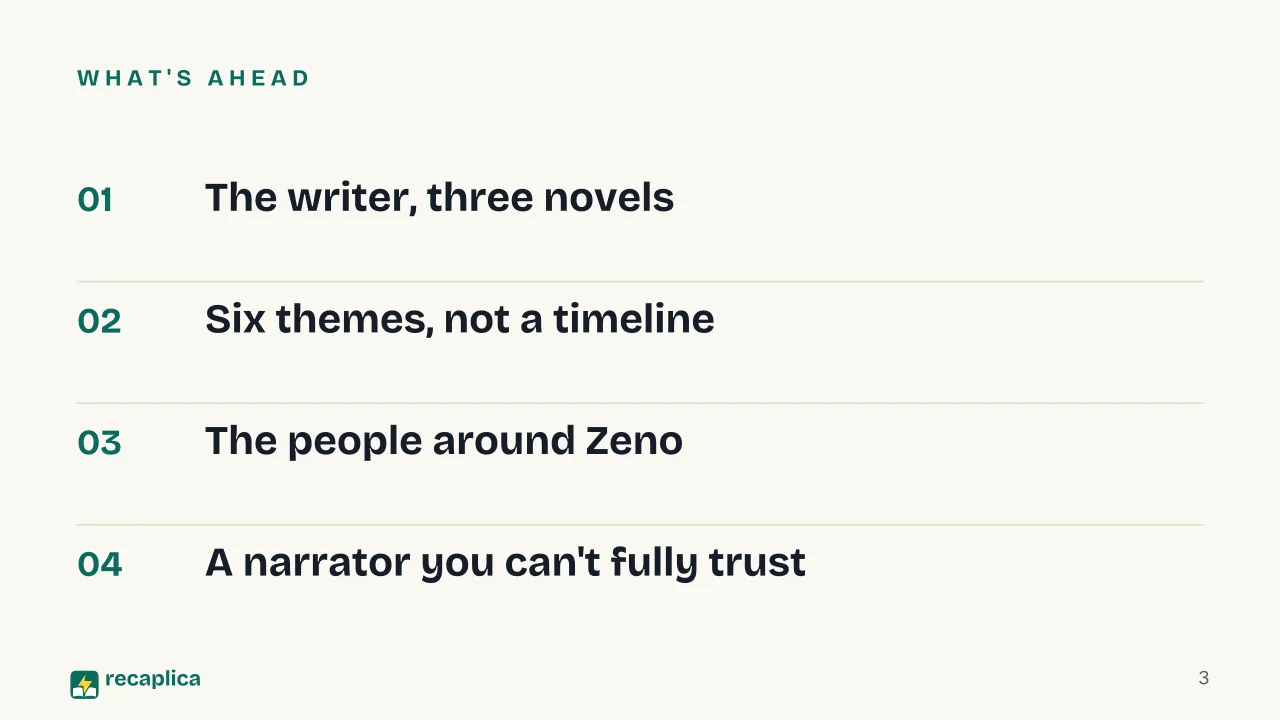  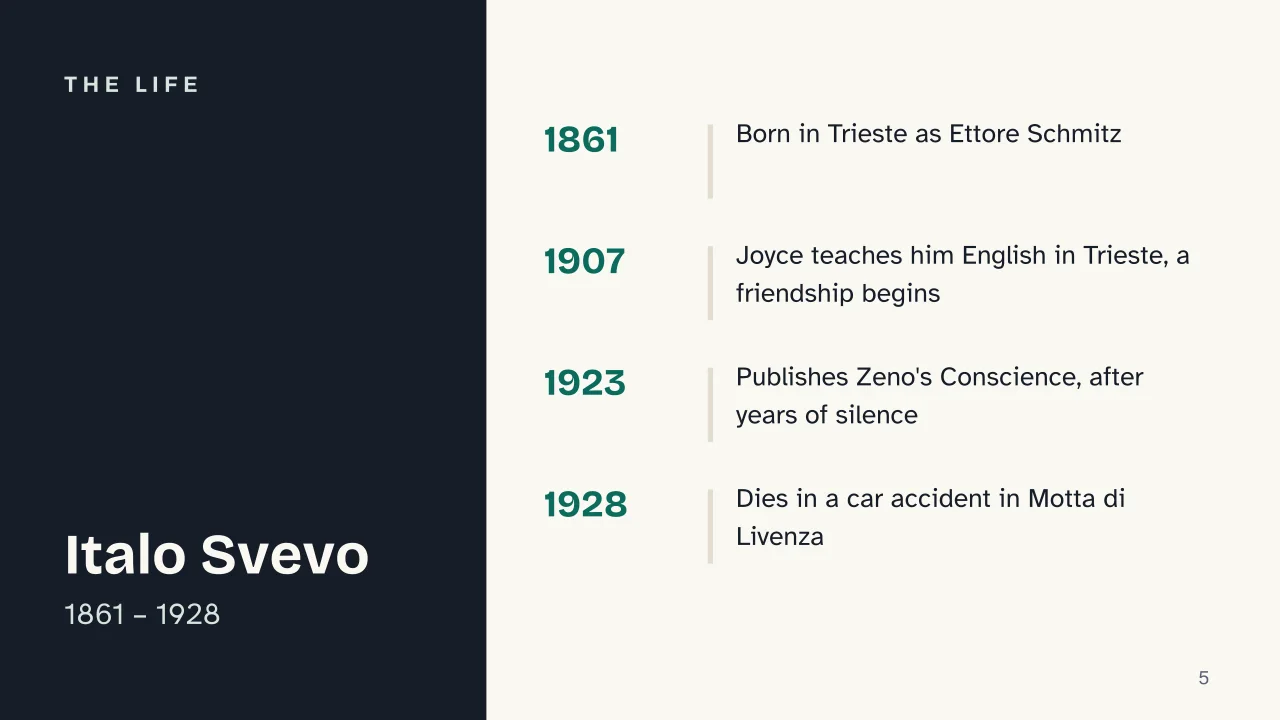 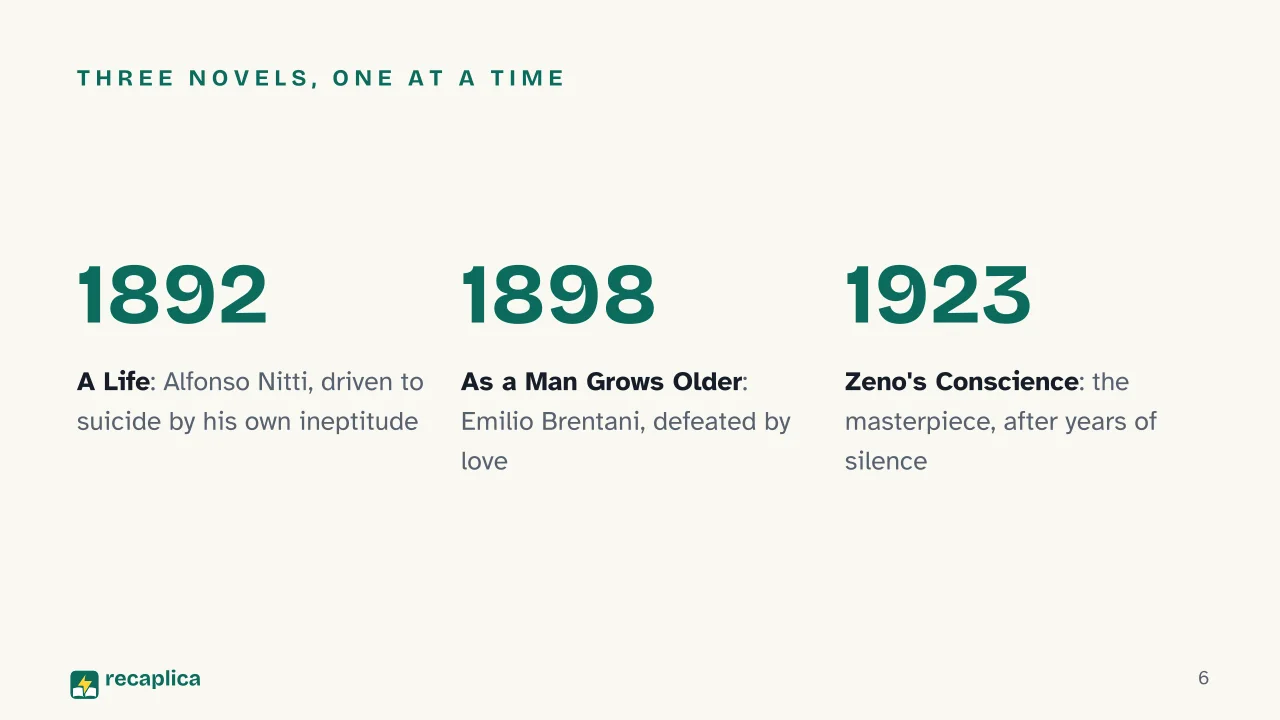  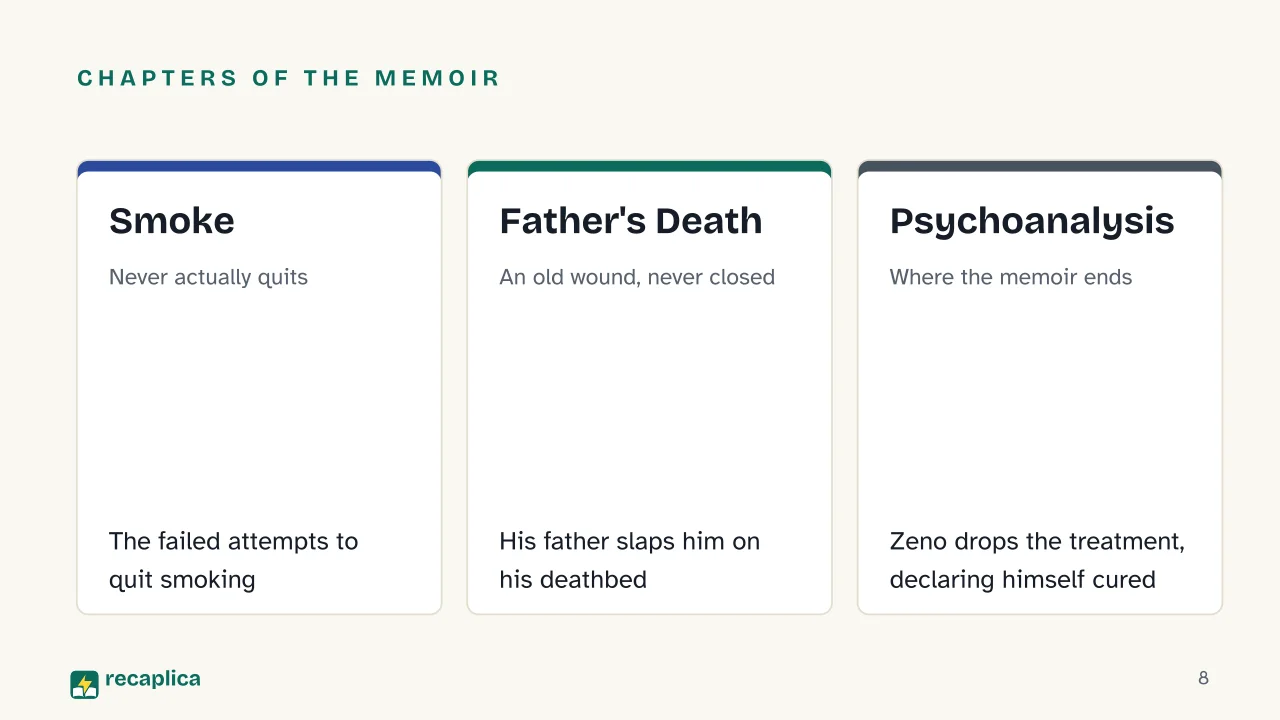 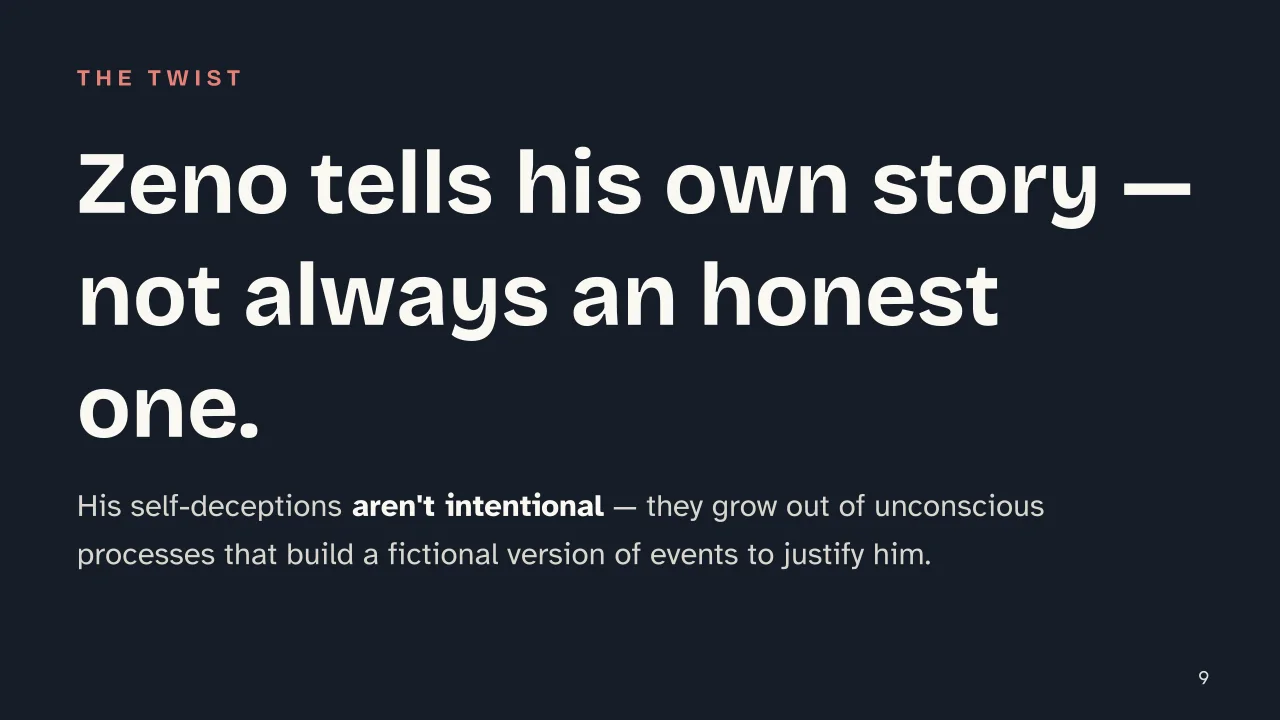  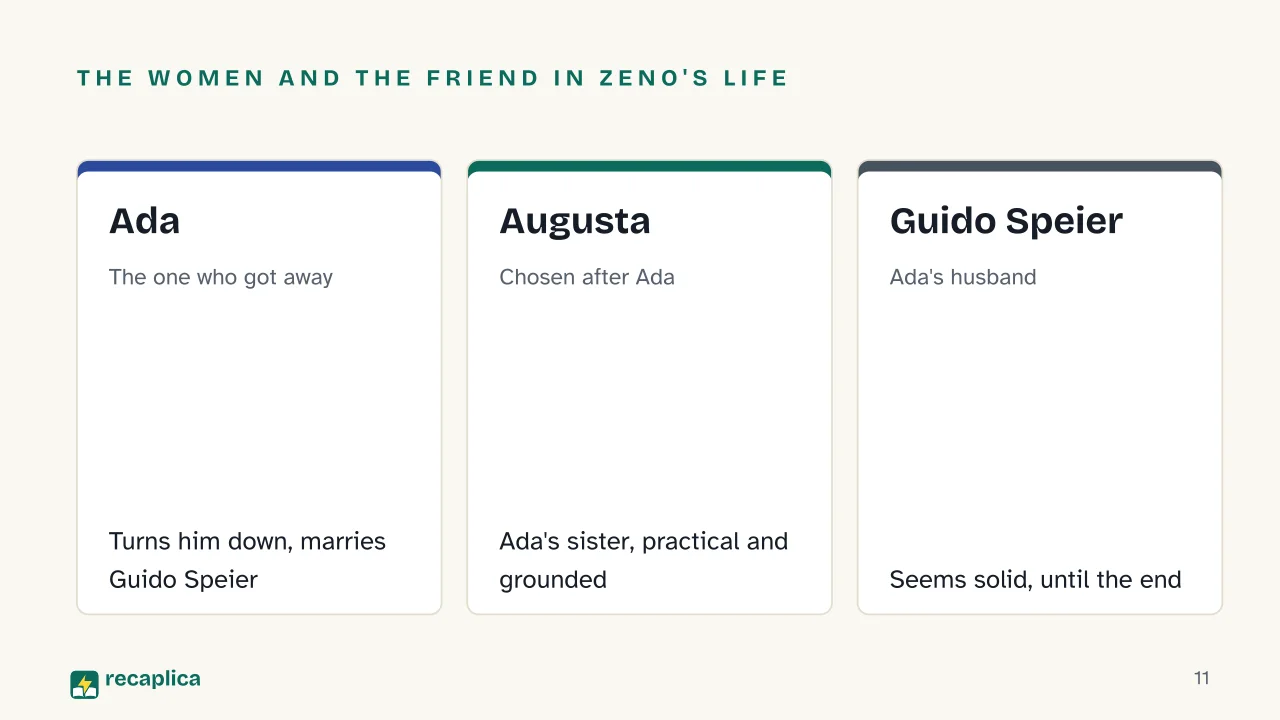 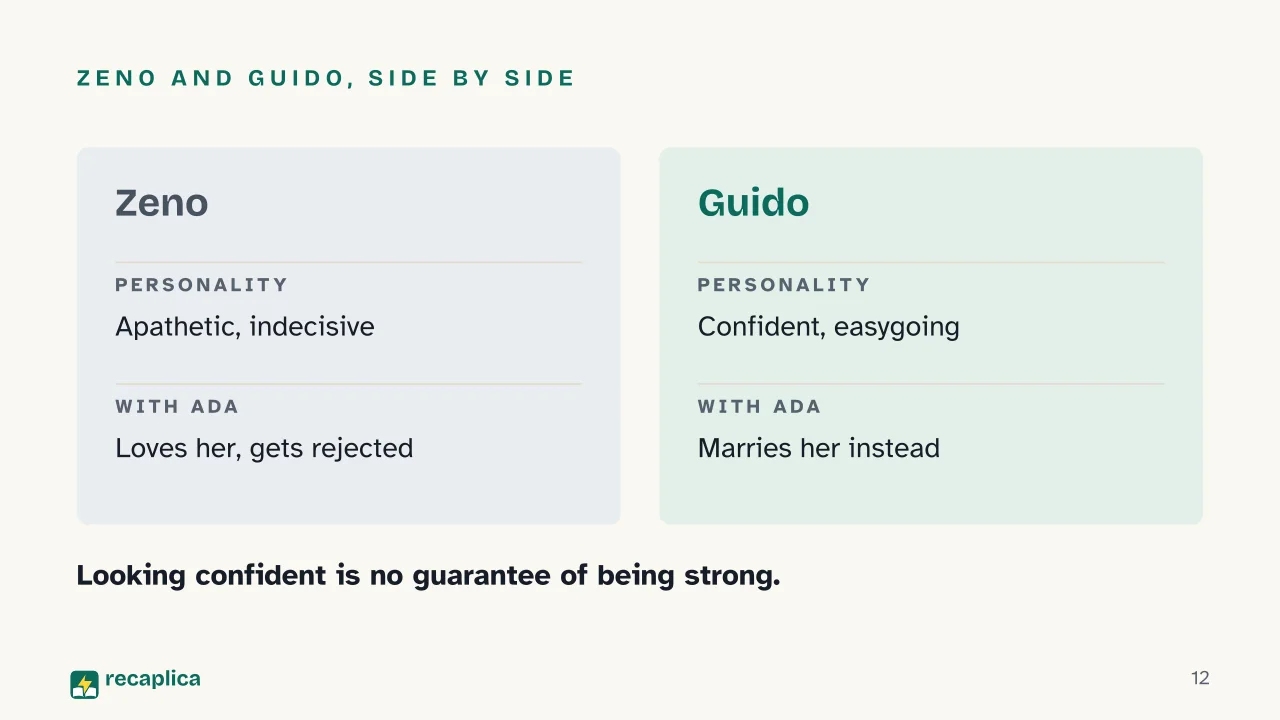  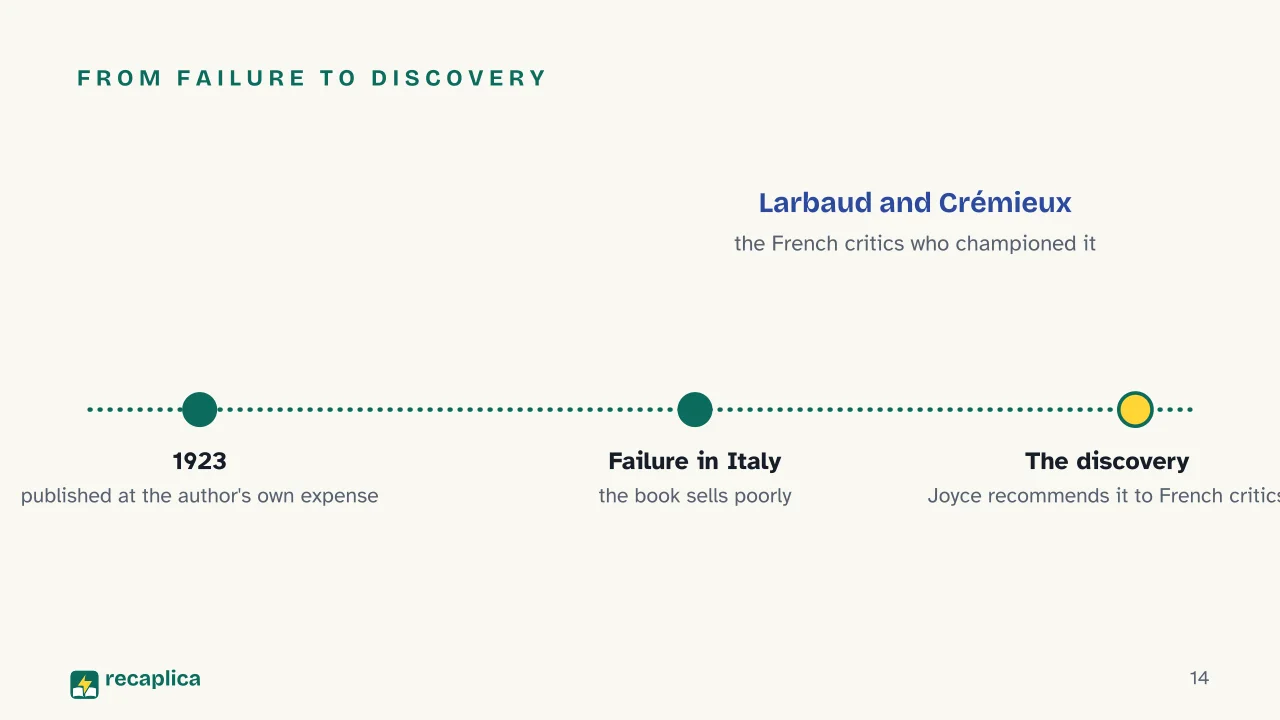 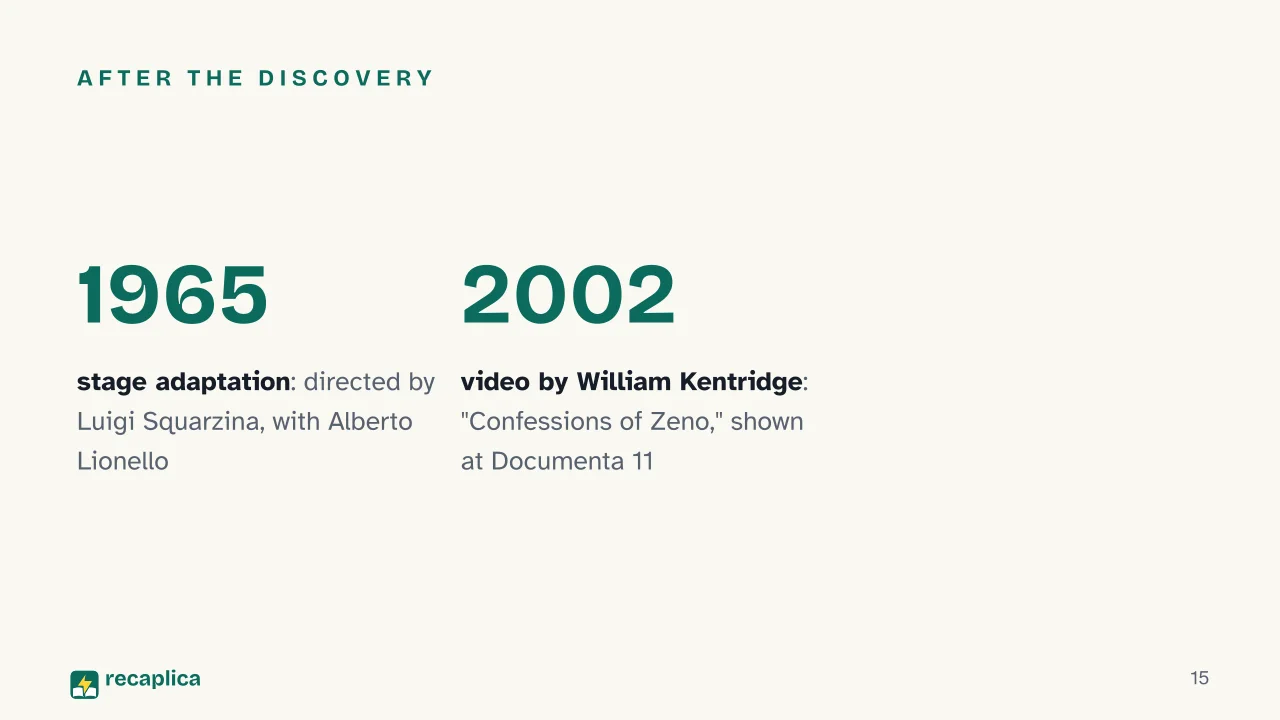 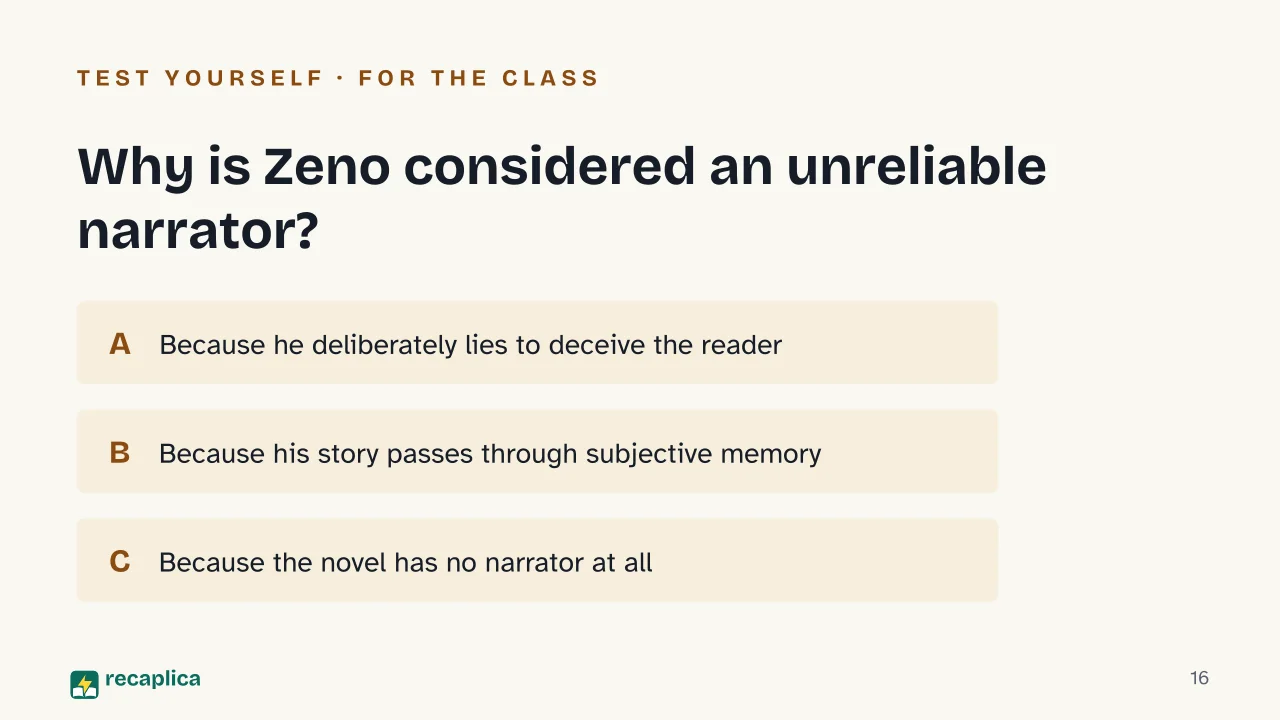  Common myths
Mind mapDrag the background to move around and the nodes to reposition them; use − and + to collapse and expand branches. 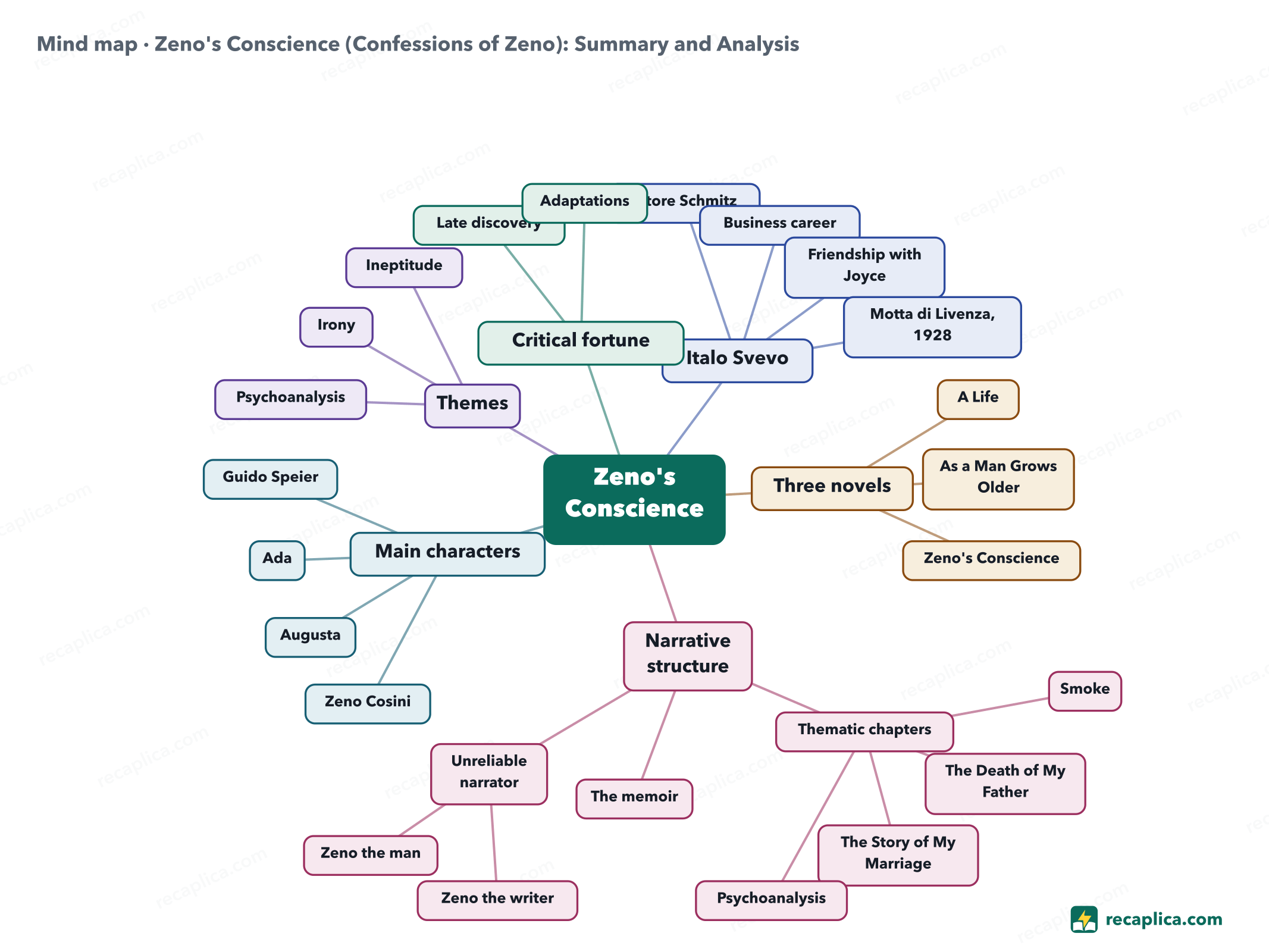
Quiz: test yourselfAnswer the questions to check what you have learned: you get instant feedback and a short explanation. Grade 0/10 0/5
FlashcardsTap the card to flip it and check whether you remember the answer, then move to the next one. 1 / 8 Explain it in your own wordsThe ultimate test: if you can explain it in simple words, you've truly understood it. Write your explanation, then compare it with the Recap. Your explanation is saved only on this device.
Frequently asked questionsWhat is Zeno's Conscience about?It is the memoir Zeno Cosini writes at his psychoanalyst's urging, working back through episodes of his life by theme rather than in chronological order — the smoking habit he never quits, the conflict with his father, his marriage to Augusta after Ada turns him down, a secret affair with his lover Carla, business dealings with his brother-in-law Guido Speier, and the declared end of his psychoanalytic treatment. Who is Zeno Cosini?The protagonist and narrator of the novel, a wealthy man from Trieste whom Treccani describes as "abulic," meaning lacking in will. He recounts his life in an account written for his own psychiatrist, mixing grotesque, paradoxical episodes with an admitted ordinariness. Why is Zeno called an unreliable narrator?Because his account passes through memory and a subjective point of view. According to Skuola.net, his self-deceptions are not intentional; they arise from unconscious processes that bend events in his favor, producing a version of the facts that is convenient rather than accurate. How does Zeno's Conscience differ from Svevo's first two novels?A Life (1892) and As a Man Grows Older (1898) were both met with little success, and after the second Svevo spent over twenty years devoted to business instead of writing. Zeno's Conscience (1923) comes after that long silence and is the novel critics regard as his masterpiece. How was the novel rediscovered after its early failure?Svevo had published it at his own expense and it sold poorly in Italy. Years later his friend James Joyce recommended it to two French critics, Valéry Larbaud and Benjamin Crémieux, who championed it and made its worth known, setting off Svevo's critical reputation. Every Recap goes through an independent review before publication. |