recaplica
Clear in 30 seconds, yours in 10 minutes.
In 30 seconds quick read
Plotinus is the Greek-Egyptian philosopher the tradition credits with founding Neoplatonism. Born in Egypt, by most historians' reckoning in 204 CE, he trained in Alexandria under the teacher Ammonius Saccas, whom he followed for eleven years. After a military expedition into Persia that went wrong, he settled in Rome, where he opened a school and spent more than a quarter of a century teaching, until he died in 270 CE. There he welcomed Porphyry, the student who became his biographer and editor. At the center of his thought stands the One, the principle from which all reality flows by emanation.
Key Points
Plotinus was born in Egypt, by historians' reckoning in 204 CE; the exact place is unknown, and he himself never spoke of it.
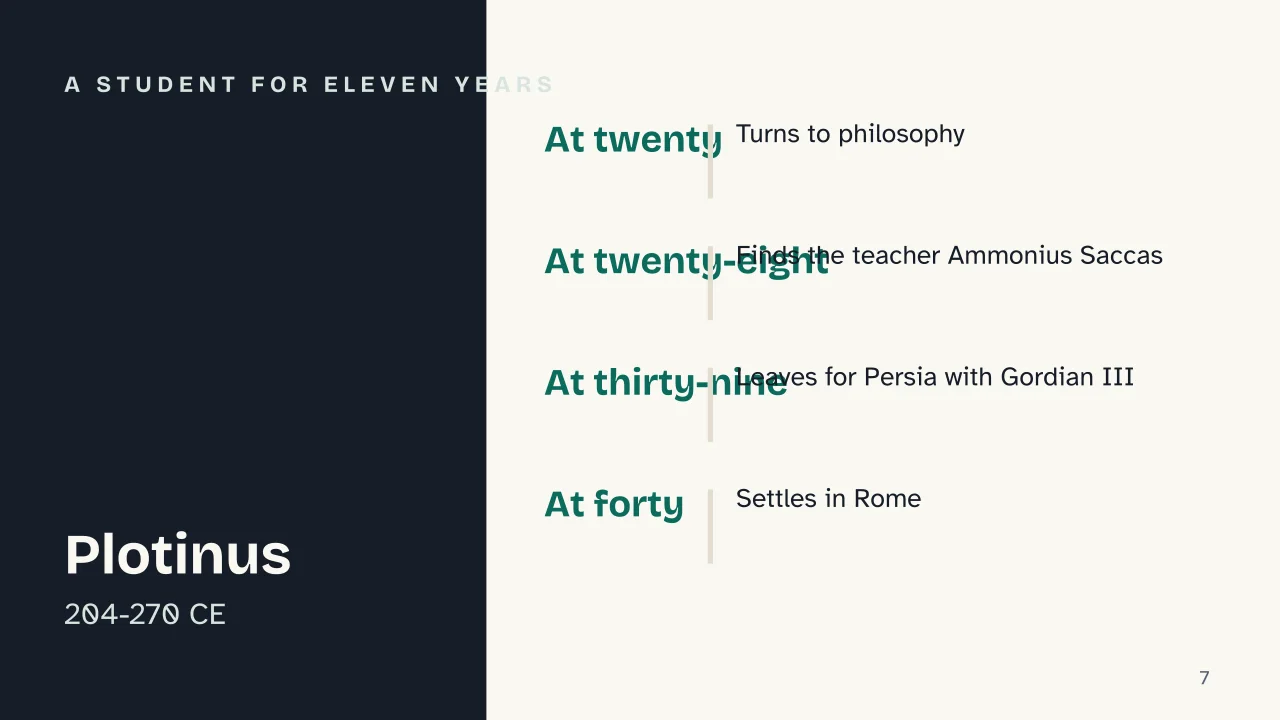
At twenty-eight he began attending Ammonius Saccas' lectures in Alexandria, after turning to philosophy at twenty, and stayed his student for eleven full years.
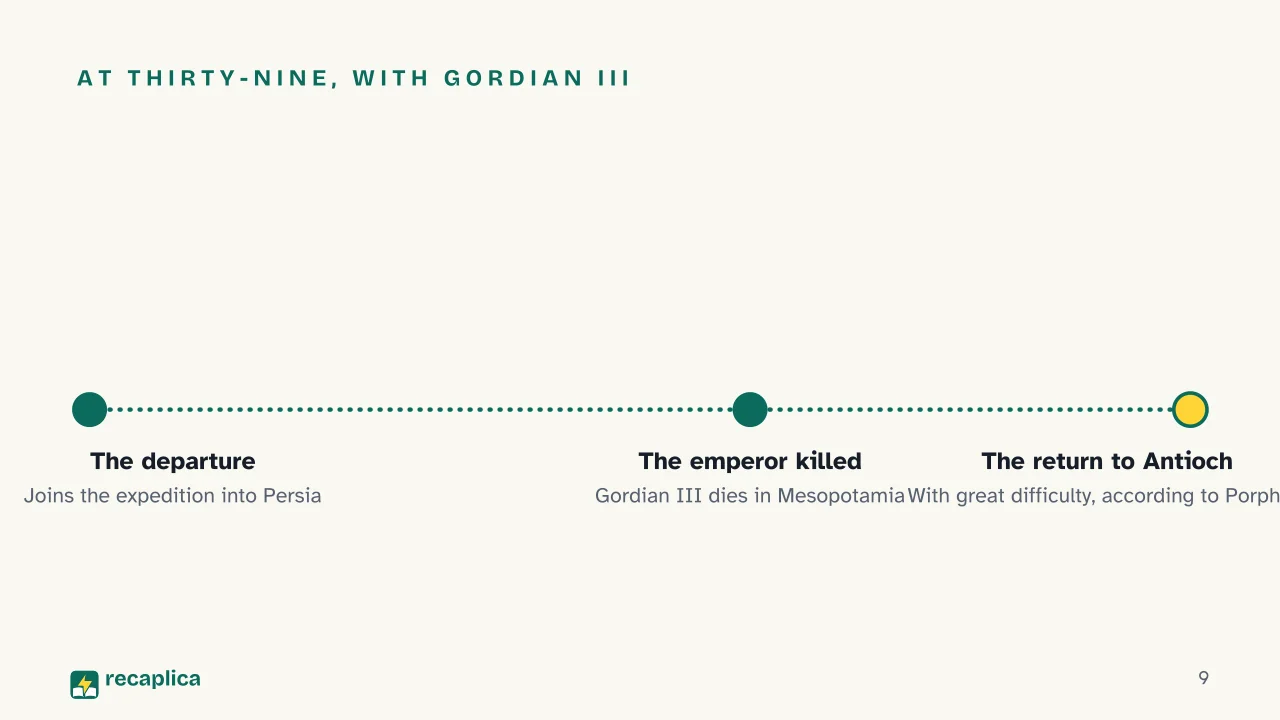
At thirty-nine he joined Emperor Gordian III's expedition into Persia, cut short when the emperor was killed in Mesopotamia.
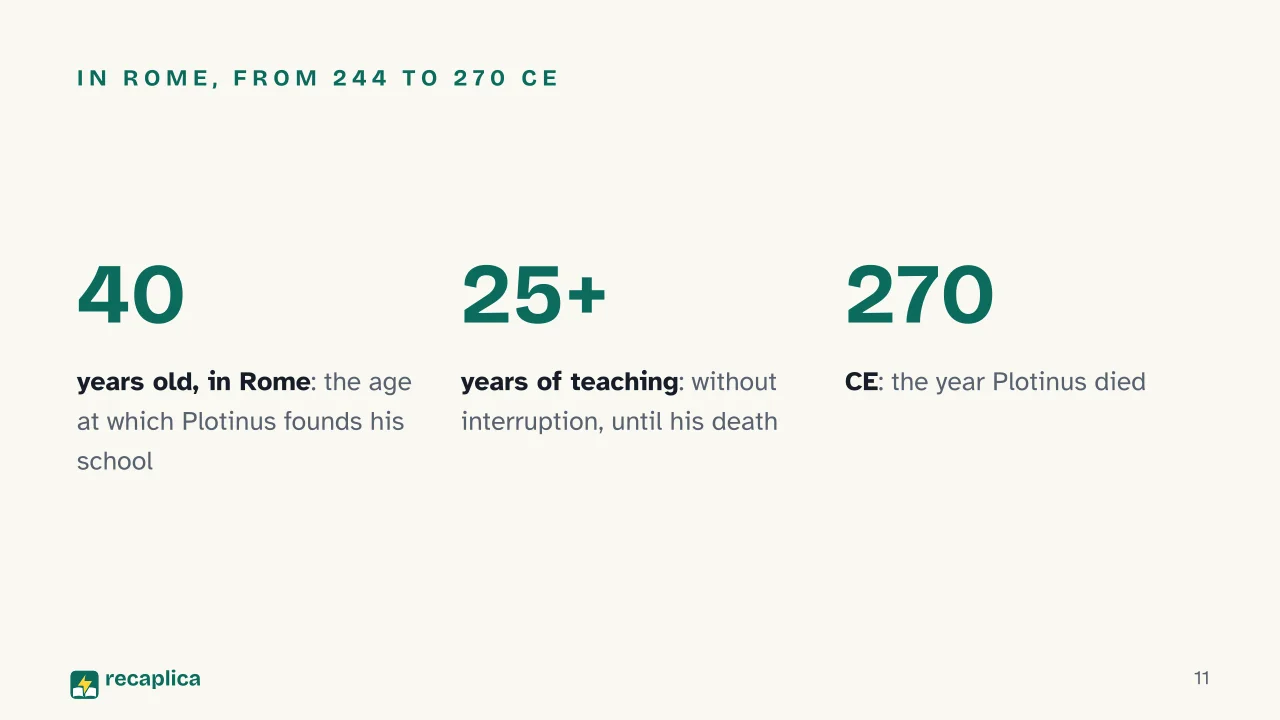
At forty he settled in Rome, where he founded a school of philosophy and taught without interruption for more than twenty-five years, until his death in 270 CE.
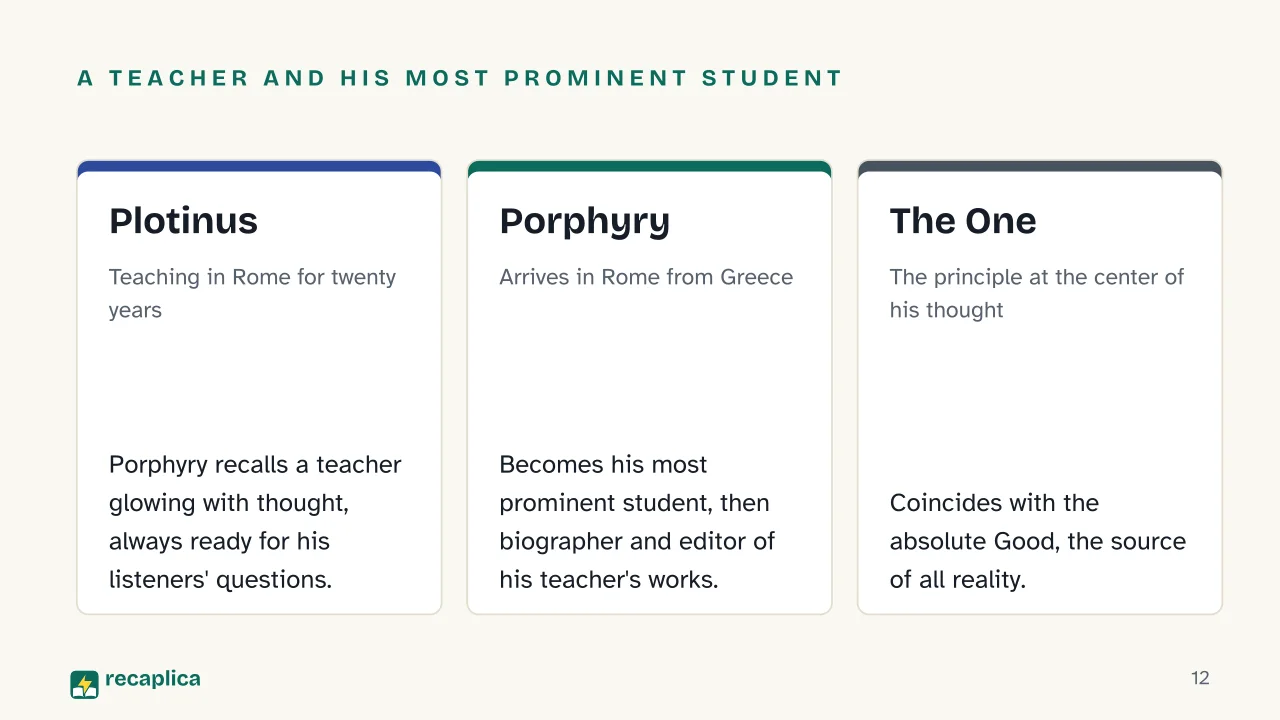
Porphyry arrived in Rome when Plotinus had already been teaching for twenty years, became his most prominent student, and, by his own account, spent six years at his side before editing his biography and his works.
For Plotinus the One coincides with the absolute Good: neither being nor essence, but the source from which the Intellect, and then the rest of reality, flows by emanation.
Key figures
204-270 CE the birth and death years historians assign to Plotinus, as reported by the Stanford Encyclopedia of Philosophy Source: Stanford Encyclopedia of Philosophy
Deep Dive
A man who did not speak of himself
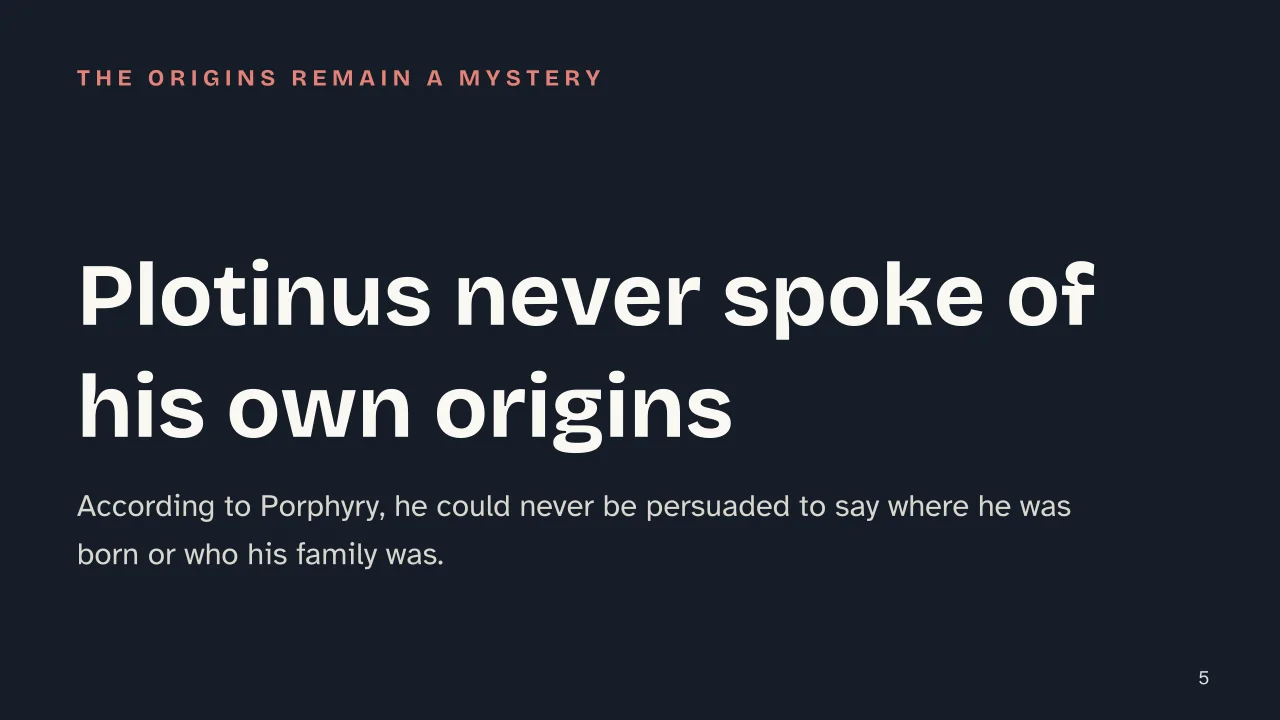
By historians’ reckoning, Plotinus was born in Egypt in 204 CE; the exact place is unknown, because he himself never spoke of it. Porphyry, his student and biographer, recounts that Plotinus could never be persuaded to say where he came from, who his family was, or where exactly he was born: a silence Porphyry presents as a deliberate trait of his teacher. At twenty he turned to philosophy, beginning a training that would carry him far from Egypt.
The years with Ammonius Saccas, in Alexandria
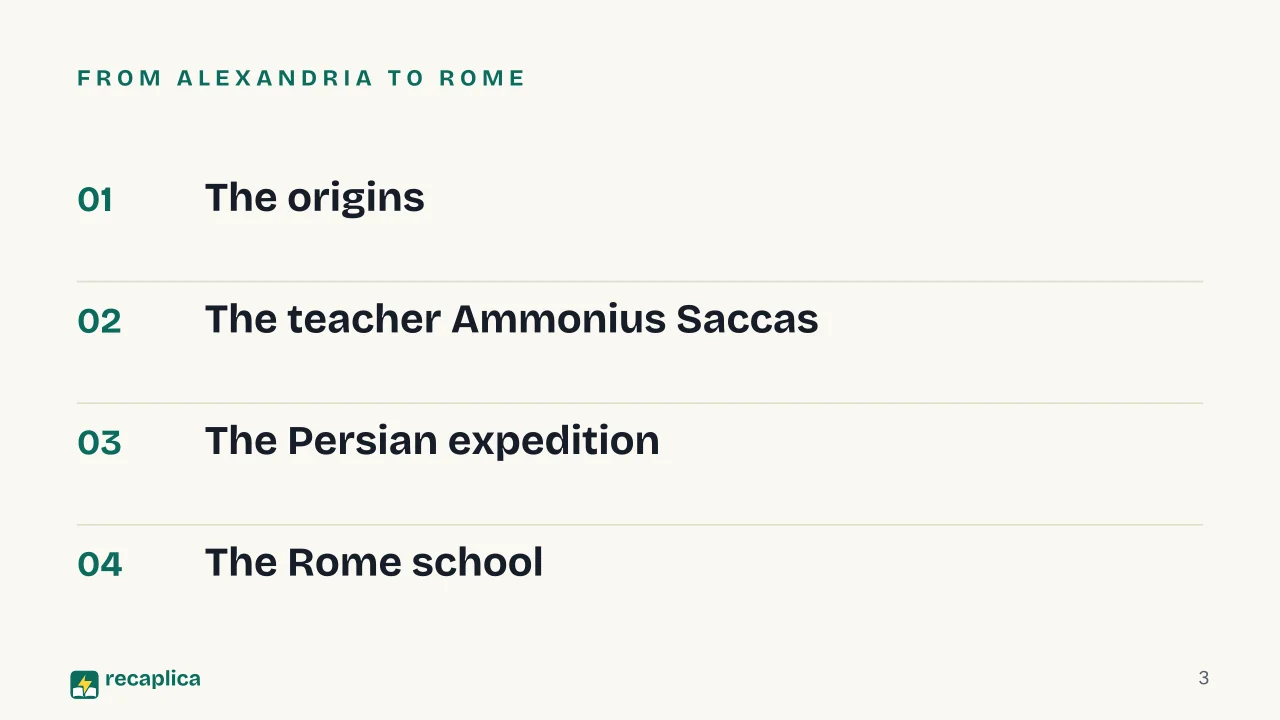
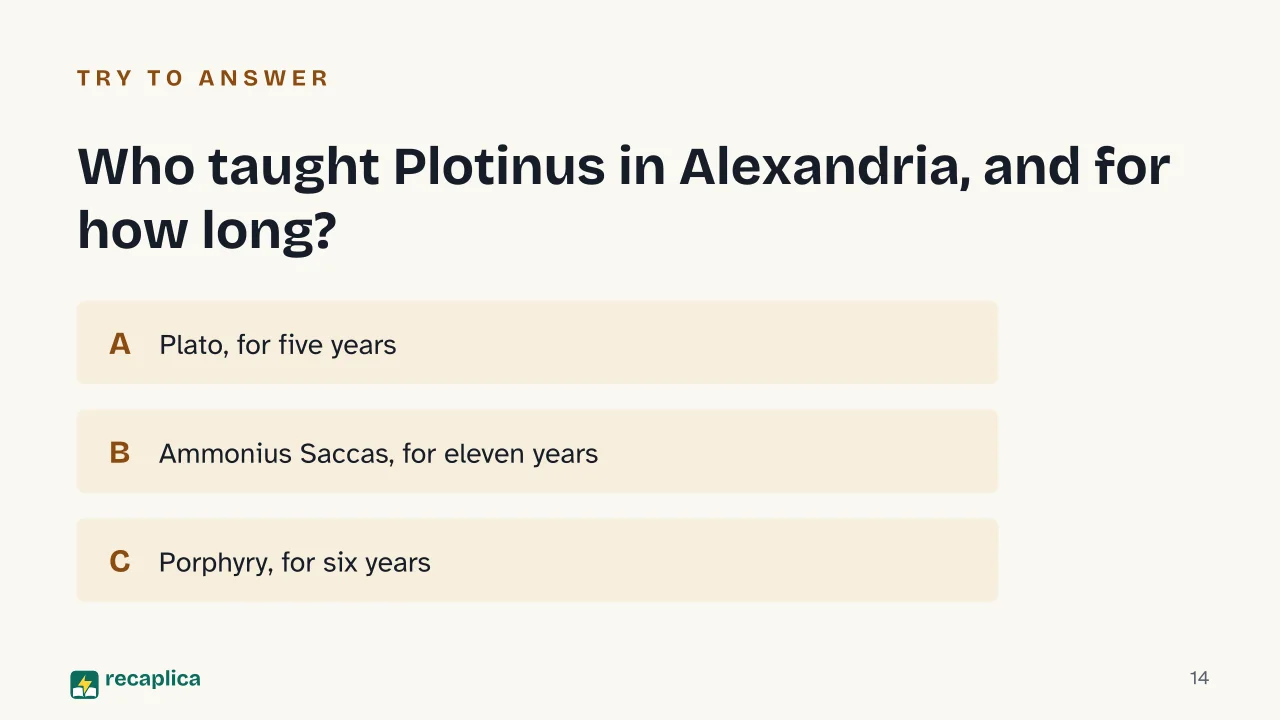
Plotinus moved to Alexandria in his mid-twenties and spent some time attending the lectures of several philosophers, none of whom truly won him over. At twenty-eight he heard Ammonius Saccas for the first time and, according to Porphyry, recognized in him the teacher he had been looking for. He remained his student for eleven full years, a long apprenticeship that shaped the thinking he would later build his own work on, later gathered into the Enneads.
Worked example: anyone who reads that Plotinus “studied in Alexandria” often pictures something brief, like a university course. The eleven years spent beside Ammonius Saccas describe instead an apprenticeship almost as long as an entire teaching career in the ancient world.
An expedition that ended in Mesopotamia
At thirty-nine Plotinus left Ammonius Saccas to join Emperor Gordian III’s military expedition into Persia, apparently intending to meet the philosophers of that country directly. The plan did not go as expected: Gordian III was killed in Mesopotamia, and the expedition never reached its goal. According to Porphyry, Plotinus only managed to get back safely to Antioch with great difficulty, before setting out again toward Rome.
The Rome school and Porphyry’s arrival
At forty, under the reign of Emperor Philip the Arab, Plotinus settled in Rome, where he already had notable social connections. There he opened a school of philosophy, teaching without pause for more than a quarter of a century, until he died alone in Campania in 270 CE. When Plotinus had already been teaching for twenty years, a young student arrived in Rome from Greece, Porphyry, who would become the most prominent of his disciples: he spent six years at the teacher’s side, by his own account, and Porphyry himself recalls that Plotinus’ expression seemed to glow with thought while he lectured, and that he welcomed questions from his audience as readily as he answered them. It was Porphyry who, after his teacher’s death, gathered and arranged his writings into the Enneads.
The One, the principle from which everything flows
At the center of Plotinus’ teaching, in Rome as earlier in Alexandria, stands the One. It coincides with the absolute Good, yet it is neither being nor essence: according to the Internet Encyclopedia of Philosophy, it is not one thing among others but what grounds the existence of everything else. From the One, through a process the tradition calls emanation, the Intellect arises, described as the first reality born from it; from there the rest of reality follows. It is this principle, more than the biography of the man behind it, that gives shape to the philosophical movement that would take the name of Neoplatonism — a doctrine that picks up and reworks themes already present in the tradition running from Socrates onward.
Slide deck
Slides ready to download and make your own in PowerPoint or Google Slides, with speaker notes. Pick the Flash cut or the Full one.
✗ Myth Many assume Plotinus' family and birthplace are known, the way detailed biographical records survive for other ancient philosophers.
✓ Reality According to Porphyry, his student and biographer, Plotinus could never be persuaded to speak about his origins, his family or the exact place he was born: a silence Porphyry describes as a deliberate trait of his teacher, not a gap in the record.
✗ Myth Many assume Plotinus founded his school in Alexandria, where he had trained for years beside Ammonius Saccas.
✓ Reality Plotinus' school was founded in Rome, where he settled at forty after the Persian expedition ended: in Alexandria he was a student for eleven years, not a teacher, and his own teaching career only begins once he reaches Rome.
✗ Myth Many picture Plotinus' One as a personal god, one deity among others to pray to.
✓ Reality According to the Internet Encyclopedia of Philosophy, the One should be understood as what makes the existence of anything else possible, not as an entity in its own right: a metaphysical principle, not a personal god to address with requests or prayers.
Mind map
Drag the background to move around and the nodes to reposition them; use − and + to collapse and expand branches.
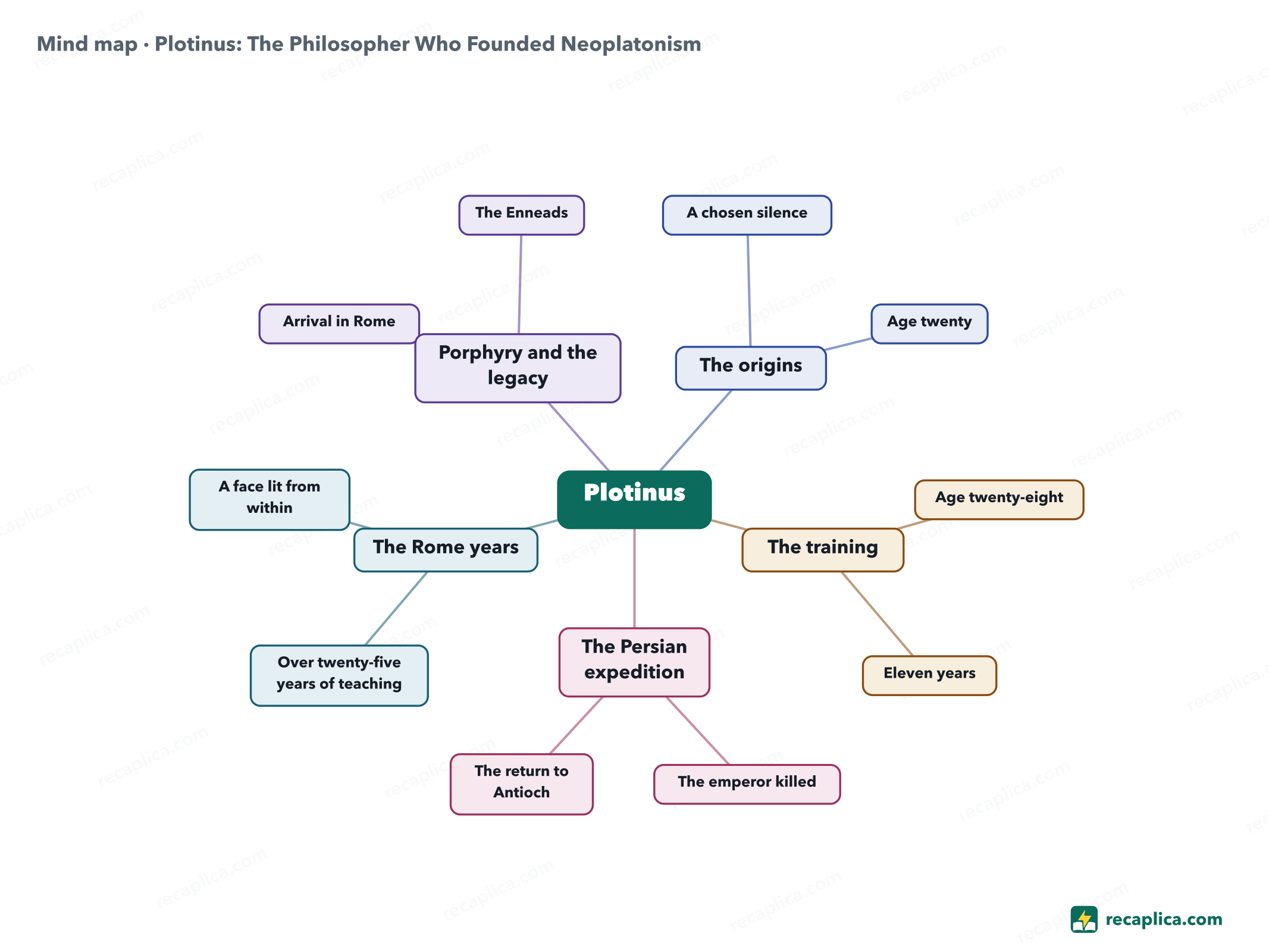
A chosen silenceNever spoke of family or birthplace
Age twentyTurns to philosophy
The trainingAlexandria, under Ammonius Saccas
Age twenty-eightRecognizes Ammonius as the teacher he sought
Eleven yearsLength of his apprenticeship
The Persian expeditionAt thirty-nine, with Gordian III
The emperor killedIn Mesopotamia, the expedition breaks off
The return to AntiochWith great difficulty, according to Porphyry
The Rome yearsHis own school, at forty
Over twenty-five years of teachingUntil his death, in 270 CE
A face lit from withinHow Porphyry describes Plotinus while lecturing
Porphyry and the legacyThe student who edited his works and his life
Arrival in RomeWhen Plotinus had already taught for twenty years
The EnneadsThe work Porphyry collected and arranged
Quiz: test yourself
Answer the questions to check what you have learned: you get instant feedback and a short explanation.
Grade0/100/5
Answers: 1-B · 2-B · 3-B · 4-B · 5-C
Flashcards
Tap the card to flip it and check whether you remember the answer, then move to the next one.
1 / 7
Explain it in your own words
The ultimate test: if you can explain it in simple words, you've truly understood it. Write your explanation, then compare it with the Recap.
Your explanation is saved only on this device.
Plotinus is the Greek-Egyptian philosopher the tradition credits with founding Neoplatonism. Born in Egypt, by most historians' reckoning in 204 CE, he trained in Alexandria under the teacher Ammonius Saccas, whom he followed for eleven years. After a military expedition into Persia that went wrong, he settled in Rome, where he opened a school and spent more than a quarter of a century teaching, until he died in 270 CE. There he welcomed Porphyry, the student who became his biographer and editor. At the center of his thought stands the One, the principle from which all reality flows by emanation.
Frequently asked questions
Who was Plotinus?
Plotinus is the name tradition links to the birth of Neoplatonism: a Greek-Egyptian philosopher, trained in Alexandria, who taught in Rome for more than twenty-five years and died in 270 CE, leaving his work in the hands of his student Porphyry.
Where and when was Plotinus born?
By historians' reckoning he was born in Egypt in 204 CE; the exact place is unknown, because Plotinus himself never spoke of it, a silence Porphyry describes as deliberate.
Who was Ammonius Saccas to Plotinus?
He was the teacher Plotinus recognized as such after first hearing him lecture in Alexandria, at twenty-eight; he remained his student for eleven full years, before leaving Alexandria.
What is Plotinus' One?
It is the supreme principle of his philosophy: he identifies it with the absolute Good and regards it as the very condition for anything to exist, not an entity like any other. From it, by emanation, the Intellect arises, and from that the rest of reality.
Who was Porphyry, and what is his connection to Plotinus?
Porphyry reached Plotinus' school in Rome at the point when his teacher had already been lecturing for two decades, and became his most prominent student. He spent six years at his side, by his own account, and after Plotinus' death edited the collection of his writings into the Enneads, also writing his biography.
Every Recap goes through an independent review before publication.
Statistics, only if you say so
To learn which Recaps help most we would use Google Analytics, with aggregate, anonymous data. It starts only with your OK, and you can change your mind anytime. Privacy policy