Skip to content
recaplica

    One moment: security check

    Cloudflare wants to make sure you're not a robot. Tick the box below and your search will continue on its own.

    IT
    recaplica Plotinus' Enneads: How Porphyry Shaped 54 Treatises into Six Books of Nine
    © 2026 Recaplica · recaplica.com — All rights reserved
    Home › History

    Plotinus' Enneads: How Porphyry Shaped 54 Treatises into Six Books of Nine

    By Recaplica Newsroom · Updated on October 10, 2026

    What to print

    Page numbers appear when printing with default margins.

    Slides

    Choose a cut

    Flash10 slidesThe essential thread, to present in classFull14 slidesEvery chapter and the deeper detail

    Both come with speaker notes.

    Telegram channel
    recaplica Clear in 30 seconds, yours in 10 minutes.
    In 30 seconds Key points Figures Deep dive Slides Myths Mind map Quiz Flashcards FAQ

    In 30 seconds quick read

    The Enneads are the complete writings of Plotinus, 54 treatises that his student Porphyry gathered, arranged and published after the philosopher's death in Campania in 270 CE. The name describes their shape, six books of nine treatises each, from the Greek word for the number nine. Each book follows a theme, from the ethics of the first Ennead to the One of the sixth, and passages are still cited with three numbers, Ennead, treatise and chapter. Plotinus started writing late, at age forty-nine, and composed the whole work over seventeen years, up to a few months before he died.

    Key Points

    • The Enneads collect 54 treatises by Plotinus, gathered and arranged by his student Porphyry after the philosopher's death in 270 CE.
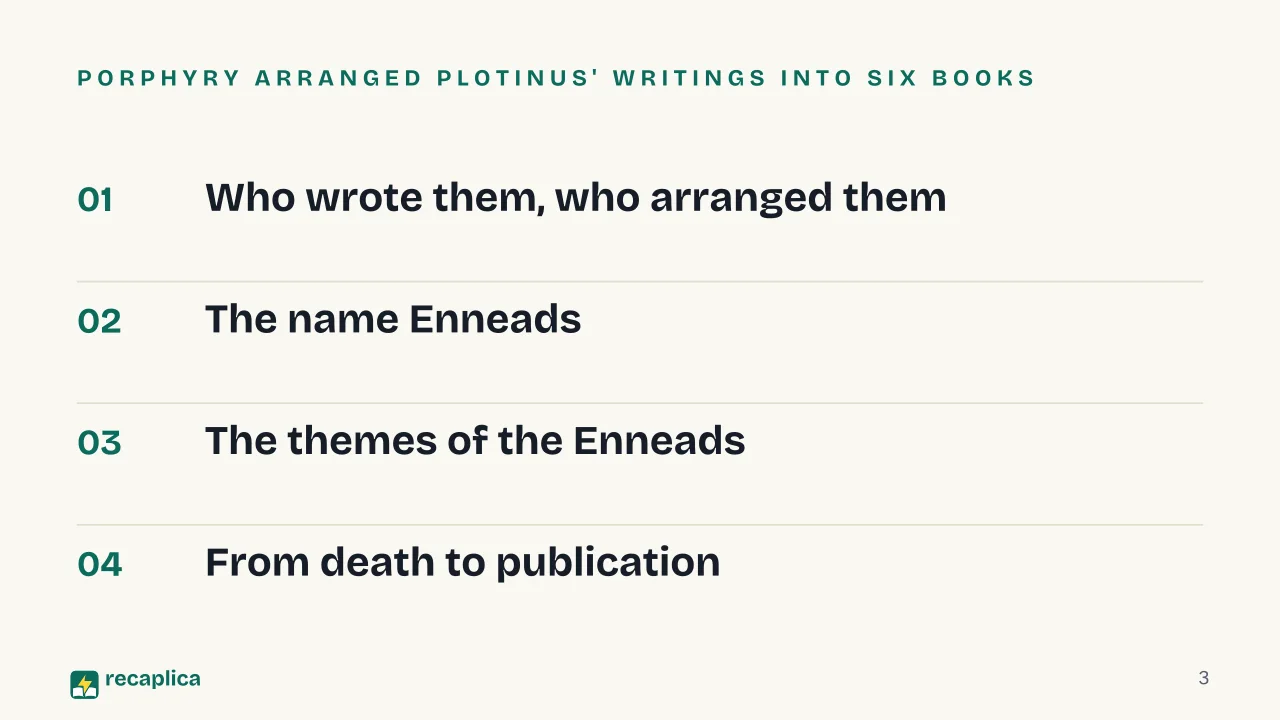
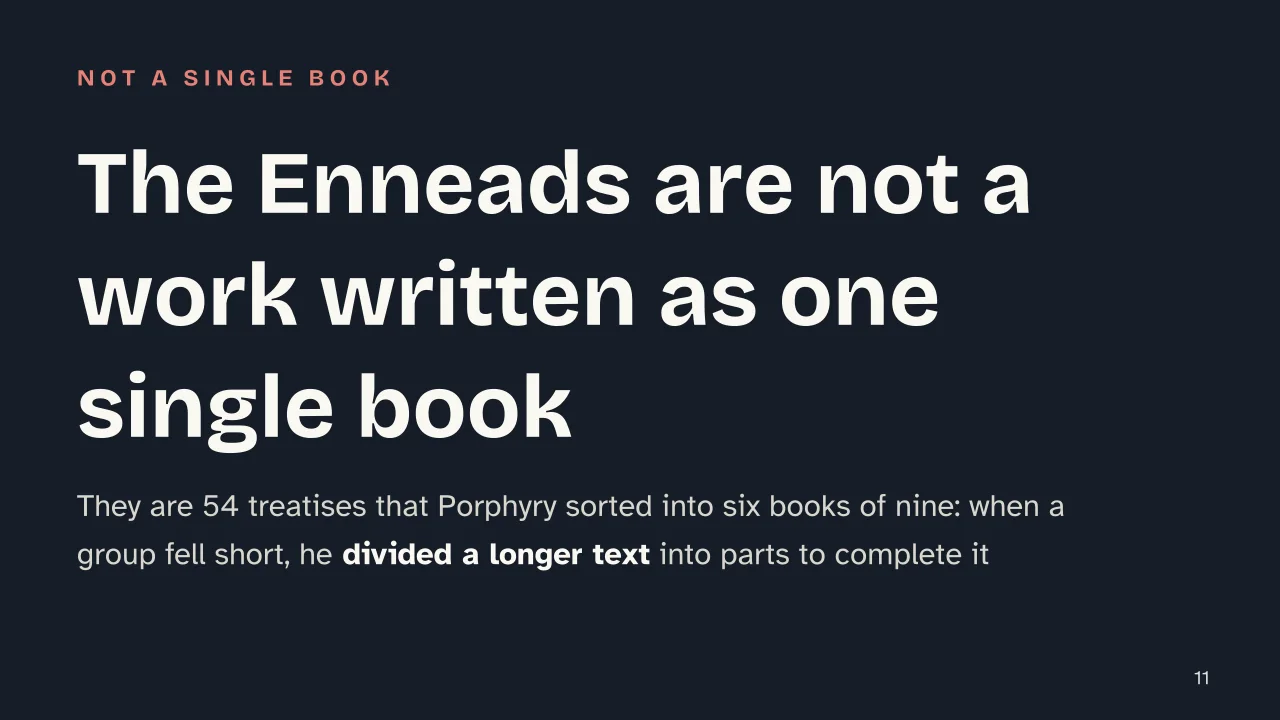
    • The name comes from the Greek word for nine, because Porphyry sorted the texts into six groups of nine treatises.
    • Each Ennead follows a theme, from ethics in the first to the soul in the fourth and the One in the sixth.
    • Porphyry published the collection around 300 CE, roughly thirty years after Plotinus died.
    • Passages in the Enneads are cited with three numbers, Ennead, treatise and chapter, as in the example IV.8.1.
    • Plotinus began writing late, at forty-nine, at his students' urging, and composed the work over seventeen years.

    Key figures

    • 54 treatises written by Plotinus between roughly 253 and 270 CE, later gathered by Porphyry into the six Enneads Source: Internet Encyclopedia of Philosophy, Wikipedia
    • 6 Enneads, each of nine treatises, the scheme that gives the collection its name, published around 300 CE Source: Internet Encyclopedia of Philosophy
    • around 300 CE year of publication, roughly thirty years after Plotinus died in 270 CE Source: Encyclopedia.com

    Deep Dive

    Who wrote the texts, who arranged them

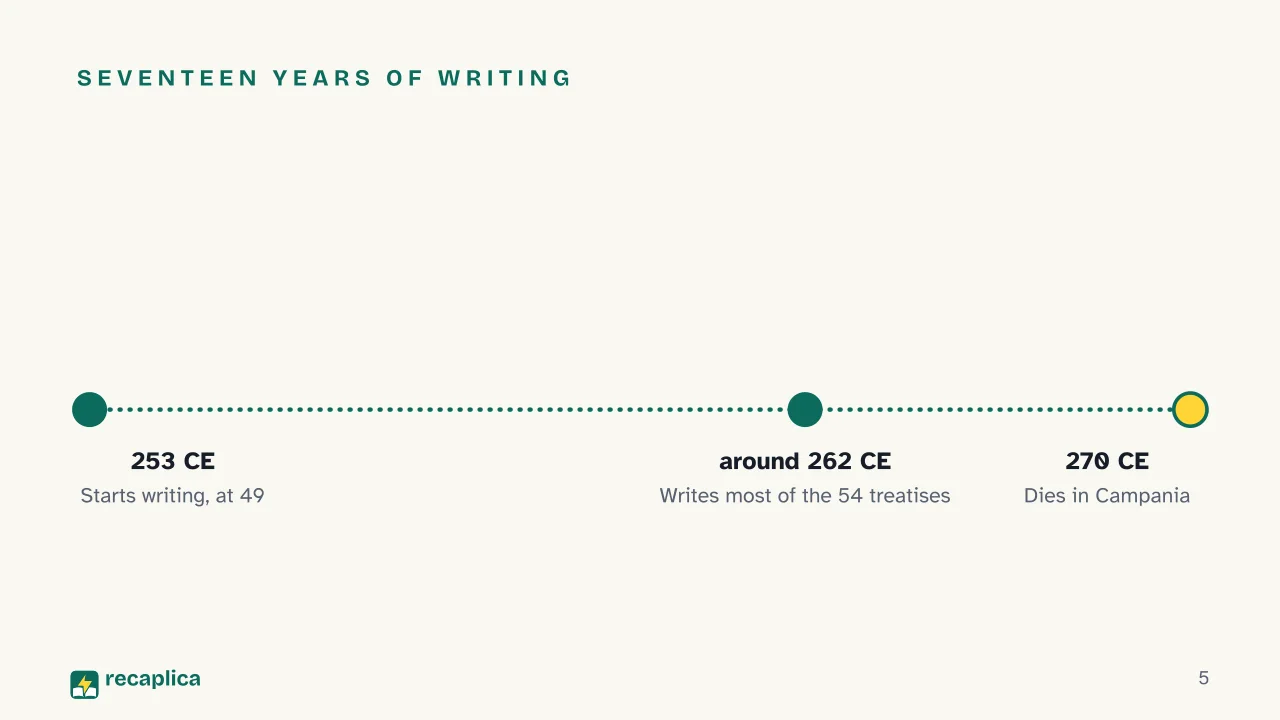
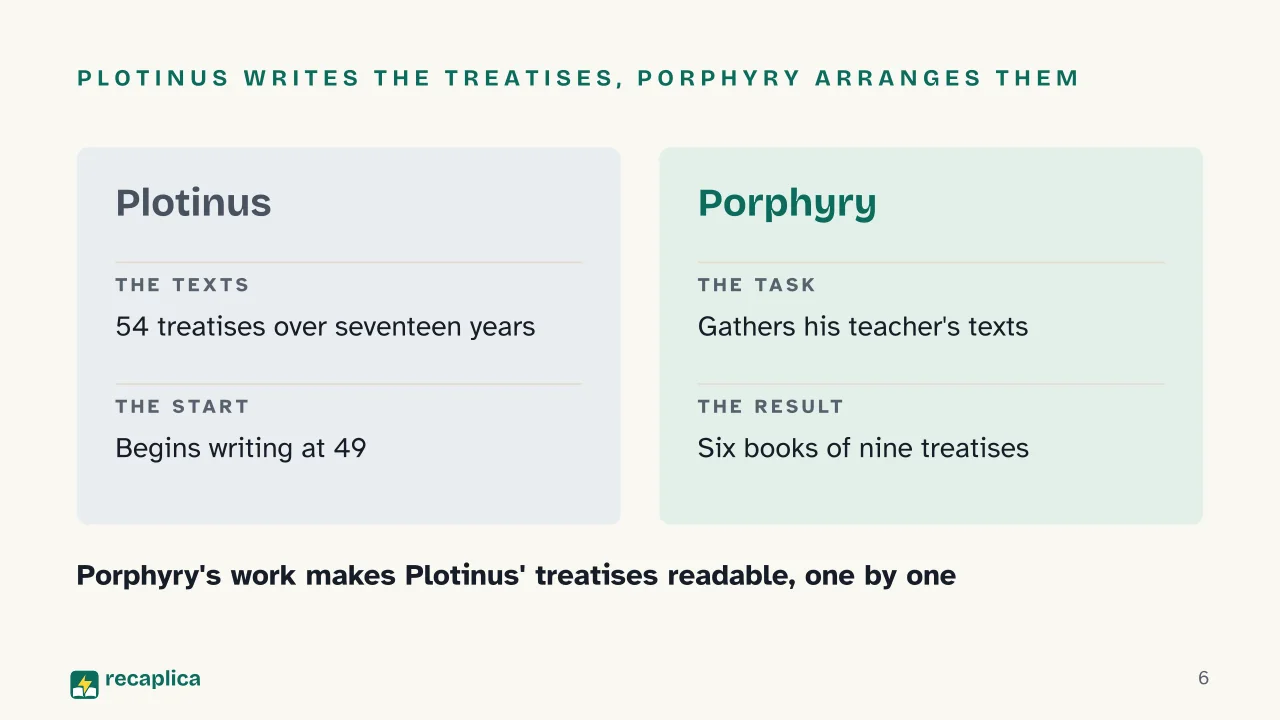
    According to the Internet Encyclopedia of Philosophy, Plotinus’ work did not come down to us as a book written for publication: it is a collection of treatises that his student Porphyry gathered and edited in the years after the philosopher’s death, in 270 CE, in Campania. Plotinus had started writing late, at forty-nine, pushed by the same students who attended his lectures, as Encyclopedia.com recounts. Over the following seventeen years he put 54 treatises into writing, most of them in his last seven or eight years, according to the Wikipedia entry on Plotinus. Porphyry put in a long stretch of work to prepare those texts for publication, which arrived only around 300 CE, roughly thirty years later. The result of that work is the Enneads, the name under which the collection has reached us.

    Why they are called Enneads

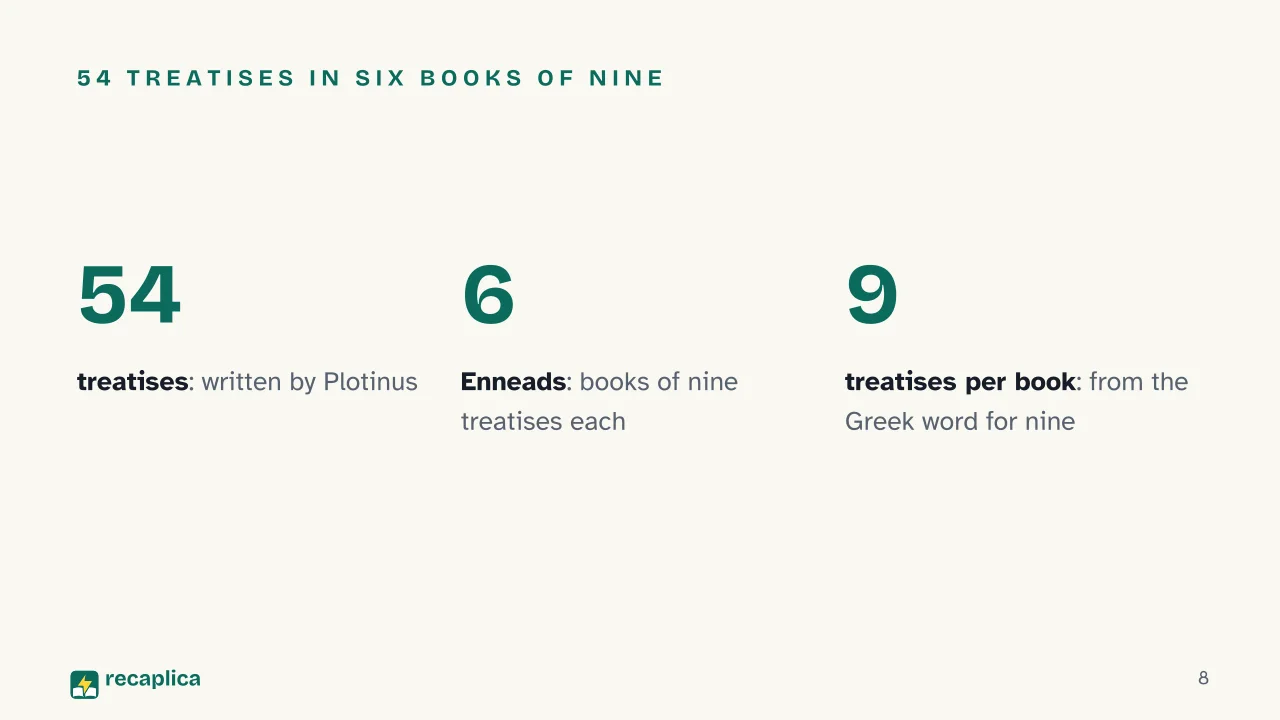
    The name describes the shape of the collection, not its content. Porphyry sorted Plotinus’ 54 treatises into six groups of nine, and Ennead is simply the Greek term for that number. To make the scheme of six groups of nine work, the Internet Encyclopedia of Philosophy notes, Porphyry sometimes split into two or more treatises a text that Plotinus had originally conceived as a single piece. Porphyry then spread the six Enneads across three volumes: the first held the first through third Enneads, the second the fourth and fifth, and the third the sixth Ennead on its own, according to the Wikipedia entry on the Enneads.

    Worked example: anyone looking up a passage in a critical edition of the Enneads finds it marked with three numbers, not a title. IV.8.1, for instance, points to the first chapter of the eighth treatise of the fourth Ennead. It is the citation system Porphyry fixed when he prepared the edition, around 300 CE.

    The themes, Ennead by Ennead

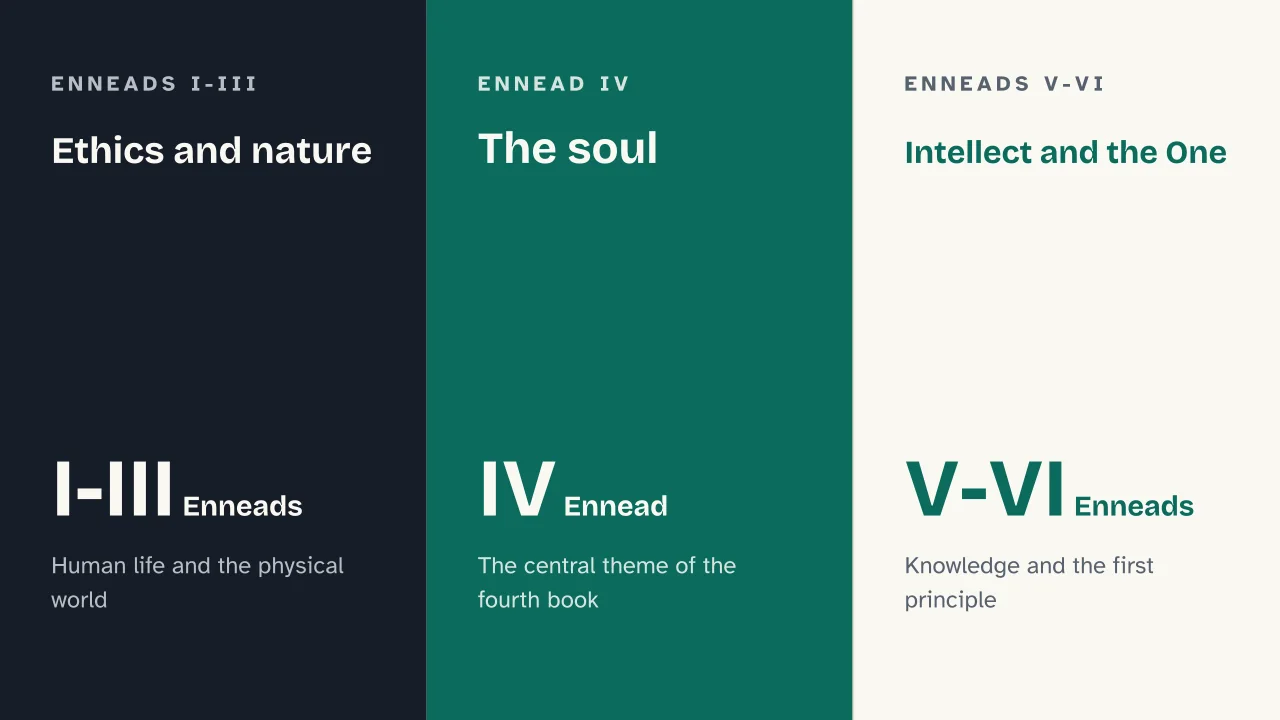
    The first Ennead gathers the treatises on ethics and human life. The second and third bring together the writings on nature and the physical world. The fourth is devoted to the soul, the fifth to knowledge and the intelligible world, that is the Intellect. The sixth centers on the One, the principle from which everything derives, more basic even than being itself.

    Those themes, already seen Ennead by Ennead, are also the structure Porphyry used to organize the whole collection, as the Wikipedia entry on the Enneads notes. Anyone approaching ancient Greece for the first time, along with the debates that ran from Socrates to the Sophists, finds in the Enneads a systematic treatise, written for students who already knew the material discussed at Plotinus’ school. The collection became the main reference point for the school of thought built around Plotinus, Neoplatonism. The movement stayed alive well into the later Roman Empire, during the decades Plotinus spent teaching in Rome.

    From scattered treatises to a standard text

    The Christian Classics Ethereal Library, which holds a digital copy, describes the Enneads simply as the writings of Plotinus gathered, arranged and edited by Porphyry. It is a minimal definition, but a useful one: without a student’s editorial work, those 54 treatises would have stayed separate texts, rather than a work that can be cited chapter by chapter through the reference system Porphyry fixed in his edition around 300 CE.

    Slide deck

    Slides ready to download and make your own in PowerPoint or Google Slides, with speaker notes. Pick the Flash cut or the Full one.
    Slide 1 of the presentation on Plotinus' Enneads: Plotinus' EnneadsSlide 2 of the presentation on Plotinus' Enneads: Why six books of nine treatises?Slide 3 of the presentation on Plotinus' Enneads: Porphyry arranged Plotinus' writings into six booksSlide 4 of the presentation on Plotinus' Enneads: Chapter 01: Who wrote them, who arranged themSlide 5 of the presentation on Plotinus' Enneads: Seventeen years of writingSlide 6 of the presentation on Plotinus' Enneads: Plotinus writes the treatises, Porphyry arranges themSlide 7 of the presentation on Plotinus' Enneads: Chapter 02: The name EnneadsSlide 8 of the presentation on Plotinus' Enneads: 54 treatises in six books of nineSlide 9 of the presentation on Plotinus' Enneads: Chapter 03: The themes of the EnneadsSlide 10 of the presentation on Plotinus' Enneads: Ethics and nature · The soul · Intellect and the OneSlide 11 of the presentation on Plotinus' Enneads: The Enneads are not a work written as one single bookSlide 12 of the presentation on Plotinus' Enneads: Chapter 04: From death to publicationSlide 13 of the presentation on Plotinus' Enneads: Where does the name Enneads come from?Slide 14 of the presentation on Plotinus' Enneads: Now, time to review
    Flash10 slidesThe essential thread, to present in classFull14 slidesEvery chapter and the deeper detail

    Common myths

    • ✗ Myth The Enneads are a single book, written by Plotinus at one point in his life

      ✓ Reality They are 54 treatises composed over seventeen years and assembled only after the philosopher's death, by his student Porphyry, as the Wikipedia entry on Plotinus explains.

    • ✗ Myth The name Enneads points to a specific subject, like a literary genre

      ✓ Reality The name comes only from the number nine, the criterion Porphyry used to group the treatises into six books: the content shifts from one Ennead to the next, according to the Internet Encyclopedia of Philosophy.

    • ✗ Myth Plotinus wrote as a young man, like many philosophers of his era

      ✓ Reality According to Encyclopedia.com he only began putting his arguments in writing at forty-nine, at his students' urging: the Enneads come from his philosophical maturity, not his youth.

    Mind map

    Drag the background to move around and the nodes to reposition them; use − and + to collapse and expand branches.
    Customize
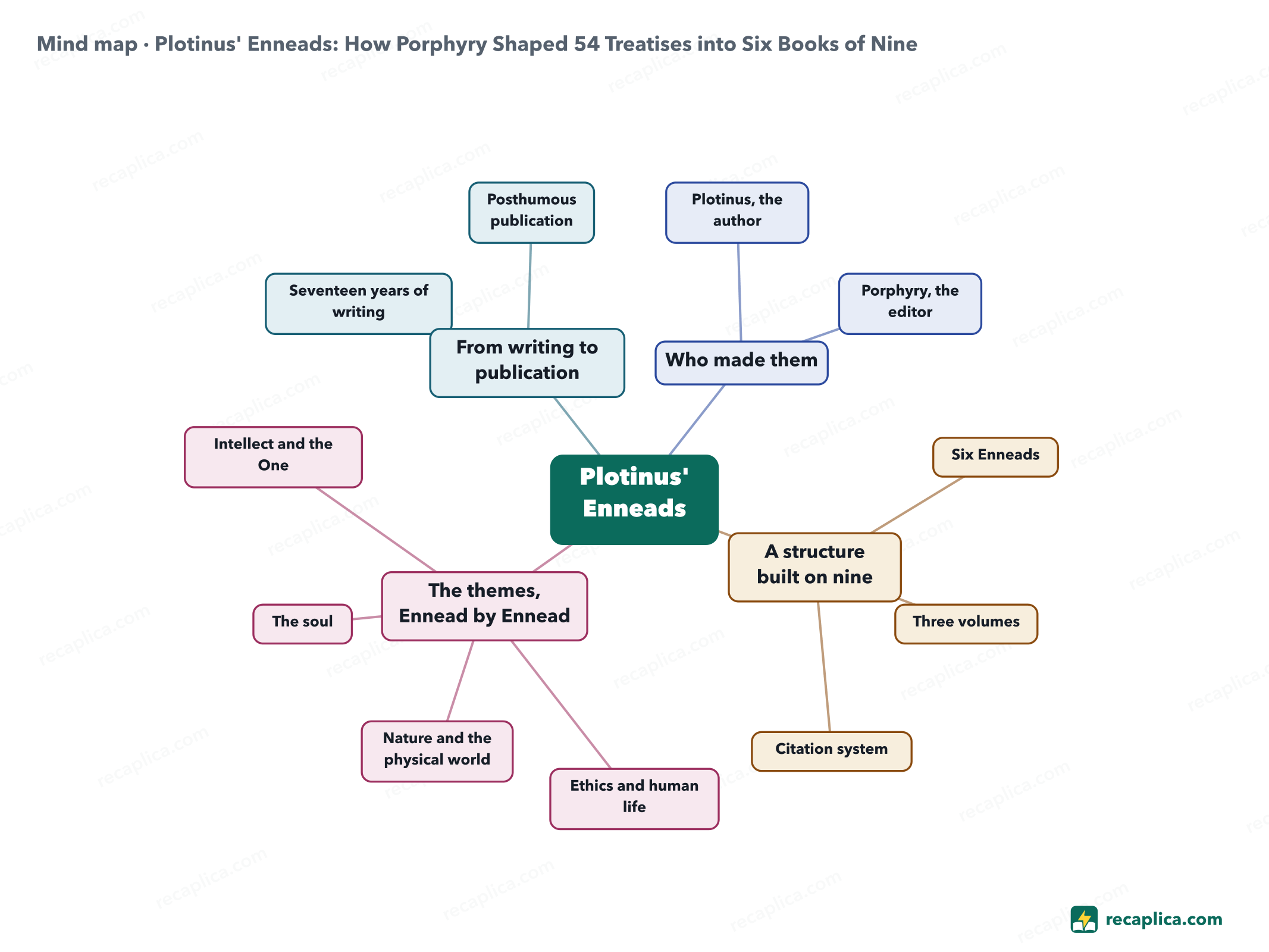
    Mind map: Plotinus' Enneads: How Porphyry Shaped 54 Treatises into Six Books of Nine
    • Plotinus' Enneads
      • Who made them
        • Plotinus, the author Wrote the treatises from roughly 253 CE until a few months before his death, in 270 CE
        • Porphyry, the editor Plotinus' student, gathered and arranged the texts after his teacher's death
      • A structure built on nine
        • Six Enneads Each of nine treatises, which gives the collection its name
        • Three volumes Porphyry distributed the six Enneads across three volumes
        • Citation system Ennead, treatise and chapter number, as in IV.8.1
      • The themes, Ennead by Ennead
        • Ethics and human life First Ennead
        • Nature and the physical world Second and third Ennead
        • The soul Fourth Ennead
        • Intellect and the One Fifth and sixth Ennead
      • From writing to publication
        • Seventeen years of writing From roughly 253 to 270 CE
        • Posthumous publication Around 300 CE, by Porphyry's hand

    Quiz: test yourself

    Answer the questions to check what you have learned: you get instant feedback and a short explanation.

    Grade 0/10 0/5
    1 Who edited and arranged Plotinus' writings into the Enneads?

    Porphyry, Plotinus' student, gathered his 54 treatises into six books of nine, according to the Internet Encyclopedia of Philosophy and Encyclopedia.com.

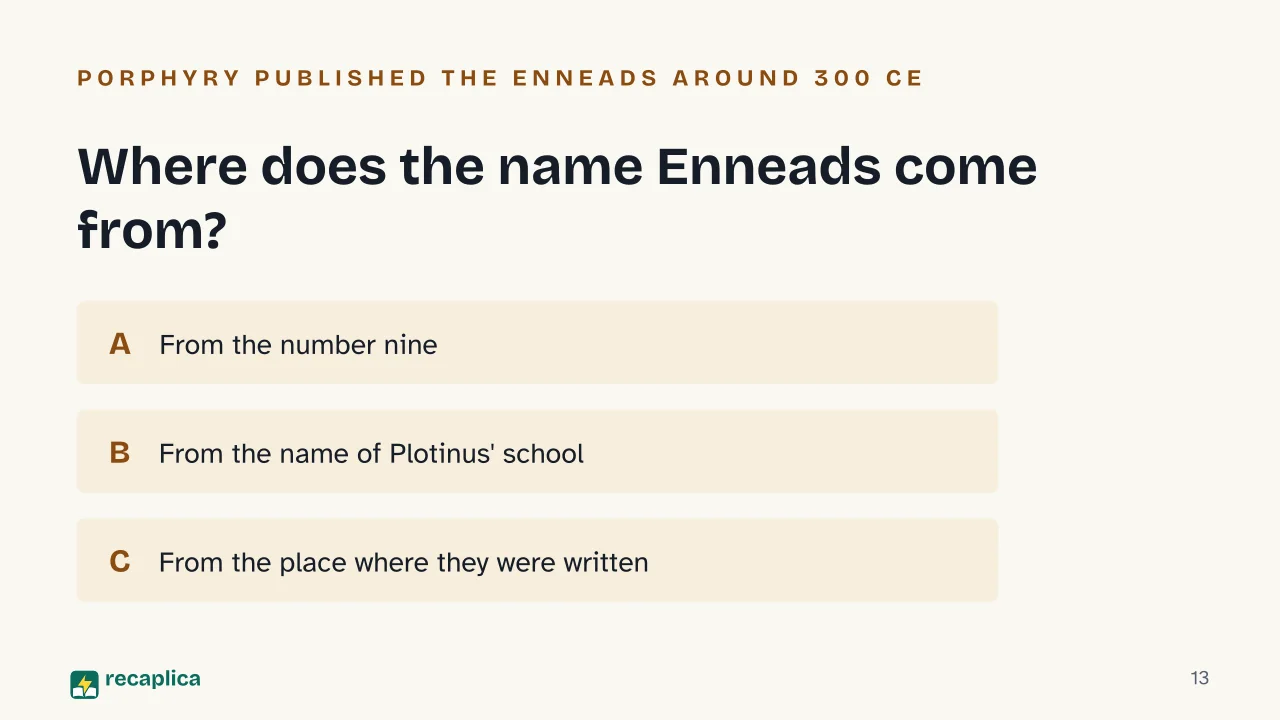
    2 Where does the name Enneads come from?

    The name comes from the division into six groups of nine treatises, as the Internet Encyclopedia of Philosophy and Wikipedia explain.

    3 How many treatises make up the Enneads, according to the sources?

    There are 54 treatises in total, spread across six Enneads of nine each.

    4 Which Ennead deals with the One, the first principle of all things?

    According to the Wikipedia entry on the Enneads, the sixth Ennead deals with the One, the origin of everything, which stands even above being.

    5 True or false, Plotinus started writing as a young man, right after he began teaching

    According to Encyclopedia.com, he only began writing later in life, pushed by the students who attended his lectures.

    Answers: 1-A · 2-B · 3-B · 4-C · 5-B

    Flashcards

    Tap the card to flip it and check whether you remember the answer, then move to the next one.

    1 / 7

    Explain it in your own words

    The ultimate test: if you can explain it in simple words, you've truly understood it. Write your explanation, then compare it with the Recap.

    Your explanation is saved only on this device.

    The Enneads are the complete writings of Plotinus, 54 treatises that his student Porphyry gathered, arranged and published after the philosopher's death in Campania in 270 CE. The name describes their shape, six books of nine treatises each, from the Greek word for the number nine. Each book follows a theme, from the ethics of the first Ennead to the One of the sixth, and passages are still cited with three numbers, Ennead, treatise and chapter. Plotinus started writing late, at age forty-nine, and composed the whole work over seventeen years, up to a few months before he died.

    Frequently asked questions

    What are Plotinus' Enneads?

    They are the complete writings of Plotinus, 54 treatises that his student Porphyry gathered and arranged into six books of nine texts each, which gives the collection its name.

    Who wrote the Enneads?

    The texts are by Plotinus, composed roughly between 253 and 270 CE. His student Porphyry put them together and published them, around 300 CE.

    Why are they called Enneads?

    Because Porphyry, in preparing the edition, grouped Plotinus' writings into six sets of nine texts, and Ennead is the Greek term for that number.

    How are the six Enneads organized?

    They follow different themes: the first covers ethics, the second and third nature and the physical world, the fourth the soul, the fifth the Intellect, and the sixth the One.

    Sources

    • Internet Encyclopedia of Philosophy, Plotinus
    • Wikipedia, Enneads
    • Encyclopedia.com, Plotinus
    • Wikipedia, Plotinus
    • Christian Classics Ethereal Library, Enneads

    Every Recap goes through an independent review before publication.

    Every evening, the day's new Recaps on our Telegram channel. Join the channel →

    Keep learning

    • History Roman Education: How Rome's Three-Tier School System Worked Roman education grew out of an idea the Romans called humanitas: the belief that a full human being is shaped by learning, not born complete. The word humanus originally meant simply being kind to others, but by the 1st century BC Cicero had stretched it to cover liberal education too, what the Greeks called paideia. That idea took a very concrete shape in Roman schools, split into three stages: the litterator taught children to read and write, the grammaticus added Greek and the natural sciences, and the rhetor trained young men in public speaking and law. Very few girls went past the first stage, since most married while still in their teens. Read the Recap →
    • History Saint Augustine of Hippo: Life, Conversion, and Philosophy Augustine of Hippo (354-430) was born in Thagaste, in Roman Numidia, to a Roman father and a mother, likely Berber, who was Christian. After a youth of rhetorical study and years following Manichaeism, he converted to Christianity in Milan in 386 and was baptized the following year. He became bishop of Hippo and wrote the Confessions and the City of God, two works that shaped Western philosophy. His thought blends the Neoplatonic tradition with Christianity, around the themes of free will, sin, and grace. Read the Recap →
    • History Hellenistic Judaism: What It Was and How Philo Read the Bible with Plato Hellenistic Judaism is the name given to Jewish thought as it grew up inside Greek culture, and the Internet Encyclopedia of Philosophy treats Philo of Alexandria as the most elaborate case of that encounter in Alexandria. Philo was born in Alexandria in Egypt around 20 BCE, into a wealthy and prominent Jewish family, and he trained in Greek philosophy at a high level. He read Scripture on the assumption that the text carries a literal sense and, underneath it, an allegorical one. Out of that reading came the idea he is best known for, the Logos, the part of God that a human mind can actually reach. Read the Recap →

    recaplica

    Clear in 30 seconds, yours in 10 minutes.

    Recaps Mind maps Request a Recap Telegram channel Mind map maker Our method About Privacy & cookies Legal notes & terms of use

    © 2026 Recaplica · A project by Curi S.r.l. — VAT IT05472000750

    Statistics, only if you say so

    To learn which Recaps help most we would use Google Analytics, with aggregate, anonymous data. It starts only with your OK, and you can change your mind anytime. Privacy policy