|
recaplica
The Roman Empire: rise, peak and fall | ||||||||||||||||||
| © 2026 Recaplica · recaplica.com — All rights reserved | ||||||||||||||||||
The Roman Empire: rise, peak and fallWhat to print Page numbers appear when printing with default margins. SlidesChoose a cut Flash10 slidesThe essential thread, to present in classFull19 slidesEvery chapter and the deeper detailBoth come with speaker notes. In 30 seconds quick readThe Roman Empire begins in 27 BC, when Octavian takes the name Augustus and becomes the first emperor. Over the following two centuries the Pax Romana holds together a territory that by around AD 100 contains, on the highest estimates, up to 100 million people, across land that today belongs to some fifty countries. The high point is Trajan's reign, which in AD 117 pushes the borders from northern Britain to the Caspian Sea. Then come the long third-century crisis, the administrative split, and in 476 the deposition of the last western emperor. The eastern half, however, does not fall at all: it keeps calling itself the Roman Empire until 1453. Key Points
Key figures
Deep DiveAn empire that begins without a battleThe Roman Empire does not start with a conquest. It starts with a change of regime from within: in 27 BC Octavian, Julius Caesar’s great-nephew and adopted son, becomes Rome’s first emperor and takes the name Augustus. The state already existed, so did the provinces; what changes is who decides. The Senate grants him authority over the provinces and tribunician power, which lets him pass laws through the popular assemblies: on paper two distinct powers, in practice control of the state. The institutions of the Republic formally stay in place (magistrates are still elected, the Senate still meets), but the final say belongs to one person. It is a gradual, almost quiet transition, and that is precisely why it works: there is no morning on which Romans wake up inside a system they do not recognise. Augustus rules until AD 14. Ancient writers passed down the line that he found Rome a city of brick and left it a city of marble. The less quoted but more consequential fact is a different one: under him the road network is extended and kept in working order, and the seas are cleared of pirates. From then on, goods move. That network was neither his work nor the work of a single century: the Via Appia dates from 312 BC, and Roman public roadway would eventually pass 120,000 kilometres over five centuries of building. The Pax Romana: two centuries when trade paid offThe period Augustus opens is called the Pax Romana, and it lasts over two hundred years, until the death of Marcus Aurelius in AD 180. The name is slightly misleading: it does not mean fighting stopped. Campaigns on the frontiers went on without pause, and twenty-three professional legions were stationed there for exactly that reason. It means that inside the borders security held long enough to make it sensible to open a business a thousand kilometres from home. Between AD 96 and 180 five rulers succeed one another, the ones historians call the Five Good Emperors: Nerva, Trajan, Hadrian, Antoninus Pius and Marcus Aurelius. It is the stretch of Roman history when the empire is at its largest and most stable.
Trajan and the furthest pointTrajan reigns from AD 98 to 117. Born at Italica, near modern Seville, on 18 September AD 53, he is the first emperor who does not come from Italy — which already says something about how the empire worked. Between 101 and 106 two campaigns break the Dacia of King Decebalus, which is absorbed and resettled with Roman colonists: roughly, modern Romania. Between 114 and 116 he annexes Armenia and Mesopotamia, going as far as taking Ctesiphon, the Parthian capital. At his death, on 9 August 117, the borders run from northern Britain to the Caspian Sea: no successor will push them further. The Dacian spoils pay for Trajan’s Forum, dedicated in 112, and for Trajan’s Column the year after: thirty metres of marble up which a spiral frieze tells the Dacian campaigns without a break, with the emperor’s ashes buried at its base. It is one of the few ancient works where official propaganda and historical record are the same object. What held fifty countries togetherAround AD 100, on the most generous estimates, up to a hundred million people lived inside the empire, on territory that today belongs to some fifty different states. In the second century the limes, the frontier line, ran for more than five thousand kilometres: one continuous arc starting in northern Britain, crossing Europe and carrying on to the Near East and the deserts of North Africa. Governing something like that, with no telephones and no engines, took more than military force, as the most visible case of all shows.
Then there was the law. In AD 212 the emperor Caracalla issues the Constitutio Antoniniana, granting Roman citizenship to all free inhabitants of the empire and erasing the distinction between Italians and provincials. The stated motive was equality; the practical one, as the Metropolitan Museum notes, was fiscal: money was needed after the huge sums lavished on the army, and widening the pool of citizens widened the base of the inheritance tax. The long-term effect was profound anyway, because citizenship stopped being a privilege to be earned and became the ordinary status of anyone living in the empire, speeding up a shift towards the provinces that was already under way: Trajan, a Spaniard, had been emperor a century earlier. And there were the cities, built everywhere to the same recognisable template. The Colosseum, officially the Flavian Amphitheatre after the dynasty that built it in the first century AD, is the monumental version of a model repeated in hundreds of smaller towns. It opened in AD 80 under Titus with a hundred days of games, and held roughly 45,000 seated spectators plus another 5,000 standing. The nickname is not explained by its size: scholars trace it to a colossal statue that once stood beside it. It remains, all the same, the largest amphitheatre in the world. The third-century crisis and the reformsBetween AD 235 and 284 the empire goes through what historians call the crisis of the third century: half a century of political instability, with emperors following one another in quick succession, pressure on the borders and economic trouble. The answer comes with Diocletian. In 285 he appoints a colleague for the West and splits the administration in two; from 293 he extends it to four rulers, the tetrarchy. Not to break the empire apart, but because a territory that size had become ungovernable from a single centre. Constantine, proclaimed emperor by his troops in 306 and master of the West after his victory at the Milvian Bridge in 312, becomes sole ruler of the whole empire in 324; in 330 he founds Constantinople, on the Bosphorus, which becomes the new political capital. In 395 the separation between East and West becomes formal and final. The same caveat applies as with the Cold War: a line drawn on a map for practical reasons can harden, over time, into two worlds that no longer speak to each other. With one substantial difference: in the Roman case the split was not an ideological rupture but an administrative choice that time made irreversible. 476, and what it actually meansIn 410 Alaric’s troops sack Rome; in 455 it is the Vandals’ turn. These are severe blows to prestige, but they are not the end. The conventional date is another: 4 September 476, when the Germanic king Odoacer deposes the emperor Romulus Augustulus. The name is almost a joke of history: the last western emperor was called after both the city’s legendary founder and the first emperor, each in diminutive form. Why did it fall? Not for a single reason, and historians are wary of single-cause explanations. The instability accumulated in the third century counts, as do the rising cost of an enormous army and administration, the difficulty of defending thousands of kilometres of frontier, and the pressure of peoples pushing at the borders. The limits of the date itself count too: as historians observe, the cataclysmic character of 476 has ended up masking how much continuity lay underneath. Cities went on existing, Roman law stayed in use, the language turned into the Romance languages rather than disappearing. In Britain, for instance, the latest coins found along Hadrian’s Wall date to AD 403-406: the Romans had already left seventy years before 476, without anyone declaring it. The other half, the one that did not fallHere lies the most widespread misunderstanding. What ends in 476 is the Western Empire. The East carries on, with its capital at Constantinople, for nearly another thousand years: until 29 May 1453, when the Ottoman sultan Mehmed II takes the city. The last emperor, Constantine XI Palaiologos, dies in the fighting on the walls; his body was never identified with certainty, and the traditional account, the emperor throwing away his regalia and charging into the melee, comes from chronicles written in the years that followed. We call it the Byzantine Empire, but that is a label scholars coined after it was gone. The people living in it called their state the Roman Empire and themselves Romans. This was not a rhetorical claim: it was the continuation of the same state structure born in 27 BC. Why we still study itFew civilisations have left traces this concrete two thousand years on. The borders of many European states still partly follow Roman administrative divisions. Half the civil law of the continent descends from Roman law. And the languages of Italy, France, Spain, Portugal and Romania are nothing but Latin, changed by time. For a sense of the timescale: more than three thousand years separate the unification of Egypt under Menes from the Roman conquest, and ancient Egypt remains the natural comparison for sheer longevity. The Roman Empire is shorter but wider, and above all it left an administrative organisation that outlived it. When post-revolutionary France had to build itself a new political vocabulary, it went there for it: the Republic of 1792, then the Senate, the Consulate and the Tribunate of the 1799 constitution, are all Roman words put back into service. The French Revolution closed one era using the language of another. And the Industrial Revolution was, among other things, the first moment when Europe built a transport network comparable in ambition to the Roman roads, about eighteen centuries late. Slide deckSlides ready to download and make your own in PowerPoint or Google Slides, with speaker notes. Pick the Flash cut or the Full one.     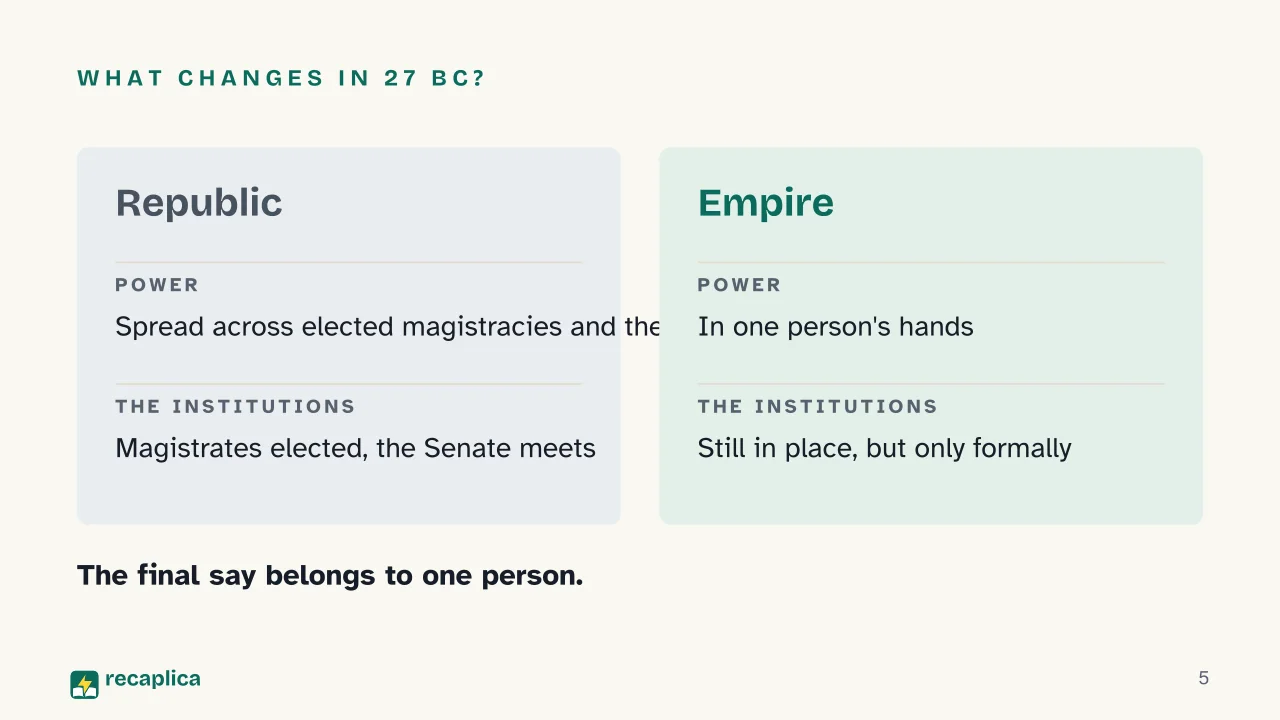 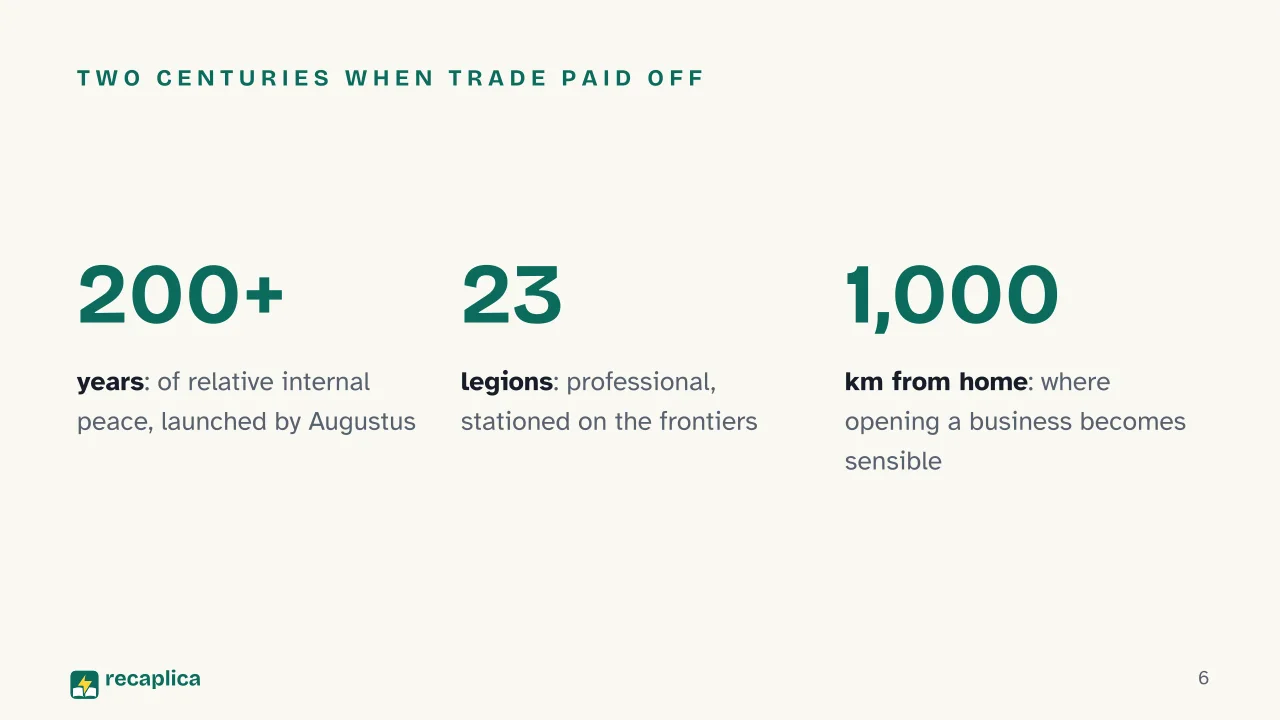  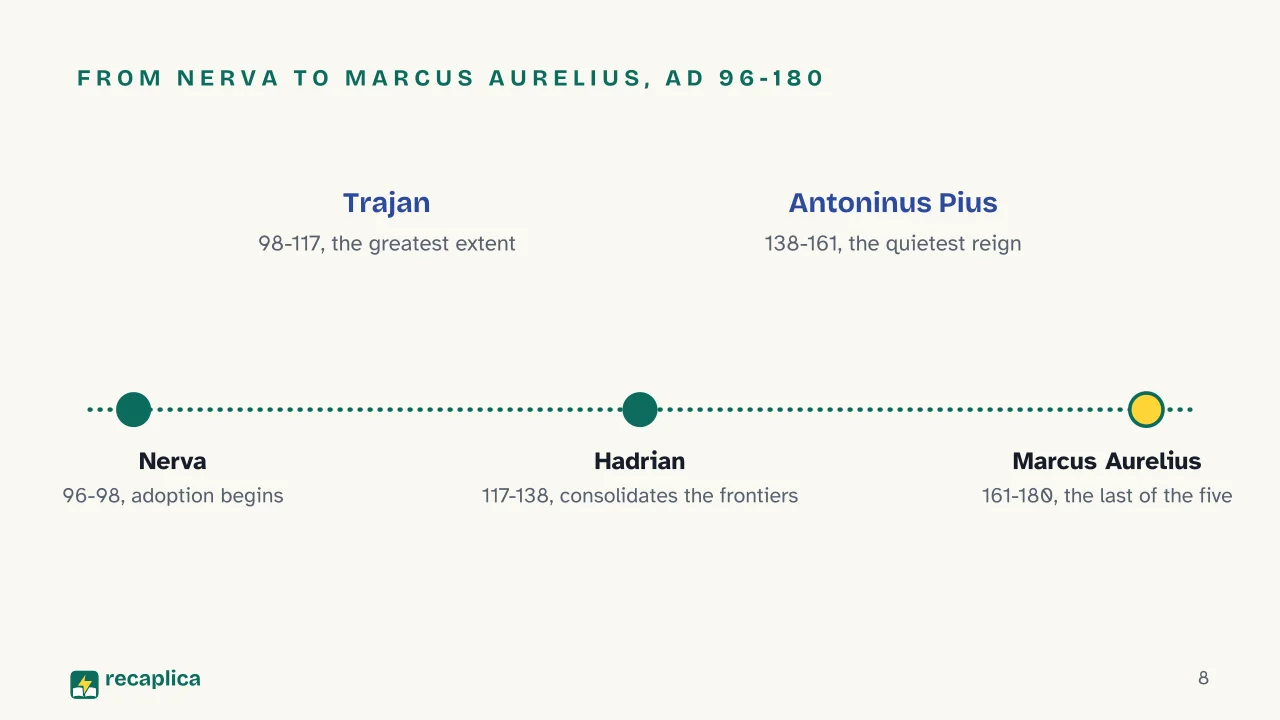 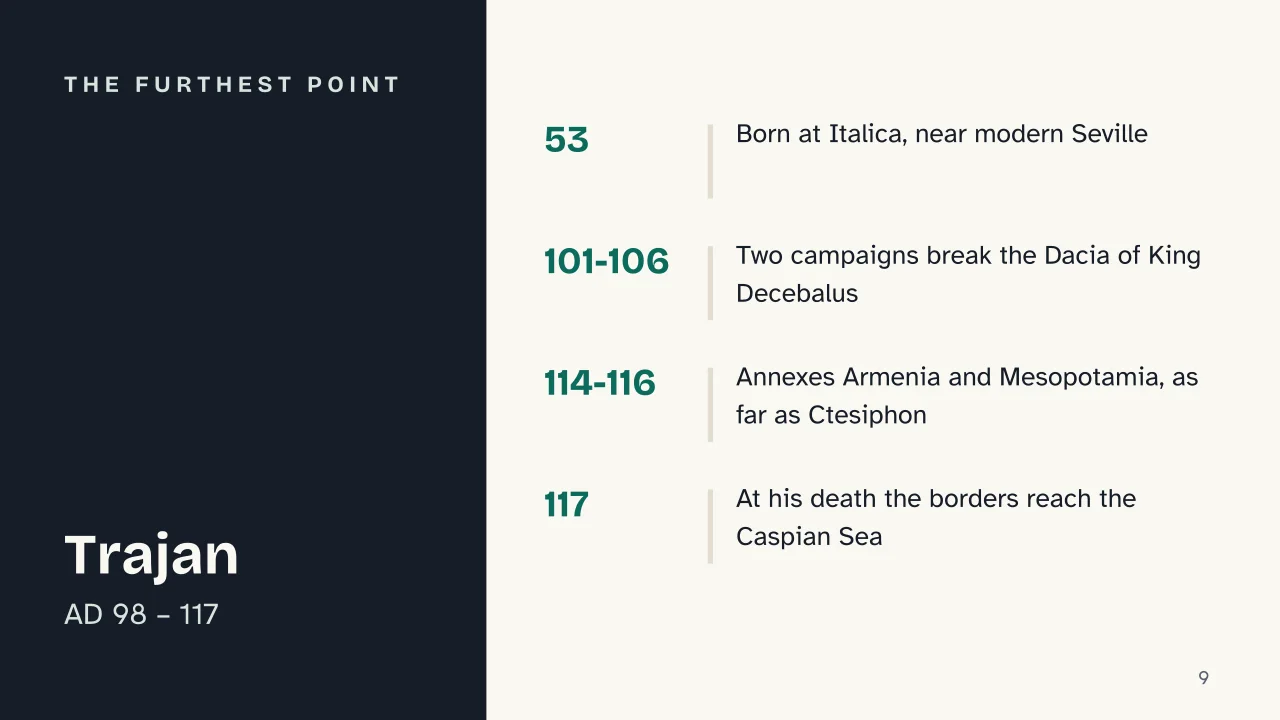  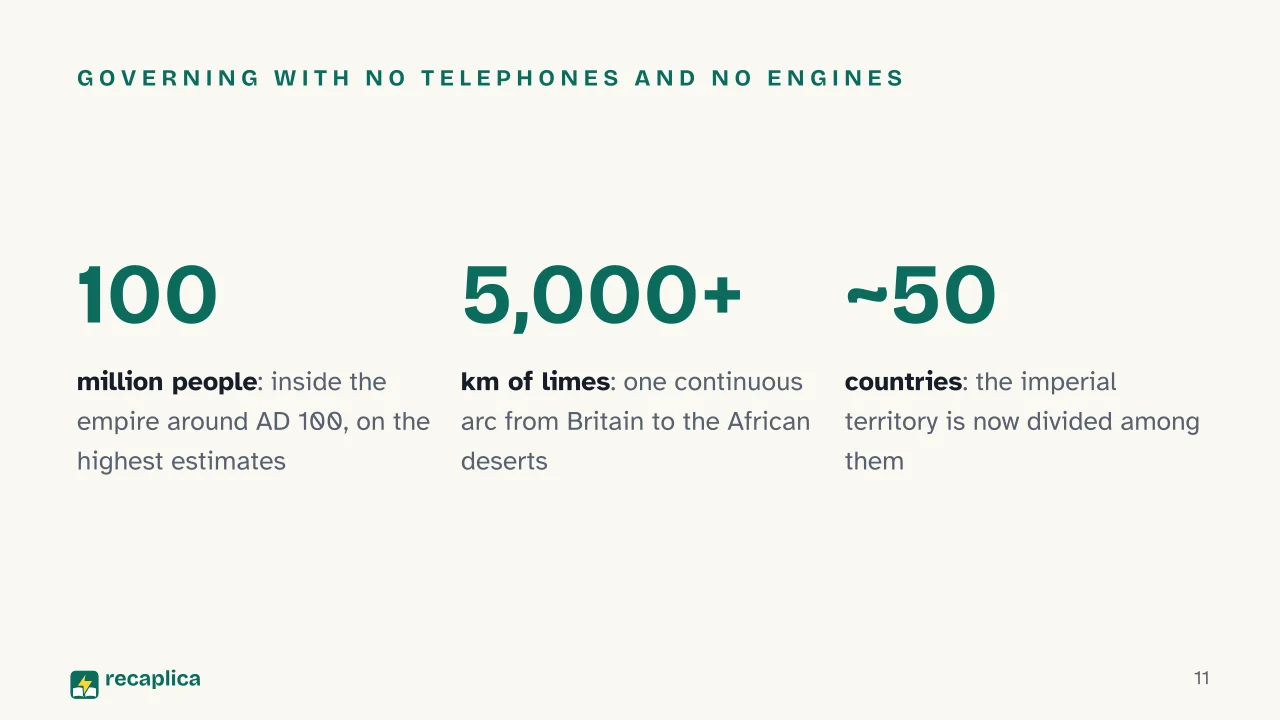 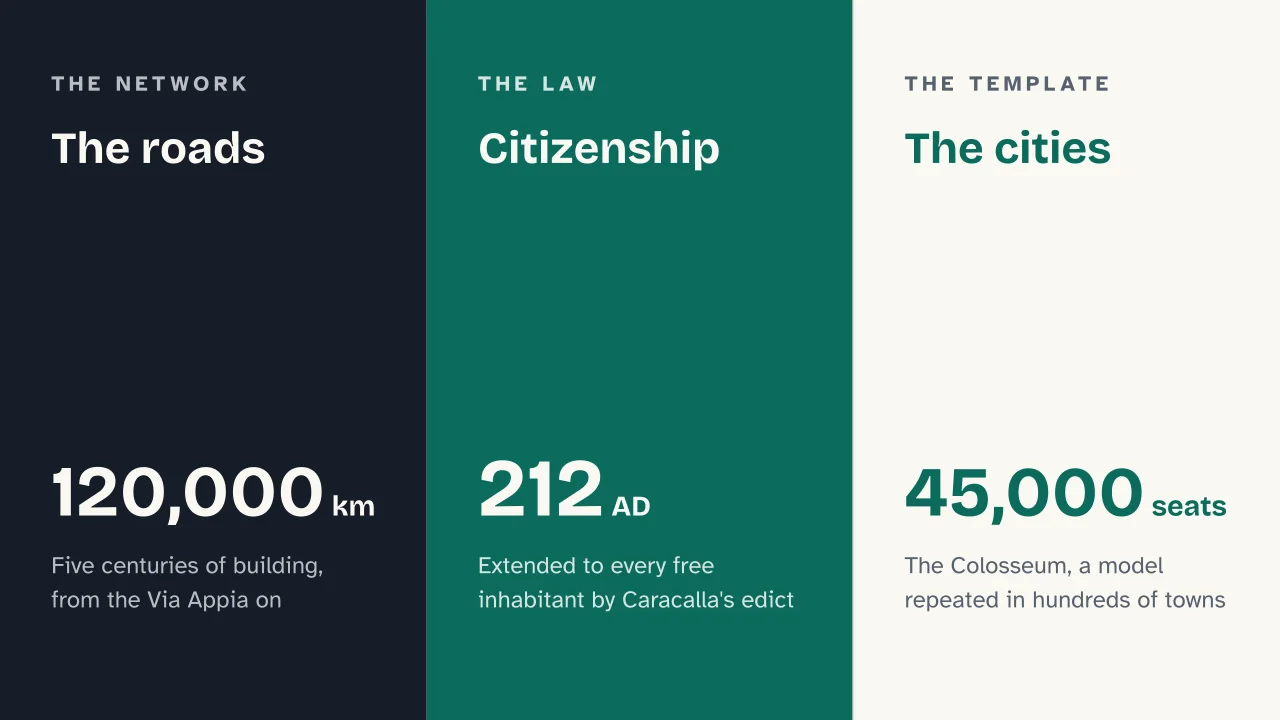 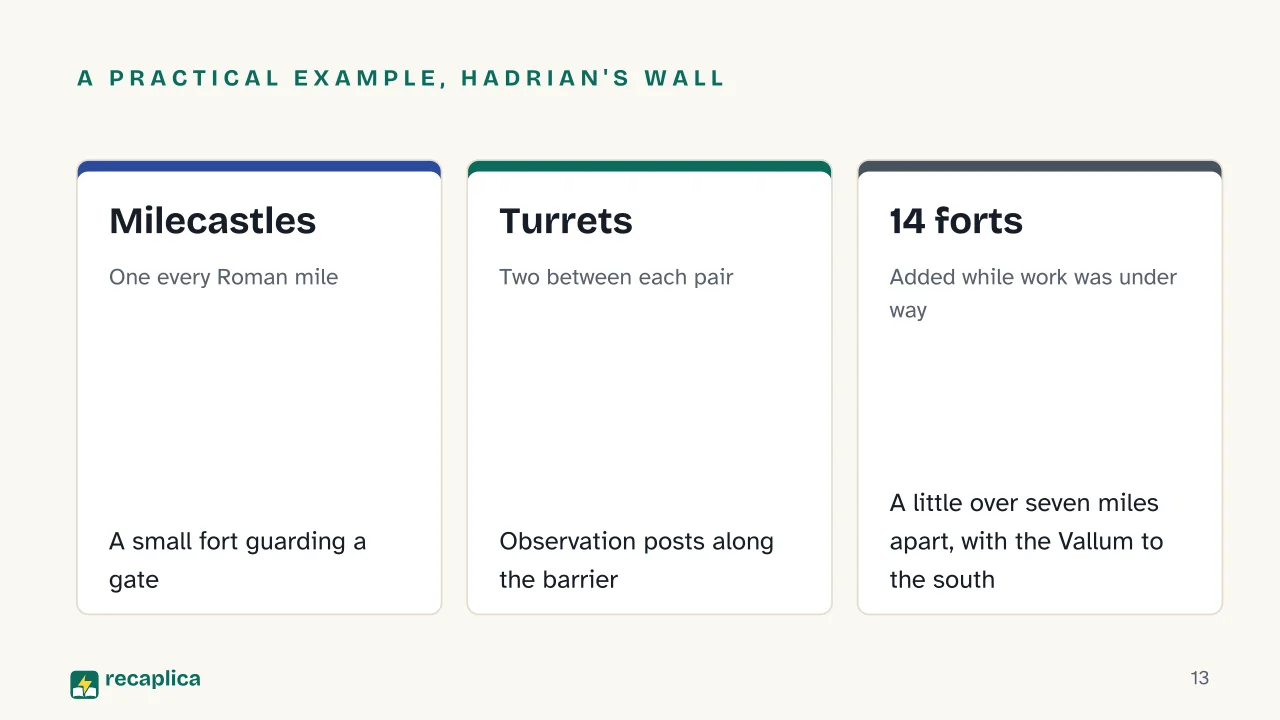  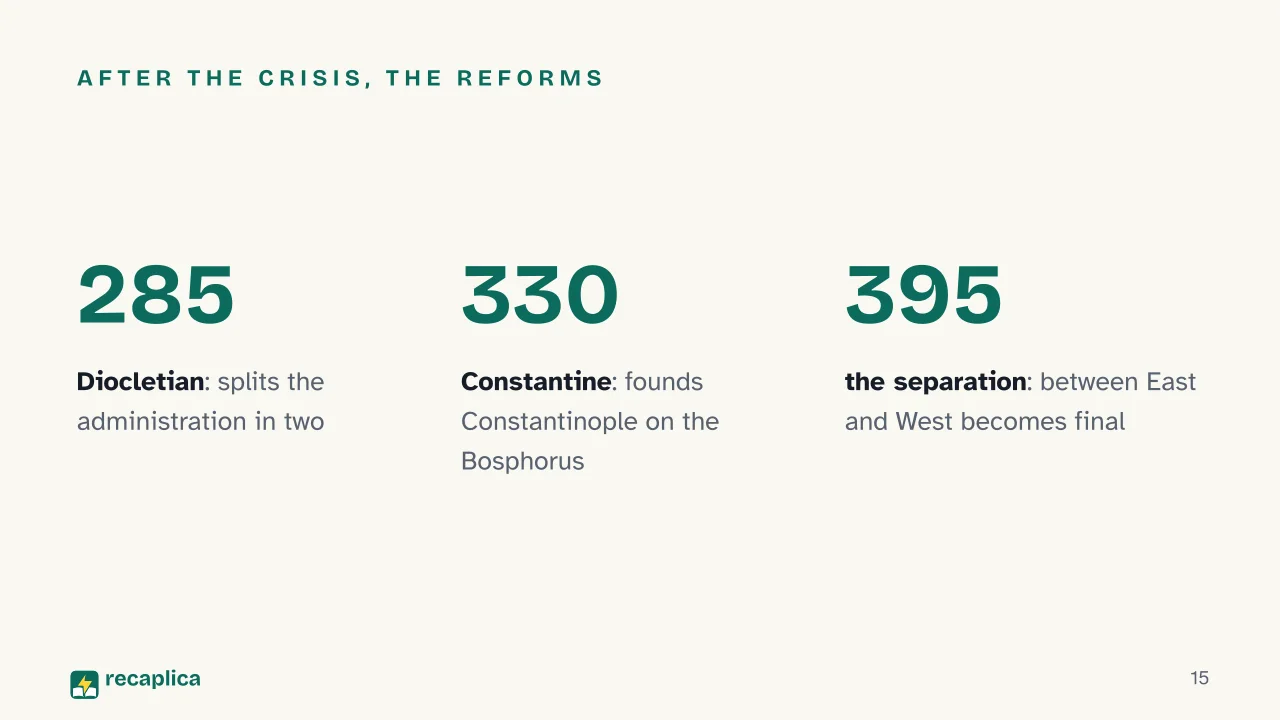  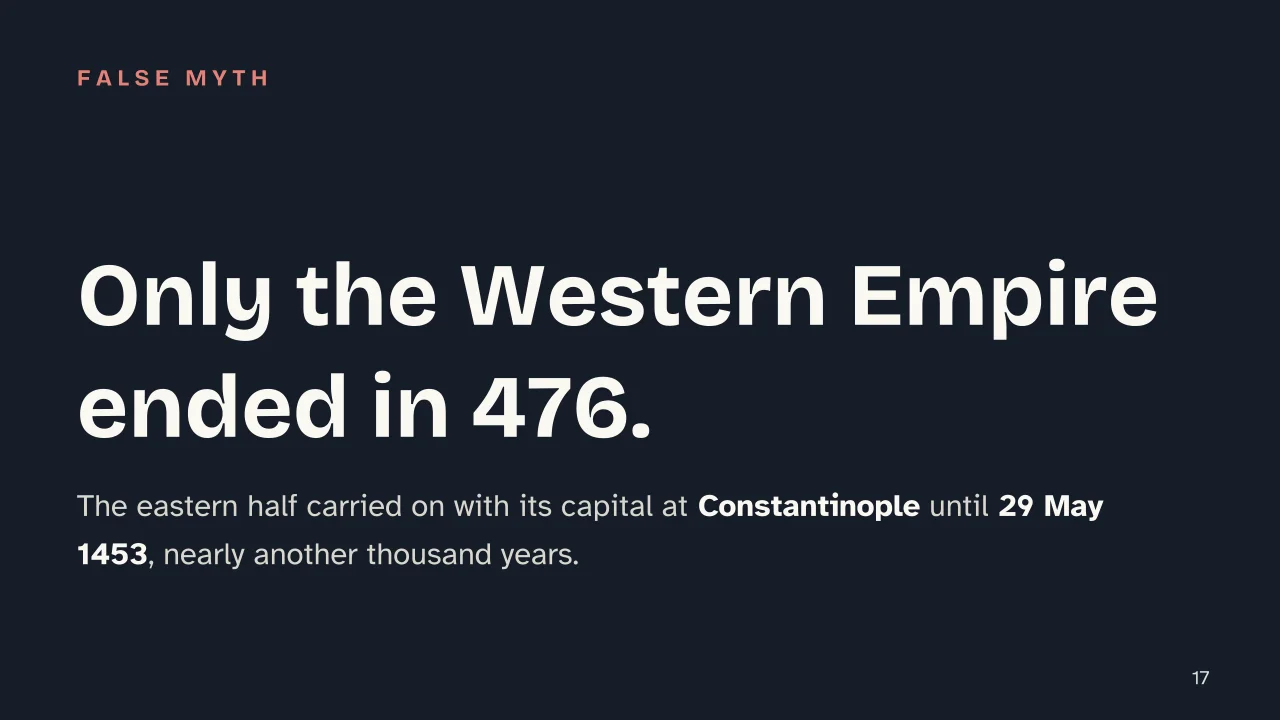 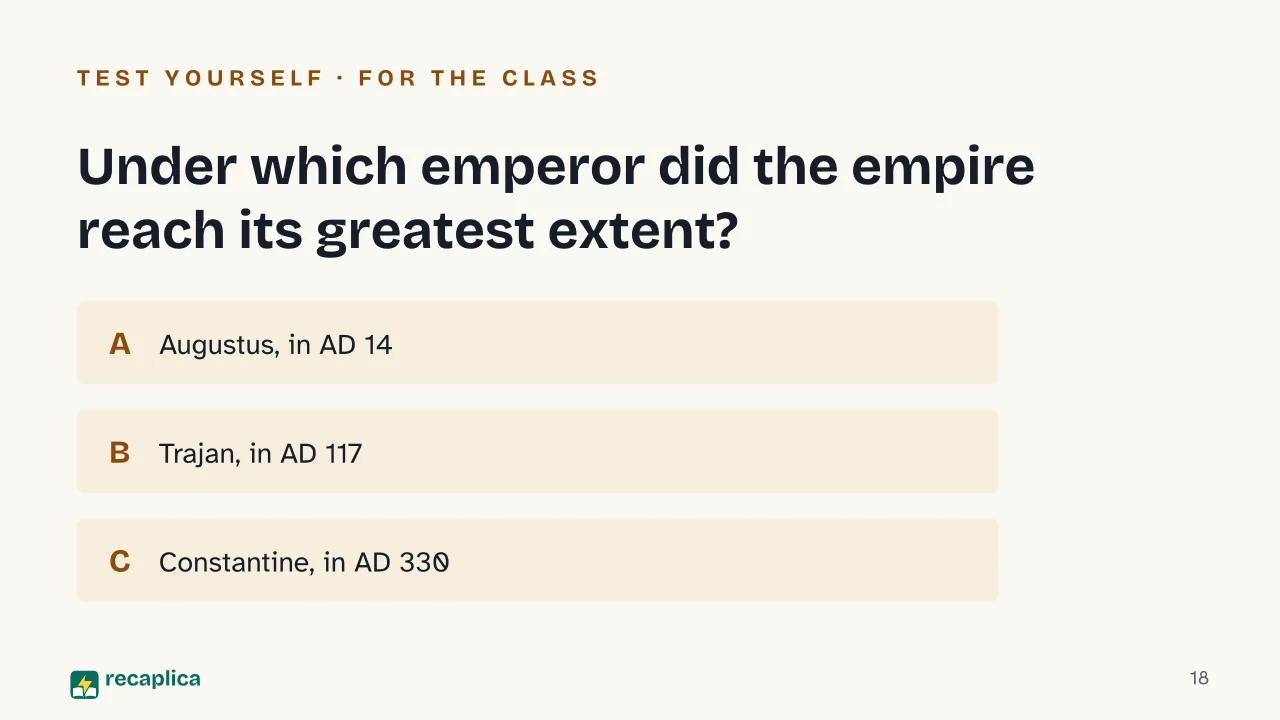  Common myths
Mind mapDrag the background to move around and the nodes to reposition them; use − and + to collapse and expand branches. 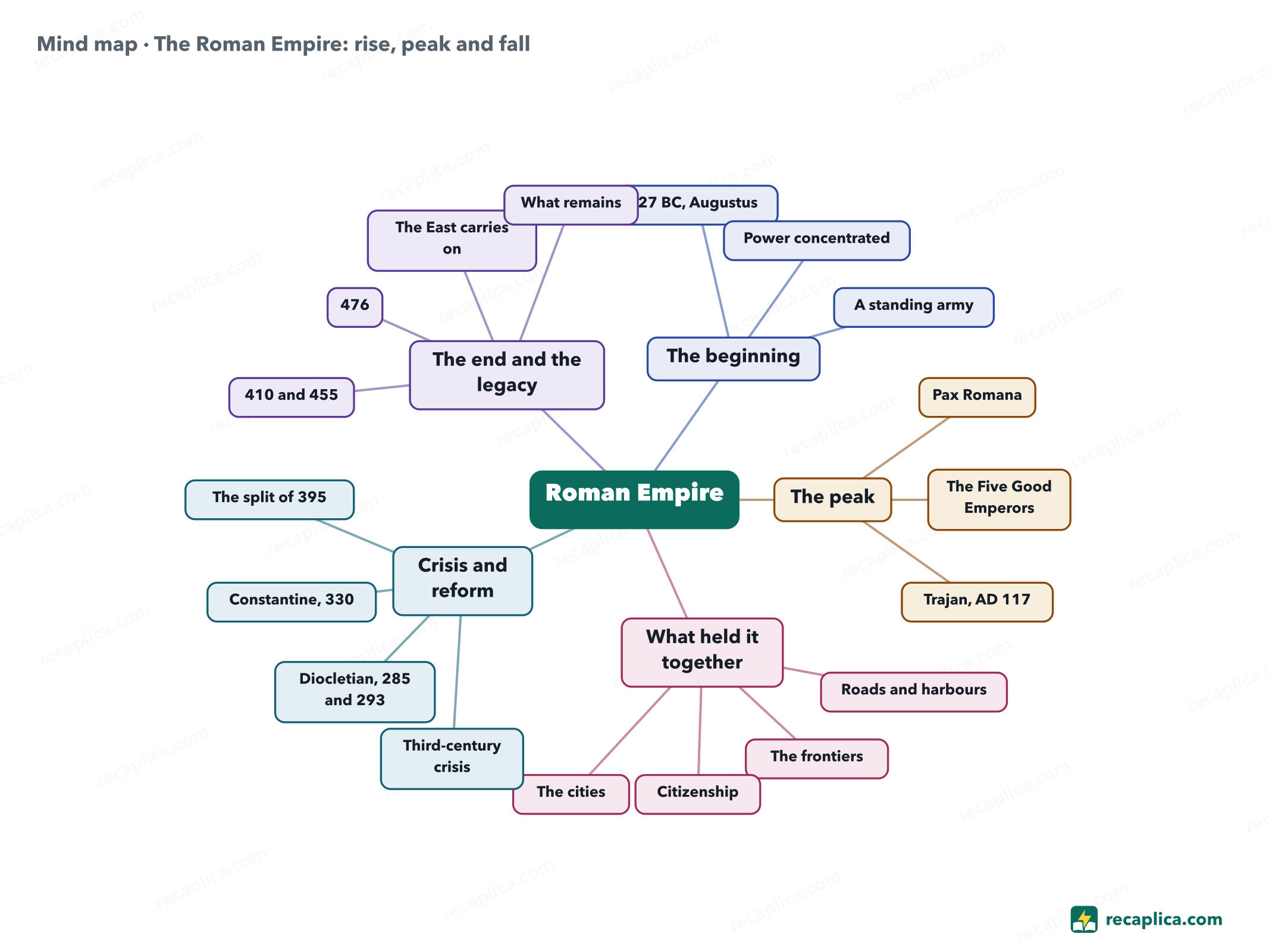
Quiz: test yourselfAnswer the questions to check what you have learned: you get instant feedback and a short explanation. Grade 0/10 0/5
FlashcardsTap the card to flip it and check whether you remember the answer, then move to the next one. 1 / 8 Explain it in your own wordsThe ultimate test: if you can explain it in simple words, you've truly understood it. Write your explanation, then compare it with the Recap. Your explanation is saved only on this device.
Frequently asked questionsHow long did the Roman Empire last?It depends which half you look at. The Western Empire runs from 27 BC to AD 476, about five centuries. The Eastern one, with its capital at Constantinople from 330, lasts until 1453: nearly a thousand years longer. The people living in it did not think of it as a different empire, but as the same state carrying on. Why did the Western Roman Empire fall?Not for one single reason. Historians point to factors that pile up over time: the long instability of the third-century crisis, the difficulty of defending a frontier thousands of kilometres long, pressure from peoples on the borders, the rising cost of the army and the administration. The sacks of Rome in 410 and 455 were symptoms, not the cause. The 476 deposition is a convenient date: the transformation had already happened. What is the difference between the Roman Republic and the Roman Empire?The Republic spread power across elected magistracies and the Senate. With Augustus, in 27 BC, that power concentrates in one person's hands: the Senate grants him authority over the provinces and tribunician power, which lets him pass laws through the popular assemblies. Republican institutions formally remain, but the final decision belongs to one man. How big was the Roman Empire?At its height, around AD 117, it stretched from northern Britain to the Caspian Sea. In the second century the limes, the frontier line, ran for over 5,000 kilometres and reached the Near East and North Africa. Around AD 100 up to 100 million people lived in it on the highest estimates, on land that today corresponds to some fifty countries. Who were the 'Five Good Emperors'?It is the name historians give to the five rulers who follow one another between AD 96 and 180: Nerva (96-98), Trajan (98-117), Hadrian (117-138), Antoninus Pius (138-161) and Marcus Aurelius (161-180). They coincide with the empire's phase of greatest extent and prosperity. Every Recap goes through an independent review before publication. |