Skip to content
recaplica

    One moment: security check

    Cloudflare wants to make sure you're not a robot. Tick the box below and your search will continue on its own.

    IT
    recaplica The Birth of Venus by Botticelli: What It Shows and What It Means
    © 2026 Recaplica · recaplica.com — All rights reserved
    Home › History

    The Birth of Venus by Botticelli: What It Shows and What It Means

    By Recaplica Newsroom · Updated on September 30, 2026

    What to print

    Page numbers appear when printing with default margins.

    Slides

    Choose a cut

    Flash10 slidesThe essential thread, to present in classFull15 slidesEvery chapter and the deeper detail

    Both come with speaker notes.

    Telegram channel
    recaplica Clear in 30 seconds, yours in 10 minutes.
    In 30 seconds Key points Figures Deep dive Slides Myths Mind map Quiz Flashcards FAQ

    In 30 seconds quick read

    The Birth of Venus is one of Sandro Botticelli's best-known paintings: a tempera on canvas measuring roughly 172.5 by 278.5 centimeters, made around 1485 and now held at the Uffizi Galleries in Florence. It shows the goddess of love just arrived on shore, standing on a giant shell, blown toward land by the wind of Zephyr and welcomed by a figure offering her a cloak. The patron is not documented, though several clues point to the Medici family, and for centuries art historians have also read the painting as an image of Florentine Neoplatonic philosophy, which held that contemplating physical beauty could draw the mind closer to the divine.

    Key Points

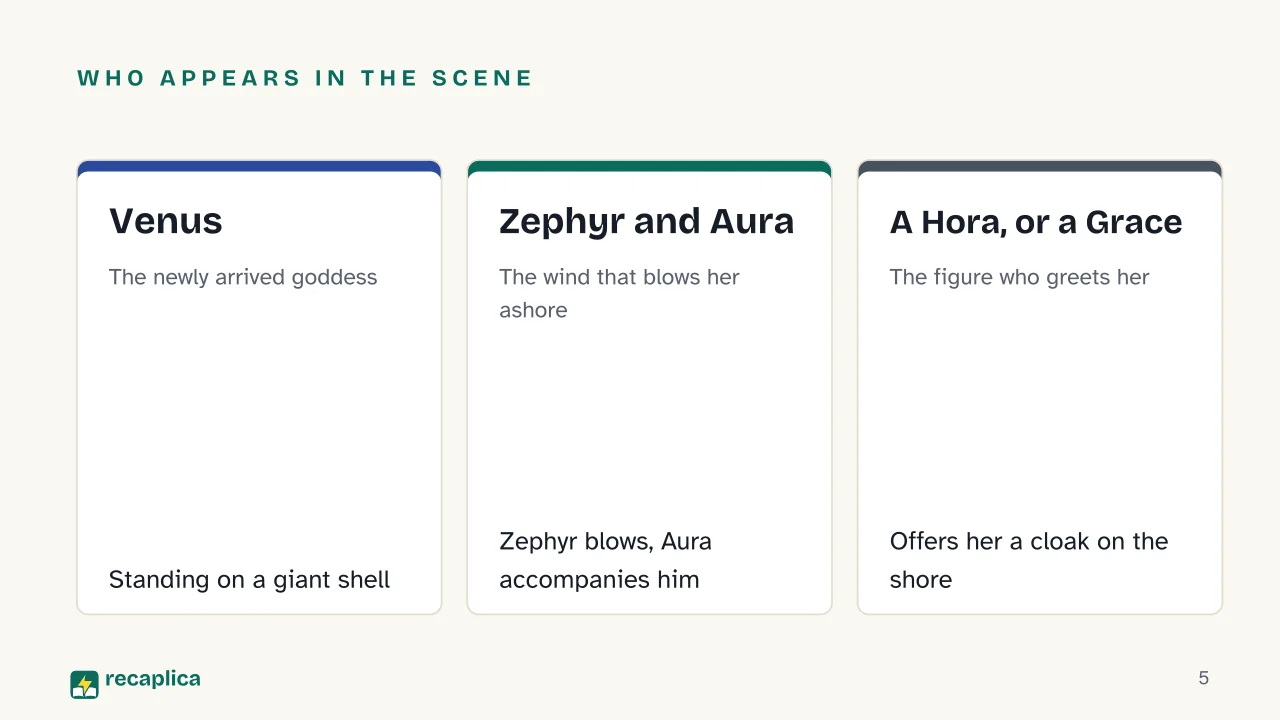
    • The painting shows Venus arriving on land: born from the sea foam, she stands already full-grown on a giant shell, blown ashore by Zephyr (accompanied by a figure called Aura) and greeted by one of the Horae, or Graces, who offers her a cloak.
    • It is a tempera on canvas measuring about 172.5 by 278.5 cm, painted around 1485: canvas was a cheaper support than wood panel, an unusual choice for a work of this importance.
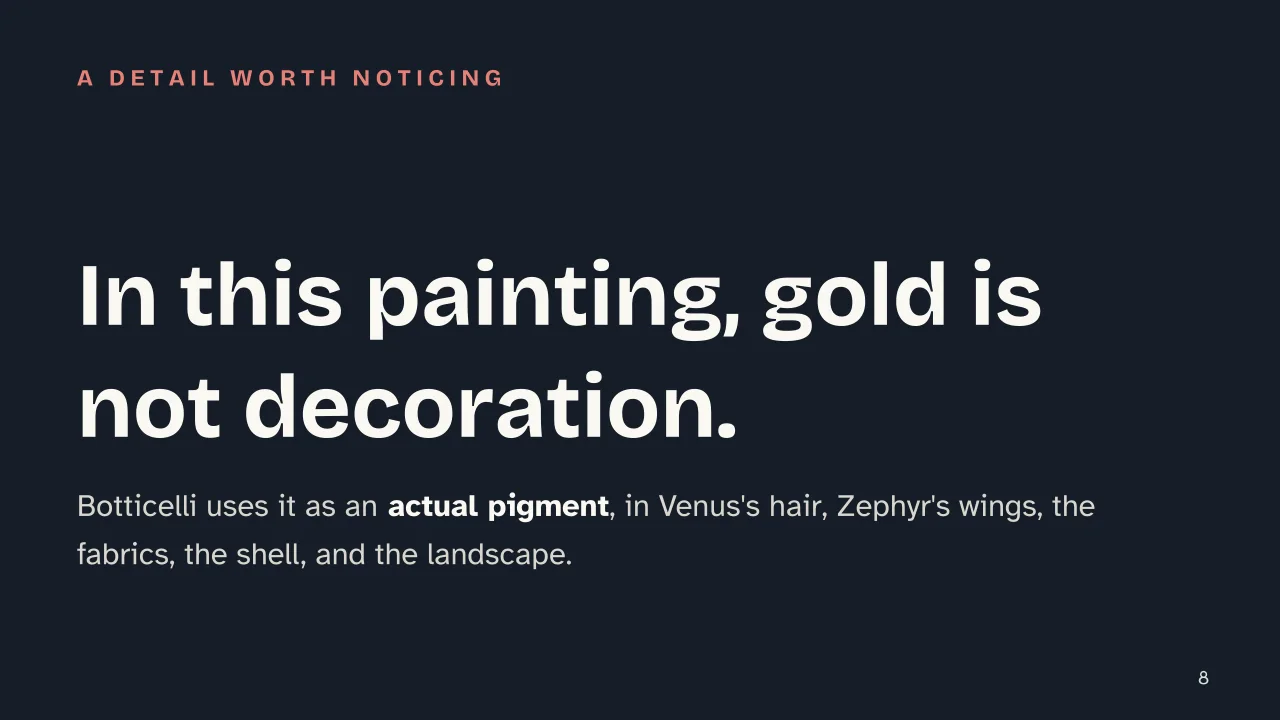
    • Botticelli uses gold as an actual pigment, not just decoration: it appears in Venus's hair, in Zephyr's wings, in the fabrics, on the shell, and in the landscape.
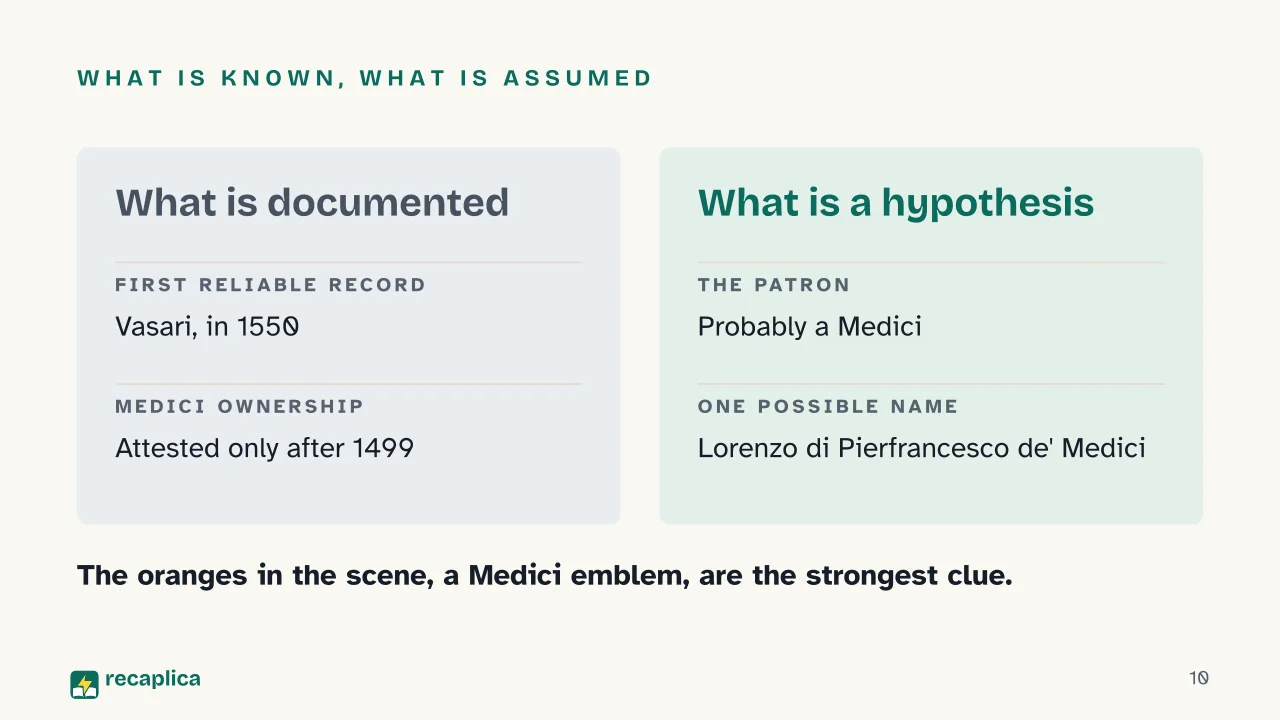
    • The patron is not documented with certainty: the orange trees painted on the shore, considered a Medici emblem, and the name of Lorenzo di Pierfrancesco de' Medici make a Medici connection likely, but the earliest reliable record of the painting dates only to 1550, when Giorgio Vasari describes it in a Medici villa, and documented Medici ownership only begins after 1499.
    • A long-standing reading sees in Venus the Neoplatonic idea that looking at physical beauty helps the mind grasp a higher, spiritual beauty, a theme central to Marsilio Ficino's philosophy in Florence in the second half of the 15th century.
    • Venus's face is sometimes linked to Simonetta Cattaneo Vespucci, but this remains a hypothesis from art-historical tradition, not a documented fact.

    Key figures

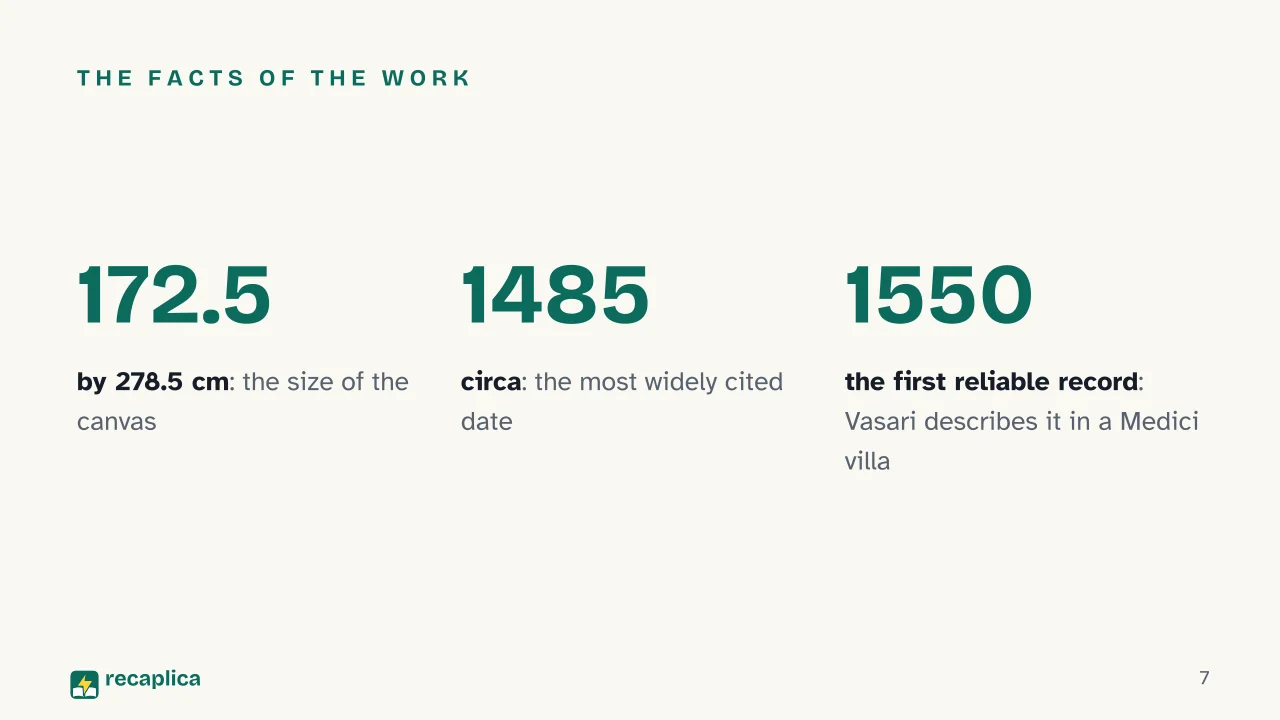
    • 172.5 x 278.5 cm the size of the tempera on canvas, now held at the Uffizi Galleries Source: Uffizi Galleries
    • circa 1485 the most widely cited date for the painting, though no surviving document from the period fixes it precisely Source: Uffizi Galleries
    • 1550 the year of the first reliable record of the work, when Giorgio Vasari describes it in the Medici villa of Castello Source: Uffizi Galleries

    Deep Dive

    A birth that arrives already grown, on a shell

    The painting captures a precise moment from the myth: the arrival on land of Venus, the goddess of love and beauty, born from the foam of the sea. As classical tradition demands, she appears already full-grown, standing on a giant shell that serves as an improvised boat.

    Wind pushes her toward the shore. On the left, a pair of figures blows toward Venus: it is Zephyr, accompanied by a figure called Aura, a personification of a lighter breeze. On the right, waiting for her on dry land, is a female figure the Uffizi Galleries describe as one of the Horae, the minor Greek goddesses linked to the seasons, or alternatively as one of the Graces: the identification is not settled, but the gesture is clear, as the figure offers Venus a cloak to cover herself.

    The scene closely echoes the birth of Aphrodite as told in the mythology of ancient Greece, where the Horae and the Graces often appear beside the goddess of love. For the pose of Venus’s body, Botticelli looks to even older models: he draws on classical-era statues for the goddess’s stance, a typical gesture of the visual culture of his time, that of the Florentine Renaissance.

    Canvas, not panel: technique and size

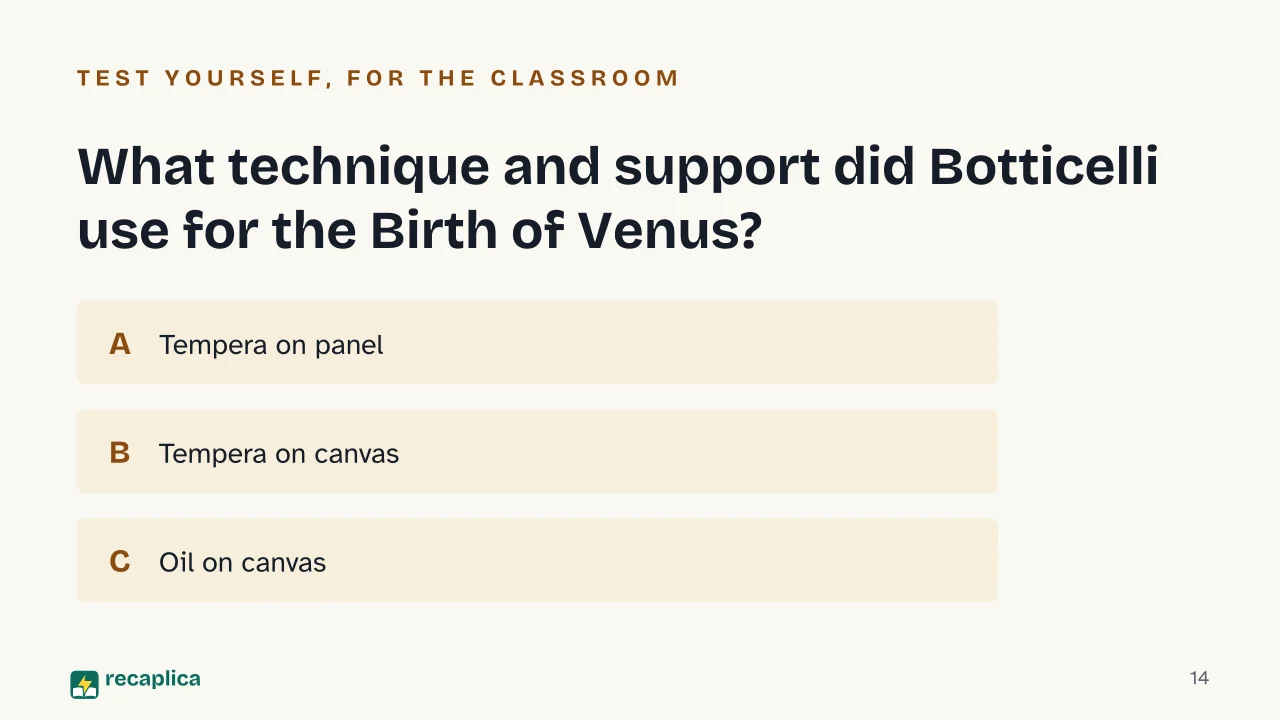
    The Birth of Venus is a tempera on canvas measuring about 172.5 by 278.5 centimeters. In 15th-century Florence, wood panel was the standard support for large-format paintings, and canvas was the cheaper option. Using it for a work of this size and ambition was therefore an unusual decision. Another striking technical element is the use of gold. It is not a decoration applied afterward, but an actual pigment, laid down to catch light at specific points in the composition: Venus’s hair, Zephyr’s wings, some of the fabrics, the shell, and even parts of the landscape. When light strikes it, the painting seems to carry its own, almost metallic glints among the tempera colors.

    Practical example: recognizing this technique helps distinguish early Florentine Renaissance works from later ones: when a painting from that period shows golden highlights concentrated on hair, wings, or the edges of fabric, the artist likely used gold as a pigment rather than as a frame or separate ornament.

    The most widely cited date for the painting is around 1485, but it is worth being precise about what that means: no surviving document from the period fixes the year with certainty. The first reliable record of the work comes much later, in 1550, when the historian and painter Giorgio Vasari describes it in the Medici villa of Castello, near Florence.

    Who commissioned the painting: a hypothesis, not a document

    The question of who wanted the Birth of Venus made has no certain answer.

    It is very likely that the patron should be sought within the Medici family: orange trees appear in the scene, and oranges were considered an emblem of the Florentine dynasty. On this basis, one tradition names Lorenzo di Pierfrancesco de’ Medici, an important supporter of Botticelli.

    This reconstruction rests on clues, not on a surviving commission document. The painting first appears in written sources only in 1550, with Vasari, and research into its history shows that Medici ownership of the work is documented only from after 1499: a stretch of time, between the presumed date of execution and the first firm evidence, during which the painting’s whereabouts remain unclear.

    The Neoplatonic meaning: beauty as a path toward the divine

    Beyond its mythological subject, the Birth of Venus has long been read as a philosophical image as well. The key is the Neoplatonism that, in Florence in the second half of the 15th century, finds its central figure in Marsilio Ficino. For Ficino, love is, at bottom, a desire for beauty: looking at something beautiful stirs a movement in the mind that, if followed through, can lead beyond physical beauty toward a higher, spiritual one.

    Ficino’s philosophy describes a general idea about beauty and love, and does not comment directly on Botticelli’s work: it is later critical tradition that applied that theory to the figure of Venus, reading in the goddess’s nude body an occasion for contemplation that, according to the Neoplatonic scheme, should carry the gaze, and the mind, beyond the surface. Ficino’s teaching, moreover, did not take place in a formal institution with a fixed seat: it was an informal circle of students whom the philosopher instructed when he could, closer to a study group than to an academy in the modern sense.

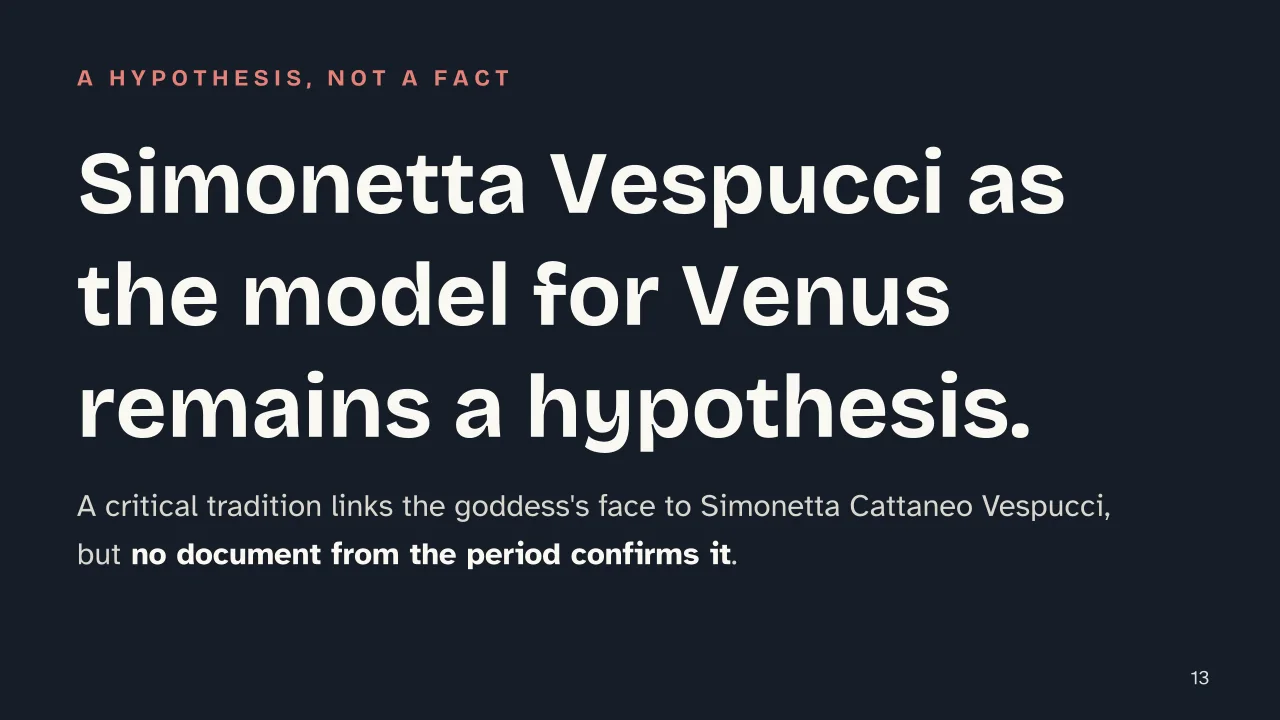
    There is also a narrower connection, concerning only Venus’s face: one tradition links it to Simonetta Cattaneo Vespucci, a Florentine noblewoman celebrated for her beauty. No source contemporary with Botticelli confirms it, and no document ties her face to the painting: it is an attribution built by later critics on the woman’s fame.

    One further, more literary connection concerns the closeness between Botticelli’s paintings and the poetry of his time: the Treccani encyclopedia entry on Botticelli notes an affinity between the Birth of Venus, together with the Primavera, and the poetry of Angelo Poliziano, the court poet tied to the Medici. The entry mentions the connection in a single line and does not elaborate on it.

    Where the painting is today

    The Birth of Venus is held at the Uffizi Galleries in Florence, in Room A12, dedicated to the works of Sandro Botticelli. It is there that the painting is displayed and studied, alongside other works by the Florentine painter: readers who want to learn about the rest of his output and his life can continue with Sandro Botticelli’s life and works.

    Slide deck

    Slides ready to download and make your own in PowerPoint or Google Slides, with speaker notes. Pick the Flash cut or the Full one.

    Slide 1 of the presentation on The Birth of Venus by Botticelli: The Birth of VenusSlide 2 of the presentation on The Birth of Venus by Botticelli: Why does Venus arrive already full-grown, on a shell?Slide 3 of the presentation on The Birth of Venus by Botticelli: What we will coverSlide 4 of the presentation on The Birth of Venus by Botticelli: Chapter 01: The scene and its figuresSlide 5 of the presentation on The Birth of Venus by Botticelli: Who appears in the scene: Venus, Zephyr and Aura, A Hora, or a GraceSlide 6 of the presentation on The Birth of Venus by Botticelli: Chapter 02: Technique and sizeSlide 7 of the presentation on The Birth of Venus by Botticelli: The facts of the workSlide 8 of the presentation on The Birth of Venus by Botticelli: In this painting, gold is not decoration.Slide 9 of the presentation on The Birth of Venus by Botticelli: Chapter 03: Who commissioned itSlide 10 of the presentation on The Birth of Venus by Botticelli: What is known, what is assumedSlide 11 of the presentation on The Birth of Venus by Botticelli: Chapter 04: What the painting meansSlide 12 of the presentation on The Birth of Venus by Botticelli: Why would looking at Venus's beauty draw the soul closer to the divine?Slide 13 of the presentation on The Birth of Venus by Botticelli: Simonetta Vespucci as the model for Venus remains a hypothesis.Slide 14 of the presentation on The Birth of Venus by Botticelli: What technique and support did Botticelli use for the Birth of Venus?Slide 15 of the presentation on The Birth of Venus by Botticelli: Now, time to review
    Flash10 slidesThe essential thread, to present in classFull15 slidesEvery chapter and the deeper detail

    Common myths

    • ✗ Myth Venus's face is definitely Simonetta Vespucci's.

      ✓ Reality No document from the period confirms this. The idea grows out of Simonetta Cattaneo Vespucci's fame as a Florentine beauty of her time and has circulated for a long time in critical tradition.

    • ✗ Myth The painting is certainly a Medici commission, backed by a surviving document.

      ✓ Reality It is a very likely hypothesis, supported by clues such as the orange trees painted in the scene (a family emblem), but no surviving document confirms it directly. The earliest reliable record of the work dates to 1550, when Vasari describes it already in a Medici villa, and Medici ownership is only documented from after 1499.

    • ✗ Myth It is an oil painting, like most great Renaissance works seen in museums today.

      ✓ Reality It is a tempera on canvas. Canvas, moreover, was a cheaper support than a wood panel, and it was unusual to use it for a work of this importance.

    Mind map

    Drag the background to move around and the nodes to reposition them; use − and + to collapse and expand branches.
    Customize
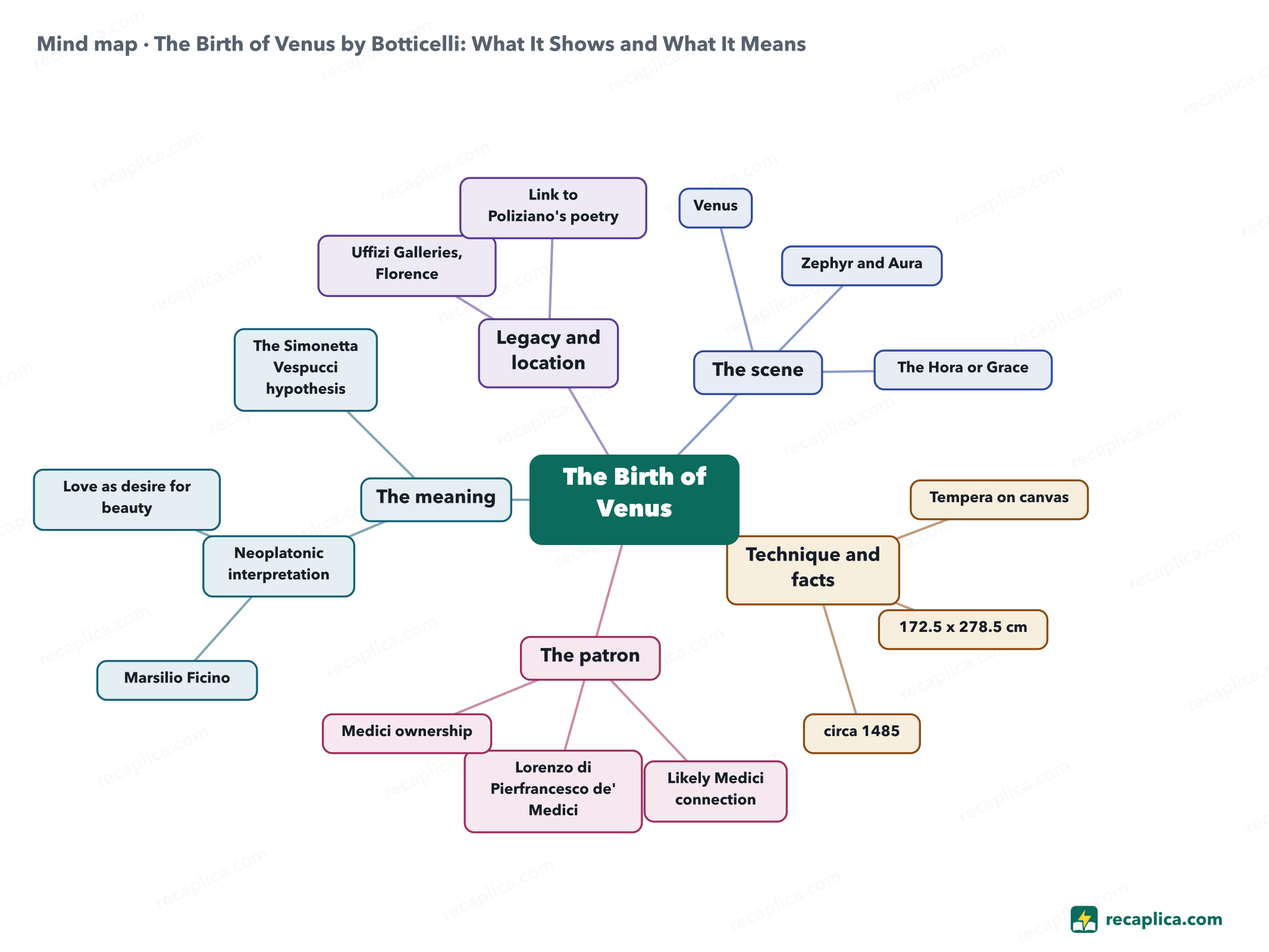
    Mind map: The Birth of Venus by Botticelli: What It Shows and What It Means
    • The Birth of Venus
      • The scene
        • Venus Born from the sea foam, on a shell
        • Zephyr and Aura Blow her toward shore with the wind
        • The Hora or Grace Offers her a cloak on the shore
      • Technique and facts
        • Tempera on canvas A cheaper support for such an important work
        • 172.5 x 278.5 cm
        • circa 1485 First reliable record only in 1550, by Vasari
      • The patron
        • Likely Medici connection The oranges in the scene, a family emblem
        • Lorenzo di Pierfrancesco de' Medici A name from tradition; no document attests it
        • Medici ownership Documented only after 1499
      • The meaning
        • Neoplatonic interpretation Physical beauty as a path to spiritual beauty
          • Marsilio Ficino 15th-century Florentine philosopher
          • Love as desire for beauty
        • The Simonetta Vespucci hypothesis Venus's face, an undocumented link
      • Legacy and location
        • Uffizi Galleries, Florence Room A12
        • Link to Poliziano's poetry Affinity noted by critics in a single line

    Quiz: test yourself

    Answer the questions to check what you have learned: you get instant feedback and a short explanation.

    Grade 0/10 0/5
    1 What does the central scene of the Birth of Venus depict?

    Venus, already full-grown, stands on a giant shell; Zephyr (with Aura) blows her toward shore, and one of the Horae or Graces welcomes her with a cloak.

    2 What support and technique did Botticelli use for the painting?

    The painting is a tempera on canvas, a cheaper support than wood panel, and in 15th-century Florence it was unusual to see it under a work of this importance.

    3 True or false: a document from 1485 proves with certainty who commissioned the painting.

    False: the patron remains a hypothesis. The earliest reliable record dates to 1550, when Vasari describes the painting in a Medici villa, and documented Medici ownership only begins after 1499.

    4 In brief, what does the Neoplatonic reading of the painting argue?

    It is the idea, rooted in Marsilio Ficino's philosophy in Florence, that contemplating physical beauty draws the soul closer to the divine; a long-standing reading applies this idea to Botticelli's Venus.

    5 What is the relationship between the painting and Simonetta Cattaneo Vespucci?

    The source that reports this hypothesis describes it as speculative: no document links Venus's face to Simonetta Vespucci.

    Answers: 1-A · 2-C · 3-B · 4-B · 5-B

    Flashcards

    Tap the card to flip it and check whether you remember the answer, then move to the next one.

    1 / 8

    Explain it in your own words

    The ultimate test: if you can explain it in simple words, you've truly understood it. Write your explanation, then compare it with the Recap.

    Your explanation is saved only on this device.

    The Birth of Venus is one of Sandro Botticelli's best-known paintings: a tempera on canvas measuring roughly 172.5 by 278.5 centimeters, made around 1485 and now held at the Uffizi Galleries in Florence. It shows the goddess of love just arrived on shore, standing on a giant shell, blown toward land by the wind of Zephyr and welcomed by a figure offering her a cloak. The patron is not documented, though several clues point to the Medici family, and for centuries art historians have also read the painting as an image of Florentine Neoplatonic philosophy, which held that contemplating physical beauty could draw the mind closer to the divine.

    Frequently asked questions

    Where is the Birth of Venus located?

    At the Uffizi Galleries in Florence, in Room A12, dedicated to Sandro Botticelli.

    What does the Birth of Venus depict?

    The arrival on land of the goddess Venus, just born from the sea foam. She is already full-grown, standing on a giant shell; the wind of Zephyr, accompanied by a figure called Aura, blows her toward shore, where one of the Horae or Graces greets her with a cloak.

    Who commissioned the Birth of Venus?

    It is not documented with certainty. The patron was most likely a member of the Medici family, partly because the orange trees painted in the scene were a Medici emblem, and one tradition names Lorenzo di Pierfrancesco de' Medici; but the earliest reliable record of the painting is from 1550, when Vasari describes it, already in a Medici villa; ownership by the Medici is documented only from after 1499.

    What does the Birth of Venus mean?

    Beyond its mythological subject, the painting has long been read as an image of the Neoplatonic philosophy of Marsilio Ficino, its central figure in Florence in the second half of the 15th century: the idea that contemplating physical beauty is a first step toward drawing the soul closer to a higher, spiritual beauty. It is a widespread reading among art historians; Botticelli himself left no written instruction to that effect.

    Is Venus's face modeled on Simonetta Vespucci?

    For a long time the idea has circulated that the face is Simonetta Cattaneo Vespucci's, a Florentine noblewoman known for her beauty. No document from the period confirms it: the connection was proposed by critical tradition, at a later date than Botticelli.

    Sources

    • Le Gallerie degli Uffizi — scheda opera, "La nascita di Venere"
    • Uffizi Galleries — artwork page, "The Birth of Venus"
    • Treccani, Enciclopedia — Botticèlli, Sandro di Mariano Filipepi detto il
    • Wikipedia (EN) — "The Birth of Venus (Botticelli)"
    • Stanford Encyclopedia of Philosophy — "Marsilio Ficino"

    Every Recap goes through an independent review before publication.

    Every evening, the day's new Recaps on our Telegram channel. Join the channel →

    Keep learning

    • History The Roman Empire: rise, peak and fall The Roman Empire begins in 27 BC, when Octavian takes the name Augustus and becomes the first emperor. Over the following two centuries the Pax Romana holds together a territory that by around AD 100 contains, on the highest estimates, up to 100 million people, across land that today belongs to some fifty countries. The high point is Trajan's reign, which in AD 117 pushes the borders from northern Britain to the Caspian Sea. Then come the long third-century crisis, the administrative split, and in 476 the deposition of the last western emperor. The eastern half, however, does not fall at all: it keeps calling itself the Roman Empire until 1453. Read the Recap →
    • History Botticelli: Life, Style and Major Paintings Sandro Botticelli, born Alessandro di Mariano Filipepi, is one of the defining painters of Quattrocento Florence. He trained in Filippo Lippi's workshop and spent nearly his whole career working for the Medici family, who commissioned paintings that later became famous, including the Primavera. His fine line and distinctive use of color gave shape to mythological and sacred subjects, culminating in the frescoes he painted for the Sistine Chapel in the Vatican. In the final stretch of his career, Girolamo Savonarola's preaching pushed his work toward a darker, more dramatic religiosity. Read the Recap →
    • History Why do we give gifts at Christmas, from Saturnalia to Saint Nicholas Christmas gift-giving brings together customs from different eras. In Roman times the Saturnalia ran from 17 to 23 December, and people gave each other presents and terracotta figurines. Christian tradition has the gifts of the Magi, in the Gospel of Matthew, and Saint Nicholas of Myra, a fourth-century saint who, according to legend, left gold in secret. In the nineteenth century Christmas also became a business, pushed along by publishing, even though the first card, printed in 1843, was judged a commercial flop. The date when gifts arrive still varies from country to country. Read the Recap →

    recaplica

    Clear in 30 seconds, yours in 10 minutes.

    Recaps Mind maps Request a Recap Telegram channel Mind map maker Our method About Privacy & cookies Legal notes & terms of use

    © 2026 Recaplica · A project by Curi S.r.l. — VAT IT05472000750

    Statistics, only if you say so

    To learn which Recaps help most we would use Google Analytics, with aggregate, anonymous data. It starts only with your OK, and you can change your mind anytime. Privacy policy