|
recaplica
Botticelli: Life, Style and Major Paintings | ||||||||||||
| © 2026 Recaplica · recaplica.com — All rights reserved | ||||||||||||
Botticelli: Life, Style and Major PaintingsWhat to print Page numbers appear when printing with default margins. SlidesChoose a cut Flash10 slidesThe essential thread, to present in classFull16 slidesEvery chapter and the deeper detailBoth come with speaker notes. In 30 seconds quick readSandro Botticelli, born Alessandro di Mariano Filipepi, is one of the defining painters of Quattrocento Florence. He trained in Filippo Lippi's workshop and spent nearly his whole career working for the Medici family, who commissioned paintings that later became famous, including the Primavera. His fine line and distinctive use of color gave shape to mythological and sacred subjects, culminating in the frescoes he painted for the Sistine Chapel in the Vatican. In the final stretch of his career, Girolamo Savonarola's preaching pushed his work toward a darker, more dramatic religiosity. Key Points
Deep DiveSandro Botticelli was never actually called Botticelli. His name was Alessandro, known as Sandro, di Mariano Filipepi: the surname we know him by today was his older brother Giovanni’s nickname, “Botticello” (“little barrel”), later passed down to the youngest of the family. Born in Florence, according to Treccani “in 1444 or 1445” (the National Gallery in London uses the same caution, “about 1445”), he died in the same city in 1510. He is one of the most recognizable painters of the Renaissance, and his story is a good window onto Quattrocento Florence: a city that was still, in the shape of its institutions, a medieval Italian city-state, even as its painting, poetry and politics were already changing shape. Filippo Lippi’s workshopAccording to Treccani, Botticelli was a “pupil of Filippo Lippi”; the National Gallery specifies that he entered “the studio of the artist Fra Filippo Lippi.” A workshop, in Quattrocento Florence, was not a school in the modern sense: an established painter took on apprentices, set them to work on the minor details of his own paintings, and gradually let them handle entire compositions on their own. That is where Botticelli learned the trade, before striking out on his own and building his own workshop and clientele. The Medici connectionThat trade, in Florence, was practiced above all in the service of a handful of great families. For Botticelli, the decisive family was the Medici: Treccani writes that “the Medici turned to Botticelli for numerous works,” and the National Gallery is even more direct, noting that “Botticelli in turn spent almost all his life working for the Medici family.” This was not a one-off arrangement but a long-running relationship, inside a world where painting was intertwined with poetry and with the culture of the Medici circle: Treccani observes that some of his works come out “very close to the poetry of Poliziano,” the court poet tied to the Medici, and the Uffizi’s catalogue entry for the Birth of Venus raises the same idea with the same caution, writing that the painting’s subject “was perhaps suggested by the poet Agnolo Poliziano.” None of the sources consulted use the word “Neoplatonism” to describe this connection: it is more accurate to speak of a shared cultural world, that of the Medici circle, than of a philosophical doctrine applied point by point to the paintings. In that same span of decades, in a Florence still dominated by the Medici, political reflections like those in Machiavelli’s The Prince were also taking shape — a sign of how much that city remained a laboratory, in painting as in politics. Major paintings: Primavera and the Birth of VenusBotticelli’s two best-known works are held today at the Uffizi, in Florence. The Primavera, according to the museum’s official catalogue entry, dates to about 1480 (Treccani instead dates it to “about 1478”: the sources differ by a couple of years, without disagreeing on substance or location), and toward the end of the Quattrocento it stood in the house on Via Larga that had belonged to the heirs of Lorenzo di Pierfrancesco de’ Medici, a cousin of Lorenzo the Magnificent. Its meaning, the Uffizi write, “remains a mystery” in its full interpretation, but the painting is nonetheless “a celebration of love, peace, and prosperity.” The Birth of Venus, dated by the Uffizi to about 1485, has a Recap of its own that looks at its imagery and meaning; here it is enough to say that the museum calls it “highly probable” that it was commissioned by a member of the Medici family, while admitting that there is no written trace of the painting before 1550, when Giorgio Vasari described it in the Medici villa of Castello.
The Sistine Chapel frescoesWorking for the Medici did not keep Botticelli in Florence at all times. Treccani recounts that “in 1481 (or 1482) he painted the frescoes in the Sistine Chapel in the Vatican”; the National Gallery adds that he was “summoned by the Pope to Rome to help decorate the walls of the recently completed Sistine Chapel.” It was one of the few public, Roman commissions of a career that otherwise remained deeply Florentine.
The late period, under Savonarola’s influenceToward the end of his career, Botticelli’s style shifted register. Treccani writes that “a dramatic religiosity, which came to Botticelli from Savonarola’s preaching, marks his last works”; the National Gallery confirms that “in his latter years Botticelli became a follower of the fanatical Dominican friar Savonarola.” Girolamo Savonarola preached a strict moral and religious reform in Florence, and his influence on Botticelli shows up in darker paintings, far from the serene subjects of the Primavera. It is a less widely known chapter of his biography, but the one the institutional sources flag most clearly for the final years of his career. Today Botticelli’s works can mostly be seen at the Uffizi, which hold the core of his output, and in the Sistine Chapel, where his Roman frescoes of 1481 remain. Looking at them in sequence, from the Primavera to the last Savonarola-inflected canvases, is probably the most direct way to see how a single painter moved, over the course of one lifetime, through much of the cultural currents of the Florentine Renaissance. Slide deckSlides ready to download and make your own in PowerPoint or Google Slides, with speaker notes. Pick the Flash cut or the Full one.     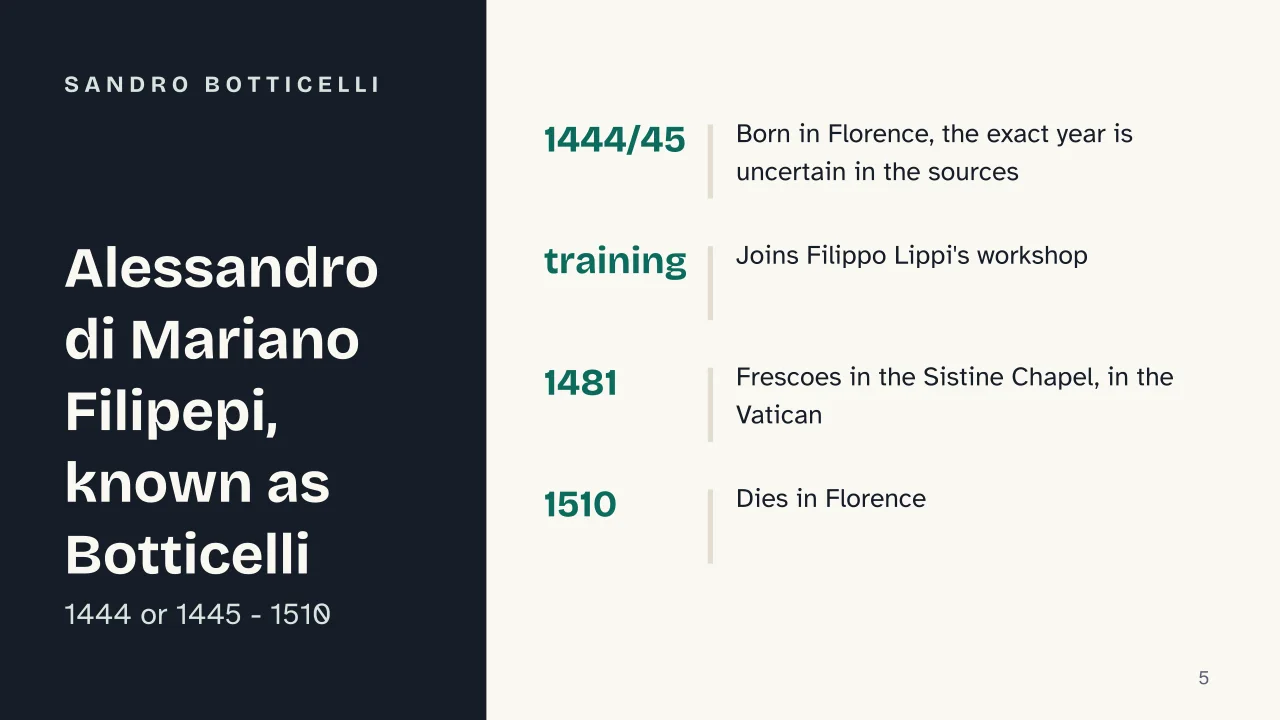  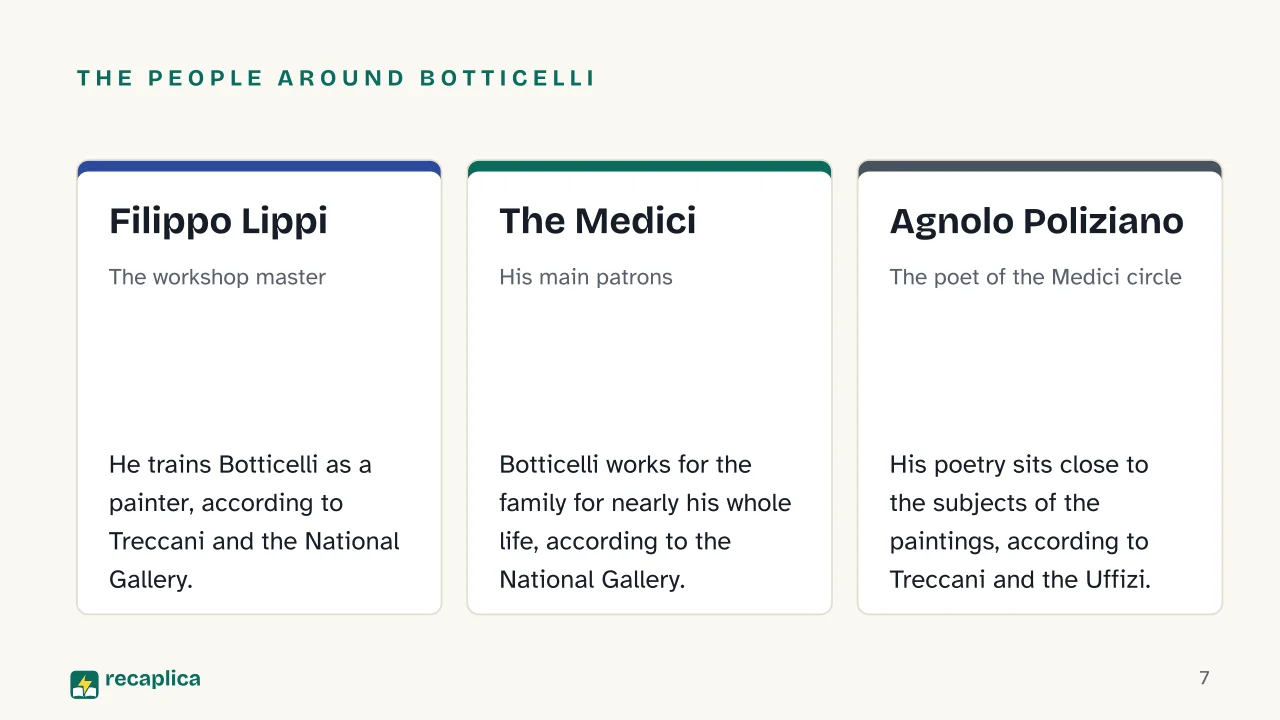  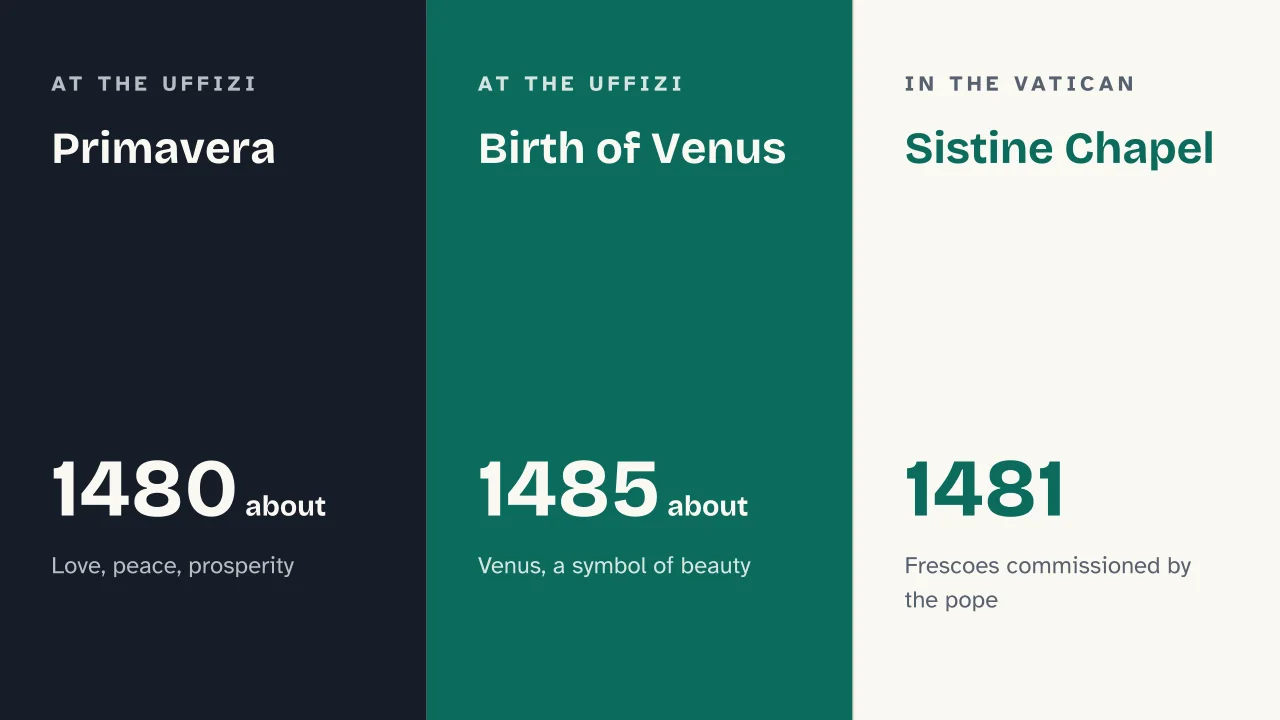 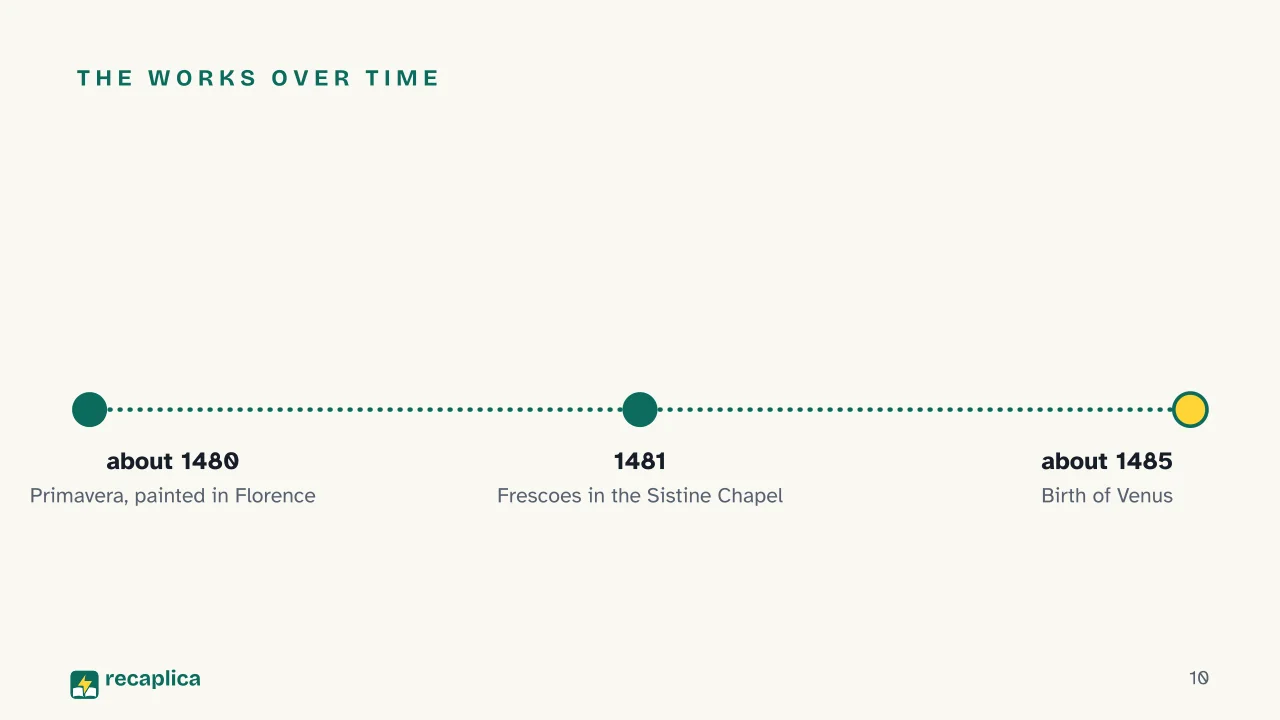 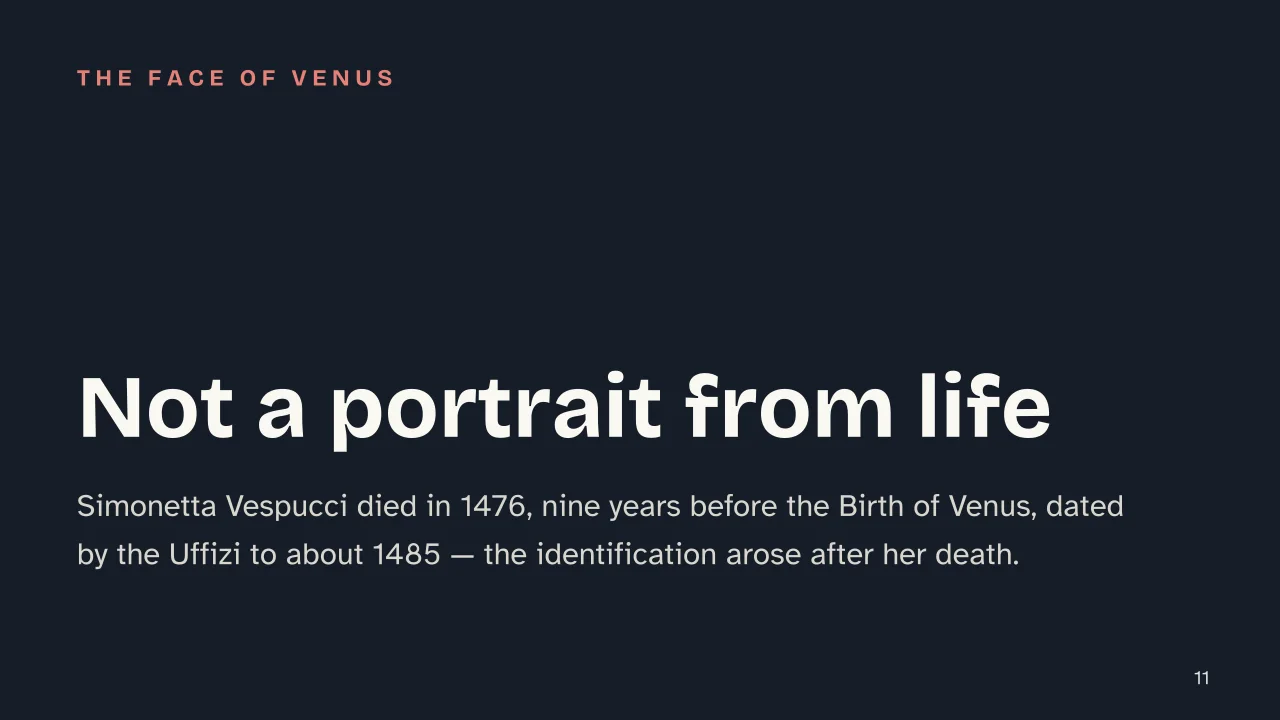 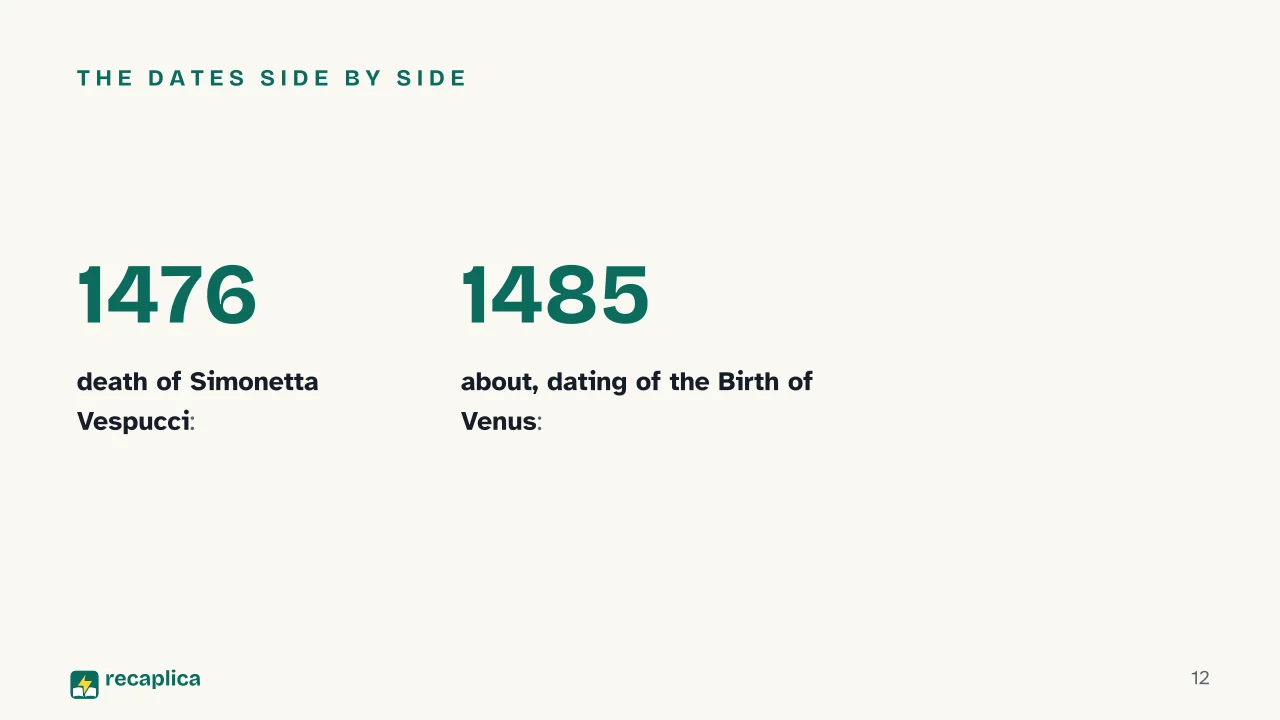  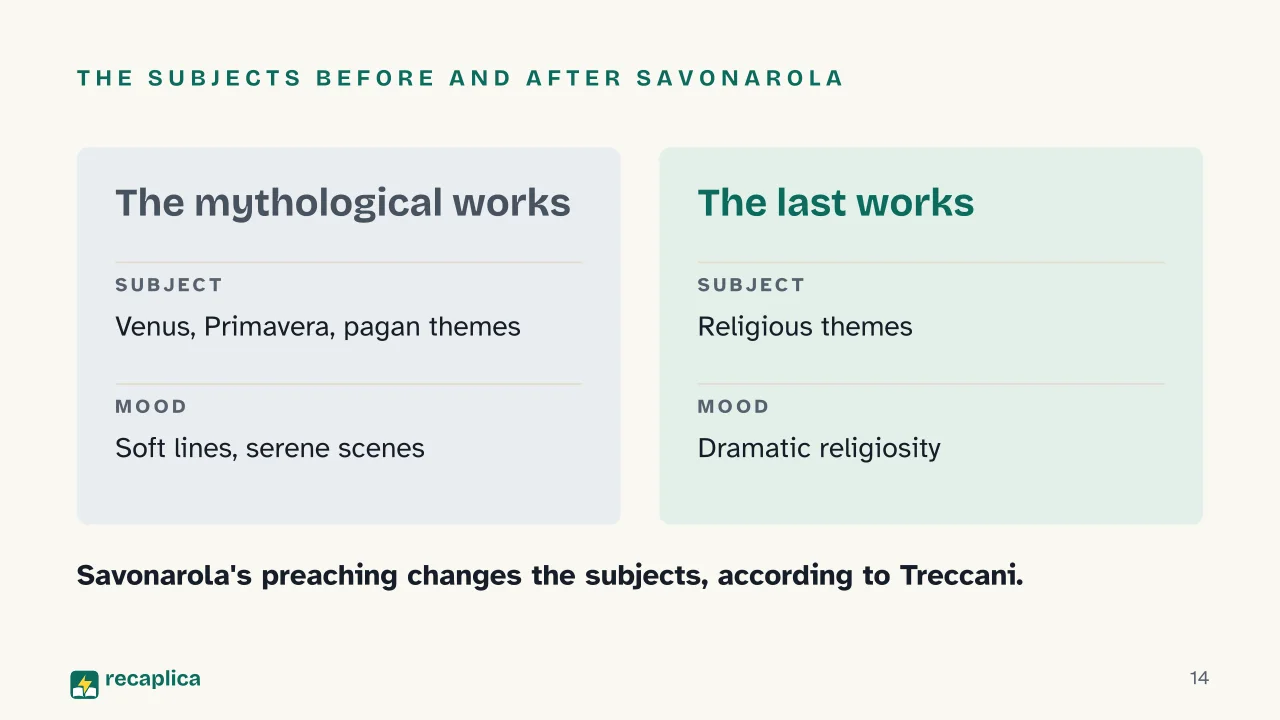 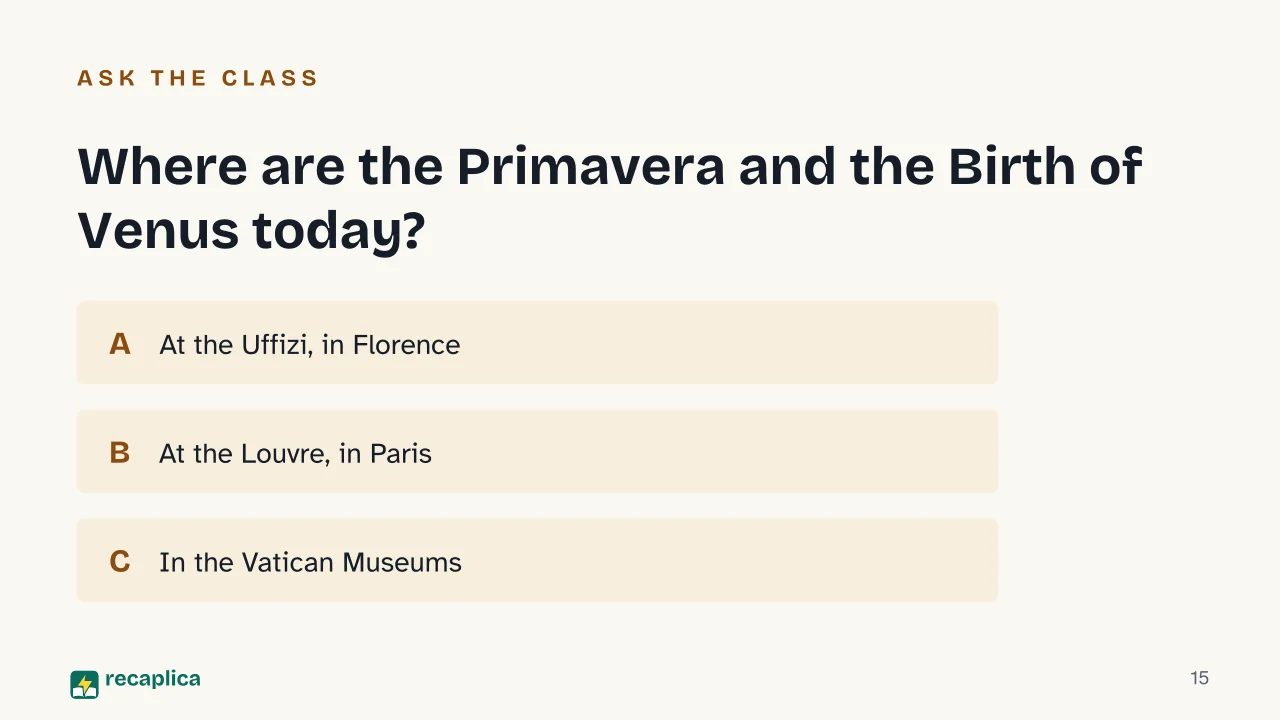  Common myths
Mind mapDrag the background to move around and the nodes to reposition them; use − and + to collapse and expand branches. 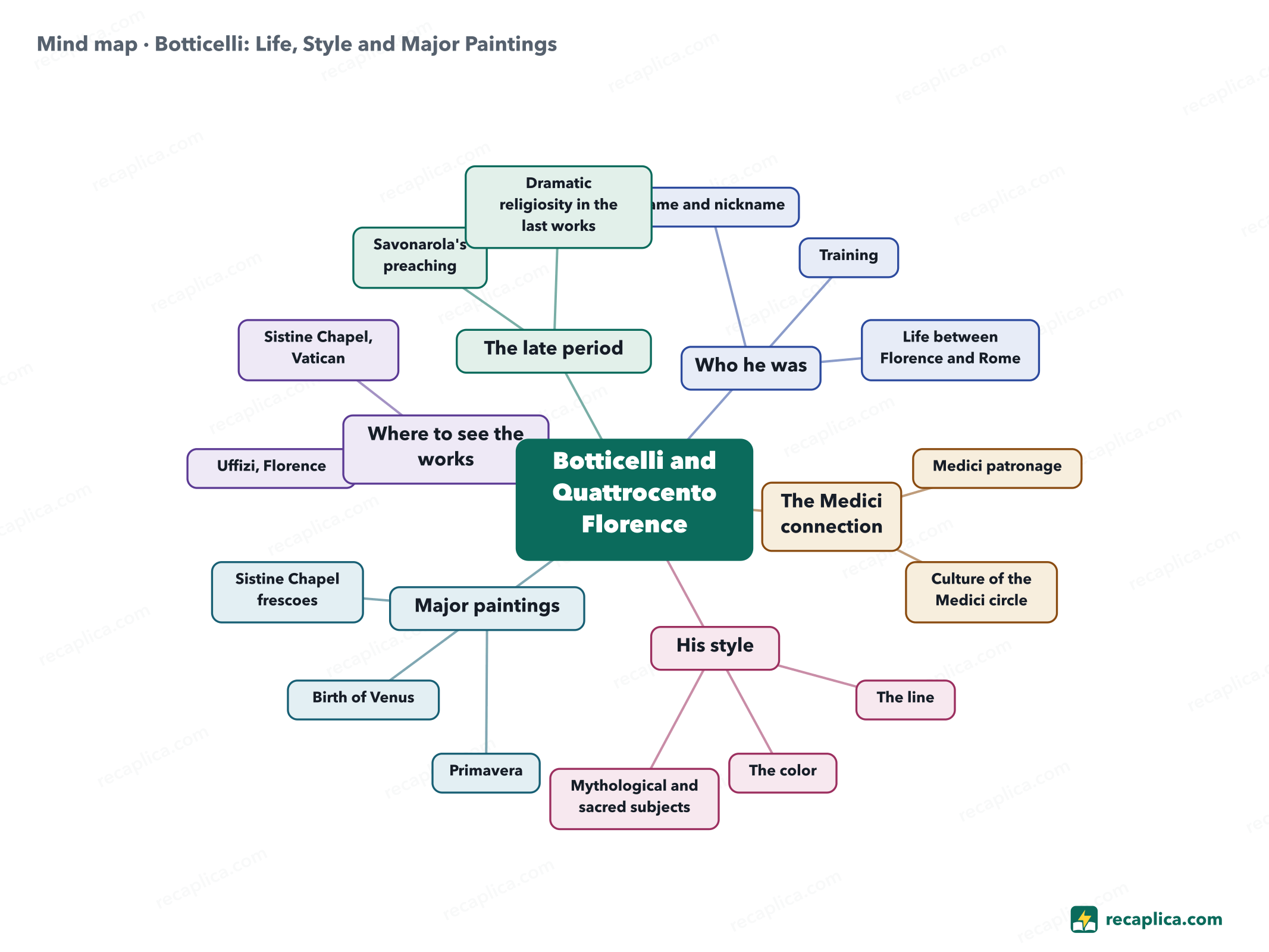
Quiz: test yourselfAnswer the questions to check what you have learned: you get instant feedback and a short explanation. Grade 0/10 0/5
FlashcardsTap the card to flip it and check whether you remember the answer, then move to the next one. 1 / 8 Explain it in your own wordsThe ultimate test: if you can explain it in simple words, you've truly understood it. Write your explanation, then compare it with the Recap. Your explanation is saved only on this device.
Frequently asked questionsWho was Sandro Botticelli?A Florentine painter, born in 1444 or 1445 and who died in 1510, trained in Filippo Lippi's workshop and active for nearly his whole life in the service of the Medici family. Why is he called Botticelli if his name was Filipepi?Botticelli was a family nickname, born with his older brother Giovanni, known as "Botticello," and later stuck to Alessandro. Where are Botticelli's works today?The Primavera and the Birth of Venus are held at the Uffizi, in Florence; the 1481 frescoes are in the Sistine Chapel, in the Vatican. Did Botticelli really paint in the Sistine Chapel?Yes. According to Treccani and the National Gallery, in 1481 he was summoned to Rome to paint frescoes in the recently completed Sistine Chapel. Who is the woman portrayed in the Birth of Venus?A long-standing identification links her to Simonetta Vespucci, which the Uffizi present as a critical tradition built up over time. Simonetta died in 1476, while the painting is dated to about 1485. Every Recap goes through an independent review before publication. |