Skip to content
recaplica

    One moment: security check

    Cloudflare wants to make sure you're not a robot. Tick the box below and your search will continue on its own.

    IT
    recaplica Giambattista Vico: His Philosophy of History Explained
    © 2026 Recaplica · recaplica.com — All rights reserved
    Home › History

    Giambattista Vico: His Philosophy of History Explained

    By Recaplica Newsroom · Updated on October 13, 2026

    What to print

    Page numbers appear when printing with default margins.

    Slides

    Choose a cut

    Flash10 slidesThe essential thread, to present in classFull15 slidesEvery chapter and the deeper detail

    Both come with speaker notes.

    Telegram channel
    recaplica Clear in 30 seconds, yours in 10 minutes.
    In 30 seconds Key points Figures Deep dive Slides Myths Mind map Quiz Flashcards FAQ

    In 30 seconds quick read

    Giambattista Vico was a philosopher from Naples who lived from 1668 to 1744 and spent most of his career teaching rhetoric. In his main work, the New Science, he argued that every nation passes through three stages, one led by religion, one dominated by heroes fighting the common people, and one where shared reason prevails. When this third stage reaches its limit, Vico held that history circles back toward conditions similar to ones already lived through. That idea also gave him a way to break with Descartes, who placed truth in clear and distinct ideas alone.

    Key Points

    • Vico was born and died in Naples (1668-1744) and taught rhetoric at the University of Naples, a chair he won by competition in 1699.
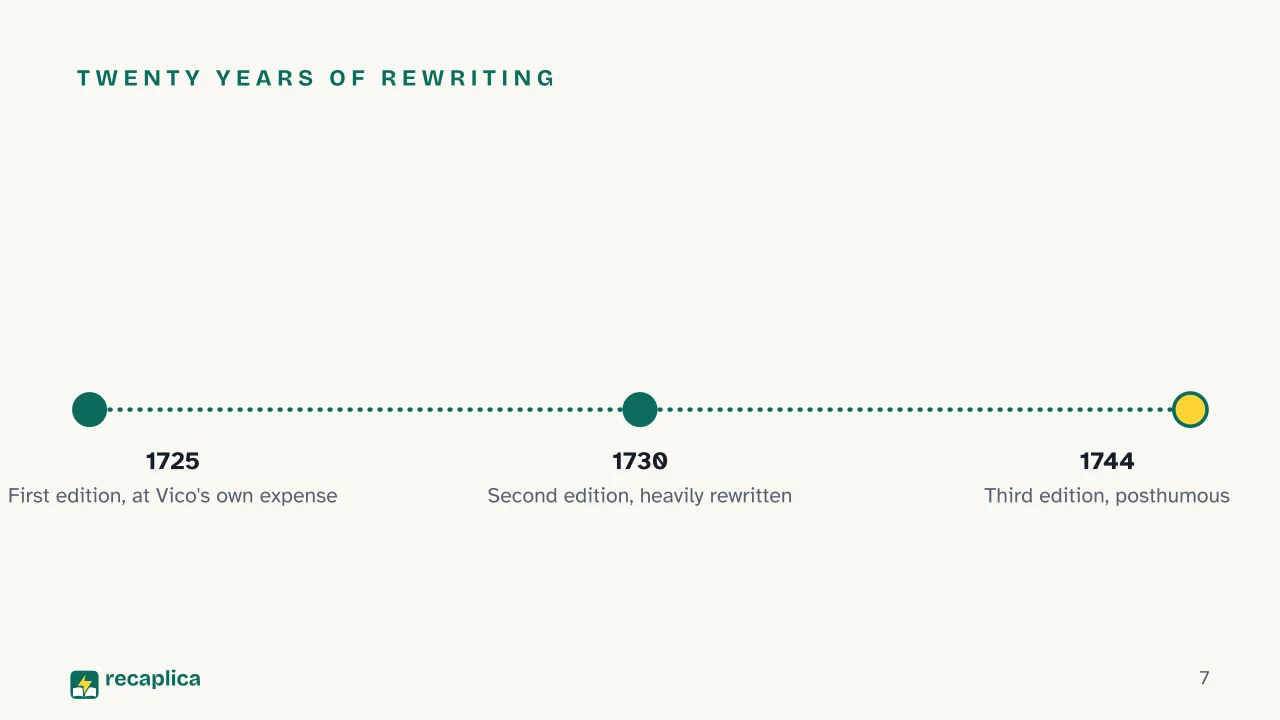
    • His main work, the New Science, came out in 1725 and was rewritten for a second edition in 1730 and a third, posthumous one in 1744.
    • Vico argued that every nation moves through three stages, religious, heroic and rational, before the cycle closes.
    • A recurrence brings back conditions comparable to an earlier stage of the same nation.
    • Vico's principle of verum ipsum factum holds that we truly know only what we ourselves have made, against Descartes's clear and distinct ideas.
    • Vico's ideas found a wide audience only long after his death, mostly during the nineteenth century.

    Key figures

    • 1725 Year the first edition of the New Science was published in Naples, at Vico's own expense Source: Treccani
    • 1730 Year the second, heavily rewritten edition of the New Science appeared Source: Stanford Encyclopedia of Philosophy
    • 1744 Year the third edition came out, after Vico's death earlier that same year Source: Stanford Encyclopedia of Philosophy

    Deep Dive

    Who was Giambattista Vico

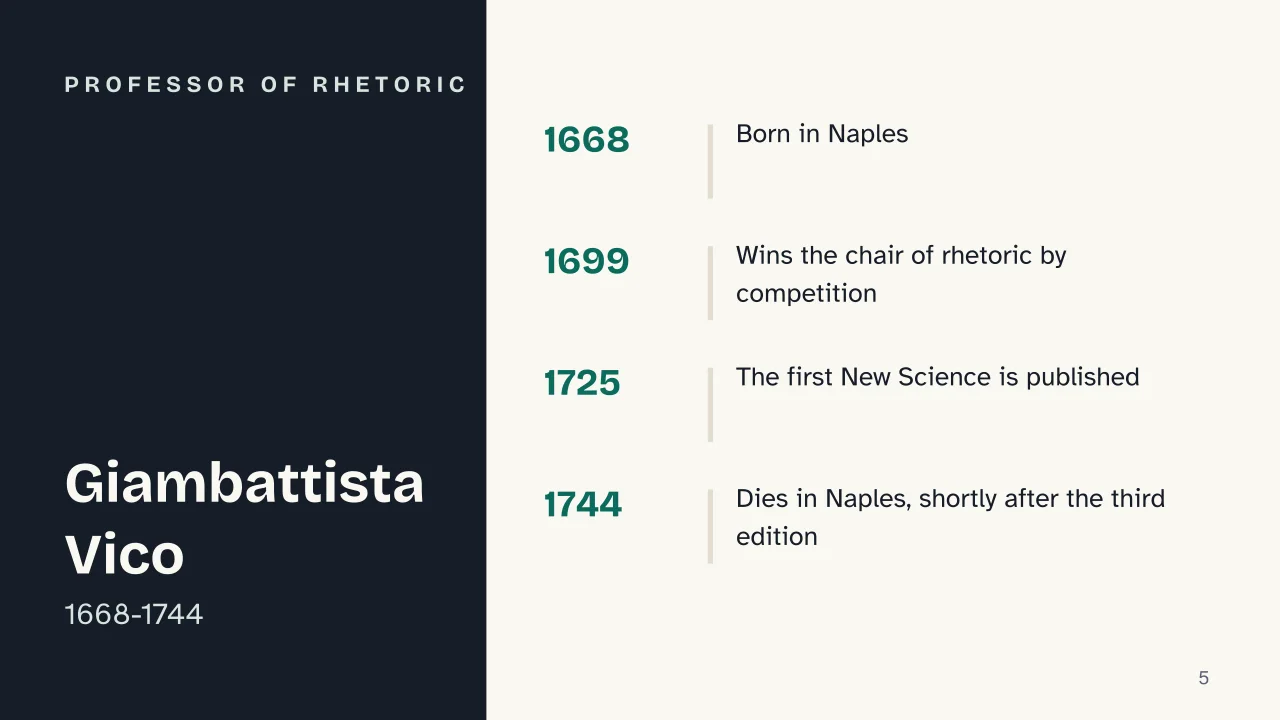
    Giambattista Vico was born and died in Naples, between 1668 and 1744. According to the Stanford Encyclopedia of Philosophy, he taught rhetoric at the University of Naples for most of his professional life, a chair Treccani dates to 1699 and which he won by competition rather than direct appointment. The Internet Encyclopedia of Philosophy reports that he held the post until 1741.

    The pre-Socratic philosophers searched for the arché, the principle behind natural things (Pre-Socratic Philosophers: A Summary of the Search for the Arché). Vico turned the same kind of question toward the history of nations: what makes a civilization rise, grow and decline. That question runs through every page of his main work.

    The New Science: a work written three times

    The New Science, the text in which Vico laid out his view of history, was first published in Naples in October 1725, at his own expense, according to Treccani. A second, heavily rewritten edition appeared between December 1729 and April 1730, and a third came out posthumously in June 1744, shortly after Vico’s death, which the Stanford Encyclopedia of Philosophy places between January 22 and 23 of that year.

    Naples, in the middle of the Baroque period, remained a center of learning that traced back to the Renaissance, where rhetoric, law and philosophy were closely intertwined.

    The three ages of history

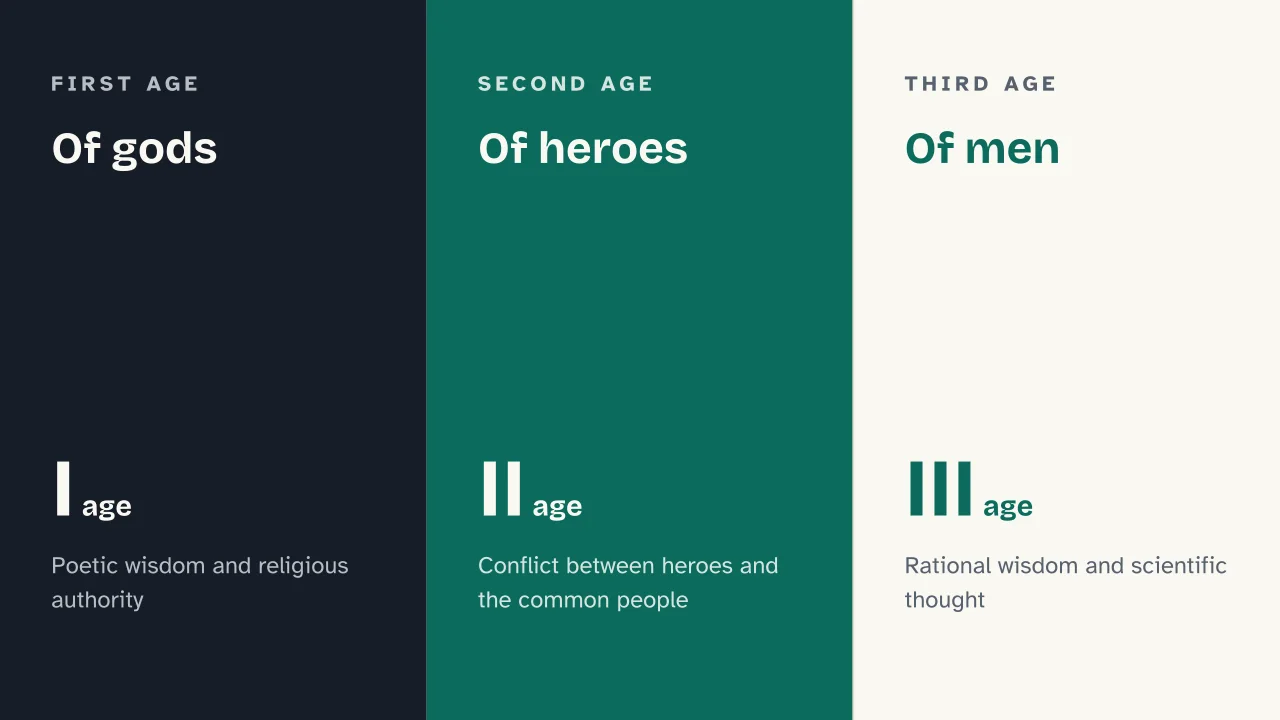
    Vico describes the history of every nation, the Stanford Encyclopedia of Philosophy notes, as a path marked by three ages that follow one another in a constant order of causes and effects: the age of gods, the age of heroes and the age of men.

    AgeWho is in chargeWhat prevails
    Of godsAn aristocracy of “fathers”Poetic wisdom and religious authority
    Of heroesHeroes against commoners claiming privilegesConflict over power
    Of menCommoners, now equal by rightRational wisdom and scientific thought

    The Internet Encyclopedia of Philosophy adds a detail the three-part scheme alone does not capture: within each cycle, people move in sequence from need to utility, to comfort, to pleasure, and finally to indulgence in luxury and ruin.

    Practical example: picture a community that forms around a shared religious authority, what Vico calls the age of gods. Over time a warrior nobility emerges that claims power and clashes with those demanding the same rights, the age of heroes. Eventually the idea prevails that all people are equal by nature and capable of reasoning scientifically, the age of men. For Vico, once even this stage reaches its breaking point, the community finds itself back in conditions comparable to the first age, though on different grounds than before.

    Cycles of history: what it actually means

    This is the mechanism usually summed up as cycles of history, or recurrence; Treccani summarizes it this way: the history of nations unfolds in courses and recurrences, not as a repeat of identical events, but as a return of similar historical forms. The Stanford Encyclopedia of Philosophy adds that, for Vico, society tends toward an ideal progress without ever reaching perfection, because the path is interrupted by a recurrence, a return to a relatively more primitive condition.

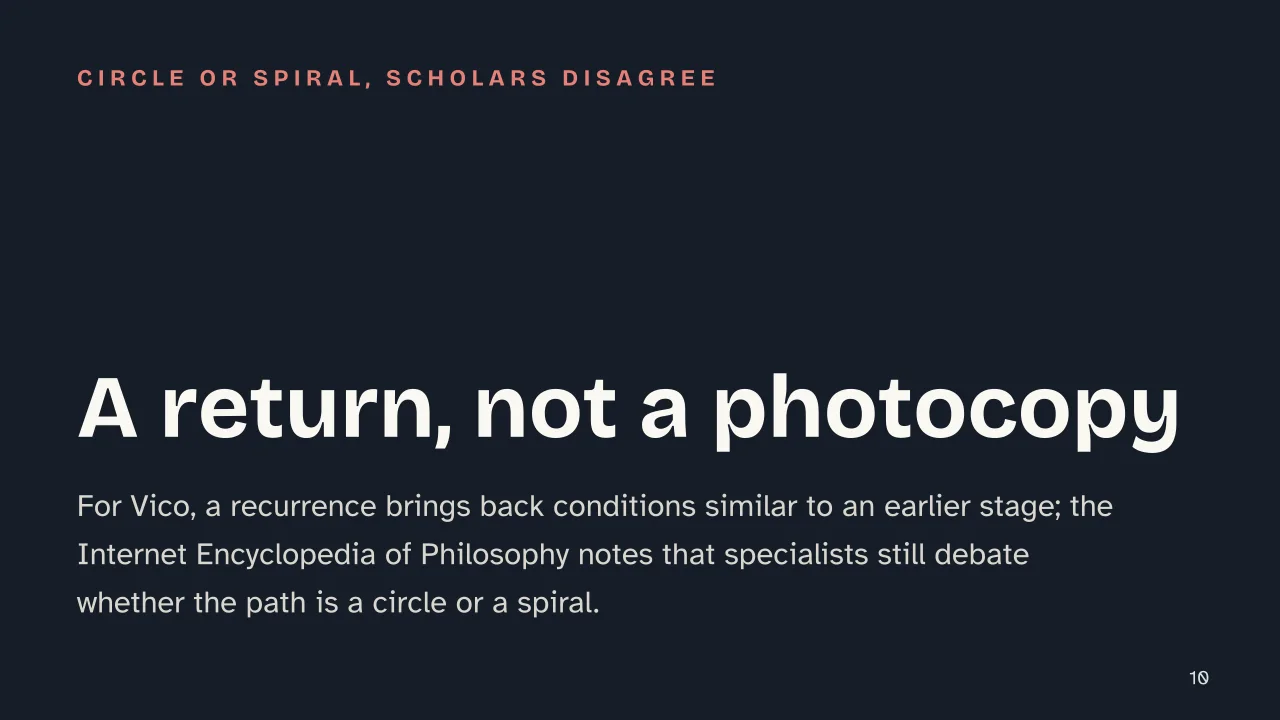
    One point the sources themselves do not fully agree on: the Internet Encyclopedia of Philosophy notes that it remains an open question among Vico scholars whether his historical course should be pictured as a circle closing in on itself or as a spiral that returns to similar forms while still standing further ahead than before.

    Vico against Descartes

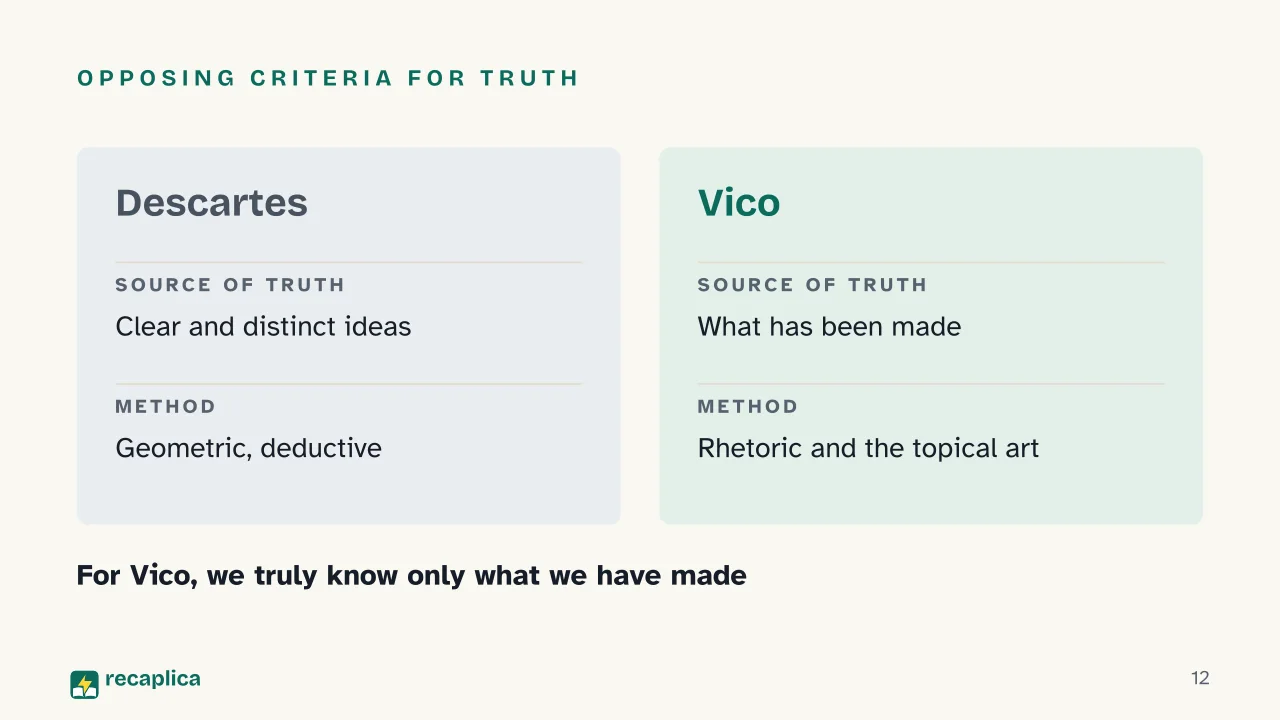
    One of the differences between Vico and his contemporaries concerned the method for reaching truth. Descartes, according to the Stanford Encyclopedia of Philosophy, grounded truth in clear and distinct ideas; Vico rejected that principle and set a different standard against it, verum ipsum factum, truth coincides with what is made, meaning we truly know only what we have produced. Treccani notes that this polemical stance against Descartes grew sharper over the course of his career, up to a rejection of the cogito as the foundation of science. According to the Internet Encyclopedia of Philosophy, this same standard underlay Vico’s defense of rhetoric and the topical art, disciplines rooted in classical Greek philosophy and the debate between Aristotle and Plato, which he considered useful even for developing children’s imagination, against the geometric method Descartes applied to every field of knowledge.

    Vico died in 1744, nearly half a century before the French Revolution helped spread a notion of linear, irreversible progress among European philosophers.

    Vico’s legacy

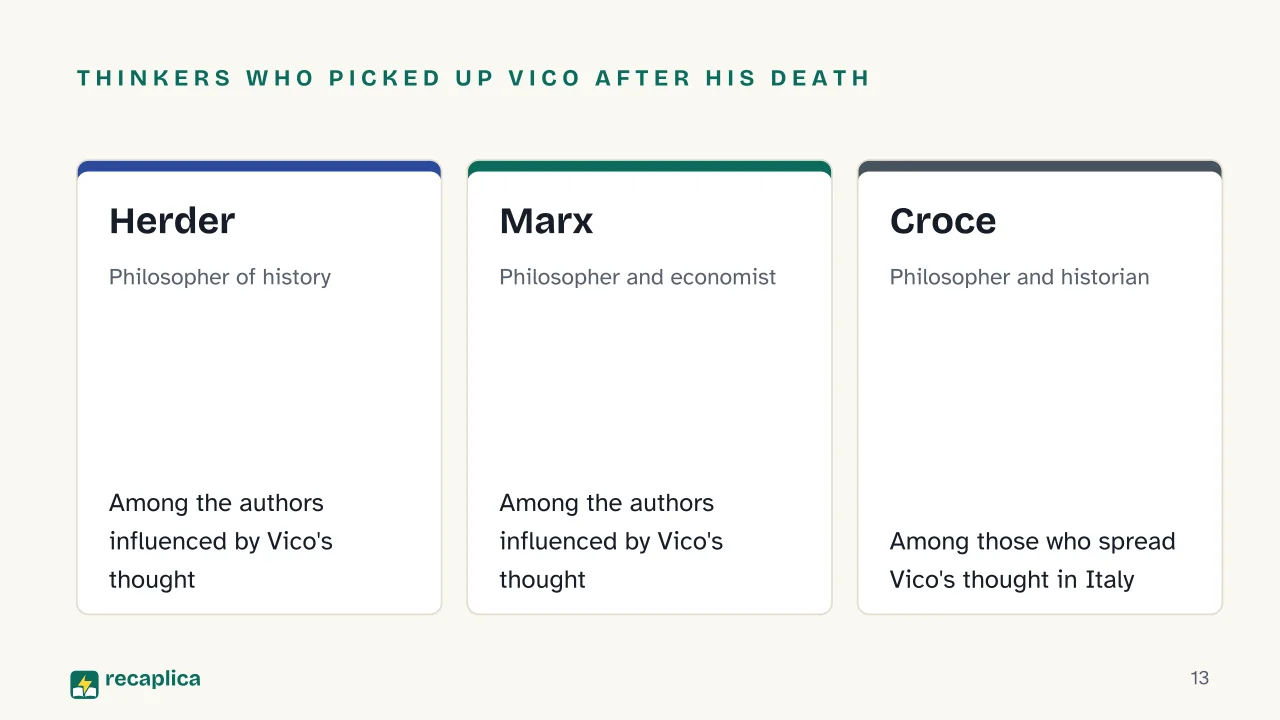
    Vico’s thought did not find a large audience right away. His ideas, the Stanford Encyclopedia of Philosophy notes, reached a wider readership only from the nineteenth century onward, eventually becoming a common reference point in the humanities and social sciences. The Internet Encyclopedia of Philosophy lists among the authors influenced by his writings names such as Herder, Marx, Coleridge, Joyce, Croce, Collingwood and Horkheimer.

    Slide deck

    Slides ready to download and make your own in PowerPoint or Google Slides, with speaker notes. Pick the Flash cut or the Full one.
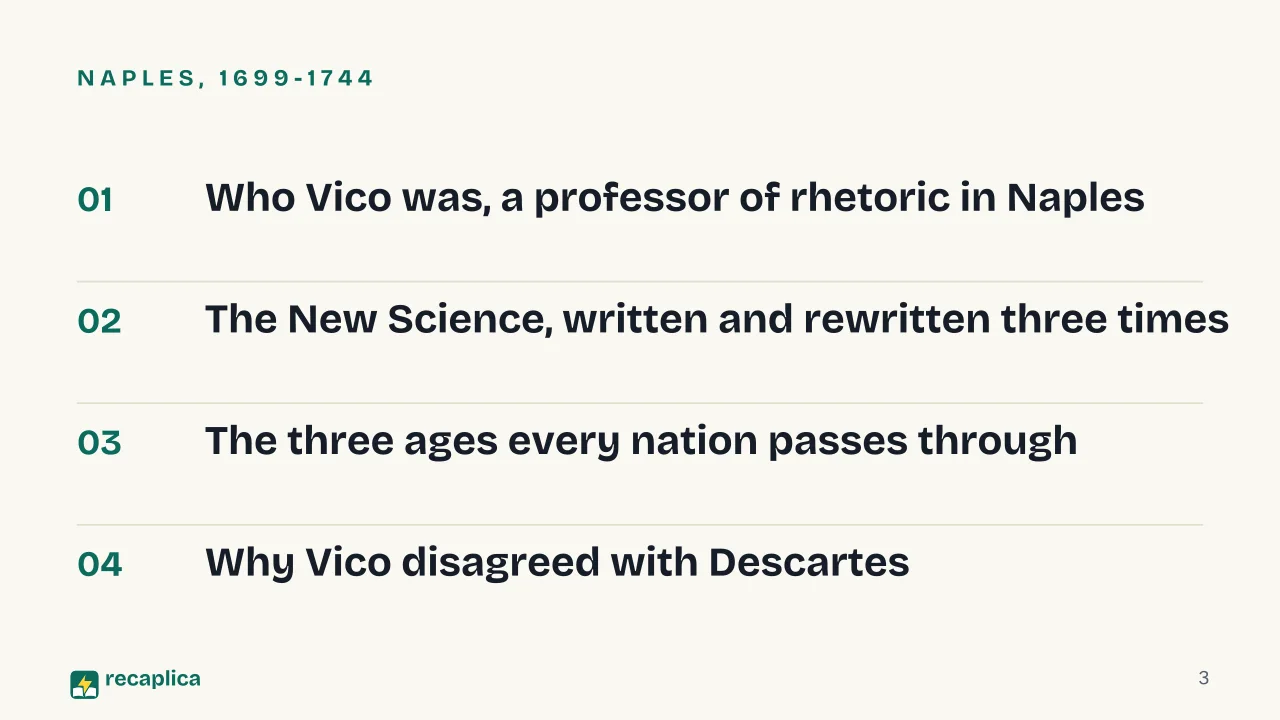
    Slide 1 of the presentation on Giambattista Vico: Giambattista VicoSlide 2 of the presentation on Giambattista Vico: Does human history always move forward, or does it circle back?Slide 3 of the presentation on Giambattista Vico: Naples, 1699-1744Slide 4 of the presentation on Giambattista Vico: Chapter 01: Who Vico wasSlide 5 of the presentation on Giambattista Vico: Professor of rhetoricSlide 6 of the presentation on Giambattista Vico: Chapter 02: The New ScienceSlide 7 of the presentation on Giambattista Vico: Twenty years of rewritingSlide 8 of the presentation on Giambattista Vico: Chapter 03: The three agesSlide 9 of the presentation on Giambattista Vico: Of gods · Of heroes · Of menSlide 10 of the presentation on Giambattista Vico: A return, not a photocopySlide 11 of the presentation on Giambattista Vico: Chapter 04: Vico against DescartesSlide 12 of the presentation on Giambattista Vico: Opposing criteria for truthSlide 13 of the presentation on Giambattista Vico: Thinkers who picked up Vico after his death: Herder, Marx, CroceSlide 14 of the presentation on Giambattista Vico: What does Vico mean by a "recurrence"?Slide 15 of the presentation on Giambattista Vico: Stanford, Treccani, IEP
    Flash10 slidesThe essential thread, to present in classFull15 slidesEvery chapter and the deeper detail

    Common myths

    • ✗ Myth Vico believed history repeats itself exactly, like a closed circle.

      ✓ Reality A recurrence brings back forms similar to an earlier stage, not identical events; the Internet Encyclopedia of Philosophy notes that scholars still debate whether Vico's course is better pictured as a circle or a spiral.

    • ✗ Myth Vico was a widely read and influential philosopher during his own lifetime.

      ✓ Reality According to the Stanford Encyclopedia of Philosophy, his thought reached a wide audience only from the nineteenth century onward, well after his death.

    • ✗ Myth Vico simply applied Descartes's method to the history of nations.

      ✓ Reality Vico rejected the Cartesian assumption that clear and distinct ideas alone were enough to reach the truth, proposing instead a different standard, verum ipsum factum.

    Mind map

    Drag the background to move around and the nodes to reposition them; use − and + to collapse and expand branches.
    Customize
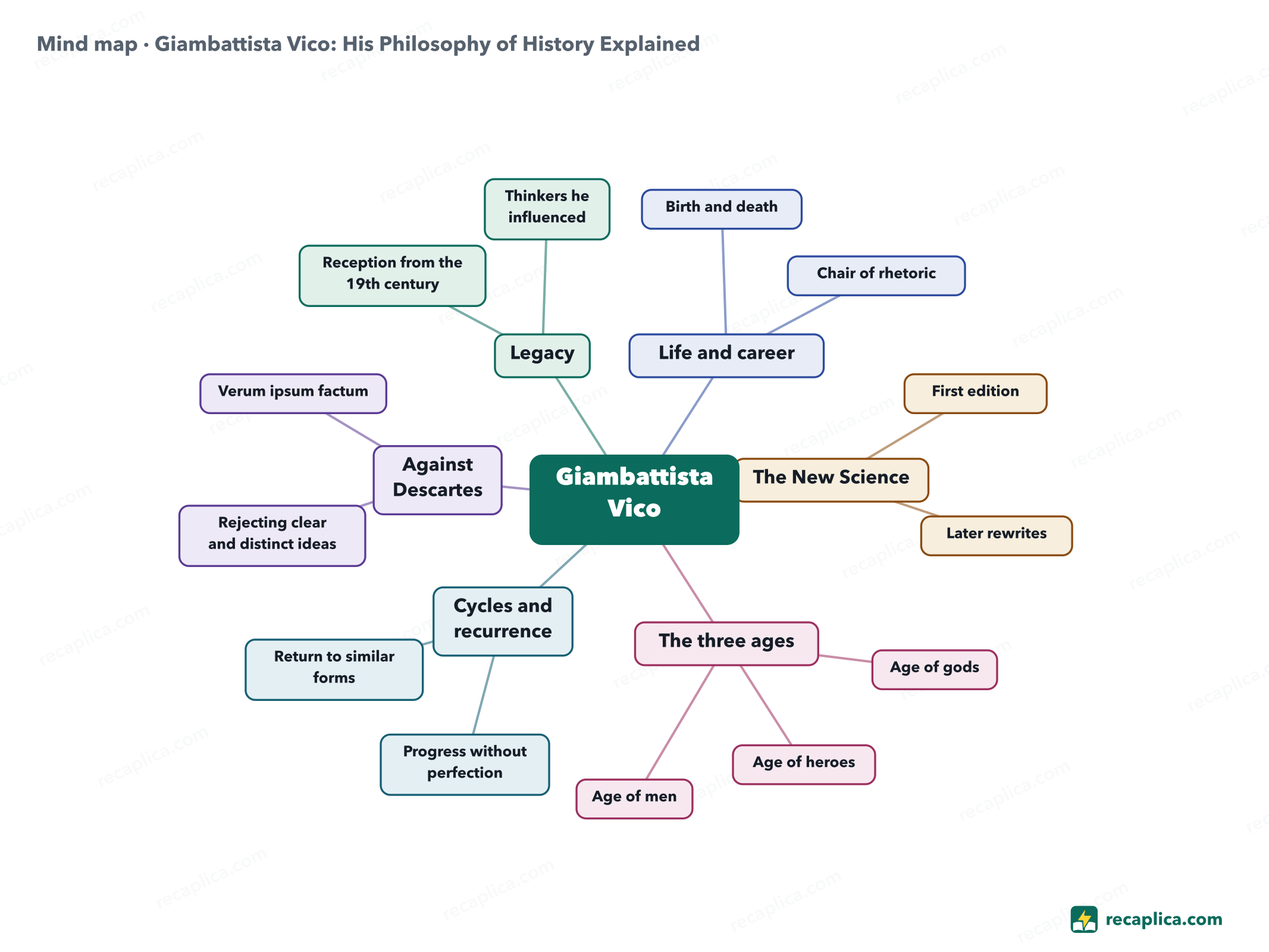
    Mind map: Giambattista Vico: His Philosophy of History Explained
    • Giambattista Vico
      • Life and career Philosopher and professor in Naples
        • Birth and death Naples, 1668-1744
        • Chair of rhetoric Won by competition in 1699, held until 1741
      • The New Science The main work, in three editions
        • First edition Naples, 1725
        • Later rewrites Second edition in 1730, third posthumous in 1744
      • The three ages The cycle every nation goes through
        • Age of gods Poetic wisdom, religion, authority of fathers
        • Age of heroes Conflict between heroes and the common people
        • Age of men Rational wisdom, scientific thought
      • Cycles and recurrence Progress that stalls
        • Progress without perfection An ideal trend never fully reached
        • Return to similar forms Not identical events, but comparable conditions
      • Against Descartes A different standard of truth
        • Rejecting clear and distinct ideas Refusal of the cogito as the basis of science
        • Verum ipsum factum Truth coincides with what has been made
      • Legacy An influence that came late
        • Reception from the 19th century Wider audience after Vico's death
        • Thinkers he influenced Herder, Marx, Croce and others

    Quiz: test yourself

    Answer the questions to check what you have learned: you get instant feedback and a short explanation.

    Grade 0/10 0/5
    1 Where was Giambattista Vico born and where did he die?

    According to the Stanford Encyclopedia of Philosophy and Treccani, Vico was born and died in Naples, between 1668 and 1744.

    2 How many editions did Vico's main work, the New Science, have?

    The New Science came out in 1725, was rewritten for a second edition in 1730, and published in a third, posthumous edition in 1744.

    3 True or false: according to Vico, the history of nations passes through three ages, of gods, of heroes, and of men.

    This is exactly the sequence Vico described in the New Science, reported by both Treccani and the Stanford Encyclopedia of Philosophy.

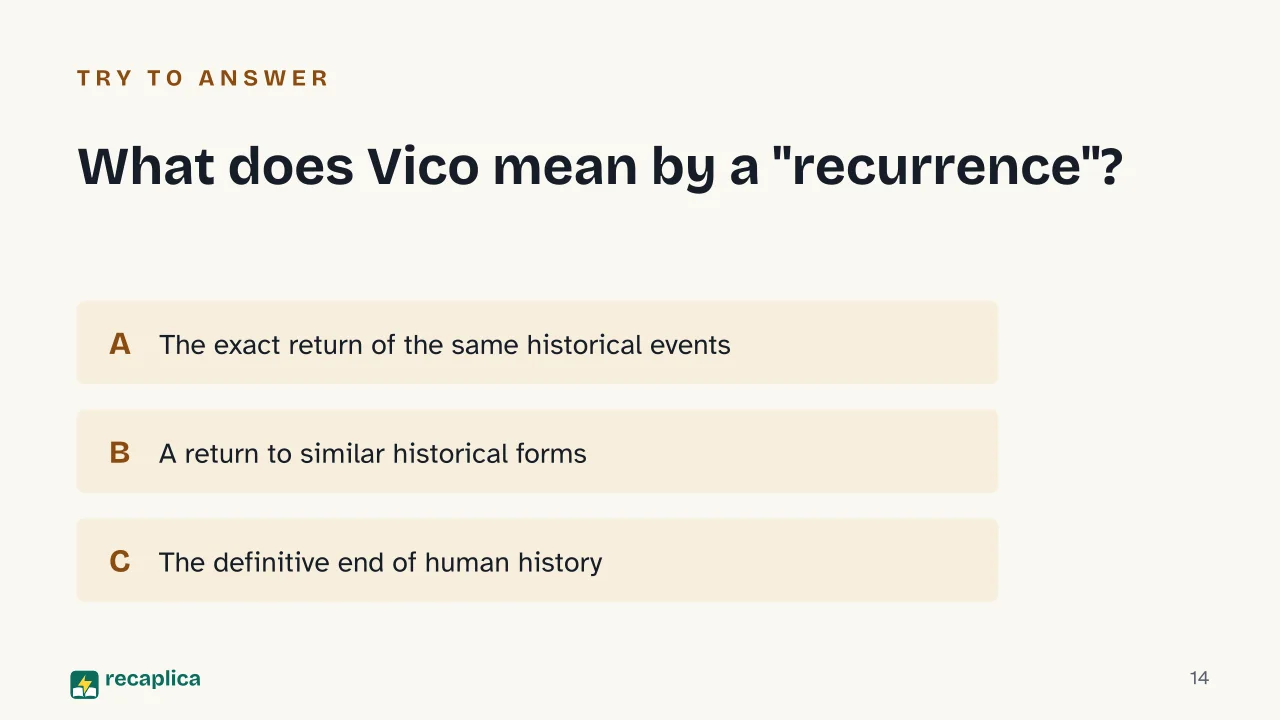
    4 What does Vico mean by a historical "recurrence"?

    For Vico, a recurrence is a return to a relatively more primitive condition and to historical forms similar to ones already lived through.

    5 What does Vico's principle of verum ipsum factum state?

    This is the principle Vico used against Descartes: truth is not found in clear and distinct ideas, but in producing what one knows.

    Answers: 1-A · 2-C · 3-A · 4-B · 5-A

    Flashcards

    Tap the card to flip it and check whether you remember the answer, then move to the next one.

    1 / 7

    Explain it in your own words

    The ultimate test: if you can explain it in simple words, you've truly understood it. Write your explanation, then compare it with the Recap.

    Your explanation is saved only on this device.

    Giambattista Vico was a philosopher from Naples who lived from 1668 to 1744 and spent most of his career teaching rhetoric. In his main work, the New Science, he argued that every nation passes through three stages, one led by religion, one dominated by heroes fighting the common people, and one where shared reason prevails. When this third stage reaches its limit, Vico held that history circles back toward conditions similar to ones already lived through. That idea also gave him a way to break with Descartes, who placed truth in clear and distinct ideas alone.

    Frequently asked questions

    What does Vico mean by cycles of history?

    It is the idea, set out in the New Science, that the history of nations moves toward a progress that never settles into a final state: at a certain point a recurrence takes hold, bringing conditions comparable to an earlier stage.

    Who was Giambattista Vico?

    A philosopher from Naples who lived from 1668 to 1744, a professor of rhetoric at the University of Naples for over forty years and the author of the New Science, his most important work.

    What is Giambattista Vico's main work?

    The New Science, first published in 1725, then rewritten for a second edition in 1730 and a third, posthumous edition in 1744.

    Why did Vico oppose Descartes's method?

    Because Descartes grounded truth in clear and distinct ideas, while Vico held that we truly know only what we have made ourselves, the principle known as verum ipsum factum.

    Did Vico believe history always repeats in the same way?

    No: a recurrence does not bring back the same events, but historical forms similar to ones already lived through; scholars still debate whether to describe it as a circle or a spiral.

    Sources

    • Stanford Encyclopedia of Philosophy, entry "Giambattista Vico"
    • Treccani, Enciclopedia, voce "Giambattista Vico"
    • Internet Encyclopedia of Philosophy, entry "Giambattista Vico"

    Every Recap goes through an independent review before publication.

    Every evening, the day's new Recaps on our Telegram channel. Join the channel →

    Keep learning

    • History What Is Existentialism? Heidegger, Being and Time, and Dasein Existentialism is a current of twentieth-century philosophy centered on human existence, freedom and the search for meaning. According to the Stanford Encyclopedia of Philosophy, the German philosopher Martin Heidegger (1889-1976) shaped that current more than almost anyone else, even though he never accepted the label. In 1927 he published Being and Time, his major work, where he introduced the concept of Dasein: the human being as the one entity that questions its own existence. That book influenced Jean-Paul Sartre's existentialism, but in 1946, in the Letter on Humanism, Heidegger openly broke with Sartre and refused to be called an existentialist. In 1933 he was elected rector of the University of Freiburg and became a Nazi party member, keeping that membership until the regime fell - an episode Heidegger himself later denied or played down more than once. Read the Recap →
    • History What Is Phenomenology? Husserl's Philosophy Explained Edmund Husserl founded phenomenology as a philosophical discipline around 1900-1901, with his Logical Investigations. His method starts from the epoché, a suspension of our everyday, unquestioning stance toward the world, and moves toward phenomenological reduction: studying how things appear to consciousness rather than what they are in themselves. At the center sits intentionality, the idea that every experience is always an experience of something specific, whether hoping, perceiving, or desiring. The method Husserl built carried into the 20th century through Heidegger, Sartre, and Merleau-Ponty, moving from German philosophy into French philosophy along the way. Read the Recap →
    • History Legal Positivism: What It Is, from Austin to Kelsen and Hart According to the Stanford Encyclopedia of Philosophy, legal positivism measures legal validity against observable social facts, keeping moral judgment on a separate track. Its roots lie in Hobbes and Hume. Jeremy Bentham produced the theory's first full account, which John Austin later took up and spread: for Austin, a rule is law only when a sovereign commands it under threat of punishment. In the twentieth century, Hans Kelsen grounded legal validity in a hierarchy that traces back to a presupposed basic norm, while Herbert Hart located it instead in a rule of recognition actually followed by judges and officials. Natural law theory takes the opposite view: an unjust law is not really a law. Legal positivism disagrees — a law stays valid even when it is morally unjust, as long as it was made the way the system requires. Read the Recap →

    recaplica

    Clear in 30 seconds, yours in 10 minutes.

    Recaps Mind maps Request a Recap Telegram channel Mind map maker Our method About Privacy & cookies Legal notes & terms of use

    © 2026 Recaplica · A project by Curi S.r.l. — VAT IT05472000750

    Statistics, only if you say so

    To learn which Recaps help most we would use Google Analytics, with aggregate, anonymous data. It starts only with your OK, and you can change your mind anytime. Privacy policy