|
recaplica
Emile Durkheim: Theory, Social Facts and Anomie | |||||||||||||||||||||||||||||||||||
| © 2026 Recaplica · recaplica.com — All rights reserved | |||||||||||||||||||||||||||||||||||
Emile Durkheim: Theory, Social Facts and AnomieWhat to print Page numbers appear when printing with default margins. SlidesChoose a cut Flash10 slidesThe essential thread, to present in classFull16 slidesEvery chapter and the deeper detailBoth come with speaker notes. In 30 seconds quick readÉmile Durkheim (1858-1917) was a French sociologist who is counted, along with Karl Marx and Max Weber, among the founders of modern sociology. He argued that sociology studies "social facts": ways of acting and thinking that exist before we are born and shape what we do, such as language or money. In The Division of Labour in Society (1893) he separated mechanical solidarity, based on likeness, from organic solidarity, based on mutual dependence. In Suicide (1897) he explained a society's suicide rate by how strongly its groups integrate and regulate their members. In The Elementary Forms of Religious Life (1912) religion becomes, on the IEP's reading, society worshipping itself. Key Points
Deep DiveWho was Emile Durkheim?David Émile Durkheim was born in Épinal, in Lorraine, on 15 April 1858. His family was observant Jewish, and his father, grandfather and great-grandfather had all been rabbis. He broke with that line in 1879, when he entered the École normale supérieure in Paris to study philosophy. In 1887 the University of Bordeaux hired him to teach social science and education. According to the Internet Encyclopedia of Philosophy (IEP), these were the first official sociology courses in France. His three best-known books came out during the Bordeaux years: his doctoral thesis The Division of Labour in Society (1893), The Rules of Sociological Method (1895) and Suicide (1897). In 1896 he founded the journal L’Année sociologique. He moved to the Sorbonne in Paris in 1902 with a chair in the Science of Education, became a full professor in 1906, and only in 1913 did the chair add sociology to its title. He sided with Alfred Dreyfus during the Dreyfus affair. The First World War killed many of his students and, in 1915, his son André. Durkheim died of a stroke in Paris on 15 November 1917, leaving his last major work, La Morale, unfinished beyond its introduction. The IEP ranks him among the main founders of modern sociology, alongside Karl Marx and Max Weber. He took the scientific approach to studying societies from Auguste Comte’s positivism, yet he faulted both Comte and Herbert Spencer for failing to shake off their metaphysical assumptions. Social facts and The Rules of Sociological MethodIn The Rules of Sociological Method (1895), Durkheim defines social facts as ways of acting, thinking and feeling that exist outside the individual and press on them with coercive power. Examples the IEP draws from his work include a legal code, the way people dress and a society’s idea of beauty. Some currents also fall into this category: they show up in individual cases and can be measured by statistics, like the suicide rate or the birth rate.
You can tell a social fact by the way it resists anyone who tries to change it single-handedly. Durkheim saw it as a new reality, sui generis, that individuals taken one at a time cannot account for, in the same way that water cannot be explained by looking at hydrogen and oxygen atoms separately. This leads to the rule that opens the second chapter of the Rules, which he himself calls the first and most fundamental: consider social facts as things. For him, society has to be explained in sociological terms. According to the IEP, readers who take Durkheim to mean that social facts live a life of their own get him wrong. Those facts exist only through people, even though they come before them and constrain them. Normal and pathological: why crime is normalThe third chapter of the Rules sets out a test. A social fact is normal for a given type of society, at a given stage of its development, when it occurs in the average society of that type at the same stage; whatever departs from that average is pathological. Durkheim applies the test to crime. A society with no crime at all is impossible, so crime is normal. Durkheim pictures a perfect convent, a society of saints: real crimes would vanish there, but the smallest faults would cause as much outrage as an ordinary offence. In Durkheim’s view crime is bound up with the conditions of all social life, and that is why it helps morality and law to develop. Under Athenian law Socrates was a criminal, and his offence, independent thinking, was preparing a new morality. Crime can also take abnormal forms, for instance when its rate becomes excessive. The sociologist Stanley Cohen traces back to these pages the idea that deviance also serves positive functions for social order. Mechanical and organic solidarity in The Division of Labour in SocietyThe Division of Labour in Society (1893) tackles, as Rainer Zoll puts it, the problem of social order: what holds a society together. The book argues against the social contract theorists and utilitarians such as Spencer, because Durkheim wants to show that the individual emerges from collective life. Durkheim describes the collective consciousness as “the body of beliefs and feelings common to the average members of a society”, a system with a life of its own. In small groups, where people resemble each other, the individual’s consciousness almost merges with the collective one. He calls this bond mechanical solidarity, by analogy with the cohesion of lifeless bodies. As moral density grows, meaning how often people come into contact and interact, competition grows with it. People ease it by specializing in different tasks, and that is the division of labour. The solidarity that comes out of it is organic, like that of the organs in a higher animal, each with its own job and part of one body; Durkheim also calls it contractual.
An act is criminal when it offends the strong, well-defined states of the collective consciousness, and here Durkheim turns common sense around: we do not condemn an act because it is a crime; it becomes a crime because we condemn it. In restitutive law the judge determines what is owed and imposes no penalty. On this point Durkheim parts ways with Karl Marx. For him, specialized work is good for individuals, who can develop their own talents, and the division of labour is a possible source of cohesion. Michele Salvati puts it this way: Marx analyses capitalism, while Durkheim and Weber study modern society. The IEP points out that the terms mechanical and organic belong only to the early works, and Durkheim dropped them soon after 1893. The whole third part of the book deals with abnormal forms of the division of labour. Anomie in Durkheim’s theoryHe did not coin the word. The philosopher Jean-Marie Guyau had used it in 1885, according to Philippe Besnard (Treccani, 1991), and Durkheim took it up with an entirely different meaning. In The Division of Labour in Society, the anomic division of labour is one of the pathological forms: for a time, there are no social rules able to make specialized functions work together. Durkheim sees examples in the conflict between capital and labour, in economic crises and in a science that has lost its unity. In Suicide, the meaning shifts. Besnard ties it to goals that stay vague and aspirations that know no bounds, in times when the economy expands or people climb the social ladder quickly. The IEP speaks of deregulation: traditional rules have lost their authority and morality comes apart. Durkheim connects it to the mal de l’infini, the “sickness of the infinite”, when a person’s expectations no longer match reality. Treccani writes that he regarded it as the greatest threat to social stability. Besnard nonetheless considers anomie a minor, underdeveloped theme in his work, even though Durkheim is often presented as the sociologist of anomie. In 1938 Robert Merton turned it into a structural gap between goals and means, an idea Besnard sees as the opposite of the original. Suicide: integration and regulationSuicide (1897) starts from the claim that personal motives cannot explain how many suicides a society produces. Durkheim measures each society’s tendency through its suicide rate, the ratio of suicides to population, and notes that it stays steady over long periods, more so than the general death rate. The reasons that drive a single person, he writes, are the psychologist’s business. According to Stanley Cohen, he chose the most individual act of all on purpose, to build a model of social causation. Studies at the time mostly looked for physiological or psychological causes. Durkheim noticed that populations of similar genetic origin had different rates, and that suicide did not track alcoholism, as it should have if weak character were to blame. He compared the statistics against marital status, religion, age, sex and economic change. In his data, married people took their own lives less often than unmarried ones, and Protestants, more loosely tied to their group, more often than Catholics and Jews. Nations going through a political crisis had lower rates, because the group pulled closer together. As Besnard reads him, the variations depend on two independent variables. One is integration, meaning how far members share feelings, beliefs and practices and feel directed toward common goals; the other is regulation. Talcott Parsons reads the scheme as two pairs of poles, with suicides more frequent at the poles.
The fourth type appears only in a footnote. According to Realino Marra, Durkheim did not consider it significant. The test from the Rules comes back here too. As Marra reads it, a certain share of suicides is normal in every society and turns pathological when one current prevails excessively. In his account, Durkheim judged the situation of the late nineteenth century pathological: in under fifty years suicides had at least tripled, the egoistic and anomic ones above all. As a remedy, in the closing pages, he proposes reviving professional corporations, intermediate groups between the individual and the state. The Elementary Forms of Religious Life: sacred and profaneIn his last work, The Elementary Forms of Religious Life (1912), Durkheim defines religion as “a unified system of beliefs and practices relative to sacred things”, which brings everyone who follows it into one moral community, a Church. The sacred is what is set apart and forbidden, the profane is what the sacred must be shielded from, and religious thought stands out precisely because it divides the world between the two. His case study is the totemism of Aboriginal Australians, the simplest religion known at the time, read through the ethnographic data then available. When the group gathers for a rite and shares an intense excitement, Durkheim speaks of collective effervescence: this is where religion is born and gains legitimacy. On the IEP’s reading, religion is society worshipping itself. That is why ritual is necessary. Beliefs alone are not enough, and the group’s collective strength has to be renewed at regular intervals. For the modern West he foresaw a cult of the individual, grounded in human dignity. Critics have challenged its method and its reading of the ethnographic data, and accused it of undermining traditional religion. Durkheim’s legacyThe Oxford Dictionary of Sociology describes him as the figure long recognized as the founder of functionalism, and the IEP traces his analogy between society and an organism largely to Herbert Spencer. According to the IEP, it is a common mistake to think Durkheim had no theory of social change: Europe’s passage from the Middle Ages to modernity is one of his main themes. Some critics charge him with determinism, a view of society so binding that it erases individual autonomy. The encyclopedia holds that these critiques misread his thought. Slide deckSlides ready to download and make your own in PowerPoint or Google Slides, with speaker notes. Pick the Flash cut or the Full one.    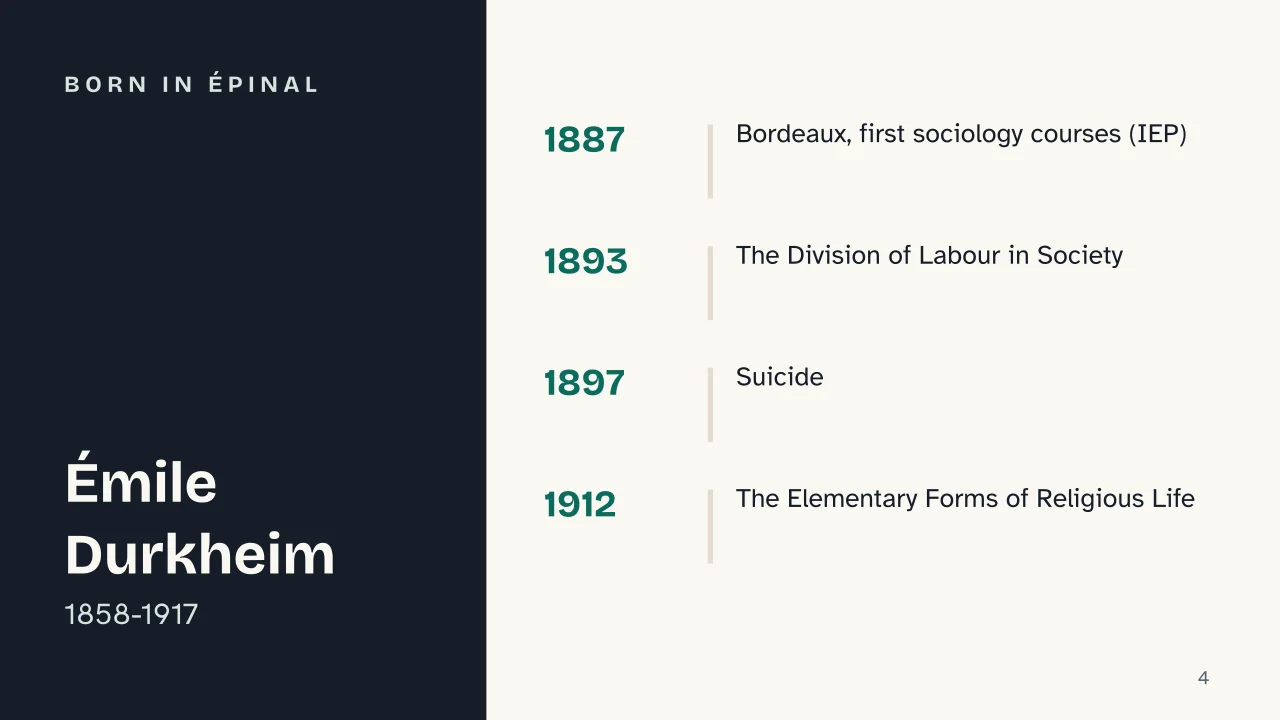    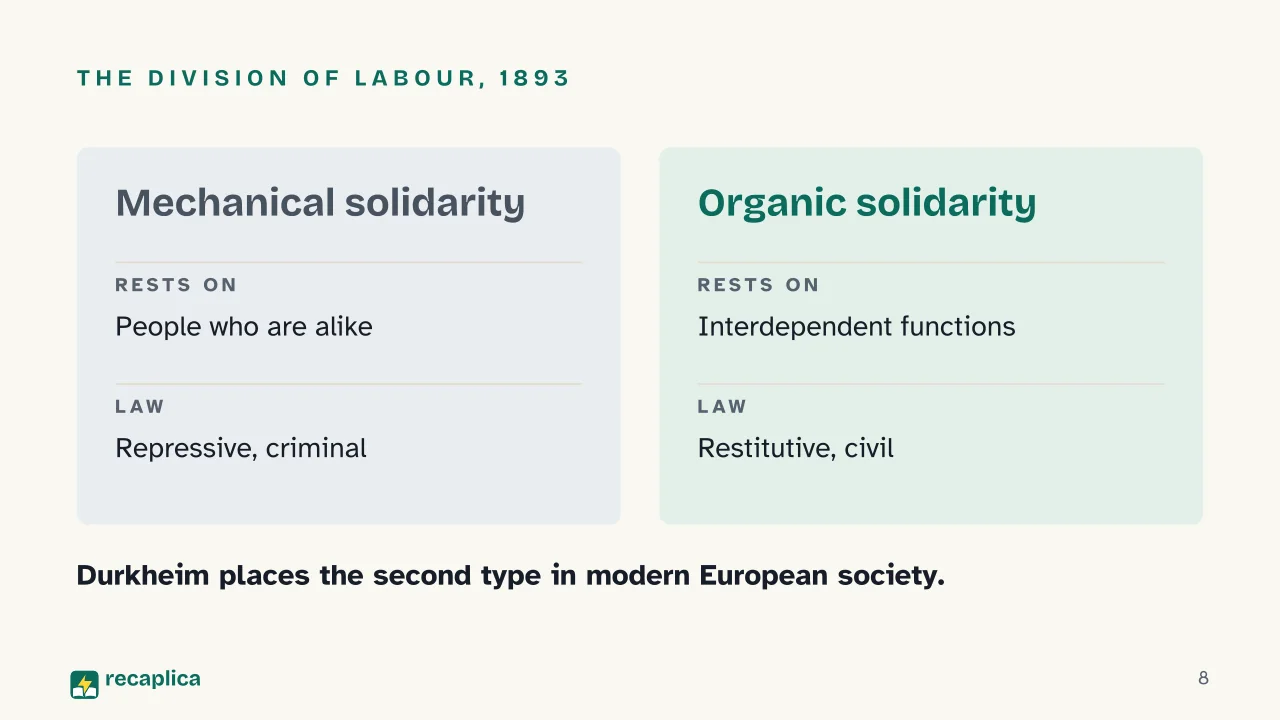 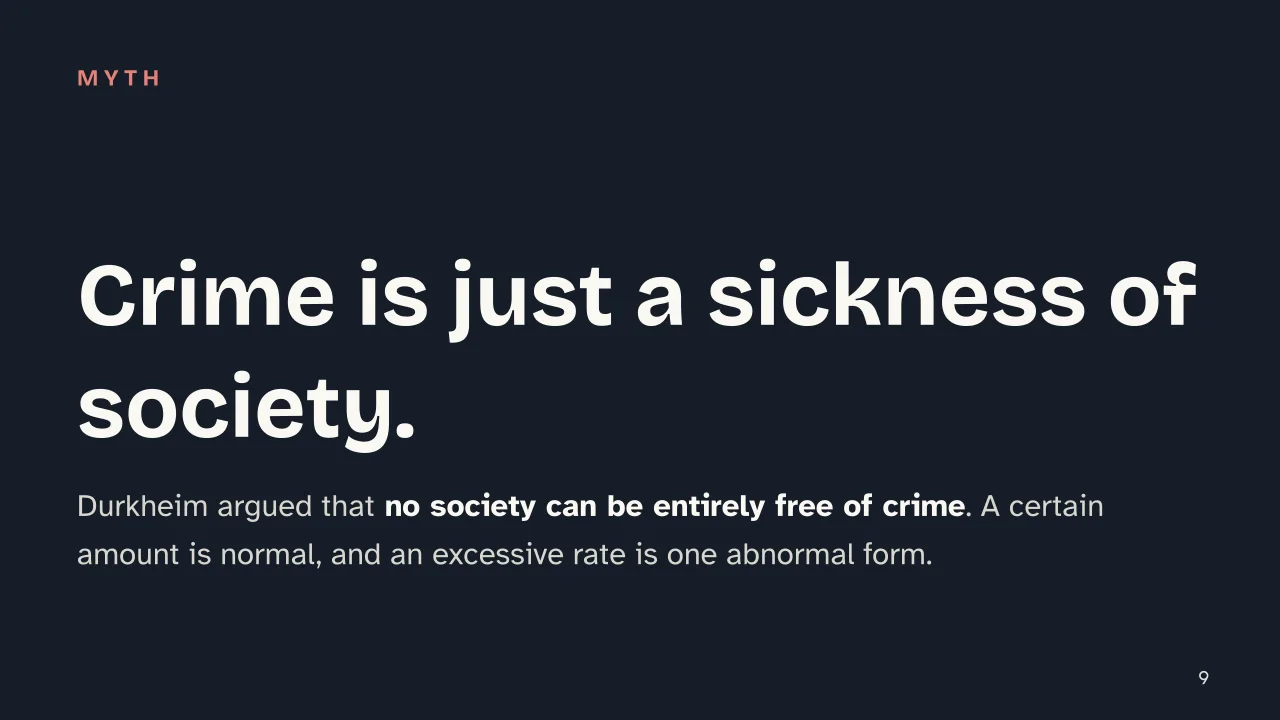  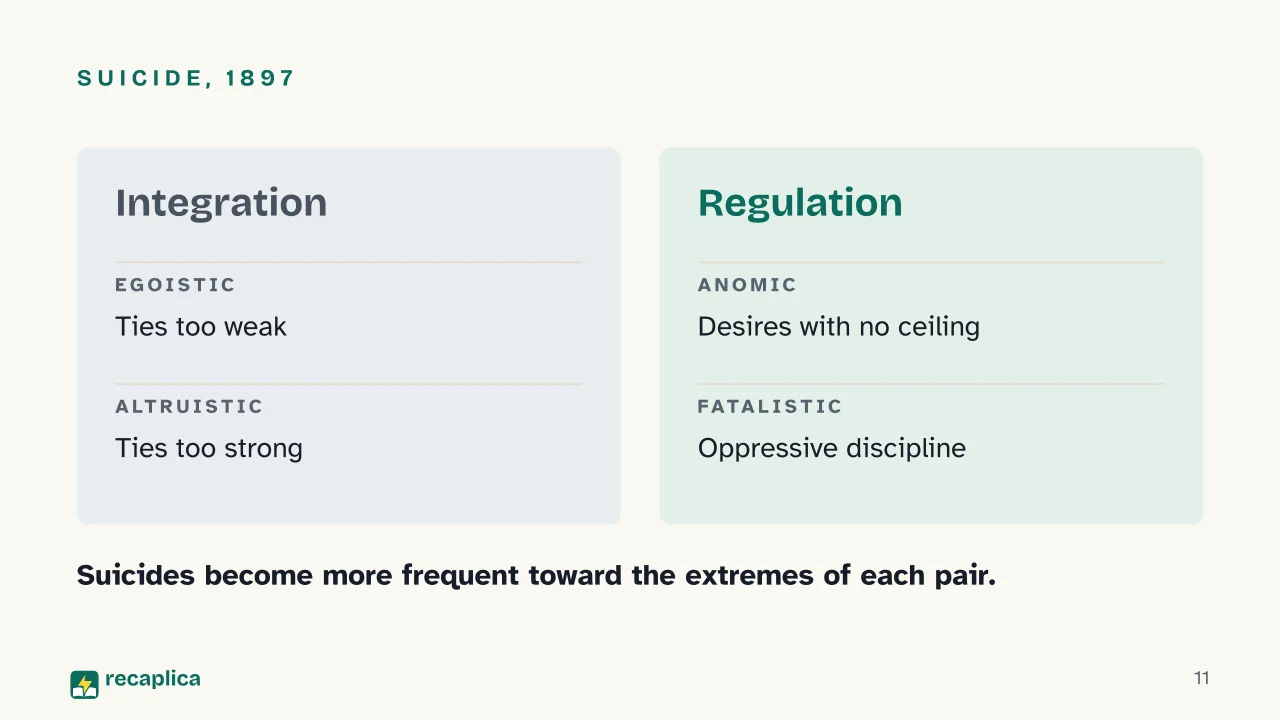   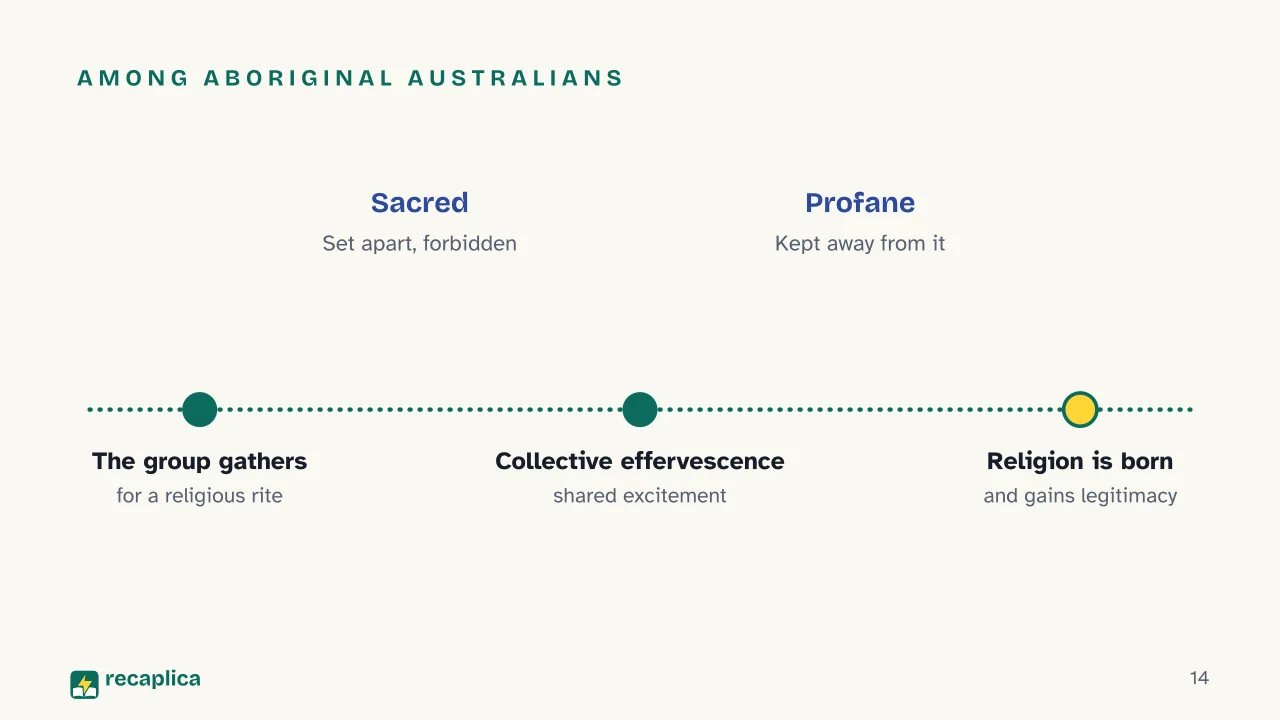 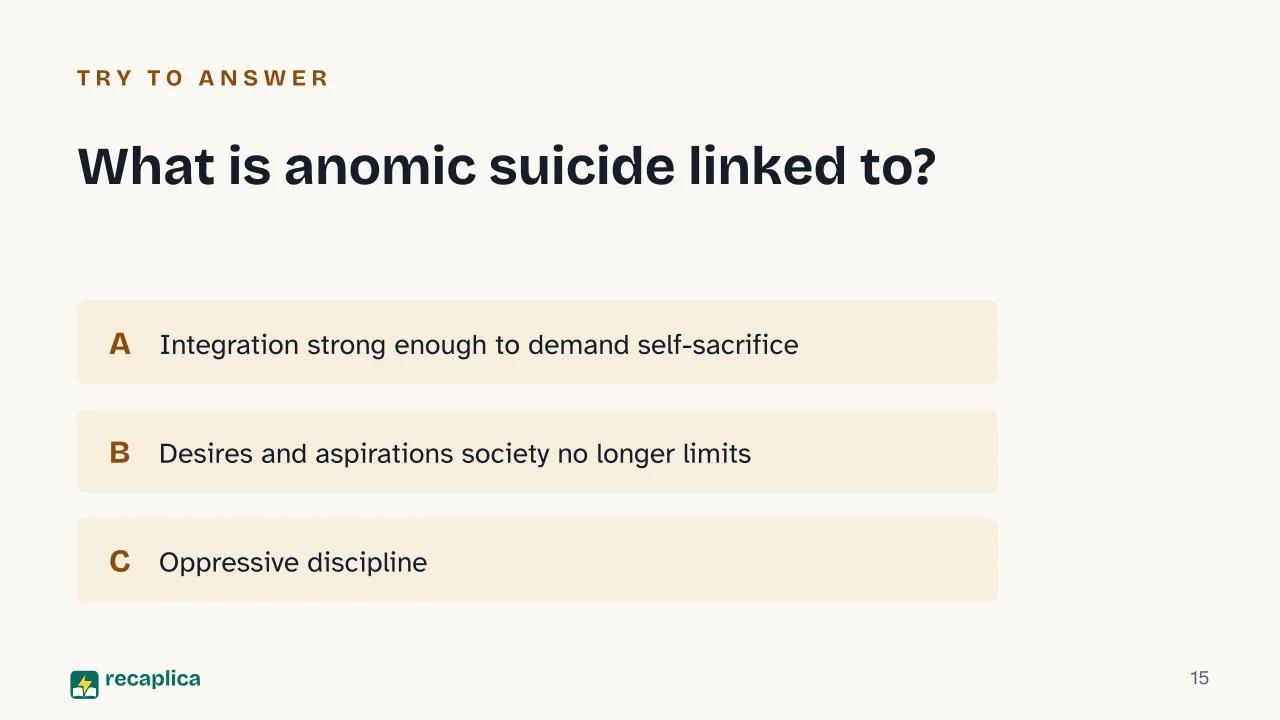  Common myths
Mind mapDrag the background to move around and the nodes to reposition them; use − and + to collapse and expand branches. 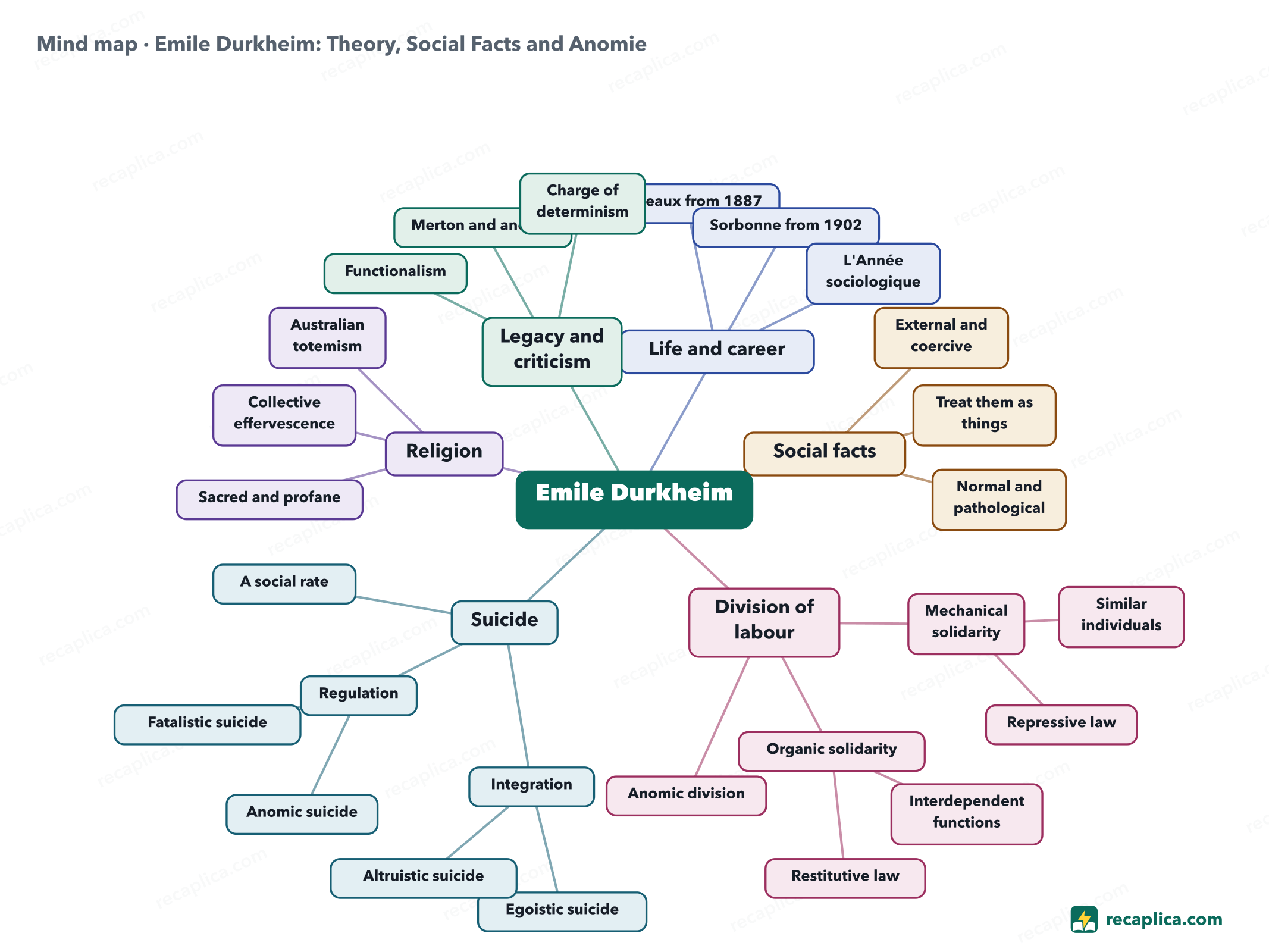
Quiz: test yourselfAnswer the questions to check what you have learned: you get instant feedback and a short explanation. Grade 0/10 0/5
FlashcardsTap the card to flip it and check whether you remember the answer, then move to the next one. 1 / 7 Explain it in your own wordsThe ultimate test: if you can explain it in simple words, you've truly understood it. Write your explanation, then compare it with the Recap. Your explanation is saved only on this device.
Frequently asked questionsWhat was Emile Durkheim's contribution to sociology?He gave the discipline its own subject matter, social facts, and a method, set out in The Rules of Sociological Method (1895). According to the IEP, the courses he taught at Bordeaux from 1887 were the first official sociology courses in France, and in 1896 he founded the journal L'Année sociologique. What is anomie according to Durkheim?It is a condition in which collective rules lose their authority. In The Division of Labour in Society (1893) it refers to a temporary lack of norms that would let specialized functions cooperate; in Suicide (1897) it becomes a state of limitless aspirations, typical of periods of expansion. Durkheim took the word from the philosopher Jean-Marie Guyau, who had used it in 1885 with a different meaning. What is the difference between mechanical and organic solidarity?Mechanical solidarity holds together people who resemble each other, in small groups where each person's consciousness almost merges with the collective one. Organic solidarity comes from the division of labour: people do different jobs and rely on one another. Durkheim connected the first with criminal law and the second with civil and commercial law. What are Durkheim's four types of suicide?Egoistic (the group integrates its members too little), altruistic (too much), anomic (it regulates desires too little) and fatalistic (it regulates them oppressively). Durkheim gave the fatalistic type only a footnote. Every Recap goes through an independent review before publication. |